Stay Ahead in Fast-Growing Economies.
Browse Reports Now
Plant-based Ice Creams Market-In-Deep Analysis Focusing on Market Share
Plant-based ice creams are frozen desserts that are made without any animal-derived ingredients. Traditional ice cream typically contains dairy products like milk and cream, as well as eggs. Plant-based ice creams, on the other hand, use plant-based alternatives to create a creamy and delicious frozen treat.

IMR Group
Description
Global Plant-based Ice Creams Market Synopsis
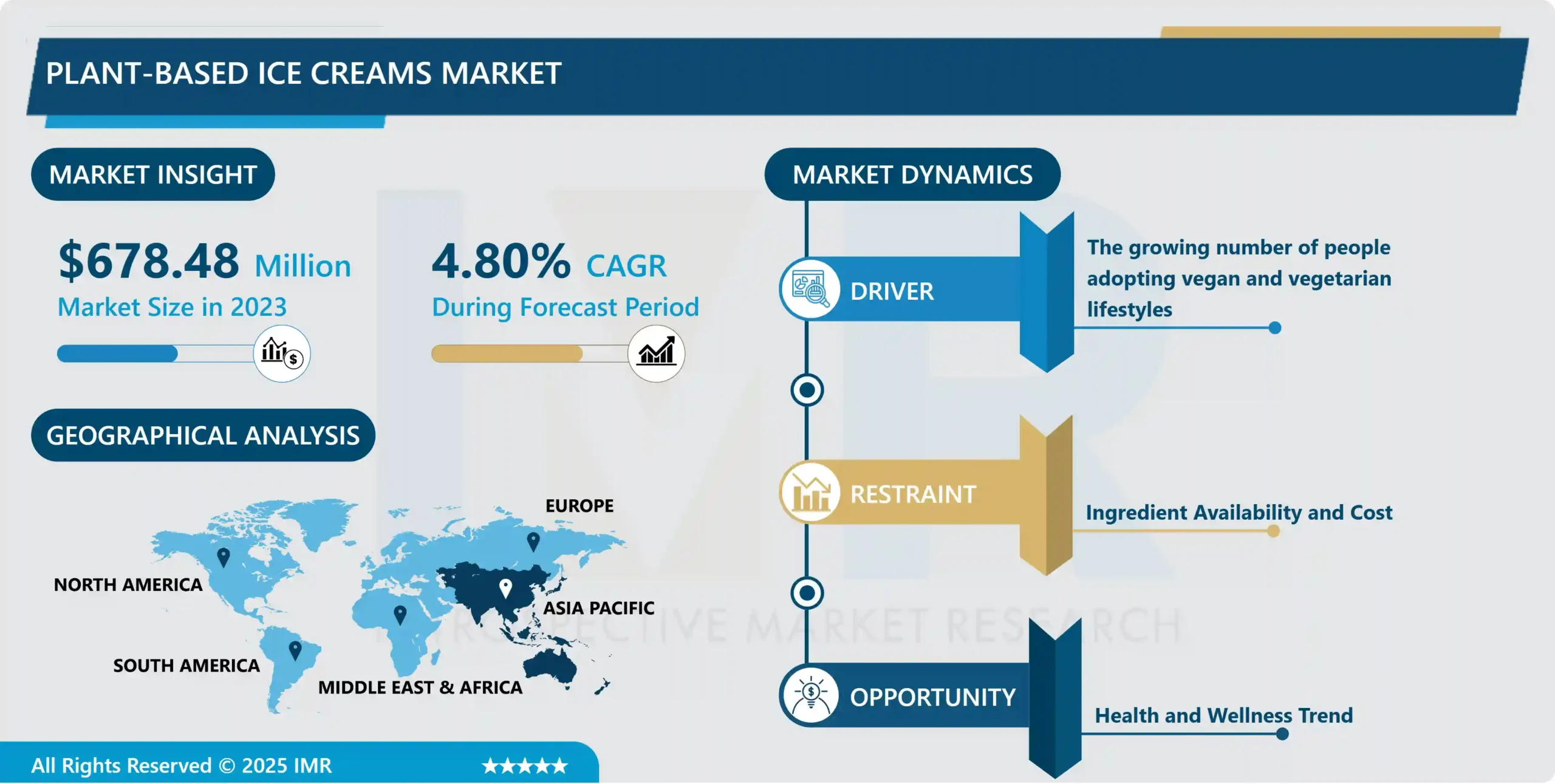
The global plant-based ice cream market was worth USD 678.48 million in 2023. It is expected to reach USD 987.25 Million by 2032 at a CAGR of 4.8% over the period from 2024 to 2032.
Plant-based ice creams are frozen desserts that are made without any animal-derived ingredients. Traditional ice cream typically contains dairy products like milk and cream, as well as eggs. Plant-based ice creams, on the other hand, use plant-based alternatives to create a creamy and delicious frozen treat.
The market has been significantly driven by the growing consumer interest in nutritional and sustainable food options. There is an increasing number of people looking for alternatives to traditional dairy ice creams because they are becoming aware of the ecological consequences and health implications that may arise from their choice of diet. Plant-based ice creams cater to these dietary limitations by not containing lactose and being low in saturated triglycerides, thus enabling a guilt-free indulgence.
To produce plant-based ice creams, non-dairy ingredients are used such as cashew milk, almond milk, coconut milk and soy milk among others. They helps lose weight, prevent heart disease, and improve the appearance of skin; they are also known as “vegan ice creams”. The plant-based ice creams come in a variety of Flavors such as caramel, chocolate, coconut, citrus and strawberry.
The market for plant-based ice cream continues to expand due to the following factors: Increasing consumer curiosity and interest in plant-based ice cream, growing demand for non-dairy desserts among vegan consumers, increased flexitarian diets that are adopted by consumers based on health concerns limiting the consumption of dairy products.
Global Plant-based Ice Creams Market Trend Analysis
The Growing Number of People Adopting Vegan and Vegetarian Lifestyles
The surge in individuals embracing vegan and vegetarian lifestyles has significantly propelled the plant-based ice cream market. This growing consumer base, driven by health, environmental, and ethical considerations, has fueled the demand for dairy-free alternatives. Plant-based ice creams, crafted from ingredients like coconut milk, almond milk, or soy, cater to this expanding market segment seeking cruelty-free and sustainable options.
The rising awareness of health benefits associated with plant-based diets, including reduced cholesterol and lower environmental impact, has been a key driver for the increasing popularity of plant-based ice creams. Moreover, as more people seek indulgent treats without compromising their dietary preferences, the market for these alternatives has experienced notable growth. Food companies have innovated and diversified their plant-based ice cream offerings, providing a wide array of flavors and textures to meet the evolving preferences of consumers.
Health and Wellness Trend Creates an Opportunity for Global Plant-based Ice Creams Market
The Health and Wellness trend presents a significant opportunity for the plant-based ice cream market. As consumers increasingly prioritize their well-being, there has been a notable shift towards healthier food choices. Plant-based ice creams, made from ingredients such as almond milk, coconut milk, or soy, align perfectly with this growing demand for nutritious yet indulgent treats.
These dairy-free alternatives cater to various dietary preferences, including vegan, lactose intolerant, and those seeking a lower-calorie option. Plant-based ice creams often boast natural, wholesome ingredients, offering a guilt-free dessert option. Additionally, they may contain less saturated fat and cholesterol compared to traditional dairy ice creams, appealing to health-conscious consumers.
The surge in environmental consciousness further contributes to the popularity of plant-based options. As consumers become more aware of the impact of their food choices on the planet, they are drawn to sustainable and eco-friendly alternatives. Plant-based ice creams, with their lower carbon footprint, fit well into this narrative.
Global Plant-based Ice Creams Market Segment Analysis:
Global Plant-based Ice Creams Market is Segmented into Form, Flavour, Packaging Type, Source, and Distribution Channel.
By Form
The Blends segment of plant-based ice cream experiencing rapid growth due to there’s a growing awareness of health and environmental concerns associated with traditional dairy products. Plant-based blends offer a healthier alternative, often containing lower levels of saturated fats and cholesterol while being rich in nutrients like vitamins, minerals, and fiber.
Additionally, dietary restrictions and preferences, including lactose intolerance, veganism, and vegetarianism, are prompting consumers to seek out dairy-free options. Plant-based ice cream blends cater to these needs, offering a delicious alternative without sacrificing taste or texture.
Furthermore, as the plant-based movement gains momentum, there’s an increasing demand for innovative and diverse flavors and formulations within the ice cream market. Plant-based blends provide a platform for experimentation, allowing manufacturers to create unique and exciting products that appeal to a wide range of tastes and preferences.
By Flavour
Beans such as chickpeas, black beans, and lentils are rich in protein and fiber, making them attractive options for health-conscious consumers seeking alternatives to traditional dairy ice creams. These beans provide a creamy texture and a subtle, nutty flavor that appeals to a wide range of taste preferences.
Additionally, the rise in veganism and plant-based diets has spurred demand for innovative and flavorful plant-based alternatives across various food categories, including ice cream. Beans offer a versatile base for creating creamy and indulgent frozen desserts without the need for dairy products, aligning perfectly with the preferences of vegan and lactose-intolerant consumers.
Furthermore, the sustainability aspect of beans contributes to their popularity in the plant-based ice cream market. Beans require fewer resources such as water and land compared to dairy farming, making them a more environmentally friendly choice. This sustainability factor resonates with consumers increasingly concerned about the environmental impact of their food choices.
Global Plant-based Ice Creams Market Regional Insights:
Asia Pacific is Expected to Dominate the Market Over the Forecast Period
Asia-Pacific was the leading region in the plant-based ice cream market. The global plant-based ice cream market can be segmented into five main regions, namely Africa, North America, South America, Europe and Asia Pacific and Middle East. A study on the current state of the plant-based ice cream market reveals that Asia-Pacific held the largest market share of 38.6% in 2022. Consumer awareness affects the demand for plant-based ice cream in the region.
The market for plant-based ice cream in the Asia-Pacific region, including emerging economies like Japan, China and India is discussed. Among major factors driving the growth of plant-based ice cream market at large are rise in health awareness and new products launch by players. While the consumers prefer ice cream made with almond and coconut milk instead of soy milk, the latter is healthier and has a better taste.
Global Plant-based Ice Creams Market Top Key Players:
Ben & Jerry’s (United States)
Häagen-Dazs (United States)
So Delicious Dairy Free (United States)
Alpro (Belgium)
NadaMoo! (United States)
Oatly (Sweden)
Coconut Bliss (United States)
Perfect Day (United States)
Nush Foods (United Kingdom)
Van Leeuwen (United States)
Nobó (Ireland)
Daiya Foods (Canada)
Booja-Booja (United Kingdom)
Eclipse Foods (United States)
Tofutti Brands Inc. (United States)
Arctic Zero (United States)
Three Twins Ice Cream (United States)
Dream (United States)
Talenti (United States)
Revelé (United States)
Oat & Mill (Canada)
Sweet Ritual (United States)
Frankie & Jo’s (United States)
Oat of the Ordinary (United States)
Mister Dewie’s (United States)
Key Industry Developments in the Global Plant-based Ice Creams Market:
In January 2024, Greenyard acquired Crème de la Crème to expand its reach into the plant-based food sector. Crème de la Crème boasts 25 years of experience and a vast product portfolio, including private label ice creams for major brands. Their products have a global presence, reaching markets in the Middle East and East Asia. This acquisition strengthens Greenyard’s position in the growing plant-based food market, particularly in the ice cream segment.
In May 2023, Häagen-Dazs launched a new vegan-friendly technique to enjoy its classic frozen sweets. This new oat-based line, designed for flexitarians aiming to incorporate more plants to their diet, aims to exceed preconceptions of what plant-based frozen treats may taste like.
Chapter 1: Introduction
1.1 Scope and Coverage
Chapter 2:Executive Summary
Chapter 3: Market Landscape
3.1 Market Dynamics
3.1.1 Drivers
3.1.2 Restraints
3.1.3 Opportunities
3.1.4 Challenges
3.2 Market Trend Analysis
3.3 PESTLE Analysis
3.4 Porter’s Five Forces Analysis
3.5 Industry Value Chain Analysis
3.6 Ecosystem
3.7 Regulatory Landscape
3.8 Price Trend Analysis
3.9 Patent Analysis
3.10 Technology Evolution
3.11 Investment Pockets
3.12 Import-Export Analysis
Chapter 4: Plant-based Ice Creams Market by Form (2018-2032)
4.1 Plant-based Ice Creams Market Snapshot and Growth Engine
4.2 Market Overview
4.3 Blends
4.3.1 Introduction and Market Overview
4.3.2 Historic and Forecasted Market Size in Value USD and Volume Units
4.3.3 Key Market Trends, Growth Factors, and Opportunities
4.3.4 Geographic Segmentation Analysis
4.4 Singles
Chapter 5: Plant-based Ice Creams Market by Flavour (2018-2032)
5.1 Plant-based Ice Creams Market Snapshot and Growth Engine
5.2 Market Overview
5.3 Beans
5.3.1 Introduction and Market Overview
5.3.2 Historic and Forecasted Market Size in Value USD and Volume Units
5.3.3 Key Market Trends, Growth Factors, and Opportunities
5.3.4 Geographic Segmentation Analysis
5.4 Nuts
5.5 Fruits
5.6 Herbs
Chapter 6: Plant-based Ice Creams Market by Packaging Type (2018-2032)
6.1 Plant-based Ice Creams Market Snapshot and Growth Engine
6.2 Market Overview
6.3 Tubs
6.3.1 Introduction and Market Overview
6.3.2 Historic and Forecasted Market Size in Value USD and Volume Units
6.3.3 Key Market Trends, Growth Factors, and Opportunities
6.3.4 Geographic Segmentation Analysis
6.4 Cones
6.5 Bars
Chapter 7: Plant-based Ice Creams Market by Source (2018-2032)
7.1 Plant-based Ice Creams Market Snapshot and Growth Engine
7.2 Market Overview
7.3 Coconut Milk
7.3.1 Introduction and Market Overview
7.3.2 Historic and Forecasted Market Size in Value USD and Volume Units
7.3.3 Key Market Trends, Growth Factors, and Opportunities
7.3.4 Geographic Segmentation Analysis
7.4 Soy Milk
7.5 Almond Milk
7.6 Cashew Milk
Chapter 8: Plant-based Ice Creams Market by Distribution Channel (2018-2032)
8.1 Plant-based Ice Creams Market Snapshot and Growth Engine
8.2 Market Overview
8.3 Supermarkets and Hypermarkets
8.3.1 Introduction and Market Overview
8.3.2 Historic and Forecasted Market Size in Value USD and Volume Units
8.3.3 Key Market Trends, Growth Factors, and Opportunities
8.3.4 Geographic Segmentation Analysis
8.4 Convenience stores
8.5 Specialty stores
8.6 Online retail
Chapter 9: Company Profiles and Competitive Analysis
9.1 Competitive Landscape
9.1.1 Competitive Benchmarking
9.1.2 Plant-based Ice Creams Market Share by Manufacturer (2024)
9.1.3 Industry BCG Matrix
9.1.4 Heat Map Analysis
9.1.5 Mergers and Acquisitions
9.2 MENTOR WORLDWIDE LLC (U.S.)
9.2.1 Company Overview
9.2.2 Key Executives
9.2.3 Company Snapshot
9.2.4 Role of the Company in the Market
9.2.5 Sustainability and Social Responsibility
9.2.6 Operating Business Segments
9.2.7 Product Portfolio
9.2.8 Business Performance
9.2.9 Key Strategic Moves and Recent Developments
9.2.10 SWOT Analysis
9.3 SIENTRA INC. (U.S.)
9.4 JOHNSON & JOHNSON (U.S.)
9.5 IDEAL IMPLANT INCORPORATED (U.S.)
9.6 RTI SURGICAL INC. (U.S.)
9.7 ZIMMER BIOMET HOLDINGS INC. (U.S.)
9.8 ESTABLISHMENT LABS HOLDINGS INC. (U.S.)
9.9 ALLERGAN (IRELAND)
9.10 GC AESTHETICS (IRELAND)
9.11 POLYTECH HEALTH & AESTHETICS GMBH (GERMANY)
9.12 SEBBIN SAS (FRANCE)
9.13 ARION LABORATORIES (FRANCE)
9.14 GROUPE SEBBIN SAS (FRANCE)
9.15 CEREPLAS (FRANCE)
9.16 LABORATOIRES ARION (FRANCE)
9.17 POLYTECH HEALTH & AESTHETICS GMBH (GERMANY)
9.18 HANS BIOMED CO. LTD. (SOUTH KOREA)
9.19 SHANGHAI KANGNING MEDICAL SUPPLIES LTD. (CHINA)
9.20 G&G BIOTECHNOLOGY LTD. (CHINA)
9.21 GUANGZHOU WANHE PLASTIC MATERIALS COLTD. (CHINA)
9.22 SHANGHAI KANGNING MEDICAL DEVICE COLTD. (CHINA)
9.23 WANHE PLASTIC MATERIALS COLTD. (CHINA)
Chapter 10: Global Plant-based Ice Creams Market By Region
10.1 Overview
10.2. North America Plant-based Ice Creams Market
10.2.1 Key Market Trends, Growth Factors and Opportunities
10.2.2 Top Key Companies
10.2.3 Historic and Forecasted Market Size by Segments
10.2.4 Historic and Forecasted Market Size by Form
10.2.4.1 Blends
10.2.4.2 Singles
10.2.5 Historic and Forecasted Market Size by Flavour
10.2.5.1 Beans
10.2.5.2 Nuts
10.2.5.3 Fruits
10.2.5.4 Herbs
10.2.6 Historic and Forecasted Market Size by Packaging Type
10.2.6.1 Tubs
10.2.6.2 Cones
10.2.6.3 Bars
10.2.7 Historic and Forecasted Market Size by Source
10.2.7.1 Coconut Milk
10.2.7.2 Soy Milk
10.2.7.3 Almond Milk
10.2.7.4 Cashew Milk
10.2.8 Historic and Forecasted Market Size by Distribution Channel
10.2.8.1 Supermarkets and Hypermarkets
10.2.8.2 Convenience stores
10.2.8.3 Specialty stores
10.2.8.4 Online retail
10.2.9 Historic and Forecast Market Size by Country
10.2.9.1 US
10.2.9.2 Canada
10.2.9.3 Mexico
10.3. Eastern Europe Plant-based Ice Creams Market
10.3.1 Key Market Trends, Growth Factors and Opportunities
10.3.2 Top Key Companies
10.3.3 Historic and Forecasted Market Size by Segments
10.3.4 Historic and Forecasted Market Size by Form
10.3.4.1 Blends
10.3.4.2 Singles
10.3.5 Historic and Forecasted Market Size by Flavour
10.3.5.1 Beans
10.3.5.2 Nuts
10.3.5.3 Fruits
10.3.5.4 Herbs
10.3.6 Historic and Forecasted Market Size by Packaging Type
10.3.6.1 Tubs
10.3.6.2 Cones
10.3.6.3 Bars
10.3.7 Historic and Forecasted Market Size by Source
10.3.7.1 Coconut Milk
10.3.7.2 Soy Milk
10.3.7.3 Almond Milk
10.3.7.4 Cashew Milk
10.3.8 Historic and Forecasted Market Size by Distribution Channel
10.3.8.1 Supermarkets and Hypermarkets
10.3.8.2 Convenience stores
10.3.8.3 Specialty stores
10.3.8.4 Online retail
10.3.9 Historic and Forecast Market Size by Country
10.3.9.1 Russia
10.3.9.2 Bulgaria
10.3.9.3 The Czech Republic
10.3.9.4 Hungary
10.3.9.5 Poland
10.3.9.6 Romania
10.3.9.7 Rest of Eastern Europe
10.4. Western Europe Plant-based Ice Creams Market
10.4.1 Key Market Trends, Growth Factors and Opportunities
10.4.2 Top Key Companies
10.4.3 Historic and Forecasted Market Size by Segments
10.4.4 Historic and Forecasted Market Size by Form
10.4.4.1 Blends
10.4.4.2 Singles
10.4.5 Historic and Forecasted Market Size by Flavour
10.4.5.1 Beans
10.4.5.2 Nuts
10.4.5.3 Fruits
10.4.5.4 Herbs
10.4.6 Historic and Forecasted Market Size by Packaging Type
10.4.6.1 Tubs
10.4.6.2 Cones
10.4.6.3 Bars
10.4.7 Historic and Forecasted Market Size by Source
10.4.7.1 Coconut Milk
10.4.7.2 Soy Milk
10.4.7.3 Almond Milk
10.4.7.4 Cashew Milk
10.4.8 Historic and Forecasted Market Size by Distribution Channel
10.4.8.1 Supermarkets and Hypermarkets
10.4.8.2 Convenience stores
10.4.8.3 Specialty stores
10.4.8.4 Online retail
10.4.9 Historic and Forecast Market Size by Country
10.4.9.1 Germany
10.4.9.2 UK
10.4.9.3 France
10.4.9.4 The Netherlands
10.4.9.5 Italy
10.4.9.6 Spain
10.4.9.7 Rest of Western Europe
10.5. Asia Pacific Plant-based Ice Creams Market
10.5.1 Key Market Trends, Growth Factors and Opportunities
10.5.2 Top Key Companies
10.5.3 Historic and Forecasted Market Size by Segments
10.5.4 Historic and Forecasted Market Size by Form
10.5.4.1 Blends
10.5.4.2 Singles
10.5.5 Historic and Forecasted Market Size by Flavour
10.5.5.1 Beans
10.5.5.2 Nuts
10.5.5.3 Fruits
10.5.5.4 Herbs
10.5.6 Historic and Forecasted Market Size by Packaging Type
10.5.6.1 Tubs
10.5.6.2 Cones
10.5.6.3 Bars
10.5.7 Historic and Forecasted Market Size by Source
10.5.7.1 Coconut Milk
10.5.7.2 Soy Milk
10.5.7.3 Almond Milk
10.5.7.4 Cashew Milk
10.5.8 Historic and Forecasted Market Size by Distribution Channel
10.5.8.1 Supermarkets and Hypermarkets
10.5.8.2 Convenience stores
10.5.8.3 Specialty stores
10.5.8.4 Online retail
10.5.9 Historic and Forecast Market Size by Country
10.5.9.1 China
10.5.9.2 India
10.5.9.3 Japan
10.5.9.4 South Korea
10.5.9.5 Malaysia
10.5.9.6 Thailand
10.5.9.7 Vietnam
10.5.9.8 The Philippines
10.5.9.9 Australia
10.5.9.10 New Zealand
10.5.9.11 Rest of APAC
10.6. Middle East & Africa Plant-based Ice Creams Market
10.6.1 Key Market Trends, Growth Factors and Opportunities
10.6.2 Top Key Companies
10.6.3 Historic and Forecasted Market Size by Segments
10.6.4 Historic and Forecasted Market Size by Form
10.6.4.1 Blends
10.6.4.2 Singles
10.6.5 Historic and Forecasted Market Size by Flavour
10.6.5.1 Beans
10.6.5.2 Nuts
10.6.5.3 Fruits
10.6.5.4 Herbs
10.6.6 Historic and Forecasted Market Size by Packaging Type
10.6.6.1 Tubs
10.6.6.2 Cones
10.6.6.3 Bars
10.6.7 Historic and Forecasted Market Size by Source
10.6.7.1 Coconut Milk
10.6.7.2 Soy Milk
10.6.7.3 Almond Milk
10.6.7.4 Cashew Milk
10.6.8 Historic and Forecasted Market Size by Distribution Channel
10.6.8.1 Supermarkets and Hypermarkets
10.6.8.2 Convenience stores
10.6.8.3 Specialty stores
10.6.8.4 Online retail
10.6.9 Historic and Forecast Market Size by Country
10.6.9.1 Turkiye
10.6.9.2 Bahrain
10.6.9.3 Kuwait
10.6.9.4 Saudi Arabia
10.6.9.5 Qatar
10.6.9.6 UAE
10.6.9.7 Israel
10.6.9.8 South Africa
10.7. South America Plant-based Ice Creams Market
10.7.1 Key Market Trends, Growth Factors and Opportunities
10.7.2 Top Key Companies
10.7.3 Historic and Forecasted Market Size by Segments
10.7.4 Historic and Forecasted Market Size by Form
10.7.4.1 Blends
10.7.4.2 Singles
10.7.5 Historic and Forecasted Market Size by Flavour
10.7.5.1 Beans
10.7.5.2 Nuts
10.7.5.3 Fruits
10.7.5.4 Herbs
10.7.6 Historic and Forecasted Market Size by Packaging Type
10.7.6.1 Tubs
10.7.6.2 Cones
10.7.6.3 Bars
10.7.7 Historic and Forecasted Market Size by Source
10.7.7.1 Coconut Milk
10.7.7.2 Soy Milk
10.7.7.3 Almond Milk
10.7.7.4 Cashew Milk
10.7.8 Historic and Forecasted Market Size by Distribution Channel
10.7.8.1 Supermarkets and Hypermarkets
10.7.8.2 Convenience stores
10.7.8.3 Specialty stores
10.7.8.4 Online retail
10.7.9 Historic and Forecast Market Size by Country
10.7.9.1 Brazil
10.7.9.2 Argentina
10.7.9.3 Rest of SA
Chapter 11 Analyst Viewpoint and Conclusion
11.1 Recommendations and Concluding Analysis
11.2 Potential Market Strategies
Chapter 12 Research Methodology
12.1 Research Process
12.2 Primary Research
12.3 Secondary Research
Q1: What would be the forecast period in the Global Plant-based Ice Creams Market research report?
A1: The forecast period in the Global Plant-based Ice Creams Market research report is 2023-2032.
Q2: Who are the key players in the Global Plant-based Ice Creams Market?
A2: Ben & Jerry's (United States), Häagen-Dazs (United States), So Delicious Dairy Free (United States), Alpro (Belgium), NadaMoo! (United States), Oatly (Sweden), Coconut Bliss (United States), Perfect Day (United States), Nush Foods (United Kingdom), Van Leeuwen (United States), Nobó (Ireland), Daiya Foods (Canada), Booja-Booja (United Kingdom), Eclipse Foods (United States), Tofutti Brands Inc. (United States), Arctic Zero (United States), Three Twins Ice Cream (United States), Dream (United States), Talenti (United States), Revelé (United States), Oat & Mill (Canada), Sweet Ritual (United States), Frankie & Jo's (United States), Oat of the Ordinary (United States), Mister Dewie's (United States) and Other Major Players.
Q3: What are the segments of the Global Plant-based Ice Creams Market?
A3: The Global Plant-based Ice Creams Market is segmented into Form, Flavour, Packaging Type, Source, Distribution Channel, and region. By Form, the market is categorized into Blends, Singles. By Flavour, the market is categorized into Beans, Nuts, Fruits, Herbs. By Packaging Type, the market is categorized into Tubs, Cones, Bars. By Source, the market is categorized into Coconut Milk, Soy Milk, Almond Milk, Cashew Milk. By Distribution Channel, the market is categorized into Supermarkets/Hypermarkets, Convenience stores, Specialty stores, Online retail. By region, it is analyzed across North America (U.S.; Canada; Mexico), Eastern Europe (Bulgaria; The Czech Republic; Hungary; Poland; Romania; Rest of Eastern Europe), Western Europe (Germany; UK; France; Netherlands; Italy; Russia; Spain; Rest of Western Europe), Asia-Pacific (China; India; Japan; Southeast Asia, etc.), South America (Brazil; Argentina, etc.), Middle East & Africa (Saudi Arabia; South Africa, etc.).
Q4: What is the Global Plant-based Ice Creams Market?
A4: Plant-based ice creams are frozen desserts that are made without any animal-derived ingredients. Traditional ice cream typically contains dairy products like milk and cream, as well as eggs. Plant-based ice creams, on the other hand, use plant-based alternatives to create a creamy and delicious frozen treat.
Q5: How big is the Global Plant-based Ice Creams Market?
A5: Plant-based Ice Creams Market Size Was Valued at USD 678.48 Million in 2023, and is Projected to Reach USD 987.25 Million by 2032, Growing at a CAGR of 4.8% From 2024-2032.
How to Buy a Report from eminsights.jp
On the product page, choose the license you want: Single-User License, Multi-User License or Enterprise License.
If you required report in your native language, then you can click on Translated Report button and fill out the form with report name and language you want, then our team will contact you as soon as possible.
Click the Buy Now button.
You will be redirected to the checkout page. Enter your company details and payment information.
Click Place Order to complete the purchase.
Confirmation: You’ll receive an order confirmation and our team will contact you shortly with your ordered report.
If you have any questions, fill out the contact form below or email us at bizdev@eminsights.net.
Thank you for choosing eminsights.jp!