Stay Ahead in Fast-Growing Economies.
Browse Reports Now
Photodynamic Therapy Market Share, Trends & Market Forecast (2024-2032)
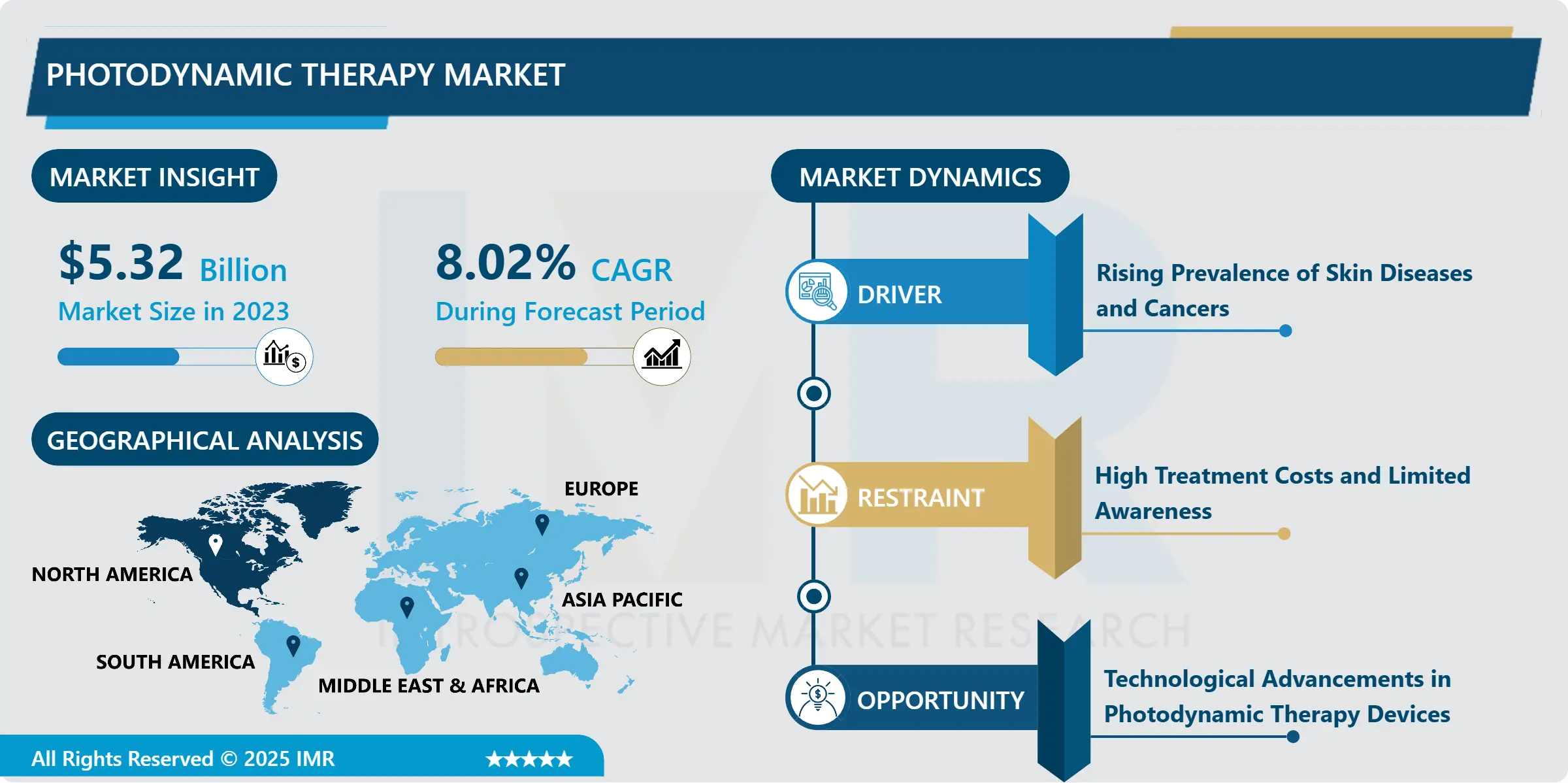
Photodynamic Therapy Market Size Was Valued at USD 5.32 Billion in 2023, and is Projected to Reach USD 10.65 Billion by 2032, Growing at a CAGR of 8.02% From 2024-2032.

IMR Group
Description
Photodynamic Therapy Market Synopsis:
Photodynamic Therapy Market Size Was Valued at USD 5.32 Billion in 2023, and is Projected to Reach USD 10.65 Billion by 2032, Growing at a CAGR of 8.02% From 2024-2032.
Photodynamic therapy is a kind of treatment procedure that includes photosensitizer drugs and light exposure to annihilate the targeted cells vital in cancer and other skin diseases. Photosensitizing agents, when illuminated by light of a particular wave-band, produce oxidants which on the one hand act on malignant cells or tissues, and on the other do not affect the healthy ones. PDT has appeared as one of the most potential therapies in the recent years because this therapy is highly accurate non-invasive and has relatively fewer side effects than surgical or chemotherapy.
Photodynamic therapy has numerous applications in various sectors of medicines, but is mainly utilized in oncology, dermatology and ophthalmology. As cancers and skin diseases rates have grown, people are now looking for less invasive and more efficient treatments. Photodynamic therapy has made a difference in practice due to its efficiency in the selective destruction of the altered cell while causing little or no harm to the health of the adjacent tissues, unlike some other methods. This therapy involves two key components: photosensitizing drugs and light sources which, in combination with one another, can remove cancerous or eighty tissues.
Pivotal factors that driving the growth of the market are growing awareness about non-surgical treatments, higher prevalence rates of diseases such as actinic keratosis and psoriasis, and product innovation in the field of PDT equipment. The market is divided by geographic regions and by products such as photosensitizer drugs and PDT devices and applications involving treatments for cancer, actinic keratosis and acne. Furthermore, it is observed that PDT is encompassing other cancer care treatment plans and dermatological operations because of clinical evidence present worldwide. On the same note, however, some difficulties such as high costs of medical treatment and low information in the developing world are shortcomings of the plan. Nevertheless, the market should gradually expand as the improvement of its effectiveness continues as a result of more extensive research and the development of new technologies.
Photodynamic Therapy Market Trend Analysis:
Increased Focus on Cancer Treatment Applications
Application of photodynamic therapy in cancer treatment is one of the major trends in the development of this market. PDT has be established to be useful in eradicating many types of Cancer for instance Skin, Esophagus and Lung Cancer due to its accuracy and minimal harm to the body. Unlike invasive treatment programs such as chemotherapy, PDT affects only the malignant cells, causing no destruction to surrounding healthy tissues and cells and giving patients who are in search of less invasive techniques a chance to recover. The development of new types of photosensitizer drugs in the recent past has enhanced the possibility of using PDT in cancer therapy. There are more selective and effective drugs at the meantime, new source of light, all these have shown favourable results in the field of patients. This trend is expected to persist in the future in respect to the continued identification of potential indications in using PDT in treating cancer such as using PDT with more virile malignant tumors and those tumors, which are difficult to access.
Technological Advancements in Photodynamic Therapy Devices
Another market opportunity is the increasing research and development in SD-OCT based photodynamic therapy machines. One wide ranging factor that has boosted the efficacy of the PDT is the kind of light needed to activate the PSP and this has been provided by the light based technologies common in the modern world such as the LED light sources and laser systems. They have also increased the efficacy and localization of affected tissues and in the end offered the patients improved therapeutic outcomes and shorter recovery time. This opportunity means a positive outlook for manufacturers of next generation PDT devices.
In addition to PDT application and development, the integration of PDT with novel enlightening domains such as nanotechnology and precision medicine is expanding possibilities of creation. For example, to enhance the use of PDT, nanocarriers are in the pipeline to enhance the ability to deliver photosensitizing drugs in tissues affected by cancer. In light of the enhanced or optimized targeting, need for accurate or individualized treatment, PDT equipment, which can be customized to suit the current condition of particular patient, is bound to experience a surge in demand.
Photodynamic Therapy Market Segment Analysis:
Photodynamic Therapy Market is Segmented on the basis of Product Type, Light Source, Application and End User.
By Product Type, Photosensitizer Drugs segment is expected to dominate the market during the forecast period
The photodynamic therapy market is segmented into two main product types: photosensitizer drugs and photodynamic therapy devices on the market. Photosensitizer drugs are crucial for PDT as they are used by light to generate ROS that eliminate focused cells. There is increasing popularity in these drugs which has been precipitated by the discovery of other better drugs in the market.
On the other hand, photodynamic therapy devices are relatively young and improving withEmitter light sources includes lasers and LEDs. These devices optimize positioning of light over the targeted tissue so as to achieve high treatment outcomes. High growth in the developed drugs hand in hand with innovative devices will be the main drivers for the market’s growth in the nearest future.
By Application, Cancer segment expected to held the largest share
The use of PDT also stretches across many specialties, though the oncology niche is the largest one among them. Because PDT can be used effectively against different kinds of tumors, including skin, esophageal and lung carcinoma, the therapy has found important place in various researches. Its selective and effectiveness and features that makes it less destructive to other tissues are therefore an improvement from chemotherapy.
In dermatology, PDT works for treating Actinic keratosis, Psoriasis, and Acne. Keratosis, which is a pre-malignant disease resulting from over-exposure to the sun, can be well controlled by PDT to help avoid the development of skin cancer. PDT for acne is also becoming popular due to its ease of application, especially where standard treatments are not successful.
Photodynamic Therapy Market Regional Insights:
North America is Expected to Dominate the Market Over the Forecast period
North America is the largest market for PDT owing to its well-developed healthcare system, raised incidence of skin diseases and cancer, and increasing knowledge about PDT. Members of the region enjoy steady outlays for research and development with the introduction of new PDT technologies and drugs into clinical practice.
Besides, some reimbursement policies in this procedure are friendly and this has been made evident most especially in countries like the U.S. Since skin cancer is on the increase especially in areas with high sun radiation, North American is expected to continue to dominate the market for photodynamic therapy across the globe.
Active Key Players in the Photodynamic Therapy Market
Biofrontera AG (Germany)
Galderma (Switzerland)
Sun Pharmaceutical Industries Ltd (India)
Bausch Health Companies Inc. (Canada)
Theralase Technologies Inc. (Canada)
Valeant Pharmaceuticals International, Inc. (Canada)
Modulight (Finland)
PDT Pharma (Brazil)
Biolitec AG (Germany)
Quest PharmaTech Inc. (Canada)
Hologic, Inc. (USA)
Lumenis Ltd. (Israel), and Other Active Players
Key Industry Developments in the Photodynamic Therapy Market:
In June 2024, Biofrontera AG launched RhodeXL lamp with Ameluz (aminolevulinic acid hydrochloride) topical gel for patients suffering from actinic keratosis in order to strengthen their product portfolio.
In February 2024, Biofrontera AG collaborated with GME – German Medical Engineering GmbH in order to promote the Multilite daylight lamp for the photodynamic therapy for actinic keratosis in Germany and the U.K.
In July 2023, Better Therapeutics received the U.S. FDA authorization for AspyreRx (formerly BT-001), a PDT treatment to provide behavioral therapy to patients or older with type 2 diabetes.
In February 2023, Galderma collaborated with German Medical Engineering (GME) with the aim of promoting their photosensitizer drug, Metvix. This helped the company to strengthen its brand presence globally.
Chapter 1: Introduction
1.1 Scope and Coverage
Chapter 2:Executive Summary
Chapter 3: Market Landscape
3.1 Market Dynamics
3.1.1 Drivers
3.1.2 Restraints
3.1.3 Opportunities
3.1.4 Challenges
3.2 Market Trend Analysis
3.3 PESTLE Analysis
3.4 Porter’s Five Forces Analysis
3.5 Industry Value Chain Analysis
3.6 Ecosystem
3.7 Regulatory Landscape
3.8 Price Trend Analysis
3.9 Patent Analysis
3.10 Technology Evolution
3.11 Investment Pockets
3.12 Import-Export Analysis
Chapter 4: Photodynamic Therapy Market by Product Type
4.1 Photodynamic Therapy Market Snapshot and Growth Engine
4.2 Photodynamic Therapy Market Overview
4.3 Photosensitizer Drugs
4.3.1 Introduction and Market Overview
4.3.2 Historic and Forecasted Market Size in Value USD and Volume Units (2017-2032F)
4.3.3 Key Market Trends, Growth Factors and Opportunities
4.3.4 Photosensitizer Drugs: Geographic Segmentation Analysis
4.4 Photodynamic Therapy Devices
4.4.1 Introduction and Market Overview
4.4.2 Historic and Forecasted Market Size in Value USD and Volume Units (2017-2032F)
4.4.3 Key Market Trends, Growth Factors and Opportunities
4.4.4 Photodynamic Therapy Devices: Geographic Segmentation Analysis
Chapter 5: Photodynamic Therapy Market by Light Source
5.1 Photodynamic Therapy Market Snapshot and Growth Engine
5.2 Photodynamic Therapy Market Overview
5.3 Lasers
5.3.1 Introduction and Market Overview
5.3.2 Historic and Forecasted Market Size in Value USD and Volume Units (2017-2032F)
5.3.3 Key Market Trends, Growth Factors and Opportunities
5.3.4 Lasers: Geographic Segmentation Analysis
5.4 Light Emitting Diodes (LEDs)
5.4.1 Introduction and Market Overview
5.4.2 Historic and Forecasted Market Size in Value USD and Volume Units (2017-2032F)
5.4.3 Key Market Trends, Growth Factors and Opportunities
5.4.4 Light Emitting Diodes (LEDs): Geographic Segmentation Analysis
5.5 Lamps
5.5.1 Introduction and Market Overview
5.5.2 Historic and Forecasted Market Size in Value USD and Volume Units (2017-2032F)
5.5.3 Key Market Trends, Growth Factors and Opportunities
5.5.4 Lamps: Geographic Segmentation Analysis
5.6 Others
5.6.1 Introduction and Market Overview
5.6.2 Historic and Forecasted Market Size in Value USD and Volume Units (2017-2032F)
5.6.3 Key Market Trends, Growth Factors and Opportunities
5.6.4 Others: Geographic Segmentation Analysis
Chapter 6: Photodynamic Therapy Market by Application
6.1 Photodynamic Therapy Market Snapshot and Growth Engine
6.2 Photodynamic Therapy Market Overview
6.3 Cancer
6.3.1 Introduction and Market Overview
6.3.2 Historic and Forecasted Market Size in Value USD and Volume Units (2017-2032F)
6.3.3 Key Market Trends, Growth Factors and Opportunities
6.3.4 Cancer: Geographic Segmentation Analysis
6.4 Actinic Keratosis (AK)
6.4.1 Introduction and Market Overview
6.4.2 Historic and Forecasted Market Size in Value USD and Volume Units (2017-2032F)
6.4.3 Key Market Trends, Growth Factors and Opportunities
6.4.4 Actinic Keratosis (AK): Geographic Segmentation Analysis
6.5 Psoriasis
6.5.1 Introduction and Market Overview
6.5.2 Historic and Forecasted Market Size in Value USD and Volume Units (2017-2032F)
6.5.3 Key Market Trends, Growth Factors and Opportunities
6.5.4 Psoriasis: Geographic Segmentation Analysis
6.6 Acne
6.6.1 Introduction and Market Overview
6.6.2 Historic and Forecasted Market Size in Value USD and Volume Units (2017-2032F)
6.6.3 Key Market Trends, Growth Factors and Opportunities
6.6.4 Acne: Geographic Segmentation Analysis
6.7 Others
6.7.1 Introduction and Market Overview
6.7.2 Historic and Forecasted Market Size in Value USD and Volume Units (2017-2032F)
6.7.3 Key Market Trends, Growth Factors and Opportunities
6.7.4 Others: Geographic Segmentation Analysis
Chapter 7: Photodynamic Therapy Market by End User
7.1 Photodynamic Therapy Market Snapshot and Growth Engine
7.2 Photodynamic Therapy Market Overview
7.3 Hospitals
7.3.1 Introduction and Market Overview
7.3.2 Historic and Forecasted Market Size in Value USD and Volume Units (2017-2032F)
7.3.3 Key Market Trends, Growth Factors and Opportunities
7.3.4 Hospitals: Geographic Segmentation Analysis
7.4 Cancer Treatment Centres
7.4.1 Introduction and Market Overview
7.4.2 Historic and Forecasted Market Size in Value USD and Volume Units (2017-2032F)
7.4.3 Key Market Trends, Growth Factors and Opportunities
7.4.4 Cancer Treatment Centres: Geographic Segmentation Analysis
7.5 Cosmetic and Dermatology Clinics
7.5.1 Introduction and Market Overview
7.5.2 Historic and Forecasted Market Size in Value USD and Volume Units (2017-2032F)
7.5.3 Key Market Trends, Growth Factors and Opportunities
7.5.4 Cosmetic and Dermatology Clinics: Geographic Segmentation Analysis
7.6 Others
7.6.1 Introduction and Market Overview
7.6.2 Historic and Forecasted Market Size in Value USD and Volume Units (2017-2032F)
7.6.3 Key Market Trends, Growth Factors and Opportunities
7.6.4 Others: Geographic Segmentation Analysis
Chapter 8: Company Profiles and Competitive Analysis
8.1 Competitive Landscape
8.1.1 Competitive Benchmarking
8.1.2 Photodynamic Therapy Market Share by Manufacturer (2023)
8.1.3 Industry BCG Matrix
8.1.4 Heat Map Analysis
8.1.5 Mergers and Acquisitions
8.2 BIOFRONTERA AG (GERMANY)
8.2.1 Company Overview
8.2.2 Key Executives
8.2.3 Company Snapshot
8.2.4 Role of the Company in the Market
8.2.5 Sustainability and Social Responsibility
8.2.6 Operating Business Segments
8.2.7 Product Portfolio
8.2.8 Business Performance
8.2.9 Key Strategic Moves and Recent Developments
8.2.10 SWOT Analysis
8.3 GALDERMA (SWITZERLAND)
8.4 SUN PHARMACEUTICAL INDUSTRIES LTD (INDIA)
8.5 BAUSCH HEALTH COMPANIES INC. (CANADA)
8.6 THERALASE TECHNOLOGIES INC. (CANADA)
8.7 VALEANT PHARMACEUTICALS INTERNATIONAL INC. (CANADA)
8.8 MODULIGHT (FINLAND)
8.9 PDT PHARMA (BRAZIL)
8.10 BIOLITEC AG (GERMANY)
8.11 QUEST PHARMATECH INC. (CANADA)
8.12 HOLOGIC INC. (USA)
8.13 LUMENIS LTD. (ISRAEL)
8.14 OTHER ACTIVE PLAYERS
Chapter 9: Global Photodynamic Therapy Market By Region
9.1 Overview
9.2. North America Photodynamic Therapy Market
9.2.1 Key Market Trends, Growth Factors and Opportunities
9.2.2 Top Key Companies
9.2.3 Historic and Forecasted Market Size by Segments
9.2.4 Historic and Forecasted Market Size By Product Type
9.2.4.1 Photosensitizer Drugs
9.2.4.2 Photodynamic Therapy Devices
9.2.5 Historic and Forecasted Market Size By Light Source
9.2.5.1 Lasers
9.2.5.2 Light Emitting Diodes (LEDs)
9.2.5.3 Lamps
9.2.5.4 Others
9.2.6 Historic and Forecasted Market Size By Application
9.2.6.1 Cancer
9.2.6.2 Actinic Keratosis (AK)
9.2.6.3 Psoriasis
9.2.6.4 Acne
9.2.6.5 Others
9.2.7 Historic and Forecasted Market Size By End User
9.2.7.1 Hospitals
9.2.7.2 Cancer Treatment Centres
9.2.7.3 Cosmetic and Dermatology Clinics
9.2.7.4 Others
9.2.8 Historic and Forecast Market Size by Country
9.2.8.1 US
9.2.8.2 Canada
9.2.8.3 Mexico
9.3. Eastern Europe Photodynamic Therapy Market
9.3.1 Key Market Trends, Growth Factors and Opportunities
9.3.2 Top Key Companies
9.3.3 Historic and Forecasted Market Size by Segments
9.3.4 Historic and Forecasted Market Size By Product Type
9.3.4.1 Photosensitizer Drugs
9.3.4.2 Photodynamic Therapy Devices
9.3.5 Historic and Forecasted Market Size By Light Source
9.3.5.1 Lasers
9.3.5.2 Light Emitting Diodes (LEDs)
9.3.5.3 Lamps
9.3.5.4 Others
9.3.6 Historic and Forecasted Market Size By Application
9.3.6.1 Cancer
9.3.6.2 Actinic Keratosis (AK)
9.3.6.3 Psoriasis
9.3.6.4 Acne
9.3.6.5 Others
9.3.7 Historic and Forecasted Market Size By End User
9.3.7.1 Hospitals
9.3.7.2 Cancer Treatment Centres
9.3.7.3 Cosmetic and Dermatology Clinics
9.3.7.4 Others
9.3.8 Historic and Forecast Market Size by Country
9.3.8.1 Russia
9.3.8.2 Bulgaria
9.3.8.3 The Czech Republic
9.3.8.4 Hungary
9.3.8.5 Poland
9.3.8.6 Romania
9.3.8.7 Rest of Eastern Europe
9.4. Western Europe Photodynamic Therapy Market
9.4.1 Key Market Trends, Growth Factors and Opportunities
9.4.2 Top Key Companies
9.4.3 Historic and Forecasted Market Size by Segments
9.4.4 Historic and Forecasted Market Size By Product Type
9.4.4.1 Photosensitizer Drugs
9.4.4.2 Photodynamic Therapy Devices
9.4.5 Historic and Forecasted Market Size By Light Source
9.4.5.1 Lasers
9.4.5.2 Light Emitting Diodes (LEDs)
9.4.5.3 Lamps
9.4.5.4 Others
9.4.6 Historic and Forecasted Market Size By Application
9.4.6.1 Cancer
9.4.6.2 Actinic Keratosis (AK)
9.4.6.3 Psoriasis
9.4.6.4 Acne
9.4.6.5 Others
9.4.7 Historic and Forecasted Market Size By End User
9.4.7.1 Hospitals
9.4.7.2 Cancer Treatment Centres
9.4.7.3 Cosmetic and Dermatology Clinics
9.4.7.4 Others
9.4.8 Historic and Forecast Market Size by Country
9.4.8.1 Germany
9.4.8.2 UK
9.4.8.3 France
9.4.8.4 The Netherlands
9.4.8.5 Italy
9.4.8.6 Spain
9.4.8.7 Rest of Western Europe
9.5. Asia Pacific Photodynamic Therapy Market
9.5.1 Key Market Trends, Growth Factors and Opportunities
9.5.2 Top Key Companies
9.5.3 Historic and Forecasted Market Size by Segments
9.5.4 Historic and Forecasted Market Size By Product Type
9.5.4.1 Photosensitizer Drugs
9.5.4.2 Photodynamic Therapy Devices
9.5.5 Historic and Forecasted Market Size By Light Source
9.5.5.1 Lasers
9.5.5.2 Light Emitting Diodes (LEDs)
9.5.5.3 Lamps
9.5.5.4 Others
9.5.6 Historic and Forecasted Market Size By Application
9.5.6.1 Cancer
9.5.6.2 Actinic Keratosis (AK)
9.5.6.3 Psoriasis
9.5.6.4 Acne
9.5.6.5 Others
9.5.7 Historic and Forecasted Market Size By End User
9.5.7.1 Hospitals
9.5.7.2 Cancer Treatment Centres
9.5.7.3 Cosmetic and Dermatology Clinics
9.5.7.4 Others
9.5.8 Historic and Forecast Market Size by Country
9.5.8.1 China
9.5.8.2 India
9.5.8.3 Japan
9.5.8.4 South Korea
9.5.8.5 Malaysia
9.5.8.6 Thailand
9.5.8.7 Vietnam
9.5.8.8 The Philippines
9.5.8.9 Australia
9.5.8.10 New Zealand
9.5.8.11 Rest of APAC
9.6. Middle East & Africa Photodynamic Therapy Market
9.6.1 Key Market Trends, Growth Factors and Opportunities
9.6.2 Top Key Companies
9.6.3 Historic and Forecasted Market Size by Segments
9.6.4 Historic and Forecasted Market Size By Product Type
9.6.4.1 Photosensitizer Drugs
9.6.4.2 Photodynamic Therapy Devices
9.6.5 Historic and Forecasted Market Size By Light Source
9.6.5.1 Lasers
9.6.5.2 Light Emitting Diodes (LEDs)
9.6.5.3 Lamps
9.6.5.4 Others
9.6.6 Historic and Forecasted Market Size By Application
9.6.6.1 Cancer
9.6.6.2 Actinic Keratosis (AK)
9.6.6.3 Psoriasis
9.6.6.4 Acne
9.6.6.5 Others
9.6.7 Historic and Forecasted Market Size By End User
9.6.7.1 Hospitals
9.6.7.2 Cancer Treatment Centres
9.6.7.3 Cosmetic and Dermatology Clinics
9.6.7.4 Others
9.6.8 Historic and Forecast Market Size by Country
9.6.8.1 Turkiye
9.6.8.2 Bahrain
9.6.8.3 Kuwait
9.6.8.4 Saudi Arabia
9.6.8.5 Qatar
9.6.8.6 UAE
9.6.8.7 Israel
9.6.8.8 South Africa
9.7. South America Photodynamic Therapy Market
9.7.1 Key Market Trends, Growth Factors and Opportunities
9.7.2 Top Key Companies
9.7.3 Historic and Forecasted Market Size by Segments
9.7.4 Historic and Forecasted Market Size By Product Type
9.7.4.1 Photosensitizer Drugs
9.7.4.2 Photodynamic Therapy Devices
9.7.5 Historic and Forecasted Market Size By Light Source
9.7.5.1 Lasers
9.7.5.2 Light Emitting Diodes (LEDs)
9.7.5.3 Lamps
9.7.5.4 Others
9.7.6 Historic and Forecasted Market Size By Application
9.7.6.1 Cancer
9.7.6.2 Actinic Keratosis (AK)
9.7.6.3 Psoriasis
9.7.6.4 Acne
9.7.6.5 Others
9.7.7 Historic and Forecasted Market Size By End User
9.7.7.1 Hospitals
9.7.7.2 Cancer Treatment Centres
9.7.7.3 Cosmetic and Dermatology Clinics
9.7.7.4 Others
9.7.8 Historic and Forecast Market Size by Country
9.7.8.1 Brazil
9.7.8.2 Argentina
9.7.8.3 Rest of SA
Chapter 10 Analyst Viewpoint and Conclusion
10.1 Recommendations and Concluding Analysis
10.2 Potential Market Strategies
Chapter 11 Research Methodology
11.1 Research Process
11.2 Primary Research
11.3 Secondary Research
Q1: What would be the forecast period in the Photodynamic Therapy Market research report?
A1: The forecast period in the Photodynamic Therapy Market research report is 2024-2032.
Q2: Who are the key players in the Photodynamic Therapy Market?
A2: Biofrontera AG (Germany), Galderma (Switzerland), Sun Pharmaceutical Industries Ltd (India), Bausch Health Companies Inc. (Canada), Theralase Technologies Inc. (Canada), Valeant Pharmaceuticals International, Inc. (Canada), Modulight (Finland), PDT Pharma (Brazil), Biolitec AG (Germany), Quest PharmaTech Inc. (Canada), Hologic, Inc. (USA), Lumenis Ltd. (Israel), and Other Active Players.
Q3: What are the segments of the Photodynamic Therapy Market?
A3: The Photodynamic Therapy Market is segmented into Product Type, Light Source, Application, End User and region. By Product Type, the market is categorized into Photosensitizer Drugs, Photodynamic Therapy Devices. By Light Source, the market is categorized into Lasers, Light Emitting Diodes (LEDs), Lamps, Others. By Application, the market is categorized into Cancer, Actinic Keratosis (AK), Psoriasis, Acne, Others. By End User, the market is categorized into Hospitals, Cancer Treatment Centres, Cosmetic and Dermatology Clinics, and Others. By region, it is analyzed across North America (U.S., Canada, Mexico), Eastern Europe (Russia, Bulgaria, The Czech Republic, Hungary, Poland, Romania, Rest of Eastern Europe), Western Europe (Germany, UK, France, Netherlands, Italy, Spain, Rest of Western Europe), Asia Pacific (China, India, Japan, South Korea, Malaysia, Thailand, Vietnam, The Philippines, Australia, New Zealand, Rest of APAC), Middle East & Africa (Turkiye, Bahrain, Kuwait, Saudi Arabia, Qatar, UAE, Israel, South Africa), South America (Brazil, Argentina, Rest of SA).
Q4: What is the Photodynamic Therapy Market?
A4: Photodynamic therapy is a kind of treatment procedure that includes photosensitizer drugs and light exposure to annihilate the targeted cells vital in cancer and other skin diseases. Photosensitizing agents, when illuminated by light of a particular wave-band, produce oxidants which on the one hand act on malignant cells or tissues, and on the other do not affect the healthy ones. PDT has recently emerged onto the scene as a promising therapy due to its high accuracy, low invasiveness and reduced side effects when compared to other therapies such as surgical or chemotherapy.
Q5: How big is the Photodynamic Therapy Market?
A5: Photodynamic Therapy Market Size Was Valued at USD 5.32 Billion in 2023, and is Projected to Reach USD 10.65 Billion by 2032, Growing at a CAGR of 8.02% From 2024-2032.X`
How to Buy a Report from eminsights.jp
On the product page, choose the license you want: Single-User License, Multi-User License or Enterprise License.
If you required report in your native language, then you can click on Translated Report button and fill out the form with report name and language you want, then our team will contact you as soon as possible.
Click the Buy Now button.
You will be redirected to the checkout page. Enter your company details and payment information.
Click Place Order to complete the purchase.
Confirmation: You’ll receive an order confirmation and our team will contact you shortly with your ordered report.
If you have any questions, fill out the contact form below or email us at bizdev@eminsights.net.
Thank you for choosing eminsights.jp!