Stay Ahead in Fast-Growing Economies.
Browse Reports Now




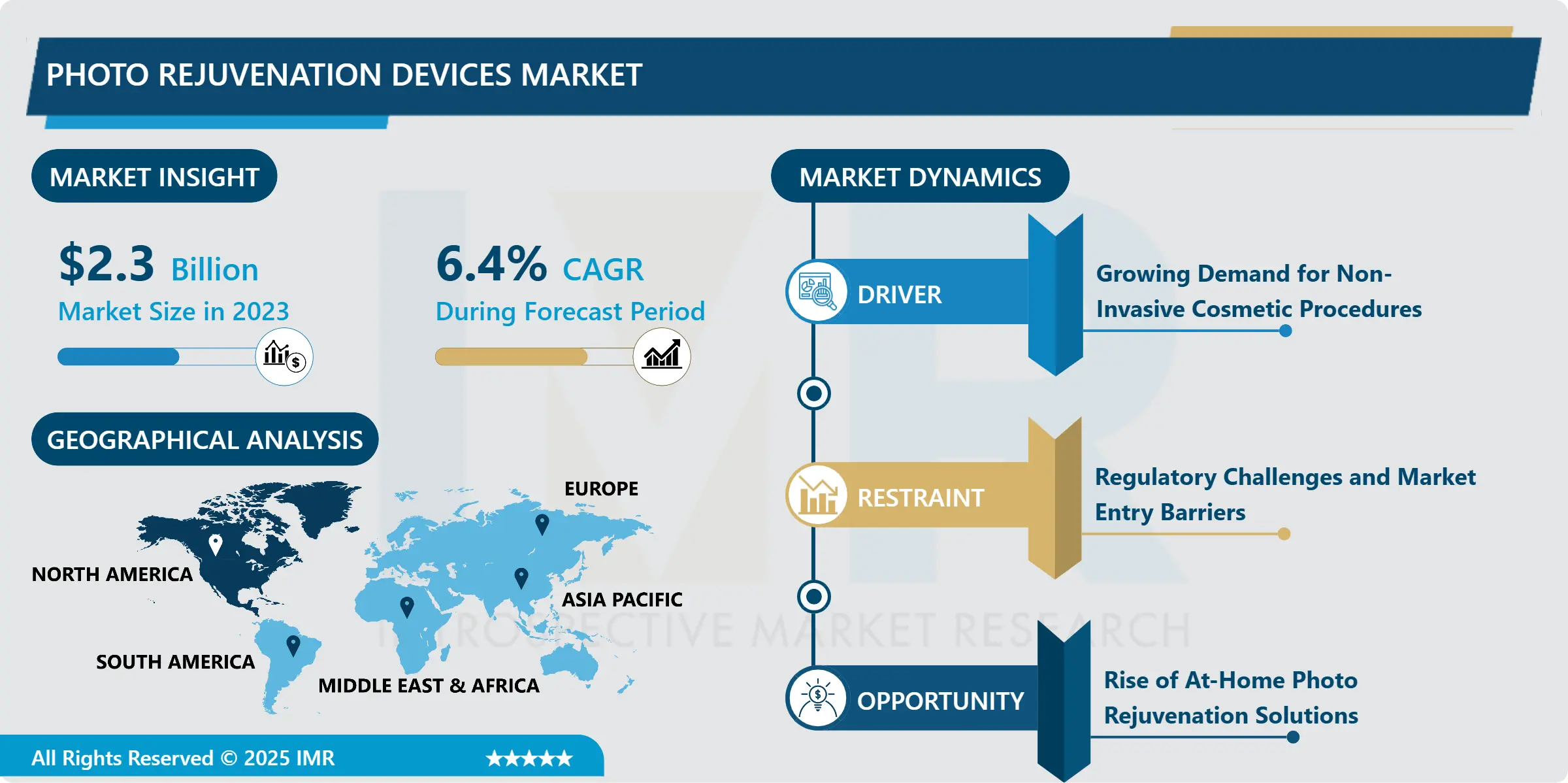
Photo Rejuvenation Devices Market Size, Share, Growth & Forecast (2024-2032)
Photo Rejuvenation Devices Market Size Was Valued at USD 2.30 Billion in 2023, and is Projected to Reach USD 4.03 Billion by 2032, Growing at a CAGR of 6.40% From 2024-2032.

IMR Group
Description
Photo Rejuvenation Devices Market Synopsis:
Photo Rejuvenation Devices Market Size Was Valued at USD 2.30 Billion in 2023, and is Projected to Reach USD 4.03 Billion by 2032, Growing at a CAGR of 6.40% From 2024-2032.
It defines the Photo Rejuvenation Devices Market in terms of the exact technologies and instruments that are employed for the treatment of skin problems that affect look and feel through light therapy. They mainly work with laser, IPL, LED, and photodynamic therapy (PDT) for skin rejuvenation, skin care, and some treatments that can effectively capture the demands of dermatology clinics, beauty clinics, hospitals, and home-care markets. They have gained popularity because of the achievements in providing a younger looking skin and solving various skin complaints with little down time required.
Growing need for Cosmetic treatments and specifically for Photo Rejuvenation Devices is greatly attributed by the rise in demand for cosmetic procedures that entail minimal or no down time at all. Such a change is due to innovations in beauty treatments, an increase in concerns for looks and the comfort of these procedures, especially among the elder population and the youth is keen on the early onset of skincare procedures. Also, technological enhancement of these devices has enhanced functionalities and safety hence enhancing consumer uptake across multiple end-users namely skin clinics and beauty centers.
However, growing discretionary income and the increasing popularity of medical tourism in emerging markets is providing further boost to the market. In Asia-Pacific new markets, mostly among countries with a rapidly growing economy, the availability of the procedures and devices is increasing. This trend is further emphasized by decreasing costs of devices meaning that more people can afford treatments and therefore buttressing the Photo Rejuvenation Devices Market’s growth worldwide.
Photo Rejuvenation Devices Market Trend Analysis:
Preference for at-home photo rejuvenation devices.
Another emerging trend to note is the large trend towards photo rejuvenation devices that can be used inside a home to suit consumers’s busy schedules and help them maintain privacy. There is an evolution characteristic evident in major innovations and measurements in comfortable hand-held devices perfect for home operating concerning more and more consumer preference for handy, long-term economy. Present day gadgets employ smart features in developing treatment session therefore making these products more accessible and attractive in the consumer skincare market.
One of the emerging trends which influences the market is associated with AI and machine learning capabilities integrated into professional-end devices for dermatology or beauty clinics. This brings about a better way to treat skin problems with high accuracy and effectiveness resulting in increased accuracy in the formulation of treatment plans for skin disorders – the new gold standard in skin care. The need for novel products and technology adoption is expected to promote the market evolution even more, especially by drawing more firms to innovate and develop new products for the market.
Booming beauty and cosmetic industry and rising disposable incomes.
Current market conditions in Asia-Pacific countries are perfect for further development due to increasing demand for beauty and cosmetics products and the increase in people’s disposable income. The demand for non-invasive skincare amongst the younger populations due to heightened awareness is extending the market while on the other, global brands investing in the marketing alongside localized partnerships are also reaching out to a large customer base. Further, the increase in the use of tele dermatology promoted by photo rejuvenation device firms is boosting the geographic access to these instruments in previously underserved areas in the region.
At the same time, there is a new potential to aim at medical services that is promptly gaining popularity in the countries of Latin America and South East Asia, for instance. These regions provide standard and efficient treatment at cheaper prices hence provoking patients from all over the world in need of skincare and treatments to turn to them. This shift in healthcare market is to complement the base for growth of photo rejuvenation devices from a standpoint of medical tourism once international travel is resumes, this picture illustrates how clinics, providers of medical treatment and care seek to apply and purchase the latest innovation in technology to reach international clients.
Photo Rejuvenation Devices Market Segment Analysis:
Photo Rejuvenation Devices Market Segmented on the basis of Product type, Modality, application and end user.
By Product Type, Laser Devices segment is expected to dominate the market during the forecast period
By product type, the photo rejuvenation devices market comprises laser devices, IPL, LED, and PDT devices, with different modality to alter the skin look. Laser devices are widely applied in dermatology for focusing on such skin issues as fine lines, changes in skin pigmentation, or spider veins, using the light rays. IPL devices use a non-focused light bulb which can treat minor skin problems such as hair removal and photo aging, because the light goes deep into the skin. The LED device which is considered mild incorporates light emitting diodes whose different wavelengths can help in correcting skin texture, lessen redness and raise collagen production for a non-surgical skin renewal. Finally, PDT devices treat acne, pre-cancerous spots and other skin irregularities through the exposure of the skin to light and photosensitizing agents which make it efficient for solving more complex skincare issues.
By Application, Skin Treatment segment expected to held the largest share
The Photo Rejuvenation Devices Market classified by application contains skin treatment, hair removal, vascular lesions, skin pigmentation, and acne treatment, all used for different dermatological requirements. Skin treatment applications are aimed solely on giving the skin a younger look, decreased the appearance of fine lines, wrinkles and improving over all skin tone. Hair removal still remains a widely used treatment, for devices provide for permanent hair removal due to the selective destruction of hair follicles. Spider veins and broken capillaries are other vascular lesions that are removed using instruments that selectively apply energy to vessels to seal them or destroy them without affecting the other tissues in the area. Laser peeling and pigmentation treatment solutions eliminate the abovementioned skin issues through the use of light on skin issues such as discolouration, age spots, and sun damage. About Acne treatment applications utilizes the photo rejuvenation to calm, exterminate microorganisms and quickens healing adding up to be the non-invasive treatments for acne skin.
Photo Rejuvenation Devices Market Regional Insights:
North America is Expected to Dominate the Market Over the Forecast period
North America holds the largest share of Photo Rejuvenation Devices Market because of increasing popularity of cosmetic procedures, well-developed healthcare system, and key market players. This was compounded by the regions emphasis on aesthetic medical technologies, and high end consumer expenditure on beauty treatments such as facial care products. Dermatology and beauty clinics in USA and Canada being the pioneers for usage of premium devices are expected to derive high growth for photo rejuvenation technology in this market.
In addition, awareness and education of the North American consumer regarding the non-surgical procedures has been on the rise. A strong incentive for manufacturers and distributors, the prospects are further boosted by latest higher R&D investments and improved regulations. Due to, high health care expenditure and sound economy of the region, the demand for the cosmetic treatment devices and hence the photo rejuvenation devices remain evergreen and help the market to grow and diversify the technology.
Active Key Players in the Photo Rejuvenation Devices Market:
Alma Lasers (Israel)
BISON Medical (South Korea)
Cutera, Inc. (U.S.)
Cynosure, Inc. (U.S.)
Fotona d.o.o. (Slovenia)
Lumenis Ltd. (Israel)
Lutronic Corporation (South Korea)
Sciton, Inc. (U.S.)
Syneron Medical Ltd. (Israel)
Venus Concept Ltd. (Canada)
Other Active Players
Chapter 1: Introduction
1.1 Scope and Coverage
Chapter 2:Executive Summary
Chapter 3: Market Landscape
3.1 Market Dynamics
3.1.1 Drivers
3.1.2 Restraints
3.1.3 Opportunities
3.1.4 Challenges
3.2 Market Trend Analysis
3.3 PESTLE Analysis
3.4 Porter’s Five Forces Analysis
3.5 Industry Value Chain Analysis
3.6 Ecosystem
3.7 Regulatory Landscape
3.8 Price Trend Analysis
3.9 Patent Analysis
3.10 Technology Evolution
3.11 Investment Pockets
3.12 Import-Export Analysis
Chapter 4: Photo Rejuvenation Devices Market by Product Type
4.1 Photo Rejuvenation Devices Market Snapshot and Growth Engine
4.2 Photo Rejuvenation Devices Market Overview
4.3 Laser Devices
4.3.1 Introduction and Market Overview
4.3.2 Historic and Forecasted Market Size in Value USD and Volume Units (2017-2032F)
4.3.3 Key Market Trends, Growth Factors and Opportunities
4.3.4 Laser Devices: Geographic Segmentation Analysis
4.4 Intense Pulsed Light (IPL) Devices
4.4.1 Introduction and Market Overview
4.4.2 Historic and Forecasted Market Size in Value USD and Volume Units (2017-2032F)
4.4.3 Key Market Trends, Growth Factors and Opportunities
4.4.4 Intense Pulsed Light (IPL) Devices: Geographic Segmentation Analysis
4.5 LED Devices
4.5.1 Introduction and Market Overview
4.5.2 Historic and Forecasted Market Size in Value USD and Volume Units (2017-2032F)
4.5.3 Key Market Trends, Growth Factors and Opportunities
4.5.4 LED Devices: Geographic Segmentation Analysis
4.6 Photodynamic Therapy (PDT) Devices
4.6.1 Introduction and Market Overview
4.6.2 Historic and Forecasted Market Size in Value USD and Volume Units (2017-2032F)
4.6.3 Key Market Trends, Growth Factors and Opportunities
4.6.4 Photodynamic Therapy (PDT) Devices: Geographic Segmentation Analysis
Chapter 5: Photo Rejuvenation Devices Market by Modality
5.1 Photo Rejuvenation Devices Market Snapshot and Growth Engine
5.2 Photo Rejuvenation Devices Market Overview
5.3 Standalone
5.3.1 Introduction and Market Overview
5.3.2 Historic and Forecasted Market Size in Value USD and Volume Units (2017-2032F)
5.3.3 Key Market Trends, Growth Factors and Opportunities
5.3.4 Standalone: Geographic Segmentation Analysis
5.4 Portable
5.4.1 Introduction and Market Overview
5.4.2 Historic and Forecasted Market Size in Value USD and Volume Units (2017-2032F)
5.4.3 Key Market Trends, Growth Factors and Opportunities
5.4.4 Portable: Geographic Segmentation Analysis
Chapter 6: Photo Rejuvenation Devices Market by Application
6.1 Photo Rejuvenation Devices Market Snapshot and Growth Engine
6.2 Photo Rejuvenation Devices Market Overview
6.3 Skin Treatment
6.3.1 Introduction and Market Overview
6.3.2 Historic and Forecasted Market Size in Value USD and Volume Units (2017-2032F)
6.3.3 Key Market Trends, Growth Factors and Opportunities
6.3.4 Skin Treatment: Geographic Segmentation Analysis
6.4 Hair Removal
6.4.1 Introduction and Market Overview
6.4.2 Historic and Forecasted Market Size in Value USD and Volume Units (2017-2032F)
6.4.3 Key Market Trends, Growth Factors and Opportunities
6.4.4 Hair Removal: Geographic Segmentation Analysis
6.5 Vascular Lesions
6.5.1 Introduction and Market Overview
6.5.2 Historic and Forecasted Market Size in Value USD and Volume Units (2017-2032F)
6.5.3 Key Market Trends, Growth Factors and Opportunities
6.5.4 Vascular Lesions: Geographic Segmentation Analysis
6.6 Pigmentation
6.6.1 Introduction and Market Overview
6.6.2 Historic and Forecasted Market Size in Value USD and Volume Units (2017-2032F)
6.6.3 Key Market Trends, Growth Factors and Opportunities
6.6.4 Pigmentation: Geographic Segmentation Analysis
6.7 Acne Treatment
6.7.1 Introduction and Market Overview
6.7.2 Historic and Forecasted Market Size in Value USD and Volume Units (2017-2032F)
6.7.3 Key Market Trends, Growth Factors and Opportunities
6.7.4 Acne Treatment: Geographic Segmentation Analysis
Chapter 7: Photo Rejuvenation Devices Market by End User
7.1 Photo Rejuvenation Devices Market Snapshot and Growth Engine
7.2 Photo Rejuvenation Devices Market Overview
7.3 Hospitals
7.3.1 Introduction and Market Overview
7.3.2 Historic and Forecasted Market Size in Value USD and Volume Units (2017-2032F)
7.3.3 Key Market Trends, Growth Factors and Opportunities
7.3.4 Hospitals: Geographic Segmentation Analysis
7.4 Dermatology Clinics
7.4.1 Introduction and Market Overview
7.4.2 Historic and Forecasted Market Size in Value USD and Volume Units (2017-2032F)
7.4.3 Key Market Trends, Growth Factors and Opportunities
7.4.4 Dermatology Clinics: Geographic Segmentation Analysis
7.5 Beauty Clinics
7.5.1 Introduction and Market Overview
7.5.2 Historic and Forecasted Market Size in Value USD and Volume Units (2017-2032F)
7.5.3 Key Market Trends, Growth Factors and Opportunities
7.5.4 Beauty Clinics: Geographic Segmentation Analysis
7.6 Home Care Settings
7.6.1 Introduction and Market Overview
7.6.2 Historic and Forecasted Market Size in Value USD and Volume Units (2017-2032F)
7.6.3 Key Market Trends, Growth Factors and Opportunities
7.6.4 Home Care Settings: Geographic Segmentation Analysis
Chapter 8: Company Profiles and Competitive Analysis
8.1 Competitive Landscape
8.1.1 Competitive Benchmarking
8.1.2 Photo Rejuvenation Devices Market Share by Manufacturer (2023)
8.1.3 Industry BCG Matrix
8.1.4 Heat Map Analysis
8.1.5 Mergers and Acquisitions
8.2 ALMA LASERS (ISRAEL)
8.2.1 Company Overview
8.2.2 Key Executives
8.2.3 Company Snapshot
8.2.4 Role of the Company in the Market
8.2.5 Sustainability and Social Responsibility
8.2.6 Operating Business Segments
8.2.7 Product Portfolio
8.2.8 Business Performance
8.2.9 Key Strategic Moves and Recent Developments
8.2.10 SWOT Analysis
8.3 BISON MEDICAL (SOUTH KOREA)
8.4 CUTERA INC. (U.S.)
8.5 CYNOSURE INC. (U.S.)
8.6 FOTONA D.O.O. (SLOVENIA)
8.7 LUMENIS LTD. (ISRAEL)
8.8 LUTRONIC CORPORATION (SOUTH KOREA)
8.9 SCITON INC. (U.S.)
8.10 SYNERON MEDICAL LTD. (ISRAEL)
8.11 VENUS CONCEPT LTD. (CANADA)
8.12 OTHER ACTIVE PLAYERS
Chapter 9: Global Photo Rejuvenation Devices Market By Region
9.1 Overview
9.2. North America Photo Rejuvenation Devices Market
9.2.1 Key Market Trends, Growth Factors and Opportunities
9.2.2 Top Key Companies
9.2.3 Historic and Forecasted Market Size by Segments
9.2.4 Historic and Forecasted Market Size By Product Type
9.2.4.1 Laser Devices
9.2.4.2 Intense Pulsed Light (IPL) Devices
9.2.4.3 LED Devices
9.2.4.4 Photodynamic Therapy (PDT) Devices
9.2.5 Historic and Forecasted Market Size By Modality
9.2.5.1 Standalone
9.2.5.2 Portable
9.2.6 Historic and Forecasted Market Size By Application
9.2.6.1 Skin Treatment
9.2.6.2 Hair Removal
9.2.6.3 Vascular Lesions
9.2.6.4 Pigmentation
9.2.6.5 Acne Treatment
9.2.7 Historic and Forecasted Market Size By End User
9.2.7.1 Hospitals
9.2.7.2 Dermatology Clinics
9.2.7.3 Beauty Clinics
9.2.7.4 Home Care Settings
9.2.8 Historic and Forecast Market Size by Country
9.2.8.1 US
9.2.8.2 Canada
9.2.8.3 Mexico
9.3. Eastern Europe Photo Rejuvenation Devices Market
9.3.1 Key Market Trends, Growth Factors and Opportunities
9.3.2 Top Key Companies
9.3.3 Historic and Forecasted Market Size by Segments
9.3.4 Historic and Forecasted Market Size By Product Type
9.3.4.1 Laser Devices
9.3.4.2 Intense Pulsed Light (IPL) Devices
9.3.4.3 LED Devices
9.3.4.4 Photodynamic Therapy (PDT) Devices
9.3.5 Historic and Forecasted Market Size By Modality
9.3.5.1 Standalone
9.3.5.2 Portable
9.3.6 Historic and Forecasted Market Size By Application
9.3.6.1 Skin Treatment
9.3.6.2 Hair Removal
9.3.6.3 Vascular Lesions
9.3.6.4 Pigmentation
9.3.6.5 Acne Treatment
9.3.7 Historic and Forecasted Market Size By End User
9.3.7.1 Hospitals
9.3.7.2 Dermatology Clinics
9.3.7.3 Beauty Clinics
9.3.7.4 Home Care Settings
9.3.8 Historic and Forecast Market Size by Country
9.3.8.1 Russia
9.3.8.2 Bulgaria
9.3.8.3 The Czech Republic
9.3.8.4 Hungary
9.3.8.5 Poland
9.3.8.6 Romania
9.3.8.7 Rest of Eastern Europe
9.4. Western Europe Photo Rejuvenation Devices Market
9.4.1 Key Market Trends, Growth Factors and Opportunities
9.4.2 Top Key Companies
9.4.3 Historic and Forecasted Market Size by Segments
9.4.4 Historic and Forecasted Market Size By Product Type
9.4.4.1 Laser Devices
9.4.4.2 Intense Pulsed Light (IPL) Devices
9.4.4.3 LED Devices
9.4.4.4 Photodynamic Therapy (PDT) Devices
9.4.5 Historic and Forecasted Market Size By Modality
9.4.5.1 Standalone
9.4.5.2 Portable
9.4.6 Historic and Forecasted Market Size By Application
9.4.6.1 Skin Treatment
9.4.6.2 Hair Removal
9.4.6.3 Vascular Lesions
9.4.6.4 Pigmentation
9.4.6.5 Acne Treatment
9.4.7 Historic and Forecasted Market Size By End User
9.4.7.1 Hospitals
9.4.7.2 Dermatology Clinics
9.4.7.3 Beauty Clinics
9.4.7.4 Home Care Settings
9.4.8 Historic and Forecast Market Size by Country
9.4.8.1 Germany
9.4.8.2 UK
9.4.8.3 France
9.4.8.4 The Netherlands
9.4.8.5 Italy
9.4.8.6 Spain
9.4.8.7 Rest of Western Europe
9.5. Asia Pacific Photo Rejuvenation Devices Market
9.5.1 Key Market Trends, Growth Factors and Opportunities
9.5.2 Top Key Companies
9.5.3 Historic and Forecasted Market Size by Segments
9.5.4 Historic and Forecasted Market Size By Product Type
9.5.4.1 Laser Devices
9.5.4.2 Intense Pulsed Light (IPL) Devices
9.5.4.3 LED Devices
9.5.4.4 Photodynamic Therapy (PDT) Devices
9.5.5 Historic and Forecasted Market Size By Modality
9.5.5.1 Standalone
9.5.5.2 Portable
9.5.6 Historic and Forecasted Market Size By Application
9.5.6.1 Skin Treatment
9.5.6.2 Hair Removal
9.5.6.3 Vascular Lesions
9.5.6.4 Pigmentation
9.5.6.5 Acne Treatment
9.5.7 Historic and Forecasted Market Size By End User
9.5.7.1 Hospitals
9.5.7.2 Dermatology Clinics
9.5.7.3 Beauty Clinics
9.5.7.4 Home Care Settings
9.5.8 Historic and Forecast Market Size by Country
9.5.8.1 China
9.5.8.2 India
9.5.8.3 Japan
9.5.8.4 South Korea
9.5.8.5 Malaysia
9.5.8.6 Thailand
9.5.8.7 Vietnam
9.5.8.8 The Philippines
9.5.8.9 Australia
9.5.8.10 New Zealand
9.5.8.11 Rest of APAC
9.6. Middle East & Africa Photo Rejuvenation Devices Market
9.6.1 Key Market Trends, Growth Factors and Opportunities
9.6.2 Top Key Companies
9.6.3 Historic and Forecasted Market Size by Segments
9.6.4 Historic and Forecasted Market Size By Product Type
9.6.4.1 Laser Devices
9.6.4.2 Intense Pulsed Light (IPL) Devices
9.6.4.3 LED Devices
9.6.4.4 Photodynamic Therapy (PDT) Devices
9.6.5 Historic and Forecasted Market Size By Modality
9.6.5.1 Standalone
9.6.5.2 Portable
9.6.6 Historic and Forecasted Market Size By Application
9.6.6.1 Skin Treatment
9.6.6.2 Hair Removal
9.6.6.3 Vascular Lesions
9.6.6.4 Pigmentation
9.6.6.5 Acne Treatment
9.6.7 Historic and Forecasted Market Size By End User
9.6.7.1 Hospitals
9.6.7.2 Dermatology Clinics
9.6.7.3 Beauty Clinics
9.6.7.4 Home Care Settings
9.6.8 Historic and Forecast Market Size by Country
9.6.8.1 Turkiye
9.6.8.2 Bahrain
9.6.8.3 Kuwait
9.6.8.4 Saudi Arabia
9.6.8.5 Qatar
9.6.8.6 UAE
9.6.8.7 Israel
9.6.8.8 South Africa
9.7. South America Photo Rejuvenation Devices Market
9.7.1 Key Market Trends, Growth Factors and Opportunities
9.7.2 Top Key Companies
9.7.3 Historic and Forecasted Market Size by Segments
9.7.4 Historic and Forecasted Market Size By Product Type
9.7.4.1 Laser Devices
9.7.4.2 Intense Pulsed Light (IPL) Devices
9.7.4.3 LED Devices
9.7.4.4 Photodynamic Therapy (PDT) Devices
9.7.5 Historic and Forecasted Market Size By Modality
9.7.5.1 Standalone
9.7.5.2 Portable
9.7.6 Historic and Forecasted Market Size By Application
9.7.6.1 Skin Treatment
9.7.6.2 Hair Removal
9.7.6.3 Vascular Lesions
9.7.6.4 Pigmentation
9.7.6.5 Acne Treatment
9.7.7 Historic and Forecasted Market Size By End User
9.7.7.1 Hospitals
9.7.7.2 Dermatology Clinics
9.7.7.3 Beauty Clinics
9.7.7.4 Home Care Settings
9.7.8 Historic and Forecast Market Size by Country
9.7.8.1 Brazil
9.7.8.2 Argentina
9.7.8.3 Rest of SA
Chapter 10 Analyst Viewpoint and Conclusion
10.1 Recommendations and Concluding Analysis
10.2 Potential Market Strategies
Chapter 11 Research Methodology
11.1 Research Process
11.2 Primary Research
11.3 Secondary Research
Q1: What would be the forecast period in the Photo Rejuvenation Devices Market research report?
A1: The forecast period in the Photo Rejuvenation Devices Market research report is 2024-2032.
Q2: Who are the key players in the Photo Rejuvenation Devices Market?
A2: Alma Lasers (Israel), BISON Medical (South Korea), Cutera, Inc. (U.S.), Cynosure, Inc. (U.S.), Fotona d.o.o. (Slovenia), Lumenis Ltd. (Israel), Lutronic Corporation (South Korea), Sciton, Inc. (U.S.), Syneron Medical Ltd. (Israel), Venus Concept Ltd. (Canada), and Other Active Players.
Q3: What are the segments of the Photo Rejuvenation Devices Market?
A3: The Photo Rejuvenation Devices Market is segmented into Product Type, Modality, Application, End User and region. By Product Type, the market is categorized into Laser Devices, Intense Pulsed Light (IPL) Devices, LED Devices, Photodynamic Therapy (PDT) Devices). By Modality, the market is categorized into Standalone, and Portable. By Application, the market is categorized into Skin Treatment, Hair Removal, Vascular Lesions, Pigmentation, and Acne Treatment. By End User, the market is categorized into Hospitals, Dermatology Clinics, Beauty Clinics, and Home Care Settings. By region, it is analyzed across North America (U.S., Canada, Mexico), Eastern Europe (Russia, Bulgaria, The Czech Republic, Hungary, Poland, Romania, Rest of Eastern Europe), Western Europe (Germany, UK, France, Netherlands, Italy, Spain, Rest of Western Europe), Asia Pacific (China, India, Japan, South Korea, Malaysia, Thailand, Vietnam, The Philippines, Australia, New Zealand, Rest of APAC), Middle East & Africa (Turkiye, Bahrain, Kuwait, Saudi Arabia, Qatar, UAE, Israel, South Africa), South America (Brazil, Argentina, Rest of SA).
Q4: What is the Photo Rejuvenation Devices Market?
A4: It defines the Photo Rejuvenation Devices Market in terms of the exact technologies and instruments that are employed for the treatment of skin problems that affect look and feel through light therapy. They mainly work with laser, IPL, LED, and photodynamic therapy (PDT) for skin rejuvenation, skin care, and some treatments that can effectively capture the demands of dermatology clinics, beauty clinics, hospitals, and home-care markets. They have gained popularity because of the achievements in providing a younger looking skin and solving various skin complaints with little down time required.
Q5: How big is the Photo Rejuvenation Devices Market?
A5: Photo Rejuvenation Devices Market Size Was Valued at USD 2.30 Billion in 2023, and is Projected to Reach USD 4.03 Billion by 2032, Growing at a CAGR of 6.40% From 2024-2032.
How to Buy a Report from eminsights.jp
On the product page, choose the license you want: Single-User License, Multi-User License or Enterprise License.
If you required report in your native language, then you can click on Translated Report button and fill out the form with report name and language you want, then our team will contact you as soon as possible.
Click the Buy Now button.
You will be redirected to the checkout page. Enter your company details and payment information.
Click Place Order to complete the purchase.
Confirmation: You’ll receive an order confirmation and our team will contact you shortly with your ordered report.
If you have any questions, fill out the contact form below or email us at bizdev@eminsights.net.
Thank you for choosing eminsights.jp!