Stay Ahead in Fast-Growing Economies.
Browse Reports Now




Pharmaceutical Logistics Market Size, Share, Growth & Forecast (2024-2032)
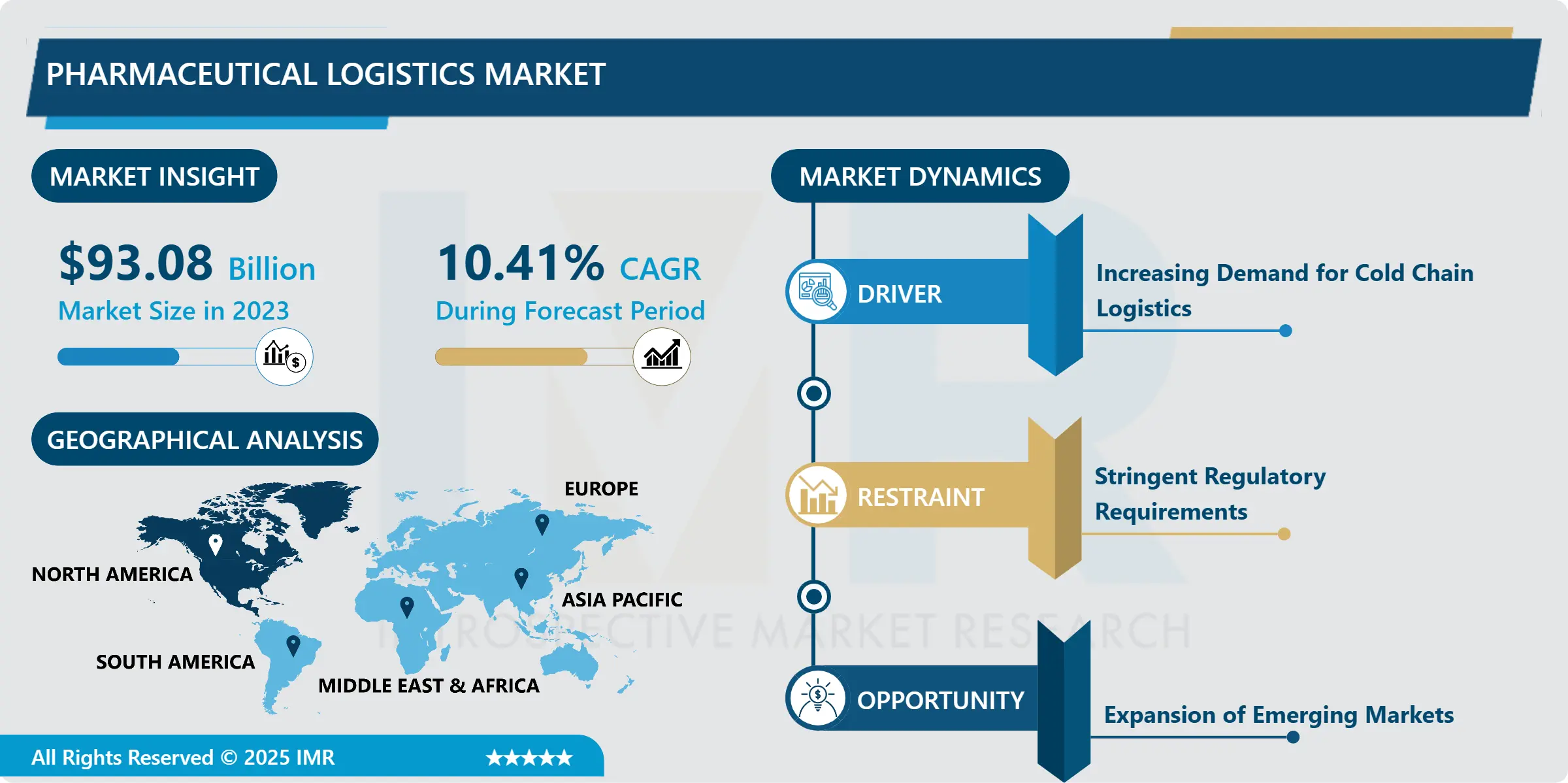
Pharmaceutical Logistics Market Size Was Valued at USD 93.08 Billion in 2023, and is Projected to Reach USD 226.95 Billion by 2032, Growing at a CAGR of 10.41% From 2024-2032.

IMR Group
Description
Pharmaceutical Logistics Market Synopsis:
Pharmaceutical Logistics Market Size Was Valued at USD 93.08 Billion in 2023, and is Projected to Reach USD 226.95 Billion by 2032, Growing at a CAGR of 10.41% From 2024-2032.
Pharmaceutical logistics market consequently can be defined as the surveillance and movement of the pharmaceutical products across the chain of manufacturers, distributors, pharmacies, hospitals or consumers. This market is crucial as it will enable those product’s safe and efficient delivery to their end-users, which include patients, hospitals, clinics, doctor’s offices and laboratories among others. It is important for the sector to abide by rules in regulating the flow of pharmaceutical products while at the same time applying technology measures in this process to ensure the quality of products is not compromised through technology measures like monitoring in real time and advance packaging.
Pharmaceutical logistics can be described as a well-defined sub-sector of logistics. They are involved in the storage, handling and delivery of various Pharmaceutical products which most at times demand certain temperatures in order to be effective. The market comprises products related to cold chain logistics, which is required for vaccines and biologic products, and non –Cold Chain Logistics for products not requiring temperature control.
Pharmaceutical logistics has thus emerged as a more important feature of the overall supply chain because of the global sourcing, regulatory demands, and entry of biologics and personalised medication. However, COVID 19 exposed the importance of efficient delivery of medications through the supply chain particularly the vaccine shipment across the globe.
Other technologies like IoT sensors, real time tracking, and blockchain for supply chain credibility are making a huge difference in the sector. It is especially important to maintain GDP and cold chain conditions for certain drugs in order to avoid loss of product, minimize waste, and protect the population’s health. Therefore, many pharma players or drug makers are now outsourcing logistics with third-party logistics or 3PL service providers who have understanding of specific business.
Pharmaceutical Logistics Market Trend Analysis:
Technological Advancements in Supply Chain Visibility
Supply chain visibility and increasing traceability levels in the pharmaceutical logistics market are one of the major trends. Again, with the help of the Internet of things the real-time tracking systems are getting industry standard in cold chain logistics that helps to track location and condition of the shipments in real-time. This means that temperature sensitive goods for example vaccines and biologics are kept within the desired temperature throughout the transit period.
Such developments give an increased visibility of the supply chain risk so as to give a response to disruptions that may occur. A growing number of organisations is also adopting blockchain technology in the sector to ensure secure exchange of information that cannot be altered among all the stakeholders involved in the transport and distribution of goods. This trend is useful for translating regulatory compliance to a higher level and increasing the effectiveness of pharmaceutical distribution.
Expansion of Emerging Markets
Consequently, the effect of growth of pharmaceuticals logistics in emerging markets remain a major opportunity within the pharmaceutical logistics market, especially in the Asia-Pacific, Latin America and African zones. With the development of healthcare system and availability of drugs and medical equipment, the demand for reasonable solutions for these industries, is growing. There is an increased production and use of pharmaceutical products in emerging markets alongside emerging contracts for cold and non- refrigerated temperature pharmaceutical logistics.
Number of international branded players in the global pharma industry and logistic players are being established in different regional structures and more strategies are being developed for linkages with regional players for better reach. This expansion into logistical markets with these characteristics represent a major source of growth for logistics providers able to accommodate the specific regulatory, environmental, and economic conditions within these regions.
Pharmaceutical Logistics Market Segment Analysis:
Pharmaceutical Logistics Market is Segmented on the basis of Type, Product, Component application, Procedure, and Region.
By Type, Non-Cold segment is expected to dominate the market during the forecast period
Segmentation of the pharmaceutical logistics market is done based on Cold chain and Non Cold chain logistics. Temperature controlled products are those products which require constant monitoring of their temperature such as vaccines, insulin and biologic products, hence it’s referred to as cold chain logistics. This segment demands corrugated and reefer containers, real-time temperature trackers, and packaging accessories.
On the other hand, Non cold chain logistics is the movement of pharmaceutical products that do not require refrigeration. This segment usually encompasses the movement of conventional medicines such as tablets, capsules and over the counter medicines. In contrast to cold chain logistic, however, non cold chain logistic entail equally strict procedure on handling to minimize product spoilage or contamination.
By Application, Chemical Pharma, segment expected to held the largest share
Market by application includes chemical pharma, bio-pharma, and specialized pharma segments. Chemical pharma deals with conventional medicines including tablets and capsules that may not need special handling, the cold chain. Leveraging regulatory compliance and smooth logistics solutions, the distribution process in this segment is not very complex.
Specialized pharma and bio pharma take more logistics since the products involved are sensitive in their nature. Bio-pharma products are cold sensitive, for instance biologics, and gene therapy thus some of them need to be shipped under a particular temperature. Specialized pharma often encompasses orphan drugs and a patient specific medicine where logistics of the drug has too be worked out very meticulously to ensure that it gets to the required destination in one piece and on time.
Pharmaceutical Logistics Market Regional Insights:
North America is Expected to Dominate the Market Over the Forecast period
North America is at the moment the market leader in pharmaceutical logistics due to such factors as sound health care delivery system, sophisticated pharma manufacturing, and adherence to standard practice. America and Canada are the chief customers of contract logistics manufacturers as well as providers in terms of innovative pharmaceuticals such as the new biologics and similar personalized medicines that require quite distinct forms of logistics.
It also has most of the leading global logistics providers, on expenditure on cold chain systems and solutions. Hence the crucial role of North American in pharmaceutical logistics, owing to increased emphasis on research and development, coupled with the strong norms of regulatory environment.
Active Key Players in the Pharmaceutical Logistics Market
DHL Supply Chain & Global Forwarding (Germany)
Kuehne + Nagel (Switzerland)
FedEx (United States)
United Parcel Service (United States)
DB Schenker (Germany)
CEVA Logistics (France)
DSV (Denmark)
Panalpina (Switzerland)
C.H. Robinson (United States)
Agility (Kuwait)
Expeditors International (United States)
Nippon Express (Japan)
Other Active Players
Chapter 1: Introduction
1.1 Scope and Coverage
Chapter 2:Executive Summary
Chapter 3: Market Landscape
3.1 Market Dynamics
3.1.1 Drivers
3.1.2 Restraints
3.1.3 Opportunities
3.1.4 Challenges
3.2 Market Trend Analysis
3.3 PESTLE Analysis
3.4 Porter’s Five Forces Analysis
3.5 Industry Value Chain Analysis
3.6 Ecosystem
3.7 Regulatory Landscape
3.8 Price Trend Analysis
3.9 Patent Analysis
3.10 Technology Evolution
3.11 Investment Pockets
3.12 Import-Export Analysis
Chapter 4: Pharmaceutical Logistics Market by Type
4.1 Pharmaceutical Logistics Market Snapshot and Growth Engine
4.2 Pharmaceutical Logistics Market Overview
4.3 Cold Chain Logistics
4.3.1 Introduction and Market Overview
4.3.2 Historic and Forecasted Market Size in Value USD and Volume Units (2017-2032F)
4.3.3 Key Market Trends, Growth Factors and Opportunities
4.3.4 Cold Chain Logistics: Geographic Segmentation Analysis
4.4 Non Cold Chain Logistics
4.4.1 Introduction and Market Overview
4.4.2 Historic and Forecasted Market Size in Value USD and Volume Units (2017-2032F)
4.4.3 Key Market Trends, Growth Factors and Opportunities
4.4.4 Non Cold Chain Logistics: Geographic Segmentation Analysis
Chapter 5: Pharmaceutical Logistics Market by Product
5.1 Pharmaceutical Logistics Market Snapshot and Growth Engine
5.2 Pharmaceutical Logistics Market Overview
5.3 Generic Drugs
5.3.1 Introduction and Market Overview
5.3.2 Historic and Forecasted Market Size in Value USD and Volume Units (2017-2032F)
5.3.3 Key Market Trends, Growth Factors and Opportunities
5.3.4 Generic Drugs: Geographic Segmentation Analysis
5.4 Branded Drugs
5.4.1 Introduction and Market Overview
5.4.2 Historic and Forecasted Market Size in Value USD and Volume Units (2017-2032F)
5.4.3 Key Market Trends, Growth Factors and Opportunities
5.4.4 Branded Drugs: Geographic Segmentation Analysis
Chapter 6: Pharmaceutical Logistics Market by Component
6.1 Pharmaceutical Logistics Market Snapshot and Growth Engine
6.2 Pharmaceutical Logistics Market Overview
6.3 Storage
6.3.1 Introduction and Market Overview
6.3.2 Historic and Forecasted Market Size in Value USD and Volume Units (2017-2032F)
6.3.3 Key Market Trends, Growth Factors and Opportunities
6.3.4 Storage: Geographic Segmentation Analysis
6.4 Transportation
6.4.1 Introduction and Market Overview
6.4.2 Historic and Forecasted Market Size in Value USD and Volume Units (2017-2032F)
6.4.3 Key Market Trends, Growth Factors and Opportunities
6.4.4 Transportation: Geographic Segmentation Analysis
6.5 Software
6.5.1 Introduction and Market Overview
6.5.2 Historic and Forecasted Market Size in Value USD and Volume Units (2017-2032F)
6.5.3 Key Market Trends, Growth Factors and Opportunities
6.5.4 Software: Geographic Segmentation Analysis
Chapter 7: Pharmaceutical Logistics Market by Procedure
7.1 Pharmaceutical Logistics Market Snapshot and Growth Engine
7.2 Pharmaceutical Logistics Market Overview
7.3 Picking
7.3.1 Introduction and Market Overview
7.3.2 Historic and Forecasted Market Size in Value USD and Volume Units (2017-2032F)
7.3.3 Key Market Trends, Growth Factors and Opportunities
7.3.4 Picking: Geographic Segmentation Analysis
7.4 Storage
7.4.1 Introduction and Market Overview
7.4.2 Historic and Forecasted Market Size in Value USD and Volume Units (2017-2032F)
7.4.3 Key Market Trends, Growth Factors and Opportunities
7.4.4 Storage: Geographic Segmentation Analysis
7.5 Retrieval Systems
7.5.1 Introduction and Market Overview
7.5.2 Historic and Forecasted Market Size in Value USD and Volume Units (2017-2032F)
7.5.3 Key Market Trends, Growth Factors and Opportunities
7.5.4 Retrieval Systems: Geographic Segmentation Analysis
7.6 Handling Systems
7.6.1 Introduction and Market Overview
7.6.2 Historic and Forecasted Market Size in Value USD and Volume Units (2017-2032F)
7.6.3 Key Market Trends, Growth Factors and Opportunities
7.6.4 Handling Systems: Geographic Segmentation Analysis
Chapter 8: Pharmaceutical Logistics Market by Application
8.1 Pharmaceutical Logistics Market Snapshot and Growth Engine
8.2 Pharmaceutical Logistics Market Overview
8.3 Chemical Pharma
8.3.1 Introduction and Market Overview
8.3.2 Historic and Forecasted Market Size in Value USD and Volume Units (2017-2032F)
8.3.3 Key Market Trends, Growth Factors and Opportunities
8.3.4 Chemical Pharma: Geographic Segmentation Analysis
8.4 Bio-Pharma
8.4.1 Introduction and Market Overview
8.4.2 Historic and Forecasted Market Size in Value USD and Volume Units (2017-2032F)
8.4.3 Key Market Trends, Growth Factors and Opportunities
8.4.4 Bio-Pharma: Geographic Segmentation Analysis
8.5 Specialized Pharma
8.5.1 Introduction and Market Overview
8.5.2 Historic and Forecasted Market Size in Value USD and Volume Units (2017-2032F)
8.5.3 Key Market Trends, Growth Factors and Opportunities
8.5.4 Specialized Pharma: Geographic Segmentation Analysis
Chapter 9: Company Profiles and Competitive Analysis
9.1 Competitive Landscape
9.1.1 Competitive Benchmarking
9.1.2 Pharmaceutical Logistics Market Share by Manufacturer (2023)
9.1.3 Industry BCG Matrix
9.1.4 Heat Map Analysis
9.1.5 Mergers and Acquisitions
9.2 DHL SUPPLY CHAIN & GLOBAL FORWARDING (GERMANY)
9.2.1 Company Overview
9.2.2 Key Executives
9.2.3 Company Snapshot
9.2.4 Role of the Company in the Market
9.2.5 Sustainability and Social Responsibility
9.2.6 Operating Business Segments
9.2.7 Product Portfolio
9.2.8 Business Performance
9.2.9 Key Strategic Moves and Recent Developments
9.2.10 SWOT Analysis
9.3 KUEHNE + NAGEL (SWITZERLAND)
9.4 FEDEX (UNITED STATES)
9.5 UNITED PARCEL SERVICE (UNITED STATES)
9.6 DB SCHENKER (GERMANY)
9.7 CEVA LOGISTICS (FRANCE)
9.8 DSV (DENMARK)
9.9 PANALPINA (SWITZERLAND)
9.10 C.H. ROBINSON (UNITED STATES)
9.11 AGILITY (KUWAIT)
9.12 EXPEDITORS INTERNATIONAL (UNITED STATES)
9.13 NIPPON EXPRESS (JAPAN)
9.14 OTHER ACTIVE PLAYERS
Chapter 10: Global Pharmaceutical Logistics Market By Region
10.1 Overview
10.2. North America Pharmaceutical Logistics Market
10.2.1 Key Market Trends, Growth Factors and Opportunities
10.2.2 Top Key Companies
10.2.3 Historic and Forecasted Market Size by Segments
10.2.4 Historic and Forecasted Market Size By Type
10.2.4.1 Cold Chain Logistics
10.2.4.2 Non Cold Chain Logistics
10.2.5 Historic and Forecasted Market Size By Product
10.2.5.1 Generic Drugs
10.2.5.2 Branded Drugs
10.2.6 Historic and Forecasted Market Size By Component
10.2.6.1 Storage
10.2.6.2 Transportation
10.2.6.3 Software
10.2.7 Historic and Forecasted Market Size By Procedure
10.2.7.1 Picking
10.2.7.2 Storage
10.2.7.3 Retrieval Systems
10.2.7.4 Handling Systems
10.2.8 Historic and Forecasted Market Size By Application
10.2.8.1 Chemical Pharma
10.2.8.2 Bio-Pharma
10.2.8.3 Specialized Pharma
10.2.9 Historic and Forecast Market Size by Country
10.2.9.1 US
10.2.9.2 Canada
10.2.9.3 Mexico
10.3. Eastern Europe Pharmaceutical Logistics Market
10.3.1 Key Market Trends, Growth Factors and Opportunities
10.3.2 Top Key Companies
10.3.3 Historic and Forecasted Market Size by Segments
10.3.4 Historic and Forecasted Market Size By Type
10.3.4.1 Cold Chain Logistics
10.3.4.2 Non Cold Chain Logistics
10.3.5 Historic and Forecasted Market Size By Product
10.3.5.1 Generic Drugs
10.3.5.2 Branded Drugs
10.3.6 Historic and Forecasted Market Size By Component
10.3.6.1 Storage
10.3.6.2 Transportation
10.3.6.3 Software
10.3.7 Historic and Forecasted Market Size By Procedure
10.3.7.1 Picking
10.3.7.2 Storage
10.3.7.3 Retrieval Systems
10.3.7.4 Handling Systems
10.3.8 Historic and Forecasted Market Size By Application
10.3.8.1 Chemical Pharma
10.3.8.2 Bio-Pharma
10.3.8.3 Specialized Pharma
10.3.9 Historic and Forecast Market Size by Country
10.3.9.1 Russia
10.3.9.2 Bulgaria
10.3.9.3 The Czech Republic
10.3.9.4 Hungary
10.3.9.5 Poland
10.3.9.6 Romania
10.3.9.7 Rest of Eastern Europe
10.4. Western Europe Pharmaceutical Logistics Market
10.4.1 Key Market Trends, Growth Factors and Opportunities
10.4.2 Top Key Companies
10.4.3 Historic and Forecasted Market Size by Segments
10.4.4 Historic and Forecasted Market Size By Type
10.4.4.1 Cold Chain Logistics
10.4.4.2 Non Cold Chain Logistics
10.4.5 Historic and Forecasted Market Size By Product
10.4.5.1 Generic Drugs
10.4.5.2 Branded Drugs
10.4.6 Historic and Forecasted Market Size By Component
10.4.6.1 Storage
10.4.6.2 Transportation
10.4.6.3 Software
10.4.7 Historic and Forecasted Market Size By Procedure
10.4.7.1 Picking
10.4.7.2 Storage
10.4.7.3 Retrieval Systems
10.4.7.4 Handling Systems
10.4.8 Historic and Forecasted Market Size By Application
10.4.8.1 Chemical Pharma
10.4.8.2 Bio-Pharma
10.4.8.3 Specialized Pharma
10.4.9 Historic and Forecast Market Size by Country
10.4.9.1 Germany
10.4.9.2 UK
10.4.9.3 France
10.4.9.4 The Netherlands
10.4.9.5 Italy
10.4.9.6 Spain
10.4.9.7 Rest of Western Europe
10.5. Asia Pacific Pharmaceutical Logistics Market
10.5.1 Key Market Trends, Growth Factors and Opportunities
10.5.2 Top Key Companies
10.5.3 Historic and Forecasted Market Size by Segments
10.5.4 Historic and Forecasted Market Size By Type
10.5.4.1 Cold Chain Logistics
10.5.4.2 Non Cold Chain Logistics
10.5.5 Historic and Forecasted Market Size By Product
10.5.5.1 Generic Drugs
10.5.5.2 Branded Drugs
10.5.6 Historic and Forecasted Market Size By Component
10.5.6.1 Storage
10.5.6.2 Transportation
10.5.6.3 Software
10.5.7 Historic and Forecasted Market Size By Procedure
10.5.7.1 Picking
10.5.7.2 Storage
10.5.7.3 Retrieval Systems
10.5.7.4 Handling Systems
10.5.8 Historic and Forecasted Market Size By Application
10.5.8.1 Chemical Pharma
10.5.8.2 Bio-Pharma
10.5.8.3 Specialized Pharma
10.5.9 Historic and Forecast Market Size by Country
10.5.9.1 China
10.5.9.2 India
10.5.9.3 Japan
10.5.9.4 South Korea
10.5.9.5 Malaysia
10.5.9.6 Thailand
10.5.9.7 Vietnam
10.5.9.8 The Philippines
10.5.9.9 Australia
10.5.9.10 New Zealand
10.5.9.11 Rest of APAC
10.6. Middle East & Africa Pharmaceutical Logistics Market
10.6.1 Key Market Trends, Growth Factors and Opportunities
10.6.2 Top Key Companies
10.6.3 Historic and Forecasted Market Size by Segments
10.6.4 Historic and Forecasted Market Size By Type
10.6.4.1 Cold Chain Logistics
10.6.4.2 Non Cold Chain Logistics
10.6.5 Historic and Forecasted Market Size By Product
10.6.5.1 Generic Drugs
10.6.5.2 Branded Drugs
10.6.6 Historic and Forecasted Market Size By Component
10.6.6.1 Storage
10.6.6.2 Transportation
10.6.6.3 Software
10.6.7 Historic and Forecasted Market Size By Procedure
10.6.7.1 Picking
10.6.7.2 Storage
10.6.7.3 Retrieval Systems
10.6.7.4 Handling Systems
10.6.8 Historic and Forecasted Market Size By Application
10.6.8.1 Chemical Pharma
10.6.8.2 Bio-Pharma
10.6.8.3 Specialized Pharma
10.6.9 Historic and Forecast Market Size by Country
10.6.9.1 Turkiye
10.6.9.2 Bahrain
10.6.9.3 Kuwait
10.6.9.4 Saudi Arabia
10.6.9.5 Qatar
10.6.9.6 UAE
10.6.9.7 Israel
10.6.9.8 South Africa
10.7. South America Pharmaceutical Logistics Market
10.7.1 Key Market Trends, Growth Factors and Opportunities
10.7.2 Top Key Companies
10.7.3 Historic and Forecasted Market Size by Segments
10.7.4 Historic and Forecasted Market Size By Type
10.7.4.1 Cold Chain Logistics
10.7.4.2 Non Cold Chain Logistics
10.7.5 Historic and Forecasted Market Size By Product
10.7.5.1 Generic Drugs
10.7.5.2 Branded Drugs
10.7.6 Historic and Forecasted Market Size By Component
10.7.6.1 Storage
10.7.6.2 Transportation
10.7.6.3 Software
10.7.7 Historic and Forecasted Market Size By Procedure
10.7.7.1 Picking
10.7.7.2 Storage
10.7.7.3 Retrieval Systems
10.7.7.4 Handling Systems
10.7.8 Historic and Forecasted Market Size By Application
10.7.8.1 Chemical Pharma
10.7.8.2 Bio-Pharma
10.7.8.3 Specialized Pharma
10.7.9 Historic and Forecast Market Size by Country
10.7.9.1 Brazil
10.7.9.2 Argentina
10.7.9.3 Rest of SA
Chapter 11 Analyst Viewpoint and Conclusion
11.1 Recommendations and Concluding Analysis
11.2 Potential Market Strategies
Chapter 12 Research Methodology
12.1 Research Process
12.2 Primary Research
12.3 Secondary Research
Q1: What would be the forecast period in the Pharmaceutical Logistics Market research report?
A1: The forecast period in the Pharmaceutical Logistics Market research report is 2024-2032.
Q2: Who are the key players in the Pharmaceutical Logistics Market?
A2: DHL Supply Chain & Global Forwarding (Germany), Kuehne + Nagel (Switzerland), FedEx (United States), United Parcel Service (United States), DB Schenker (Germany), CEVA Logistics (France), DSV (Denmark), Panalpina (Switzerland), C.H. Robinson (United States), Agility (Kuwait), Expeditors International (United States), Nippon Express (Japan), and Other Active Players
Q3: What are the segments of the Pharmaceutical Logistics Market?
A3: The Pharmaceutical Logistics Market is segmented into Type, Product, Component, Application, procedure and region. By Type, the market is categorized into Cold Chain Logistics, Non-Cold Chain Logistics. By Product, the market is categorized into Generic Drugs, Branded Drugs. By Component, the market is categorized into Storage, Transportation, and Software. By Procedure, Picking, Storage, Retrieval Systems, Handling Systems. By Application, the market is categorized into Chemical Pharma, Bio-Pharma, and Specialized Pharma. By region, it is analyzed across North America (U.S., Canada, Mexico), Eastern Europe (Russia, Bulgaria, The Czech Republic, Hungary, Poland, Romania, Rest of Eastern Europe), Western Europe (Germany, UK, France, Netherlands, Italy, Spain, Rest of Western Europe), Asia Pacific (China, India, Japan, South Korea, Malaysia, Thailand, Vietnam, The Philippines, Australia, New Zealand, Rest of APAC), Middle East & Africa (Turkiye, Bahrain, Kuwait, Saudi Arabia, Qatar, UAE, Israel, South Africa), South America (Brazil, Argentina, Rest of SA).
Q4: What is the Pharmaceutical Logistics Market?
A4: Pharmaceutical logistics market consequently can be defined as the surveillance and movement of the pharmaceutical products across the chain of manufacturers, distributors, pharmacies, hospitals or consumers. This market is crucial as it will enable those product’s safe and efficient delivery to their end-users, which include patients, hospitals, clinics, doctor’s offices and laboratories among others. It is important for the sector to abide by rules in regulating the flow of pharmaceutical products while at the same time applying technology measures in this process to ensure the quality of products is not compromised through technology measures like monitoring in real time and advance packaging.
Q5: How big is the Pharmaceutical Logistics Market?
A5: Pharmaceutical Logistics Market Size Was Valued at USD 93.08 Billion in 2023, and is Projected to Reach USD 226.95 Billion by 2032, Growing at a CAGR of 10.41% From 2024-2032.
How to Buy a Report from eminsights.jp
On the product page, choose the license you want: Single-User License, Multi-User License or Enterprise License.
If you required report in your native language, then you can click on Translated Report button and fill out the form with report name and language you want, then our team will contact you as soon as possible.
Click the Buy Now button.
You will be redirected to the checkout page. Enter your company details and payment information.
Click Place Order to complete the purchase.
Confirmation: You’ll receive an order confirmation and our team will contact you shortly with your ordered report.
If you have any questions, fill out the contact form below or email us at bizdev@eminsights.net.
Thank you for choosing eminsights.jp!