Stay Ahead in Fast-Growing Economies.
Browse Reports Now
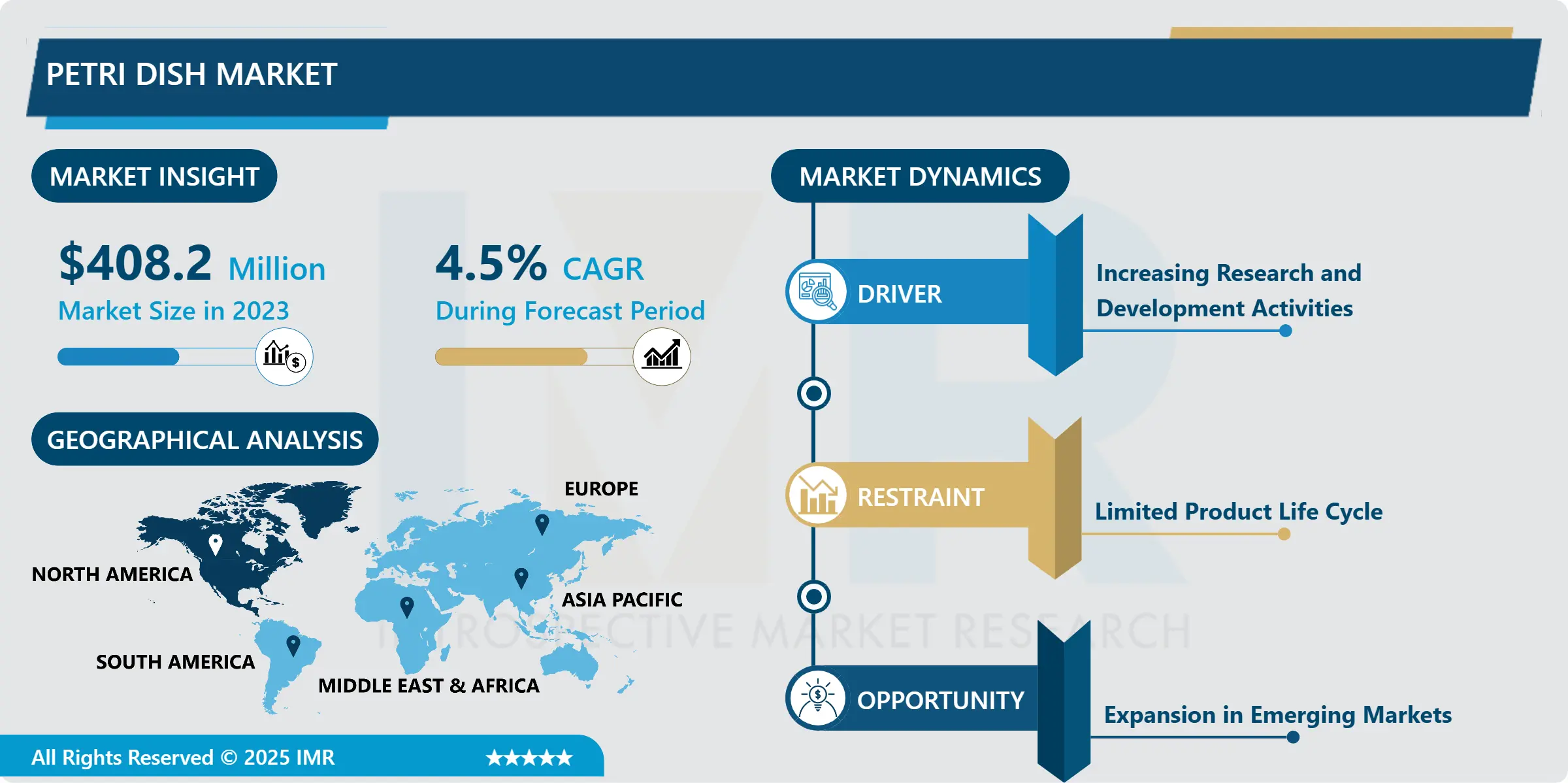
Petri Dish Market Size, Trends, and Forecast Analysis (2024-2032)
The market for petri dishes involves the manufacturing and distribution of shallow, flat dishes made of glass or plastic.

IMR Group
Description
Petri Dish Market Synopsis:
Petri Dish Market Size Was Valued at USD 408.2 Million in 2023, and is Projected to Reach USD 606.62 Million by 2032, Growing at a CAGR of 4.5% From 2024-2032.
The market for petri dishes involves the manufacturing and distribution of shallow, flat dishes made of glass or plastic. Mainly, these are used inside laboratories for culturing microorganisms, cell cultures, and varying biological experiments. Using the petri dishes, scientists can analyze the growth and behavior of different biological specimens in a controlled environment, making them inevitable tools in microbiology, environmental testing, and pharmaceutical research.
As active research and development in biotechnology, pharmaceuticals, and environmental sciences have sparked the growth of the Petri dish market for several decades, the fact that infectious diseases have been growing increasingly, followed by an increased demand for diagnostic tools and equipment of superior quality, has created a thrust for high-quality Petri dishes in clinical laboratories. Moreover, increased food safety and quality demand has led the field of testing in the food and beverage sectors to look further into the market demand for Petri dishes. As hospitals transform and research methodology changes, the market also evolves with the tides and offers innovation, such as biodegradable dishes that comply with the sustainability movement of laboratory practices.
The high demand for Asia-Pacific and Latin America is pushing the market for Petri dishes. The increasing numbers of educational institutions and research organizations in the aforementioned countries have increased the demands of laboratories for their laboratory equipment, supplies, and also for Petri dishes. Further, manufacturing technologies have advanced to improve the performance of produced Petri dishes for more applications, including cell culture, environmental monitoring, and microbiological studies. The market for personalized medicine and regenerative therapies also throws light on the increasing importance of in vitro conditions associated with the use of Petri dishes that can be afforded to support the complexities of experimental designs that could support growth.
Petri Dish Market Trend Analysis:
Shift Towards Biodegradable Petri Dishes
Among the trends developed by the growing awareness of environmental sustainability in the Petri dish market is the uptake of biodegradable Petri dishes. Such dishes are made from naturally decomposable material, free from environmental impact generated by traditional plastic options. With the regulatory bodies and research institutions now on the road to emphasizing sustainable practices in laboratories, a commendable demand for biodegradable Petri dishes has emerged. Besides that, more pressure from the scientific community has been increasing, given the need for a reduction in plastic waste. As a result, manufacturers have been compelled to be innovative and come up with environment-friendly alternatives.
Many companies respond to these changes by making considerable investments in research and development to develop biodegradable materials under high standards of requirements in laboratory application. Such biodegradable material should exhibit sterility, strength, and compatibility with different testing procedures in addition to having evident environmental benefits. Implementation of these biodegradable Petri dishes is not just aligned to the approach of corporate social responsibility but also meets the needs of socially and environmentally aware consumers and researchers. Finally, they will mold the future of the market for the Petri dishes.
Expansion in Emerging Markets
The growth opportunity in the Petri dish market is significant in the emerging markets. Industrialization and rapid urbanization in the Asia-Pacific and Latin American markets are key drivers of investment in healthcare infrastructure and laboratory capabilities. As these markets continue to grow, demand for laboratory supplies, such as Petri dishes, will significantly increase. Increasing research and development activity in association with growing interest of people in biotechnology and pharmaceutical products may lead to regions becoming all the more important leaders in the global Petri dish market.
Local producers may partner with overseas corporations to introduce high-tech laboratory equipment in the respective regions. A business may be able to make entry into a new developing market easier using existing distribution networks as well as the knowledge of markets already acquired. This opportunity serves not only in building up the market presence but also in the growth of the Petri dish industry, where key focus will be made on serving varied applications in diverse scientific disciplines.
Petri Dish Market Segment Analysis:
Petri Dish Market is Segmented on the basis of Material, Size, Type, Application, End User, and Region.
By Type, Standard Petri Dishes segment is expected to dominate the market during the forecast period
The market for Petri dish is segmented into various types such as standard Petri dishes, dual-chamber Petri dishes, biodegradable ones, and other types. Standard Petri dishes are extremely in use in the laboratories for the culture of microorganisms and for carrying out various experiments. These standard ones are versatile and also inexpensive enough to be widely used in many research setups. Dual chamber Petri dishes offer a better capability to study the interaction between different microbial species or cell types, which makes possible some very complex experimental designs.
The second pressure from sustainability has set up biodegradable Petri dishes popular among environmentally responsible researchers and institutions. Biodegradable Petri dishes based on the materials that naturally decompose have aligned with global efforts at reducing plastic waste in laboratory environments. Increasing environmental consciousness should lead to investment on the part of manufacturers with a focus toward developing biodegradable alternatives that align with significant scientific research’s stringent standards while at the same time having a minimum ecological footprint.
By Application, Microbiology segment expected to held the largest share
In the application varieties of petri dish markets include mainly: microbiology, cell culture, environmental testing, food and beverage testing, pharmaceutical applications, among others. In the field of microbiology, there is a need to have petri dishes in the process of isolating and identifying microorganisms, which are further analyzed regarding their characteristics and behavior. For this reason, in the use of petri dishes, cell culture applications make use of controlled environments for growing and maintaining cells since this can lead to breaking research in medical fields and biotechnology.
Environmental testing and food and beverage testing are other significant applications of Petri dishes. In environmental research, they are utilized to assess samples of soil and water for microbial contamination, and within the food industry, they play a very significant role in safety and regulation with health inputs. The design and testing of drugs could not be carried out without Petri dishes. These applications remain to this day part of a broad area of science, and in such a scenario, the Petri dish market will continue growing due to research innovations and regulatory needs.
Petri Dish Market Regional Insights:
North America is Expected to Dominate the Market Over the Forecast period
North America currently accounts for the largest share in the market for Petri dishes, mainly because of the maturity of its healthcare infrastructure and strong focus on research and development. Also contributing are the significant biotechnology and pharmaceutical companies set up in the region. The region boasts of unparalleled investment in scientific research, with several institutions focused on innovative research in microbiology, cell biology, and environmental sciences. This concentration of resources has led to high demands for laboratory supplies with particular focus on the use of petri dishes especially since researchers come out with new diagnostic tools and therapeutic solutions.
The stringent quality norms relating to laboratory products in North America also increase demand for reliable Petri dishes. Furthermore, awareness about sustainability has even impacted the purchasing decision such that laboratories have started sourcing products that meet biodegradable options which are green initiatives. The North American Petri dish market is built to take off on the heels of its technological advancements and sustainability during its future growth periods.
Active Key Players in the Petri Dish Market:
Thermo Fisher Scientific (USA)
Corning Incorporated (USA)
BD (Becton, Dickinson and Company) (USA)
VWR International (USA)
Sartorius AG (Germany)
Merck Group (Germany)
Bio-Rad Laboratories (USA)
Greiner Bio-One International GmbH (Germany)
Eppendorf AG (Germany)
Falcon (Becton, Dickinson and Company) (USA)
Miltenyi Biotec (Germany)
Nunc (Thermo Fisher Scientific) (USA)
Other Active Players
Key Industry Developments in the Petri Dish Market:
In May 2023, Avantor, Inc., collaborated with Labguru, a research-to-production platform for leading global pharma, national research institutes, and others, aiming to provide high-quality products at the lab bench.
Chapter 1: Introduction
1.1 Scope and Coverage
Chapter 2:Executive Summary
Chapter 3: Market Landscape
3.1 Market Dynamics
3.1.1 Drivers
3.1.2 Restraints
3.1.3 Opportunities
3.1.4 Challenges
3.2 Market Trend Analysis
3.3 PESTLE Analysis
3.4 Porter’s Five Forces Analysis
3.5 Industry Value Chain Analysis
3.6 Ecosystem
3.7 Regulatory Landscape
3.8 Price Trend Analysis
3.9 Patent Analysis
3.10 Technology Evolution
3.11 Investment Pockets
3.12 Import-Export Analysis
Chapter 4: Petri Dish Market by Material
4.1 Petri Dish Market Snapshot and Growth Engine
4.2 Petri Dish Market Overview
4.3 Polypropylene
4.3.1 Introduction and Market Overview
4.3.2 Historic and Forecasted Market Size in Value USD and Volume Units (2017-2032F)
4.3.3 Key Market Trends, Growth Factors and Opportunities
4.3.4 Polypropylene: Geographic Segmentation Analysis
4.4 Polystyrene
4.4.1 Introduction and Market Overview
4.4.2 Historic and Forecasted Market Size in Value USD and Volume Units (2017-2032F)
4.4.3 Key Market Trends, Growth Factors and Opportunities
4.4.4 Polystyrene: Geographic Segmentation Analysis
4.5 Glass
4.5.1 Introduction and Market Overview
4.5.2 Historic and Forecasted Market Size in Value USD and Volume Units (2017-2032F)
4.5.3 Key Market Trends, Growth Factors and Opportunities
4.5.4 Glass: Geographic Segmentation Analysis
4.6 Others
4.6.1 Introduction and Market Overview
4.6.2 Historic and Forecasted Market Size in Value USD and Volume Units (2017-2032F)
4.6.3 Key Market Trends, Growth Factors and Opportunities
4.6.4 Others: Geographic Segmentation Analysis
Chapter 5: Petri Dish Market by Type
5.1 Petri Dish Market Snapshot and Growth Engine
5.2 Petri Dish Market Overview
5.3 Standard Petri Dishes
5.3.1 Introduction and Market Overview
5.3.2 Historic and Forecasted Market Size in Value USD and Volume Units (2017-2032F)
5.3.3 Key Market Trends, Growth Factors and Opportunities
5.3.4 Standard Petri Dishes: Geographic Segmentation Analysis
5.4 Dual Chamber Petri Dishes
5.4.1 Introduction and Market Overview
5.4.2 Historic and Forecasted Market Size in Value USD and Volume Units (2017-2032F)
5.4.3 Key Market Trends, Growth Factors and Opportunities
5.4.4 Dual Chamber Petri Dishes: Geographic Segmentation Analysis
5.5 Biodegradable Petri Dishes
5.5.1 Introduction and Market Overview
5.5.2 Historic and Forecasted Market Size in Value USD and Volume Units (2017-2032F)
5.5.3 Key Market Trends, Growth Factors and Opportunities
5.5.4 Biodegradable Petri Dishes: Geographic Segmentation Analysis
5.6 Others
5.6.1 Introduction and Market Overview
5.6.2 Historic and Forecasted Market Size in Value USD and Volume Units (2017-2032F)
5.6.3 Key Market Trends, Growth Factors and Opportunities
5.6.4 Others: Geographic Segmentation Analysis
Chapter 6: Petri Dish Market by Size
6.1 Petri Dish Market Snapshot and Growth Engine
6.2 Petri Dish Market Overview
6.3 Small (up to 60 mm)
6.3.1 Introduction and Market Overview
6.3.2 Historic and Forecasted Market Size in Value USD and Volume Units (2017-2032F)
6.3.3 Key Market Trends, Growth Factors and Opportunities
6.3.4 Small (up to 60 mm): Geographic Segmentation Analysis
6.4 Medium (60 mm – 100 mm)
6.4.1 Introduction and Market Overview
6.4.2 Historic and Forecasted Market Size in Value USD and Volume Units (2017-2032F)
6.4.3 Key Market Trends, Growth Factors and Opportunities
6.4.4 Medium (60 mm – 100 mm): Geographic Segmentation Analysis
6.5 Large (above 100 mm)
6.5.1 Introduction and Market Overview
6.5.2 Historic and Forecasted Market Size in Value USD and Volume Units (2017-2032F)
6.5.3 Key Market Trends, Growth Factors and Opportunities
6.5.4 Large (above 100 mm): Geographic Segmentation Analysis
Chapter 7: Petri Dish Market by Application
7.1 Petri Dish Market Snapshot and Growth Engine
7.2 Petri Dish Market Overview
7.3 Microbiology
7.3.1 Introduction and Market Overview
7.3.2 Historic and Forecasted Market Size in Value USD and Volume Units (2017-2032F)
7.3.3 Key Market Trends, Growth Factors and Opportunities
7.3.4 Microbiology: Geographic Segmentation Analysis
7.4 Cell Culture
7.4.1 Introduction and Market Overview
7.4.2 Historic and Forecasted Market Size in Value USD and Volume Units (2017-2032F)
7.4.3 Key Market Trends, Growth Factors and Opportunities
7.4.4 Cell Culture: Geographic Segmentation Analysis
7.5 Environmental Testing
7.5.1 Introduction and Market Overview
7.5.2 Historic and Forecasted Market Size in Value USD and Volume Units (2017-2032F)
7.5.3 Key Market Trends, Growth Factors and Opportunities
7.5.4 Environmental Testing: Geographic Segmentation Analysis
7.6 Food and Beverage Testing
7.6.1 Introduction and Market Overview
7.6.2 Historic and Forecasted Market Size in Value USD and Volume Units (2017-2032F)
7.6.3 Key Market Trends, Growth Factors and Opportunities
7.6.4 Food and Beverage Testing: Geographic Segmentation Analysis
7.7 Pharmaceutical Applications
7.7.1 Introduction and Market Overview
7.7.2 Historic and Forecasted Market Size in Value USD and Volume Units (2017-2032F)
7.7.3 Key Market Trends, Growth Factors and Opportunities
7.7.4 Pharmaceutical Applications: Geographic Segmentation Analysis
7.8 Others
7.8.1 Introduction and Market Overview
7.8.2 Historic and Forecasted Market Size in Value USD and Volume Units (2017-2032F)
7.8.3 Key Market Trends, Growth Factors and Opportunities
7.8.4 Others: Geographic Segmentation Analysis
Chapter 8: Petri Dish Market by End User
8.1 Petri Dish Market Snapshot and Growth Engine
8.2 Petri Dish Market Overview
8.3 Academic and Research Institutes
8.3.1 Introduction and Market Overview
8.3.2 Historic and Forecasted Market Size in Value USD and Volume Units (2017-2032F)
8.3.3 Key Market Trends, Growth Factors and Opportunities
8.3.4 Academic and Research Institutes: Geographic Segmentation Analysis
8.4 Pharmaceutical and Biotechnology Companies
8.4.1 Introduction and Market Overview
8.4.2 Historic and Forecasted Market Size in Value USD and Volume Units (2017-2032F)
8.4.3 Key Market Trends, Growth Factors and Opportunities
8.4.4 Pharmaceutical and Biotechnology Companies: Geographic Segmentation Analysis
8.5 Clinical Laboratories
8.5.1 Introduction and Market Overview
8.5.2 Historic and Forecasted Market Size in Value USD and Volume Units (2017-2032F)
8.5.3 Key Market Trends, Growth Factors and Opportunities
8.5.4 Clinical Laboratories: Geographic Segmentation Analysis
8.6 Hospitals
8.6.1 Introduction and Market Overview
8.6.2 Historic and Forecasted Market Size in Value USD and Volume Units (2017-2032F)
8.6.3 Key Market Trends, Growth Factors and Opportunities
8.6.4 Hospitals: Geographic Segmentation Analysis
8.7 Others
8.7.1 Introduction and Market Overview
8.7.2 Historic and Forecasted Market Size in Value USD and Volume Units (2017-2032F)
8.7.3 Key Market Trends, Growth Factors and Opportunities
8.7.4 Others: Geographic Segmentation Analysis
Chapter 9: Company Profiles and Competitive Analysis
9.1 Competitive Landscape
9.1.1 Competitive Benchmarking
9.1.2 Petri Dish Market Share by Manufacturer (2023)
9.1.3 Industry BCG Matrix
9.1.4 Heat Map Analysis
9.1.5 Mergers and Acquisitions
9.2 THERMO FISHER SCIENTIFIC (USA)
9.2.1 Company Overview
9.2.2 Key Executives
9.2.3 Company Snapshot
9.2.4 Role of the Company in the Market
9.2.5 Sustainability and Social Responsibility
9.2.6 Operating Business Segments
9.2.7 Product Portfolio
9.2.8 Business Performance
9.2.9 Key Strategic Moves and Recent Developments
9.2.10 SWOT Analysis
9.3 CORNING INCORPORATED (USA)
9.4 BD (BECTON
9.5 DICKINSON AND COMPANY) (USA)
9.6 VWR INTERNATIONAL (USA)
9.7 SARTORIUS AG (GERMANY)
9.8 MERCK GROUP (GERMANY)
9.9 BIO-RAD LABORATORIES (USA)
9.10 GREINER BIO-ONE INTERNATIONAL GMBH (GERMANY)
9.11 EPPENDORF AG (GERMANY)
9.12 FALCON (BECTON
9.13 DICKINSON AND COMPANY) (USA)
9.14 MILTENYI BIOTEC (GERMANY)
9.15 NUNC (THERMO FISHER SCIENTIFIC) (USA)
9.16 OTHER ACTIVE PLAYERS
Chapter 10: Global Petri Dish Market By Region
10.1 Overview
10.2. North America Petri Dish Market
10.2.1 Key Market Trends, Growth Factors and Opportunities
10.2.2 Top Key Companies
10.2.3 Historic and Forecasted Market Size by Segments
10.2.4 Historic and Forecasted Market Size By Material
10.2.4.1 Polypropylene
10.2.4.2 Polystyrene
10.2.4.3 Glass
10.2.4.4 Others
10.2.5 Historic and Forecasted Market Size By Type
10.2.5.1 Standard Petri Dishes
10.2.5.2 Dual Chamber Petri Dishes
10.2.5.3 Biodegradable Petri Dishes
10.2.5.4 Others
10.2.6 Historic and Forecasted Market Size By Size
10.2.6.1 Small (up to 60 mm)
10.2.6.2 Medium (60 mm – 100 mm)
10.2.6.3 Large (above 100 mm)
10.2.7 Historic and Forecasted Market Size By Application
10.2.7.1 Microbiology
10.2.7.2 Cell Culture
10.2.7.3 Environmental Testing
10.2.7.4 Food and Beverage Testing
10.2.7.5 Pharmaceutical Applications
10.2.7.6 Others
10.2.8 Historic and Forecasted Market Size By End User
10.2.8.1 Academic and Research Institutes
10.2.8.2 Pharmaceutical and Biotechnology Companies
10.2.8.3 Clinical Laboratories
10.2.8.4 Hospitals
10.2.8.5 Others
10.2.9 Historic and Forecast Market Size by Country
10.2.9.1 US
10.2.9.2 Canada
10.2.9.3 Mexico
10.3. Eastern Europe Petri Dish Market
10.3.1 Key Market Trends, Growth Factors and Opportunities
10.3.2 Top Key Companies
10.3.3 Historic and Forecasted Market Size by Segments
10.3.4 Historic and Forecasted Market Size By Material
10.3.4.1 Polypropylene
10.3.4.2 Polystyrene
10.3.4.3 Glass
10.3.4.4 Others
10.3.5 Historic and Forecasted Market Size By Type
10.3.5.1 Standard Petri Dishes
10.3.5.2 Dual Chamber Petri Dishes
10.3.5.3 Biodegradable Petri Dishes
10.3.5.4 Others
10.3.6 Historic and Forecasted Market Size By Size
10.3.6.1 Small (up to 60 mm)
10.3.6.2 Medium (60 mm – 100 mm)
10.3.6.3 Large (above 100 mm)
10.3.7 Historic and Forecasted Market Size By Application
10.3.7.1 Microbiology
10.3.7.2 Cell Culture
10.3.7.3 Environmental Testing
10.3.7.4 Food and Beverage Testing
10.3.7.5 Pharmaceutical Applications
10.3.7.6 Others
10.3.8 Historic and Forecasted Market Size By End User
10.3.8.1 Academic and Research Institutes
10.3.8.2 Pharmaceutical and Biotechnology Companies
10.3.8.3 Clinical Laboratories
10.3.8.4 Hospitals
10.3.8.5 Others
10.3.9 Historic and Forecast Market Size by Country
10.3.9.1 Russia
10.3.9.2 Bulgaria
10.3.9.3 The Czech Republic
10.3.9.4 Hungary
10.3.9.5 Poland
10.3.9.6 Romania
10.3.9.7 Rest of Eastern Europe
10.4. Western Europe Petri Dish Market
10.4.1 Key Market Trends, Growth Factors and Opportunities
10.4.2 Top Key Companies
10.4.3 Historic and Forecasted Market Size by Segments
10.4.4 Historic and Forecasted Market Size By Material
10.4.4.1 Polypropylene
10.4.4.2 Polystyrene
10.4.4.3 Glass
10.4.4.4 Others
10.4.5 Historic and Forecasted Market Size By Type
10.4.5.1 Standard Petri Dishes
10.4.5.2 Dual Chamber Petri Dishes
10.4.5.3 Biodegradable Petri Dishes
10.4.5.4 Others
10.4.6 Historic and Forecasted Market Size By Size
10.4.6.1 Small (up to 60 mm)
10.4.6.2 Medium (60 mm – 100 mm)
10.4.6.3 Large (above 100 mm)
10.4.7 Historic and Forecasted Market Size By Application
10.4.7.1 Microbiology
10.4.7.2 Cell Culture
10.4.7.3 Environmental Testing
10.4.7.4 Food and Beverage Testing
10.4.7.5 Pharmaceutical Applications
10.4.7.6 Others
10.4.8 Historic and Forecasted Market Size By End User
10.4.8.1 Academic and Research Institutes
10.4.8.2 Pharmaceutical and Biotechnology Companies
10.4.8.3 Clinical Laboratories
10.4.8.4 Hospitals
10.4.8.5 Others
10.4.9 Historic and Forecast Market Size by Country
10.4.9.1 Germany
10.4.9.2 UK
10.4.9.3 France
10.4.9.4 The Netherlands
10.4.9.5 Italy
10.4.9.6 Spain
10.4.9.7 Rest of Western Europe
10.5. Asia Pacific Petri Dish Market
10.5.1 Key Market Trends, Growth Factors and Opportunities
10.5.2 Top Key Companies
10.5.3 Historic and Forecasted Market Size by Segments
10.5.4 Historic and Forecasted Market Size By Material
10.5.4.1 Polypropylene
10.5.4.2 Polystyrene
10.5.4.3 Glass
10.5.4.4 Others
10.5.5 Historic and Forecasted Market Size By Type
10.5.5.1 Standard Petri Dishes
10.5.5.2 Dual Chamber Petri Dishes
10.5.5.3 Biodegradable Petri Dishes
10.5.5.4 Others
10.5.6 Historic and Forecasted Market Size By Size
10.5.6.1 Small (up to 60 mm)
10.5.6.2 Medium (60 mm – 100 mm)
10.5.6.3 Large (above 100 mm)
10.5.7 Historic and Forecasted Market Size By Application
10.5.7.1 Microbiology
10.5.7.2 Cell Culture
10.5.7.3 Environmental Testing
10.5.7.4 Food and Beverage Testing
10.5.7.5 Pharmaceutical Applications
10.5.7.6 Others
10.5.8 Historic and Forecasted Market Size By End User
10.5.8.1 Academic and Research Institutes
10.5.8.2 Pharmaceutical and Biotechnology Companies
10.5.8.3 Clinical Laboratories
10.5.8.4 Hospitals
10.5.8.5 Others
10.5.9 Historic and Forecast Market Size by Country
10.5.9.1 China
10.5.9.2 India
10.5.9.3 Japan
10.5.9.4 South Korea
10.5.9.5 Malaysia
10.5.9.6 Thailand
10.5.9.7 Vietnam
10.5.9.8 The Philippines
10.5.9.9 Australia
10.5.9.10 New Zealand
10.5.9.11 Rest of APAC
10.6. Middle East & Africa Petri Dish Market
10.6.1 Key Market Trends, Growth Factors and Opportunities
10.6.2 Top Key Companies
10.6.3 Historic and Forecasted Market Size by Segments
10.6.4 Historic and Forecasted Market Size By Material
10.6.4.1 Polypropylene
10.6.4.2 Polystyrene
10.6.4.3 Glass
10.6.4.4 Others
10.6.5 Historic and Forecasted Market Size By Type
10.6.5.1 Standard Petri Dishes
10.6.5.2 Dual Chamber Petri Dishes
10.6.5.3 Biodegradable Petri Dishes
10.6.5.4 Others
10.6.6 Historic and Forecasted Market Size By Size
10.6.6.1 Small (up to 60 mm)
10.6.6.2 Medium (60 mm – 100 mm)
10.6.6.3 Large (above 100 mm)
10.6.7 Historic and Forecasted Market Size By Application
10.6.7.1 Microbiology
10.6.7.2 Cell Culture
10.6.7.3 Environmental Testing
10.6.7.4 Food and Beverage Testing
10.6.7.5 Pharmaceutical Applications
10.6.7.6 Others
10.6.8 Historic and Forecasted Market Size By End User
10.6.8.1 Academic and Research Institutes
10.6.8.2 Pharmaceutical and Biotechnology Companies
10.6.8.3 Clinical Laboratories
10.6.8.4 Hospitals
10.6.8.5 Others
10.6.9 Historic and Forecast Market Size by Country
10.6.9.1 Turkiye
10.6.9.2 Bahrain
10.6.9.3 Kuwait
10.6.9.4 Saudi Arabia
10.6.9.5 Qatar
10.6.9.6 UAE
10.6.9.7 Israel
10.6.9.8 South Africa
10.7. South America Petri Dish Market
10.7.1 Key Market Trends, Growth Factors and Opportunities
10.7.2 Top Key Companies
10.7.3 Historic and Forecasted Market Size by Segments
10.7.4 Historic and Forecasted Market Size By Material
10.7.4.1 Polypropylene
10.7.4.2 Polystyrene
10.7.4.3 Glass
10.7.4.4 Others
10.7.5 Historic and Forecasted Market Size By Type
10.7.5.1 Standard Petri Dishes
10.7.5.2 Dual Chamber Petri Dishes
10.7.5.3 Biodegradable Petri Dishes
10.7.5.4 Others
10.7.6 Historic and Forecasted Market Size By Size
10.7.6.1 Small (up to 60 mm)
10.7.6.2 Medium (60 mm – 100 mm)
10.7.6.3 Large (above 100 mm)
10.7.7 Historic and Forecasted Market Size By Application
10.7.7.1 Microbiology
10.7.7.2 Cell Culture
10.7.7.3 Environmental Testing
10.7.7.4 Food and Beverage Testing
10.7.7.5 Pharmaceutical Applications
10.7.7.6 Others
10.7.8 Historic and Forecasted Market Size By End User
10.7.8.1 Academic and Research Institutes
10.7.8.2 Pharmaceutical and Biotechnology Companies
10.7.8.3 Clinical Laboratories
10.7.8.4 Hospitals
10.7.8.5 Others
10.7.9 Historic and Forecast Market Size by Country
10.7.9.1 Brazil
10.7.9.2 Argentina
10.7.9.3 Rest of SA
Chapter 11 Analyst Viewpoint and Conclusion
11.1 Recommendations and Concluding Analysis
11.2 Potential Market Strategies
Chapter 12 Research Methodology
12.1 Research Process
12.2 Primary Research
12.3 Secondary Research
Q1: What would be the forecast period in the Petri Dish Market research report?
A1: The forecast period in the Petri Dish Market research report is 2024-2032.
Q2: Who are the key players in the Petri Dish Market?
A2: Thermo Fisher Scientific (USA), Corning Incorporated (USA), BD (Becton, Dickinson and Company) (USA), VWR International (USA), Sartorius AG (Germany), Merck Group (Germany), Bio-Rad Laboratories (USA), Greiner Bio-One International GmbH (Germany), Eppendorf AG (Germany), Falcon (Becton, Dickinson and Company) (USA), Miltenyi Biotec (Germany), Nunc (Thermo Fisher Scientific) (USA), and Other Active Players.
Q3: What are the segments of the Petri Dish Market?
A3: The Petri Dish Market is segmented into Material, Type, Size, Application, End User and region. By Material, the market is categorized into Polypropylene, Polystyrene, Glass, Others. By Type, the market is categorized into Standard Petri Dishes, Dual Chamber Petri Dishes, Biodegradable Petri Dishes, and Others. By Size, the market is categorized into Small (up to 60 mm), Medium (60 mm – 100 mm), and Large (above 100 mm). By Application, the market is categorized into Microbiology, Cell Culture, Environmental Testing, Food and Beverage Testing, Pharmaceutical Applications, and Others. By End User, the market is categorized into Academic and Research Institutes, Pharmaceutical and Biotechnology Companies, Clinical Laboratories, Hospitals, and Others. By region, it is analyzed across North America (U.S., Canada, Mexico), Eastern Europe (Russia, Bulgaria, The Czech Republic, Hungary, Poland, Romania, Rest of Eastern Europe), Western Europe (Germany, UK, France, Netherlands, Italy, Spain, Rest of Western Europe), Asia Pacific (China, India, Japan, South Korea, Malaysia, Thailand, Vietnam, The Philippines, Australia, New Zealand, Rest of APAC), Middle East & Africa (Turkiye, Bahrain, Kuwait, Saudi Arabia, Qatar, UAE, Israel, South Africa), South America (Brazil, Argentina, Rest of SA).
Q4: What is the Petri Dish Market?
A4: The market for petri dishes involves the manufacturing and distribution of shallow, flat dishes made of glass or plastic. Mainly, these are used inside laboratories for culturing microorganisms, cell cultures, and various biological experiments. Using the petri dishes, scientists can analyze the growth and behavior of different biological specimens in a controlled environment, making them an indispensable tool in microbiology, environmental testing, and pharmaceutical research.
Q5: How big is the Petri Dish Market?
A5: Petri Dish Market Size Was Valued at USD 408.2 Million in 2023, and is Projected to Reach USD 606.62 Million by 2032, Growing at a CAGR of 4.5% From 2024-2032.
How to Buy a Report from eminsights.jp
On the product page, choose the license you want: Single-User License, Multi-User License or Enterprise License.
If you required report in your native language, then you can click on Translated Report button and fill out the form with report name and language you want, then our team will contact you as soon as possible.
Click the Buy Now button.
You will be redirected to the checkout page. Enter your company details and payment information.
Click Place Order to complete the purchase.
Confirmation: You’ll receive an order confirmation and our team will contact you shortly with your ordered report.
If you have any questions, fill out the contact form below or email us at bizdev@eminsights.net.
Thank you for choosing eminsights.jp!