Stay Ahead in Fast-Growing Economies.
Browse Reports Now
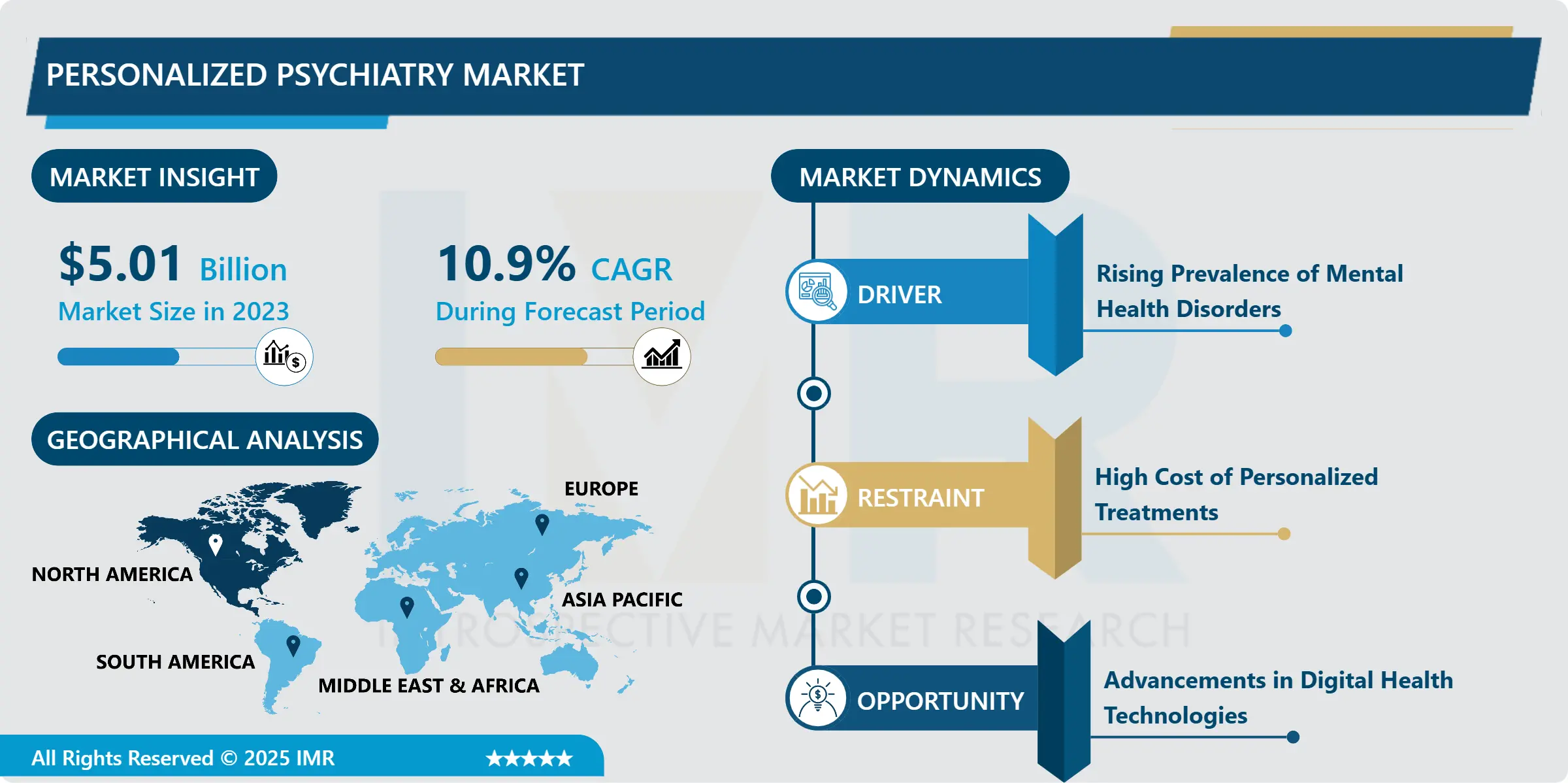
Personalized Psychiatry Market Size, Share, Growth & Forecast (2024-2032)
Personalized Psychiatry Market Size Was Valued at USD 5.01 Billion in 2023, and is Projected to Reach USD 12.71 Billion by 2032, Growing at a CAGR of 10.9 % From 2024-2032.

IMR Group
Description
Personalized Psychiatry Market Synopsis:
Personalized Psychiatry Market Size Was Valued at USD 5.01 Billion in 2023, and is Projected to Reach USD 12.71 Billion by 2032, Growing at a CAGR of 10.9 % From 2024-2032.
The personalized psychiatry market is concerned with identifying individualized treatments for mental health disorders by building on the scientific advances garnered from genomics, neuroimaging, biomarkers, and artificial intelligence. In contrast to more mainstream psychiatry, which may take some time to test out medication and therapeutic models on a patient, personalized psychiatry constitutes a much subtler approach that tries to account for the most defining biology and psychology traits of a given patient. This market covers multiple verticals and solutions, such as genetic testing, pharmacogenomics, and digital health solutions that help clinicians determine which treatment options are best suited to a patient’s genetic program, neural profile, and environment. The results of the drug therapy for complex mood disorders including depression, schizophrenia, bipolar disorder and anxiety are much more emerge on the personalitizable treatment approach. The approach is intended to minimise the risk of ADRs; enhance the effectiveness of antipsychotic medications; and shorten the time to desired mental health treatment response.
The technology of selling the opportunity of receiving the personal psychiatry service represents the young, but rather prospective segment of the mental healthcare market which focuses on the necessity of individual treatment approaches to the most severe manifestations of psychiatric disorders. Historically, mental health treatment process has used technology uniformly without taking into consideration the various factors which such technology require; this has led to variability in the behaviour of the treatment process and therefore variability in the outcome, increased length of treatment processes and potential variability in reactions to treatment technologies. Whereas, conventional psychiatry faces these threats through means as pharmacogenomics, neuroimaging, biomarkers, and artificial intelligence to develop patient-sustaining, patient-specific treatments that properly correspond to each patient’s distinct biological make-up, genetic profile, and psychological profile. This patient-centered approach is especially useful in conditions such as depression, schizophrenia, bipolar disease, and anxiety where the difference in tackling the patients with general medication may not go down well with everybody.
There is a new trend for individualized psychiatry owing to the increase in prevalence of mental disorder across the world and the recognition of mental health as an essential aspect of health. Since healthcare clients and practitioners look for minimal painful solutions, there is a higher demand for forecasts and therapies that guarantee rapid and uniform responses. Pharmacogenomics can be defined as the uses of gene information in order to predict which medications are likely to be most effective in a patient because of the reduction in the cost of DNA sequencing more and more people have access to pharmacogenomic tests.
Personalized Psychiatry Market Trend Analysis:
Growing Integration of Artificial Intelligence in Personalized Psychiatry
Another factor that has hasted development in the market for the personalized psychiatry is the use of artificial intelligence in enhancing accuracy and efficiency in the diagnosis of mental health. Extra time is gained as machine learning algorithms work with big data including genetic reports, MRI scans, patient history, and behavior, which while in tabular format makes little sense but contain information that cannot be obtained otherwise by diagnostics.
Manipulating such complex data asset may enhance the discovery of biomarkers or pattern unique to specific mental health disorders or treatment response; achieving higher accuracy of diagnosis, and overall, treatment planning. AI tools also assist in carving out the models required for determining how the patient will behave towards a particular drug, reducing the chances that clinicians will have to keep ‘gunning and checking’.
Expanding Access to Pharmacogenomic Testing Presents a Major Opportunity
The relatively recent discovery of how pharmacogenomic testing is becoming more accessible and affordable makes it an opportunity in the personalized psychiatry market.
Pharmacogenomics, a science that focuses on how the genetic differences affect drug reception, offers psychiatry an almost boundless opportunity of selecting medication suitable for the genetic type of the patient. This can markedly decrease the rates of ADR, and improve treatment outcomes in conditions affecting the mentally ill, where treatment response is highly variable from person to person. Pharmacogenomic tests were expensive and available only in clinical trials for chronic diseases, but due to latest innovation in genetic testing new tests are inexpensive and easily accessible.
Personalized Psychiatry Market Segment Analysis:
Personalized Psychiatry Market is Segmented on the basis of Type, Therapeutic Area, and Region.
By Type, Diagnostics segment is expected to dominate the market during the forecast period
Some of the diagnostics in personalized psychiatry include pharmacogenomic tests, neuroimaging and biomarker assessments and which serves the main purpose of developing a personal treatment plan for the patients. They assist clinicians identify a patient’s genetic predisposition, neurological personality, biological individuality to apply appropriate treatment for disorders with heterogeneous response to common treatment such as depression, anxiety, bipolar and schizophrenia.
The need for better and faster diagnostics forms the basis for the growth and development of more advanced diagnostics technologies in the segment, declining cost of the genetic and molecular testing and greater focus on precision medicine approach to mental health illnesses. Further, these diagnostic solutions are finding its use with heath care providers and mental health centres to enhance the precision of treatment, replace guess-work and enhance patient results.
By Therapeutic Area, Depression segment expected to held the largest share
In terms of therapeutic, the segment majoring in Depression is expected to have the highest share in the global market of personalized psychiatry. Depression is another common mental health disorder, which systematically affects millions of people and has one of the more complicated and diverse outcomes in terms of treatment with medications. These traditional strategies include trial and error and the less effective use of substitute medications that may take much more time to provide the desired results, thereby worsening symptoms and affect patients’ quality of life immensely.
The scientific approach of personalized Psychiatry makes significant leaps in the deployment of the effective drug combinations in patients with depressions due to the prescription on the basis of a pharmacogenomic test, biomarkers, and other diagnostic tools.
Personalized Psychiatry Market Regional Insights:
North America is Expected to Dominate the Market Over the Forecast period
North America is anticipated to capture the largest share of the personalized psychiatry during the predicted period due to factors such including sophisticated healthcare system, increased awareness of mental health and high uptake of sophisticated diagnostic tools. The US has observed a particular increased need for exact psychiatry because there’s more focus on mental health and a desire for personalized approaches. By having great focus on the funding of research and development and backed by the government and increasing corporate social responsibility for mental health, the North American market has put itself in a perfect setting for development for RNT personalized psychiatry. Third and also as a result of generally increased availability of various diagnostic technologies such as pharmacogenomic testing, neuroimaging etc, in clinical practice, the healthcare providers can diagnose as well as manage the patients who have complicated psychiatric disorders with anxiety, depression, and schizophrenia for example, in better ways.
The second behaviour adds to North America’s position as a result of the most supportive regulations and also the increasing reimbursement insurance for mental health treatments. Personalized psychiatry services such as, pharmacogenomic testing are now being paid for through government funded programs and private insurance companies. Further, the availability of numerous core biotechnology and pharmaceutical multinational companies, coupled with advanced research organizations, continues deriving new diagnostic methods and suitable therapies.
Active Key Players in the Personalized Psychiatry Market:
Abbott Laboratories (United States)
Alkermes plc (Ireland)
AstraZeneca plc (United Kingdom)
COMPASS Pathways plc (United Kingdom)
CNSDose (Australia)
Genomind (United States)
H. Lundbeck A/S (Denmark)
Intra-Cellular Therapies, Inc. (United States)
Johnson & Johnson (Janssen Pharmaceuticals) (United States)
Myriad Genetics, Inc. (United States)
Neurocrine Biosciences, Inc. (United States)
Pear Therapeutics, Inc. (United States)
Pfizer Inc. (United States)
Promethease (United States)
Sage Therapeutics, Inc. (United States), and Other Active Players
Key Industry Developments in the Personalized Psychiatry Market:
In July 2023, A new set of services to supplement Spring Health’s current Family Care solution which offers care and support for parents, caregivers, partners, and children from birth to adulthood was announced in July 2023 by the international provider of mental health solutions.
Chapter 1: Introduction
1.1 Scope and Coverage
Chapter 2:Executive Summary
Chapter 3: Market Landscape
3.1 Market Dynamics
3.1.1 Drivers
3.1.2 Restraints
3.1.3 Opportunities
3.1.4 Challenges
3.2 Market Trend Analysis
3.3 PESTLE Analysis
3.4 Porter’s Five Forces Analysis
3.5 Industry Value Chain Analysis
3.6 Ecosystem
3.7 Regulatory Landscape
3.8 Price Trend Analysis
3.9 Patent Analysis
3.10 Technology Evolution
3.11 Investment Pockets
3.12 Import-Export Analysis
Chapter 4: Personalized Psychiatry Market by Type
4.1 Personalized Psychiatry Market Snapshot and Growth Engine
4.2 Personalized Psychiatry Market Overview
4.3 Products
4.3.1 Introduction and Market Overview
4.3.2 Historic and Forecasted Market Size in Value USD and Volume Units (2017-2032F)
4.3.3 Key Market Trends, Growth Factors and Opportunities
4.3.4 Products: Geographic Segmentation Analysis
4.4 Diagnostics
4.4.1 Introduction and Market Overview
4.4.2 Historic and Forecasted Market Size in Value USD and Volume Units (2017-2032F)
4.4.3 Key Market Trends, Growth Factors and Opportunities
4.4.4 Diagnostics: Geographic Segmentation Analysis
4.5 Therapeutics
4.5.1 Introduction and Market Overview
4.5.2 Historic and Forecasted Market Size in Value USD and Volume Units (2017-2032F)
4.5.3 Key Market Trends, Growth Factors and Opportunities
4.5.4 Therapeutics: Geographic Segmentation Analysis
4.6 Services
4.6.1 Introduction and Market Overview
4.6.2 Historic and Forecasted Market Size in Value USD and Volume Units (2017-2032F)
4.6.3 Key Market Trends, Growth Factors and Opportunities
4.6.4 Services: Geographic Segmentation Analysis
4.7 Software
4.7.1 Introduction and Market Overview
4.7.2 Historic and Forecasted Market Size in Value USD and Volume Units (2017-2032F)
4.7.3 Key Market Trends, Growth Factors and Opportunities
4.7.4 Software : Geographic Segmentation Analysis
Chapter 5: Personalized Psychiatry Market by Therapeutic area
5.1 Personalized Psychiatry Market Snapshot and Growth Engine
5.2 Personalized Psychiatry Market Overview
5.3 Depression
5.3.1 Introduction and Market Overview
5.3.2 Historic and Forecasted Market Size in Value USD and Volume Units (2017-2032F)
5.3.3 Key Market Trends, Growth Factors and Opportunities
5.3.4 Depression: Geographic Segmentation Analysis
5.4 Anxiety
5.4.1 Introduction and Market Overview
5.4.2 Historic and Forecasted Market Size in Value USD and Volume Units (2017-2032F)
5.4.3 Key Market Trends, Growth Factors and Opportunities
5.4.4 Anxiety: Geographic Segmentation Analysis
5.5 Bipolar
5.5.1 Introduction and Market Overview
5.5.2 Historic and Forecasted Market Size in Value USD and Volume Units (2017-2032F)
5.5.3 Key Market Trends, Growth Factors and Opportunities
5.5.4 Bipolar: Geographic Segmentation Analysis
5.6 Disorder
5.6.1 Introduction and Market Overview
5.6.2 Historic and Forecasted Market Size in Value USD and Volume Units (2017-2032F)
5.6.3 Key Market Trends, Growth Factors and Opportunities
5.6.4 Disorder: Geographic Segmentation Analysis
5.7 Schizophrenia
5.7.1 Introduction and Market Overview
5.7.2 Historic and Forecasted Market Size in Value USD and Volume Units (2017-2032F)
5.7.3 Key Market Trends, Growth Factors and Opportunities
5.7.4 Schizophrenia: Geographic Segmentation Analysis
5.8 Addiction
5.8.1 Introduction and Market Overview
5.8.2 Historic and Forecasted Market Size in Value USD and Volume Units (2017-2032F)
5.8.3 Key Market Trends, Growth Factors and Opportunities
5.8.4 Addiction: Geographic Segmentation Analysis
5.9 and Others
5.9.1 Introduction and Market Overview
5.9.2 Historic and Forecasted Market Size in Value USD and Volume Units (2017-2032F)
5.9.3 Key Market Trends, Growth Factors and Opportunities
5.9.4 and Others: Geographic Segmentation Analysis
Chapter 6: Company Profiles and Competitive Analysis
6.1 Competitive Landscape
6.1.1 Competitive Benchmarking
6.1.2 Personalized Psychiatry Market Share by Manufacturer (2023)
6.1.3 Industry BCG Matrix
6.1.4 Heat Map Analysis
6.1.5 Mergers and Acquisitions
6.2 ABBOTT LABORATORIES (UNITED STATES)
6.2.1 Company Overview
6.2.2 Key Executives
6.2.3 Company Snapshot
6.2.4 Role of the Company in the Market
6.2.5 Sustainability and Social Responsibility
6.2.6 Operating Business Segments
6.2.7 Product Portfolio
6.2.8 Business Performance
6.2.9 Key Strategic Moves and Recent Developments
6.2.10 SWOT Analysis
6.3 ALKERMES PLC (IRELAND)
6.4 ASTRAZENECA PLC (UNITED KINGDOM)
6.5 COMPASS PATHWAYS PLC (UNITED KINGDOM)
6.6 CNSDOSE (AUSTRALIA)
6.7 GENOMIND (UNITED STATES)
6.8 H. LUNDBECK A/S (DENMARK)
6.9 INTRA-CELLULAR THERAPIES INC. (UNITED STATES)
6.10 JOHNSON & JOHNSON (JANSSEN PHARMACEUTICALS) (UNITED STATES)
6.11 MYRIAD GENETICS INC. (UNITED STATES)
6.12 NEUROCRINE BIOSCIENCES INC. (UNITED STATES)
6.13 PEAR THERAPEUTICS INC. (UNITED STATES)
6.14 PFIZER INC. (UNITED STATES)
6.15 PROMETHEASE (UNITED STATES)
6.16 SAGE THERAPEUTICS INC. (UNITED STATES)
6.17 OTHER ACTIVE PLAYERS
Chapter 7: Global Personalized Psychiatry Market By Region
7.1 Overview
7.2. North America Personalized Psychiatry Market
7.2.1 Key Market Trends, Growth Factors and Opportunities
7.2.2 Top Key Companies
7.2.3 Historic and Forecasted Market Size by Segments
7.2.4 Historic and Forecasted Market Size By Type
7.2.4.1 Products
7.2.4.2 Diagnostics
7.2.4.3 Therapeutics
7.2.4.4 Services
7.2.4.5 Software
7.2.5 Historic and Forecasted Market Size By Therapeutic area
7.2.5.1 Depression
7.2.5.2 Anxiety
7.2.5.3 Bipolar
7.2.5.4 Disorder
7.2.5.5 Schizophrenia
7.2.5.6 Addiction
7.2.5.7 and Others
7.2.6 Historic and Forecast Market Size by Country
7.2.6.1 US
7.2.6.2 Canada
7.2.6.3 Mexico
7.3. Eastern Europe Personalized Psychiatry Market
7.3.1 Key Market Trends, Growth Factors and Opportunities
7.3.2 Top Key Companies
7.3.3 Historic and Forecasted Market Size by Segments
7.3.4 Historic and Forecasted Market Size By Type
7.3.4.1 Products
7.3.4.2 Diagnostics
7.3.4.3 Therapeutics
7.3.4.4 Services
7.3.4.5 Software
7.3.5 Historic and Forecasted Market Size By Therapeutic area
7.3.5.1 Depression
7.3.5.2 Anxiety
7.3.5.3 Bipolar
7.3.5.4 Disorder
7.3.5.5 Schizophrenia
7.3.5.6 Addiction
7.3.5.7 and Others
7.3.6 Historic and Forecast Market Size by Country
7.3.6.1 Russia
7.3.6.2 Bulgaria
7.3.6.3 The Czech Republic
7.3.6.4 Hungary
7.3.6.5 Poland
7.3.6.6 Romania
7.3.6.7 Rest of Eastern Europe
7.4. Western Europe Personalized Psychiatry Market
7.4.1 Key Market Trends, Growth Factors and Opportunities
7.4.2 Top Key Companies
7.4.3 Historic and Forecasted Market Size by Segments
7.4.4 Historic and Forecasted Market Size By Type
7.4.4.1 Products
7.4.4.2 Diagnostics
7.4.4.3 Therapeutics
7.4.4.4 Services
7.4.4.5 Software
7.4.5 Historic and Forecasted Market Size By Therapeutic area
7.4.5.1 Depression
7.4.5.2 Anxiety
7.4.5.3 Bipolar
7.4.5.4 Disorder
7.4.5.5 Schizophrenia
7.4.5.6 Addiction
7.4.5.7 and Others
7.4.6 Historic and Forecast Market Size by Country
7.4.6.1 Germany
7.4.6.2 UK
7.4.6.3 France
7.4.6.4 The Netherlands
7.4.6.5 Italy
7.4.6.6 Spain
7.4.6.7 Rest of Western Europe
7.5. Asia Pacific Personalized Psychiatry Market
7.5.1 Key Market Trends, Growth Factors and Opportunities
7.5.2 Top Key Companies
7.5.3 Historic and Forecasted Market Size by Segments
7.5.4 Historic and Forecasted Market Size By Type
7.5.4.1 Products
7.5.4.2 Diagnostics
7.5.4.3 Therapeutics
7.5.4.4 Services
7.5.4.5 Software
7.5.5 Historic and Forecasted Market Size By Therapeutic area
7.5.5.1 Depression
7.5.5.2 Anxiety
7.5.5.3 Bipolar
7.5.5.4 Disorder
7.5.5.5 Schizophrenia
7.5.5.6 Addiction
7.5.5.7 and Others
7.5.6 Historic and Forecast Market Size by Country
7.5.6.1 China
7.5.6.2 India
7.5.6.3 Japan
7.5.6.4 South Korea
7.5.6.5 Malaysia
7.5.6.6 Thailand
7.5.6.7 Vietnam
7.5.6.8 The Philippines
7.5.6.9 Australia
7.5.6.10 New Zealand
7.5.6.11 Rest of APAC
7.6. Middle East & Africa Personalized Psychiatry Market
7.6.1 Key Market Trends, Growth Factors and Opportunities
7.6.2 Top Key Companies
7.6.3 Historic and Forecasted Market Size by Segments
7.6.4 Historic and Forecasted Market Size By Type
7.6.4.1 Products
7.6.4.2 Diagnostics
7.6.4.3 Therapeutics
7.6.4.4 Services
7.6.4.5 Software
7.6.5 Historic and Forecasted Market Size By Therapeutic area
7.6.5.1 Depression
7.6.5.2 Anxiety
7.6.5.3 Bipolar
7.6.5.4 Disorder
7.6.5.5 Schizophrenia
7.6.5.6 Addiction
7.6.5.7 and Others
7.6.6 Historic and Forecast Market Size by Country
7.6.6.1 Turkiye
7.6.6.2 Bahrain
7.6.6.3 Kuwait
7.6.6.4 Saudi Arabia
7.6.6.5 Qatar
7.6.6.6 UAE
7.6.6.7 Israel
7.6.6.8 South Africa
7.7. South America Personalized Psychiatry Market
7.7.1 Key Market Trends, Growth Factors and Opportunities
7.7.2 Top Key Companies
7.7.3 Historic and Forecasted Market Size by Segments
7.7.4 Historic and Forecasted Market Size By Type
7.7.4.1 Products
7.7.4.2 Diagnostics
7.7.4.3 Therapeutics
7.7.4.4 Services
7.7.4.5 Software
7.7.5 Historic and Forecasted Market Size By Therapeutic area
7.7.5.1 Depression
7.7.5.2 Anxiety
7.7.5.3 Bipolar
7.7.5.4 Disorder
7.7.5.5 Schizophrenia
7.7.5.6 Addiction
7.7.5.7 and Others
7.7.6 Historic and Forecast Market Size by Country
7.7.6.1 Brazil
7.7.6.2 Argentina
7.7.6.3 Rest of SA
Chapter 8 Analyst Viewpoint and Conclusion
8.1 Recommendations and Concluding Analysis
8.2 Potential Market Strategies
Chapter 9 Research Methodology
9.1 Research Process
9.2 Primary Research
9.3 Secondary Research
Q1: What would be the forecast period in the Personalized Psychiatry Market research report?
A1: The forecast period in the Personalized Psychiatry Market research report is 2024-2032.
Q2: Who are the key players in the Personalized Psychiatry Market?
A2: Abbott Laboratories (United States), Alkermes plc (Ireland), AstraZeneca plc (United Kingdom), COMPASS Pathways plc (United Kingdom), CNSDose (Australia), Genomind (United States), H. Lundbeck A/S (Denmark), Intra-Cellular Therapies, Inc. (United States), Johnson & Johnson (Janssen Pharmaceuticals) (United States), Myriad Genetics, Inc. (United States), Neurocrine Biosciences, Inc. (United States), Pear Therapeutics, Inc. (United States), Pfizer Inc. (United States), Promethease (United States), Sage Therapeutics, Inc. (United States), and Other Active Players.
Q3: What are the segments of the Personalized Psychiatry Market?
A3: The Personalized Psychiatry Market is segmented into Type,?Therapeutic area, and region. By Type, the market is categorized into Products,?Diagnostics, Therapeutics, Services, and?Software. By Therapeutic area, the market is categorized into depression,?Anxiety, Bipolar, Disorder, Schizophrenia, Addiction, and Others.?By region, it is analyzed across North America (U.S., Canada, Mexico), Eastern Europe (Russia, Bulgaria, The Czech Republic, Hungary, Poland, Romania, Rest of Eastern Europe), Western Europe (Germany, UK, France, Netherlands, Italy, Spain, Rest of Western Europe), Asia Pacific (China, India, Japan, South Korea, Malaysia, Thailand, Vietnam, The Philippines, Australia, New Zealand, Rest of APAC), Middle East & Africa (Turkiye, Bahrain, Kuwait, Saudi Arabia, Qatar, UAE, Israel, South Africa), South America (Brazil, Argentina, Rest of SA).
Q4: What is the Personalized Psychiatry Market?
A4: The personalized psychiatry market is concerned with identifying individualized treatments for mental health disorders by building on the scientific advances garnered from genomics, neuroimaging, biomarkers, and artificial intelligence. In contrast to more mainstream psychiatry, which may take some time to test out medication and therapeutic models on a patient, personalized psychiatry constitutes a much subtler approach that tries to account for the most defining biology and psychology traits of a given patient.
Q5: How big is the Personalized Psychiatry Market?
A5: Personalized Psychiatry Market Size Was Valued at USD 5.01 Billion in 2023, and is Projected to Reach USD 12.71 Billion by 2032, Growing at a CAGR of 10.9 % From 2024-2032.
How to Buy a Report from eminsights.jp
On the product page, choose the license you want: Single-User License, Multi-User License or Enterprise License.
If you required report in your native language, then you can click on Translated Report button and fill out the form with report name and language you want, then our team will contact you as soon as possible.
Click the Buy Now button.
You will be redirected to the checkout page. Enter your company details and payment information.
Click Place Order to complete the purchase.
Confirmation: You’ll receive an order confirmation and our team will contact you shortly with your ordered report.
If you have any questions, fill out the contact form below or email us at bizdev@eminsights.net.
Thank you for choosing eminsights.jp!