Stay Ahead in Fast-Growing Economies.
Browse Reports Now




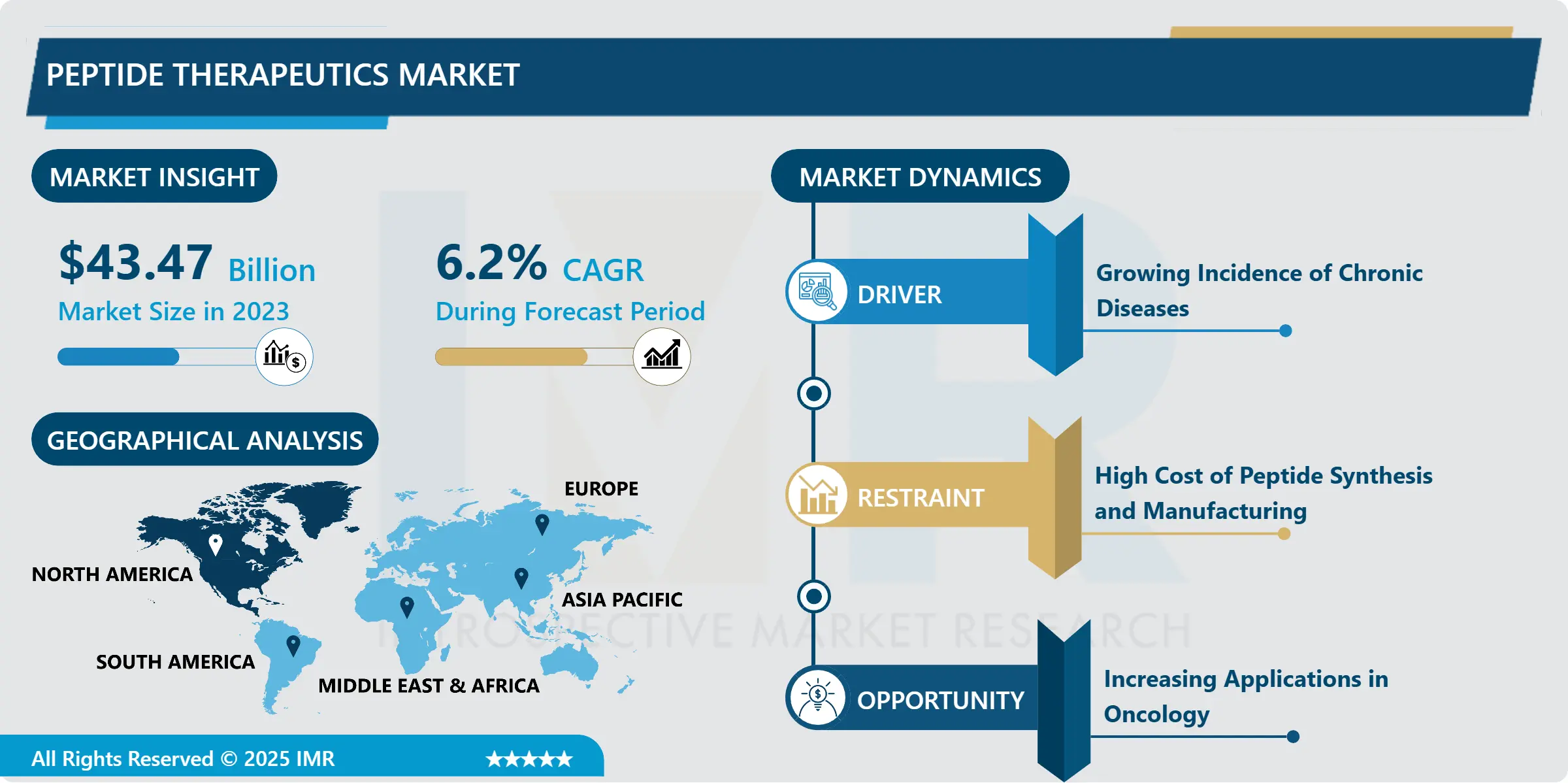
Peptide Therapeutics Market Insights, Dynamics, and Growth Forecast (2024-2032)
Peptide Therapeutics Market Size Was Valued at USD 43.47 Billion in 2023, and is Projected to Reach USD 74.70 Billion by 2032, Growing at a CAGR of 6.2% From 2024-2032. Peptide therapeutics are molecules made of short chains of amino acids that are used as drug compounds for multiple illnesses.

IMR Group
Description
Peptide Therapeutics Market Synopsis:
Peptide Therapeutics Market Size Was Valued at USD 43.47 Billion in 2023, and is Projected to Reach USD 74.70 Billion by 2032, Growing at a CAGR of 6.2% From 2024-2032.
Peptide therapeutics are molecules made of short chains of amino acids that are used as drug compounds for multiple illnesses. Such peptides are applied to influence certain biological processes and are gradually becoming one of the most promising kinds of treatment in such diseases as oncology, diabetes, atherosclerosis etc, since they are perspective due to their high selectivity, effectiveness, and minimal side effects.
The market for peptide therapeutics is relatively recent, and has begin to show promising growth in the past few years due to the development of biotechnology, new drug delivery systems, and increased awareness of the effectiveness of peptides in the treatment for a number of diseases. They act as bioactive molecules in the body; thus, when used as therapeutics they minimize on side effects due to specificity and increase efficiency of treatment. The market for peptide-based drugs has experienced steady growth and, as more money is invested in peptide-drug research, the market is projected to grow even larger over the next few years.
This has been boosted by increasing incidence of chronic diseases such as cancer, diabetes and cardiovascular diseases driving the need for new and exotic therapeutic solutions. The increase of neurological and hormonal disorders also plays a role in the growth of the market as peptide-based drugs offers specific treatment. Secondly, advancement in methods of drug delivery systems and manners of synthesizing peptides mean better demands for production in the markets.
The demand for peptide-based drugs in the pharmaceutical industry has also been boosted by other factors such as regulatory support and appreciation that is currently growing clinically. Several large organizations are now striving to develop peptide drugs and more so with respect to the new peptides and the peptide vaccines. Likewise, the enhancements of peptide biology and human understanding in the same as well as the modifiability of peptides for various uses and the creation of formulations such as long acting peptides in pharmaceuticals will drive the market further.
In the current growing market for peptide therapeutics, increasing importance is placed on discovering and developing new solutions for patient population with unmet medical needs. The use of peptides as drugs will also increase as new chemical entities achieve market authorization, placing peptide therapeutics into numerous disease categories. The development in technologies, the rising usage of peptide drugs and increasing number of chronic diseases in the world will lead to the growth of the market.
Peptide Therapeutics Market Trend Analysis:
Increased Focus on Peptide Drug Delivery Systems
Another major development in the peptide therapeutics business is the growing importance of enhanced peptide drug delivery systems. These systems are designed to address some of the challenges enhanced by low bio availability/stability of peptides. Development of more advanced formulations include nanoparticles or liposomes, have also been made for peptides and these new formations enable these drugs to stay in bloodstream for a longer period hence improving the benefits of the drug. This trend is especially significant to peptides that are administered for extended dosages where achieving systematic control of drug release would greatly improve patient compliance and success.
The novel approaches for oral peptides is another potential therapeutic agent worth exploring next. Conventional routes of administration of peptides have been systemic, primarily through injections since the molecules are degraded when taken orally. But currently under development there are new technologies as enzyme inhibitors, nanoparticle-based carriers and transdermal patches to provide oral peptide therapeutics. This development should enhance patient convenience and increase the demand for peptide-based drugs to drive market growth.
Increasing Applications in Oncology
The market opportunity that is a trend in the peptide therapeutics market is the expanding use of peptides in cancer treatment. This opens up a picket fence therapy, which can specifically target only the cancer cells and not the other normal cells which can be destroyed via surgery chemotheraphy and radiation thus resulting in few side effects. Pepscan claims that the use of peptides provides a therapeutic advantage that higher specificity for cancerous cells make the better option as compared to existing drugs. Further, peptides can be functionalized to carry toxic molecules to the tumor tissue and thereby increasing the efficiency of the similar cancer therapies.
Peptide cancer vaccines, vaccines studies showing the potential of peptides in immunotherapy, are also being investigated. These therapies want to improve the ability of the immune system to identify and destroy cancer cells. Consequently, peptide therapeutics will continue to assume a growing significance as agents used in combating cancer. As the amount of investment in cancer researc IH concerned and the continual clinical trials of peptide therapies are increasing, this segment is potentially conducive to the market developments in the future years.
Peptide Therapeutics Market Segment Analysis:
Peptide Therapeutics Market is Segmented on the basis of Type, Application, End User, Route of Administration, and Region.
By Type, Linear Peptides segment is expected to dominate the market during the forecast period
The Linear Peptides segment is poised to dominate the peptide therapeutics market during the forecast period, owing to several critical advantages. Linear peptides are relatively simpler to synthesize and modify, making them cost-effective and commercially viable for large-scale production. Their structural flexibility allows for easy manipulation, which enhances their binding affinity, stability, and therapeutic activity.
Advancements in peptide drug delivery systems and formulation technologies are overcoming previous limitations related to stability and bioavailability. These factors, coupled with growing clinical adoption in treating metabolic disorders, cancer, and infectious diseases, are driving robust demand. The increasing focus on precision medicine and biologics is amplifying the use of linear peptides in targeted therapies. As pharmaceutical companies invest heavily in R&D, linear peptides are set to lead the market with both clinical and commercial impact.
By Application, Cancer segment expected to held the largest share
The cancer segment is anticipated to hold the largest share in the peptide therapeutics market, driven by the increasing prevalence of various forms of cancer and the growing demand for targeted therapies. Peptide-based drugs have shown significant potential in oncology due to their high specificity, low toxicity, and ability to modulate protein–protein interactions involved in tumor growth and progression.
Advancements in peptide synthesis and drug delivery technologies have enhanced the efficacy and bioavailability of these therapeutics, further accelerating their adoption in cancer treatment. Government support, rising healthcare expenditure, and a strong pipeline of peptide-based anticancer agents under clinical development are also contributing to the dominance of this segment. Pharmaceutical companies are increasingly investing in oncology-focused peptide drug development, which is expected to sustain the growth trajectory of the cancer application segment in the global peptide therapeutics market.
Peptide Therapeutics Market Regional Insights:
North America is Expected to Dominate the Market Over the Forecast period
North America is currently the market dominant region in the peptide therapeutics market. The region has a strong base for healthcare facilities, proficient R&D and BIopharmaceutical development and huge investments in the same. Also, major players from the pharmaceutical sector and strong healthcare services ensure North America is a significant participant within the global market. C) The large patient population undergoing treatment due to chronic diseases, along with favourable policies and high fundamental requirements for novel and superior therapeutics contribute to the growth of the peptide therapeutics market in the respective area.
The US, for instance, boasts of so many biotechnology and pharmaceutical companies that have strived to invest in various forms of peptide-based treatment. The research also showed that the number of approved peptide drugs by FDA is on the rise in North America, thus enhancing the position of the market. And with the increasing number of the geriatric population and continually escalating costs of healthcare in North America, the region is poised to continue to dominate the market for peptide therapeutics.
Active Key Players in the Peptide Therapeutics Market:
Novo Nordisk (Denmark)
Eli Lilly and Co. (USA)
Bachem Holding AG (Switzerland)
Sandoz (Novartis) (Switzerland)
Ipsen (France)
Amgen (USA)
Merck & Co., Inc. (USA)
Teva Pharmaceutical Industries (Israel)
PeptiDream Inc. (Japan)
BiotechPharma (India)
Hikma Pharmaceuticals (UK)
Lonza Group (Switzerland), and Other Active Players
Key Industry Developments in the Peptide Therapeutics Market:
In March 2023, Ono Pharmaceuticals and PeptiDream entered into a collaboration for drug discovery and development of Macrocyclic Constrained Peptide Therapeutics
In October 2023, Biosynth acquired Pepceuticals Limited, a British synthetic peptide manufacturer, and through this acquisition company aimed to strengthen its peptide division.
Chapter 1: Introduction
1.1 Scope and Coverage
Chapter 2:Executive Summary
Chapter 3: Market Landscape
3.1 Market Dynamics
3.1.1 Drivers
3.1.2 Restraints
3.1.3 Opportunities
3.1.4 Challenges
3.2 Market Trend Analysis
3.3 PESTLE Analysis
3.4 Porter’s Five Forces Analysis
3.5 Industry Value Chain Analysis
3.6 Ecosystem
3.7 Regulatory Landscape
3.8 Price Trend Analysis
3.9 Patent Analysis
3.10 Technology Evolution
3.11 Investment Pockets
3.12 Import-Export Analysis
Chapter 4: Peptide Therapeutics Market by Application
4.1 Peptide Therapeutics Market Snapshot and Growth Engine
4.2 Peptide Therapeutics Market Overview
4.3 Water Treatment
4.3.1 Introduction and Market Overview
4.3.2 Historic and Forecasted Market Size in Value USD and Volume Units (2017-2032F)
4.3.3 Key Market Trends, Growth Factors and Opportunities
4.3.4 Water Treatment: Geographic Segmentation Analysis
4.4 Food and Beverage
4.4.1 Introduction and Market Overview
4.4.2 Historic and Forecasted Market Size in Value USD and Volume Units (2017-2032F)
4.4.3 Key Market Trends, Growth Factors and Opportunities
4.4.4 Food and Beverage: Geographic Segmentation Analysis
4.5 Healthcare
4.5.1 Introduction and Market Overview
4.5.2 Historic and Forecasted Market Size in Value USD and Volume Units (2017-2032F)
4.5.3 Key Market Trends, Growth Factors and Opportunities
4.5.4 Healthcare: Geographic Segmentation Analysis
4.6 Pulp and Paper
4.6.1 Introduction and Market Overview
4.6.2 Historic and Forecasted Market Size in Value USD and Volume Units (2017-2032F)
4.6.3 Key Market Trends, Growth Factors and Opportunities
4.6.4 Pulp and Paper: Geographic Segmentation Analysis
4.7 Agriculture
4.7.1 Introduction and Market Overview
4.7.2 Historic and Forecasted Market Size in Value USD and Volume Units (2017-2032F)
4.7.3 Key Market Trends, Growth Factors and Opportunities
4.7.4 Agriculture: Geographic Segmentation Analysis
4.8 Industrial Cleaning
4.8.1 Introduction and Market Overview
4.8.2 Historic and Forecasted Market Size in Value USD and Volume Units (2017-2032F)
4.8.3 Key Market Trends, Growth Factors and Opportunities
4.8.4 Industrial Cleaning: Geographic Segmentation Analysis
4.9 Others
4.9.1 Introduction and Market Overview
4.9.2 Historic and Forecasted Market Size in Value USD and Volume Units (2017-2032F)
4.9.3 Key Market Trends, Growth Factors and Opportunities
4.9.4 Others: Geographic Segmentation Analysis
Chapter 5: Peptide Therapeutics Market by End-User Industry
5.1 Peptide Therapeutics Market Snapshot and Growth Engine
5.2 Peptide Therapeutics Market Overview
5.3 Water Treatment
5.3.1 Introduction and Market Overview
5.3.2 Historic and Forecasted Market Size in Value USD and Volume Units (2017-2032F)
5.3.3 Key Market Trends, Growth Factors and Opportunities
5.3.4 Water Treatment: Geographic Segmentation Analysis
5.4 Food Processing
5.4.1 Introduction and Market Overview
5.4.2 Historic and Forecasted Market Size in Value USD and Volume Units (2017-2032F)
5.4.3 Key Market Trends, Growth Factors and Opportunities
5.4.4 Food Processing: Geographic Segmentation Analysis
5.5 Healthcare and Sanitation
5.5.1 Introduction and Market Overview
5.5.2 Historic and Forecasted Market Size in Value USD and Volume Units (2017-2032F)
5.5.3 Key Market Trends, Growth Factors and Opportunities
5.5.4 Healthcare and Sanitation: Geographic Segmentation Analysis
5.6 Agriculture
5.6.1 Introduction and Market Overview
5.6.2 Historic and Forecasted Market Size in Value USD and Volume Units (2017-2032F)
5.6.3 Key Market Trends, Growth Factors and Opportunities
5.6.4 Agriculture: Geographic Segmentation Analysis
5.7 Chemical Manufacturing
5.7.1 Introduction and Market Overview
5.7.2 Historic and Forecasted Market Size in Value USD and Volume Units (2017-2032F)
5.7.3 Key Market Trends, Growth Factors and Opportunities
5.7.4 Chemical Manufacturing: Geographic Segmentation Analysis
5.8 Pulp and Paper
5.8.1 Introduction and Market Overview
5.8.2 Historic and Forecasted Market Size in Value USD and Volume Units (2017-2032F)
5.8.3 Key Market Trends, Growth Factors and Opportunities
5.8.4 Pulp and Paper: Geographic Segmentation Analysis
5.9 Others
5.9.1 Introduction and Market Overview
5.9.2 Historic and Forecasted Market Size in Value USD and Volume Units (2017-2032F)
5.9.3 Key Market Trends, Growth Factors and Opportunities
5.9.4 Others: Geographic Segmentation Analysis
Chapter 6: Peptide Therapeutics Market by Concentration Level
6.1 Peptide Therapeutics Market Snapshot and Growth Engine
6.2 Peptide Therapeutics Market Overview
6.3 Low Concentration
6.3.1 Introduction and Market Overview
6.3.2 Historic and Forecasted Market Size in Value USD and Volume Units (2017-2032F)
6.3.3 Key Market Trends, Growth Factors and Opportunities
6.3.4 Low Concentration: Geographic Segmentation Analysis
6.4 High Concentration
6.4.1 Introduction and Market Overview
6.4.2 Historic and Forecasted Market Size in Value USD and Volume Units (2017-2032F)
6.4.3 Key Market Trends, Growth Factors and Opportunities
6.4.4 High Concentration: Geographic Segmentation Analysis
Chapter 7: Peptide Therapeutics Market by Form
7.1 Peptide Therapeutics Market Snapshot and Growth Engine
7.2 Peptide Therapeutics Market Overview
7.3 Liquid
7.3.1 Introduction and Market Overview
7.3.2 Historic and Forecasted Market Size in Value USD and Volume Units (2017-2032F)
7.3.3 Key Market Trends, Growth Factors and Opportunities
7.3.4 Liquid: Geographic Segmentation Analysis
7.4 Solid
7.4.1 Introduction and Market Overview
7.4.2 Historic and Forecasted Market Size in Value USD and Volume Units (2017-2032F)
7.4.3 Key Market Trends, Growth Factors and Opportunities
7.4.4 Solid: Geographic Segmentation Analysis
Chapter 8: Company Profiles and Competitive Analysis
8.1 Competitive Landscape
8.1.1 Competitive Benchmarking
8.1.2 Peptide Therapeutics Market Share by Manufacturer (2023)
8.1.3 Industry BCG Matrix
8.1.4 Heat Map Analysis
8.1.5 Mergers and Acquisitions
8.2 NOVO NORDISK (DENMARK)
8.2.1 Company Overview
8.2.2 Key Executives
8.2.3 Company Snapshot
8.2.4 Role of the Company in the Market
8.2.5 Sustainability and Social Responsibility
8.2.6 Operating Business Segments
8.2.7 Product Portfolio
8.2.8 Business Performance
8.2.9 Key Strategic Moves and Recent Developments
8.2.10 SWOT Analysis
8.3 ELI LILLY AND CO. (USA)
8.4 BACHEM HOLDING AG (SWITZERLAND)
8.5 SANDOZ (NOVARTIS) (SWITZERLAND)
8.6 IPSEN (FRANCE)
8.7 AMGEN (USA)
8.8 MERCK & CO. INC. (USA)
8.9 TEVA PHARMACEUTICAL INDUSTRIES (ISRAEL)
8.10 PEPTIDREAM INC. (JAPAN)
8.11 BIOTECHPHARMA (INDIA)
8.12 HIKMA PHARMACEUTICALS (UK)
8.13 LONZA GROUP (SWITZERLAND)
8.14 OTHER ACTIVE PLAYERS
Chapter 9: Global Peptide Therapeutics Market By Region
9.1 Overview
9.2. North America Peptide Therapeutics Market
9.2.1 Key Market Trends, Growth Factors and Opportunities
9.2.2 Top Key Companies
9.2.3 Historic and Forecasted Market Size by Segments
9.2.4 Historic and Forecasted Market Size By Application
9.2.4.1 Water Treatment
9.2.4.2 Food and Beverage
9.2.4.3 Healthcare
9.2.4.4 Pulp and Paper
9.2.4.5 Agriculture
9.2.4.6 Industrial Cleaning
9.2.4.7 Others
9.2.5 Historic and Forecasted Market Size By End-User Industry
9.2.5.1 Water Treatment
9.2.5.2 Food Processing
9.2.5.3 Healthcare and Sanitation
9.2.5.4 Agriculture
9.2.5.5 Chemical Manufacturing
9.2.5.6 Pulp and Paper
9.2.5.7 Others
9.2.6 Historic and Forecasted Market Size By Concentration Level
9.2.6.1 Low Concentration
9.2.6.2 High Concentration
9.2.7 Historic and Forecasted Market Size By Form
9.2.7.1 Liquid
9.2.7.2 Solid
9.2.8 Historic and Forecast Market Size by Country
9.2.8.1 US
9.2.8.2 Canada
9.2.8.3 Mexico
9.3. Eastern Europe Peptide Therapeutics Market
9.3.1 Key Market Trends, Growth Factors and Opportunities
9.3.2 Top Key Companies
9.3.3 Historic and Forecasted Market Size by Segments
9.3.4 Historic and Forecasted Market Size By Application
9.3.4.1 Water Treatment
9.3.4.2 Food and Beverage
9.3.4.3 Healthcare
9.3.4.4 Pulp and Paper
9.3.4.5 Agriculture
9.3.4.6 Industrial Cleaning
9.3.4.7 Others
9.3.5 Historic and Forecasted Market Size By End-User Industry
9.3.5.1 Water Treatment
9.3.5.2 Food Processing
9.3.5.3 Healthcare and Sanitation
9.3.5.4 Agriculture
9.3.5.5 Chemical Manufacturing
9.3.5.6 Pulp and Paper
9.3.5.7 Others
9.3.6 Historic and Forecasted Market Size By Concentration Level
9.3.6.1 Low Concentration
9.3.6.2 High Concentration
9.3.7 Historic and Forecasted Market Size By Form
9.3.7.1 Liquid
9.3.7.2 Solid
9.3.8 Historic and Forecast Market Size by Country
9.3.8.1 Russia
9.3.8.2 Bulgaria
9.3.8.3 The Czech Republic
9.3.8.4 Hungary
9.3.8.5 Poland
9.3.8.6 Romania
9.3.8.7 Rest of Eastern Europe
9.4. Western Europe Peptide Therapeutics Market
9.4.1 Key Market Trends, Growth Factors and Opportunities
9.4.2 Top Key Companies
9.4.3 Historic and Forecasted Market Size by Segments
9.4.4 Historic and Forecasted Market Size By Application
9.4.4.1 Water Treatment
9.4.4.2 Food and Beverage
9.4.4.3 Healthcare
9.4.4.4 Pulp and Paper
9.4.4.5 Agriculture
9.4.4.6 Industrial Cleaning
9.4.4.7 Others
9.4.5 Historic and Forecasted Market Size By End-User Industry
9.4.5.1 Water Treatment
9.4.5.2 Food Processing
9.4.5.3 Healthcare and Sanitation
9.4.5.4 Agriculture
9.4.5.5 Chemical Manufacturing
9.4.5.6 Pulp and Paper
9.4.5.7 Others
9.4.6 Historic and Forecasted Market Size By Concentration Level
9.4.6.1 Low Concentration
9.4.6.2 High Concentration
9.4.7 Historic and Forecasted Market Size By Form
9.4.7.1 Liquid
9.4.7.2 Solid
9.4.8 Historic and Forecast Market Size by Country
9.4.8.1 Germany
9.4.8.2 UK
9.4.8.3 France
9.4.8.4 The Netherlands
9.4.8.5 Italy
9.4.8.6 Spain
9.4.8.7 Rest of Western Europe
9.5. Asia Pacific Peptide Therapeutics Market
9.5.1 Key Market Trends, Growth Factors and Opportunities
9.5.2 Top Key Companies
9.5.3 Historic and Forecasted Market Size by Segments
9.5.4 Historic and Forecasted Market Size By Application
9.5.4.1 Water Treatment
9.5.4.2 Food and Beverage
9.5.4.3 Healthcare
9.5.4.4 Pulp and Paper
9.5.4.5 Agriculture
9.5.4.6 Industrial Cleaning
9.5.4.7 Others
9.5.5 Historic and Forecasted Market Size By End-User Industry
9.5.5.1 Water Treatment
9.5.5.2 Food Processing
9.5.5.3 Healthcare and Sanitation
9.5.5.4 Agriculture
9.5.5.5 Chemical Manufacturing
9.5.5.6 Pulp and Paper
9.5.5.7 Others
9.5.6 Historic and Forecasted Market Size By Concentration Level
9.5.6.1 Low Concentration
9.5.6.2 High Concentration
9.5.7 Historic and Forecasted Market Size By Form
9.5.7.1 Liquid
9.5.7.2 Solid
9.5.8 Historic and Forecast Market Size by Country
9.5.8.1 China
9.5.8.2 India
9.5.8.3 Japan
9.5.8.4 South Korea
9.5.8.5 Malaysia
9.5.8.6 Thailand
9.5.8.7 Vietnam
9.5.8.8 The Philippines
9.5.8.9 Australia
9.5.8.10 New Zealand
9.5.8.11 Rest of APAC
9.6. Middle East & Africa Peptide Therapeutics Market
9.6.1 Key Market Trends, Growth Factors and Opportunities
9.6.2 Top Key Companies
9.6.3 Historic and Forecasted Market Size by Segments
9.6.4 Historic and Forecasted Market Size By Application
9.6.4.1 Water Treatment
9.6.4.2 Food and Beverage
9.6.4.3 Healthcare
9.6.4.4 Pulp and Paper
9.6.4.5 Agriculture
9.6.4.6 Industrial Cleaning
9.6.4.7 Others
9.6.5 Historic and Forecasted Market Size By End-User Industry
9.6.5.1 Water Treatment
9.6.5.2 Food Processing
9.6.5.3 Healthcare and Sanitation
9.6.5.4 Agriculture
9.6.5.5 Chemical Manufacturing
9.6.5.6 Pulp and Paper
9.6.5.7 Others
9.6.6 Historic and Forecasted Market Size By Concentration Level
9.6.6.1 Low Concentration
9.6.6.2 High Concentration
9.6.7 Historic and Forecasted Market Size By Form
9.6.7.1 Liquid
9.6.7.2 Solid
9.6.8 Historic and Forecast Market Size by Country
9.6.8.1 Turkiye
9.6.8.2 Bahrain
9.6.8.3 Kuwait
9.6.8.4 Saudi Arabia
9.6.8.5 Qatar
9.6.8.6 UAE
9.6.8.7 Israel
9.6.8.8 South Africa
9.7. South America Peptide Therapeutics Market
9.7.1 Key Market Trends, Growth Factors and Opportunities
9.7.2 Top Key Companies
9.7.3 Historic and Forecasted Market Size by Segments
9.7.4 Historic and Forecasted Market Size By Application
9.7.4.1 Water Treatment
9.7.4.2 Food and Beverage
9.7.4.3 Healthcare
9.7.4.4 Pulp and Paper
9.7.4.5 Agriculture
9.7.4.6 Industrial Cleaning
9.7.4.7 Others
9.7.5 Historic and Forecasted Market Size By End-User Industry
9.7.5.1 Water Treatment
9.7.5.2 Food Processing
9.7.5.3 Healthcare and Sanitation
9.7.5.4 Agriculture
9.7.5.5 Chemical Manufacturing
9.7.5.6 Pulp and Paper
9.7.5.7 Others
9.7.6 Historic and Forecasted Market Size By Concentration Level
9.7.6.1 Low Concentration
9.7.6.2 High Concentration
9.7.7 Historic and Forecasted Market Size By Form
9.7.7.1 Liquid
9.7.7.2 Solid
9.7.8 Historic and Forecast Market Size by Country
9.7.8.1 Brazil
9.7.8.2 Argentina
9.7.8.3 Rest of SA
Chapter 10 Analyst Viewpoint and Conclusion
10.1 Recommendations and Concluding Analysis
10.2 Potential Market Strategies
Chapter 11 Research Methodology
11.1 Research Process
11.2 Primary Research
11.3 Secondary Research
Q1: What would be the forecast period in the Peptide Therapeutics Market research report?
A1: The forecast period in the Peptide Therapeutics Market research report is 2024-2032.
Q2: Who are the key players in the Peptide Therapeutics Market?
A2: Novo Nordisk (Denmark), Eli Lilly and Co. (USA), Bachem Holding AG (Switzerland), Sandoz (Novartis) (Switzerland), Ipsen (France), Amgen (USA), Merck & Co., Inc. (USA), Teva Pharmaceutical Industries (Israel), PeptiDream Inc. (Japan), BiotechPharma (India), Hikma Pharmaceuticals (UK), Lonza Group (Switzerland), and Other Active Players.
Q3: What are the segments of the Peptide Therapeutics Market?
A3: The Peptide Therapeutics Market is segmented into Type, Application, End User, Route of Administration and Region. By Type, the market is categorized into Linear Peptides, Branched Peptides, Cyclic Peptides. By Application, the market is categorized into Cancer, Diabetes, Cardiovascular Diseases, Infectious Diseases, Neurological Disorders, Hormonal Disorders, Others. By End User, the market is categorized into Hospitals, Clinics, Research Institutions, Pharmaceutical and Biotech Companies. By Route of Administration, the market is categorized into Parenteral, Oral, Transdermal, Nasal. By region, it is analyzed across North America (U.S., Canada, Mexico), Eastern Europe (Russia, Bulgaria, The Czech Republic, Hungary, Poland, Romania, Rest of Eastern Europe), Western Europe (Germany, UK, France, Netherlands, Italy, Spain, Rest of Western Europe), Asia Pacific (China, India, Japan, South Korea, Malaysia, Thailand, Vietnam, The Philippines, Australia, New Zealand, Rest of APAC), Middle East & Africa (Turkiye, Bahrain, Kuwait, Saudi Arabia, Qatar, UAE, Israel, South Africa), South America (Brazil, Argentina, Rest of SA).
Q4: What is the Peptide Therapeutics Market?
A4: Peptide therapeutics are molecules made of short chains of amino acids that are used as drug compounds for multiple illnesses. Such peptides are applied to influence certain biological processes and are gradually becoming one of the most promising kinds of treatment in such diseases as oncology, diabetes, atherosclerosis etc, since they are perspective due to their high selectivity, effectiveness, and minimal side effects.
Q5: How big is the Peptide Therapeutics Market?
A5: Peptide Therapeutics Market Size Was Valued at USD 43.47 Billion in 2023, and is Projected to Reach USD 74.70 Billion by 2032, Growing at a CAGR of 6.2% From 2024-2032.
How to Buy a Report from eminsights.jp
On the product page, choose the license you want: Single-User License, Multi-User License or Enterprise License.
If you required report in your native language, then you can click on Translated Report button and fill out the form with report name and language you want, then our team will contact you as soon as possible.
Click the Buy Now button.
You will be redirected to the checkout page. Enter your company details and payment information.
Click Place Order to complete the purchase.
Confirmation: You’ll receive an order confirmation and our team will contact you shortly with your ordered report.
If you have any questions, fill out the contact form below or email us at bizdev@eminsights.net.
Thank you for choosing eminsights.jp!