Stay Ahead in Fast-Growing Economies.
Browse Reports Now




Peptic Ulcer Drugs Market Emerging Trends, Competitive Landscape & Forecast (2024-2032)
The Peptic Ulcer Drugs Market covers products to treat peptic ulcers, which are breaks in the lining of the stomach, small intestine, or esophagus. These medications alleviate inflammation, facilitate ulceration, and discourage additional irritation from a variety of factors associated with peptic ulcers, including bacterial infection or over-production of acid.

IMR Group
Description
Peptic Ulcer Drugs Market Synopsis:
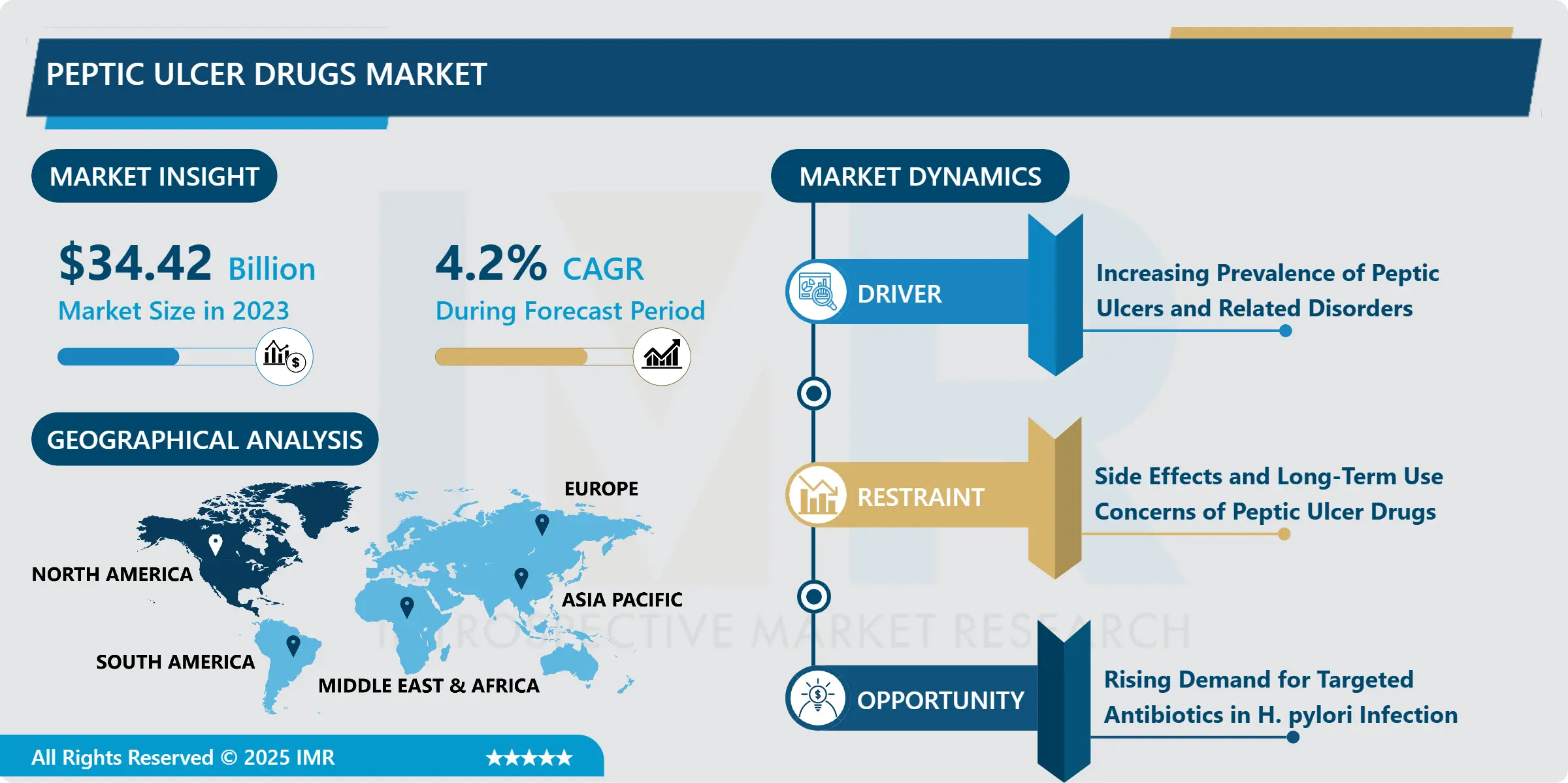
Peptic Ulcer Drugs Market Size Was Valued at USD 34.42 Billion in 2023, and is Projected to Reach USD 49.84 Billion by 2032, Growing at a CAGR of 4.2% From 2024-2032.
The Peptic Ulcer Drugs Market covers products to treat peptic ulcers, which are breaks in the lining of the stomach, small intestine, or esophagus. These medications alleviate inflammation, facilitate ulceration, and discourage additional irritation from a variety of factors associated with peptic ulcers, including bacterial infection or over-production of acid.
The peptic ulcer drugs market has developed amazingly because of the rising incidence of various gut problems like peptic ulcers. These ulcers can be relieved by Heliobacter pylori, onset through the frequent usage of NSAIDs, and hyperacidity. The need for drugs for treatment of such ulcers is due to increased incidence of those conditions among different groups of society.
Study found that PPIs are the treatment choice of preference for patients suffering from peptic ulcers, with secondary preferences being H2 antagonists, antibiotics, and antacids. The market is mainly driven by development in formulation and treatment procedures that can effectively decrease ulcer reoccurrence and enhance healing. Due to constant changes in the gastrointestinal diseases and the introduction of the new methods of drug therapy, it is anticipated that the market for the treatments would progress further, and the companies would focus their efforts on creating new drugs that have increased efficacy, rapid healing, and fewer side effects compared to the present drugs.
Cytoprotective agents as well as selective antibiotics are among the new tool that they have predicted to form a big proportion of peptic ulcers’ treatment. That is why the growth of preventive treatments, especially in high-risk groups such as people over 65 years old and those taking long-term NSAIDs, has also affected the market positively. Moreover, increasing global health consciousness, improved access to healthcare centers and technologies and improvement in diagnostic equipment also exacerbate the requirement of peptic ulcer drugs.
Peptic Ulcer Drugs Market Trend Analysis:
Rising Preference for Proton Pump Inhibitors (PPIs)
The increasing tendency to use proton pump inhibitors (PPIs) as a first-line treatment for peptic ulcers is one of the trends amid the peptic ulcer drugs market. Additionally, they have strong appeal since they provide relief of stomach acid production thus enabling the ulcer to heal and rare chances of the same arising in future. Being effective for the treatment of both gastric and duodenal ulcers, PPIs are gradually emerging as essentials in the management of patients with PUD.
Proton Pump Inhibitors (PPIs) has helped fuel the demand for PPIs more so given that lifestyles have precipitated previously mentioned ailments like stress, low diet, and alcohol which cause acid reflux and ulcers. Given this development, patients in need of a rapid and effective technique for the treatment of ulcer-related pains resort to the coordinated purchase of PPIs. Also, increasing the availability of PPIs in several regions as an over-the-counter drug has a positive effect on its publicity and market line growth.
Rising Demand for Targeted Antibiotics in H. pylori Infection
One important opportunity found prevalent in the peptic-ulcer drugs market is the prospects for antibiotics targeting the Helicobacter pylori (H. pylori) – the major cause of peptic ulcers. H. pylori is a key component of peptic ulcer treatment, and the potential for targeted H. pylori antibiotic treatments with fewer side effects and increased potency is currently emerging. However the global increase in antibiotic resistance has led to emergence of new market which is the antibiotic therapies that can combat resistant antibiotic strains of H.pylori.
Another area focus for investigation is the analysis of antibiotic, combination therapy with other treatments like PPIs or cytoprotective agents. Such combinations may potentially provide improved treatment to patients with peptic ulcers, thus lessening the rate of ulcer relapse, and promoting patient concordance. Businesses that can invent better, more specific antibiotics for the treatment of peptic ulcers could best utilize this potential and, thereby,??? the market.
Peptic Ulcer Drugs Market Segment Analysis:
Peptic Ulcer Drugs Market is Segmented on the basis of Drug Class, Indication, Distribution Channel, Formulation, and Region.
By Drug Class, Proton Pump Inhibitors (PPIs) segment is expected to dominate the market during the forecast period
The peptic ulcer drugs market can be classified based on drug type as proton pump inhibitors, H2 receptor antagonists, antacids, antibiotics, cytoprotective agents, and other. PPIs remain the most used class of drugs owing to the fact that they offer rapid relief and, by suppressing stomach acid secretion, promote ulcer healing. They continue to dominate the market in terms of prescription and use as staple over the counter drugs .
H2 antagonists are also frequently used of ulcers, albeit less effectively as compared to PPIs and particularly where the latter can no longer be given due to contraindications. They act by antagonising histamine receptors and therefore decreasing acid secretion. Antacids and antisecretory agents reduce stomach acidity and promote ulcer healing in gastric ulcers caused by H. pylori, antibiotics on the other hand eradicating the bacterium. The existence of these two drug classes guarantees adequate ulcer control, thereby increasing the overall demand for the drugs.
By Indication, Gastric Ulcers segment expected to held the largest share
Peptic ulcers are generally categorized by the site of occurrence: emesis, peptic ulcer disease including both gastric and duodenal ulcers and Zollinger Ellison Syndrome. Gastric ulcers affect the gastric mucosa and are often the result of infection with H. pylori or the consumption of NSAIDs. These ulcers are treated using PPIs and antibiotics to treat the bacterial infection that causes the ulcer and decreases acid secretion.
Duodenal ulcers develop in the superior portion of the small intestines and they also can be treated using PPIs, H2 antagonists and antibiotics. Less common diseases such as Zollinger-Ellison syndrome, which occurs when tumors stimulate the production of stomach acid, use different therapeutic measures, including the use of higher PPI doses. This need for drugs aimed at these various indications plays a major role in the overall development of the peptic ulcer drugs market.
Peptic Ulcer Drugs Market Regional Insights:
North America is Expected to Dominate the Market Over the Forecast period
North America is on the forefront of the peptic ulcer drugs market since it has a high incidence of gastrointestinal disorders, the population has increased and improved access to healthcare, as well as the availability of effective treatments. The healthcare facilities are well developed in the region, and recently people have become more familiar with peptic ulcers, thereby using the medications at maximum ratio. Thirdly, there is an aging population in North America that is increasingly likely to get peptic ulcers, thus creating the demand for drugs.
The rules of entry in the machinery of the health care systems in the North American region are favorable for the approval of new drugs and their commercialization, which is good news for the pharmaceutical industry. More than half of the major drug manufacturing companies are located in North America therefore the region will remain the largest market for peptic ulcer drugs.
Active Key Players in the Peptic Ulcer Drugs Market:
Pfizer (USA)
AbbVie (USA)
AstraZeneca (UK)
GlaxoSmithKline (UK)
Johnson & Johnson (USA)
Novartis (Switzerland)
Sanofi (France)
Takeda Pharmaceutical (Japan)
Eli Lilly (USA)
Bayer (Germany)
Mylan (USA)
Teva Pharmaceutical Industries (Israel)
Other Active Players
Chapter 1: Introduction
1.1 Scope and Coverage
Chapter 2:Executive Summary
Chapter 3: Market Landscape
3.1 Market Dynamics
3.1.1 Drivers
3.1.2 Restraints
3.1.3 Opportunities
3.1.4 Challenges
3.2 Market Trend Analysis
3.3 PESTLE Analysis
3.4 Porter’s Five Forces Analysis
3.5 Industry Value Chain Analysis
3.6 Ecosystem
3.7 Regulatory Landscape
3.8 Price Trend Analysis
3.9 Patent Analysis
3.10 Technology Evolution
3.11 Investment Pockets
3.12 Import-Export Analysis
Chapter 4: Peptic Ulcer Drugs Market by Type
4.1 Peptic Ulcer Drugs Market Snapshot and Growth Engine
4.2 Peptic Ulcer Drugs Market Overview
4.3 Linear Peptides
4.3.1 Introduction and Market Overview
4.3.2 Historic and Forecasted Market Size in Value USD and Volume Units (2017-2032F)
4.3.3 Key Market Trends, Growth Factors and Opportunities
4.3.4 Linear Peptides: Geographic Segmentation Analysis
4.4 Branched Peptides
4.4.1 Introduction and Market Overview
4.4.2 Historic and Forecasted Market Size in Value USD and Volume Units (2017-2032F)
4.4.3 Key Market Trends, Growth Factors and Opportunities
4.4.4 Branched Peptides: Geographic Segmentation Analysis
4.5 Cyclic Peptides
4.5.1 Introduction and Market Overview
4.5.2 Historic and Forecasted Market Size in Value USD and Volume Units (2017-2032F)
4.5.3 Key Market Trends, Growth Factors and Opportunities
4.5.4 Cyclic Peptides: Geographic Segmentation Analysis
Chapter 5: Peptic Ulcer Drugs Market by Application
5.1 Peptic Ulcer Drugs Market Snapshot and Growth Engine
5.2 Peptic Ulcer Drugs Market Overview
5.3 Cancer
5.3.1 Introduction and Market Overview
5.3.2 Historic and Forecasted Market Size in Value USD and Volume Units (2017-2032F)
5.3.3 Key Market Trends, Growth Factors and Opportunities
5.3.4 Cancer: Geographic Segmentation Analysis
5.4 Diabetes
5.4.1 Introduction and Market Overview
5.4.2 Historic and Forecasted Market Size in Value USD and Volume Units (2017-2032F)
5.4.3 Key Market Trends, Growth Factors and Opportunities
5.4.4 Diabetes: Geographic Segmentation Analysis
5.5 Cardiovascular Diseases
5.5.1 Introduction and Market Overview
5.5.2 Historic and Forecasted Market Size in Value USD and Volume Units (2017-2032F)
5.5.3 Key Market Trends, Growth Factors and Opportunities
5.5.4 Cardiovascular Diseases: Geographic Segmentation Analysis
5.6 Infectious Diseases
5.6.1 Introduction and Market Overview
5.6.2 Historic and Forecasted Market Size in Value USD and Volume Units (2017-2032F)
5.6.3 Key Market Trends, Growth Factors and Opportunities
5.6.4 Infectious Diseases: Geographic Segmentation Analysis
5.7 Neurological Disorders
5.7.1 Introduction and Market Overview
5.7.2 Historic and Forecasted Market Size in Value USD and Volume Units (2017-2032F)
5.7.3 Key Market Trends, Growth Factors and Opportunities
5.7.4 Neurological Disorders: Geographic Segmentation Analysis
5.8 Hormonal Disorders
5.8.1 Introduction and Market Overview
5.8.2 Historic and Forecasted Market Size in Value USD and Volume Units (2017-2032F)
5.8.3 Key Market Trends, Growth Factors and Opportunities
5.8.4 Hormonal Disorders: Geographic Segmentation Analysis
5.9 Others
5.9.1 Introduction and Market Overview
5.9.2 Historic and Forecasted Market Size in Value USD and Volume Units (2017-2032F)
5.9.3 Key Market Trends, Growth Factors and Opportunities
5.9.4 Others: Geographic Segmentation Analysis
Chapter 6: Peptic Ulcer Drugs Market by End User
6.1 Peptic Ulcer Drugs Market Snapshot and Growth Engine
6.2 Peptic Ulcer Drugs Market Overview
6.3 Hospitals
6.3.1 Introduction and Market Overview
6.3.2 Historic and Forecasted Market Size in Value USD and Volume Units (2017-2032F)
6.3.3 Key Market Trends, Growth Factors and Opportunities
6.3.4 Hospitals: Geographic Segmentation Analysis
6.4 Clinics
6.4.1 Introduction and Market Overview
6.4.2 Historic and Forecasted Market Size in Value USD and Volume Units (2017-2032F)
6.4.3 Key Market Trends, Growth Factors and Opportunities
6.4.4 Clinics: Geographic Segmentation Analysis
6.5 Research Institutions
6.5.1 Introduction and Market Overview
6.5.2 Historic and Forecasted Market Size in Value USD and Volume Units (2017-2032F)
6.5.3 Key Market Trends, Growth Factors and Opportunities
6.5.4 Research Institutions: Geographic Segmentation Analysis
6.6 Pharmaceutical and Biotech Companies
6.6.1 Introduction and Market Overview
6.6.2 Historic and Forecasted Market Size in Value USD and Volume Units (2017-2032F)
6.6.3 Key Market Trends, Growth Factors and Opportunities
6.6.4 Pharmaceutical and Biotech Companies: Geographic Segmentation Analysis
Chapter 7: Peptic Ulcer Drugs Market by Route of Administration
7.1 Peptic Ulcer Drugs Market Snapshot and Growth Engine
7.2 Peptic Ulcer Drugs Market Overview
7.3 Parenteral
7.3.1 Introduction and Market Overview
7.3.2 Historic and Forecasted Market Size in Value USD and Volume Units (2017-2032F)
7.3.3 Key Market Trends, Growth Factors and Opportunities
7.3.4 Parenteral: Geographic Segmentation Analysis
7.4 Oral
7.4.1 Introduction and Market Overview
7.4.2 Historic and Forecasted Market Size in Value USD and Volume Units (2017-2032F)
7.4.3 Key Market Trends, Growth Factors and Opportunities
7.4.4 Oral: Geographic Segmentation Analysis
7.5 Transdermal
7.5.1 Introduction and Market Overview
7.5.2 Historic and Forecasted Market Size in Value USD and Volume Units (2017-2032F)
7.5.3 Key Market Trends, Growth Factors and Opportunities
7.5.4 Transdermal: Geographic Segmentation Analysis
7.6 Nasal
7.6.1 Introduction and Market Overview
7.6.2 Historic and Forecasted Market Size in Value USD and Volume Units (2017-2032F)
7.6.3 Key Market Trends, Growth Factors and Opportunities
7.6.4 Nasal: Geographic Segmentation Analysis
Chapter 8: Company Profiles and Competitive Analysis
8.1 Competitive Landscape
8.1.1 Competitive Benchmarking
8.1.2 Peptic Ulcer Drugs Market Share by Manufacturer (2023)
8.1.3 Industry BCG Matrix
8.1.4 Heat Map Analysis
8.1.5 Mergers and Acquisitions
8.2 PFIZER (USA)
8.2.1 Company Overview
8.2.2 Key Executives
8.2.3 Company Snapshot
8.2.4 Role of the Company in the Market
8.2.5 Sustainability and Social Responsibility
8.2.6 Operating Business Segments
8.2.7 Product Portfolio
8.2.8 Business Performance
8.2.9 Key Strategic Moves and Recent Developments
8.2.10 SWOT Analysis
8.3 ABBVIE (USA)
8.4 ASTRAZENECA (UK)
8.5 GLAXOSMITHKLINE (UK)
8.6 JOHNSON & JOHNSON (USA)
8.7 NOVARTIS (SWITZERLAND)
8.8 SANOFI (FRANCE)
8.9 TAKEDA PHARMACEUTICAL (JAPAN)
8.10 ELI LILLY (USA)
8.11 BAYER (GERMANY)
8.12 MYLAN (USA)
8.13 TEVA PHARMACEUTICAL INDUSTRIES (ISRAEL)
8.14 OTHER ACTIVE PLAYERS
Chapter 9: Global Peptic Ulcer Drugs Market By Region
9.1 Overview
9.2. North America Peptic Ulcer Drugs Market
9.2.1 Key Market Trends, Growth Factors and Opportunities
9.2.2 Top Key Companies
9.2.3 Historic and Forecasted Market Size by Segments
9.2.4 Historic and Forecasted Market Size By Type
9.2.4.1 Linear Peptides
9.2.4.2 Branched Peptides
9.2.4.3 Cyclic Peptides
9.2.5 Historic and Forecasted Market Size By Application
9.2.5.1 Cancer
9.2.5.2 Diabetes
9.2.5.3 Cardiovascular Diseases
9.2.5.4 Infectious Diseases
9.2.5.5 Neurological Disorders
9.2.5.6 Hormonal Disorders
9.2.5.7 Others
9.2.6 Historic and Forecasted Market Size By End User
9.2.6.1 Hospitals
9.2.6.2 Clinics
9.2.6.3 Research Institutions
9.2.6.4 Pharmaceutical and Biotech Companies
9.2.7 Historic and Forecasted Market Size By Route of Administration
9.2.7.1 Parenteral
9.2.7.2 Oral
9.2.7.3 Transdermal
9.2.7.4 Nasal
9.2.8 Historic and Forecast Market Size by Country
9.2.8.1 US
9.2.8.2 Canada
9.2.8.3 Mexico
9.3. Eastern Europe Peptic Ulcer Drugs Market
9.3.1 Key Market Trends, Growth Factors and Opportunities
9.3.2 Top Key Companies
9.3.3 Historic and Forecasted Market Size by Segments
9.3.4 Historic and Forecasted Market Size By Type
9.3.4.1 Linear Peptides
9.3.4.2 Branched Peptides
9.3.4.3 Cyclic Peptides
9.3.5 Historic and Forecasted Market Size By Application
9.3.5.1 Cancer
9.3.5.2 Diabetes
9.3.5.3 Cardiovascular Diseases
9.3.5.4 Infectious Diseases
9.3.5.5 Neurological Disorders
9.3.5.6 Hormonal Disorders
9.3.5.7 Others
9.3.6 Historic and Forecasted Market Size By End User
9.3.6.1 Hospitals
9.3.6.2 Clinics
9.3.6.3 Research Institutions
9.3.6.4 Pharmaceutical and Biotech Companies
9.3.7 Historic and Forecasted Market Size By Route of Administration
9.3.7.1 Parenteral
9.3.7.2 Oral
9.3.7.3 Transdermal
9.3.7.4 Nasal
9.3.8 Historic and Forecast Market Size by Country
9.3.8.1 Russia
9.3.8.2 Bulgaria
9.3.8.3 The Czech Republic
9.3.8.4 Hungary
9.3.8.5 Poland
9.3.8.6 Romania
9.3.8.7 Rest of Eastern Europe
9.4. Western Europe Peptic Ulcer Drugs Market
9.4.1 Key Market Trends, Growth Factors and Opportunities
9.4.2 Top Key Companies
9.4.3 Historic and Forecasted Market Size by Segments
9.4.4 Historic and Forecasted Market Size By Type
9.4.4.1 Linear Peptides
9.4.4.2 Branched Peptides
9.4.4.3 Cyclic Peptides
9.4.5 Historic and Forecasted Market Size By Application
9.4.5.1 Cancer
9.4.5.2 Diabetes
9.4.5.3 Cardiovascular Diseases
9.4.5.4 Infectious Diseases
9.4.5.5 Neurological Disorders
9.4.5.6 Hormonal Disorders
9.4.5.7 Others
9.4.6 Historic and Forecasted Market Size By End User
9.4.6.1 Hospitals
9.4.6.2 Clinics
9.4.6.3 Research Institutions
9.4.6.4 Pharmaceutical and Biotech Companies
9.4.7 Historic and Forecasted Market Size By Route of Administration
9.4.7.1 Parenteral
9.4.7.2 Oral
9.4.7.3 Transdermal
9.4.7.4 Nasal
9.4.8 Historic and Forecast Market Size by Country
9.4.8.1 Germany
9.4.8.2 UK
9.4.8.3 France
9.4.8.4 The Netherlands
9.4.8.5 Italy
9.4.8.6 Spain
9.4.8.7 Rest of Western Europe
9.5. Asia Pacific Peptic Ulcer Drugs Market
9.5.1 Key Market Trends, Growth Factors and Opportunities
9.5.2 Top Key Companies
9.5.3 Historic and Forecasted Market Size by Segments
9.5.4 Historic and Forecasted Market Size By Type
9.5.4.1 Linear Peptides
9.5.4.2 Branched Peptides
9.5.4.3 Cyclic Peptides
9.5.5 Historic and Forecasted Market Size By Application
9.5.5.1 Cancer
9.5.5.2 Diabetes
9.5.5.3 Cardiovascular Diseases
9.5.5.4 Infectious Diseases
9.5.5.5 Neurological Disorders
9.5.5.6 Hormonal Disorders
9.5.5.7 Others
9.5.6 Historic and Forecasted Market Size By End User
9.5.6.1 Hospitals
9.5.6.2 Clinics
9.5.6.3 Research Institutions
9.5.6.4 Pharmaceutical and Biotech Companies
9.5.7 Historic and Forecasted Market Size By Route of Administration
9.5.7.1 Parenteral
9.5.7.2 Oral
9.5.7.3 Transdermal
9.5.7.4 Nasal
9.5.8 Historic and Forecast Market Size by Country
9.5.8.1 China
9.5.8.2 India
9.5.8.3 Japan
9.5.8.4 South Korea
9.5.8.5 Malaysia
9.5.8.6 Thailand
9.5.8.7 Vietnam
9.5.8.8 The Philippines
9.5.8.9 Australia
9.5.8.10 New Zealand
9.5.8.11 Rest of APAC
9.6. Middle East & Africa Peptic Ulcer Drugs Market
9.6.1 Key Market Trends, Growth Factors and Opportunities
9.6.2 Top Key Companies
9.6.3 Historic and Forecasted Market Size by Segments
9.6.4 Historic and Forecasted Market Size By Type
9.6.4.1 Linear Peptides
9.6.4.2 Branched Peptides
9.6.4.3 Cyclic Peptides
9.6.5 Historic and Forecasted Market Size By Application
9.6.5.1 Cancer
9.6.5.2 Diabetes
9.6.5.3 Cardiovascular Diseases
9.6.5.4 Infectious Diseases
9.6.5.5 Neurological Disorders
9.6.5.6 Hormonal Disorders
9.6.5.7 Others
9.6.6 Historic and Forecasted Market Size By End User
9.6.6.1 Hospitals
9.6.6.2 Clinics
9.6.6.3 Research Institutions
9.6.6.4 Pharmaceutical and Biotech Companies
9.6.7 Historic and Forecasted Market Size By Route of Administration
9.6.7.1 Parenteral
9.6.7.2 Oral
9.6.7.3 Transdermal
9.6.7.4 Nasal
9.6.8 Historic and Forecast Market Size by Country
9.6.8.1 Turkiye
9.6.8.2 Bahrain
9.6.8.3 Kuwait
9.6.8.4 Saudi Arabia
9.6.8.5 Qatar
9.6.8.6 UAE
9.6.8.7 Israel
9.6.8.8 South Africa
9.7. South America Peptic Ulcer Drugs Market
9.7.1 Key Market Trends, Growth Factors and Opportunities
9.7.2 Top Key Companies
9.7.3 Historic and Forecasted Market Size by Segments
9.7.4 Historic and Forecasted Market Size By Type
9.7.4.1 Linear Peptides
9.7.4.2 Branched Peptides
9.7.4.3 Cyclic Peptides
9.7.5 Historic and Forecasted Market Size By Application
9.7.5.1 Cancer
9.7.5.2 Diabetes
9.7.5.3 Cardiovascular Diseases
9.7.5.4 Infectious Diseases
9.7.5.5 Neurological Disorders
9.7.5.6 Hormonal Disorders
9.7.5.7 Others
9.7.6 Historic and Forecasted Market Size By End User
9.7.6.1 Hospitals
9.7.6.2 Clinics
9.7.6.3 Research Institutions
9.7.6.4 Pharmaceutical and Biotech Companies
9.7.7 Historic and Forecasted Market Size By Route of Administration
9.7.7.1 Parenteral
9.7.7.2 Oral
9.7.7.3 Transdermal
9.7.7.4 Nasal
9.7.8 Historic and Forecast Market Size by Country
9.7.8.1 Brazil
9.7.8.2 Argentina
9.7.8.3 Rest of SA
Chapter 10 Analyst Viewpoint and Conclusion
10.1 Recommendations and Concluding Analysis
10.2 Potential Market Strategies
Chapter 11 Research Methodology
11.1 Research Process
11.2 Primary Research
11.3 Secondary Research
Q1: What would be the forecast period in the Peptic Ulcer Drugs Market research report?
A1: The forecast period in the Peptic Ulcer Drugs Market research report is 2024-2032.
Q2: Who are the key players in the Peptic Ulcer Drugs Market?
A2: Pfizer (USA), AbbVie (USA), AstraZeneca (UK), GlaxoSmithKline (UK), Johnson & Johnson (USA), Novartis (Switzerland), Sanofi (France), Takeda Pharmaceutical (Japan) and Other Active Players.
Q3: What are the segments of the Peptic Ulcer Drugs Market?
A3: The Peptic Ulcer Drugs Market is segmented into Drug Class, Indication, Distribution Channel, Formulation and Region. By Drug Class, the market is categorized into Proton Pump Inhibitors (PPIs), H2 Antagonists, Antacids, Antibiotics, Cytoprotective Agents, Others. By Indication, the market is categorized into Gastric Ulcers, Duodenal Ulcers, Zollinger-Ellison Syndrome. By Distribution Channel, the market is categorized into Hospital Pharmacies, Retail Pharmacies, Online Pharmacies. By Formulation, the market is categorized into Tablets, Capsules, Oral Suspensions, Injections. By region, it is analyzed across North America (U.S., Canada, Mexico), Eastern Europe (Russia, Bulgaria, The Czech Republic, Hungary, Poland, Romania, Rest of Eastern Europe), Western Europe (Germany, UK, France, Netherlands, Italy, Spain, Rest of Western Europe), Asia Pacific (China, India, Japan, South Korea, Malaysia, Thailand, Vietnam, The Philippines, Australia, New Zealand, Rest of APAC), Middle East & Africa (Turkiye, Bahrain, Kuwait, Saudi Arabia, Qatar, UAE, Israel, South Africa), South America (Brazil, Argentina, Rest of SA).
Q4: What is the Peptic Ulcer Drugs Market?
A4: The Peptic Ulcer Drugs Market covers products to treat peptic ulcers, which are breaks in the lining of the stomach, small intestine, or esophagus. These medications alleviate inflammation, facilitate ulceration, and discourage additional irritation from a variety of factors associated with peptic ulcers, including bacterial infection or over-production of acid.
Q5: How big is the Peptic Ulcer Drugs Market?
A5: Peptic Ulcer Drugs Market Size Was Valued at USD 34.42 Billion in 2023, and is Projected to Reach USD 49.84 Billion by 2032, Growing at a CAGR of 4.2% From 2024-2032.
How to Buy a Report from eminsights.jp
On the product page, choose the license you want: Single-User License, Multi-User License or Enterprise License.
If you required report in your native language, then you can click on Translated Report button and fill out the form with report name and language you want, then our team will contact you as soon as possible.
Click the Buy Now button.
You will be redirected to the checkout page. Enter your company details and payment information.
Click Place Order to complete the purchase.
Confirmation: You’ll receive an order confirmation and our team will contact you shortly with your ordered report.
If you have any questions, fill out the contact form below or email us at bizdev@eminsights.net.
Thank you for choosing eminsights.jp!