Stay Ahead in Fast-Growing Economies.
Browse Reports Now




PACS and RIS Market Outlook & Forecast to 2032
PACS and RIS Market To Reach USD 5 Billion by 2032

IMR Group
Description
PACS and RIS Market Synopsis:
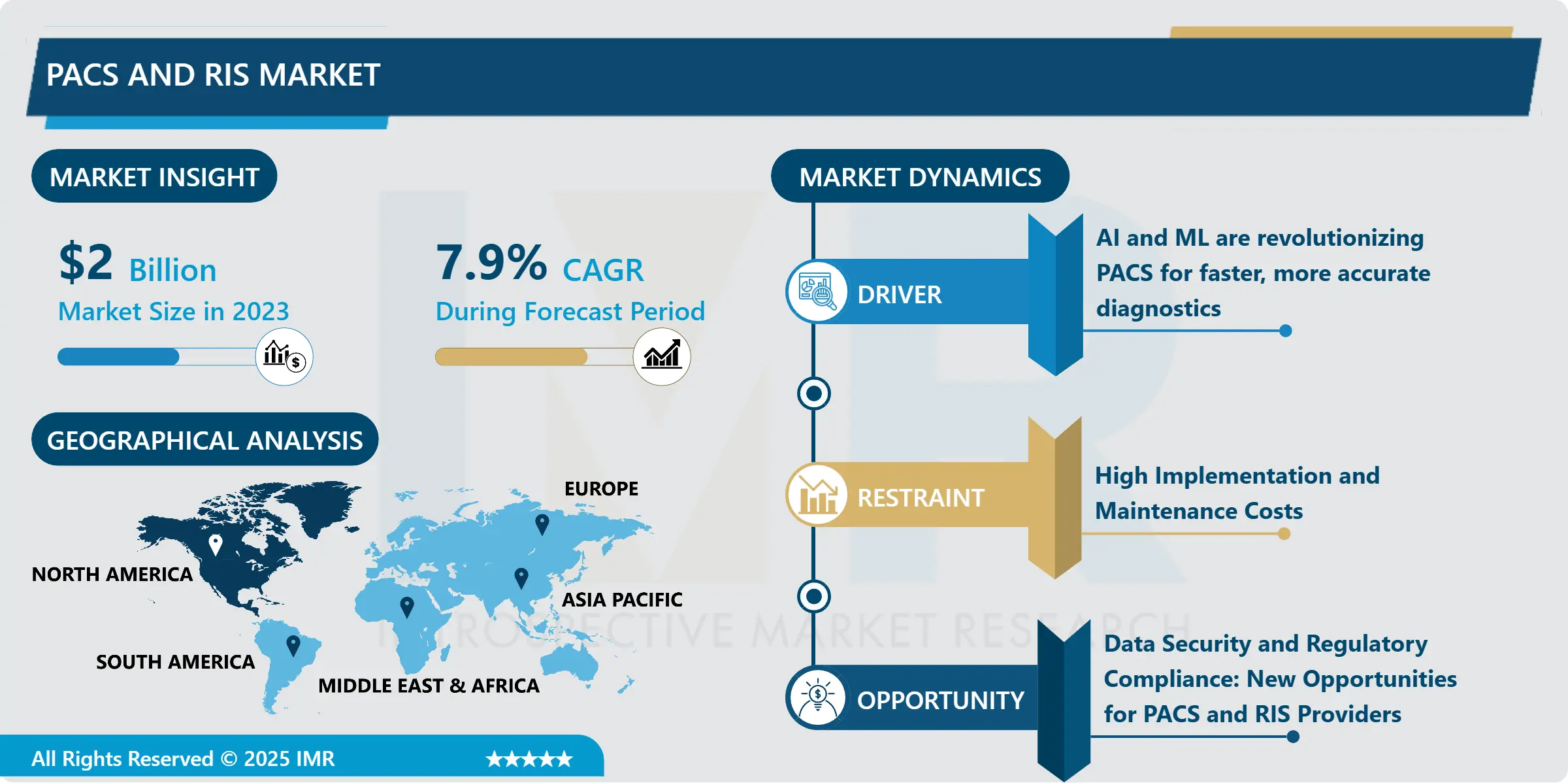
PACS and RIS Market Size Was Valued at USD 2 Billion in 2023, and is Projected to Reach USD 5 Billion by 2032, Growing at a CAGR of 7.9% From 2024-2032.
The PACS (Picture Archiving and Communication System) and RIS (Radiology Information System) market encompasses advanced healthcare IT solutions designed to streamline the management, storage, retrieval, and communication of medical imaging data. PACS enables the electronic handling of medical images from modalities such as X-ray, MRI, and CT scans, while RIS focuses on the administrative and workflow management aspects within radiology departments, including patient scheduling, tracking, and reporting. Together, these systems facilitate efficient radiological workflows, enhance diagnostic accuracy, and promote faster clinical decision-making.
The PACS and RIS market is a critical segment of the broader healthcare IT and medical imaging industry, driven by the rising adoption of digital imaging solutions across hospitals, diagnostic centers, and outpatient clinics globally. Increasing demand for better healthcare outcomes, coupled with government initiatives promoting digital health infrastructure, has accelerated the integration of PACS and RIS systems. Furthermore, the growing prevalence of chronic diseases and rising geriatric population are expanding the need for timely and accurate diagnostic imaging.
Technological advancements such as cloud-based PACS, artificial intelligence (AI) integration for image analysis, and enhanced interoperability with Electronic Health Records (EHR) are reshaping the PACS and RIS market. Cloud deployments provide scalable and cost-effective solutions for healthcare providers, enabling remote access and teleradiology services. Moreover, AI-powered tools assist radiologists in improving image interpretation accuracy and reducing workload. These innovations are boosting market adoption, especially in developed economies, while emerging markets show significant growth potential due to increasing healthcare infrastructure investments.
The PACS and RIS market is characterized by intense competition among global technology providers and specialized vendors focusing on innovation and partnerships with healthcare institutions. Market leaders are investing heavily in R&D to deliver integrated, user-friendly solutions that improve radiology workflows and patient outcomes. Additionally, compliance with stringent healthcare regulations and standards such as HIPAA, GDPR, and DICOM is essential to ensure data security and privacy. These regulatory frameworks influence product development and adoption rates across different regions, further shaping the market dynamics.
PACS and RIS Market Trend Analysis:
AI and Machine Learning Transforming PACS Systems for Enhanced Diagnostics
Deploying AI/ML in PACS is transforming medical imaging, improving diagnostic outcomes using AI/ML for accuracy, efficiency, and minimal human-interference. AI and ML can proceed with the image analysis at an increasingly enhanced rate and accuracy, helping the radiologist to plan treatment at a faster speed. Another key area, through which PACS is expected to be transformed by AI is the automated interpretation of images. Using AI-based approach has shown promising result in diagnosis of diseases like cancer, cardiovascular disease or neurological disorders from the medical images including CT scan, MRI, X-ray better than manual analysis. For instance, in oncology, it can identify early-stage tumors in imaging, and this discovery can go a long way in having radiologists diagnose cancer early saving lives. This capability does not only contribute to increasing the quality of diagnostics, but it also minimizes the possibility of human error and, therefore, patient benefit. Deep learning algorithms are used to learn from patterns of imaging data and are designed to detect and classify them in particular. They also get updated as they have to learn from a large set of data and optimize its diagnostic capabilities with time. Therefore, radiologists get the assistances of AI in radiology consultancy where more detailed and accurate analysis are given and the time spent in image interpretation is reduced yet made more accurate.
In specific, AI and ML in PACS systems are making workflow more efficient. For instance, the algorithms can detect if a case is urgent or out of the ordinary, and thus tag it for early attention, and so those that are critical are dealt with first. There won’t be any additional load on the radiologists also, since the routine activities like sorting images, annotations, and reports will also be handled by the AI system. Also, the increased demand for AI-driven predictive analytics constitutes a highly important trend. These systems can, therefore, use past imaging data and patient file information to determine patient prognosis, disease prognosis, and the possibility of disease relapse, therefore informing better long-term patient management. These predictive potentials include, not only diagnostic capabilities but parts of treatment planning and monitoring, thus broadening the range of contributions by PACS to the healthcare environment.
Data Security and Regulatory Compliance Create New Opportunities for PACS and RIS Provider
With healthcare organizations today storing more patient data electronically, issues of data privacy and other compliance requirement have arisen significantly, thus opening new prospects for PACS and RIS solution suppliers. Downs American healthcare organizations due to strict regulation such as the HIPAA (Health Insurance Portability and accountability Act) in the U.S, GDPR (General Data Protection Regulation) in the Europe, and other country’s privacy laws Health care organizations are under pressure to keep medical data safe from cyber threats and breaches. Due to this regulatory environment, most hospitals, imaging centres and healthcare systems are looking for PACS and RIS systems that provide sound security features like data encryption, multiple factor authentication, network security with access controls and log trails. This means that vendors that are capable of delivering systems that already incorporate enhanced security, and that meet all the legal requirements will be the most sought for especially because, and because health care organization shall place priority in protecting their data.
In addition, the rising sophistication of the data involved in healthcare provision and growing need for sound IT platforms and solutions that will guarantee patient data security have created fresh opportunities in the PACS and RIS spaces. With the transition to cloud solutions and even more interconnected systems in healthcare, providers are interested in solutions that can secure data in transit while keeping data sharing efficient. Vendors that can provide PACS and RIS solutions that are safe and needs to be loaded on to the cloud and is compatible with corresponding standards of various countries will again have a main advantage in the market. This transition to more secured and compliant systems also opens windows of opportunities that PACS and RIS developers can engage with healthcare organisations, thus can provide them with suitably designed solutions to match their data security compliance and need of rising compliant digital healthcare solutions.
PACS and RIS Market Segment Analysis:
PACS and RIS Market Segmented based on type, application, end user, and region.
By Type, the PACS segment is expected to dominate the market during the forecast period
The PACS (Picture Archiving and Communication Systems) segment is anticipated to have the largest market share because of its more significant contribution to the industry regarding its contribution to the integration of medical imaging processes into the digital framework widely adopted across healthcare systems. PACS therefore has an advantage over direct digital radiography in speed of delivery, access and cost compared to a conventional, film-based healthcare system. It allows creation and management of medical imaging information from image creation to archive and retrieval accomplish more promptly and effectively to improve patients’ management. PACS systems are being actively incorporated into healthcare because of the gradual implementation of latest imaging techniques like 3D imaging, MRI & CT scans and because of emphasis on telemedicine. They enable remote viewing of images needed in telehealth, distant consultations, and extend the use of these systems in the contemporary settings of medical practice.
Also, the rising need for Artificial intelligence integrated PACS systems is another factor that is boosting its segment’s position. PACS solutions are being developed with features of artificial intelligence and machine learning to help analyze images and improve diagnostics as well as optimize interactions. AI can assist radiologists by pointing out structures in an image that may be invisible to the naked eye and hence can increase early disease diagnoses as well as decrease diagnostic oversights. Moreover, new generation of PACS is cloud based PACS systems are also used due to its flexibility, low investment on hardware and then potentialities of cloud services from any point. PACS again emerges as the market leader for software for the duration of the forecast period due to several factors: Cloud-based products are likely to be more affordable and more flexible, a key consideration as healthcare facilities, especially in emerging markets, seek to contain costs and upgrade their diagnostic capabilities.
By Application, the Software segment expected to hold the largest share
For the duration of the forecast period, one of the software segments is anticipated to dominate the size of the PACS and RIS market. This is mainly attributed to the fact that organisations are moving to cloud solutions, integration of AI and ML, and the need for software solutions that can improve and complement the management, acquisition, and processing of medical imaging data. Software solutions, especially those including AI, help not only to acquire and organize medical images, but also to decide on their analysis and display. Some samples of AI implementation are next. The technology of image analysis, for example, enables radiologists to diagnose cancerous tissues by minimizing human intervention and hence the chances of errors. The need to install these software solutions as part of other healthcare IT systems, such as EHR (Electronic Health Records) and HIS (Hospital Information Systems) cements the role of software in creating efficient health care networks.
Moreover, the aspects of data protection, as well as regulatory concerns, are driving the growth of software solutions meeting requirements for secure, scalable, and compliant systems. Web-based PACS and RIS software solutions are suitable for use by healthcare organizations of different types, and they are especially necessary in the emerging markets when cost-efficient solutions are the most important. In addition, SaaS solutions have led to lower costs as well as more clinics, imaging centers, and hospitals as adopters of these solutions. Considering these aspects, software solutions, particularly those addressed in the cloud and artificial intelligence, will remain the market leaders, since investing in efficient diagnostic support systems, the enhancement of which is facilitated by AI and cloud technologies, is crucial for addressing the issues arising in the context of the growing global demand for technological support of the healthcare sector.
PACS and RIS Market Regional Insights:
North America is Expected to Dominate the Market Over the Forecast period
The present market for PACS and RIS market is projected to be marked greater in the North American region in the foreseen future. It can be attributed to the fact that the region has well developed healthcare systems, a high level of penetration of digital imaging technologies and the emphasis on the combination of modern technologies into the sphere of healthcare. However, the United States continues to dominate the direct investment in health IT, as a large number of existing and new hospitals and diagnostic centers, and outpatient clinics replace traditional film based radiology with the digital PACS systems. Furthermore, there has been a transition in the implementation of PACS and RIS in the USA and Canada will quickly transition to cloud-based solutions due to their flexibility, low cost and support for remote working that is vital for telemedicine and consultations.
The increasing number of patients with chronic diseases which include cancer, cardiovascular diseases as well as neurological disorders in North America is also contributing to the use of diagnostic imaging technologies. Because most of these conditions call for more frequent and sophisticated imaging studies, PACS and RIS play a vital role in speeding up accuracy in diagnosis. Also, the strategic development of AI in the region for the improvement of medical technologies is creating robust opportunities for the analysis of adopting AI and ML with the PACS and RIS systems. In this part, the applications of AI in radiology have been described how the radiologists are increasing the diagnostic rates, reducing time, and focusing on critical patients cases for boosting the overall performance of a health care facility. Due to the well-developed regulation and high health care expenditure North America is expected to retain its position as the leading market for PACS and RIS in the years to come.
Active Key Players in the PACS and RIS Market
Agfa-Gevaert Group (Belgium)
Canon Medical Systems Corporation (Japan)
Carestream Health (United States)
Cerner Corporation (United States)
Dell Technologies (VMware) (United States)
Esaote S.p.A. (Italy)
Fujifilm Holdings Corporation (Japan)
GE Healthcare (United States)
Hitachi Healthcare (Japan)
Infinitt Healthcare (South Korea)
KONICA MINOLTA, Inc. (Japan)
McKesson Corporation (United States)
Merge Healthcare (acquired by IBM Watson Health) (United States)
Philips Healthcare (Netherlands)
Radiology Partners (United States)
Ricoh Company, Ltd. (Japan)
Siemens Healthineers (Germany)
Visiomed Group (France), Other Active Players
Chapter 1: Introduction
1.1 Scope and Coverage
Chapter 2:Executive Summary
Chapter 3: Market Landscape
3.1 Market Dynamics
3.1.1 Drivers
3.1.2 Restraints
3.1.3 Opportunities
3.1.4 Challenges
3.2 Market Trend Analysis
3.3 PESTLE Analysis
3.4 Porter’s Five Forces Analysis
3.5 Industry Value Chain Analysis
3.6 Ecosystem
3.7 Regulatory Landscape
3.8 Price Trend Analysis
3.9 Patent Analysis
3.10 Technology Evolution
3.11 Investment Pockets
3.12 Import-Export Analysis
Chapter 4: PACS and RIS Market by Product Type
4.1 PACS and RIS Market Snapshot and Growth Engine
4.2 PACS and RIS Market Overview
4.3 RIS
4.3.1 Introduction and Market Overview
4.3.2 Historic and Forecasted Market Size in Value USD and Volume Units (2017-2032F)
4.3.3 Key Market Trends, Growth Factors and Opportunities
4.3.4 RIS: Geographic Segmentation Analysis
4.4 PACS
4.4.1 Introduction and Market Overview
4.4.2 Historic and Forecasted Market Size in Value USD and Volume Units (2017-2032F)
4.4.3 Key Market Trends, Growth Factors and Opportunities
4.4.4 PACS: Geographic Segmentation Analysis
Chapter 5: PACS and RIS Market by Component
5.1 PACS and RIS Market Snapshot and Growth Engine
5.2 PACS and RIS Market Overview
5.3 Software
5.3.1 Introduction and Market Overview
5.3.2 Historic and Forecasted Market Size in Value USD and Volume Units (2017-2032F)
5.3.3 Key Market Trends, Growth Factors and Opportunities
5.3.4 Software: Geographic Segmentation Analysis
5.4 Hardware
5.4.1 Introduction and Market Overview
5.4.2 Historic and Forecasted Market Size in Value USD and Volume Units (2017-2032F)
5.4.3 Key Market Trends, Growth Factors and Opportunities
5.4.4 Hardware: Geographic Segmentation Analysis
Chapter 6: PACS and RIS Market by End User
6.1 PACS and RIS Market Snapshot and Growth Engine
6.2 PACS and RIS Market Overview
6.3 Hospitals
6.3.1 Introduction and Market Overview
6.3.2 Historic and Forecasted Market Size in Value USD and Volume Units (2017-2032F)
6.3.3 Key Market Trends, Growth Factors and Opportunities
6.3.4 Hospitals: Geographic Segmentation Analysis
6.4 Academic & Research Institutes
6.4.1 Introduction and Market Overview
6.4.2 Historic and Forecasted Market Size in Value USD and Volume Units (2017-2032F)
6.4.3 Key Market Trends, Growth Factors and Opportunities
6.4.4 Academic & Research Institutes: Geographic Segmentation Analysis
6.5 and Diagnostic Centres
6.5.1 Introduction and Market Overview
6.5.2 Historic and Forecasted Market Size in Value USD and Volume Units (2017-2032F)
6.5.3 Key Market Trends, Growth Factors and Opportunities
6.5.4 and Diagnostic Centres: Geographic Segmentation Analysis
Chapter 7: Company Profiles and Competitive Analysis
7.1 Competitive Landscape
7.1.1 Competitive Benchmarking
7.1.2 PACS and RIS Market Share by Manufacturer (2023)
7.1.3 Industry BCG Matrix
7.1.4 Heat Map Analysis
7.1.5 Mergers and Acquisitions
7.2 AGFA-GEVAERT GROUP (BELGIUM)
7.2.1 Company Overview
7.2.2 Key Executives
7.2.3 Company Snapshot
7.2.4 Role of the Company in the Market
7.2.5 Sustainability and Social Responsibility
7.2.6 Operating Business Segments
7.2.7 Product Portfolio
7.2.8 Business Performance
7.2.9 Key Strategic Moves and Recent Developments
7.2.10 SWOT Analysis
7.3 CANON MEDICAL SYSTEMS CORPORATION (JAPAN)
7.4 CARESTREAM HEALTH (UNITED STATES)
7.5 CERNER CORPORATION (UNITED STATES)
7.6 DELL TECHNOLOGIES (VMWARE) (UNITED STATES)
7.7 ESAOTE S.P.A. (ITALY)
7.8 FUJIFILM HOLDINGS CORPORATION (JAPAN)
7.9 GE HEALTHCARE (UNITED STATES)
7.10 HITACHI HEALTHCARE (JAPAN)
7.11 INFINITT HEALTHCARE (SOUTH KOREA)
7.12 KONICA MINOLTA INC. (JAPAN)
7.13 MCKESSON CORPORATION (UNITED STATES)
7.14 MERGE HEALTHCARE (ACQUIRED BY IBM WATSON HEALTH) (UNITED STATES)
7.15 PHILIPS HEALTHCARE (NETHERLANDS)
7.16 RADIOLOGY PARTNERS (UNITED STATES)
7.17 RICOH COMPANY
7.18 LTD. (JAPAN)
7.19 SIEMENS HEALTHINEERS (GERMANY)
7.20 VISIOMED GROUP (FRANCE)
7.21 OTHER ACTIVE PLAYERS
Chapter 8: Global PACS and RIS Market By Region
8.1 Overview
8.2. North America PACS and RIS Market
8.2.1 Key Market Trends, Growth Factors and Opportunities
8.2.2 Top Key Companies
8.2.3 Historic and Forecasted Market Size by Segments
8.2.4 Historic and Forecasted Market Size By Product Type
8.2.4.1 RIS
8.2.4.2 PACS
8.2.5 Historic and Forecasted Market Size By Component
8.2.5.1 Software
8.2.5.2 Hardware
8.2.6 Historic and Forecasted Market Size By End User
8.2.6.1 Hospitals
8.2.6.2 Academic & Research Institutes
8.2.6.3 and Diagnostic Centres
8.2.7 Historic and Forecast Market Size by Country
8.2.7.1 US
8.2.7.2 Canada
8.2.7.3 Mexico
8.3. Eastern Europe PACS and RIS Market
8.3.1 Key Market Trends, Growth Factors and Opportunities
8.3.2 Top Key Companies
8.3.3 Historic and Forecasted Market Size by Segments
8.3.4 Historic and Forecasted Market Size By Product Type
8.3.4.1 RIS
8.3.4.2 PACS
8.3.5 Historic and Forecasted Market Size By Component
8.3.5.1 Software
8.3.5.2 Hardware
8.3.6 Historic and Forecasted Market Size By End User
8.3.6.1 Hospitals
8.3.6.2 Academic & Research Institutes
8.3.6.3 and Diagnostic Centres
8.3.7 Historic and Forecast Market Size by Country
8.3.7.1 Russia
8.3.7.2 Bulgaria
8.3.7.3 The Czech Republic
8.3.7.4 Hungary
8.3.7.5 Poland
8.3.7.6 Romania
8.3.7.7 Rest of Eastern Europe
8.4. Western Europe PACS and RIS Market
8.4.1 Key Market Trends, Growth Factors and Opportunities
8.4.2 Top Key Companies
8.4.3 Historic and Forecasted Market Size by Segments
8.4.4 Historic and Forecasted Market Size By Product Type
8.4.4.1 RIS
8.4.4.2 PACS
8.4.5 Historic and Forecasted Market Size By Component
8.4.5.1 Software
8.4.5.2 Hardware
8.4.6 Historic and Forecasted Market Size By End User
8.4.6.1 Hospitals
8.4.6.2 Academic & Research Institutes
8.4.6.3 and Diagnostic Centres
8.4.7 Historic and Forecast Market Size by Country
8.4.7.1 Germany
8.4.7.2 UK
8.4.7.3 France
8.4.7.4 The Netherlands
8.4.7.5 Italy
8.4.7.6 Spain
8.4.7.7 Rest of Western Europe
8.5. Asia Pacific PACS and RIS Market
8.5.1 Key Market Trends, Growth Factors and Opportunities
8.5.2 Top Key Companies
8.5.3 Historic and Forecasted Market Size by Segments
8.5.4 Historic and Forecasted Market Size By Product Type
8.5.4.1 RIS
8.5.4.2 PACS
8.5.5 Historic and Forecasted Market Size By Component
8.5.5.1 Software
8.5.5.2 Hardware
8.5.6 Historic and Forecasted Market Size By End User
8.5.6.1 Hospitals
8.5.6.2 Academic & Research Institutes
8.5.6.3 and Diagnostic Centres
8.5.7 Historic and Forecast Market Size by Country
8.5.7.1 China
8.5.7.2 India
8.5.7.3 Japan
8.5.7.4 South Korea
8.5.7.5 Malaysia
8.5.7.6 Thailand
8.5.7.7 Vietnam
8.5.7.8 The Philippines
8.5.7.9 Australia
8.5.7.10 New Zealand
8.5.7.11 Rest of APAC
8.6. Middle East & Africa PACS and RIS Market
8.6.1 Key Market Trends, Growth Factors and Opportunities
8.6.2 Top Key Companies
8.6.3 Historic and Forecasted Market Size by Segments
8.6.4 Historic and Forecasted Market Size By Product Type
8.6.4.1 RIS
8.6.4.2 PACS
8.6.5 Historic and Forecasted Market Size By Component
8.6.5.1 Software
8.6.5.2 Hardware
8.6.6 Historic and Forecasted Market Size By End User
8.6.6.1 Hospitals
8.6.6.2 Academic & Research Institutes
8.6.6.3 and Diagnostic Centres
8.6.7 Historic and Forecast Market Size by Country
8.6.7.1 Turkiye
8.6.7.2 Bahrain
8.6.7.3 Kuwait
8.6.7.4 Saudi Arabia
8.6.7.5 Qatar
8.6.7.6 UAE
8.6.7.7 Israel
8.6.7.8 South Africa
8.7. South America PACS and RIS Market
8.7.1 Key Market Trends, Growth Factors and Opportunities
8.7.2 Top Key Companies
8.7.3 Historic and Forecasted Market Size by Segments
8.7.4 Historic and Forecasted Market Size By Product Type
8.7.4.1 RIS
8.7.4.2 PACS
8.7.5 Historic and Forecasted Market Size By Component
8.7.5.1 Software
8.7.5.2 Hardware
8.7.6 Historic and Forecasted Market Size By End User
8.7.6.1 Hospitals
8.7.6.2 Academic & Research Institutes
8.7.6.3 and Diagnostic Centres
8.7.7 Historic and Forecast Market Size by Country
8.7.7.1 Brazil
8.7.7.2 Argentina
8.7.7.3 Rest of SA
Chapter 9 Analyst Viewpoint and Conclusion
9.1 Recommendations and Concluding Analysis
9.2 Potential Market Strategies
Chapter 10 Research Methodology
10.1 Research Process
10.2 Primary Research
10.3 Secondary Research
Q1: What would be the forecast period in the PACS and RIS Market research report?
A1: The forecast period in the PACS and RIS Market research report is 2024-2032.
Q2: Who are the key players in the PACS and RIS Market?
A2: Agfa-Gevaert Group (Belgium), Canon Medical Systems Corporation (Japan), Carestream Health (United States), Cerner Corporation (United States), Dell Technologies (VMware) (United States), Esaote S.p.A. (Italy), Fujifilm Holdings Corporation (Japan), GE Healthcare (United States), Hitachi Healthcare (Japan), Infinitt Healthcare (South Korea), KONICA MINOLTA, Inc. (Japan), McKesson Corporation (United States), Merge Healthcare (acquired by IBM Watson Health) (United States), Philips Healthcare (Netherlands), Radiology Partners (United States), Ricoh Company, Ltd. (Japan), Siemens Healthineers (Germany), Visiomed Group (France), Other Active Players.
Q3: What are the segments of the PACS and RIS Market?
A3: The PACS and RIS Market is segmented into Type, Application, End User, and region. By Type, the market is categorized into RIS, PACS. By Component, the market is categorized into Software, Hardware. By End User, the market is categorized into (Hospitals, Academic & Research Institutes, and Diagnostic Centers. By region, it is analyzed across North America (U.S., Canada, Mexico), Eastern Europe (Russia, Bulgaria, The Czech Republic, Hungary, Poland, Romania, Rest of Eastern Europe), Western Europe (Germany, UK, France, Netherlands, Italy, Spain, Rest of Western Europe), Asia Pacific (China, India, Japan, South Korea, Malaysia, Thailand, Vietnam, The Philippines, Australia, New-Zealand, Rest of APAC), Middle East & Africa (Türkiye, Bahrain, Kuwait, Saudi Arabia, Qatar, UAE, Israel, South Africa), South America (Brazil, Argentina, Rest of SA).
Q4: What is the PACS and RIS Market?
A4: The PACS (Picture Archiving and Communication System) and RIS (Radiology Information System) market encompasses advanced healthcare IT solutions designed to streamline the management, storage, retrieval, and communication of medical imaging data. PACS enables the electronic handling of medical images from modalities such as X-ray, MRI, and CT scans, while RIS focuses on the administrative and workflow management aspects within radiology departments, including patient scheduling, tracking, and reporting. Together, these systems facilitate efficient radiological workflows, enhance diagnostic accuracy, and promote faster clinical decision-making.
Q5: How big is the PACS and RIS Market?
A5: PACS and RIS Market Size Was Valued at USD 2 Billion in 2023, and is Projected to Reach USD 5 Billion by 2032, Growing at a CAGR of 7.9% From 2024-2032.
How to Buy a Report from eminsights.jp
On the product page, choose the license you want: Single-User License, Multi-User License or Enterprise License.
If you required report in your native language, then you can click on Translated Report button and fill out the form with report name and language you want, then our team will contact you as soon as possible.
Click the Buy Now button.
You will be redirected to the checkout page. Enter your company details and payment information.
Click Place Order to complete the purchase.
Confirmation: You’ll receive an order confirmation and our team will contact you shortly with your ordered report.
If you have any questions, fill out the contact form below or email us at bizdev@eminsights.net.
Thank you for choosing eminsights.jp!