Stay Ahead in Fast-Growing Economies.
Browse Reports Now




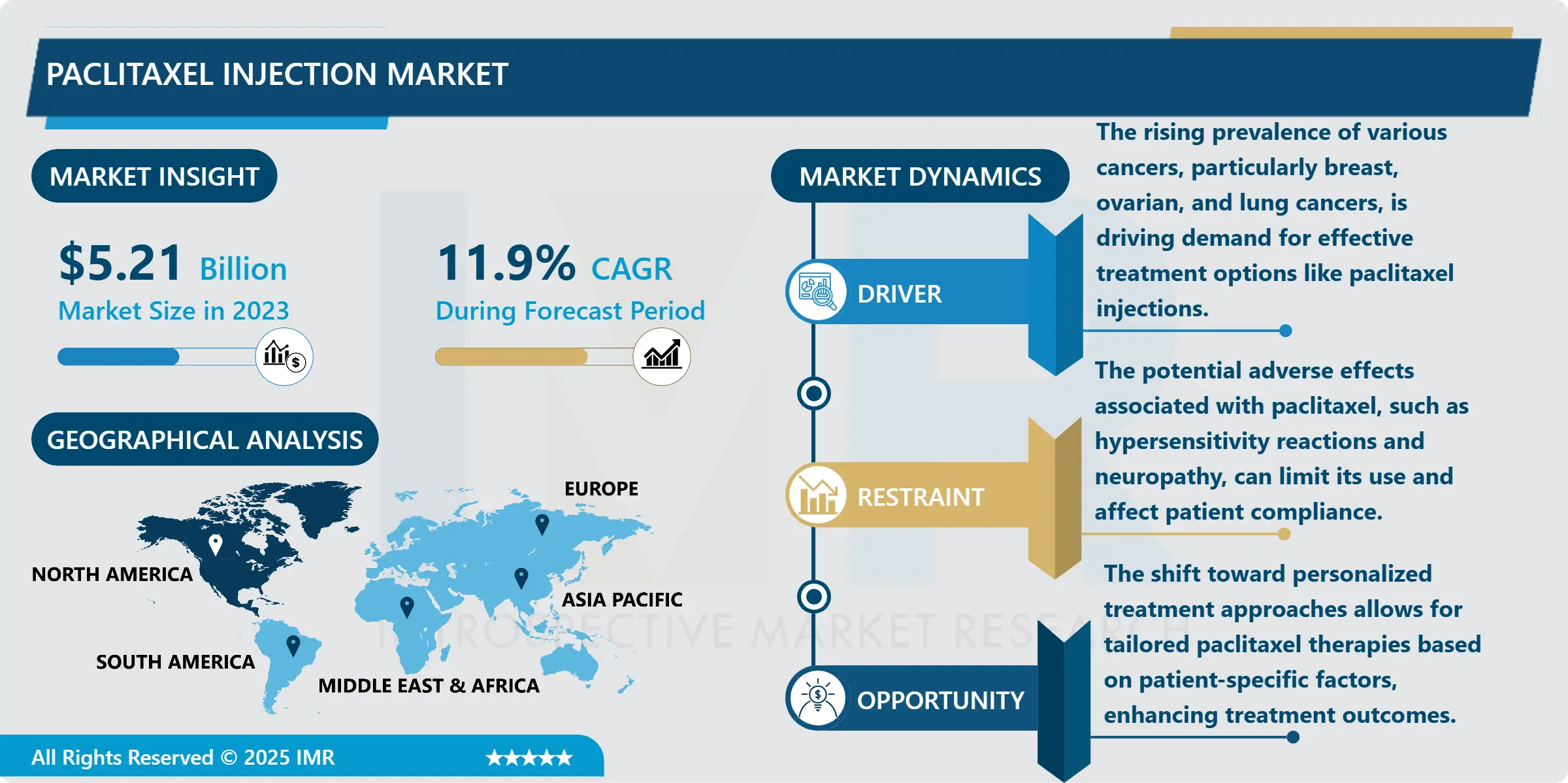
Paclitaxel Injection market Current Scenario & Forecast Growth Report (2024-2032)
Paclitaxel Injection is a chemotherapy drug widely used for the treatment of various cancers, including breast, ovarian, and non-small cell lung cancer. It belongs to the taxane class of drugs and works by stabilizing microtubules, thereby inhibiting cell division and promoting cancer cell death. Paclitaxel is administered intravenously and is available in both conventional formulations (requiring solvents like Cremophor EL) and advanced albumin-bound formulations (such as Abraxane), which offer improved safety profiles and bioavailability.

IMR Group
Description
Paclitaxel Injection Market Synopsis:
Paclitaxel injection market Size Was Valued at USD 5.21 billion in 2023, and is projected to reach USD 15.88 billion by 2032, growing at a CAGR of 11.9 % from 2024-2032.
Paclitaxel Injection is a chemotherapy drug widely used for the treatment of various cancers, including breast, ovarian, and non-small cell lung cancer. It belongs to the taxane class of drugs and works by stabilizing microtubules, thereby inhibiting cell division and promoting cancer cell death. Paclitaxel is administered intravenously and is available in both conventional formulations (requiring solvents like Cremophor EL) and advanced albumin-bound formulations (such as Abraxane), which offer improved safety profiles and bioavailability.
The global paclitaxel injection market has experienced steady growth over the past decade, driven primarily by the rising prevalence of cancer worldwide and the increasing demand for effective chemotherapy agents. The market is supported by growing cancer awareness, enhanced screening programs, and the expanding elderly population, which is more susceptible to cancer. Moreover, the increasing adoption of combination therapies involving paclitaxel and the ongoing research to expand its clinical applications are further fueling demand.
Key players in the market include Bristol-Myers Squibb, Celgene (Bristol-Myers Squibb subsidiary), Dr. Reddy’s Laboratories, Fresenius Kabi, and Teva Pharmaceuticals. The market is segmented based on product type (conventional vs. albumin-bound), application (breast cancer, ovarian cancer, NSCLC, and others), distribution channels, and geography. Developing regions such as Asia-Pacific and Latin America are witnessing accelerated growth due to improvements in healthcare infrastructure, government cancer care initiatives, and increased generic drug penetration.
However, the market faces challenges such as stringent regulatory requirements, high development costs, and the potential for adverse side effects. Additionally, competition from alternative therapies and biosimilars could limit market expansion. Nonetheless, with continuous innovation, increasing healthcare investment, and the growing availability of paclitaxel generics, the market is expected to maintain a positive growth trajectory in the coming years.
Paclitaxel Injection Market Trend Analysis:
Rising Global Cancer Incidence
The primary driver propelling the paclitaxel injection market is the increasing global burden of cancer. According to the World Health Organization (WHO), cancer remains one of the leading causes of death worldwide, with millions of new cases reported annually. This surge is attributed to factors such as aging populations, changing lifestyles, environmental exposures, and improved detection techniques. Among the most common cancers treated with paclitaxel are breast, ovarian, and non-small cell lung cancers, all of which show rising prevalence across both developed and developing nations.
As the number of cancer diagnoses continues to rise, there is a corresponding increase in demand for effective and accessible chemotherapy options. Paclitaxel injection, being a cornerstone drug in oncology treatment protocols, has witnessed expanded usage globally. This heightened demand not only strengthens the market outlook for branded drugs but also opens up significant opportunities for generic manufacturers to penetrate emerging markets and improve patient access to affordable cancer care.
Shift Toward Albumin-Bound Paclitaxel Formulations
A notable trend shaping the paclitaxel injection market is the increasing adoption of albumin-bound paclitaxel formulations, such as Abraxane. Unlike traditional formulations that use solvents like Cremophor EL, often associated with hypersensitivity reactions and neurotoxicity, albumin-bound paclitaxel eliminates the need for such solvents. This results in fewer side effects, improved patient compliance, and more favorable safety profiles. Additionally, the nanoparticle-based formulation enhances drug delivery and tumor penetration, making it a preferred option in many clinical settings.
This trend is further supported by advancements in nanotechnology and targeted drug delivery systems. Healthcare providers are increasingly favoring solvent-free formulations, especially in patients with comorbidities or a high risk of allergic reactions. While the cost of albumin-bound paclitaxel remains higher than its conventional counterparts, its therapeutic advantages are prompting hospitals and oncologists to shift their prescribing patterns, particularly in developed regions. As regulatory approvals expand and generic versions become available, this trend is expected to gain momentum globally.
Paclitaxel Injection Market Segment Analysis:
Paclitaxel injection market is segmented on the basis of type, application and end user, and region.
By Type, Nanoparticle Albumin-Bound (NAB) Paclitaxel segment is expected to dominate the market during the forecast period
The Nanoparticle Albumin-Bound (NAB) Paclitaxel segment is poised to dominate the paclitaxel injection market during the forecast period, primarily due to its enhanced pharmacokinetic properties and improved therapeutic profile. Unlike traditional paclitaxel formulations, NAB paclitaxel utilizes albumin as a carrier to facilitate more efficient drug delivery. This innovative approach significantly enhances the solubility of paclitaxel, allowing for higher drug concentrations at tumor sites while minimizing systemic toxicity. The targeted delivery mechanism not only increases the efficacy of the treatment but also reduces the incidence of common side effects associated with conventional paclitaxel, such as hypersensitivity reactions and peripheral neuropathy. As a result, NAB paclitaxel is gaining traction among healthcare providers who seek to optimize patient outcomes in cancer therapy.
Additionally, the growing body of clinical evidence supporting the efficacy of NAB paclitaxel in various cancer types, including breast cancer and non-small cell lung cancer, further strengthens its market position. Clinical trials have demonstrated that NAB paclitaxel not only improves overall response rates but also enhances progression-free survival compared to traditional formulations. As healthcare systems increasingly prioritize patient-centered approaches and seek to provide therapies with better tolerability, the demand for NAB paclitaxel is expected to rise. Moreover, the ongoing research into combination therapies involving NAB paclitaxel and other treatment modalities is likely to expand its application range, solidifying its dominance in the market and paving the way for further innovations in cancer treatment.
By Application, Breast Cancer segment expected to held the largest share
The Breast Cancer segment is anticipated to hold the largest share of the paclitaxel injection market during the forecast period, driven by the high prevalence of this disease and the established role of paclitaxel in treatment protocols. Breast cancer remains one of the most common cancers globally, leading to a significant demand for effective therapeutic options. Paclitaxel is widely recognized for its efficacy in various treatment regimens, particularly in neoadjuvant and adjuvant settings, where it is often combined with other chemotherapeutic agents to improve patient outcomes. This widespread use underscores the importance of paclitaxel in breast cancer therapy, making it a cornerstone in the management of this disease.
Moreover, the increasing awareness and advancements in breast cancer screening and early detection have resulted in more patients seeking treatment, further bolstering the market for paclitaxel injections. Clinical guidelines frequently recommend paclitaxel as a key component in the treatment of early-stage and metastatic breast cancer, reinforcing its pivotal role in oncological care. As healthcare providers continue to emphasize personalized treatment strategies, the ability to tailor paclitaxel regimens to individual patient profiles is likely to enhance its adoption. With ongoing research into combination therapies and novel formulations, the Breast Cancer segment is expected to not only maintain its dominant market share but also continue to evolve, improving treatment outcomes for patients diagnosed with this prevalent disease.
Paclitaxel Injection Market Regional Insights:
North America is expected to dominate the Market Over the Forecast period
North America is anticipated to dominate the paclitaxel injection market over the forecast period, driven by several key factors that position the region as a leader in oncology therapeutics. The presence of advanced healthcare infrastructure, coupled with significant investments in research and development, enables rapid adoption of innovative cancer treatments, including paclitaxel injections. The United States, in particular, has a well-established market for oncology drugs, supported by a robust regulatory framework that facilitates the approval and commercialization of new therapies. High levels of healthcare spending, along with a strong emphasis on personalized medicine and patient-centric care, further enhance the demand for effective cancer treatments, positioning paclitaxel as a critical component in treatment regimens.
Moreover, the increasing prevalence of cancer in North America is a significant driver of market growth. As cancer incidence rates continue to rise, particularly among populations at higher risk, the demand for effective treatment options like paclitaxel is expected to surge. Ongoing clinical research and trials focused on optimizing paclitaxel formulations and exploring combination therapies also contribute to market expansion in the region. Additionally, strong collaboration between pharmaceutical companies, academic institutions, and healthcare providers fosters an environment conducive to innovation and the development of new treatment strategies. As a result, North America is poised to maintain its dominance in the paclitaxel injection market, ensuring that patients have access to the latest advancements in cancer care.
Active Key Players in the Paclitaxel Injection Market:
Amgen (USA)
AstraZeneca (UK/Sweden)
Bayer (Germany)
Bristol-Myers Squibb (USA)
Celgene (Bristol-Myers Squibb) (USA)
Dr. Reddy’s Laboratories (India)
Eisai (Japan)
Eli Lilly (USA)
Fresenius Kabi (Germany)
Hikma Pharmaceuticals (UK/Jordan)
Merck & Co. (USA)
Mylan (USA)
Pfizer (USA)
Roche (Switzerland)
Sandoz (Novartis) (Switzerland)
Sun Pharmaceutical Industries (India)
Teva Pharmaceutical Industries (Israel)
Zydus Cadila (India), and Other Active Players
Chapter 1: Introduction
1.1 Scope and Coverage
Chapter 2:Executive Summary
Chapter 3: Market Landscape
3.1 Market Dynamics
3.1.1 Drivers
3.1.2 Restraints
3.1.3 Opportunities
3.1.4 Challenges
3.2 Market Trend Analysis
3.3 PESTLE Analysis
3.4 Porter’s Five Forces Analysis
3.5 Industry Value Chain Analysis
3.6 Ecosystem
3.7 Regulatory Landscape
3.8 Price Trend Analysis
3.9 Patent Analysis
3.10 Technology Evolution
3.11 Investment Pockets
3.12 Import-Export Analysis
Chapter 4: Paclitaxel injection Market by Type
4.1 Paclitaxel injection Market Snapshot and Growth Engine
4.2 Paclitaxel injection Market Overview
4.3 Conventional Paclitaxel Injection
4.3.1 Introduction and Market Overview
4.3.2 Historic and Forecasted Market Size in Value USD and Volume Units (2017-2032F)
4.3.3 Key Market Trends, Growth Factors and Opportunities
4.3.4 Conventional Paclitaxel Injection: Geographic Segmentation Analysis
4.4 Nanoparticle Albumin-Bound (NAB) Paclitaxel
4.4.1 Introduction and Market Overview
4.4.2 Historic and Forecasted Market Size in Value USD and Volume Units (2017-2032F)
4.4.3 Key Market Trends, Growth Factors and Opportunities
4.4.4 Nanoparticle Albumin-Bound (NAB) Paclitaxel: Geographic Segmentation Analysis
4.5 Other Formulation
4.5.1 Introduction and Market Overview
4.5.2 Historic and Forecasted Market Size in Value USD and Volume Units (2017-2032F)
4.5.3 Key Market Trends, Growth Factors and Opportunities
4.5.4 Other Formulation: Geographic Segmentation Analysis
Chapter 5: Paclitaxel injection Market by Application
5.1 Paclitaxel injection Market Snapshot and Growth Engine
5.2 Paclitaxel injection Market Overview
5.3 Breast Cancer
5.3.1 Introduction and Market Overview
5.3.2 Historic and Forecasted Market Size in Value USD and Volume Units (2017-2032F)
5.3.3 Key Market Trends, Growth Factors and Opportunities
5.3.4 Breast Cancer: Geographic Segmentation Analysis
5.4 Ovarian Cancer
5.4.1 Introduction and Market Overview
5.4.2 Historic and Forecasted Market Size in Value USD and Volume Units (2017-2032F)
5.4.3 Key Market Trends, Growth Factors and Opportunities
5.4.4 Ovarian Cancer: Geographic Segmentation Analysis
5.5 Non-Small Cell Lung Cancer
5.5.1 Introduction and Market Overview
5.5.2 Historic and Forecasted Market Size in Value USD and Volume Units (2017-2032F)
5.5.3 Key Market Trends, Growth Factors and Opportunities
5.5.4 Non-Small Cell Lung Cancer: Geographic Segmentation Analysis
Chapter 6: Paclitaxel injection Market by End User
6.1 Paclitaxel injection Market Snapshot and Growth Engine
6.2 Paclitaxel injection Market Overview
6.3 Hospitals
6.3.1 Introduction and Market Overview
6.3.2 Historic and Forecasted Market Size in Value USD and Volume Units (2017-2032F)
6.3.3 Key Market Trends, Growth Factors and Opportunities
6.3.4 Hospitals: Geographic Segmentation Analysis
6.4 Oncology Clinics
6.4.1 Introduction and Market Overview
6.4.2 Historic and Forecasted Market Size in Value USD and Volume Units (2017-2032F)
6.4.3 Key Market Trends, Growth Factors and Opportunities
6.4.4 Oncology Clinics: Geographic Segmentation Analysis
6.5 Ambulatory Surgical Centers
6.5.1 Introduction and Market Overview
6.5.2 Historic and Forecasted Market Size in Value USD and Volume Units (2017-2032F)
6.5.3 Key Market Trends, Growth Factors and Opportunities
6.5.4 Ambulatory Surgical Centers: Geographic Segmentation Analysis
6.6 Home Healthcare Settings
6.6.1 Introduction and Market Overview
6.6.2 Historic and Forecasted Market Size in Value USD and Volume Units (2017-2032F)
6.6.3 Key Market Trends, Growth Factors and Opportunities
6.6.4 Home Healthcare Settings: Geographic Segmentation Analysis
Chapter 7: Company Profiles and Competitive Analysis
7.1 Competitive Landscape
7.1.1 Competitive Benchmarking
7.1.2 Paclitaxel injection Market Share by Manufacturer (2023)
7.1.3 Industry BCG Matrix
7.1.4 Heat Map Analysis
7.1.5 Mergers and Acquisitions
7.2 AMGEN (USA)
7.2.1 Company Overview
7.2.2 Key Executives
7.2.3 Company Snapshot
7.2.4 Role of the Company in the Market
7.2.5 Sustainability and Social Responsibility
7.2.6 Operating Business Segments
7.2.7 Product Portfolio
7.2.8 Business Performance
7.2.9 Key Strategic Moves and Recent Developments
7.2.10 SWOT Analysis
7.3 ASTRAZENECA (UK/SWEDEN)
7.4 BAYER (GERMANY)
7.5 BRISTOL-MYERS SQUIBB (USA)
7.6 CELGENE (BRISTOL-MYERS SQUIBB) (USA)
7.7 DR. REDDY’S LABORATORIES (INDIA)
7.8 EISAI (JAPAN)
7.9 ELI LILLY (USA)
7.10 FRESENIUS KABI (GERMANY)
7.11 HIKMA PHARMACEUTICALS (UK/JORDAN)
7.12 MERCK & CO. (USA)
7.13 MYLAN (USA)
7.14 PFIZER (USA)
7.15 ROCHE (SWITZERLAND)
7.16 SANDOZ (NOVARTIS) (SWITZERLAND)
7.17 SUN PHARMACEUTICAL INDUSTRIES (INDIA)
7.18 TEVA PHARMACEUTICAL INDUSTRIES (ISRAEL)
7.19 ZYDUS CADILA (INDIA)
7.20 OTHER ACTIVE PLAYERS
Chapter 8: Global Paclitaxel injection Market By Region
8.1 Overview
8.2. North America Paclitaxel injection Market
8.2.1 Key Market Trends, Growth Factors and Opportunities
8.2.2 Top Key Companies
8.2.3 Historic and Forecasted Market Size by Segments
8.2.4 Historic and Forecasted Market Size By Type
8.2.4.1 Conventional Paclitaxel Injection
8.2.4.2 Nanoparticle Albumin-Bound (NAB) Paclitaxel
8.2.4.3 Other Formulation
8.2.5 Historic and Forecasted Market Size By Application
8.2.5.1 Breast Cancer
8.2.5.2 Ovarian Cancer
8.2.5.3 Non-Small Cell Lung Cancer
8.2.6 Historic and Forecasted Market Size By End User
8.2.6.1 Hospitals
8.2.6.2 Oncology Clinics
8.2.6.3 Ambulatory Surgical Centers
8.2.6.4 Home Healthcare Settings
8.2.7 Historic and Forecast Market Size by Country
8.2.7.1 US
8.2.7.2 Canada
8.2.7.3 Mexico
8.3. Eastern Europe Paclitaxel injection Market
8.3.1 Key Market Trends, Growth Factors and Opportunities
8.3.2 Top Key Companies
8.3.3 Historic and Forecasted Market Size by Segments
8.3.4 Historic and Forecasted Market Size By Type
8.3.4.1 Conventional Paclitaxel Injection
8.3.4.2 Nanoparticle Albumin-Bound (NAB) Paclitaxel
8.3.4.3 Other Formulation
8.3.5 Historic and Forecasted Market Size By Application
8.3.5.1 Breast Cancer
8.3.5.2 Ovarian Cancer
8.3.5.3 Non-Small Cell Lung Cancer
8.3.6 Historic and Forecasted Market Size By End User
8.3.6.1 Hospitals
8.3.6.2 Oncology Clinics
8.3.6.3 Ambulatory Surgical Centers
8.3.6.4 Home Healthcare Settings
8.3.7 Historic and Forecast Market Size by Country
8.3.7.1 Russia
8.3.7.2 Bulgaria
8.3.7.3 The Czech Republic
8.3.7.4 Hungary
8.3.7.5 Poland
8.3.7.6 Romania
8.3.7.7 Rest of Eastern Europe
8.4. Western Europe Paclitaxel injection Market
8.4.1 Key Market Trends, Growth Factors and Opportunities
8.4.2 Top Key Companies
8.4.3 Historic and Forecasted Market Size by Segments
8.4.4 Historic and Forecasted Market Size By Type
8.4.4.1 Conventional Paclitaxel Injection
8.4.4.2 Nanoparticle Albumin-Bound (NAB) Paclitaxel
8.4.4.3 Other Formulation
8.4.5 Historic and Forecasted Market Size By Application
8.4.5.1 Breast Cancer
8.4.5.2 Ovarian Cancer
8.4.5.3 Non-Small Cell Lung Cancer
8.4.6 Historic and Forecasted Market Size By End User
8.4.6.1 Hospitals
8.4.6.2 Oncology Clinics
8.4.6.3 Ambulatory Surgical Centers
8.4.6.4 Home Healthcare Settings
8.4.7 Historic and Forecast Market Size by Country
8.4.7.1 Germany
8.4.7.2 UK
8.4.7.3 France
8.4.7.4 The Netherlands
8.4.7.5 Italy
8.4.7.6 Spain
8.4.7.7 Rest of Western Europe
8.5. Asia Pacific Paclitaxel injection Market
8.5.1 Key Market Trends, Growth Factors and Opportunities
8.5.2 Top Key Companies
8.5.3 Historic and Forecasted Market Size by Segments
8.5.4 Historic and Forecasted Market Size By Type
8.5.4.1 Conventional Paclitaxel Injection
8.5.4.2 Nanoparticle Albumin-Bound (NAB) Paclitaxel
8.5.4.3 Other Formulation
8.5.5 Historic and Forecasted Market Size By Application
8.5.5.1 Breast Cancer
8.5.5.2 Ovarian Cancer
8.5.5.3 Non-Small Cell Lung Cancer
8.5.6 Historic and Forecasted Market Size By End User
8.5.6.1 Hospitals
8.5.6.2 Oncology Clinics
8.5.6.3 Ambulatory Surgical Centers
8.5.6.4 Home Healthcare Settings
8.5.7 Historic and Forecast Market Size by Country
8.5.7.1 China
8.5.7.2 India
8.5.7.3 Japan
8.5.7.4 South Korea
8.5.7.5 Malaysia
8.5.7.6 Thailand
8.5.7.7 Vietnam
8.5.7.8 The Philippines
8.5.7.9 Australia
8.5.7.10 New Zealand
8.5.7.11 Rest of APAC
8.6. Middle East & Africa Paclitaxel injection Market
8.6.1 Key Market Trends, Growth Factors and Opportunities
8.6.2 Top Key Companies
8.6.3 Historic and Forecasted Market Size by Segments
8.6.4 Historic and Forecasted Market Size By Type
8.6.4.1 Conventional Paclitaxel Injection
8.6.4.2 Nanoparticle Albumin-Bound (NAB) Paclitaxel
8.6.4.3 Other Formulation
8.6.5 Historic and Forecasted Market Size By Application
8.6.5.1 Breast Cancer
8.6.5.2 Ovarian Cancer
8.6.5.3 Non-Small Cell Lung Cancer
8.6.6 Historic and Forecasted Market Size By End User
8.6.6.1 Hospitals
8.6.6.2 Oncology Clinics
8.6.6.3 Ambulatory Surgical Centers
8.6.6.4 Home Healthcare Settings
8.6.7 Historic and Forecast Market Size by Country
8.6.7.1 Turkiye
8.6.7.2 Bahrain
8.6.7.3 Kuwait
8.6.7.4 Saudi Arabia
8.6.7.5 Qatar
8.6.7.6 UAE
8.6.7.7 Israel
8.6.7.8 South Africa
8.7. South America Paclitaxel injection Market
8.7.1 Key Market Trends, Growth Factors and Opportunities
8.7.2 Top Key Companies
8.7.3 Historic and Forecasted Market Size by Segments
8.7.4 Historic and Forecasted Market Size By Type
8.7.4.1 Conventional Paclitaxel Injection
8.7.4.2 Nanoparticle Albumin-Bound (NAB) Paclitaxel
8.7.4.3 Other Formulation
8.7.5 Historic and Forecasted Market Size By Application
8.7.5.1 Breast Cancer
8.7.5.2 Ovarian Cancer
8.7.5.3 Non-Small Cell Lung Cancer
8.7.6 Historic and Forecasted Market Size By End User
8.7.6.1 Hospitals
8.7.6.2 Oncology Clinics
8.7.6.3 Ambulatory Surgical Centers
8.7.6.4 Home Healthcare Settings
8.7.7 Historic and Forecast Market Size by Country
8.7.7.1 Brazil
8.7.7.2 Argentina
8.7.7.3 Rest of SA
Chapter 9 Analyst Viewpoint and Conclusion
9.1 Recommendations and Concluding Analysis
9.2 Potential Market Strategies
Chapter 10 Research Methodology
10.1 Research Process
10.2 Primary Research
10.3 Secondary Research
Q1: What would be the forecast period in the Paclitaxel injection market research report?
A1: The forecast period in the Paclitaxel injection market research report is 2024-2032.
Q2: Who are the key players in the Paclitaxel injection market?
A2: Amgen (USA), AstraZeneca (UK/Sweden), Bayer (Germany), Bristol-Myers Squibb (USA), Celgene (Bristol-Myers Squibb) (USA), Dr. Reddy's Laboratories (India), Eisai (Japan), Eli Lilly (USA), Fresenius Kabi (Germany), Hikma Pharmaceuticals (UK/Jordan), Merck & Co. (USA), Mylan (USA), Pfizer (USA), Roche (Switzerland), Sandoz (Novartis) (Switzerland), Sun Pharmaceutical Industries (India), Teva Pharmaceutical Industries (Israel), Zydus Cadila (India), and Other Active Players.
Q3: What are the segments of the Paclitaxel injection market?
A3: The Paclitaxel injection market is segmented into Type, Application, End User and region. By Type, the market is categorized into Conventional Paclitaxel Injection, Nanoparticle Albumin-Bound (NAB) Paclitaxel, Other Formulation. By Application, the market is categorized into Breast Cancer, Ovarian Cancer, Non-Small Cell Lung Cancer. By End User, the market is categorized into Hospitals, Oncology Clinics, Ambulatory Surgical Centers, Home Healthcare Settings. By region, it is analyzed across North America (U.S., Canada, Mexico),Eastern Europe (Russia, Bulgaria, The Czech Republic, Hungary, Poland, Romania, Rest of Eastern Europe),Western Europe (Germany, UK, France, Netherlands, Italy, Spain, Rest of Western Europe),Asia Pacific (China, India, Japan, South Korea, Malaysia, Thailand, Vietnam, The Philippines, Australia, New-Zealand, Rest of APAC),Middle East & Africa (Türkiye, Bahrain, Kuwait, Saudi Arabia, Qatar, UAE, Israel, South Africa),South America (Brazil, Argentina, Rest of SA).
Q4: What is the Paclitaxel injection market?
A4: Paclitaxel injection is a chemotherapy drug widely used for the treatment of various cancers, including breast, ovarian, and non-small cell lung cancer. It belongs to the taxane class of drugs and works by stabilizing microtubules, thereby inhibiting cell division and promoting cancer cell death. Paclitaxel is administered intravenously and is available in both conventional formulations (requiring solvents like Cremophor EL) and advanced albumin-bound formulations (such as Abraxane), which offer improved safety profiles and bioavailability.
Q5: How big is the Paclitaxel injection market?
A5: Paclitaxel injection market Size Was Valued at USD 5.21 billion in 2023, and is projected to reach USD 15.88 billion by 2032, growing at a CAGR of 11.9 % from 2024-2032.
How to Buy a Report from eminsights.jp
On the product page, choose the license you want: Single-User License, Multi-User License or Enterprise License.
If you required report in your native language, then you can click on Translated Report button and fill out the form with report name and language you want, then our team will contact you as soon as possible.
Click the Buy Now button.
You will be redirected to the checkout page. Enter your company details and payment information.
Click Place Order to complete the purchase.
Confirmation: You’ll receive an order confirmation and our team will contact you shortly with your ordered report.
If you have any questions, fill out the contact form below or email us at bizdev@eminsights.net.
Thank you for choosing eminsights.jp!