Stay Ahead in Fast-Growing Economies.
Browse Reports Now




Ophthalmoscopes Market Share, Trends & Market Forecast (2024-2032)
The global ophthalmoscopes market is witnessing steady growth driven by the increasing prevalence of eye-related disorders such as diabetic retinopathy, glaucoma, and age-related macular degeneration.

IMR Group
Description
Ophthalmoscopes Market Synopsis:
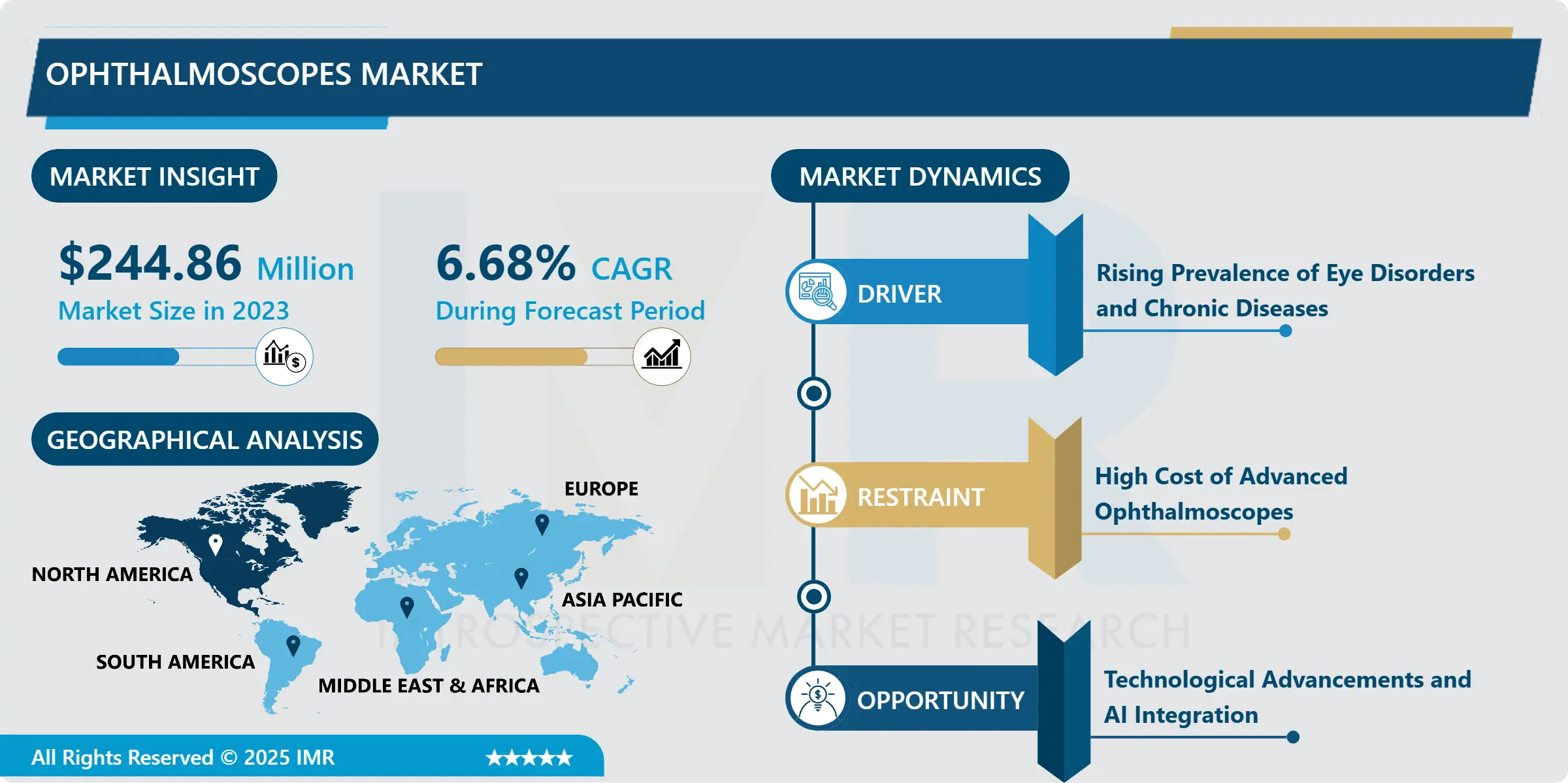
Ophthalmoscopes Market Size Was Valued at USD 244.86 Million in 2023, and is Projected to Reach USD 438.19 Million by 2032, Growing at a CAGR of 6.68% From 2024-2032
The ophthalmoscopes market refers to the global industry involved in the manufacturing, distribution, and sale of ophthalmoscopes—medical devices used by eye care professionals to examine the interior structures of the eye, particularly the retina. These devices are essential diagnostic tools in ophthalmology, optometry, and general medicine for detecting ocular diseases and systemic conditions manifesting in the eye.
The global ophthalmoscopes market is witnessing steady growth driven by the increasing prevalence of eye-related disorders such as diabetic retinopathy, glaucoma, and age-related macular degeneration. With the growing aging population and rising incidence of chronic diseases, early and accurate eye diagnosis has become more critical, thereby boosting demand for both direct and indirect ophthalmoscopes. Moreover, technological advancements have led to the development of digital and portable devices, enhancing diagnostic efficiency and accessibility in remote areas.
Healthcare infrastructure expansion, particularly in emerging economies, is another key driver contributing to the market’s growth. Governments and healthcare organizations are increasingly investing in screening programs and equipping primary care settings with basic ophthalmic diagnostic tools. Additionally, the adoption of telemedicine and digital health solutions has supported the integration of ophthalmoscopes into connected diagnostic systems, further enhancing their utility.
Despite the positive outlook, the market faces challenges such as the high cost of advanced ophthalmoscopic equipment and the lack of trained professionals in rural regions. However, ongoing innovation, increased awareness of eye health, and the incorporation of AI-assisted diagnostics are expected to create new growth opportunities, particularly in underserved markets. The market is also seeing heightened interest from private players and startups aiming to introduce cost-effective and user-friendly devices.
Ophthalmoscopes Market Trend Analysis:
Rising Prevalence of Eye Disorders and Chronic Diseases
The key drivers fueling the growth of the ophthalmoscopes market is the increasing global burden of eye disorders and systemic diseases with ocular manifestations. Conditions such as diabetic retinopathy, glaucoma, cataracts, and age-related macular degeneration (AMD) are becoming more prevalent, particularly among aging populations and individuals with diabetes or hypertension. According to the World Health Organization (WHO), over 2.2 billion people globally suffer from vision impairment or blindness, much of which is preventable or treatable if detected early using diagnostic tools like ophthalmoscopes.
The growing incidence of diabetes, in particular, has led to a surge in cases of diabetic retinopathy—an eye complication that can be identified through retinal examination. Ophthalmoscopes, especially advanced digital versions, enable healthcare providers to detect early signs of such complications during routine health check-ups. This makes them essential in both ophthalmology practices and general healthcare settings, thus driving market demand. As public health agencies emphasize early screening and preventive care, the adoption of ophthalmoscopes is expected to expand significantly.
Technological Advancements and AI Integration
An emerging opportunity within the ophthalmoscopes market lies in the integration of advanced technologies, particularly digital imaging and artificial intelligence (AI). Modern ophthalmoscopes equipped with high-resolution digital sensors allow clinicians to capture and store images of the retina for further analysis or remote consultations. This capability not only improves diagnostic accuracy but also facilitates tele-ophthalmology—a growing segment in remote and underserved regions. Additionally, portable and smartphone-based ophthalmoscopes are gaining popularity due to their affordability and ease of use.
AI-driven diagnostic algorithms are being developed to automatically detect signs of diseases such as diabetic retinopathy or glaucoma from retinal images. When combined with digital ophthalmoscopy, these systems can assist non-specialist healthcare workers in performing preliminary diagnoses and referring patients for specialized care. This opens up a vast opportunity to scale vision care services in low-resource settings while improving efficiency and reducing workload on specialists. As the technology matures and regulatory bodies approve AI-based diagnostic tools, the ophthalmoscopes market is likely to experience accelerated growth through innovation and digital health integration.
Ophthalmoscopes Market Segment Analysis:
Ophthalmoscopes Market Segmented on the basis of Product Type, End User, and Region.
By Product Type, Direct Inspection segment is expected to dominate the market during the forecast period
The direct inspection ophthalmoscope segment is anticipated to hold the largest market share during the forecast period due to its widespread use in routine eye examinations and primary care settings. These devices are compact, cost-effective, and easy to operate, making them an essential tool for general practitioners, optometrists, and emergency physicians. Their ability to provide real-time visualization of the retina and optic disc without the need for dilation or specialized imaging systems makes them highly practical in clinical workflows. Furthermore, their portability and lower maintenance requirements contribute to their strong adoption, especially in resource-limited healthcare environments.
In addition, advancements in direct ophthalmoscope technology—such as enhanced LED illumination, ergonomic designs, and smartphone-compatible versions—are further boosting the segment’s appeal. Medical training institutions also prioritize direct ophthalmoscopes for educating students on basic fundus examination, reinforcing their presence across healthcare ecosystems. With increasing awareness around early detection of eye conditions and systemic diseases through fundoscopic evaluation, the demand for direct inspection devices is expected to remain strong, ensuring their dominance in the product type segment of the ophthalmoscopes market.
By End User, the Hospitals segment is expected to hold the largest share
The hospitals segment is projected to dominate the ophthalmoscopes market by end user, owing to the high volume of patient visits, advanced diagnostic infrastructure, and availability of specialized ophthalmologists. Hospitals are typically equipped with comprehensive eye care units where ophthalmoscopes—both direct and indirect—are routinely used for diagnosing retinal disorders, optic nerve abnormalities, and systemic conditions like hypertension and diabetes that manifest in the eye. Additionally, hospitals often serve as referral centers for complex eye cases, necessitating the use of advanced diagnostic tools and facilitating greater procurement of ophthalmic equipment.
Moreover, hospitals benefit from stronger purchasing power and better access to funding for integrating technologically advanced devices, including digital ophthalmoscopes and AI-assisted diagnostic platforms. Their ability to support electronic health record integration and image storage also favors the adoption of connected ophthalmoscopy systems. With rising healthcare investments, increasing patient inflow for vision screening, and growing awareness around preventive eye care, the hospital segment is expected to maintain its lead in the market over the forecast period.
Ophthalmoscopes Market Regional Insights:
North America is expected to dominate the Market Over the Forecast period
North America is projected to lead the global ophthalmoscopes market throughout the forecast period, primarily driven by its well-established healthcare infrastructure, high prevalence of eye-related disorders, and strong adoption of advanced medical technologies. The region has a high incidence of chronic conditions like diabetes and hypertension, which significantly increase the risk of developing eye complications such as diabetic retinopathy and glaucoma. With routine eye screenings embedded in preventive healthcare practices, the demand for diagnostic tools like ophthalmoscopes remains consistently high across hospitals, clinics, and specialty care centers in the U.S. and Canada.
In addition to disease prevalence, the dominance of North America is supported by substantial R&D investments, presence of leading medical device manufacturers, and favorable reimbursement policies that facilitate early diagnosis and treatment. The growing integration of digital ophthalmoscopes and teleophthalmology services—especially in rural and underserved areas—has further strengthened market penetration. The region also benefits from a high level of awareness among both healthcare providers and patients regarding the importance of early eye disease detection, contributing to sustained demand across public and private healthcare settings.
Active Key Players in the Ophthalmoscopes Market:
Albert Waeschle Ltd. (UK)
American Diagnostic Corporation – ADC (USA)
Carl Zeiss Meditec AG (Germany)
Dino-Lite Europe (Netherlands)
Haag-Streit AG (Switzerland)
Halma plc (UK)
Heidelberg Engineering (Germany)
HEINE Optotechnik (Germany)
IRIDEX Corporation (USA)
Keeler Ltd. (UK)
Lumenis Ltd. (Israel)
Luxamed (Germany)
Neitz Instruments Co., Ltd. (Japan)
NIDEK Co., Ltd. (Japan)
Rudolf Riester GmbH (Germany)
Topcon Corporation (Japan)
US Ophthalmic (USA)
Welch Allyn (USA)
Zhejiang Honsun Medical Technology Co., Ltd. (China)
Zumax Medical Co., Ltd. (China), and Other Active Players.
Chapter 1: Introduction
1.1 Scope and Coverage
Chapter 2:Executive Summary
Chapter 3: Market Landscape
3.1 Market Dynamics
3.1.1 Drivers
3.1.2 Restraints
3.1.3 Opportunities
3.1.4 Challenges
3.2 Market Trend Analysis
3.3 PESTLE Analysis
3.4 Porter’s Five Forces Analysis
3.5 Industry Value Chain Analysis
3.6 Ecosystem
3.7 Regulatory Landscape
3.8 Price Trend Analysis
3.9 Patent Analysis
3.10 Technology Evolution
3.11 Investment Pockets
3.12 Import-Export Analysis
Chapter 4: Ophthalmoscopes Market by Product Type
4.1 Ophthalmoscopes Market Snapshot and Growth Engine
4.2 Ophthalmoscopes Market Overview
4.3 Direct Inspection and Indirect Inspection
4.3.1 Introduction and Market Overview
4.3.2 Historic and Forecasted Market Size in Value USD and Volume Units (2017-2032F)
4.3.3 Key Market Trends, Growth Factors and Opportunities
4.3.4 Direct Inspection and Indirect Inspection: Geographic Segmentation Analysis
Chapter 5: Ophthalmoscopes Market by End User
5.1 Ophthalmoscopes Market Snapshot and Growth Engine
5.2 Ophthalmoscopes Market Overview
5.3 Hospitals
5.3.1 Introduction and Market Overview
5.3.2 Historic and Forecasted Market Size in Value USD and Volume Units (2017-2032F)
5.3.3 Key Market Trends, Growth Factors and Opportunities
5.3.4 Hospitals: Geographic Segmentation Analysis
5.4 Eye Clinics
5.4.1 Introduction and Market Overview
5.4.2 Historic and Forecasted Market Size in Value USD and Volume Units (2017-2032F)
5.4.3 Key Market Trends, Growth Factors and Opportunities
5.4.4 Eye Clinics: Geographic Segmentation Analysis
5.5 and Ambulatory Surgical Centers
5.5.1 Introduction and Market Overview
5.5.2 Historic and Forecasted Market Size in Value USD and Volume Units (2017-2032F)
5.5.3 Key Market Trends, Growth Factors and Opportunities
5.5.4 and Ambulatory Surgical Centers: Geographic Segmentation Analysis
Chapter 6: Company Profiles and Competitive Analysis
6.1 Competitive Landscape
6.1.1 Competitive Benchmarking
6.1.2 Ophthalmoscopes Market Share by Manufacturer (2023)
6.1.3 Industry BCG Matrix
6.1.4 Heat Map Analysis
6.1.5 Mergers and Acquisitions
6.2 WELCH ALLYN (USA)
6.2.1 Company Overview
6.2.2 Key Executives
6.2.3 Company Snapshot
6.2.4 Role of the Company in the Market
6.2.5 Sustainability and Social Responsibility
6.2.6 Operating Business Segments
6.2.7 Product Portfolio
6.2.8 Business Performance
6.2.9 Key Strategic Moves and Recent Developments
6.2.10 SWOT Analysis
6.3 KEELER LTD. (UK)
6.4 ZUMAX MEDICAL CO. LTD. (CHINA)
6.5 ALBERT WAESCHLE (GERMANY)
6.6 NEITZ INSTRUMENTS CO. LTD. (JAPAN)
6.7 US OPHTHALMIC (USA)
6.8 HEINE USA LTD (USA)
6.9 HONSUN GROUP (CHINA)
6.10 RUDOLF RIESTER GMBH (GERMANY)
6.11 DINO-LITE EUROPE (NETHERLANDS)
6.12 IRIDEX CORPORATION (USA)
6.13 OTHER ACTIVE PLAYERS
Chapter 7: Global Ophthalmoscopes Market By Region
7.1 Overview
7.2. North America Ophthalmoscopes Market
7.2.1 Key Market Trends, Growth Factors and Opportunities
7.2.2 Top Key Companies
7.2.3 Historic and Forecasted Market Size by Segments
7.2.4 Historic and Forecasted Market Size By Product Type
7.2.4.1 Direct Inspection and Indirect Inspection
7.2.5 Historic and Forecasted Market Size By End User
7.2.5.1 Hospitals
7.2.5.2 Eye Clinics
7.2.5.3 and Ambulatory Surgical Centers
7.2.6 Historic and Forecast Market Size by Country
7.2.6.1 US
7.2.6.2 Canada
7.2.6.3 Mexico
7.3. Eastern Europe Ophthalmoscopes Market
7.3.1 Key Market Trends, Growth Factors and Opportunities
7.3.2 Top Key Companies
7.3.3 Historic and Forecasted Market Size by Segments
7.3.4 Historic and Forecasted Market Size By Product Type
7.3.4.1 Direct Inspection and Indirect Inspection
7.3.5 Historic and Forecasted Market Size By End User
7.3.5.1 Hospitals
7.3.5.2 Eye Clinics
7.3.5.3 and Ambulatory Surgical Centers
7.3.6 Historic and Forecast Market Size by Country
7.3.6.1 Russia
7.3.6.2 Bulgaria
7.3.6.3 The Czech Republic
7.3.6.4 Hungary
7.3.6.5 Poland
7.3.6.6 Romania
7.3.6.7 Rest of Eastern Europe
7.4. Western Europe Ophthalmoscopes Market
7.4.1 Key Market Trends, Growth Factors and Opportunities
7.4.2 Top Key Companies
7.4.3 Historic and Forecasted Market Size by Segments
7.4.4 Historic and Forecasted Market Size By Product Type
7.4.4.1 Direct Inspection and Indirect Inspection
7.4.5 Historic and Forecasted Market Size By End User
7.4.5.1 Hospitals
7.4.5.2 Eye Clinics
7.4.5.3 and Ambulatory Surgical Centers
7.4.6 Historic and Forecast Market Size by Country
7.4.6.1 Germany
7.4.6.2 UK
7.4.6.3 France
7.4.6.4 The Netherlands
7.4.6.5 Italy
7.4.6.6 Spain
7.4.6.7 Rest of Western Europe
7.5. Asia Pacific Ophthalmoscopes Market
7.5.1 Key Market Trends, Growth Factors and Opportunities
7.5.2 Top Key Companies
7.5.3 Historic and Forecasted Market Size by Segments
7.5.4 Historic and Forecasted Market Size By Product Type
7.5.4.1 Direct Inspection and Indirect Inspection
7.5.5 Historic and Forecasted Market Size By End User
7.5.5.1 Hospitals
7.5.5.2 Eye Clinics
7.5.5.3 and Ambulatory Surgical Centers
7.5.6 Historic and Forecast Market Size by Country
7.5.6.1 China
7.5.6.2 India
7.5.6.3 Japan
7.5.6.4 South Korea
7.5.6.5 Malaysia
7.5.6.6 Thailand
7.5.6.7 Vietnam
7.5.6.8 The Philippines
7.5.6.9 Australia
7.5.6.10 New Zealand
7.5.6.11 Rest of APAC
7.6. Middle East & Africa Ophthalmoscopes Market
7.6.1 Key Market Trends, Growth Factors and Opportunities
7.6.2 Top Key Companies
7.6.3 Historic and Forecasted Market Size by Segments
7.6.4 Historic and Forecasted Market Size By Product Type
7.6.4.1 Direct Inspection and Indirect Inspection
7.6.5 Historic and Forecasted Market Size By End User
7.6.5.1 Hospitals
7.6.5.2 Eye Clinics
7.6.5.3 and Ambulatory Surgical Centers
7.6.6 Historic and Forecast Market Size by Country
7.6.6.1 Turkiye
7.6.6.2 Bahrain
7.6.6.3 Kuwait
7.6.6.4 Saudi Arabia
7.6.6.5 Qatar
7.6.6.6 UAE
7.6.6.7 Israel
7.6.6.8 South Africa
7.7. South America Ophthalmoscopes Market
7.7.1 Key Market Trends, Growth Factors and Opportunities
7.7.2 Top Key Companies
7.7.3 Historic and Forecasted Market Size by Segments
7.7.4 Historic and Forecasted Market Size By Product Type
7.7.4.1 Direct Inspection and Indirect Inspection
7.7.5 Historic and Forecasted Market Size By End User
7.7.5.1 Hospitals
7.7.5.2 Eye Clinics
7.7.5.3 and Ambulatory Surgical Centers
7.7.6 Historic and Forecast Market Size by Country
7.7.6.1 Brazil
7.7.6.2 Argentina
7.7.6.3 Rest of SA
Chapter 8 Analyst Viewpoint and Conclusion
8.1 Recommendations and Concluding Analysis
8.2 Potential Market Strategies
Chapter 9 Research Methodology
9.1 Research Process
9.2 Primary Research
9.3 Secondary Research
Q1: What would be the forecast period in the Ophthalmoscopes Market research report?
A1: The forecast period in the Ophthalmoscopes Market research report is 2024-2032.
Q2: Who are the key players in the Ophthalmoscopes Market?
A2: Albert Waeschle Ltd. (UK), American Diagnostic Corporation – ADC (USA), Carl Zeiss Meditec AG (Germany), Dino-Lite Europe (Netherlands), Haag-Streit AG (Switzerland), Halma plc (UK), Heidelberg Engineering (Germany), HEINE Optotechnik (Germany), IRIDEX Corporation (USA), Keeler Ltd. (UK), Lumenis Ltd. (Israel), Luxamed (Germany), Neitz Instruments Co., Ltd. (Japan), NIDEK Co., Ltd. (Japan), Rudolf Riester GmbH (Germany), Topcon Corporation (Japan), US Ophthalmic (USA), Welch Allyn (USA), Zhejiang Honsun Medical Technology Co., Ltd. (China), Zumax Medical Co., Ltd. (China), and Other Active Players.
Q3: What are the segments of the Ophthalmoscopes Market?
A3: The Ophthalmoscopes Market is segmented into by Product Type, End User and region. by Product Type (Direct Inspection and Indirect Inspection), by End User (Hospitals, Eye Clinics, and Ambulatory Surgical Centers). By region, it is analyzed across North America (U.S., Canada, Mexico), Eastern Europe (Russia, Bulgaria, The Czech Republic, Hungary, Poland, Romania, Rest of Eastern Europe), Western Europe (Germany, UK, France, Netherlands, Italy, Spain, Rest of Western Europe), Asia Pacific (China, India, Japan, South Korea, Malaysia, Thailand, Vietnam, The Philippines, Australia, New-Zealand, Rest of APAC), Middle East & Africa (Türkiye, Bahrain, Kuwait, Saudi Arabia, Qatar, UAE, Israel, South Africa), South America (Brazil, Argentina, Rest of SA).
Q4: What is the Ophthalmoscope Market?
A4: The ophthalmoscopes market refers to the global industry involved in the manufacturing, distribution, and sale of ophthalmoscopes, medical devices used by eye care professionals to examine the interior structures of the eye, particularly the retina. These devices are essential diagnostic tools in ophthalmology, optometry, and general medicine for detecting ocular diseases and systemic conditions manifesting in the eye.
Q5: How big is the Ophthalmoscope market?
A5: Ophthalmoscopes Market Size Was Valued at USD 244.86 Million in 2023, and is Projected to Reach USD 438.19 Million by 2032, Growing at a CAGR of 6.68% From 2024-2032
How to Buy a Report from eminsights.jp
On the product page, choose the license you want: Single-User License, Multi-User License or Enterprise License.
If you required report in your native language, then you can click on Translated Report button and fill out the form with report name and language you want, then our team will contact you as soon as possible.
Click the Buy Now button.
You will be redirected to the checkout page. Enter your company details and payment information.
Click Place Order to complete the purchase.
Confirmation: You’ll receive an order confirmation and our team will contact you shortly with your ordered report.
If you have any questions, fill out the contact form below or email us at bizdev@eminsights.net.
Thank you for choosing eminsights.jp!