Stay Ahead in Fast-Growing Economies.
Browse Reports Now
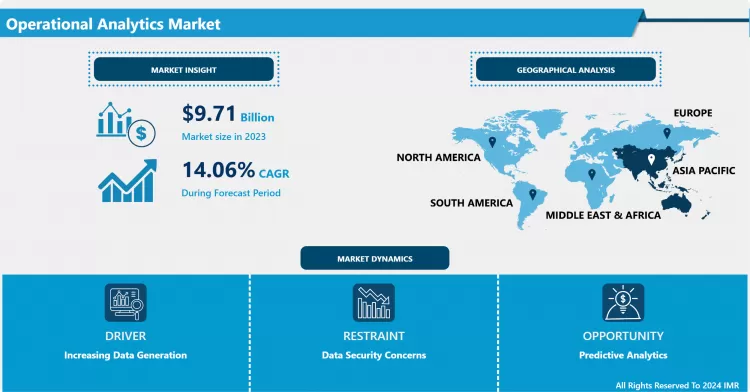
Operational Analytics Market – Overview & Outlook by Potential Growth
The operational analytics market refers to the practice of using various techniques and tools to analyze operational data in real-time to gain insights, make informed decisions, and optimize business processes. It involves the collection, processing, and analysis of data from various operational systems such as manufacturing processes, supply chain management, customer interactions, and financial transactions.

IMR Group
Description
Operational Analytics Market Synopsis
Operational Analytics Market Size Was Valued at USD 9.71 Billion in 2023, and is Projected to Reach USD 31.71 Billion by 2032, Growing at a CAGR of 14.06% From 2024-2032.
The operational analytics market refers to the practice of using various techniques and tools to analyze operational data in real-time to gain insights, make informed decisions, and optimize business processes. It involves the collection, processing, and analysis of data from various operational systems such as manufacturing processes, supply chain management, customer interactions, and financial transactions. Operational analytics leverages advanced analytics techniques like predictive analytics, machine learning, and data visualization to monitor key performance indicators (KPIs), detect anomalies, identify trends, and improve overall operational efficiency and effectiveness. Organizations utilize operational analytics to enhance decision-making processes, reduce costs, improve quality, and ultimately drive competitive advantage in their respective industries.
Operational Analytics Market Trend Analysis
Integration of AI and Machine Learning in Operational Analytics
The integration of AI and machine learning in operational analytics represents a transformative shift in how businesses harness data to drive strategic decision-making. These technologies enable predictive analytics by analyzing historical data patterns to forecast future trends and behaviors. In manufacturing, for instance, AI-powered predictive maintenance algorithms can detect equipment failures before they occur, minimizing downtime and optimizing production schedules. This proactive approach not only reduces maintenance costs but also enhances overall operational efficiency.
In healthcare, AI-driven predictive analytics can analyze patient data to identify individuals at high risk of developing certain conditions, enabling healthcare providers to intervene early and improve patient outcomes. Moreover, AI enhances personalized medicine by tailoring treatment plans based on individual patient profiles and predictive insights derived from vast amounts of data.
In retail, machine learning algorithms analyze customer purchasing patterns and behaviors to predict demand trends, optimize inventory management, and personalize marketing campaigns. By understanding customer preferences in real-time, retailers can offer targeted promotions and improve customer engagement, ultimately driving sales and loyalty.
Overall, the integration of AI and machine learning in operational analytics not only empowers businesses to anticipate operational issues but also enables them to innovate new products and services based on data-driven insights. As these technologies continue to evolve, their ability to deliver actionable intelligence in real-time will be crucial in shaping competitive advantages across various industries globally.
The Impact of Cloud-Based Deployment Models on Operational Analytics
Cloud-based deployment models have revolutionized the operational analytics landscape by providing businesses with unprecedented scalability, flexibility, and cost-effectiveness. Unlike traditional on-premises solutions that require significant upfront investment in hardware and infrastructure maintenance, cloud-based operational analytics offer a pay-as-you-go model. This scalability allows organizations to dynamically adjust their computing resources based on demand, ensuring they can efficiently handle large volumes of data during peak periods without overprovisioning or underutilizing resources during quieter times.
Flexibility is another key advantage of cloud-based operational analytics. Businesses can choose from a variety of analytics tools and platforms offered by cloud providers, tailoring their solutions to meet specific operational needs and industry requirements. Moreover, cloud environments facilitate seamless integration with existing IT ecosystems, enabling organizations to leverage their data from multiple sources for comprehensive analytics insights.
Cost-effectiveness is significantly enhanced through cloud-based deployment models. By eliminating the need for extensive on-premises hardware investments and reducing IT overhead costs associated with maintenance and upgrades, businesses can allocate resources more efficiently towards innovation and strategic initiatives. Furthermore, cloud-based solutions typically offer predictable pricing structures and lower total cost of ownership over time, making advanced analytics capabilities accessible to organizations of all sizes, from startups to large enterprises.
Accelerating time-to-insight is a critical benefit of cloud-based operational analytics. By leveraging the computing power and storage capabilities of cloud platforms, businesses can rapidly process and analyze vast amounts of data in real-time or near-real-time. This agility enables faster decision-making, proactive problem-solving, and the ability to capitalize on emerging opportunities swiftly, thereby gaining a competitive edge in dynamic markets.
Operational Analytics Market Segment Analysis:
Operational Analytics Market Segmented based on By Type, By Business Function, By Application,By Deployment Model and By Industry Vertical
By Type, Software segment is expected to dominate the market during the forecast period
Software solutions have established dominance in the analytics market primarily due to their inherent advantages in scalability and customization. Unlike traditional hardware-based systems, software solutions can adapt to varying data volumes and complexities, making them ideal for organizations scaling their analytics capabilities. The ability to customize software according to specific business needs allows companies to tailor analytics tools to their unique requirements, whether for predictive modeling, business intelligence dashboards, or complex data mining tasks. This flexibility not only enhances operational efficiency but also supports strategic decision-making by providing real-time insights into market trends, customer behavior, and operational performance.
Moreover, software solutions excel in integration capabilities, seamlessly connecting with existing IT infrastructure and applications across different business functions. This integration ensures that analytics insights are readily accessible to relevant departments, from marketing and sales to finance and operations. Modern software platforms often feature user-friendly interfaces and intuitive visualization tools, democratizing data access within organizations. This accessibility empowers non-technical users to explore data, generate reports, and derive actionable insights independently, fostering a data-driven culture throughout the enterprise. As businesses increasingly prioritize agility and data-driven decision-making, software solutions continue to evolve, incorporating advanced analytics techniques like machine learning and artificial intelligence to deliver deeper, more accurate insights that drive competitive advantage.
By Deployment Model, On-Premises segment held the largest share in 2023
On-Premises solutions have historically been favored by organizations across various industries, primarily due to their robust security measures, regulatory compliance adherence, and the assurance of direct control over sensitive data. Security concerns remain paramount for many businesses, especially those handling confidential information or operating in highly regulated sectors such as finance, healthcare, and government. On-Premises solutions provide a level of data security that is perceived as higher compared to cloud-based alternatives, as they allow organizations to manage and safeguard their data within their own physical or virtual infrastructure. This control over data access and storage locations ensures compliance with stringent data protection regulations, offering peace of mind to enterprises wary of outsourcing data management to third-party cloud providers.
Regulatory compliance requirements further drive the preference for On-Premises solutions. Industries like healthcare and finance must adhere to strict regulations such as HIPAA and PCI-DSS, which mandate stringent data handling practices and security measures. On-Premises solutions enable organizations to implement customized security protocols and encryption standards tailored to meet regulatory mandates, thereby minimizing the risk of non-compliance penalties and data breaches. Additionally, certain operational requirements, such as the need for low-latency data processing or offline accessibility in remote locations, make On-Premises deployments more suitable for specific use cases where immediate access to data and applications is critical. Despite the growing popularity of cloud-based solutions for their scalability and cost-efficiency, On-Premises deployments continue to maintain a significant presence in industries where data security, regulatory compliance, and operational control are paramount considerations.
Operational Analytics Market Regional Insights:
Asia Pacific is Expected to Dominate the Market Over the Forecast period
Asia Pacific is increasingly becoming a hotspot for operational analytics, driven by several key factors. Countries like China, India, and Japan are at the forefront of digital transformation, with robust investments in cloud computing and big data infrastructure. These investments are not only enhancing data storage and processing capabilities but also enabling businesses to leverage advanced analytics tools to extract meaningful insights from their operational data.
In China, for instance, the rapid growth of e-commerce giants like Alibaba and JD.com has spurred the adoption of operational analytics to manage large-scale logistics operations and optimize supply chain efficiency. Big data analytics are used to track consumer behavior, predict market trends, and streamline delivery processes, ensuring timely and efficient service.
India’s burgeoning telecommunications sector is another significant driver of operational analytics adoption. With the proliferation of mobile devices and increasing internet penetration, telecom companies are leveraging analytics to improve network performance, enhance customer service, and manage operational costs effectively. Real-time data analytics enable these companies to proactively address network issues and optimize bandwidth allocation based on user demand patterns.
Meanwhile, Japan’s healthcare industry is adopting operational analytics to improve patient care outcomes and operational efficiency in hospitals and healthcare facilities. Analytics-driven insights help healthcare providers optimize resource allocation, reduce wait times, and personalize patient treatment plans based on predictive analytics models.
Overall, the Asia Pacific region’s embrace of operational analytics is transforming industries by enabling data-driven decision-making, enhancing operational efficiency, and meeting the growing expectations of consumers in a digitally connected world. As investment in digital infrastructure continues to grow, the region is poised to remain a pivotal force in the global operational analytics market.
Active Key Players in the Operational Analytics Market
IBM Corporation (U.S.),
Oracle (U.S.),
Microsoft (U.S.),
SAP SE (Germany),
Hexagon AB (Sweden),
IMS Software, Inc. (U.S.),
Autodesk Inc. (U.S.),
Bentley Systems, Incorporated (U.S.),
Alteryx, Inc. (U.S.),
SAS Institute Inc. (U.S.),
Hewlett Packard Enterprise Development LP (U.S.),
Cisco Systems, Inc. (U.S.),
VMware, Inc. (U.S.),
Continuity Software Ltd. (Israel),
ExtraHop Networks, Inc. (U.S.),
BMC Software, Inc. (U.S.),
Apptio, Inc. (U.S.),
Appnomic (U.S.),
Evolven Software (U.S.),
Splunk Inc. (U.S.) and Other Key Players
Key Industry Developments in the Operational Analytics Market:
In June 2023, Jaguar Land Rover (JLR) announced a collaboration with Everstream Analytics, a supply chain solutions provider. This partnership integrates AI into JLR’s supply chain management, enabling real-time monitoring and mitigating supply-related issues
In March 2023, Insight Software, a leading technology company specializing in reporting, analytics, and performance management solutions, announced the expansion of its Angles Professional product line for Oracle. By integrating Logi Analytics, the company enhanced its offerings to create a tool beneficial for all business departments
In February 2023, IBM launched its new Watson AIOps platform, leveraging AI and machine learning to automate IT operations and enhance decision-making processes
Chapter 1: Introduction
1.1 Scope and Coverage
Chapter 2:Executive Summary
Chapter 3: Market Landscape
3.1 Market Dynamics
3.1.1 Drivers
3.1.2 Restraints
3.1.3 Opportunities
3.1.4 Challenges
3.2 Market Trend Analysis
3.3 PESTLE Analysis
3.4 Porter’s Five Forces Analysis
3.5 Industry Value Chain Analysis
3.6 Ecosystem
3.7 Regulatory Landscape
3.8 Price Trend Analysis
3.9 Patent Analysis
3.10 Technology Evolution
3.11 Investment Pockets
3.12 Import-Export Analysis
Chapter 4: Operational Analytics Market by Type (2018-2032)
4.1 Operational Analytics Market Snapshot and Growth Engine
4.2 Market Overview
4.3 Software
4.3.1 Introduction and Market Overview
4.3.2 Historic and Forecasted Market Size in Value USD and Volume Units
4.3.3 Key Market Trends, Growth Factors, and Opportunities
4.3.4 Geographic Segmentation Analysis
4.4 Service
Chapter 5: Operational Analytics Market by Business Function (2018-2032)
5.1 Operational Analytics Market Snapshot and Growth Engine
5.2 Market Overview
5.3 Information Technology
5.3.1 Introduction and Market Overview
5.3.2 Historic and Forecasted Market Size in Value USD and Volume Units
5.3.3 Key Market Trends, Growth Factors, and Opportunities
5.3.4 Geographic Segmentation Analysis
5.4 Marketing
5.5 Sales
5.6 Finance
5.7 Human Resources
5.8 Others
Chapter 6: Operational Analytics Market by Application (2018-2032)
6.1 Operational Analytics Market Snapshot and Growth Engine
6.2 Market Overview
6.3 Predictive Asset Maintenance
6.3.1 Introduction and Market Overview
6.3.2 Historic and Forecasted Market Size in Value USD and Volume Units
6.3.3 Key Market Trends, Growth Factors, and Opportunities
6.3.4 Geographic Segmentation Analysis
6.4 Risk Management
6.5 Fraud Detection
6.6 Supply Chain Management
6.7 Customer Management
6.8 Workforce Management
6.9 Sales and Marketing Management
6.10 Others
Chapter 7: Operational Analytics Market by Deployment Model (2018-2032)
7.1 Operational Analytics Market Snapshot and Growth Engine
7.2 Market Overview
7.3 On-Premises
7.3.1 Introduction and Market Overview
7.3.2 Historic and Forecasted Market Size in Value USD and Volume Units
7.3.3 Key Market Trends, Growth Factors, and Opportunities
7.3.4 Geographic Segmentation Analysis
7.4 Hosted/ On-Cloud
Chapter 8: Operational Analytics Market by Industry Vertical (2018-2032)
8.1 Operational Analytics Market Snapshot and Growth Engine
8.2 Market Overview
8.3 Telecommunication
8.3.1 Introduction and Market Overview
8.3.2 Historic and Forecasted Market Size in Value USD and Volume Units
8.3.3 Key Market Trends, Growth Factors, and Opportunities
8.3.4 Geographic Segmentation Analysis
8.4 Retail and Consumer Goods
8.5 Manufacturing
8.6 Government and Defense
8.7 Energy and Utilities
8.8 Transportation and Logistics
8.9 Others
Chapter 9: Company Profiles and Competitive Analysis
9.1 Competitive Landscape
9.1.1 Competitive Benchmarking
9.1.2 Operational Analytics Market Share by Manufacturer (2024)
9.1.3 Industry BCG Matrix
9.1.4 Heat Map Analysis
9.1.5 Mergers and Acquisitions
9.2 IBM CORPORATION (U.S.) ORACLE (U.S.) MICROSOFT (U.S.) SAP SE (GERMANY) HEXAGON AB (SWEDEN) IMS SOFTWARE INC. (U.S.) AUTODESK INC. (U.S.) BENTLEY SYSTEMS INCORPORATED (U.S.) ALTERYX INC. (U.S.) SAS INSTITUTE INC. (U.S.) HEWLETT PACKARD ENTERPRISE DEVELOPMENT LP (U.S.) CISCO SYSTEMS INC. (U.S.) VMWARE INC. (U.S.) CONTINUITY SOFTWARE LTD. (ISRAEL) EXTRAHOP NETWORKS INC. (U.S.) BMC SOFTWARE INC. (U.S.) APPTIO INC. (U.S.) APPNOMIC (U.S.) EVOLVEN SOFTWARE (U.S.) SPLUNK INC. (U.S.) OTHER KEY PLAYERS
9.2.1 Company Overview
9.2.2 Key Executives
9.2.3 Company Snapshot
9.2.4 Role of the Company in the Market
9.2.5 Sustainability and Social Responsibility
9.2.6 Operating Business Segments
9.2.7 Product Portfolio
9.2.8 Business Performance
9.2.9 Key Strategic Moves and Recent Developments
9.2.10 SWOT Analysis
Chapter 10: Global Operational Analytics Market By Region
10.1 Overview
10.2. North America Operational Analytics Market
10.2.1 Key Market Trends, Growth Factors and Opportunities
10.2.2 Top Key Companies
10.2.3 Historic and Forecasted Market Size by Segments
10.2.4 Historic and Forecasted Market Size by Type
10.2.4.1 Software
10.2.4.2 Service
10.2.5 Historic and Forecasted Market Size by Business Function
10.2.5.1 Information Technology
10.2.5.2 Marketing
10.2.5.3 Sales
10.2.5.4 Finance
10.2.5.5 Human Resources
10.2.5.6 Others
10.2.6 Historic and Forecasted Market Size by Application
10.2.6.1 Predictive Asset Maintenance
10.2.6.2 Risk Management
10.2.6.3 Fraud Detection
10.2.6.4 Supply Chain Management
10.2.6.5 Customer Management
10.2.6.6 Workforce Management
10.2.6.7 Sales and Marketing Management
10.2.6.8 Others
10.2.7 Historic and Forecasted Market Size by Deployment Model
10.2.7.1 On-Premises
10.2.7.2 Hosted/ On-Cloud
10.2.8 Historic and Forecasted Market Size by Industry Vertical
10.2.8.1 Telecommunication
10.2.8.2 Retail and Consumer Goods
10.2.8.3 Manufacturing
10.2.8.4 Government and Defense
10.2.8.5 Energy and Utilities
10.2.8.6 Transportation and Logistics
10.2.8.7 Others
10.2.9 Historic and Forecast Market Size by Country
10.2.9.1 US
10.2.9.2 Canada
10.2.9.3 Mexico
10.3. Eastern Europe Operational Analytics Market
10.3.1 Key Market Trends, Growth Factors and Opportunities
10.3.2 Top Key Companies
10.3.3 Historic and Forecasted Market Size by Segments
10.3.4 Historic and Forecasted Market Size by Type
10.3.4.1 Software
10.3.4.2 Service
10.3.5 Historic and Forecasted Market Size by Business Function
10.3.5.1 Information Technology
10.3.5.2 Marketing
10.3.5.3 Sales
10.3.5.4 Finance
10.3.5.5 Human Resources
10.3.5.6 Others
10.3.6 Historic and Forecasted Market Size by Application
10.3.6.1 Predictive Asset Maintenance
10.3.6.2 Risk Management
10.3.6.3 Fraud Detection
10.3.6.4 Supply Chain Management
10.3.6.5 Customer Management
10.3.6.6 Workforce Management
10.3.6.7 Sales and Marketing Management
10.3.6.8 Others
10.3.7 Historic and Forecasted Market Size by Deployment Model
10.3.7.1 On-Premises
10.3.7.2 Hosted/ On-Cloud
10.3.8 Historic and Forecasted Market Size by Industry Vertical
10.3.8.1 Telecommunication
10.3.8.2 Retail and Consumer Goods
10.3.8.3 Manufacturing
10.3.8.4 Government and Defense
10.3.8.5 Energy and Utilities
10.3.8.6 Transportation and Logistics
10.3.8.7 Others
10.3.9 Historic and Forecast Market Size by Country
10.3.9.1 Russia
10.3.9.2 Bulgaria
10.3.9.3 The Czech Republic
10.3.9.4 Hungary
10.3.9.5 Poland
10.3.9.6 Romania
10.3.9.7 Rest of Eastern Europe
10.4. Western Europe Operational Analytics Market
10.4.1 Key Market Trends, Growth Factors and Opportunities
10.4.2 Top Key Companies
10.4.3 Historic and Forecasted Market Size by Segments
10.4.4 Historic and Forecasted Market Size by Type
10.4.4.1 Software
10.4.4.2 Service
10.4.5 Historic and Forecasted Market Size by Business Function
10.4.5.1 Information Technology
10.4.5.2 Marketing
10.4.5.3 Sales
10.4.5.4 Finance
10.4.5.5 Human Resources
10.4.5.6 Others
10.4.6 Historic and Forecasted Market Size by Application
10.4.6.1 Predictive Asset Maintenance
10.4.6.2 Risk Management
10.4.6.3 Fraud Detection
10.4.6.4 Supply Chain Management
10.4.6.5 Customer Management
10.4.6.6 Workforce Management
10.4.6.7 Sales and Marketing Management
10.4.6.8 Others
10.4.7 Historic and Forecasted Market Size by Deployment Model
10.4.7.1 On-Premises
10.4.7.2 Hosted/ On-Cloud
10.4.8 Historic and Forecasted Market Size by Industry Vertical
10.4.8.1 Telecommunication
10.4.8.2 Retail and Consumer Goods
10.4.8.3 Manufacturing
10.4.8.4 Government and Defense
10.4.8.5 Energy and Utilities
10.4.8.6 Transportation and Logistics
10.4.8.7 Others
10.4.9 Historic and Forecast Market Size by Country
10.4.9.1 Germany
10.4.9.2 UK
10.4.9.3 France
10.4.9.4 The Netherlands
10.4.9.5 Italy
10.4.9.6 Spain
10.4.9.7 Rest of Western Europe
10.5. Asia Pacific Operational Analytics Market
10.5.1 Key Market Trends, Growth Factors and Opportunities
10.5.2 Top Key Companies
10.5.3 Historic and Forecasted Market Size by Segments
10.5.4 Historic and Forecasted Market Size by Type
10.5.4.1 Software
10.5.4.2 Service
10.5.5 Historic and Forecasted Market Size by Business Function
10.5.5.1 Information Technology
10.5.5.2 Marketing
10.5.5.3 Sales
10.5.5.4 Finance
10.5.5.5 Human Resources
10.5.5.6 Others
10.5.6 Historic and Forecasted Market Size by Application
10.5.6.1 Predictive Asset Maintenance
10.5.6.2 Risk Management
10.5.6.3 Fraud Detection
10.5.6.4 Supply Chain Management
10.5.6.5 Customer Management
10.5.6.6 Workforce Management
10.5.6.7 Sales and Marketing Management
10.5.6.8 Others
10.5.7 Historic and Forecasted Market Size by Deployment Model
10.5.7.1 On-Premises
10.5.7.2 Hosted/ On-Cloud
10.5.8 Historic and Forecasted Market Size by Industry Vertical
10.5.8.1 Telecommunication
10.5.8.2 Retail and Consumer Goods
10.5.8.3 Manufacturing
10.5.8.4 Government and Defense
10.5.8.5 Energy and Utilities
10.5.8.6 Transportation and Logistics
10.5.8.7 Others
10.5.9 Historic and Forecast Market Size by Country
10.5.9.1 China
10.5.9.2 India
10.5.9.3 Japan
10.5.9.4 South Korea
10.5.9.5 Malaysia
10.5.9.6 Thailand
10.5.9.7 Vietnam
10.5.9.8 The Philippines
10.5.9.9 Australia
10.5.9.10 New Zealand
10.5.9.11 Rest of APAC
10.6. Middle East & Africa Operational Analytics Market
10.6.1 Key Market Trends, Growth Factors and Opportunities
10.6.2 Top Key Companies
10.6.3 Historic and Forecasted Market Size by Segments
10.6.4 Historic and Forecasted Market Size by Type
10.6.4.1 Software
10.6.4.2 Service
10.6.5 Historic and Forecasted Market Size by Business Function
10.6.5.1 Information Technology
10.6.5.2 Marketing
10.6.5.3 Sales
10.6.5.4 Finance
10.6.5.5 Human Resources
10.6.5.6 Others
10.6.6 Historic and Forecasted Market Size by Application
10.6.6.1 Predictive Asset Maintenance
10.6.6.2 Risk Management
10.6.6.3 Fraud Detection
10.6.6.4 Supply Chain Management
10.6.6.5 Customer Management
10.6.6.6 Workforce Management
10.6.6.7 Sales and Marketing Management
10.6.6.8 Others
10.6.7 Historic and Forecasted Market Size by Deployment Model
10.6.7.1 On-Premises
10.6.7.2 Hosted/ On-Cloud
10.6.8 Historic and Forecasted Market Size by Industry Vertical
10.6.8.1 Telecommunication
10.6.8.2 Retail and Consumer Goods
10.6.8.3 Manufacturing
10.6.8.4 Government and Defense
10.6.8.5 Energy and Utilities
10.6.8.6 Transportation and Logistics
10.6.8.7 Others
10.6.9 Historic and Forecast Market Size by Country
10.6.9.1 Turkiye
10.6.9.2 Bahrain
10.6.9.3 Kuwait
10.6.9.4 Saudi Arabia
10.6.9.5 Qatar
10.6.9.6 UAE
10.6.9.7 Israel
10.6.9.8 South Africa
10.7. South America Operational Analytics Market
10.7.1 Key Market Trends, Growth Factors and Opportunities
10.7.2 Top Key Companies
10.7.3 Historic and Forecasted Market Size by Segments
10.7.4 Historic and Forecasted Market Size by Type
10.7.4.1 Software
10.7.4.2 Service
10.7.5 Historic and Forecasted Market Size by Business Function
10.7.5.1 Information Technology
10.7.5.2 Marketing
10.7.5.3 Sales
10.7.5.4 Finance
10.7.5.5 Human Resources
10.7.5.6 Others
10.7.6 Historic and Forecasted Market Size by Application
10.7.6.1 Predictive Asset Maintenance
10.7.6.2 Risk Management
10.7.6.3 Fraud Detection
10.7.6.4 Supply Chain Management
10.7.6.5 Customer Management
10.7.6.6 Workforce Management
10.7.6.7 Sales and Marketing Management
10.7.6.8 Others
10.7.7 Historic and Forecasted Market Size by Deployment Model
10.7.7.1 On-Premises
10.7.7.2 Hosted/ On-Cloud
10.7.8 Historic and Forecasted Market Size by Industry Vertical
10.7.8.1 Telecommunication
10.7.8.2 Retail and Consumer Goods
10.7.8.3 Manufacturing
10.7.8.4 Government and Defense
10.7.8.5 Energy and Utilities
10.7.8.6 Transportation and Logistics
10.7.8.7 Others
10.7.9 Historic and Forecast Market Size by Country
10.7.9.1 Brazil
10.7.9.2 Argentina
10.7.9.3 Rest of SA
Chapter 11 Analyst Viewpoint and Conclusion
11.1 Recommendations and Concluding Analysis
11.2 Potential Market Strategies
Chapter 12 Research Methodology
12.1 Research Process
12.2 Primary Research
12.3 Secondary Research
Q1: What would be the forecast period in the Operational Analytics Market research report?
A1: The forecast period in the Operational Analytics Market research report is 2024-2032.
Q2: Who are the key players in the Operational Analytics Market?
A2: IBM Corporation (U.S.), Oracle (U.S.), Microsoft (U.S.), SAP SE (Germany), Hexagon AB (Sweden), IMS Software, Inc. (U.S.), Autodesk Inc. (U.S.), Bentley Systems, Incorporated (U.S.), Alteryx, Inc. (U.S.), SAS Institute Inc. (U.S.), Hewlett Packard Enterprise Development LP (U.S.), Cisco Systems, Inc. (U.S.), VMware, Inc. (U.S.), Continuity Software Ltd. (Israel), ExtraHop Networks, Inc. (U.S.), BMC Software, Inc. (U.S.), Apptio, Inc. (U.S.), Appnomic (U.S.), Evolven Software (U.S.), Splunk Inc. (U.S.) and Other Major Players.
Q3: What are the segments of the Operational Analytics Market?
A3: The Operational Analytics Market is segmented into By Type, By Business Function, By Application,By Deployment Model, By Industry Vertical and region. By Type, the market is categorized into Software and Service.By Business Function, the market is categorized into Information Technology, Marketing, Sales, Finance, Human Resources and Others. By Application, the market is categorized into Predictive Asset Maintenance, Risk Management, Fraud Detection, Supply Chain Management, Customer Management, Workforce Management, Sales and Marketing Management and Others. By Deployment Model, the market is categorized into On-Premises and Hosted/ On-Cloud. By Industry Vertical, the market is categorized into Telecommunication, Retail and Consumer Goods, Manufacturing, Government and Defense, Energy and Utilities, Transportation and Logistics and Others. By region, it is analyzed across North America (U.S.; Canada; Mexico), Europe (Germany; U.K.; France; Italy; Russia; Spain, etc.), Asia-Pacific (China; India; Japan; Southeast Asia, etc.), South America (Brazil; Argentina, etc.), Middle East & Africa (Saudi Arabia; South Africa, etc.).
Q4: What is the Operational Analytics Market?
A4: The operational analytics market refers to the practice of using various techniques and tools to analyze operational data in real-time to gain insights, make informed decisions, and optimize business processes. It involves the collection, processing, and analysis of data from various operational systems such as manufacturing processes, supply chain management, customer interactions, and financial transactions. Operational analytics leverages advanced analytics techniques like predictive analytics, machine learning, and data visualization to monitor key performance indicators (KPIs), detect anomalies, identify trends, and improve overall operational efficiency and effectiveness. Organizations utilize operational analytics to enhance decision-making processes, reduce costs, improve quality, and ultimately drive competitive advantage in their respective industries.
Q5: How big is the Operational Analytics Market?
A5: Operational Analytics Market Size Was Valued at USD 9.71 Billion in 2023, and is Projected to Reach USD 31.71 Billion by 2032, Growing at a CAGR of 14.06% From 2024-2032.
How to Buy a Report from eminsights.jp
On the product page, choose the license you want: Single-User License, Multi-User License or Enterprise License.
If you required report in your native language, then you can click on Translated Report button and fill out the form with report name and language you want, then our team will contact you as soon as possible.
Click the Buy Now button.
You will be redirected to the checkout page. Enter your company details and payment information.
Click Place Order to complete the purchase.
Confirmation: You’ll receive an order confirmation and our team will contact you shortly with your ordered report.
If you have any questions, fill out the contact form below or email us at bizdev@eminsights.net.
Thank you for choosing eminsights.jp!