Stay Ahead in Fast-Growing Economies.
Browse Reports Now
Oncolytic Virus Therapy Market Emerging Trends, Competitive Landscape & Forecast (2024-2032)
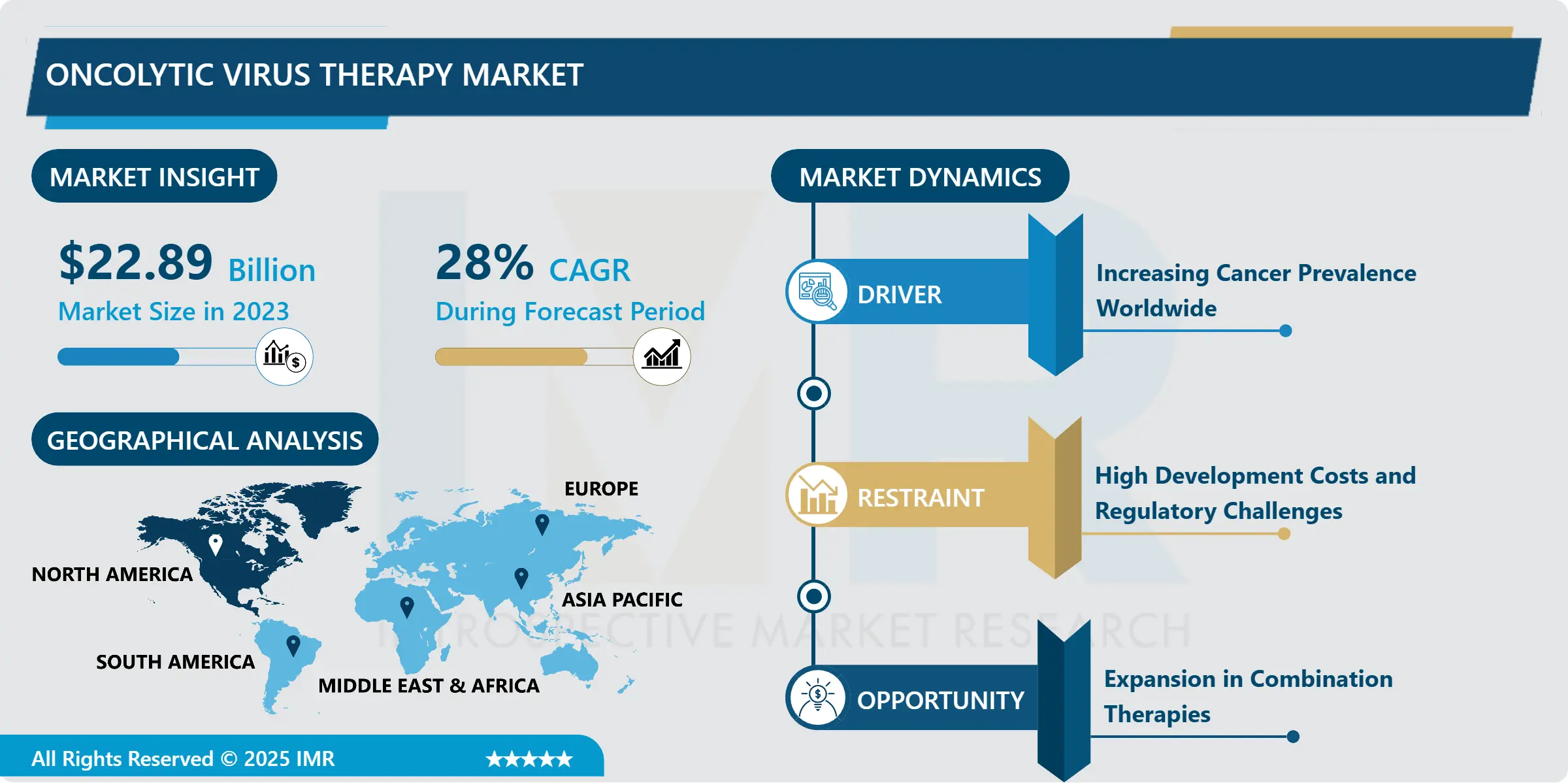
Oncolytic Virus Therapy Market Size Was Valued at USD 22.89 Billion in 2023, and is Projected to Reach USD 211.12 Billion by 2032, Growing at a CAGR of 28% From 2024-2032.

IMR Group
Description
Oncolytic Virus Therapy Market Synopsis:
Oncolytic Virus Therapy Market Size Was Valued at USD 22.89 Billion in 2023, and is Projected to Reach USD 211.12 Billion by 2032, Growing at a CAGR of 28% From 2024-2032.
The global oncolytic virus therapy market is emerging as a transformative segment within oncology therapeutics, driven by advancements in virotherapy and increasing focus on precision medicine. Oncolytic viruses are genetically modified or naturally occurring viruses that selectively infect and kill cancer cells without harming normal tissues. As cancer incidence continues to rise globally, the demand for novel and effective treatment options has surged, positioning oncolytic virus therapy as a promising alternative or adjunct to traditional cancer treatments such as chemotherapy and radiation.
North America currently leads the market, supported by significant R&D investments, favorable regulatory pathways, and strategic partnerships between biotech firms and academic institutions. Europe follows closely, with countries like Germany and the UK investing in clinical trials and early-stage development programs. Meanwhile, the Asia-Pacific region is gaining momentum due to growing cancer prevalence, increasing awareness, and improved healthcare infrastructure, especially in countries like China, Japan, and South Korea.
Key drivers propelling market growth include rising cancer burden, growing interest in immuno-oncology, and increasing FDA approvals for innovative therapies. The approval of products like Imlygic (Talimogene Laherparepvec) by Amgen has validated the commercial potential of this therapeutic class. Additionally, oncolytic viruses’ ability to stimulate systemic anti-tumor immunity has opened opportunities for combination therapies with checkpoint inhibitors, further broadening their market applicability.
Despite promising developments, the market faces notable challenges such as high costs associated with clinical trials, complex manufacturing processes, and limited awareness among oncologists and patients. Regulatory hurdles and variability in viral vector safety profiles also constrain faster adoption. However, ongoing innovations in vector design, delivery systems, and personalized oncology are expected to gradually overcome these barriers and support long-term market growth.
Oncolytic Virus Therapy Market Trend Analysis:
Rising Cancer Incidence and Demand for Novel Therapies
The primary drivers of the oncolytic virus therapy market is the global increase in cancer incidence, which continues to strain existing treatment options. As cancer remains one of the leading causes of death worldwide, the need for more effective, targeted therapies has become increasingly urgent. Traditional treatments like chemotherapy and radiation, though widely used, are often associated with significant side effects and limited specificity, highlighting the need for innovative approaches. Oncolytic virus therapy offers a promising solution by targeting cancer cells with minimal damage to healthy tissues, providing a more precise and potentially less toxic treatment alternative.
This rising demand for novel cancer therapies has led to a surge in research and development activities focused on oncolytic viruses. Governments, research institutions, and biotechnology companies are investing heavily in clinical trials and studies to optimize the efficacy of oncolytic virus therapy. As more treatments demonstrate positive results in clinical settings, the therapeutic modality gains momentum, drawing significant attention from both oncologists and patients looking for advanced treatment options. The increasing cancer burden is, therefore, a key factor driving the growth and adoption of oncolytic virus therapies in the global market.
Combination Therapy with Immune Checkpoint Inhibitors
A significant market opportunity for oncolytic virus therapy lies in its potential for combination with immune checkpoint inhibitors, a rapidly growing segment in cancer immunotherapy. Immune checkpoint inhibitors, such as PD-1/PD-L1 inhibitors, have revolutionized cancer treatment by enhancing the body’s immune response against tumors. Combining these therapies with oncolytic viruses has shown promise in preclinical and clinical trials, as the oncolytic viruses can stimulate the immune system, potentially improving the efficacy of checkpoint inhibitors. This synergy could enhance both localized and systemic anti-tumor immunity, providing a more robust treatment option for patients with advanced cancers.
As the understanding of immuno-oncology deepens, the opportunity to combine oncolytic virus therapy with other immunotherapies presents a powerful strategy to overcome resistance mechanisms and improve patient outcomes. This combination approach could significantly expand the market for oncolytic viruses, as it allows for treatment across a broader range of cancers and enhances therapeutic outcomes. Furthermore, the clinical success of such combinations could lead to more strategic partnerships between biotech companies developing oncolytic viruses and pharmaceutical companies focused on immuno-oncology, accelerating market penetration and growth.
Oncolytic Virus Therapy Market Segment Analysis:
Oncolytic Virus Therapy Market is Segmented on the basis of Virus Type, Therapy Type, application, end user, and region.
By Virus Type, Herpes Simplex Virus (HSV) segment is expected to dominate the market during the forecast period
The Herpes Simplex Virus (HSV) segment is expected to dominate the oncolytic virus therapy market during the forecast period due to its promising clinical efficacy and well-established research foundation. HSV has been one of the most extensively studied viral vectors in oncolytic virotherapy. Its natural ability to selectively infect and kill tumor cells, while leaving healthy cells largely unaffected, makes it a prime candidate for therapeutic development. Additionally, HSV-based oncolytic therapies can be engineered to enhance their oncolytic activity and modify the immune response, improving both tumor targeting and systemic anti-cancer effects.
Furthermore, HSV-based therapies, such as Talimogene Laherparepvec (T-VEC), have already received regulatory approval, cementing the viability of this virus type as a treatment option. The success of T-VEC in treating melanoma has spurred ongoing clinical trials and research into expanding its use to other cancer types. The familiarity and proven safety profile of HSV, combined with ongoing advancements in gene-editing technologies to optimize viral vectors, make this segment a key driver of growth in the oncolytic virus therapy market. As more therapies based on HSV continue to show positive results in clinical settings, its dominance in the market is expected to persist.
By Application, Melanoma segment expected to held the largest share
The melanoma segment is expected to hold the largest share of the oncolytic virus therapy market due to the high prevalence of melanoma and the growing need for innovative treatment options. Melanoma, a type of skin cancer known for its aggressive nature and resistance to traditional therapies, presents a significant challenge for oncologists. Oncolytic virus therapy has demonstrated considerable promise in treating melanoma, particularly with treatments like Talimogene Laherparepvec (T-VEC), which has shown efficacy in clinical trials. These therapies utilize genetically modified viruses, such as Herpes Simplex Virus (HSV), to target and destroy melanoma cells while stimulating the immune system to recognize and attack cancerous tissue.
As melanoma continues to be one of the most common and deadly forms of skin cancer, there is a strong demand for novel therapies that offer improved outcomes compared to existing treatments. The success of HSV-based oncolytic therapies in melanoma has generated significant interest, both from the medical community and patients. Furthermore, as melanoma cases increase globally, particularly in regions with high sun exposure, the market for oncolytic virus therapy in this application is expected to expand. The growing body of clinical evidence supporting the effectiveness of these therapies in melanoma underscores the segment’s dominant position in the overall oncolytic virus therapy market.
Oncolytic Virus Therapy Market Regional Insights:
North America is Expected to Dominate the Market Over the Forecast period
North America is expected to dominate the oncolytic virus therapy market during the forecast period, driven by robust healthcare infrastructure, substantial investments in research and development, and a favorable regulatory environment. The United States, in particular, is a global leader in the biotechnology and pharmaceutical sectors, with numerous companies and research institutions focused on advancing oncolytic virus therapies. The approval of treatments like Talimogene Laherparepvec (T-VEC) by the U.S. Food and Drug Administration (FDA) has provided a strong foundation for the growth of this market. Additionally, the presence of prominent biotech companies and well-established clinical trial networks contributes to a rapid pipeline development, fostering continuous innovation and clinical advancements in oncolytic virus therapies.
The high cancer incidence rates, particularly melanoma and other solid tumors, further fuel the demand for alternative cancer treatments in North America. The region’s increasing emphasis on personalized medicine and immuno-oncology therapies aligns with the capabilities of oncolytic virus treatments, which can target specific tumor cells while activating the body’s immune system. With ongoing collaborations between biotech companies, academic institutions, and healthcare providers, North America is poised to maintain its leadership position in the global oncolytic virus therapy market, accounting for the largest market share in the coming years.
Active Key Players in the Oncolytic Virus Therapy Market:
Amgen Inc. (USA)
Cold Genesys, Inc. (USA)
Genelux Corporation (USA)
Lokon Pharma AB (Sweden)
Oncolytics Biotech Inc. (Canada)
PsiOxus Therapeutics Ltd. (UK)
Replimune Group, Inc. (USA)
Sorrento Therapeutics, Inc. (USA)
Targovax ASA (Norway)
Transgene SA (France)
Viralytics Ltd. (Australia)
Vyriad, Inc. (USA), and Other Active Players.
Chapter 1: Introduction
1.1 Scope and Coverage
Chapter 2:Executive Summary
Chapter 3: Market Landscape
3.1 Market Dynamics
3.1.1 Drivers
3.1.2 Restraints
3.1.3 Opportunities
3.1.4 Challenges
3.2 Market Trend Analysis
3.3 PESTLE Analysis
3.4 Porter’s Five Forces Analysis
3.5 Industry Value Chain Analysis
3.6 Ecosystem
3.7 Regulatory Landscape
3.8 Price Trend Analysis
3.9 Patent Analysis
3.10 Technology Evolution
3.11 Investment Pockets
3.12 Import-Export Analysis
Chapter 4: Oncolytic Virus Therapy Market by Virus Type
4.1 Oncolytic Virus Therapy Market Snapshot and Growth Engine
4.2 Oncolytic Virus Therapy Market Overview
4.3 Herpes Simplex Virus (HSV)
4.3.1 Introduction and Market Overview
4.3.2 Historic and Forecasted Market Size in Value USD and Volume Units (2017-2032F)
4.3.3 Key Market Trends, Growth Factors and Opportunities
4.3.4 Herpes Simplex Virus (HSV): Geographic Segmentation Analysis
4.4 Adenovirus
4.4.1 Introduction and Market Overview
4.4.2 Historic and Forecasted Market Size in Value USD and Volume Units (2017-2032F)
4.4.3 Key Market Trends, Growth Factors and Opportunities
4.4.4 Adenovirus: Geographic Segmentation Analysis
4.5 Reovirus
4.5.1 Introduction and Market Overview
4.5.2 Historic and Forecasted Market Size in Value USD and Volume Units (2017-2032F)
4.5.3 Key Market Trends, Growth Factors and Opportunities
4.5.4 Reovirus: Geographic Segmentation Analysis
4.6 Vaccinia Virus
4.6.1 Introduction and Market Overview
4.6.2 Historic and Forecasted Market Size in Value USD and Volume Units (2017-2032F)
4.6.3 Key Market Trends, Growth Factors and Opportunities
4.6.4 Vaccinia Virus: Geographic Segmentation Analysis
4.7 Newcastle Disease Virus
4.7.1 Introduction and Market Overview
4.7.2 Historic and Forecasted Market Size in Value USD and Volume Units (2017-2032F)
4.7.3 Key Market Trends, Growth Factors and Opportunities
4.7.4 Newcastle Disease Virus: Geographic Segmentation Analysis
4.8 Others
4.8.1 Introduction and Market Overview
4.8.2 Historic and Forecasted Market Size in Value USD and Volume Units (2017-2032F)
4.8.3 Key Market Trends, Growth Factors and Opportunities
4.8.4 Others: Geographic Segmentation Analysis
Chapter 5: Oncolytic Virus Therapy Market by Therapy Type
5.1 Oncolytic Virus Therapy Market Snapshot and Growth Engine
5.2 Oncolytic Virus Therapy Market Overview
5.3 Monotherapy
5.3.1 Introduction and Market Overview
5.3.2 Historic and Forecasted Market Size in Value USD and Volume Units (2017-2032F)
5.3.3 Key Market Trends, Growth Factors and Opportunities
5.3.4 Monotherapy: Geographic Segmentation Analysis
5.4 Combination Therapy
5.4.1 Introduction and Market Overview
5.4.2 Historic and Forecasted Market Size in Value USD and Volume Units (2017-2032F)
5.4.3 Key Market Trends, Growth Factors and Opportunities
5.4.4 Combination Therapy: Geographic Segmentation Analysis
Chapter 6: Oncolytic Virus Therapy Market by Application
6.1 Oncolytic Virus Therapy Market Snapshot and Growth Engine
6.2 Oncolytic Virus Therapy Market Overview
6.3 Melanoma
6.3.1 Introduction and Market Overview
6.3.2 Historic and Forecasted Market Size in Value USD and Volume Units (2017-2032F)
6.3.3 Key Market Trends, Growth Factors and Opportunities
6.3.4 Melanoma: Geographic Segmentation Analysis
6.4 Breast Cancer
6.4.1 Introduction and Market Overview
6.4.2 Historic and Forecasted Market Size in Value USD and Volume Units (2017-2032F)
6.4.3 Key Market Trends, Growth Factors and Opportunities
6.4.4 Breast Cancer: Geographic Segmentation Analysis
6.5 Prostate Cancer
6.5.1 Introduction and Market Overview
6.5.2 Historic and Forecasted Market Size in Value USD and Volume Units (2017-2032F)
6.5.3 Key Market Trends, Growth Factors and Opportunities
6.5.4 Prostate Cancer: Geographic Segmentation Analysis
6.6 Lung Cancer
6.6.1 Introduction and Market Overview
6.6.2 Historic and Forecasted Market Size in Value USD and Volume Units (2017-2032F)
6.6.3 Key Market Trends, Growth Factors and Opportunities
6.6.4 Lung Cancer: Geographic Segmentation Analysis
6.7 Glioblastoma
6.7.1 Introduction and Market Overview
6.7.2 Historic and Forecasted Market Size in Value USD and Volume Units (2017-2032F)
6.7.3 Key Market Trends, Growth Factors and Opportunities
6.7.4 Glioblastoma: Geographic Segmentation Analysis
6.8 Others
6.8.1 Introduction and Market Overview
6.8.2 Historic and Forecasted Market Size in Value USD and Volume Units (2017-2032F)
6.8.3 Key Market Trends, Growth Factors and Opportunities
6.8.4 Others: Geographic Segmentation Analysis
Chapter 7: Oncolytic Virus Therapy Market by End User
7.1 Oncolytic Virus Therapy Market Snapshot and Growth Engine
7.2 Oncolytic Virus Therapy Market Overview
7.3 Hospitals
7.3.1 Introduction and Market Overview
7.3.2 Historic and Forecasted Market Size in Value USD and Volume Units (2017-2032F)
7.3.3 Key Market Trends, Growth Factors and Opportunities
7.3.4 Hospitals: Geographic Segmentation Analysis
7.4 Cancer Research Institutes
7.4.1 Introduction and Market Overview
7.4.2 Historic and Forecasted Market Size in Value USD and Volume Units (2017-2032F)
7.4.3 Key Market Trends, Growth Factors and Opportunities
7.4.4 Cancer Research Institutes: Geographic Segmentation Analysis
7.5 Specialty Clinics
7.5.1 Introduction and Market Overview
7.5.2 Historic and Forecasted Market Size in Value USD and Volume Units (2017-2032F)
7.5.3 Key Market Trends, Growth Factors and Opportunities
7.5.4 Specialty Clinics: Geographic Segmentation Analysis
7.6 Others
7.6.1 Introduction and Market Overview
7.6.2 Historic and Forecasted Market Size in Value USD and Volume Units (2017-2032F)
7.6.3 Key Market Trends, Growth Factors and Opportunities
7.6.4 Others: Geographic Segmentation Analysis
Chapter 8: Company Profiles and Competitive Analysis
8.1 Competitive Landscape
8.1.1 Competitive Benchmarking
8.1.2 Oncolytic Virus Therapy Market Share by Manufacturer (2023)
8.1.3 Industry BCG Matrix
8.1.4 Heat Map Analysis
8.1.5 Mergers and Acquisitions
8.2 AMGEN INC. (USA)
8.2.1 Company Overview
8.2.2 Key Executives
8.2.3 Company Snapshot
8.2.4 Role of the Company in the Market
8.2.5 Sustainability and Social Responsibility
8.2.6 Operating Business Segments
8.2.7 Product Portfolio
8.2.8 Business Performance
8.2.9 Key Strategic Moves and Recent Developments
8.2.10 SWOT Analysis
8.3 ONCOLYTICS BIOTECH INC. (CANADA)
8.4 SORRENTO THERAPEUTICS INC. (USA)
8.5 REPLIMUNE GROUP INC. (USA)
8.6 LOKON PHARMA AB (SWEDEN)TARGOVAX ASA (NORWAY)
8.7 VIRALYTICS LTD. (AUSTRALIA)
8.8 PSIOXUS THERAPEUTICS LTD. (UK)
8.9 TRANSGENE SA (FRANCE)
8.10 VYRIAD INC. (USA)
8.11 GENELUX CORPORATION (USA)
8.12 COLD GENESYS INC. (USA)
8.13
8.14 OTHER ACTIVE PLAYERS
Chapter 9: Global Oncolytic Virus Therapy Market By Region
9.1 Overview
9.2. North America Oncolytic Virus Therapy Market
9.2.1 Key Market Trends, Growth Factors and Opportunities
9.2.2 Top Key Companies
9.2.3 Historic and Forecasted Market Size by Segments
9.2.4 Historic and Forecasted Market Size By Virus Type
9.2.4.1 Herpes Simplex Virus (HSV)
9.2.4.2 Adenovirus
9.2.4.3 Reovirus
9.2.4.4 Vaccinia Virus
9.2.4.5 Newcastle Disease Virus
9.2.4.6 Others
9.2.5 Historic and Forecasted Market Size By Therapy Type
9.2.5.1 Monotherapy
9.2.5.2 Combination Therapy
9.2.6 Historic and Forecasted Market Size By Application
9.2.6.1 Melanoma
9.2.6.2 Breast Cancer
9.2.6.3 Prostate Cancer
9.2.6.4 Lung Cancer
9.2.6.5 Glioblastoma
9.2.6.6 Others
9.2.7 Historic and Forecasted Market Size By End User
9.2.7.1 Hospitals
9.2.7.2 Cancer Research Institutes
9.2.7.3 Specialty Clinics
9.2.7.4 Others
9.2.8 Historic and Forecast Market Size by Country
9.2.8.1 US
9.2.8.2 Canada
9.2.8.3 Mexico
9.3. Eastern Europe Oncolytic Virus Therapy Market
9.3.1 Key Market Trends, Growth Factors and Opportunities
9.3.2 Top Key Companies
9.3.3 Historic and Forecasted Market Size by Segments
9.3.4 Historic and Forecasted Market Size By Virus Type
9.3.4.1 Herpes Simplex Virus (HSV)
9.3.4.2 Adenovirus
9.3.4.3 Reovirus
9.3.4.4 Vaccinia Virus
9.3.4.5 Newcastle Disease Virus
9.3.4.6 Others
9.3.5 Historic and Forecasted Market Size By Therapy Type
9.3.5.1 Monotherapy
9.3.5.2 Combination Therapy
9.3.6 Historic and Forecasted Market Size By Application
9.3.6.1 Melanoma
9.3.6.2 Breast Cancer
9.3.6.3 Prostate Cancer
9.3.6.4 Lung Cancer
9.3.6.5 Glioblastoma
9.3.6.6 Others
9.3.7 Historic and Forecasted Market Size By End User
9.3.7.1 Hospitals
9.3.7.2 Cancer Research Institutes
9.3.7.3 Specialty Clinics
9.3.7.4 Others
9.3.8 Historic and Forecast Market Size by Country
9.3.8.1 Russia
9.3.8.2 Bulgaria
9.3.8.3 The Czech Republic
9.3.8.4 Hungary
9.3.8.5 Poland
9.3.8.6 Romania
9.3.8.7 Rest of Eastern Europe
9.4. Western Europe Oncolytic Virus Therapy Market
9.4.1 Key Market Trends, Growth Factors and Opportunities
9.4.2 Top Key Companies
9.4.3 Historic and Forecasted Market Size by Segments
9.4.4 Historic and Forecasted Market Size By Virus Type
9.4.4.1 Herpes Simplex Virus (HSV)
9.4.4.2 Adenovirus
9.4.4.3 Reovirus
9.4.4.4 Vaccinia Virus
9.4.4.5 Newcastle Disease Virus
9.4.4.6 Others
9.4.5 Historic and Forecasted Market Size By Therapy Type
9.4.5.1 Monotherapy
9.4.5.2 Combination Therapy
9.4.6 Historic and Forecasted Market Size By Application
9.4.6.1 Melanoma
9.4.6.2 Breast Cancer
9.4.6.3 Prostate Cancer
9.4.6.4 Lung Cancer
9.4.6.5 Glioblastoma
9.4.6.6 Others
9.4.7 Historic and Forecasted Market Size By End User
9.4.7.1 Hospitals
9.4.7.2 Cancer Research Institutes
9.4.7.3 Specialty Clinics
9.4.7.4 Others
9.4.8 Historic and Forecast Market Size by Country
9.4.8.1 Germany
9.4.8.2 UK
9.4.8.3 France
9.4.8.4 The Netherlands
9.4.8.5 Italy
9.4.8.6 Spain
9.4.8.7 Rest of Western Europe
9.5. Asia Pacific Oncolytic Virus Therapy Market
9.5.1 Key Market Trends, Growth Factors and Opportunities
9.5.2 Top Key Companies
9.5.3 Historic and Forecasted Market Size by Segments
9.5.4 Historic and Forecasted Market Size By Virus Type
9.5.4.1 Herpes Simplex Virus (HSV)
9.5.4.2 Adenovirus
9.5.4.3 Reovirus
9.5.4.4 Vaccinia Virus
9.5.4.5 Newcastle Disease Virus
9.5.4.6 Others
9.5.5 Historic and Forecasted Market Size By Therapy Type
9.5.5.1 Monotherapy
9.5.5.2 Combination Therapy
9.5.6 Historic and Forecasted Market Size By Application
9.5.6.1 Melanoma
9.5.6.2 Breast Cancer
9.5.6.3 Prostate Cancer
9.5.6.4 Lung Cancer
9.5.6.5 Glioblastoma
9.5.6.6 Others
9.5.7 Historic and Forecasted Market Size By End User
9.5.7.1 Hospitals
9.5.7.2 Cancer Research Institutes
9.5.7.3 Specialty Clinics
9.5.7.4 Others
9.5.8 Historic and Forecast Market Size by Country
9.5.8.1 China
9.5.8.2 India
9.5.8.3 Japan
9.5.8.4 South Korea
9.5.8.5 Malaysia
9.5.8.6 Thailand
9.5.8.7 Vietnam
9.5.8.8 The Philippines
9.5.8.9 Australia
9.5.8.10 New Zealand
9.5.8.11 Rest of APAC
9.6. Middle East & Africa Oncolytic Virus Therapy Market
9.6.1 Key Market Trends, Growth Factors and Opportunities
9.6.2 Top Key Companies
9.6.3 Historic and Forecasted Market Size by Segments
9.6.4 Historic and Forecasted Market Size By Virus Type
9.6.4.1 Herpes Simplex Virus (HSV)
9.6.4.2 Adenovirus
9.6.4.3 Reovirus
9.6.4.4 Vaccinia Virus
9.6.4.5 Newcastle Disease Virus
9.6.4.6 Others
9.6.5 Historic and Forecasted Market Size By Therapy Type
9.6.5.1 Monotherapy
9.6.5.2 Combination Therapy
9.6.6 Historic and Forecasted Market Size By Application
9.6.6.1 Melanoma
9.6.6.2 Breast Cancer
9.6.6.3 Prostate Cancer
9.6.6.4 Lung Cancer
9.6.6.5 Glioblastoma
9.6.6.6 Others
9.6.7 Historic and Forecasted Market Size By End User
9.6.7.1 Hospitals
9.6.7.2 Cancer Research Institutes
9.6.7.3 Specialty Clinics
9.6.7.4 Others
9.6.8 Historic and Forecast Market Size by Country
9.6.8.1 Turkiye
9.6.8.2 Bahrain
9.6.8.3 Kuwait
9.6.8.4 Saudi Arabia
9.6.8.5 Qatar
9.6.8.6 UAE
9.6.8.7 Israel
9.6.8.8 South Africa
9.7. South America Oncolytic Virus Therapy Market
9.7.1 Key Market Trends, Growth Factors and Opportunities
9.7.2 Top Key Companies
9.7.3 Historic and Forecasted Market Size by Segments
9.7.4 Historic and Forecasted Market Size By Virus Type
9.7.4.1 Herpes Simplex Virus (HSV)
9.7.4.2 Adenovirus
9.7.4.3 Reovirus
9.7.4.4 Vaccinia Virus
9.7.4.5 Newcastle Disease Virus
9.7.4.6 Others
9.7.5 Historic and Forecasted Market Size By Therapy Type
9.7.5.1 Monotherapy
9.7.5.2 Combination Therapy
9.7.6 Historic and Forecasted Market Size By Application
9.7.6.1 Melanoma
9.7.6.2 Breast Cancer
9.7.6.3 Prostate Cancer
9.7.6.4 Lung Cancer
9.7.6.5 Glioblastoma
9.7.6.6 Others
9.7.7 Historic and Forecasted Market Size By End User
9.7.7.1 Hospitals
9.7.7.2 Cancer Research Institutes
9.7.7.3 Specialty Clinics
9.7.7.4 Others
9.7.8 Historic and Forecast Market Size by Country
9.7.8.1 Brazil
9.7.8.2 Argentina
9.7.8.3 Rest of SA
Chapter 10 Analyst Viewpoint and Conclusion
10.1 Recommendations and Concluding Analysis
10.2 Potential Market Strategies
Chapter 11 Research Methodology
11.1 Research Process
11.2 Primary Research
11.3 Secondary Research
Q1: What would be the forecast period in the Oncolytic Virus Therapy Market research report?
A1: The forecast period in the Oncolytic Virus Therapy Market research report is 2024-2032.
Q2: Who are the key players in the Oncolytic Virus Therapy Market?
A2: Amgen Inc. (USA), Cold Genesys, Inc. (USA), Genelux Corporation (USA), Lokon Pharma AB (Sweden), Oncolytics Biotech Inc. (Canada), PsiOxus Therapeutics Ltd. (UK), Replimune Group, Inc. (USA), Sorrento Therapeutics, Inc. (USA), Targovax ASA (Norway), Transgene SA (France), Viralytics Ltd. (Australia), Vyriad, Inc. (USA), and Other Active Players.
Q3: What are the segments of the Oncolytic Virus Therapy Market?
A3: The Oncolytic Virus Therapy Market is segmented into VirusType, Therapy Type, Application, End User and region. By Virus Type, the market is categorized into Herpes Simplex Virus (HSV), Adenovirus, Reovirus, Vaccinia Virus, Newcastle Disease Virus, Others. By Therapy Type, the market is categorized into Monotherapy, Combination Therapy. By Application, the market is categorized into Melanoma, Breast Cancer, Prostate Cancer, Lung Cancer, Glioblastoma, Others. By End User, the market is categorized into Hospitals, Cancer Research Institutes, Specialty Clinics, Others. By region, it is analyzed across North America (U.S., Canada, Mexico), Eastern Europe (Russia, Bulgaria, The Czech Republic, Hungary, Poland, Romania, Rest of Eastern Europe), Western Europe (Germany, UK, France, Netherlands, Italy, Spain, Rest of Western Europe), Asia Pacific (China, India, Japan, South Korea, Malaysia, Thailand, Vietnam, The Philippines, Australia, New-Zealand, Rest of APAC), Middle East & Africa (Türkiye, Bahrain, Kuwait, Saudi Arabia, Qatar, UAE, Israel, South Africa), South America (Brazil, Argentina, Rest of SA).
Q4: What is the Oncolytic Virus Therapy Market?
A4: The Oncolytic Virus Therapy Market refers to the segment of the biotechnology and oncology industry focused on the development and use of genetically modified or naturally occurring viruses to selectively infect and kill cancer cells while sparing healthy tissues. These viruses, such as Herpes Simplex Virus (HSV) or Adenovirus, can also stimulate the immune system to enhance the body's natural defense mechanisms against cancer. Oncolytic virus therapies offer a promising alternative or complement to traditional cancer treatments, including chemotherapy and radiation, with the potential for fewer side effects and more targeted therapeutic effects.
Q5: How big is the Oncolytic Virus Therapy Market?
A5: Oncolytic Virus Therapy Market Size Was Valued at USD 22.89 Billion in 2023, and is Projected to Reach USD 211.12 Billion by 2032, Growing at a CAGR of 28% From 2024-2032.
How to Buy a Report from eminsights.jp
On the product page, choose the license you want: Single-User License, Multi-User License or Enterprise License.
If you required report in your native language, then you can click on Translated Report button and fill out the form with report name and language you want, then our team will contact you as soon as possible.
Click the Buy Now button.
You will be redirected to the checkout page. Enter your company details and payment information.
Click Place Order to complete the purchase.
Confirmation: You’ll receive an order confirmation and our team will contact you shortly with your ordered report.
If you have any questions, fill out the contact form below or email us at bizdev@eminsights.net.
Thank you for choosing eminsights.jp!