Stay Ahead in Fast-Growing Economies.
Browse Reports Now
Oil Storage Market – Comprehensive Study Report & Recent Trends 2024-2032
There are different types and designs of oil storage tanks to meet the various requirements of the petroleum industry.

IMR Group
Description
Oil Storage Market Synopsis
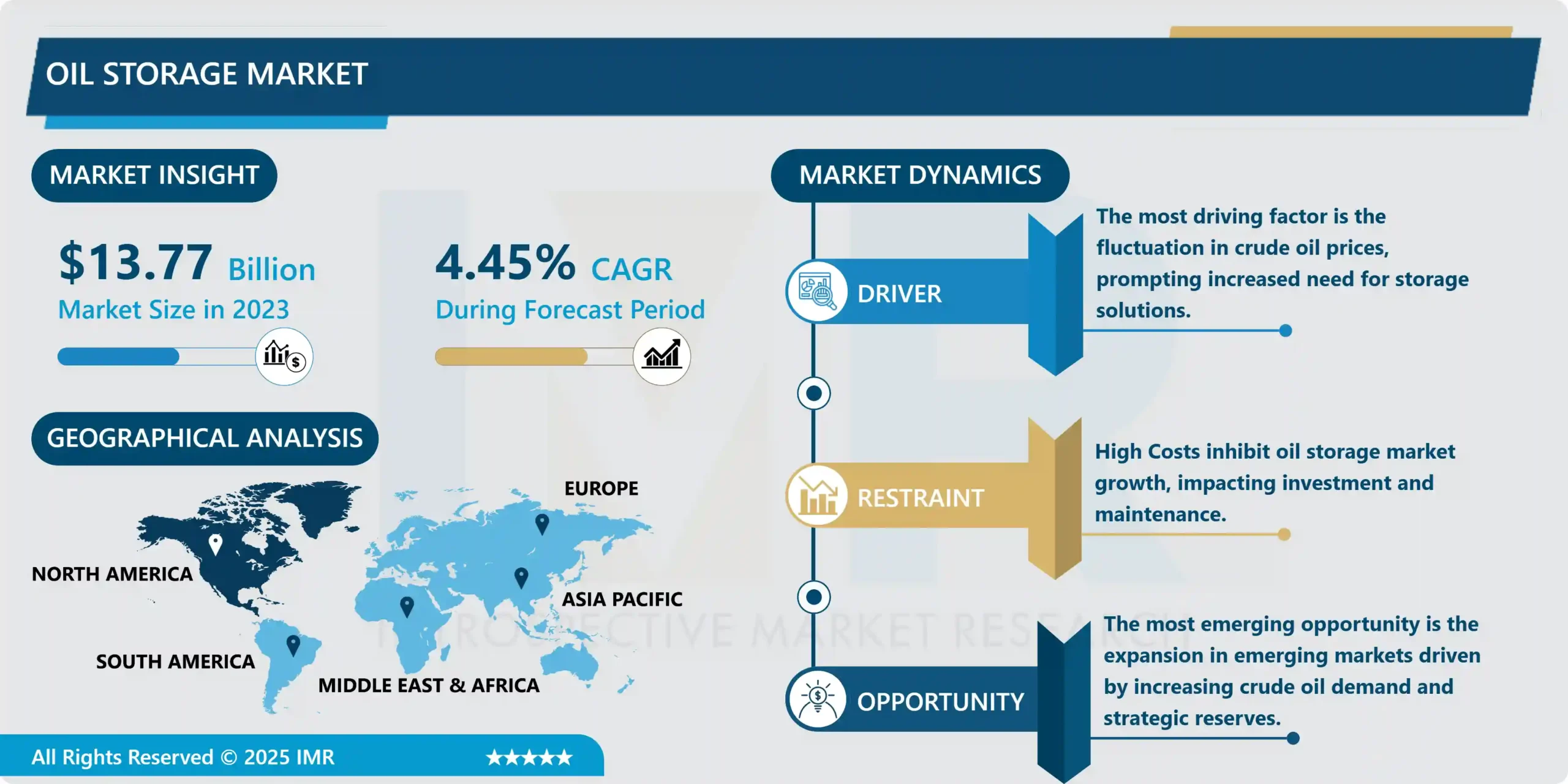
Oil Storage Market Size Was Valued at USD 13.77 Billion in 2023 and is Projected to Reach USD 20.38 Billion by 2032, Growing at a CAGR of 4.45% From 2024-2032.
There are different types and designs of oil storage tanks to meet the various requirements of the petroleum industry. Smaller tanks with bolts are utilized for temporary storage in production sites, while larger tanks with welded joints are standard in refineries and distribution terminals.
Tanks are selected depending on operational factors, storage capacities, and design needs, with materials and construction methods chosen to accommodate the properties of the stored product. Oil storage facilities are crucial in the worldwide energy supply system as they handle changes in supply and demand. They guarantee a constant oil supply for sectors such as transportation and manufacturing. Strategic reserves also play a role in decreasing dependency on foreign oil and improving energy security in the face of different risks. Fluctuations in global oil prices significantly affect the oil storage sector, altering the balance between supply and demand. Changes in supply chains require additional storage facilities to safeguard against price fluctuations.
Growing consumption and production necessitate more extensive storage facilities. Furthermore, the strategic petroleum reserves of different nations help drive market expansion, guaranteeing energy stability when there are interruptions in supply. Oil storage sites must follow strict rules regarding the environment and safety to avoid leaks and pollution, ensuring protection of the environment and public health. Tanks are equipped with advanced safety features including secondary containment and leak detection systems. Adherence is essential to prevent penalties and uphold operational integrity, as regulations consistently influence industry operations. The extensive and varied oil storage capacity worldwide ranges from small on-site tanks to large terminals, including above-ground and underground storage tanks. Essential for handling supply chains in times of high production or low demand, countries with substantial oil industries operate large storage systems. This ability is necessary for strategic stockpiles and business needs in order to guarantee a steady and dependable oil source.
Oil Storage Market Trend Analysis
The most emerging trend is the integration of automation and IoT for enhanced operational efficiency and safety.
The blending of automation and IoT technologies is a significant trend in the oil storage sector, improving efficiency, safety, and monitoring. Automated systems and IoT devices allow for monitoring in real-time, predictive maintenance, and better inventory control to ensure optimal storage conditions and adherence to regulations.
Countries worldwide are increasing their strategic petroleum reserves (SPRs) to protect energy security and handle supply interruptions, leading to a higher need for extensive storage sites and encouraging investments in infrastructure for market durability. Floating roof tanks are becoming more and more common for the storage of volatile materials such as crude oil.
They lower evaporation and fire hazards, which is why they are the top choice for secure storage. This trend shows that the industry is concentrating on safety and adhering to environmental regulations. By situating storage facilities close to transportation hubs and refineries, supply chain logistics are improved, costs are decreased, and the distribution of oil products becomes more efficient.
Proximity to ports, pipelines, and refineries improves operational effectiveness. Businesses in the oil storage industry are investigating hybrid storage solutions that merge conventional oil storage techniques with renewable energy sources such as solar and wind to decrease carbon emissions and comply with worldwide energy transition targets.
The most emerging opportunity is the expansion in emerging markets driven by increasing crude oil demand and strategic reserves.
The oil storage market has opportunities due to the integration of Automation and IoT in technological advancements. They enhance effectiveness, security, supervision, offer a competitive advantage, streamline administration, and enforce adherence.
Strategic Petroleum Reserves (SPRs) provide governments with opportunities for growth by helping to handle supply disruptions, control fluctuations in oil prices, and stimulate the need for substantial storage facilities, promoting market expansion and durability. Geopolitical factors influence investments in oil storage facilities, with nations seeking to enhance energy security and reduce dependence on imported oil. Improving and enhancing storage facilities is essential for mitigating risks.
There is a growing global demand for crude oil, creating opportunities to enlarge storage capacities. Investments in infrastructure are being made to support increased volumes and maintain a consistent supply chain as demand grows in different industries. India and China’s rapid economic growth and industrialization are fueling the expansion of the oil storage industry, particularly in emerging markets. This development allows for the growth of storage infrastructure to meet energy needs and support market expansion.
Oil Storage Market Segment Analysis:
The Oil Storage Market is Segmented on the basis of Type, Material, Product Design, Storage Type, and End-Use.
By Type, Crude Oil Segment Is Expected to Dominate the Market During the Forecast Period
Increased production and reduced demand are the reasons behind crude oil storage’s 51% market share in 2021. Greater storage capacity is required to effectively handle excess inventories.
Investments in refining plants increase the growth of middle distillates, fueled by high demand for low-sulphur distillates in Asia-Pacific nations, resulting in a rise in the storage market.
The growth of the gasoline industry is driven by its demand in both vehicles and industrial applications. Competition from Electric Vehicles could impede the potential expansion of the gasoline market in the future.
The shift to renewable energy sources and electric vehicles has led to an increased demand for crude oil storage by both governments and energy companies in order to sustain petrochemical production crucial for industries such as electric vehicle manufacturing.
Geopolitical conflicts in areas that produce oil increase the necessity for storing crude oil as a precautionary measure, leading to higher demand for storage facilities. The expansion of the market is also fueled by the LNG industry’s dependence on natural gas liquids.
By Product Design, Fixed roof tank Segment Held the Largest Share In 2023
Fixed roof tanks are crucial in the oil storage industry due to their cost efficiency and dependability. They offer important storage for different types of oil products, effectively meeting the needs of the industry. Global increases in oil production and refinery capacity are driving up the demand for fixed-roof storage tanks as there is a growing need for strong storage facilities in light of the rising oil production.
Stricter environmental regulations and spill prevention measures are the reasons why fixed roof tanks are favored over floating tanks for storing oil, as they offer superior containment and ensure compliance with safety standards. Improvements in tank technology are enhancing the use of fixed-roof storage systems in the oil industry infrastructure, increasing their effectiveness and safety.
The global market is dominated by the fixed roof oil storage segment, holding a 48% volume share in 2021. Its excellent ability to contain reduces fire hazards, while lower installation expenses for fixed-roof designs drive up demand and market expansion.
Oil Storage Market Regional Insights:
North America is Expected to Dominate the Market Over the Forecast Period
During 2020, there was a 2.8-million-barrel increase in US oil reserves as production rose and demand fell due to factors such as the COVID-19 pandemic. Limited space and excess resources necessitate strategic approaches for efficient handling.
Factors such as technological advancements, increasing environmental concerns, and a shift in consumer preferences towards sustainable alternatives have led to a decrease in oil consumption in North America and the US, affecting trends in energy consumption.
North America, which includes the United States and Canada, is putting money into new storage infrastructure such as oil terminals and expanding current facilities to manage growing inventories and keep supply chains intact as production levels rise.
The strategic placement of important storage facilities such as Freeport V, West Hackberry, and Big Hill in the US supports effective distribution, and logistics, and guarantees the durability of North America’s oil storage network. Due to investments in storage infrastructure and strategic positioning of key facilities, North America is expected to lead the global oil storage market, managing storage challenges and remaining a key player in the energy sector.
Oil Storage Market Active Players
Royal Vopak (Netherlands)
Vitol Tank Terminals International BV (VTTI) (Switzerland)
Oiltanking GmbH (Germany)
NuStar Energy L.P. (U.S.)
Magellan Midstream Partners L.P. (U.S.)
Buckeye Partners L.P. (U.S.)
CST Industries (U.S.)
NOV Inc. (U.S.)
Snyder Industries (U.S.)
LF Manufacturing (U.S.)
Superior Tank Co., Inc. (U.S.)
SHAWCOR (Canada)
Waterford Tank & Fabrication (U.S.)
ERGIL (Turkey)
Kinder Morgan (U.S.)
Containment Solutions Inc. (U.S.)
Roth Industries Inc. (Germany)
Belco Manufacturing Company Inc. (U.S.)
Enduro Composites Inc. (U.S.)
McDermott International Ltd. (U.S.)
Oil India Ltd. (India)
Reliance Industries Ltd. (India)
China National Petroleum Corporation (China)
China National Offshore Oil Corporation (China)
Sinochem Group (China)
Rosneft (Russia)
Gazprom (Russia)
Axiom Equipment Group (Canada)
Chapter 1: Introduction
1.1 Scope and Coverage
Chapter 2:Executive Summary
Chapter 3: Market Landscape
3.1 Market Dynamics
3.1.1 Drivers
3.1.2 Restraints
3.1.3 Opportunities
3.1.4 Challenges
3.2 Market Trend Analysis
3.3 PESTLE Analysis
3.4 Porter’s Five Forces Analysis
3.5 Industry Value Chain Analysis
3.6 Ecosystem
3.7 Regulatory Landscape
3.8 Price Trend Analysis
3.9 Patent Analysis
3.10 Technology Evolution
3.11 Investment Pockets
3.12 Import-Export Analysis
Chapter 4: Oil Storage Market by Type (2018-2032)
4.1 Oil Storage Market Snapshot and Growth Engine
4.2 Market Overview
4.3 Crude oil
4.3.1 Introduction and Market Overview
4.3.2 Historic and Forecasted Market Size in Value USD and Volume Units
4.3.3 Key Market Trends, Growth Factors, and Opportunities
4.3.4 Geographic Segmentation Analysis
4.4 Gasoline
4.5 Aviation fuel
4.6 Liquefied Petroleum Gas (LPG)
4.7 Diesel
4.8 Kerosene
Chapter 5: Oil Storage Market by Material (2018-2032)
5.1 Oil Storage Market Snapshot and Growth Engine
5.2 Market Overview
5.3 Steel
5.3.1 Introduction and Market Overview
5.3.2 Historic and Forecasted Market Size in Value USD and Volume Units
5.3.3 Key Market Trends, Growth Factors, and Opportunities
5.3.4 Geographic Segmentation Analysis
5.4 Carbon Steel
5.5 Fiberglass-reinforced Plastic (FRP)
Chapter 6: Oil Storage Market by Product Design (2018-2032)
6.1 Oil Storage Market Snapshot and Growth Engine
6.2 Market Overview
6.3 Open Top Tank
6.3.1 Introduction and Market Overview
6.3.2 Historic and Forecasted Market Size in Value USD and Volume Units
6.3.3 Key Market Trends, Growth Factors, and Opportunities
6.3.4 Geographic Segmentation Analysis
6.4 Fixed Roof Tank
6.5 Floating Roof Tank
6.6 Bullet Tank
6.7 Spherical Tank
Chapter 7: Oil Storage Market by Storage Type (2018-2032)
7.1 Oil Storage Market Snapshot and Growth Engine
7.2 Market Overview
7.3 Above-Ground Storage Tanks (AST)
7.3.1 Introduction and Market Overview
7.3.2 Historic and Forecasted Market Size in Value USD and Volume Units
7.3.3 Key Market Trends, Growth Factors, and Opportunities
7.3.4 Geographic Segmentation Analysis
7.4 Underground Storage Tanks (UST)
Chapter 8: Oil Storage Market by End-Use (2018-2032)
8.1 Oil Storage Market Snapshot and Growth Engine
8.2 Market Overview
8.3 Commercial
8.3.1 Introduction and Market Overview
8.3.2 Historic and Forecasted Market Size in Value USD and Volume Units
8.3.3 Key Market Trends, Growth Factors, and Opportunities
8.3.4 Geographic Segmentation Analysis
8.4 Strategic Reserves
8.5 Refineries
8.6 Petrochemical Plants
Chapter 9: Company Profiles and Competitive Analysis
9.1 Competitive Landscape
9.1.1 Competitive Benchmarking
9.1.2 Oil Storage Market Share by Manufacturer (2024)
9.1.3 Industry BCG Matrix
9.1.4 Heat Map Analysis
9.1.5 Mergers and Acquisitions
9.2 ROYAL VOPAK (NETHERLANDS)
9.2.1 Company Overview
9.2.2 Key Executives
9.2.3 Company Snapshot
9.2.4 Role of the Company in the Market
9.2.5 Sustainability and Social Responsibility
9.2.6 Operating Business Segments
9.2.7 Product Portfolio
9.2.8 Business Performance
9.2.9 Key Strategic Moves and Recent Developments
9.2.10 SWOT Analysis
9.3 VITOL TANK TERMINALS INTERNATIONAL BV (VTTI) (SWITZERLAND)
9.4 OILTANKING GMBH (GERMANY)
9.5 NUSTAR ENERGY L.P. (U.S.)
9.6 MAGELLAN MIDSTREAM PARTNERS L.P. (U.S.)
9.7 BUCKEYE PARTNERS L.P. (U.S.)
9.8 CST INDUSTRIES (U.S.)
9.9 NOV INC. (U.S.)
9.10 SNYDER INDUSTRIES (U.S.)
9.11 LF MANUFACTURING (U.S.)
9.12 SUPERIOR TANK COINC. (U.S.)
9.13 SHAWCOR (CANADA)
9.14 WATERFORD TANK & FABRICATION (U.S.)
9.15 ERGIL (TURKEY)
9.16 KINDER MORGAN (U.S.)
9.17 CONTAINMENT SOLUTIONS INC. (U.S.)
9.18 ROTH INDUSTRIES INC. (GERMANY)
9.19 BELCO MANUFACTURING COMPANY INC. (U.S.)
9.20 ENDURO COMPOSITES INC. (U.S.)
9.21 MCDERMOTT INTERNATIONAL LTD. (U.S.)
9.22 OIL INDIA LTD. (INDIA)
9.23 RELIANCE INDUSTRIES LTD. (INDIA)
9.24 CHINA NATIONAL PETROLEUM CORPORATION (CHINA)
9.25 CHINA NATIONAL OFFSHORE OIL CORPORATION (CHINA)
9.26 SINOCHEM GROUP (CHINA)
9.27 ROSNEFT (RUSSIA)
9.28 GAZPROM (RUSSIA)
9.29 AXIOM EQUIPMENT GROUP (CANADA)
9.30 LUKOIL (RUSSIA)
9.31 TRANSNEFT (RUSSIA)
9.32 E4.1ON MOBIL CORPORATION (U.S.)
Chapter 10: Global Oil Storage Market By Region
10.1 Overview
10.2. North America Oil Storage Market
10.2.1 Key Market Trends, Growth Factors and Opportunities
10.2.2 Top Key Companies
10.2.3 Historic and Forecasted Market Size by Segments
10.2.4 Historic and Forecasted Market Size by Type
10.2.4.1 Crude oil
10.2.4.2 Gasoline
10.2.4.3 Aviation fuel
10.2.4.4 Liquefied Petroleum Gas (LPG)
10.2.4.5 Diesel
10.2.4.6 Kerosene
10.2.5 Historic and Forecasted Market Size by Material
10.2.5.1 Steel
10.2.5.2 Carbon Steel
10.2.5.3 Fiberglass-reinforced Plastic (FRP)
10.2.6 Historic and Forecasted Market Size by Product Design
10.2.6.1 Open Top Tank
10.2.6.2 Fixed Roof Tank
10.2.6.3 Floating Roof Tank
10.2.6.4 Bullet Tank
10.2.6.5 Spherical Tank
10.2.7 Historic and Forecasted Market Size by Storage Type
10.2.7.1 Above-Ground Storage Tanks (AST)
10.2.7.2 Underground Storage Tanks (UST)
10.2.8 Historic and Forecasted Market Size by End-Use
10.2.8.1 Commercial
10.2.8.2 Strategic Reserves
10.2.8.3 Refineries
10.2.8.4 Petrochemical Plants
10.2.9 Historic and Forecast Market Size by Country
10.2.9.1 US
10.2.9.2 Canada
10.2.9.3 Mexico
10.3. Eastern Europe Oil Storage Market
10.3.1 Key Market Trends, Growth Factors and Opportunities
10.3.2 Top Key Companies
10.3.3 Historic and Forecasted Market Size by Segments
10.3.4 Historic and Forecasted Market Size by Type
10.3.4.1 Crude oil
10.3.4.2 Gasoline
10.3.4.3 Aviation fuel
10.3.4.4 Liquefied Petroleum Gas (LPG)
10.3.4.5 Diesel
10.3.4.6 Kerosene
10.3.5 Historic and Forecasted Market Size by Material
10.3.5.1 Steel
10.3.5.2 Carbon Steel
10.3.5.3 Fiberglass-reinforced Plastic (FRP)
10.3.6 Historic and Forecasted Market Size by Product Design
10.3.6.1 Open Top Tank
10.3.6.2 Fixed Roof Tank
10.3.6.3 Floating Roof Tank
10.3.6.4 Bullet Tank
10.3.6.5 Spherical Tank
10.3.7 Historic and Forecasted Market Size by Storage Type
10.3.7.1 Above-Ground Storage Tanks (AST)
10.3.7.2 Underground Storage Tanks (UST)
10.3.8 Historic and Forecasted Market Size by End-Use
10.3.8.1 Commercial
10.3.8.2 Strategic Reserves
10.3.8.3 Refineries
10.3.8.4 Petrochemical Plants
10.3.9 Historic and Forecast Market Size by Country
10.3.9.1 Russia
10.3.9.2 Bulgaria
10.3.9.3 The Czech Republic
10.3.9.4 Hungary
10.3.9.5 Poland
10.3.9.6 Romania
10.3.9.7 Rest of Eastern Europe
10.4. Western Europe Oil Storage Market
10.4.1 Key Market Trends, Growth Factors and Opportunities
10.4.2 Top Key Companies
10.4.3 Historic and Forecasted Market Size by Segments
10.4.4 Historic and Forecasted Market Size by Type
10.4.4.1 Crude oil
10.4.4.2 Gasoline
10.4.4.3 Aviation fuel
10.4.4.4 Liquefied Petroleum Gas (LPG)
10.4.4.5 Diesel
10.4.4.6 Kerosene
10.4.5 Historic and Forecasted Market Size by Material
10.4.5.1 Steel
10.4.5.2 Carbon Steel
10.4.5.3 Fiberglass-reinforced Plastic (FRP)
10.4.6 Historic and Forecasted Market Size by Product Design
10.4.6.1 Open Top Tank
10.4.6.2 Fixed Roof Tank
10.4.6.3 Floating Roof Tank
10.4.6.4 Bullet Tank
10.4.6.5 Spherical Tank
10.4.7 Historic and Forecasted Market Size by Storage Type
10.4.7.1 Above-Ground Storage Tanks (AST)
10.4.7.2 Underground Storage Tanks (UST)
10.4.8 Historic and Forecasted Market Size by End-Use
10.4.8.1 Commercial
10.4.8.2 Strategic Reserves
10.4.8.3 Refineries
10.4.8.4 Petrochemical Plants
10.4.9 Historic and Forecast Market Size by Country
10.4.9.1 Germany
10.4.9.2 UK
10.4.9.3 France
10.4.9.4 The Netherlands
10.4.9.5 Italy
10.4.9.6 Spain
10.4.9.7 Rest of Western Europe
10.5. Asia Pacific Oil Storage Market
10.5.1 Key Market Trends, Growth Factors and Opportunities
10.5.2 Top Key Companies
10.5.3 Historic and Forecasted Market Size by Segments
10.5.4 Historic and Forecasted Market Size by Type
10.5.4.1 Crude oil
10.5.4.2 Gasoline
10.5.4.3 Aviation fuel
10.5.4.4 Liquefied Petroleum Gas (LPG)
10.5.4.5 Diesel
10.5.4.6 Kerosene
10.5.5 Historic and Forecasted Market Size by Material
10.5.5.1 Steel
10.5.5.2 Carbon Steel
10.5.5.3 Fiberglass-reinforced Plastic (FRP)
10.5.6 Historic and Forecasted Market Size by Product Design
10.5.6.1 Open Top Tank
10.5.6.2 Fixed Roof Tank
10.5.6.3 Floating Roof Tank
10.5.6.4 Bullet Tank
10.5.6.5 Spherical Tank
10.5.7 Historic and Forecasted Market Size by Storage Type
10.5.7.1 Above-Ground Storage Tanks (AST)
10.5.7.2 Underground Storage Tanks (UST)
10.5.8 Historic and Forecasted Market Size by End-Use
10.5.8.1 Commercial
10.5.8.2 Strategic Reserves
10.5.8.3 Refineries
10.5.8.4 Petrochemical Plants
10.5.9 Historic and Forecast Market Size by Country
10.5.9.1 China
10.5.9.2 India
10.5.9.3 Japan
10.5.9.4 South Korea
10.5.9.5 Malaysia
10.5.9.6 Thailand
10.5.9.7 Vietnam
10.5.9.8 The Philippines
10.5.9.9 Australia
10.5.9.10 New Zealand
10.5.9.11 Rest of APAC
10.6. Middle East & Africa Oil Storage Market
10.6.1 Key Market Trends, Growth Factors and Opportunities
10.6.2 Top Key Companies
10.6.3 Historic and Forecasted Market Size by Segments
10.6.4 Historic and Forecasted Market Size by Type
10.6.4.1 Crude oil
10.6.4.2 Gasoline
10.6.4.3 Aviation fuel
10.6.4.4 Liquefied Petroleum Gas (LPG)
10.6.4.5 Diesel
10.6.4.6 Kerosene
10.6.5 Historic and Forecasted Market Size by Material
10.6.5.1 Steel
10.6.5.2 Carbon Steel
10.6.5.3 Fiberglass-reinforced Plastic (FRP)
10.6.6 Historic and Forecasted Market Size by Product Design
10.6.6.1 Open Top Tank
10.6.6.2 Fixed Roof Tank
10.6.6.3 Floating Roof Tank
10.6.6.4 Bullet Tank
10.6.6.5 Spherical Tank
10.6.7 Historic and Forecasted Market Size by Storage Type
10.6.7.1 Above-Ground Storage Tanks (AST)
10.6.7.2 Underground Storage Tanks (UST)
10.6.8 Historic and Forecasted Market Size by End-Use
10.6.8.1 Commercial
10.6.8.2 Strategic Reserves
10.6.8.3 Refineries
10.6.8.4 Petrochemical Plants
10.6.9 Historic and Forecast Market Size by Country
10.6.9.1 Turkiye
10.6.9.2 Bahrain
10.6.9.3 Kuwait
10.6.9.4 Saudi Arabia
10.6.9.5 Qatar
10.6.9.6 UAE
10.6.9.7 Israel
10.6.9.8 South Africa
10.7. South America Oil Storage Market
10.7.1 Key Market Trends, Growth Factors and Opportunities
10.7.2 Top Key Companies
10.7.3 Historic and Forecasted Market Size by Segments
10.7.4 Historic and Forecasted Market Size by Type
10.7.4.1 Crude oil
10.7.4.2 Gasoline
10.7.4.3 Aviation fuel
10.7.4.4 Liquefied Petroleum Gas (LPG)
10.7.4.5 Diesel
10.7.4.6 Kerosene
10.7.5 Historic and Forecasted Market Size by Material
10.7.5.1 Steel
10.7.5.2 Carbon Steel
10.7.5.3 Fiberglass-reinforced Plastic (FRP)
10.7.6 Historic and Forecasted Market Size by Product Design
10.7.6.1 Open Top Tank
10.7.6.2 Fixed Roof Tank
10.7.6.3 Floating Roof Tank
10.7.6.4 Bullet Tank
10.7.6.5 Spherical Tank
10.7.7 Historic and Forecasted Market Size by Storage Type
10.7.7.1 Above-Ground Storage Tanks (AST)
10.7.7.2 Underground Storage Tanks (UST)
10.7.8 Historic and Forecasted Market Size by End-Use
10.7.8.1 Commercial
10.7.8.2 Strategic Reserves
10.7.8.3 Refineries
10.7.8.4 Petrochemical Plants
10.7.9 Historic and Forecast Market Size by Country
10.7.9.1 Brazil
10.7.9.2 Argentina
10.7.9.3 Rest of SA
Chapter 11 Analyst Viewpoint and Conclusion
11.1 Recommendations and Concluding Analysis
11.2 Potential Market Strategies
Chapter 12 Research Methodology
12.1 Research Process
12.2 Primary Research
12.3 Secondary Research
Q1: What would be the forecast period in the Oil Storage Market research report?
A1: The forecast period in the Oil Storage Market research report is 2024-2032.
Q2: Who are the key players in the Oil Storage Market?
A2: Royal Vopak (Netherlands), Vitol Tank Terminals International BV (VTTI) (Switzerland), Oiltanking GmbH (Germany), NuStar Energy L.P. (U.S.), Magellan Midstream Partners L.P. (U.S.), Buckeye Partners L.P. (U.S.), CST Industries (U.S.), NOV Inc. (U.S.), Snyder Industries (U.S.), LF Manufacturing (U.S.), Superior Tank Co., Inc. (U.S.), SHAWCOR (Canada), Waterford Tank & Fabrication (U.S.), ERGIL (Turkey), Kinder Morgan (U.S.), Containment Solutions Inc. (U.S.), Roth Industries Inc. (Germany), Belco Manufacturing Company Inc. (U.S.), Enduro Composites Inc. (U.S.), McDermott International Ltd. (U.S.), Oil India Ltd. (India), Reliance Industries Ltd. (India), China National Petroleum Corporation (China), China National Offshore Oil Corporation (China), Sinochem Group (China), Rosneft (Russia), Gazprom (Russia), Axiom Equipment Group (Canada), LukOil (Russia), Transneft (Russia), E4.1on Mobil Corporation (U.S.) and Other Active Players.
Q3: What are the segments of the Oil Storage Market?
A3: The Oil Storage Market is segmented into Type, Material, Product Design, Storage Type, End-Use, and region. By Type, the market is categorized into Crude oil, Gasoline, Aviation fuel, Liquefied Petroleum Gas (LPG), Diesel, And Kerosene. By Material, the market is categorized into Steel, Carbon Steel, and Fiberglass-reinforced Plastic (FRP). By Product Design, the market is categorized into Open Top Tank, Fixed Roof Tank, Floating Roof Tank, Bullet Tank, and Spherical Tank. By Storage Type, the market is categorized into Above-Ground Storage Tanks (AST) and underground Storage Tanks (UST). By End-Use, The Market Is Categorized Into Commercial, Strategic Reserves, Refineries, and Petrochemical Plants. By region, it is analyzed across North America (U.S.; Canada; Mexico), Eastern Europe (Bulgaria; The Czech Republic; Hungary; Poland; Romania; Rest of Eastern Europe), Western Europe (Germany; UK; France; Netherlands; Italy; Russia; Spain; Rest of Western Europe), Asia-Pacific (China; India; Japan; Southeast Asia, etc.), South America (Brazil; Argentina, etc.), Middle East & Africa (Saudi Arabia; South Africa, etc.).
Q4: What is the Oil Storage Market?
A4: Oil storage includes tanks, pipelines, and structures for storing crude oil and related substances. Safely storing oil before transporting it to refineries or distribution centers is essential for the oil industry. Storage facilities can range in size and capacity depending on the specific requirements of the industry and the amount of oil being produced.
Q5: How big is the Oil Storage Market?
A5: Oil Storage Market Size Was Valued at USD 13.77 Billion in 2023 and is Projected to Reach USD 20.38 Billion by 2032, Growing at a CAGR of 4.45% From 2024-2032.
How to Buy a Report from eminsights.jp
On the product page, choose the license you want: Single-User License, Multi-User License or Enterprise License.
If you required report in your native language, then you can click on Translated Report button and fill out the form with report name and language you want, then our team will contact you as soon as possible.
Click the Buy Now button.
You will be redirected to the checkout page. Enter your company details and payment information.
Click Place Order to complete the purchase.
Confirmation: You’ll receive an order confirmation and our team will contact you shortly with your ordered report.
If you have any questions, fill out the contact form below or email us at bizdev@eminsights.net.
Thank you for choosing eminsights.jp!