Stay Ahead in Fast-Growing Economies.
Browse Reports Now




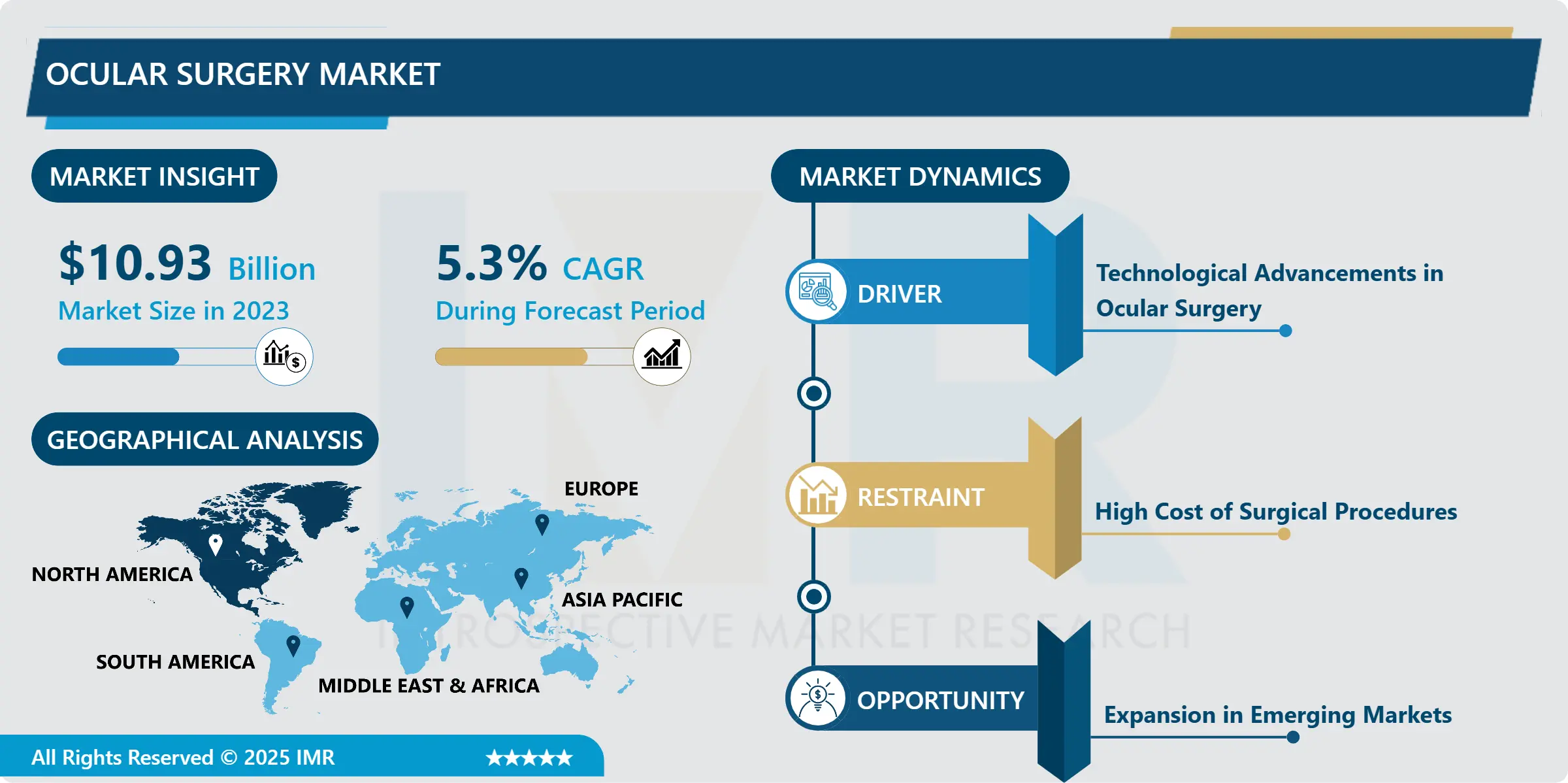
Ocular Surgery Market Size, Share & Forecast (2024-2032)
The Ocular Surgery Market is a rapidly growing segment within the global healthcare landscape, driven by advancements in ophthalmic technology and an aging population.

IMR Group
Description
Ocular Surgery Market Synopsis:
Ocular Surgery Market Size Was Valued at USD 10.93 Billion in 2023 and is Projected to Reach USD 17.4 Billion by 2032, Growing at a CAGR of 5.3% From 2024-2032.
The Ocular Surgery Market is a rapidly growing segment within the global healthcare landscape, driven by advancements in ophthalmic technology and an aging population. Ocular surgery encompasses a wide range of procedures aimed at treating various eye conditions such as cataracts, glaucoma, retinal diseases, and refractive errors. The market is particularly influenced by the increasing prevalence of vision disorders globally, with conditions like cataracts and refractive errors being among the leading causes of blindness and visual impairment. Technological innovations, such as laser-assisted surgeries and minimally invasive techniques, are significantly enhancing surgical outcomes and patient recovery times.
In terms of regional distribution, North America and Europe dominate the ocular surgery market due to their well-established healthcare infrastructures, high healthcare expenditure, and widespread adoption of advanced surgical technologies. However, the market is witnessing substantial growth in emerging economies, especially in Asia-Pacific and Latin America, where rising healthcare investments, increasing awareness of eye health, and improving access to surgical services are driving market expansion. The growing elderly population, which is more susceptible to eye diseases, is a key factor contributing to the surge in ocular surgeries across these regions.
Market dynamics in the ocular surgery space are shaped by several factors, including technological innovations and evolving patient preferences. The advent of laser-based and robotic surgeries, which offer higher precision and reduced recovery time, is a significant market driver. Additionally, there is a rising demand for refractive surgeries like LASIK, driven by increasing awareness and availability of affordable procedures. The introduction of new surgical devices and intraocular lenses (IOLs) is also enhancing surgical success rates and patient outcomes.
On the other hand, challenges in the ocular surgery market include the high cost of advanced surgical devices and procedures, which can limit accessibility in developing regions. Regulatory hurdles and the need for skilled professionals further complicate market penetration, especially in underserved areas. Additionally, while technological advancements are promising, their adoption may be slow in low-resource settings due to financial constraints. Despite these challenges, the market continues to expand with the ongoing evolution of ophthalmic technology and growing demand for eye care services.
Ocular Surgery Market Trend Analysis:
Technological Advancements in Ocular Surgery
The most significant trends in the ocular surgery market is the rapid adoption of cutting-edge technologies, such as laser-assisted and robotic surgeries. Laser technologies, including femtosecond lasers and excimer lasers, have revolutionized cataract and refractive surgeries by enhancing precision and reducing complications. These innovations are not only improving surgical outcomes but also minimizing recovery time, which is a key consideration for patients. Additionally, robotic surgery is gaining momentum, enabling ophthalmologists to perform complex surgeries with greater accuracy and control, reducing the risk of human error.
These technological advancements are also making ocular surgeries more accessible to patients worldwide. For instance, laser-based procedures like LASIK have become more affordable and available, contributing to an increase in elective surgeries. Moreover, the development of advanced intraocular lenses (IOLs) is improving the quality of vision post-surgery, addressing a broader range of vision problems. As these technologies continue to evolve, the trend of more precise and less invasive ocular surgeries is expected to expand, offering improved patient satisfaction and broader adoption globally.
Expansion in Emerging Markets
A significant opportunity in the ocular surgery market lies in the untapped potential of emerging economies, particularly in regions such as Asia-Pacific, Latin America, and Africa. As healthcare infrastructures in these areas continue to improve, there is growing access to advanced medical technologies, including those used in ocular surgeries. The rising awareness of eye health and vision care is also driving demand for surgical treatments, especially as the prevalence of age-related conditions like cataracts and glaucoma increases. Government initiatives and healthcare reforms in these regions are further facilitating the growth of the ocular surgery market by encouraging investments and making surgical procedures more accessible to a larger population.
The increasing disposable income in emerging markets is enabling more people to seek elective surgeries like LASIK for refractive errors. As the cost of advanced surgical procedures continues to decrease due to technological advancements and more widespread use of surgical equipment, the barrier to entry for patients in these regions is lowering. This provides a lucrative opportunity for companies in the ocular surgery market to expand their presence and offer affordable, high-quality services to meet the growing demand in these markets. With the right investment in healthcare infrastructure and training, the emerging markets present an exciting growth opportunity for the ocular surgery industry.
Ocular Surgery Market Segment Analysis:
Ocular Surgery Market is Segmented on the basis of By Surgery Type, Procedure Type, End-User, and Region.
By Surgery Type, Cataract Surgery segment is expected to dominate the market during the forecast period
The Cataract Surgery segment is expected to dominate the ocular surgery market during the forecast period due to the high prevalence of cataracts worldwide, particularly among the aging population. Cataracts, which cause clouding of the eye’s natural lens, are one of the leading causes of blindness globally. As the global population continues to age, the incidence of cataracts is anticipated to rise, driving the demand for cataract surgeries. Advanced techniques such as phacoemulsification (small-incision cataract surgery) and the use of intraocular lenses (IOLs) have significantly improved the effectiveness and safety of cataract surgeries, making them highly sought after. This segment is supported by technological advancements that enhance surgical precision and reduce recovery time, contributing to an increasing number of cataract surgeries performed each year.
The growing affordability and accessibility of cataract surgeries, especially in developing regions, are expected to drive market growth in this segment. Public and private healthcare initiatives aimed at increasing awareness about cataract treatment options and expanding access to advanced surgical procedures are also contributing factors. With a large number of patients requiring cataract treatment, the segment is poised to remain a dominant force in the ocular surgery market throughout the forecast period. Additionally, continuous innovations in cataract surgery technology, such as the development of advanced premium IOLs, are enhancing visual outcomes and patient satisfaction, further boosting the segment’s market share.
By End-User, Hospitals segment expected to held the largest share
The Hospitals segment is expected to hold the largest share in the ocular surgery market due to the comprehensive healthcare services they provide, including advanced surgical procedures and post-operative care. Hospitals are equipped with state-of-the-art surgical facilities, specialized equipment, and experienced healthcare professionals, making them the preferred choice for complex ocular surgeries. These institutions offer a wide range of eye treatments, including cataract surgeries, LASIK, retinal surgeries, and glaucoma procedures. The availability of advanced diagnostic and treatment technologies, along with the expertise of ophthalmologists, ensures that hospitals can handle the most critical and specialized cases, attracting a significant share of the market.
Furthermore, hospitals benefit from their ability to handle a high volume of surgeries, making them integral to the overall healthcare system. As demand for ocular surgeries continues to rise, particularly with the aging global population, hospitals are well-positioned to manage this influx due to their capacity for large-scale operations. Additionally, hospitals are often preferred by patients seeking insurance coverage for medical procedures, as many insurance plans offer extensive coverage for surgeries performed in hospital settings. With continued advancements in surgical techniques and technologies, hospitals are expected to maintain their dominant position in the ocular surgery market throughout the forecast period.
Ocular Surgery Market Regional Insights:
North America is Expected to Dominate the Market Over the Forecast period
North America is expected to dominate the ocular surgery market over the forecast period due to several key factors, including a well-established healthcare infrastructure, high healthcare spending, and early adoption of advanced surgical technologies. The region has a significant number of skilled ophthalmologists and specialized surgical centers, making it a leading market for ocular surgeries. With the widespread availability of cutting-edge technologies such as femtosecond lasers, robotic surgery, and premium intraocular lenses (IOLs), North America has been at the forefront of innovation in ocular surgery. This has resulted in improved patient outcomes and an increase in the number of procedures performed, particularly for cataracts, refractive errors, and retinal diseases.
The aging population in North America is contributing to the demand for ocular surgeries, particularly cataract surgeries, as age-related eye conditions become more prevalent. The region’s high disposable income, along with favorable insurance policies that cover ocular surgeries, further supports market growth. The increasing awareness of eye health and advancements in minimally invasive surgical options, such as laser-assisted procedures, are expected to drive further demand. As healthcare technology continues to evolve and access to innovative surgical options expands, North America is projected to maintain its leadership in the ocular surgery market throughout the forecast period.
Active Key Players in the Ocular Surgery Market:
Abbott Laboratories
Alcon Inc.
Bausch + Lomb
Carl Zeiss AG
Johnson & Johnson Vision
MicroSurgical Technology (MST)
Nidek Co., Ltd.
Rayner Surgical Group Limited
Santen Pharmaceutical Co., Ltd.
Topcon Corporation, and Other Active Players
Chapter 1: Introduction
1.1 Scope and Coverage
Chapter 2:Executive Summary
Chapter 3: Market Landscape
3.1 Market Dynamics
3.1.1 Drivers
3.1.2 Restraints
3.1.3 Opportunities
3.1.4 Challenges
3.2 Market Trend Analysis
3.3 PESTLE Analysis
3.4 Porter’s Five Forces Analysis
3.5 Industry Value Chain Analysis
3.6 Ecosystem
3.7 Regulatory Landscape
3.8 Price Trend Analysis
3.9 Patent Analysis
3.10 Technology Evolution
3.11 Investment Pockets
3.12 Import-Export Analysis
Chapter 4: Ocular Surgery Market by Surgery Type
4.1 Ocular Surgery Market Snapshot and Growth Engine
4.2 Ocular Surgery Market Overview
4.3 Cataract Surgery
4.3.1 Introduction and Market Overview
4.3.2 Historic and Forecasted Market Size in Value USD and Volume Units (2017-2032F)
4.3.3 Key Market Trends, Growth Factors and Opportunities
4.3.4 Cataract Surgery: Geographic Segmentation Analysis
4.4 Refractive Surgery
4.4.1 Introduction and Market Overview
4.4.2 Historic and Forecasted Market Size in Value USD and Volume Units (2017-2032F)
4.4.3 Key Market Trends, Growth Factors and Opportunities
4.4.4 Refractive Surgery: Geographic Segmentation Analysis
4.5 Glaucoma Surgery
4.5.1 Introduction and Market Overview
4.5.2 Historic and Forecasted Market Size in Value USD and Volume Units (2017-2032F)
4.5.3 Key Market Trends, Growth Factors and Opportunities
4.5.4 Glaucoma Surgery: Geographic Segmentation Analysis
4.6 Retinal Surgery
4.6.1 Introduction and Market Overview
4.6.2 Historic and Forecasted Market Size in Value USD and Volume Units (2017-2032F)
4.6.3 Key Market Trends, Growth Factors and Opportunities
4.6.4 Retinal Surgery: Geographic Segmentation Analysis
4.7 Corneal Surgery and Oculoplastic Surgery
4.7.1 Introduction and Market Overview
4.7.2 Historic and Forecasted Market Size in Value USD and Volume Units (2017-2032F)
4.7.3 Key Market Trends, Growth Factors and Opportunities
4.7.4 Corneal Surgery and Oculoplastic Surgery: Geographic Segmentation Analysis
Chapter 5: Ocular Surgery Market by Procedure Type
5.1 Ocular Surgery Market Snapshot and Growth Engine
5.2 Ocular Surgery Market Overview
5.3 Invasive Procedures
5.3.1 Introduction and Market Overview
5.3.2 Historic and Forecasted Market Size in Value USD and Volume Units (2017-2032F)
5.3.3 Key Market Trends, Growth Factors and Opportunities
5.3.4 Invasive Procedures: Geographic Segmentation Analysis
5.4 Minimally Invasive Procedures
5.4.1 Introduction and Market Overview
5.4.2 Historic and Forecasted Market Size in Value USD and Volume Units (2017-2032F)
5.4.3 Key Market Trends, Growth Factors and Opportunities
5.4.4 Minimally Invasive Procedures: Geographic Segmentation Analysis
Chapter 6: Ocular Surgery Market by End-User
6.1 Ocular Surgery Market Snapshot and Growth Engine
6.2 Ocular Surgery Market Overview
6.3 Hospitals
6.3.1 Introduction and Market Overview
6.3.2 Historic and Forecasted Market Size in Value USD and Volume Units (2017-2032F)
6.3.3 Key Market Trends, Growth Factors and Opportunities
6.3.4 Hospitals: Geographic Segmentation Analysis
6.4 Ambulatory Surgical Centers (ASCs) and Ophthalmology Clinics
6.4.1 Introduction and Market Overview
6.4.2 Historic and Forecasted Market Size in Value USD and Volume Units (2017-2032F)
6.4.3 Key Market Trends, Growth Factors and Opportunities
6.4.4 Ambulatory Surgical Centers (ASCs) and Ophthalmology Clinics: Geographic Segmentation Analysis
Chapter 7: Company Profiles and Competitive Analysis
7.1 Competitive Landscape
7.1.1 Competitive Benchmarking
7.1.2 Ocular Surgery Market Share by Manufacturer (2023)
7.1.3 Industry BCG Matrix
7.1.4 Heat Map Analysis
7.1.5 Mergers and Acquisitions
7.2 ALCON INC ABBOTT LABORATORIES
7.2.1 Company Overview
7.2.2 Key Executives
7.2.3 Company Snapshot
7.2.4 Role of the Company in the Market
7.2.5 Sustainability and Social Responsibility
7.2.6 Operating Business Segments
7.2.7 Product Portfolio
7.2.8 Business Performance
7.2.9 Key Strategic Moves and Recent Developments
7.2.10 SWOT Analysis
7.3 BAUSCH + LOMB
7.4 JOHNSON & JOHNSON VISION
7.5 CARL ZEISS AG
7.6 RAYNER SURGICAL GROUP LIMITED
7.7 MICROSURGICAL TECHNOLOGY (MST)
7.8 SANTEN PHARMACEUTICAL CO. LTD TOPCON CORPORATION
7.9 NIDEK CO. LTD
7.10 OTHER ACTIVE PLAYERS
Chapter 8: Global Ocular Surgery Market By Region
8.1 Overview
8.2. North America Ocular Surgery Market
8.2.1 Key Market Trends, Growth Factors and Opportunities
8.2.2 Top Key Companies
8.2.3 Historic and Forecasted Market Size by Segments
8.2.4 Historic and Forecasted Market Size By Surgery Type
8.2.4.1 Cataract Surgery
8.2.4.2 Refractive Surgery
8.2.4.3 Glaucoma Surgery
8.2.4.4 Retinal Surgery
8.2.4.5 Corneal Surgery and Oculoplastic Surgery
8.2.5 Historic and Forecasted Market Size By Procedure Type
8.2.5.1 Invasive Procedures
8.2.5.2 Minimally Invasive Procedures
8.2.6 Historic and Forecasted Market Size By End-User
8.2.6.1 Hospitals
8.2.6.2 Ambulatory Surgical Centers (ASCs) and Ophthalmology Clinics
8.2.7 Historic and Forecast Market Size by Country
8.2.7.1 US
8.2.7.2 Canada
8.2.7.3 Mexico
8.3. Eastern Europe Ocular Surgery Market
8.3.1 Key Market Trends, Growth Factors and Opportunities
8.3.2 Top Key Companies
8.3.3 Historic and Forecasted Market Size by Segments
8.3.4 Historic and Forecasted Market Size By Surgery Type
8.3.4.1 Cataract Surgery
8.3.4.2 Refractive Surgery
8.3.4.3 Glaucoma Surgery
8.3.4.4 Retinal Surgery
8.3.4.5 Corneal Surgery and Oculoplastic Surgery
8.3.5 Historic and Forecasted Market Size By Procedure Type
8.3.5.1 Invasive Procedures
8.3.5.2 Minimally Invasive Procedures
8.3.6 Historic and Forecasted Market Size By End-User
8.3.6.1 Hospitals
8.3.6.2 Ambulatory Surgical Centers (ASCs) and Ophthalmology Clinics
8.3.7 Historic and Forecast Market Size by Country
8.3.7.1 Russia
8.3.7.2 Bulgaria
8.3.7.3 The Czech Republic
8.3.7.4 Hungary
8.3.7.5 Poland
8.3.7.6 Romania
8.3.7.7 Rest of Eastern Europe
8.4. Western Europe Ocular Surgery Market
8.4.1 Key Market Trends, Growth Factors and Opportunities
8.4.2 Top Key Companies
8.4.3 Historic and Forecasted Market Size by Segments
8.4.4 Historic and Forecasted Market Size By Surgery Type
8.4.4.1 Cataract Surgery
8.4.4.2 Refractive Surgery
8.4.4.3 Glaucoma Surgery
8.4.4.4 Retinal Surgery
8.4.4.5 Corneal Surgery and Oculoplastic Surgery
8.4.5 Historic and Forecasted Market Size By Procedure Type
8.4.5.1 Invasive Procedures
8.4.5.2 Minimally Invasive Procedures
8.4.6 Historic and Forecasted Market Size By End-User
8.4.6.1 Hospitals
8.4.6.2 Ambulatory Surgical Centers (ASCs) and Ophthalmology Clinics
8.4.7 Historic and Forecast Market Size by Country
8.4.7.1 Germany
8.4.7.2 UK
8.4.7.3 France
8.4.7.4 The Netherlands
8.4.7.5 Italy
8.4.7.6 Spain
8.4.7.7 Rest of Western Europe
8.5. Asia Pacific Ocular Surgery Market
8.5.1 Key Market Trends, Growth Factors and Opportunities
8.5.2 Top Key Companies
8.5.3 Historic and Forecasted Market Size by Segments
8.5.4 Historic and Forecasted Market Size By Surgery Type
8.5.4.1 Cataract Surgery
8.5.4.2 Refractive Surgery
8.5.4.3 Glaucoma Surgery
8.5.4.4 Retinal Surgery
8.5.4.5 Corneal Surgery and Oculoplastic Surgery
8.5.5 Historic and Forecasted Market Size By Procedure Type
8.5.5.1 Invasive Procedures
8.5.5.2 Minimally Invasive Procedures
8.5.6 Historic and Forecasted Market Size By End-User
8.5.6.1 Hospitals
8.5.6.2 Ambulatory Surgical Centers (ASCs) and Ophthalmology Clinics
8.5.7 Historic and Forecast Market Size by Country
8.5.7.1 China
8.5.7.2 India
8.5.7.3 Japan
8.5.7.4 South Korea
8.5.7.5 Malaysia
8.5.7.6 Thailand
8.5.7.7 Vietnam
8.5.7.8 The Philippines
8.5.7.9 Australia
8.5.7.10 New Zealand
8.5.7.11 Rest of APAC
8.6. Middle East & Africa Ocular Surgery Market
8.6.1 Key Market Trends, Growth Factors and Opportunities
8.6.2 Top Key Companies
8.6.3 Historic and Forecasted Market Size by Segments
8.6.4 Historic and Forecasted Market Size By Surgery Type
8.6.4.1 Cataract Surgery
8.6.4.2 Refractive Surgery
8.6.4.3 Glaucoma Surgery
8.6.4.4 Retinal Surgery
8.6.4.5 Corneal Surgery and Oculoplastic Surgery
8.6.5 Historic and Forecasted Market Size By Procedure Type
8.6.5.1 Invasive Procedures
8.6.5.2 Minimally Invasive Procedures
8.6.6 Historic and Forecasted Market Size By End-User
8.6.6.1 Hospitals
8.6.6.2 Ambulatory Surgical Centers (ASCs) and Ophthalmology Clinics
8.6.7 Historic and Forecast Market Size by Country
8.6.7.1 Turkiye
8.6.7.2 Bahrain
8.6.7.3 Kuwait
8.6.7.4 Saudi Arabia
8.6.7.5 Qatar
8.6.7.6 UAE
8.6.7.7 Israel
8.6.7.8 South Africa
8.7. South America Ocular Surgery Market
8.7.1 Key Market Trends, Growth Factors and Opportunities
8.7.2 Top Key Companies
8.7.3 Historic and Forecasted Market Size by Segments
8.7.4 Historic and Forecasted Market Size By Surgery Type
8.7.4.1 Cataract Surgery
8.7.4.2 Refractive Surgery
8.7.4.3 Glaucoma Surgery
8.7.4.4 Retinal Surgery
8.7.4.5 Corneal Surgery and Oculoplastic Surgery
8.7.5 Historic and Forecasted Market Size By Procedure Type
8.7.5.1 Invasive Procedures
8.7.5.2 Minimally Invasive Procedures
8.7.6 Historic and Forecasted Market Size By End-User
8.7.6.1 Hospitals
8.7.6.2 Ambulatory Surgical Centers (ASCs) and Ophthalmology Clinics
8.7.7 Historic and Forecast Market Size by Country
8.7.7.1 Brazil
8.7.7.2 Argentina
8.7.7.3 Rest of SA
Chapter 9 Analyst Viewpoint and Conclusion
9.1 Recommendations and Concluding Analysis
9.2 Potential Market Strategies
Chapter 10 Research Methodology
10.1 Research Process
10.2 Primary Research
10.3 Secondary Research
Q1: What would be the forecast period in the Ocular Surgery Market research report?
A1: The forecast period in the Ocular Surgery Market research report is 2024-2032.
Q2: Who are the key players in the Ocular Surgery Market?
A2: Abbott Laboratories, Alcon Inc., Bausch + Lomb, Carl Zeiss AG, Johnson & Johnson Vision, MicroSurgical Technology (MST), Nidek Co., Ltd., Rayner Surgical Group Limited, Santen Pharmaceutical Co., Ltd., Topcon Corporation, and Other Active Players.
Q3: What are the segments of the Ocular Surgery Market?
A3: The Ocular Surgery Market is segmented into Surgery Type, Procedure Type, End-User, and region. By Surgery Type, the market is categorized into Cataract Surgery, Refractive Surgery, Glaucoma Surgery, Retinal Surgery, Corneal Surgery, and Oculoplastic Surgery. By Procedure Type, the market is categorized into Invasive Procedures, Minimally Invasive Procedures. By End-User, the market is categorized into Hospitals, Ambulatory Surgical Centers (ASCs), and Ophthalmology Clinics. By region, it is analyzed across North America (U.S., Canada, Mexico), Eastern Europe (Russia, Bulgaria, The Czech Republic, Hungary, Poland, Romania, Rest of Eastern Europe), Western Europe (Germany, UK, France, Netherlands, Italy, Spain, Rest of Western Europe), Asia Pacific (China, India, Japan, South Korea, Malaysia, Thailand, Vietnam, The Philippines, Australia, New-Zealand, Rest of APAC), Middle East & Africa (Türkiye, Bahrain, Kuwait, Saudi Arabia, Qatar, UAE, Israel, South Africa), South America (Brazil, Argentina, Rest of SA).
Q4: What is the Ocular Surgery Market?
A4: The Ocular Surgery Market refers to the industry focused on surgical procedures designed to treat various eye conditions, including cataracts, glaucoma, refractive errors, and retinal diseases. This market encompasses a range of surgeries such as cataract removal, LASIK, and retinal surgeries, utilizing advanced technologies like laser-assisted surgery and robotic systems. Driven by an aging global population and rising awareness of eye health, the ocular surgery market is growing, with innovations improving surgical precision, patient outcomes, and recovery times.
Q5: How big is the Ocular Surgery Market?
A5: Ocular Surgery Market Size Was Valued at USD 10.93 Billion in 2023 and is Projected to Reach USD 17.4 Billion by 2032, Growing at a CAGR of 5.3% From 2024-2032.
How to Buy a Report from eminsights.jp
On the product page, choose the license you want: Single-User License, Multi-User License or Enterprise License.
If you required report in your native language, then you can click on Translated Report button and fill out the form with report name and language you want, then our team will contact you as soon as possible.
Click the Buy Now button.
You will be redirected to the checkout page. Enter your company details and payment information.
Click Place Order to complete the purchase.
Confirmation: You’ll receive an order confirmation and our team will contact you shortly with your ordered report.
If you have any questions, fill out the contact form below or email us at bizdev@eminsights.net.
Thank you for choosing eminsights.jp!