Stay Ahead in Fast-Growing Economies.
Browse Reports Now




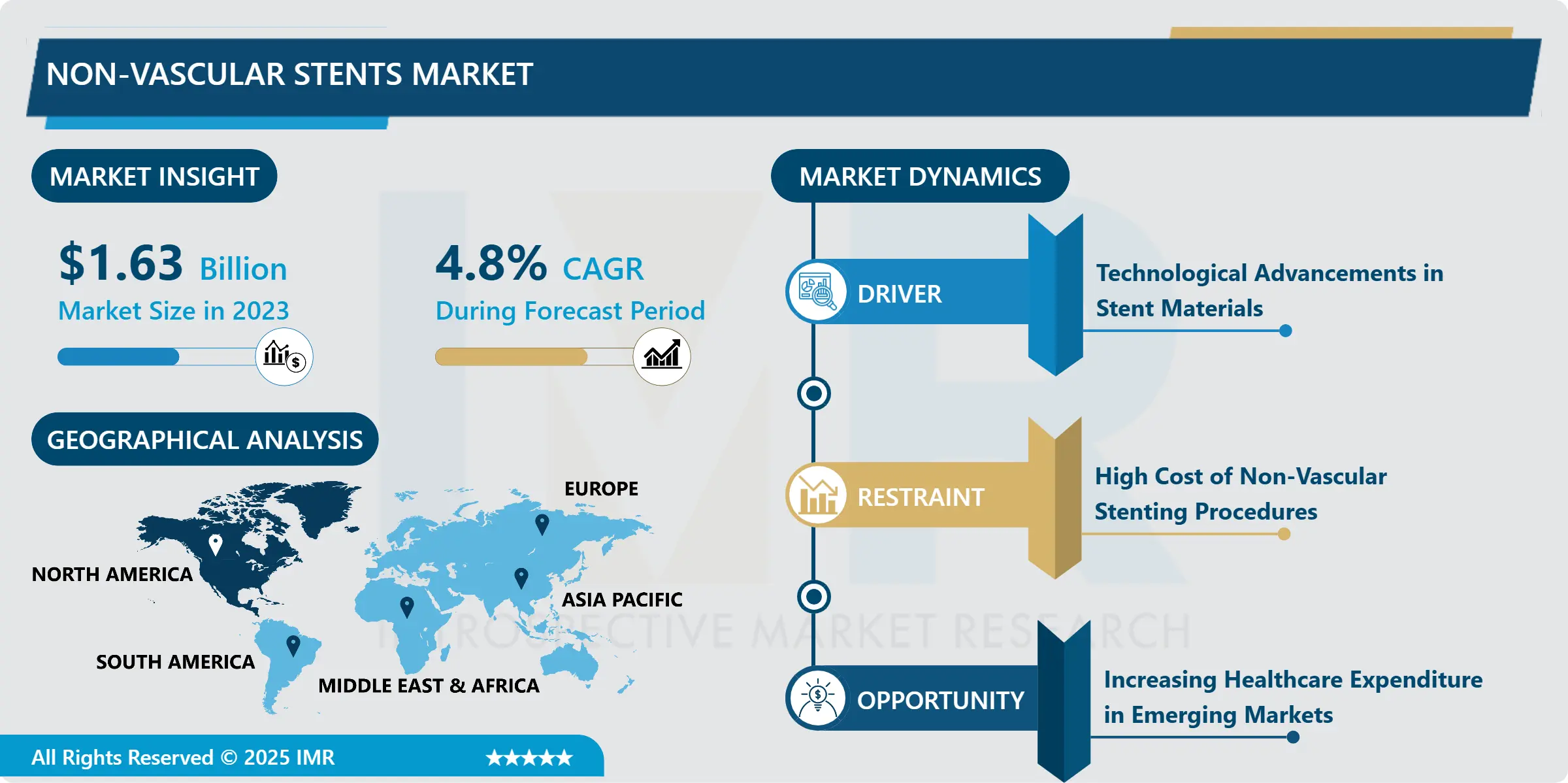
Non-Vascular Stents Market Size, Growth Dynamics & Forecast (2024-2032)
Non-vascular stents are those which are placed in the GI, respiratory and urinary tracts to keep passages or lumens open to prevent obstruction.

IMR Group
Description
Non-Vascular Stents Market Synopsis:
Non-Vascular Stents Market Size Was Valued at USD 1.63 Billion in 2023, and is Projected to Reach USD 2.48 Billion by 2032, Growing at a CAGR of 4.8% From 2024-2032.
Non-vascular stents are those which are placed in the GI, respiratory and urinary tracts to keep passages or lumens open to prevent obstruction. They are ideal for patients with diseases such as obstructed bile ducts, tracheal stenosis, or ureteral obstructions, in which surgery is very dangerous and invasive. This kind of stents is used in patients with chronic diseases, help to alleviate the symptoms, and minimize the number of interventions that need to be taken in the future, which is helpful for patient’s quality of life.
The non-vascular stents market is on the growth trajectory due to increasing incidence of chronic diseases, growing number of geriatrics, and innovation in stent systems. The non-vascular stent has found its application in the case of structures in the esophagus, biliary tract, bronchi, and ureters. As the awareness of treatment options rises and with the advancement in the use of minimally invasive treatment options to treat such conditions, there is growing use of non-vascular stents in procedures for treatment of various conditions especially for patients who may not be the best candidates for surgery. Furthermore, procedures involving the deployment of self-expanding stents, made from materials such as nitinol, which is bio-compatible, have proved safer and efficient to use than the earlier balloon expandable types; thus, their acceptance by physicians and patients.
There are two broad factors that are contributing to the growth of the non-vascular stents market – increase in healthcare facilities and growth in emerging markets. The Asia-Pacific countries, Middle Eastern countries, and some Latin American countries are observing tremendous change in medical structure supported by the government and increasing health care spending. These developments together with increase in the number of skilled personnel in the health sector are fostering the usage of non-vascular stents within these regions. With the knowledge of these new treatment options increasing, the need for enhanced-end, non-vascular stents will increase – opening new opportunities to manufacturers and service provision from providers.
Non-Vascular Stents Market Trend Analysis:
Minimally Invasive Procedures
Minimally invasive techniques are increasingly being adopted in the field of stent placements, particularly for non-vascular applications such as gastrointestinal, biliary, and airway stents. These procedures allow for smaller incisions, reduced trauma to the body, and quicker recovery times for patients. The trend is driven by technological advancements in stent design and delivery systems that make them easier to deploy with minimal intervention. The shift towards minimally invasive techniques in non-vascular stenting is especially prominent in outpatient settings, where shorter hospital stays and faster recovery are key considerations for patients and healthcare providers alike.
This trend is poised to continue growing as medical technology advances, allowing for more complex stenting procedures to be carried out with greater precision and fewer risks. The ability to use smaller and more flexible stents makes it easier for surgeons to treat a wide range of conditions, including bile duct obstructions and airway blockages, without the need for invasive surgery. Additionally, the popularity of minimally invasive procedures aligns with the general demand for more patient-centric healthcare solutions that minimize discomfort and expedite recovery.
Growing Demand for Stents in Aging Populations
As the global population ages, the incidence of non-vascular conditions that require stent placement, such as gastrointestinal diseases, airway obstructions, and urological issues, is on the rise. Elderly patients are more susceptible to chronic conditions like esophageal cancer, bile duct blockages, and benign prostatic hyperplasia, which often require stenting to alleviate symptoms and improve quality of life. This demographic shift presents a significant growth opportunity for manufacturers of non-vascular stents.
The opportunity lies in developing specialized stents tailored to the needs of the elderly, such as stents that are more biocompatible, easier to insert, and capable of being used in a wider range of medical scenarios. Additionally, the increasing prevalence of lifestyle diseases, coupled with advancements in diagnostic tools and surgical techniques, means that demand for non-vascular stents will continue to grow. Healthcare systems will increasingly seek out efficient, cost-effective, and minimally invasive solutions to manage chronic conditions in an aging population, driving further innovation and market expansion in this sector.
Non-Vascular Stents Market Segment Analysis:
Non-Vascular Stents Market is Segmented on the basis of product type, application, end user, and region.
By Product Type, Biliary stents segment is expected to dominate the market during the forecast period
The biliary stents segment is expected to dominate the non-vascular stents market during the forecast period due to the rising prevalence of biliary tract disorders, such as bile duct obstructions caused by gallstones, tumors, or strictures. Biliary stents play a critical role in relieving such blockages, particularly in patients with pancreatic or hepatobiliary cancers. With cancer rates increasing globally and more patients requiring palliative interventions, the demand for biliary stents has surged. These stents are also widely used in endoscopic retrograde cholangiopancreatography (ERCP) procedures, which are becoming more routine and accessible in both developed and emerging healthcare systems.
Technological advancements in stent materials, such as self-expanding metal stents (SEMS) and biodegradable stents, have significantly improved the efficacy and safety of biliary stenting. These innovations reduce the need for repeat interventions and enhance patient outcomes, making them a preferred choice among healthcare providers. The relatively high frequency of biliary conditions compared to other non-vascular applications, along with improved procedural success rates and growing adoption in outpatient settings, continues to reinforce the dominance of the biliary stents segment within the overall market landscape.
By Application, Gastrointestinal (GI) tract segment expected to held the largest share
The gastrointestinal (GI) tract segment is expected to hold the largest share of the non-vascular stents market during the forecast period, driven by the growing incidence of gastrointestinal cancers and disorders such as colorectal cancer, esophageal cancer, and gastric obstructions. GI stents are crucial for relieving obstructions in the digestive tract, especially in palliative care where surgery may not be feasible. With colorectal and esophageal cancers ranking among the most commonly diagnosed cancers worldwide, the demand for stents to maintain GI patency has significantly increased. Additionally, the shift toward minimally invasive and endoscopic procedures has made GI stenting a preferred intervention due to its ability to offer quick relief with minimal recovery time.
Furthermore, the segment’s growth is supported by advancements in stent design—such as drug-eluting stents, anti-migration features, and fully covered self-expanding metal stents (FCSEMS)—which enhance both the effectiveness and safety of these devices. Increasing awareness among physicians about early-stage stenting, improved diagnostic capabilities, and expanded healthcare infrastructure in developing countries are further fueling market adoption. As GI diseases become more prevalent due to aging populations and dietary/lifestyle factors, the GI tract stents segment is set to maintain a strong lead in the non-vascular stents market.
Non-Vascular Stents Market Regional Insights:
North America is Expected to Dominate the Market Over the Forecast period
North America is projected to dominate the non-vascular stents market over the forecast period, owing to its advanced healthcare infrastructure, high adoption of minimally invasive procedures, and significant investment in medical device innovation. The region is home to leading manufacturers and research institutions that continually drive product advancements in stent technologies, such as self-expanding, drug-eluting, and bioabsorbable stents. Additionally, a well-established regulatory framework and high healthcare expenditure enable quicker adoption of new devices, allowing for widespread clinical use across hospitals and ambulatory surgical centers.
The dominance of North America is also fueled by a high prevalence of non-vascular conditions requiring stents, including gastrointestinal cancers, chronic obstructive pulmonary disease (COPD), and urological disorders, especially among its aging population. Favorable reimbursement policies and increased awareness among patients and healthcare professionals further contribute to market growth. Moreover, continuous screening initiatives and early diagnosis of diseases lead to timely interventions, further boosting the demand for non-vascular stents. Collectively, these factors position North America as the leading regional market throughout the forecast period.
Active Key Players in the Non-Vascular Stents Market
B. Braun Melsungen AG (Germany)
Boston Scientific Corporation (USA)
ConMed Corporation (USA)
Cook Medical (USA)
ELLA-CS, s.r.o. (Czech Republic)
EndoChoice Inc. (USA)
Fujifilm Holdings Corporation (Japan)
Garson Medical Stents (India)
Johnson & Johnson (USA)
Merit Medical Systems (USA)
Micro-Tech (Nanjing) Co., Ltd. (China)
Olympus Corporation (Japan)
Stryker Corporation (USA)
W. L. Gore & Associates, Inc. (USA), Other Active Players.
Chapter 1: Introduction
1.1 Scope and Coverage
Chapter 2:Executive Summary
Chapter 3: Market Landscape
3.1 Market Dynamics
3.1.1 Drivers
3.1.2 Restraints
3.1.3 Opportunities
3.1.4 Challenges
3.2 Market Trend Analysis
3.3 PESTLE Analysis
3.4 Porter’s Five Forces Analysis
3.5 Industry Value Chain Analysis
3.6 Ecosystem
3.7 Regulatory Landscape
3.8 Price Trend Analysis
3.9 Patent Analysis
3.10 Technology Evolution
3.11 Investment Pockets
3.12 Import-Export Analysis
Chapter 4: Non-Vascular Stents Market by Product Type
4.1 Non-Vascular Stents Market Snapshot and Growth Engine
4.2 Non-Vascular Stents Market Overview
4.3 Biliary Stents
4.3.1 Introduction and Market Overview
4.3.2 Historic and Forecasted Market Size in Value USD and Volume Units (2017-2032F)
4.3.3 Key Market Trends, Growth Factors and Opportunities
4.3.4 Biliary Stents: Geographic Segmentation Analysis
4.4 Bronchial Stents
4.4.1 Introduction and Market Overview
4.4.2 Historic and Forecasted Market Size in Value USD and Volume Units (2017-2032F)
4.4.3 Key Market Trends, Growth Factors and Opportunities
4.4.4 Bronchial Stents: Geographic Segmentation Analysis
4.5 Oesophageal Stents
4.5.1 Introduction and Market Overview
4.5.2 Historic and Forecasted Market Size in Value USD and Volume Units (2017-2032F)
4.5.3 Key Market Trends, Growth Factors and Opportunities
4.5.4 Oesophageal Stents: Geographic Segmentation Analysis
4.6 Ureteral Stents
4.6.1 Introduction and Market Overview
4.6.2 Historic and Forecasted Market Size in Value USD and Volume Units (2017-2032F)
4.6.3 Key Market Trends, Growth Factors and Opportunities
4.6.4 Ureteral Stents: Geographic Segmentation Analysis
4.7 Others
4.7.1 Introduction and Market Overview
4.7.2 Historic and Forecasted Market Size in Value USD and Volume Units (2017-2032F)
4.7.3 Key Market Trends, Growth Factors and Opportunities
4.7.4 Others: Geographic Segmentation Analysis
Chapter 5: Non-Vascular Stents Market by Application
5.1 Non-Vascular Stents Market Snapshot and Growth Engine
5.2 Non-Vascular Stents Market Overview
5.3 Gastrointestinal (GI) Tract
5.3.1 Introduction and Market Overview
5.3.2 Historic and Forecasted Market Size in Value USD and Volume Units (2017-2032F)
5.3.3 Key Market Trends, Growth Factors and Opportunities
5.3.4 Gastrointestinal (GI) Tract: Geographic Segmentation Analysis
5.4 Pulmonary
5.4.1 Introduction and Market Overview
5.4.2 Historic and Forecasted Market Size in Value USD and Volume Units (2017-2032F)
5.4.3 Key Market Trends, Growth Factors and Opportunities
5.4.4 Pulmonary: Geographic Segmentation Analysis
5.5 Urinary Tract
5.5.1 Introduction and Market Overview
5.5.2 Historic and Forecasted Market Size in Value USD and Volume Units (2017-2032F)
5.5.3 Key Market Trends, Growth Factors and Opportunities
5.5.4 Urinary Tract: Geographic Segmentation Analysis
5.6 Others
5.6.1 Introduction and Market Overview
5.6.2 Historic and Forecasted Market Size in Value USD and Volume Units (2017-2032F)
5.6.3 Key Market Trends, Growth Factors and Opportunities
5.6.4 Others: Geographic Segmentation Analysis
Chapter 6: Non-Vascular Stents Market by End User
6.1 Non-Vascular Stents Market Snapshot and Growth Engine
6.2 Non-Vascular Stents Market Overview
6.3 Hospitals
6.3.1 Introduction and Market Overview
6.3.2 Historic and Forecasted Market Size in Value USD and Volume Units (2017-2032F)
6.3.3 Key Market Trends, Growth Factors and Opportunities
6.3.4 Hospitals: Geographic Segmentation Analysis
6.4 Ambulatory Surgical Centers
6.4.1 Introduction and Market Overview
6.4.2 Historic and Forecasted Market Size in Value USD and Volume Units (2017-2032F)
6.4.3 Key Market Trends, Growth Factors and Opportunities
6.4.4 Ambulatory Surgical Centers: Geographic Segmentation Analysis
6.5 Specialty Clinics
6.5.1 Introduction and Market Overview
6.5.2 Historic and Forecasted Market Size in Value USD and Volume Units (2017-2032F)
6.5.3 Key Market Trends, Growth Factors and Opportunities
6.5.4 Specialty Clinics: Geographic Segmentation Analysis
6.6 Others
6.6.1 Introduction and Market Overview
6.6.2 Historic and Forecasted Market Size in Value USD and Volume Units (2017-2032F)
6.6.3 Key Market Trends, Growth Factors and Opportunities
6.6.4 Others: Geographic Segmentation Analysis
Chapter 7: Company Profiles and Competitive Analysis
7.1 Competitive Landscape
7.1.1 Competitive Benchmarking
7.1.2 Non-Vascular Stents Market Share by Manufacturer (2023)
7.1.3 Industry BCG Matrix
7.1.4 Heat Map Analysis
7.1.5 Mergers and Acquisitions
7.2 B. BRAUN MELSUNGEN AG (GERMANY)
7.2.1 Company Overview
7.2.2 Key Executives
7.2.3 Company Snapshot
7.2.4 Role of the Company in the Market
7.2.5 Sustainability and Social Responsibility
7.2.6 Operating Business Segments
7.2.7 Product Portfolio
7.2.8 Business Performance
7.2.9 Key Strategic Moves and Recent Developments
7.2.10 SWOT Analysis
7.3 BOSTON SCIENTIFIC CORPORATION (USA)
7.4 CONMED CORPORATION (USA)
7.5 COOK MEDICAL (USA)
7.6 ELLA-CS
7.7 S.R.O. (CZECH REPUBLIC)
7.8 ENDOCHOICE INC. (USA)
7.9 FUJIFILM HOLDINGS CORPORATION (JAPAN)
7.10 GARSON MEDICAL STENTS (INDIA)
7.11 JOHNSON & JOHNSON (USA)
7.12 MERIT MEDICAL SYSTEMS (USA)
7.13 MICRO-TECH (NANJING) CO. LTD. (CHINA)
7.14 OLYMPUS CORPORATION (JAPAN)
7.15 STRYKER CORPORATION (USA)
7.16 W. L. GORE & ASSOCIATES INC. (USA)
7.17 OTHER ACTIVE PLAYERS
Chapter 8: Global Non-Vascular Stents Market By Region
8.1 Overview
8.2. North America Non-Vascular Stents Market
8.2.1 Key Market Trends, Growth Factors and Opportunities
8.2.2 Top Key Companies
8.2.3 Historic and Forecasted Market Size by Segments
8.2.4 Historic and Forecasted Market Size By Product Type
8.2.4.1 Biliary Stents
8.2.4.2 Bronchial Stents
8.2.4.3 Oesophageal Stents
8.2.4.4 Ureteral Stents
8.2.4.5 Others
8.2.5 Historic and Forecasted Market Size By Application
8.2.5.1 Gastrointestinal (GI) Tract
8.2.5.2 Pulmonary
8.2.5.3 Urinary Tract
8.2.5.4 Others
8.2.6 Historic and Forecasted Market Size By End User
8.2.6.1 Hospitals
8.2.6.2 Ambulatory Surgical Centers
8.2.6.3 Specialty Clinics
8.2.6.4 Others
8.2.7 Historic and Forecast Market Size by Country
8.2.7.1 US
8.2.7.2 Canada
8.2.7.3 Mexico
8.3. Eastern Europe Non-Vascular Stents Market
8.3.1 Key Market Trends, Growth Factors and Opportunities
8.3.2 Top Key Companies
8.3.3 Historic and Forecasted Market Size by Segments
8.3.4 Historic and Forecasted Market Size By Product Type
8.3.4.1 Biliary Stents
8.3.4.2 Bronchial Stents
8.3.4.3 Oesophageal Stents
8.3.4.4 Ureteral Stents
8.3.4.5 Others
8.3.5 Historic and Forecasted Market Size By Application
8.3.5.1 Gastrointestinal (GI) Tract
8.3.5.2 Pulmonary
8.3.5.3 Urinary Tract
8.3.5.4 Others
8.3.6 Historic and Forecasted Market Size By End User
8.3.6.1 Hospitals
8.3.6.2 Ambulatory Surgical Centers
8.3.6.3 Specialty Clinics
8.3.6.4 Others
8.3.7 Historic and Forecast Market Size by Country
8.3.7.1 Russia
8.3.7.2 Bulgaria
8.3.7.3 The Czech Republic
8.3.7.4 Hungary
8.3.7.5 Poland
8.3.7.6 Romania
8.3.7.7 Rest of Eastern Europe
8.4. Western Europe Non-Vascular Stents Market
8.4.1 Key Market Trends, Growth Factors and Opportunities
8.4.2 Top Key Companies
8.4.3 Historic and Forecasted Market Size by Segments
8.4.4 Historic and Forecasted Market Size By Product Type
8.4.4.1 Biliary Stents
8.4.4.2 Bronchial Stents
8.4.4.3 Oesophageal Stents
8.4.4.4 Ureteral Stents
8.4.4.5 Others
8.4.5 Historic and Forecasted Market Size By Application
8.4.5.1 Gastrointestinal (GI) Tract
8.4.5.2 Pulmonary
8.4.5.3 Urinary Tract
8.4.5.4 Others
8.4.6 Historic and Forecasted Market Size By End User
8.4.6.1 Hospitals
8.4.6.2 Ambulatory Surgical Centers
8.4.6.3 Specialty Clinics
8.4.6.4 Others
8.4.7 Historic and Forecast Market Size by Country
8.4.7.1 Germany
8.4.7.2 UK
8.4.7.3 France
8.4.7.4 The Netherlands
8.4.7.5 Italy
8.4.7.6 Spain
8.4.7.7 Rest of Western Europe
8.5. Asia Pacific Non-Vascular Stents Market
8.5.1 Key Market Trends, Growth Factors and Opportunities
8.5.2 Top Key Companies
8.5.3 Historic and Forecasted Market Size by Segments
8.5.4 Historic and Forecasted Market Size By Product Type
8.5.4.1 Biliary Stents
8.5.4.2 Bronchial Stents
8.5.4.3 Oesophageal Stents
8.5.4.4 Ureteral Stents
8.5.4.5 Others
8.5.5 Historic and Forecasted Market Size By Application
8.5.5.1 Gastrointestinal (GI) Tract
8.5.5.2 Pulmonary
8.5.5.3 Urinary Tract
8.5.5.4 Others
8.5.6 Historic and Forecasted Market Size By End User
8.5.6.1 Hospitals
8.5.6.2 Ambulatory Surgical Centers
8.5.6.3 Specialty Clinics
8.5.6.4 Others
8.5.7 Historic and Forecast Market Size by Country
8.5.7.1 China
8.5.7.2 India
8.5.7.3 Japan
8.5.7.4 South Korea
8.5.7.5 Malaysia
8.5.7.6 Thailand
8.5.7.7 Vietnam
8.5.7.8 The Philippines
8.5.7.9 Australia
8.5.7.10 New Zealand
8.5.7.11 Rest of APAC
8.6. Middle East & Africa Non-Vascular Stents Market
8.6.1 Key Market Trends, Growth Factors and Opportunities
8.6.2 Top Key Companies
8.6.3 Historic and Forecasted Market Size by Segments
8.6.4 Historic and Forecasted Market Size By Product Type
8.6.4.1 Biliary Stents
8.6.4.2 Bronchial Stents
8.6.4.3 Oesophageal Stents
8.6.4.4 Ureteral Stents
8.6.4.5 Others
8.6.5 Historic and Forecasted Market Size By Application
8.6.5.1 Gastrointestinal (GI) Tract
8.6.5.2 Pulmonary
8.6.5.3 Urinary Tract
8.6.5.4 Others
8.6.6 Historic and Forecasted Market Size By End User
8.6.6.1 Hospitals
8.6.6.2 Ambulatory Surgical Centers
8.6.6.3 Specialty Clinics
8.6.6.4 Others
8.6.7 Historic and Forecast Market Size by Country
8.6.7.1 Turkiye
8.6.7.2 Bahrain
8.6.7.3 Kuwait
8.6.7.4 Saudi Arabia
8.6.7.5 Qatar
8.6.7.6 UAE
8.6.7.7 Israel
8.6.7.8 South Africa
8.7. South America Non-Vascular Stents Market
8.7.1 Key Market Trends, Growth Factors and Opportunities
8.7.2 Top Key Companies
8.7.3 Historic and Forecasted Market Size by Segments
8.7.4 Historic and Forecasted Market Size By Product Type
8.7.4.1 Biliary Stents
8.7.4.2 Bronchial Stents
8.7.4.3 Oesophageal Stents
8.7.4.4 Ureteral Stents
8.7.4.5 Others
8.7.5 Historic and Forecasted Market Size By Application
8.7.5.1 Gastrointestinal (GI) Tract
8.7.5.2 Pulmonary
8.7.5.3 Urinary Tract
8.7.5.4 Others
8.7.6 Historic and Forecasted Market Size By End User
8.7.6.1 Hospitals
8.7.6.2 Ambulatory Surgical Centers
8.7.6.3 Specialty Clinics
8.7.6.4 Others
8.7.7 Historic and Forecast Market Size by Country
8.7.7.1 Brazil
8.7.7.2 Argentina
8.7.7.3 Rest of SA
Chapter 9 Analyst Viewpoint and Conclusion
9.1 Recommendations and Concluding Analysis
9.2 Potential Market Strategies
Chapter 10 Research Methodology
10.1 Research Process
10.2 Primary Research
10.3 Secondary Research
Q1: What would be the forecast period in the Non-Vascular Stents Market research report?
A1: The forecast period in the Non-Vascular Stents Market research report is 2024-2032.
Q2: Who are the key players in the Non-Vascular Stents Market?
A2: B. Braun Melsungen AG (Germany), Boston Scientific Corporation (USA), ConMed Corporation (USA), Cook Medical (USA), ELLA-CS, s.r.o. (Czech Republic), EndoChoice Inc. (USA), Fujifilm Holdings Corporation (Japan), Garson Medical Stents (India), Johnson & Johnson (USA), Merit Medical Systems (USA), Micro-Tech (Nanjing) Co., Ltd. (China), Olympus Corporation (Japan), Stryker Corporation (USA), W. L. Gore & Associates, Inc. (USA), Other Active Players.
Q3: What are the segments of the Non-Vascular Stents Market?
A3: The Non-Vascular Stents Market is segmented into Product Type, Application, End User, and Region. By Product Type, the market is categorized into (Biliary Stents, Bronchial Stents, Oesophageal Stents, Ureteral Stents, Others. By Application, the market is categorized into Gastrointestinal (GI) Tract, Pulmonary, Urinary Tract, and Others. By End User, the market is categorized into Hospitals, Ambulatory Surgical Centers, Specialty Clinics, and Others. By region, it is analyzed across North America (U.S., Canada, Mexico), Eastern Europe (Russia, Bulgaria, The Czech Republic, Hungary, Poland, Romania, Rest of Eastern Europe), Western Europe (Germany, UK, France, Netherlands, Italy, Spain, Rest of Western Europe), Asia Pacific (China, India, Japan, South Korea, Malaysia, Thailand, Vietnam, The Philippines, Australia, New-Zealand, Rest of APAC), Middle East & Africa (Türkiye, Bahrain, Kuwait, Saudi Arabia, Qatar, UAE, Israel, South Africa), South America (Brazil, Argentina, Rest of SA).
Q4: What is the Non-Vascular Stents Market?
A4: The Non-Vascular Stents Market refers to the segment of medical devices designed to support and maintain the patency of non-blood vessel passageways in the body, such as the gastrointestinal tract, biliary ducts, airways, and urinary tract. These stents are commonly used to treat obstructions caused by tumors, strictures, or other medical conditions, offering a minimally invasive solution to restore normal flow and function in affected organs.
Q5: How big is the Non-Vascular Stents Market?
A5: Non-Vascular Stents Market Size Was Valued at USD 1.63 Billion in 2023, and is Projected to Reach USD 2.48 Billion by 2032, Growing at a CAGR of 4.8% From 2024-2032.
How to Buy a Report from eminsights.jp
On the product page, choose the license you want: Single-User License, Multi-User License or Enterprise License.
If you required report in your native language, then you can click on Translated Report button and fill out the form with report name and language you want, then our team will contact you as soon as possible.
Click the Buy Now button.
You will be redirected to the checkout page. Enter your company details and payment information.
Click Place Order to complete the purchase.
Confirmation: You’ll receive an order confirmation and our team will contact you shortly with your ordered report.
If you have any questions, fill out the contact form below or email us at bizdev@eminsights.net.
Thank you for choosing eminsights.jp!