Stay Ahead in Fast-Growing Economies.
Browse Reports Now
Non-Small Cell Lung Cancer Market Outlook & Forecast to 2032
The Non-Small Cell Lung Cancer (NSCLC) market is one of the largest segments in the oncology therapeutic space, driven by the high incidence of lung cancer globally.

IMR Group
Description
Non-Small Cell Lung Cancer Market Synopsis:
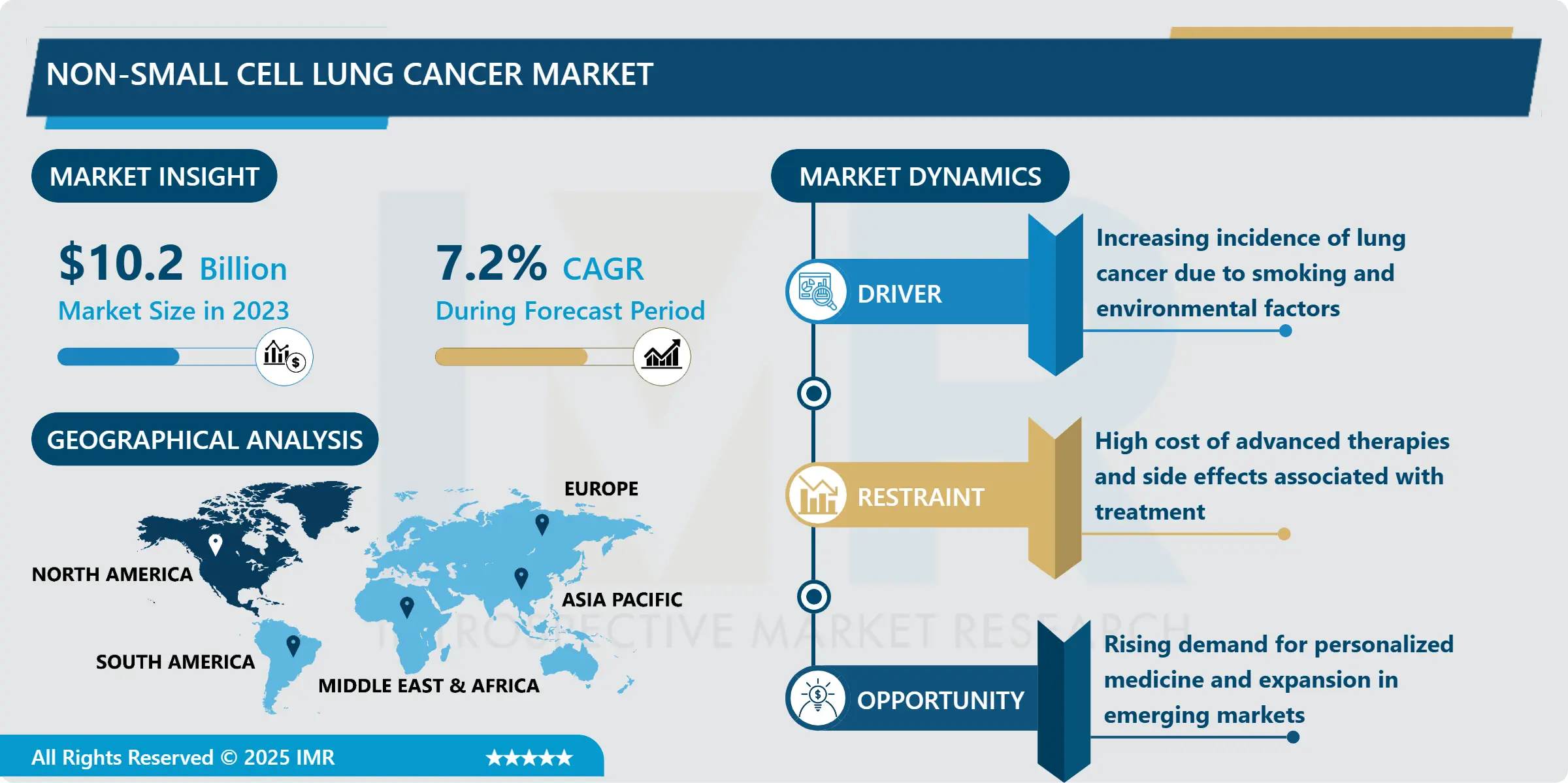
Non-Small Cell Lung Cancer Market Size Was Valued at USD 10.2 Billion in 2023, and is Projected to Reach USD 19.1 Billion by 2032, Growing at a CAGR of 7.2% From 2024-2032.
The Non-Small Cell Lung Cancer (NSCLC) market is one of the largest segments in the oncology therapeutic space, driven by the high incidence of lung cancer globally. NSCLC accounts for approximately 85% of all lung cancer cases, and its rising prevalence is attributed to risk factors such as smoking, environmental pollution, and genetic mutations. The market is predominantly focused on treatment options, including chemotherapy, targeted therapy, and immunotherapy, with advancements in these therapies being the key drivers of market growth.
In recent years, the NSCLC market has seen significant progress with the introduction of more effective therapies, particularly in the field of immuno-oncology. Immunotherapies like PD-1/PD-L1 inhibitors (Pembrolizumab, Nivolumab) have revolutionized treatment options, offering longer survival rates for patients. Targeted therapies, such as EGFR inhibitors (Erlotinib, Gefitinib), have also seen widespread adoption due to their efficacy in patients with specific genetic mutations. These advancements have not only increased treatment options but have also led to improved survival rates and quality of life for patients.
The most significant trends in the NSCLC market is the growing focus on combination therapies, where drugs from different classes are combined to achieve a more robust therapeutic effect. The combination of immunotherapy with chemotherapy or targeted therapy has shown promising results in clinical trials, and it is expected to become a standard treatment for advanced-stage NSCLC. This trend is fueling investments in research and development of new combination treatment regimens, offering patients more hope for longer survival.
Furthermore, there is a significant opportunity in emerging markets, where the rising prevalence of lung cancer and improving healthcare infrastructure are expected to drive the demand for NSCLC therapies. The Asia Pacific region, in particular, is poised for substantial growth, with increasing government investments in healthcare and the availability of novel treatments. This expansion into new regions, coupled with the development of more targeted and effective therapies, presents significant growth opportunities for pharmaceutical companies in the NSCLC space.
Non-Small Cell Lung Cancer Market Trend Analysis:
Rise in Targeted Therapies and Immunotherapies
The rise of targeted therapies and immunotherapies has transformed the treatment landscape for Non-Small Cell Lung Cancer (NSCLC), offering more personalized and effective treatment options for patients. Targeted therapies, such as EGFR inhibitors (Erlotinib, Gefitinib) and ALK inhibitors (Crizotinib), are designed to target specific mutations or genetic alterations in cancer cells, significantly improving treatment outcomes in patients with these genetic profiles. These therapies have shown remarkable efficacy, leading to higher response rates and longer progression-free survival compared to traditional chemotherapy. As genetic testing and biomarker profiling become increasingly accessible, the use of targeted therapies is expected to expand, offering a tailored treatment approach to a larger subset of NSCLC patients.
Immunotherapies, particularly PD-1/PD-L1 inhibitors like Pembrolizumab and Nivolumab, have also gained prominence in recent years. These therapies work by harnessing the body’s immune system to fight cancer, offering a new mechanism of action compared to conventional treatments. Immunotherapies have demonstrated impressive results, particularly in advanced-stage NSCLC, where they have been shown to improve overall survival rates. The combination of immunotherapy with chemotherapy or targeted therapies is emerging as a promising strategy, further boosting the effectiveness of treatment regimens. As research continues to explore new immunotherapies and combination approaches, the global NSCLC market is expected to see continued growth, providing more opportunities for patients to benefit from these innovative treatment modalities.
Expansion in Emerging Markets
The expansion of targeted therapies and immunotherapies in emerging markets is rapidly gaining momentum, driven by the increasing burden of Non-Small Cell Lung Cancer (NSCLC) and the improving healthcare infrastructure in these regions. Countries in Asia Pacific, Latin America, and the Middle East are experiencing a surge in lung cancer cases, fueled by rising smoking rates, environmental pollution, and urbanization. As healthcare systems evolve and access to advanced treatments improves, these regions are witnessing an increase in demand for novel therapies such as targeted therapies and immunotherapies. With rising disposable incomes and growing awareness, emerging markets represent a significant opportunity for pharmaceutical companies to expand their reach and provide life-saving treatments to a broader patient population.
Governments in emerging markets are investing heavily in healthcare infrastructure, offering greater access to diagnostic services and cutting-edge therapies. This has paved the way for the introduction of advanced cancer treatments, including PD-1/PD-L1 inhibitors and targeted therapies, which were previously inaccessible in these regions. As a result, local partnerships, collaborations, and regulatory pathways are becoming more favorable for the launch of these therapies. Moreover, the increasing availability of clinical trial data from these markets will further drive the adoption of innovative treatments. This expansion in emerging markets is expected to contribute significantly to the growth of the global NSCLC market, benefiting both patients and the pharmaceutical industry alike.
Non-Small Cell Lung Cancer Market Segment Analysis:
Non-Small Cell Lung Cancer Market Segmented on the basis of cancer type, treatment, and region.
By Cancer Type, Squamous Cell Carcinoma segment is expected to dominate the market during the forecast period
The Squamous Cell Carcinoma (SCC) segment of the Non-Small Cell Lung Cancer (NSCLC) market is expected to dominate the market during the forecast period due to its higher prevalence and distinct treatment needs compared to other subtypes of NSCLC, such as adenocarcinoma. SCC is typically linked to smoking and often presents at an advanced stage, making it more aggressive and difficult to treat. This has led to a significant focus on developing targeted therapies and immunotherapies specifically designed for SCC patients. With advances in biomarker identification and personalized treatment approaches, SCC patients are increasingly benefiting from targeted therapies such as EGFR inhibitors and immune checkpoint inhibitors, driving the segment’s growth.
Furthermore, the growing number of clinical trials and research studies targeting SCC is expected to bolster the availability of innovative treatments and improve patient outcomes, which will further support market dominance. The availability of new therapeutic options, particularly immunotherapy agents like Pembrolizumab and Nivolumab, has shown promising efficacy in treating SCC, making these treatments more mainstream. As more therapies are developed and approved for SCC, this segment will continue to lead the market, catering to the rising demand for effective and personalized treatment strategies in NSCLC patients.
By Treatment, Chemotherapy segment expected to held the largest share
The chemotherapy segment is expected to hold the largest share of the Non-Small Cell Lung Cancer (NSCLC) market during the forecast period due to its long-established role in the treatment of advanced-stage NSCLC. Despite the rapid rise of targeted therapies and immunotherapies, chemotherapy remains a cornerstone in the management of NSCLC, especially for patients who do not have specific genetic mutations or are not candidates for newer treatment options. Chemotherapy drugs such as cisplatin and carboplatin are commonly used in both first-line and second-line treatment regimens, often in combination with other therapies. This continued use, coupled with the ability to treat a wide range of patients regardless of their genetic profile, ensures that chemotherapy will maintain a significant market share.
Chemotherapy is often used in combination with targeted therapies or immunotherapies in patients with advanced NSCLC, enhancing its effectiveness and prolonging survival. The availability of combination regimens that incorporate chemotherapy along with newer treatments like PD-1/PD-L1 inhibitors has further solidified chemotherapy’s pivotal role in treating NSCLC. As clinical trials continue to demonstrate the efficacy of these combination therapies, chemotherapy is expected to remain integral to NSCLC treatment strategies, particularly in regions where access to the latest treatments may be limited, thus sustaining its market dominance in the coming years.
Non-Small Cell Lung Cancer Market Regional Insights:
North America is Expected to Dominate the Market Over the Forecast period
North America is expected to dominate the Non-Small Cell Lung Cancer (NSCLC) market over the forecast period due to a combination of factors, including the high prevalence of lung cancer, advanced healthcare infrastructure, and the availability of cutting-edge treatments. The region, particularly the United States, has one of the highest incidences of NSCLC, driven by risk factors such as smoking, environmental pollutants, and an aging population. The well-established healthcare systems in North America enable faster adoption of innovative therapies, such as immunotherapy and targeted treatments, which have revolutionized NSCLC management in the region. Furthermore, the U.S. remains a global leader in cancer research and drug development, ensuring continued advancements in NSCLC treatment options.
The strong presence of key pharmaceutical companies, alongside significant investments in cancer research and development, further strengthens North America’s position in the global NSCLC market. Government agencies, such as the National Cancer Institute (NCI) and the U.S. Food and Drug Administration (FDA), play a crucial role in facilitating the approval and commercialization of novel therapies, accelerating the availability of treatments to patients. Additionally, North America’s robust healthcare infrastructure ensures broad access to the latest treatment modalities and clinical trials, which contribute to the high treatment adoption rate. These factors combined will drive North America’s dominance in the NSCLC market, making it a major hub for the development and commercialization of innovative cancer therapies.
Active Key Players in the Non-Small Cell Lung Cancer Market
AbbVie (US)
Amgen (US)
Astellas Pharma (Japan)
AstraZeneca (UK)
Boehringer Ingelheim (Germany)
Bristol-Myers Squibb (US)
Eli Lilly and Company (US)
GlaxoSmithKline (UK)
Johnson & Johnson (US)
Merck & Co. (US)
Novartis (Switzerland)
Pfizer (US)
Roche (Switzerland)
Sanofi (France)
Takeda Pharmaceutical Company (Japan), Other Active Players.
Chapter 1: Introduction
1.1 Scope and Coverage
Chapter 2:Executive Summary
Chapter 3: Market Landscape
3.1 Market Dynamics
3.1.1 Drivers
3.1.2 Restraints
3.1.3 Opportunities
3.1.4 Challenges
3.2 Market Trend Analysis
3.3 PESTLE Analysis
3.4 Porter’s Five Forces Analysis
3.5 Industry Value Chain Analysis
3.6 Ecosystem
3.7 Regulatory Landscape
3.8 Price Trend Analysis
3.9 Patent Analysis
3.10 Technology Evolution
3.11 Investment Pockets
3.12 Import-Export Analysis
Chapter 4: Non-Small Cell Lung Cancer Market by Cancer Type
4.1 Non-Small Cell Lung Cancer Market Snapshot and Growth Engine
4.2 Non-Small Cell Lung Cancer Market Overview
4.3 Squamous Cell Carcinoma
4.3.1 Introduction and Market Overview
4.3.2 Historic and Forecasted Market Size in Value USD and Volume Units (2017-2032F)
4.3.3 Key Market Trends, Growth Factors and Opportunities
4.3.4 Squamous Cell Carcinoma: Geographic Segmentation Analysis
4.4 Adenocarcinoma
4.4.1 Introduction and Market Overview
4.4.2 Historic and Forecasted Market Size in Value USD and Volume Units (2017-2032F)
4.4.3 Key Market Trends, Growth Factors and Opportunities
4.4.4 Adenocarcinoma: Geographic Segmentation Analysis
4.5 Large-cell Carcinoma
4.5.1 Introduction and Market Overview
4.5.2 Historic and Forecasted Market Size in Value USD and Volume Units (2017-2032F)
4.5.3 Key Market Trends, Growth Factors and Opportunities
4.5.4 Large-cell Carcinoma: Geographic Segmentation Analysis
Chapter 5: Non-Small Cell Lung Cancer Market by Treatment
5.1 Non-Small Cell Lung Cancer Market Snapshot and Growth Engine
5.2 Non-Small Cell Lung Cancer Market Overview
5.3 Chemotherapy
5.3.1 Introduction and Market Overview
5.3.2 Historic and Forecasted Market Size in Value USD and Volume Units (2017-2032F)
5.3.3 Key Market Trends, Growth Factors and Opportunities
5.3.4 Chemotherapy: Geographic Segmentation Analysis
5.4 Targeted Therapy
5.4.1 Introduction and Market Overview
5.4.2 Historic and Forecasted Market Size in Value USD and Volume Units (2017-2032F)
5.4.3 Key Market Trends, Growth Factors and Opportunities
5.4.4 Targeted Therapy: Geographic Segmentation Analysis
5.5 Immunotherapy
5.5.1 Introduction and Market Overview
5.5.2 Historic and Forecasted Market Size in Value USD and Volume Units (2017-2032F)
5.5.3 Key Market Trends, Growth Factors and Opportunities
5.5.4 Immunotherapy: Geographic Segmentation Analysis
Chapter 6: Company Profiles and Competitive Analysis
6.1 Competitive Landscape
6.1.1 Competitive Benchmarking
6.1.2 Non-Small Cell Lung Cancer Market Share by Manufacturer (2023)
6.1.3 Industry BCG Matrix
6.1.4 Heat Map Analysis
6.1.5 Mergers and Acquisitions
6.2 ABBVIE (US)
6.2.1 Company Overview
6.2.2 Key Executives
6.2.3 Company Snapshot
6.2.4 Role of the Company in the Market
6.2.5 Sustainability and Social Responsibility
6.2.6 Operating Business Segments
6.2.7 Product Portfolio
6.2.8 Business Performance
6.2.9 Key Strategic Moves and Recent Developments
6.2.10 SWOT Analysis
6.3 AMGEN (US)
6.4 ASTELLAS PHARMA (JAPAN)
6.5 ASTRAZENECA (UK)
6.6 BOEHRINGER INGELHEIM (GERMANY)
6.7 BRISTOL-MYERS SQUIBB (US)
6.8 ELI LILLY AND COMPANY (US)
6.9 GLAXOSMITHKLINE (UK)
6.10 JOHNSON & JOHNSON (US)
6.11 MERCK & CO. (US)
6.12 NOVARTIS (SWITZERLAND)
6.13 PFIZER (US)
6.14 ROCHE (SWITZERLAND)
6.15 SANOFI (FRANCE)
6.16 TAKEDA PHARMACEUTICAL COMPANY (JAPAN)
6.17 OTHER ACTIVE PLAYERS
Chapter 7: Global Non-Small Cell Lung Cancer Market By Region
7.1 Overview
7.2. North America Non-Small Cell Lung Cancer Market
7.2.1 Key Market Trends, Growth Factors and Opportunities
7.2.2 Top Key Companies
7.2.3 Historic and Forecasted Market Size by Segments
7.2.4 Historic and Forecasted Market Size By Cancer Type
7.2.4.1 Squamous Cell Carcinoma
7.2.4.2 Adenocarcinoma
7.2.4.3 Large-cell Carcinoma
7.2.5 Historic and Forecasted Market Size By Treatment
7.2.5.1 Chemotherapy
7.2.5.2 Targeted Therapy
7.2.5.3 Immunotherapy
7.2.6 Historic and Forecast Market Size by Country
7.2.6.1 US
7.2.6.2 Canada
7.2.6.3 Mexico
7.3. Eastern Europe Non-Small Cell Lung Cancer Market
7.3.1 Key Market Trends, Growth Factors and Opportunities
7.3.2 Top Key Companies
7.3.3 Historic and Forecasted Market Size by Segments
7.3.4 Historic and Forecasted Market Size By Cancer Type
7.3.4.1 Squamous Cell Carcinoma
7.3.4.2 Adenocarcinoma
7.3.4.3 Large-cell Carcinoma
7.3.5 Historic and Forecasted Market Size By Treatment
7.3.5.1 Chemotherapy
7.3.5.2 Targeted Therapy
7.3.5.3 Immunotherapy
7.3.6 Historic and Forecast Market Size by Country
7.3.6.1 Russia
7.3.6.2 Bulgaria
7.3.6.3 The Czech Republic
7.3.6.4 Hungary
7.3.6.5 Poland
7.3.6.6 Romania
7.3.6.7 Rest of Eastern Europe
7.4. Western Europe Non-Small Cell Lung Cancer Market
7.4.1 Key Market Trends, Growth Factors and Opportunities
7.4.2 Top Key Companies
7.4.3 Historic and Forecasted Market Size by Segments
7.4.4 Historic and Forecasted Market Size By Cancer Type
7.4.4.1 Squamous Cell Carcinoma
7.4.4.2 Adenocarcinoma
7.4.4.3 Large-cell Carcinoma
7.4.5 Historic and Forecasted Market Size By Treatment
7.4.5.1 Chemotherapy
7.4.5.2 Targeted Therapy
7.4.5.3 Immunotherapy
7.4.6 Historic and Forecast Market Size by Country
7.4.6.1 Germany
7.4.6.2 UK
7.4.6.3 France
7.4.6.4 The Netherlands
7.4.6.5 Italy
7.4.6.6 Spain
7.4.6.7 Rest of Western Europe
7.5. Asia Pacific Non-Small Cell Lung Cancer Market
7.5.1 Key Market Trends, Growth Factors and Opportunities
7.5.2 Top Key Companies
7.5.3 Historic and Forecasted Market Size by Segments
7.5.4 Historic and Forecasted Market Size By Cancer Type
7.5.4.1 Squamous Cell Carcinoma
7.5.4.2 Adenocarcinoma
7.5.4.3 Large-cell Carcinoma
7.5.5 Historic and Forecasted Market Size By Treatment
7.5.5.1 Chemotherapy
7.5.5.2 Targeted Therapy
7.5.5.3 Immunotherapy
7.5.6 Historic and Forecast Market Size by Country
7.5.6.1 China
7.5.6.2 India
7.5.6.3 Japan
7.5.6.4 South Korea
7.5.6.5 Malaysia
7.5.6.6 Thailand
7.5.6.7 Vietnam
7.5.6.8 The Philippines
7.5.6.9 Australia
7.5.6.10 New Zealand
7.5.6.11 Rest of APAC
7.6. Middle East & Africa Non-Small Cell Lung Cancer Market
7.6.1 Key Market Trends, Growth Factors and Opportunities
7.6.2 Top Key Companies
7.6.3 Historic and Forecasted Market Size by Segments
7.6.4 Historic and Forecasted Market Size By Cancer Type
7.6.4.1 Squamous Cell Carcinoma
7.6.4.2 Adenocarcinoma
7.6.4.3 Large-cell Carcinoma
7.6.5 Historic and Forecasted Market Size By Treatment
7.6.5.1 Chemotherapy
7.6.5.2 Targeted Therapy
7.6.5.3 Immunotherapy
7.6.6 Historic and Forecast Market Size by Country
7.6.6.1 Turkiye
7.6.6.2 Bahrain
7.6.6.3 Kuwait
7.6.6.4 Saudi Arabia
7.6.6.5 Qatar
7.6.6.6 UAE
7.6.6.7 Israel
7.6.6.8 South Africa
7.7. South America Non-Small Cell Lung Cancer Market
7.7.1 Key Market Trends, Growth Factors and Opportunities
7.7.2 Top Key Companies
7.7.3 Historic and Forecasted Market Size by Segments
7.7.4 Historic and Forecasted Market Size By Cancer Type
7.7.4.1 Squamous Cell Carcinoma
7.7.4.2 Adenocarcinoma
7.7.4.3 Large-cell Carcinoma
7.7.5 Historic and Forecasted Market Size By Treatment
7.7.5.1 Chemotherapy
7.7.5.2 Targeted Therapy
7.7.5.3 Immunotherapy
7.7.6 Historic and Forecast Market Size by Country
7.7.6.1 Brazil
7.7.6.2 Argentina
7.7.6.3 Rest of SA
Chapter 8 Analyst Viewpoint and Conclusion
8.1 Recommendations and Concluding Analysis
8.2 Potential Market Strategies
Chapter 9 Research Methodology
9.1 Research Process
9.2 Primary Research
9.3 Secondary Research
Q1: What would be the forecast period in the Non-Small Cell Lung Cancer Market research report?
A1: The forecast period in the Non-Small Cell Lung Cancer Market research report is 2024-2032.
Q2: Who are the key players in the Non-Small Cell Lung Cancer Market?
A2: AbbVie (US), Amgen (US), Astellas Pharma (Japan), AstraZeneca (UK), Boehringer Ingelheim (Germany), Bristol-Myers Squibb (US), Eli Lilly and Company (US), GlaxoSmithKline (UK), Johnson & Johnson (US), Merck & Co. (US), Novartis (Switzerland), Pfizer (US), Roche (Switzerland), Sanofi (France), Takeda Pharmaceutical Company (Japan), Other Active Players.
Q3: What are the segments of the Non-Small Cell Lung Cancer Market?
A3: The Non-Small Cell Lung Cancer Market is segmented into Cancer Type, Treatment, and region. By Cancer Type, the market is categorized into Squamous Cell Carcinoma, Adenocarcinoma, and Large-cell Carcinoma. By Treatment, the market is categorized into Chemotherapy, Targeted Therapy, and Immunotherapy. By region, it is analyzed across North America (U.S., Canada, Mexico), Eastern Europe (Russia, Bulgaria, The Czech Republic, Hungary, Poland, Romania, Rest of Eastern Europe), Western Europe (Germany, UK, France, Netherlands, Italy, Spain, Rest of Western Europe), Asia Pacific (China, India, Japan, South Korea, Malaysia, Thailand, Vietnam, The Philippines, Australia, New-Zealand, Rest of APAC), Middle East & Africa (Türkiye, Bahrain, Kuwait, Saudi Arabia, Qatar, UAE, Israel, South Africa), South America (Brazil, Argentina, Rest of SA).
Q4: What is the Non-Small Cell Lung Cancer Market?
A4: The Non-Small Cell Lung Cancer (NSCLC) market refers to the global healthcare market focused on the diagnosis, treatment, and management of NSCLC, which is the most common type of lung cancer, accounting for approximately 85% of all cases. This market encompasses a range of therapeutic options, including chemotherapy, targeted therapies, immunotherapy, and radiation, as well as diagnostic methods like imaging and biomarker testing. The NSCLC market is driven by the increasing incidence of lung cancer, advancements in treatment options, and the growing demand for personalized medicine, making it a key area in oncology research and drug development.
Q5: How big is the Non-Small Cell Lung Cancer Market?
A5: Non-Small Cell Lung Cancer Market Size Was Valued at USD 10.2 Billion in 2023, and is Projected to Reach USD 19.1 Billion by 2032, Growing at a CAGR of 7.2% From 2024-2032.
How to Buy a Report from eminsights.jp
On the product page, choose the license you want: Single-User License, Multi-User License or Enterprise License.
If you required report in your native language, then you can click on Translated Report button and fill out the form with report name and language you want, then our team will contact you as soon as possible.
Click the Buy Now button.
You will be redirected to the checkout page. Enter your company details and payment information.
Click Place Order to complete the purchase.
Confirmation: You’ll receive an order confirmation and our team will contact you shortly with your ordered report.
If you have any questions, fill out the contact form below or email us at bizdev@eminsights.net.
Thank you for choosing eminsights.jp!