Stay Ahead in Fast-Growing Economies.
Browse Reports Now




Non-Dairy Ice Cream Market Industry Overview, Key Insights & Forecast to 2032
The non-dairy ice cream market refers to the segment of the frozen dessert industry dedicated to products that are free from traditional dairy ingredients like milk, cream, and butter. Instead, these ice creams are typically made using alternatives such as coconut milk, almond milk, soy milk, or other plant-based ingredients.

IMR Group
Description
Non-Dairy Ice Cream Market Synopsis
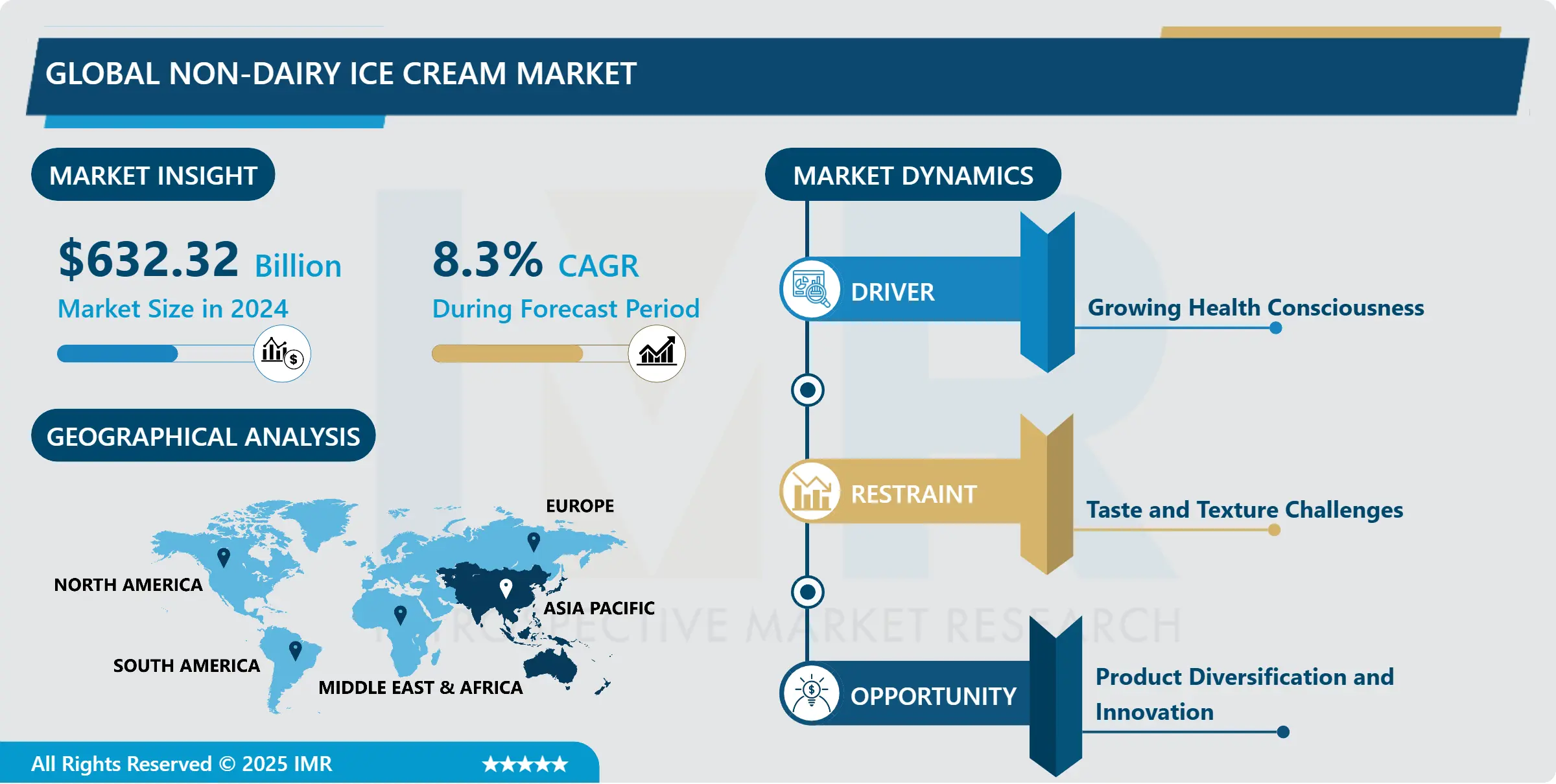
Non-Dairy Ice Cream Market Size Was Valued at USD 632.32 Million in 2024 and is Projected to Reach USD 1196.64 Million by 2032, Growing at a CAGR of 8.3% From 2025-2032.
The non-dairy ice cream market refers to the segment of the frozen dessert industry dedicated to products that are free from traditional dairy ingredients like milk, cream, and butter. Instead, these ice creams are typically made using alternatives such as coconut milk, almond milk, soy milk, or other plant-based ingredients. The rising consumer demand for dairy-free options, driven by factors such as lactose intolerance, ethical concerns, and dietary preferences like veganism, has fueled the growth of this market. Non-dairy ice creams offer a range of flavors and textures comparable to traditional ice creams, appealing to a diverse consumer base seeking healthier, more sustainable, and inclusive dessert options. As the market continues to expand, manufacturers are innovating with new ingredients, flavors, and production methods to meet the evolving preferences and expectations of consumers.
Key Market Highlights
Market Size in 2024: USD 632.32 Million
Projected Market Size by 2032: USD 1196.64 Million
CAGR (2025–2032): 8.3%
Fastest-Growing Market: Asia Pacific
By Source: The Almonds Segment is anticipated to lead the market by holding 28.46% of market share throughout the forecast period.
By Product: The Take-home segment is expected to grab 36.81% market share to maintain dominance over the forecast period.
By Region: Asia Pacific is projected to hold 31.05% market share during the forecast period.
Active Players: Eden Creamery LLC, Over The Moo, Dream, Swedish Glace, NadaMoo, and Other Active Players.
Non-Dairy Ice Cream Market Trend Analysis
Driving Forces Behind the Growth of the Non-Dairy Ice Cream Market
An increased incidence rate of lactose intolerance coupled with the increasing cases of dairy allergies in the general population contributes to the growth of the non-dairy ice cream market. Booting out, lactose intolerance which is the inability to take milk or any dairy products mainly affects a one third of the whole world population, globally it is estimated that up to 65 percent of the population have some form of lactose intolerance. Which is why, with increased knowledge about this ailment, people are not only looking for substitutes to dairy in general but to ice cream as well. Likewise, with the ordinary intolerance which may be mild or serious, the general public is opting to skip the foods derived from dairy products. Many people have become aware of special diets in the recent past as more and more people develop restricted diets due to lactose intolerance or other health issues in the society; the market for non-dairy ice cream has hence consequently risen, encouraging more manufactures to produce new flavors and varieties.
Added to this, a shift in consumers’ perception towards health-benefit properties of non-dairy products has also boosted the interest in this segment of Non-Dairy Ice Creams. Consumers are also opting for dairy-free foods due to an increasing trend towards healthier dietary choices as a way of maintaining good health. When prepared, non-dairy is recognized as a healthier choice than the conventional ice cream because usually consumed in fewer calories less saturated fat content and lack of cholesterol. Continuing with the alternative concept, more and more people, became more informed with the health benefits of consuming more plant based products mostly due to the adoption of a vegan diet, Non-dairy has always been the go to when it comes to frozen desserts. Overall, the steady change to a more healthy and conscious consumption pattern constitutes substantial growth prospects for the non-dairy ice cream market in the near future.
Environmental Awareness Driving the Rise of Non-Dairy Ice Cream
Rising concerns about the negative effects dairies have on the environment implies that many people are likely to shift towards other products that are not related to dairies such as non dairy ice cream. Such feelings of the current population on water consumption, greenhouse effect, and the welfare of the animals used in traditional practices of dairy farming, have seen the new generation consumers adopt the new innovative and sustainable forms of dairy farming. Hence, since non-dairy ice cream is made without the use of cow’s milk, they are friendly to the environment and the consumers contributor to compounding environmental issues such as global warming. This shift is also seen as a part of a continuous quest for products that are friendly to the environment by different global citizens.
To meet this cultures shift toward environmentally friendly products cues from the non-dairy ice cream market have called for aspiration of new formulations that use plant based ingredients including almond milk, coconut milk, soy milk and cashew milk. It is imperative to note that these alternatives not only suit the lactose intolerance, or dairy allergy but also vegans, or people with concern for animal life. Thus, using plant-based products as raw materials, manufacturers get not only more ecological but also a differentiated product that contains less saturated fats and cholesterol in comparison with the traditional ice cream on its basis. The positive effects of taste without the health drawbacks related to dairy, positive environmental effects, and ethical concerns have propelled non-dairy into the future and increased the range and choice for consumers.
Non-Dairy Ice Cream Market Segment Analysis:
Non-Dairy Ice Cream Market is Segmented based on Source, Form, Product, Distribution Channels and Flavor
By Source, Almonds segment is expected to dominate the market during the forecast period
Derived from the food-wholesome almonds, popular for their peculiarity for nutritive values and subtle, nutty taste, almonds have remained the most preferred in the production of the plant-based milk substitutes. The focus on consuming better and more eco-friendly dairy alternatives that can easily substitute traditional cow’s milk stimulated the increase in interest in almonds milk. It has a very fine grain and it has very little flavor, so can be added to products like cereals, morning shakes, breads, etc. Hence, almonds are produced and marketed around the world, and their availability combined with the fairly cheap price of almond milk helps maintain the plant-based milk market under the rule of almond milk.
While soy and almond milk have always had their claim in the dairy substitutes market, coconut milk has recently soared high and has found its own market. Coconut milk, unlike almond milk, is originated from mature coconuts whereby the fleshy part is ground to produce a smooth paste which is then incubated before extracting the milk; this gives it a unique taste and creamy texture. Most plant-based milk have a specific flavor, which will not be the case with coconut milk, as it is both versatile for use in sweet and savory dishes. Be it curries, and soups, and sweets and even beverages, people could not get enough of coconut milk; this thick, delicious and creamy dairy-free solution has not only captured the hearts of lovers of healthy dairy alternatives that do not lack flavors or richness. Furthermore, people have now started realizing its healthy values like MCTs content and religion, such as lauric acid putting coconut milk on the same pedestal of plant based milk rivals.
By Product, Take-home segment held the largest share in 2024
Tetra pak products, especially in terms of plant based milk, are popular with consumers because of the several advantages that include the fact that people can buy large quantities of a particular kind of milk to indulge in as often as they want. These bulk sizes are mostly bought while conducting their usual shopping activities in large stores, specifically supermarkets or through online platforms and this enables consumers to afford to stock plant based milk in large quantity for daily use. The nonstandard nature of take-home packages complements the drift toward acquiring more wholesome and sustainable production of dairy and plant-based milk products, which ensures a constant buying frequency of plant-based milk as a major household necessity. Hence, tempting various tastes and variants, which are available in take-home packages, can suit the different choice of the consumers with different diets and needs, which again secures their leading position in the specified market sector as the dominant product category.
According to the statistics, take-home packs have the most significant market share, whereas impulsive purchases are also significantly important for the Plant-Based Milk consumption, especially in convenience stores and supermarkets. These serve-sized packagings are placed close to the counters where customers might purchase a carton set while paying at the cash register or other frequently accessed zones. Some of the reasons that can lead to impulse buying include necessity, where a person only intends to buy one product but ends up buying another product for one reason or the other; need for convenience, for instance, a person only intends to get a snack but ends up being compelled to buy a certain flavor or brand of the snack. It is vital to note that the new Plant-Based milk in an single-serve packaging is not only meeting the need of 1-time consumers, but over all, they form a pathway to new consumers in the perusal of plant-based milk products. Therefore, sales of impulse products also fall directly into the growth of the plant-based milk market in addition to customers’ constant demand for take-home packs which gives a broader market reach to the product.
Non-Dairy Ice Cream Market Regional Insights:
Asia Pacific is Expected to Dominate the Market Over the Forecast period
Among the markets of Asia Pacific region, the non-dairy ice cream has establish a dominating position as they are supported by number of factors that have complements with the altering consumer’s trend. As a result of evolving consumer preferences and expectations towards consumption of nutrition and health-enhancing products, the use of plant-based products such as soy-based and other plant-based dairy products have gained prominence in Southeast Asian countries including China, Japan, and India. This change is not only driven by concerns about the effects of consuming milk and other dairy products on health but also due to the ever-growing sensitivity of consumers towards the environmental consequences of dairy production processes. Therefore, this type of product has become the topic of high interest and a huge market for both domestic and foreign manufacturers.
Furthermore, the increasing rate of urbanization further the middle income group in the region and the consumer preferences for non-dairy ice creams has also boosted the market. As one observes that consumers have higher disposable income, they prefer more luxurious or premium products such as non-dairy frozen desserts. This has been due to the realization of the large market potential in this segment by major players in the food industry that are consequently dedicating a lot of capital in both product customization from what they consider the standard palate palate and appropriate marketing strategies in the particular regions. Adopting to these characteristics and consumers preferences these companies have well established their ground and created huge market share to their own selves in non dairy ice cream market in Asia Pacific. Altogether, this approach, along with the continually increasing interest in plant-based products among consumers providing the local market with a strong impulse for constant development, it has become one of the fastest-growing segments within the ice cream industry of the region.
Active Key Players in the Non-Dairy Ice Cream Market
Eden Creamery LLC
Over The Moo
Dream
Swedish Glace
NadaMoo
Trader Joe’s
Van Leeuwen Artisan Ice Cream
Unilever
Danone, General Mills
The Booja-Booja Co. Central Europe Ltd.
Happy Cow Limited
Tofutti Brands, Inc.
Bliss Unlimited, LLC
Other Active Players
Chapter 1: Introduction
1.1 Scope and Coverage
Chapter 2:Executive Summary
Chapter 3: Market Landscape
3.1 Market Dynamics
3.1.1 Drivers
3.1.2 Restraints
3.1.3 Opportunities
3.1.4 Challenges
3.2 Market Trend Analysis
3.3 PESTLE Analysis
3.4 Porter’s Five Forces Analysis
3.5 Industry Value Chain Analysis
3.6 Ecosystem
3.7 Regulatory Landscape
3.8 Price Trend Analysis
3.9 Patent Analysis
3.10 Technology Evolution
3.11 Investment Pockets
3.12 Import-Export Analysis
Chapter 4: Non-Dairy Ice Cream Market by Source (2018-2032)
4.1 Non-Dairy Ice Cream Market Snapshot and Growth Engine
4.2 Market Overview
4.3 Coconut milk
4.3.1 Introduction and Market Overview
4.3.2 Historic and Forecasted Market Size in Value USD and Volume Units
4.3.3 Key Market Trends, Growth Factors, and Opportunities
4.3.4 Geographic Segmentation Analysis
4.4 Almond milk
4.5 Cashew milk
4.6 Soy milk
4.7 Other sources
Chapter 5: Non-Dairy Ice Cream Market by Form (2018-2032)
5.1 Non-Dairy Ice Cream Market Snapshot and Growth Engine
5.2 Market Overview
5.3 Singles
5.3.1 Introduction and Market Overview
5.3.2 Historic and Forecasted Market Size in Value USD and Volume Units
5.3.3 Key Market Trends, Growth Factors, and Opportunities
5.3.4 Geographic Segmentation Analysis
5.4 Blends
Chapter 6: Non-Dairy Ice Cream Market by Product (2018-2032)
6.1 Non-Dairy Ice Cream Market Snapshot and Growth Engine
6.2 Market Overview
6.3 Impulse
6.3.1 Introduction and Market Overview
6.3.2 Historic and Forecasted Market Size in Value USD and Volume Units
6.3.3 Key Market Trends, Growth Factors, and Opportunities
6.3.4 Geographic Segmentation Analysis
6.4 Artisanal
6.5 Take home
Chapter 7: Non-Dairy Ice Cream Market by Distribution Channels (2018-2032)
7.1 Non-Dairy Ice Cream Market Snapshot and Growth Engine
7.2 Market Overview
7.3 Supermarkets
7.3.1 Introduction and Market Overview
7.3.2 Historic and Forecasted Market Size in Value USD and Volume Units
7.3.3 Key Market Trends, Growth Factors, and Opportunities
7.3.4 Geographic Segmentation Analysis
7.4 Convenience Stores
7.5 Food & Drink Specialists
7.6 Restaurants
7.7 Online Stores
7.8 Others
Chapter 8: Non-Dairy Ice Cream Market by Flavor (2018-2032)
8.1 Non-Dairy Ice Cream Market Snapshot and Growth Engine
8.2 Market Overview
8.3 Vanilla
8.3.1 Introduction and Market Overview
8.3.2 Historic and Forecasted Market Size in Value USD and Volume Units
8.3.3 Key Market Trends, Growth Factors, and Opportunities
8.3.4 Geographic Segmentation Analysis
8.4 Chocolate
8.5 Butter pecan
8.6 Strawberry
8.7 Neapolitan
8.8 Cookies & Cream
8.9 Mint Choco chip
8.10 Caramel
Chapter 9: Company Profiles and Competitive Analysis
9.1 Competitive Landscape
9.1.1 Competitive Benchmarking
9.1.2 Non-Dairy Ice Cream Market Share by Manufacturer (2024)
9.1.3 Industry BCG Matrix
9.1.4 Heat Map Analysis
9.1.5 Mergers and Acquisitions
9.2 A&B INGREDIENTS (UNITED STATES)
9.2.1 Company Overview
9.2.2 Key Executives
9.2.3 Company Snapshot
9.2.4 Role of the Company in the Market
9.2.5 Sustainability and Social Responsibility
9.2.6 Operating Business Segments
9.2.7 Product Portfolio
9.2.8 Business Performance
9.2.9 Key Strategic Moves and Recent Developments
9.2.10 SWOT Analysis
9.3 AGT FOOD AND INGREDIENTS INC. (CANADA)
9.4 AXIOM FOODS INC. (UNITED STATES)
9.5 BIOWAY (XIAN) ORGANIC INGREDIENTS COLTD. (CHINA)
9.6 BURCON NUTRASCIENCE CORPORATION (CANADA)
9.7 COSUCRA GROUPE WARCOING SA (BELGIUM)
9.8 EMSLAND GROUP (GERMANY)
9.9 FARBEST BRANDS (UNITED STATES)
9.10 FENCHEM BIOTEK LTD. (CHINA)
9.11 GLANBIA PLC (IRELAND)
9.12 INGREDION INCORPORATED (UNITED STATES)
9.13 KERRY GROUP PLC (IRELAND)
9.14 NORBEN COMPANY INC. (UNITED STATES)
9.15 NUTRI-PEA LIMITED (CANADA)
9.16 ROQBERRY (UNITED KINGDOM)
9.17 ROQUETTE FRÈRES (FRANCE)
9.18 SHANDONG JIANYUAN GROUP (CHINA)
9.19 THE SCOULAR COMPANY (UNITED STATES)
9.20 VESTKORN MILLING AS (NORWAY)
9.21 YANTAI SHUANGTA FOOD COLTD. (CHINA)
9.22 OTHER KEY PLAYERS
Chapter 10: Global Non-Dairy Ice Cream Market By Region
10.1 Overview
10.2. North America Non-Dairy Ice Cream Market
10.2.1 Key Market Trends, Growth Factors and Opportunities
10.2.2 Top Key Companies
10.2.3 Historic and Forecasted Market Size by Segments
10.2.4 Historic and Forecasted Market Size by Source
10.2.4.1 Coconut milk
10.2.4.2 Almond milk
10.2.4.3 Cashew milk
10.2.4.4 Soy milk
10.2.4.5 Other sources
10.2.5 Historic and Forecasted Market Size by Form
10.2.5.1 Singles
10.2.5.2 Blends
10.2.6 Historic and Forecasted Market Size by Product
10.2.6.1 Impulse
10.2.6.2 Artisanal
10.2.6.3 Take home
10.2.7 Historic and Forecasted Market Size by Distribution Channels
10.2.7.1 Supermarkets
10.2.7.2 Convenience Stores
10.2.7.3 Food & Drink Specialists
10.2.7.4 Restaurants
10.2.7.5 Online Stores
10.2.7.6 Others
10.2.8 Historic and Forecasted Market Size by Flavor
10.2.8.1 Vanilla
10.2.8.2 Chocolate
10.2.8.3 Butter pecan
10.2.8.4 Strawberry
10.2.8.5 Neapolitan
10.2.8.6 Cookies & Cream
10.2.8.7 Mint Choco chip
10.2.8.8 Caramel
10.2.9 Historic and Forecast Market Size by Country
10.2.9.1 US
10.2.9.2 Canada
10.2.9.3 Mexico
10.3. Eastern Europe Non-Dairy Ice Cream Market
10.3.1 Key Market Trends, Growth Factors and Opportunities
10.3.2 Top Key Companies
10.3.3 Historic and Forecasted Market Size by Segments
10.3.4 Historic and Forecasted Market Size by Source
10.3.4.1 Coconut milk
10.3.4.2 Almond milk
10.3.4.3 Cashew milk
10.3.4.4 Soy milk
10.3.4.5 Other sources
10.3.5 Historic and Forecasted Market Size by Form
10.3.5.1 Singles
10.3.5.2 Blends
10.3.6 Historic and Forecasted Market Size by Product
10.3.6.1 Impulse
10.3.6.2 Artisanal
10.3.6.3 Take home
10.3.7 Historic and Forecasted Market Size by Distribution Channels
10.3.7.1 Supermarkets
10.3.7.2 Convenience Stores
10.3.7.3 Food & Drink Specialists
10.3.7.4 Restaurants
10.3.7.5 Online Stores
10.3.7.6 Others
10.3.8 Historic and Forecasted Market Size by Flavor
10.3.8.1 Vanilla
10.3.8.2 Chocolate
10.3.8.3 Butter pecan
10.3.8.4 Strawberry
10.3.8.5 Neapolitan
10.3.8.6 Cookies & Cream
10.3.8.7 Mint Choco chip
10.3.8.8 Caramel
10.3.9 Historic and Forecast Market Size by Country
10.3.9.1 Russia
10.3.9.2 Bulgaria
10.3.9.3 The Czech Republic
10.3.9.4 Hungary
10.3.9.5 Poland
10.3.9.6 Romania
10.3.9.7 Rest of Eastern Europe
10.4. Western Europe Non-Dairy Ice Cream Market
10.4.1 Key Market Trends, Growth Factors and Opportunities
10.4.2 Top Key Companies
10.4.3 Historic and Forecasted Market Size by Segments
10.4.4 Historic and Forecasted Market Size by Source
10.4.4.1 Coconut milk
10.4.4.2 Almond milk
10.4.4.3 Cashew milk
10.4.4.4 Soy milk
10.4.4.5 Other sources
10.4.5 Historic and Forecasted Market Size by Form
10.4.5.1 Singles
10.4.5.2 Blends
10.4.6 Historic and Forecasted Market Size by Product
10.4.6.1 Impulse
10.4.6.2 Artisanal
10.4.6.3 Take home
10.4.7 Historic and Forecasted Market Size by Distribution Channels
10.4.7.1 Supermarkets
10.4.7.2 Convenience Stores
10.4.7.3 Food & Drink Specialists
10.4.7.4 Restaurants
10.4.7.5 Online Stores
10.4.7.6 Others
10.4.8 Historic and Forecasted Market Size by Flavor
10.4.8.1 Vanilla
10.4.8.2 Chocolate
10.4.8.3 Butter pecan
10.4.8.4 Strawberry
10.4.8.5 Neapolitan
10.4.8.6 Cookies & Cream
10.4.8.7 Mint Choco chip
10.4.8.8 Caramel
10.4.9 Historic and Forecast Market Size by Country
10.4.9.1 Germany
10.4.9.2 UK
10.4.9.3 France
10.4.9.4 The Netherlands
10.4.9.5 Italy
10.4.9.6 Spain
10.4.9.7 Rest of Western Europe
10.5. Asia Pacific Non-Dairy Ice Cream Market
10.5.1 Key Market Trends, Growth Factors and Opportunities
10.5.2 Top Key Companies
10.5.3 Historic and Forecasted Market Size by Segments
10.5.4 Historic and Forecasted Market Size by Source
10.5.4.1 Coconut milk
10.5.4.2 Almond milk
10.5.4.3 Cashew milk
10.5.4.4 Soy milk
10.5.4.5 Other sources
10.5.5 Historic and Forecasted Market Size by Form
10.5.5.1 Singles
10.5.5.2 Blends
10.5.6 Historic and Forecasted Market Size by Product
10.5.6.1 Impulse
10.5.6.2 Artisanal
10.5.6.3 Take home
10.5.7 Historic and Forecasted Market Size by Distribution Channels
10.5.7.1 Supermarkets
10.5.7.2 Convenience Stores
10.5.7.3 Food & Drink Specialists
10.5.7.4 Restaurants
10.5.7.5 Online Stores
10.5.7.6 Others
10.5.8 Historic and Forecasted Market Size by Flavor
10.5.8.1 Vanilla
10.5.8.2 Chocolate
10.5.8.3 Butter pecan
10.5.8.4 Strawberry
10.5.8.5 Neapolitan
10.5.8.6 Cookies & Cream
10.5.8.7 Mint Choco chip
10.5.8.8 Caramel
10.5.9 Historic and Forecast Market Size by Country
10.5.9.1 China
10.5.9.2 India
10.5.9.3 Japan
10.5.9.4 South Korea
10.5.9.5 Malaysia
10.5.9.6 Thailand
10.5.9.7 Vietnam
10.5.9.8 The Philippines
10.5.9.9 Australia
10.5.9.10 New Zealand
10.5.9.11 Rest of APAC
10.6. Middle East & Africa Non-Dairy Ice Cream Market
10.6.1 Key Market Trends, Growth Factors and Opportunities
10.6.2 Top Key Companies
10.6.3 Historic and Forecasted Market Size by Segments
10.6.4 Historic and Forecasted Market Size by Source
10.6.4.1 Coconut milk
10.6.4.2 Almond milk
10.6.4.3 Cashew milk
10.6.4.4 Soy milk
10.6.4.5 Other sources
10.6.5 Historic and Forecasted Market Size by Form
10.6.5.1 Singles
10.6.5.2 Blends
10.6.6 Historic and Forecasted Market Size by Product
10.6.6.1 Impulse
10.6.6.2 Artisanal
10.6.6.3 Take home
10.6.7 Historic and Forecasted Market Size by Distribution Channels
10.6.7.1 Supermarkets
10.6.7.2 Convenience Stores
10.6.7.3 Food & Drink Specialists
10.6.7.4 Restaurants
10.6.7.5 Online Stores
10.6.7.6 Others
10.6.8 Historic and Forecasted Market Size by Flavor
10.6.8.1 Vanilla
10.6.8.2 Chocolate
10.6.8.3 Butter pecan
10.6.8.4 Strawberry
10.6.8.5 Neapolitan
10.6.8.6 Cookies & Cream
10.6.8.7 Mint Choco chip
10.6.8.8 Caramel
10.6.9 Historic and Forecast Market Size by Country
10.6.9.1 Turkiye
10.6.9.2 Bahrain
10.6.9.3 Kuwait
10.6.9.4 Saudi Arabia
10.6.9.5 Qatar
10.6.9.6 UAE
10.6.9.7 Israel
10.6.9.8 South Africa
10.7. South America Non-Dairy Ice Cream Market
10.7.1 Key Market Trends, Growth Factors and Opportunities
10.7.2 Top Key Companies
10.7.3 Historic and Forecasted Market Size by Segments
10.7.4 Historic and Forecasted Market Size by Source
10.7.4.1 Coconut milk
10.7.4.2 Almond milk
10.7.4.3 Cashew milk
10.7.4.4 Soy milk
10.7.4.5 Other sources
10.7.5 Historic and Forecasted Market Size by Form
10.7.5.1 Singles
10.7.5.2 Blends
10.7.6 Historic and Forecasted Market Size by Product
10.7.6.1 Impulse
10.7.6.2 Artisanal
10.7.6.3 Take home
10.7.7 Historic and Forecasted Market Size by Distribution Channels
10.7.7.1 Supermarkets
10.7.7.2 Convenience Stores
10.7.7.3 Food & Drink Specialists
10.7.7.4 Restaurants
10.7.7.5 Online Stores
10.7.7.6 Others
10.7.8 Historic and Forecasted Market Size by Flavor
10.7.8.1 Vanilla
10.7.8.2 Chocolate
10.7.8.3 Butter pecan
10.7.8.4 Strawberry
10.7.8.5 Neapolitan
10.7.8.6 Cookies & Cream
10.7.8.7 Mint Choco chip
10.7.8.8 Caramel
10.7.9 Historic and Forecast Market Size by Country
10.7.9.1 Brazil
10.7.9.2 Argentina
10.7.9.3 Rest of SA
Chapter 11 Analyst Viewpoint and Conclusion
11.1 Recommendations and Concluding Analysis
11.2 Potential Market Strategies
Chapter 12 Research Methodology
12.1 Research Process
12.2 Primary Research
12.3 Secondary Research
Q1: What would be the forecast period in the Non-Dairy Ice Cream Market research report?
A1: The forecast period in the Non-Dairy Ice Cream Market research report is 2025-2032.
Q2: Who are the key players in the Non-Dairy Ice Cream Market?
A2: Eden Creamery LLC, Over The Moo, Dream, Swedish Glace, NadaMoo, Trader Joe’s, Van Leeuwen Artisan Ice Cream, Unilever, Danone, General Mills, The Booja-Booja Co. Central Europe Ltd., Happy Cow Limited, Tofutti Brands, Inc., Bliss Unlimited, LLC and Other Active Players.
Q3: What are the segments of the Non-Dairy Ice Cream Market?
A3: The Non-Dairy Ice Cream Market is segmented into By Source, By Form, By Product, By Distribution Channels, By Flavor and region. By Source, the market is categorized into Coconut milk, Almond milk, Cashew milk, Soy milk and Other sources. By Form, the market is categorized into Singles and Blends. By Product, the market is categorized into Impulse, Artisanal and Take home. By Distribution Channels, the market is categorized into Supermarkets, Convenience Stores, Food & Drink Specialists, Restaurants, Online Stores and Others. By Flavor, the market is categorized into Vanilla, Chocolate, Butter pecan, Strawberry, Neapolitan, Cookies & Cream, Mint Choco chip and Caramel. By region, it is analyzed across North America (U.S.; Canada; Mexico), Europe (Germany; U.K.; France; Italy; Russia; Spain, etc.), Asia-Pacific (China; India; Japan; Southeast Asia, etc.), South America (Brazil; Argentina, etc.), Middle East & Africa (Saudi Arabia; South Africa, etc.).
Q4: What is the Non-Dairy Ice Cream Market?
A4: The non-dairy ice cream market refers to the segment of the frozen dessert industry dedicated to products that are free from traditional dairy ingredients like milk, cream, and butter. Instead, these ice creams are typically made using alternatives such as coconut milk, almond milk, soy milk, or other plant-based ingredients. The rising consumer demand for dairy-free options, driven by factors such as lactose intolerance, ethical concerns, and dietary preferences like veganism, has fueled the growth of this market. Non-dairy ice creams offer a range of flavors and textures comparable to traditional ice creams, appealing to a diverse consumer base seeking healthier, more sustainable, and inclusive dessert options. As the market continues to expand, manufacturers are innovating with new ingredients, flavors, and production methods to meet the evolving preferences and expectations of consumers.
Q5: How big is the Non-Dairy Ice Cream Market?
A5: Non-Dairy Ice Cream Market Size Was Valued at USD 632.32 Million in 2024 and is Projected to Reach USD 1196.64 Million by 2032, Growing at a CAGR of 8.3% From 2025-2032.
How to Buy a Report from eminsights.jp
On the product page, choose the license you want: Single-User License, Multi-User License or Enterprise License.
If you required report in your native language, then you can click on Translated Report button and fill out the form with report name and language you want, then our team will contact you as soon as possible.
Click the Buy Now button.
You will be redirected to the checkout page. Enter your company details and payment information.
Click Place Order to complete the purchase.
Confirmation: You’ll receive an order confirmation and our team will contact you shortly with your ordered report.
If you have any questions, fill out the contact form below or email us at bizdev@eminsights.net.
Thank you for choosing eminsights.jp!