Stay Ahead in Fast-Growing Economies.
Browse Reports Now
Neutralizing Antibody Market Insights, Dynamics, and Growth Forecast (2024-2032)
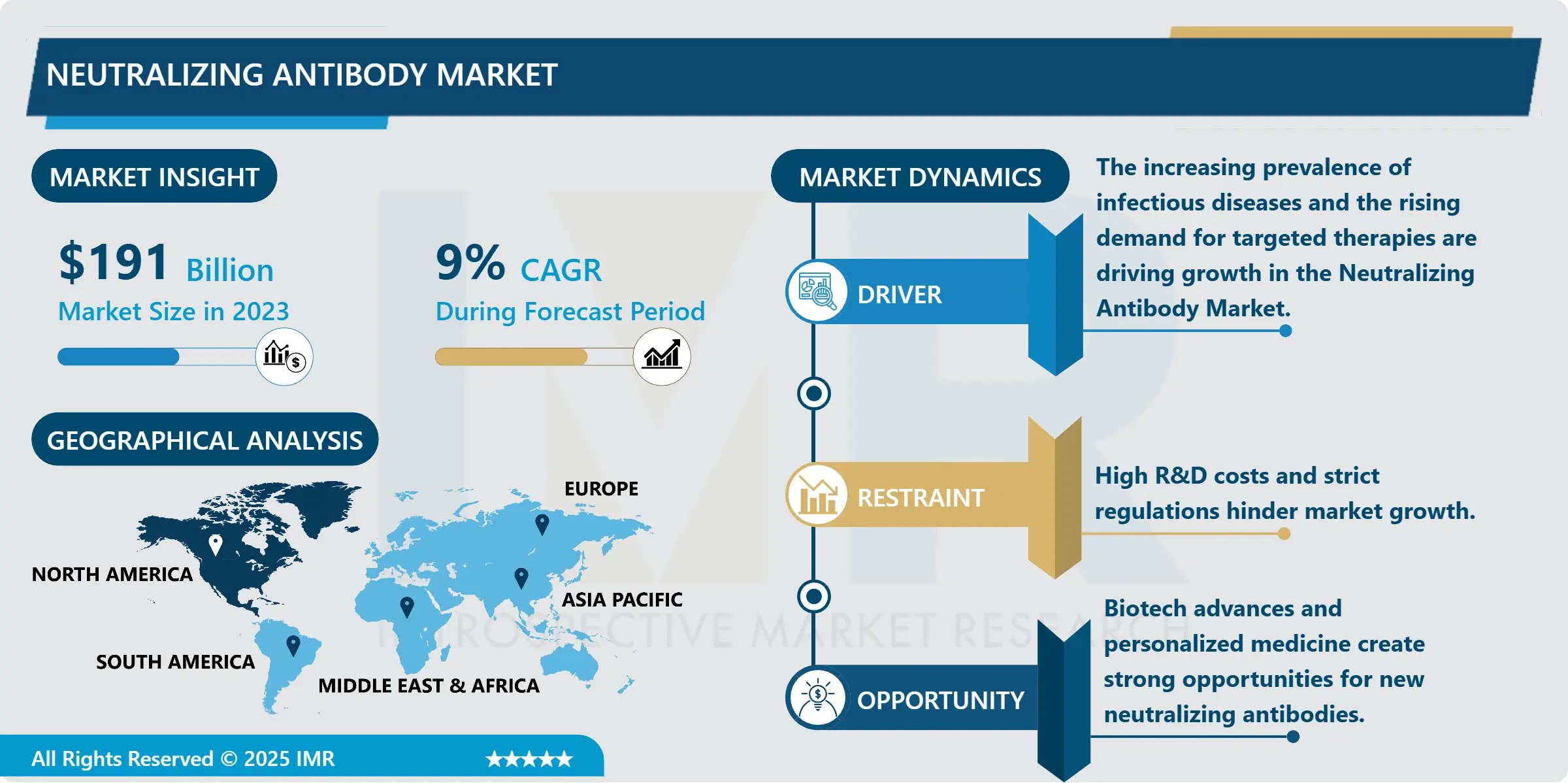
Neutralizing Antibody Market Size Was Valued at USD 191 Billion in 2023, and is Projected to Reach USD 338.98 Billion by 2032, Growing at a CAGR of 9% From 2024-2032.

IMR Group
Description
Neutralizing Antibody Market Synopsis:
Neutralizing Antibody Market Size Was Valued at USD 191 Billion in 2023, and is Projected to Reach USD 338.98 Billion by 2032, Growing at a CAGR of 9% From 2024-2032.
The Neutralizing Antibody Market deals with the production and market of the antibodies that counter the action of pathogenic organisms including viruses and bacteria. They are critical in regulating immune response because they prevent the viruses and bacteria from entering the host cells making then imperative in treatment of diseases, auto immune diseases and also cancer. The market has begun growing in the recent past, especially with developments in improved biotechnological approaches that facilitate the discovery and production of reagents, which neutralize new pathogens including the SARS-CoV-2 virus.
Major growth stimulants behind the Neutralizing Antibody Market include rising incidence of infectious illnesses, innovation and development activities and enhanced requirement for precise treatments. The COVID-19 crisis specifically has driven interest in neutralizing antibodies, readily spurring the development of monoclonal antibody and antiviral therapies. Moreover, pharma and biotech alliances and partnerships with academic and research institutions are propelling the growth of novel and innovative antibody discovery and development and expanding the therapeutic armamentarium.
However, the market also has problems like huge research and development costs, long procedural legal requirements, and strenuous trials including efficacy and safety. Nevertheless, there are a lot of opportunities in the market with the development of genetic engineering and medicine on the individual basis. The rising interest in biotechnology and indeed the growing use of neutralizing antibodies across multiple therapeutic segments is evidence of growth opportunities for the Neutralizing Antibody Market in the future.
Neutralizing Antibody Market Trend Analysis:
Surge in Monoclonal Antibody Development
The mAbs is another major trend in the market studied wherein the market is likely to witness enhanced adoption of targeted Neutralizing Antibodies in the treatment of diseases in the coming years. This trend has been particularly affected by the COVID-19 pandemic as pushed the development of neutralizing mAbs against to limit the severity of the illness. Biopharmaceutical firms have shifted towards mAb platforms to develop a selective and potent reagent that can selectively and with high affinity interact with pathogens making it a nod for treatment of various infectious diseases, both systemic as well as autoimmune diseases and some types of cancers. Hybridoma technology and phage display are now coming into use for the identification and optimization of these antibodies and this is stimulating the market growth of this segment.
Expansion of Combination Therapies
Another trend is the increasing use of combination therapies where neutralizing antibodies also act as a component of combination with vaccines and small molecule drugs. This approach is for improving the outcome of the treatments and for offering a more holistic solution on the fight against diseases; canker, cancer and viral diseases inclusive. Such integrated therapies harmonize the activity of neutralizing antibodies with other therapies making them more effective in dealing with patients’ needs, minimizing the development of resistance, and targeting various patient populations at the same time. Further, ongoing clinical trials related to the combinations strengthen this kind of approach in the Neutralizing Antibody Market.
Neutralizing Antibody Market Segment Analysis:
Neutralizing Antibody Market is Segmented on the basis of Antibody Type, Target Virus, Application, End User, Distribution Channel, and Region.
By Antibody Type, Monoclonal Antibodies segment is expected to dominate the market during the forecast period
There are four global segments for Neutralizing Antibody Market depending on antibody type: Monoclonal antibodies (mAbs) and Polyclonal antibodies (pAbs) having their advantages while using in therapeutic areas. Monoclonal antibodies are designed to fit well on target antigens, therefore, they are used to treat many diseases such as cancers and viral infections diseases. Because of their mass production and the ability to alter their effectiveness, their usage has spiked, especially in reference to new viral ailments. By contrast, poly/ectsclonal antibodies are several antibodies that can target one single epitome and several other epitome on the same antigen for enhanced immune response. They are routinely employed in circumstances, for instance passive immunization therapy, where quick effect is most desirable. Technological innovations in the fields of antibody engineering and production are anticipated to add value and versatility to the utilisation of both monoclonal and polyclonal antibodies in the neutralizing antibody arena.
By Application, Diagnostics segment expected to held the largest share
Market segmentation for the neutralizing antibody market is done on the basis of application which includes therapeutics, diagnostics, and research and development (R&D). Neutralizing antibodies are effectively being used in therapeutics as targeted therapies for numerous diseases, viral, autoimmune diseases, and even cancer, which give ahead for patient-specific medication. In diagnostics, these antibodies are of great help in determining which particular pathogen is present in the body and as early as possible. The R & D segment centers on identification and description of new uses of neutralizing antibodies to encourage novel vaccines and other therapeutic approaches. This diverse application picture underlines the versatile use and increasing importance of antagonising antibodies in every area of medicine, which again underlines their importance for the further development of medical science and for patients.
Neutralizing Antibody Market Regional Insights:
North America is the largest market for neutralizing antibodies, accounting for a market share
The study found out that North American region had the highest market share for neutralizing antibodies due to the region’s advanced health care system, research activities and well established drug manufacturing industries.. The US and Canada have been pioneers of immunotherapy and biotechnology, embracing and propagating the technology and launching of neutralizing antibodies for various diseases, including viral infections, cancer and autoimmunity. Furthermore, the government provides significant funding for the region, favourable regulations and high healthcare technology investment reinforces the market for neutralizing antibody in the region. The COVID-19 pandemic has also lent a sense of urgency to research and the commercial application of monoclonal antibody therapies, and so has cemented North America’s position in the fast-growing market.
Active Key Players in the Neutralizing Antibody Market:
Regeneron Pharmaceuticals, Inc. (U.S.)
Eli Lilly and Company (U.S.)
AstraZeneca PLC (U.K.)
GlaxoSmithKline plc (U.K.)
Sanofi SA (France)
Roche Holding AG (Switzerland)
Novartis AG (Switzerland)
Merck & Co., Inc. (U.S.)
Pfizer Inc. (U.S.)
Johnson & Johnson (U.S.)
Takeda Pharmaceutical Company Limited (Japan)
Moderna, Inc. (U.S.)
BioNTech SE (Germany)
CSL Limited (Australia)
Sinovac Biotech Ltd. (China)
Other Active Players
Chapter 1: Introduction
1.1 Scope and Coverage
Chapter 2:Executive Summary
Chapter 3: Market Landscape
3.1 Market Dynamics
3.1.1 Drivers
3.1.2 Restraints
3.1.3 Opportunities
3.1.4 Challenges
3.2 Market Trend Analysis
3.3 PESTLE Analysis
3.4 Porter’s Five Forces Analysis
3.5 Industry Value Chain Analysis
3.6 Ecosystem
3.7 Regulatory Landscape
3.8 Price Trend Analysis
3.9 Patent Analysis
3.10 Technology Evolution
3.11 Investment Pockets
3.12 Import-Export Analysis
Chapter 4: Neutralizing Antibody Market by Antibody Type
4.1 Neutralizing Antibody Market Snapshot and Growth Engine
4.2 Neutralizing Antibody Market Overview
4.3 Monoclonal Antibodies
4.3.1 Introduction and Market Overview
4.3.2 Historic and Forecasted Market Size in Value USD and Volume Units (2017-2032F)
4.3.3 Key Market Trends, Growth Factors and Opportunities
4.3.4 Monoclonal Antibodies: Geographic Segmentation Analysis
4.4 Polyclonal Antibodies
4.4.1 Introduction and Market Overview
4.4.2 Historic and Forecasted Market Size in Value USD and Volume Units (2017-2032F)
4.4.3 Key Market Trends, Growth Factors and Opportunities
4.4.4 Polyclonal Antibodies: Geographic Segmentation Analysis
Chapter 5: Neutralizing Antibody Market by Target Virus
5.1 Neutralizing Antibody Market Snapshot and Growth Engine
5.2 Neutralizing Antibody Market Overview
5.3 SARS-CoV-2 (COVID-19)
5.3.1 Introduction and Market Overview
5.3.2 Historic and Forecasted Market Size in Value USD and Volume Units (2017-2032F)
5.3.3 Key Market Trends, Growth Factors and Opportunities
5.3.4 SARS-CoV-2 (COVID-19): Geographic Segmentation Analysis
5.4 HIV
5.4.1 Introduction and Market Overview
5.4.2 Historic and Forecasted Market Size in Value USD and Volume Units (2017-2032F)
5.4.3 Key Market Trends, Growth Factors and Opportunities
5.4.4 HIV: Geographic Segmentation Analysis
5.5 Influenza
5.5.1 Introduction and Market Overview
5.5.2 Historic and Forecasted Market Size in Value USD and Volume Units (2017-2032F)
5.5.3 Key Market Trends, Growth Factors and Opportunities
5.5.4 Influenza: Geographic Segmentation Analysis
5.6 Ebola
5.6.1 Introduction and Market Overview
5.6.2 Historic and Forecasted Market Size in Value USD and Volume Units (2017-2032F)
5.6.3 Key Market Trends, Growth Factors and Opportunities
5.6.4 Ebola: Geographic Segmentation Analysis
5.7 Zika
5.7.1 Introduction and Market Overview
5.7.2 Historic and Forecasted Market Size in Value USD and Volume Units (2017-2032F)
5.7.3 Key Market Trends, Growth Factors and Opportunities
5.7.4 Zika: Geographic Segmentation Analysis
5.8 Hepatitis C
5.8.1 Introduction and Market Overview
5.8.2 Historic and Forecasted Market Size in Value USD and Volume Units (2017-2032F)
5.8.3 Key Market Trends, Growth Factors and Opportunities
5.8.4 Hepatitis C: Geographic Segmentation Analysis
5.9 Others
5.9.1 Introduction and Market Overview
5.9.2 Historic and Forecasted Market Size in Value USD and Volume Units (2017-2032F)
5.9.3 Key Market Trends, Growth Factors and Opportunities
5.9.4 Others: Geographic Segmentation Analysis
Chapter 6: Neutralizing Antibody Market by Application
6.1 Neutralizing Antibody Market Snapshot and Growth Engine
6.2 Neutralizing Antibody Market Overview
6.3 Therapeutics
6.3.1 Introduction and Market Overview
6.3.2 Historic and Forecasted Market Size in Value USD and Volume Units (2017-2032F)
6.3.3 Key Market Trends, Growth Factors and Opportunities
6.3.4 Therapeutics: Geographic Segmentation Analysis
6.4 Diagnostics
6.4.1 Introduction and Market Overview
6.4.2 Historic and Forecasted Market Size in Value USD and Volume Units (2017-2032F)
6.4.3 Key Market Trends, Growth Factors and Opportunities
6.4.4 Diagnostics: Geographic Segmentation Analysis
6.5 Research and Development
6.5.1 Introduction and Market Overview
6.5.2 Historic and Forecasted Market Size in Value USD and Volume Units (2017-2032F)
6.5.3 Key Market Trends, Growth Factors and Opportunities
6.5.4 Research and Development: Geographic Segmentation Analysis
Chapter 7: Neutralizing Antibody Market by End User
7.1 Neutralizing Antibody Market Snapshot and Growth Engine
7.2 Neutralizing Antibody Market Overview
7.3 Hospitals and Clinics
7.3.1 Introduction and Market Overview
7.3.2 Historic and Forecasted Market Size in Value USD and Volume Units (2017-2032F)
7.3.3 Key Market Trends, Growth Factors and Opportunities
7.3.4 Hospitals and Clinics: Geographic Segmentation Analysis
7.4 Research Institutes
7.4.1 Introduction and Market Overview
7.4.2 Historic and Forecasted Market Size in Value USD and Volume Units (2017-2032F)
7.4.3 Key Market Trends, Growth Factors and Opportunities
7.4.4 Research Institutes: Geographic Segmentation Analysis
7.5 Diagnostic Laboratories
7.5.1 Introduction and Market Overview
7.5.2 Historic and Forecasted Market Size in Value USD and Volume Units (2017-2032F)
7.5.3 Key Market Trends, Growth Factors and Opportunities
7.5.4 Diagnostic Laboratories: Geographic Segmentation Analysis
7.6 Pharmaceutical Companies
7.6.1 Introduction and Market Overview
7.6.2 Historic and Forecasted Market Size in Value USD and Volume Units (2017-2032F)
7.6.3 Key Market Trends, Growth Factors and Opportunities
7.6.4 Pharmaceutical Companies : Geographic Segmentation Analysis
7.7 Others
7.7.1 Introduction and Market Overview
7.7.2 Historic and Forecasted Market Size in Value USD and Volume Units (2017-2032F)
7.7.3 Key Market Trends, Growth Factors and Opportunities
7.7.4 Others: Geographic Segmentation Analysis
Chapter 8: Neutralizing Antibody Market by Distribution Channel
8.1 Neutralizing Antibody Market Snapshot and Growth Engine
8.2 Neutralizing Antibody Market Overview
8.3 Direct Sales to End-Users
8.3.1 Introduction and Market Overview
8.3.2 Historic and Forecasted Market Size in Value USD and Volume Units (2017-2032F)
8.3.3 Key Market Trends, Growth Factors and Opportunities
8.3.4 Direct Sales to End-Users: Geographic Segmentation Analysis
8.4 Distributors
8.4.1 Introduction and Market Overview
8.4.2 Historic and Forecasted Market Size in Value USD and Volume Units (2017-2032F)
8.4.3 Key Market Trends, Growth Factors and Opportunities
8.4.4 Distributors: Geographic Segmentation Analysis
8.5 Online Retail
8.5.1 Introduction and Market Overview
8.5.2 Historic and Forecasted Market Size in Value USD and Volume Units (2017-2032F)
8.5.3 Key Market Trends, Growth Factors and Opportunities
8.5.4 Online Retail: Geographic Segmentation Analysis
8.6 Others
8.6.1 Introduction and Market Overview
8.6.2 Historic and Forecasted Market Size in Value USD and Volume Units (2017-2032F)
8.6.3 Key Market Trends, Growth Factors and Opportunities
8.6.4 Others: Geographic Segmentation Analysis
Chapter 9: Company Profiles and Competitive Analysis
9.1 Competitive Landscape
9.1.1 Competitive Benchmarking
9.1.2 Neutralizing Antibody Market Share by Manufacturer (2023)
9.1.3 Industry BCG Matrix
9.1.4 Heat Map Analysis
9.1.5 Mergers and Acquisitions
9.2 REGENERON PHARMACEUTICALS INC. (U.S.)
9.2.1 Company Overview
9.2.2 Key Executives
9.2.3 Company Snapshot
9.2.4 Role of the Company in the Market
9.2.5 Sustainability and Social Responsibility
9.2.6 Operating Business Segments
9.2.7 Product Portfolio
9.2.8 Business Performance
9.2.9 Key Strategic Moves and Recent Developments
9.2.10 SWOT Analysis
9.3 ELI LILLY AND COMPANY (U.S.)
9.4 ASTRAZENECA PLC (U.K.)
9.5 GLAXOSMITHKLINE PLC (U.K.)
9.6 SANOFI SA (FRANCE)
9.7 ROCHE HOLDING AG (SWITZERLAND)
9.8 NOVARTIS AG (SWITZERLAND)
9.9 MERCK & CO. INC. (U.S.)
9.10 PFIZER INC. (U.S.)
9.11 JOHNSON & JOHNSON (U.S.)
9.12 TAKEDA PHARMACEUTICAL COMPANY LIMITED (JAPAN)
9.13 MODERNA INC. (U.S.)
9.14 BIONTECH SE (GERMANY)
9.15 CSL LIMITED (AUSTRALIA)
9.16 SINOVAC BIOTECH LTD. (CHINA)
9.17 OTHER ACTIVE PLAYERS
Chapter 10: Global Neutralizing Antibody Market By Region
10.1 Overview
10.2. North America Neutralizing Antibody Market
10.2.1 Key Market Trends, Growth Factors and Opportunities
10.2.2 Top Key Companies
10.2.3 Historic and Forecasted Market Size by Segments
10.2.4 Historic and Forecasted Market Size By Antibody Type
10.2.4.1 Monoclonal Antibodies
10.2.4.2 Polyclonal Antibodies
10.2.5 Historic and Forecasted Market Size By Target Virus
10.2.5.1 SARS-CoV-2 (COVID-19)
10.2.5.2 HIV
10.2.5.3 Influenza
10.2.5.4 Ebola
10.2.5.5 Zika
10.2.5.6 Hepatitis C
10.2.5.7 Others
10.2.6 Historic and Forecasted Market Size By Application
10.2.6.1 Therapeutics
10.2.6.2 Diagnostics
10.2.6.3 Research and Development
10.2.7 Historic and Forecasted Market Size By End User
10.2.7.1 Hospitals and Clinics
10.2.7.2 Research Institutes
10.2.7.3 Diagnostic Laboratories
10.2.7.4 Pharmaceutical Companies
10.2.7.5 Others
10.2.8 Historic and Forecasted Market Size By Distribution Channel
10.2.8.1 Direct Sales to End-Users
10.2.8.2 Distributors
10.2.8.3 Online Retail
10.2.8.4 Others
10.2.9 Historic and Forecast Market Size by Country
10.2.9.1 US
10.2.9.2 Canada
10.2.9.3 Mexico
10.3. Eastern Europe Neutralizing Antibody Market
10.3.1 Key Market Trends, Growth Factors and Opportunities
10.3.2 Top Key Companies
10.3.3 Historic and Forecasted Market Size by Segments
10.3.4 Historic and Forecasted Market Size By Antibody Type
10.3.4.1 Monoclonal Antibodies
10.3.4.2 Polyclonal Antibodies
10.3.5 Historic and Forecasted Market Size By Target Virus
10.3.5.1 SARS-CoV-2 (COVID-19)
10.3.5.2 HIV
10.3.5.3 Influenza
10.3.5.4 Ebola
10.3.5.5 Zika
10.3.5.6 Hepatitis C
10.3.5.7 Others
10.3.6 Historic and Forecasted Market Size By Application
10.3.6.1 Therapeutics
10.3.6.2 Diagnostics
10.3.6.3 Research and Development
10.3.7 Historic and Forecasted Market Size By End User
10.3.7.1 Hospitals and Clinics
10.3.7.2 Research Institutes
10.3.7.3 Diagnostic Laboratories
10.3.7.4 Pharmaceutical Companies
10.3.7.5 Others
10.3.8 Historic and Forecasted Market Size By Distribution Channel
10.3.8.1 Direct Sales to End-Users
10.3.8.2 Distributors
10.3.8.3 Online Retail
10.3.8.4 Others
10.3.9 Historic and Forecast Market Size by Country
10.3.9.1 Russia
10.3.9.2 Bulgaria
10.3.9.3 The Czech Republic
10.3.9.4 Hungary
10.3.9.5 Poland
10.3.9.6 Romania
10.3.9.7 Rest of Eastern Europe
10.4. Western Europe Neutralizing Antibody Market
10.4.1 Key Market Trends, Growth Factors and Opportunities
10.4.2 Top Key Companies
10.4.3 Historic and Forecasted Market Size by Segments
10.4.4 Historic and Forecasted Market Size By Antibody Type
10.4.4.1 Monoclonal Antibodies
10.4.4.2 Polyclonal Antibodies
10.4.5 Historic and Forecasted Market Size By Target Virus
10.4.5.1 SARS-CoV-2 (COVID-19)
10.4.5.2 HIV
10.4.5.3 Influenza
10.4.5.4 Ebola
10.4.5.5 Zika
10.4.5.6 Hepatitis C
10.4.5.7 Others
10.4.6 Historic and Forecasted Market Size By Application
10.4.6.1 Therapeutics
10.4.6.2 Diagnostics
10.4.6.3 Research and Development
10.4.7 Historic and Forecasted Market Size By End User
10.4.7.1 Hospitals and Clinics
10.4.7.2 Research Institutes
10.4.7.3 Diagnostic Laboratories
10.4.7.4 Pharmaceutical Companies
10.4.7.5 Others
10.4.8 Historic and Forecasted Market Size By Distribution Channel
10.4.8.1 Direct Sales to End-Users
10.4.8.2 Distributors
10.4.8.3 Online Retail
10.4.8.4 Others
10.4.9 Historic and Forecast Market Size by Country
10.4.9.1 Germany
10.4.9.2 UK
10.4.9.3 France
10.4.9.4 The Netherlands
10.4.9.5 Italy
10.4.9.6 Spain
10.4.9.7 Rest of Western Europe
10.5. Asia Pacific Neutralizing Antibody Market
10.5.1 Key Market Trends, Growth Factors and Opportunities
10.5.2 Top Key Companies
10.5.3 Historic and Forecasted Market Size by Segments
10.5.4 Historic and Forecasted Market Size By Antibody Type
10.5.4.1 Monoclonal Antibodies
10.5.4.2 Polyclonal Antibodies
10.5.5 Historic and Forecasted Market Size By Target Virus
10.5.5.1 SARS-CoV-2 (COVID-19)
10.5.5.2 HIV
10.5.5.3 Influenza
10.5.5.4 Ebola
10.5.5.5 Zika
10.5.5.6 Hepatitis C
10.5.5.7 Others
10.5.6 Historic and Forecasted Market Size By Application
10.5.6.1 Therapeutics
10.5.6.2 Diagnostics
10.5.6.3 Research and Development
10.5.7 Historic and Forecasted Market Size By End User
10.5.7.1 Hospitals and Clinics
10.5.7.2 Research Institutes
10.5.7.3 Diagnostic Laboratories
10.5.7.4 Pharmaceutical Companies
10.5.7.5 Others
10.5.8 Historic and Forecasted Market Size By Distribution Channel
10.5.8.1 Direct Sales to End-Users
10.5.8.2 Distributors
10.5.8.3 Online Retail
10.5.8.4 Others
10.5.9 Historic and Forecast Market Size by Country
10.5.9.1 China
10.5.9.2 India
10.5.9.3 Japan
10.5.9.4 South Korea
10.5.9.5 Malaysia
10.5.9.6 Thailand
10.5.9.7 Vietnam
10.5.9.8 The Philippines
10.5.9.9 Australia
10.5.9.10 New Zealand
10.5.9.11 Rest of APAC
10.6. Middle East & Africa Neutralizing Antibody Market
10.6.1 Key Market Trends, Growth Factors and Opportunities
10.6.2 Top Key Companies
10.6.3 Historic and Forecasted Market Size by Segments
10.6.4 Historic and Forecasted Market Size By Antibody Type
10.6.4.1 Monoclonal Antibodies
10.6.4.2 Polyclonal Antibodies
10.6.5 Historic and Forecasted Market Size By Target Virus
10.6.5.1 SARS-CoV-2 (COVID-19)
10.6.5.2 HIV
10.6.5.3 Influenza
10.6.5.4 Ebola
10.6.5.5 Zika
10.6.5.6 Hepatitis C
10.6.5.7 Others
10.6.6 Historic and Forecasted Market Size By Application
10.6.6.1 Therapeutics
10.6.6.2 Diagnostics
10.6.6.3 Research and Development
10.6.7 Historic and Forecasted Market Size By End User
10.6.7.1 Hospitals and Clinics
10.6.7.2 Research Institutes
10.6.7.3 Diagnostic Laboratories
10.6.7.4 Pharmaceutical Companies
10.6.7.5 Others
10.6.8 Historic and Forecasted Market Size By Distribution Channel
10.6.8.1 Direct Sales to End-Users
10.6.8.2 Distributors
10.6.8.3 Online Retail
10.6.8.4 Others
10.6.9 Historic and Forecast Market Size by Country
10.6.9.1 Turkiye
10.6.9.2 Bahrain
10.6.9.3 Kuwait
10.6.9.4 Saudi Arabia
10.6.9.5 Qatar
10.6.9.6 UAE
10.6.9.7 Israel
10.6.9.8 South Africa
10.7. South America Neutralizing Antibody Market
10.7.1 Key Market Trends, Growth Factors and Opportunities
10.7.2 Top Key Companies
10.7.3 Historic and Forecasted Market Size by Segments
10.7.4 Historic and Forecasted Market Size By Antibody Type
10.7.4.1 Monoclonal Antibodies
10.7.4.2 Polyclonal Antibodies
10.7.5 Historic and Forecasted Market Size By Target Virus
10.7.5.1 SARS-CoV-2 (COVID-19)
10.7.5.2 HIV
10.7.5.3 Influenza
10.7.5.4 Ebola
10.7.5.5 Zika
10.7.5.6 Hepatitis C
10.7.5.7 Others
10.7.6 Historic and Forecasted Market Size By Application
10.7.6.1 Therapeutics
10.7.6.2 Diagnostics
10.7.6.3 Research and Development
10.7.7 Historic and Forecasted Market Size By End User
10.7.7.1 Hospitals and Clinics
10.7.7.2 Research Institutes
10.7.7.3 Diagnostic Laboratories
10.7.7.4 Pharmaceutical Companies
10.7.7.5 Others
10.7.8 Historic and Forecasted Market Size By Distribution Channel
10.7.8.1 Direct Sales to End-Users
10.7.8.2 Distributors
10.7.8.3 Online Retail
10.7.8.4 Others
10.7.9 Historic and Forecast Market Size by Country
10.7.9.1 Brazil
10.7.9.2 Argentina
10.7.9.3 Rest of SA
Chapter 11 Analyst Viewpoint and Conclusion
11.1 Recommendations and Concluding Analysis
11.2 Potential Market Strategies
Chapter 12 Research Methodology
12.1 Research Process
12.2 Primary Research
12.3 Secondary Research
Q1: What would be the forecast period in the Neutralizing Antibody Market research report?
A1: The forecast period in the Neutralizing Antibody Market research report is 2024-2032.
Q2: Who are the key players in the Neutralizing Antibody Market?
A2: Regeneron Pharmaceuticals, Inc. (U.S.), Eli Lilly and Company (U.S.), AstraZeneca PLC (U.K.), GlaxoSmithKline plc (U.K.), Sanofi SA (France), Roche Holding AG (Switzerland), Novartis AG (Switzerland), Merck & Co., Inc. (U.S.), Pfizer Inc. (U.S.), Johnson & Johnson (U.S.), Takeda Pharmaceutical Company Limited (Japan), Moderna, Inc. (U.S.), BioNTech SE (Germany), CSL Limited (Australia), Sinovac Biotech Ltd. (China), and Other Active Players
Q3: What are the segments of the Neutralizing Antibody Market?
A3: The Neutralizing Antibody Market is segmented into By Antibody Type, By Target, By Application, End User, By Distribution Channel, and region. By Antibody Type (Monoclonal Antibodies, Polyclonal Antibodies), By Target Virus (SARS-CoV-2 (COVID-19), HIV, Influenza, Ebola, Zika, Hepatitis C, Others), By Application (Therapeutics, Diagnostics, Research and Development), By End User (Hospitals and Clinics, Research Institutes, Diagnostic Laboratories, Pharmaceutical Companies, Others), By Distribution Channel (Direct Sales to End-Users, Distributors, Online Retail, Others). By region, it is analyzed across North America (U.S., Canada, Mexico), Eastern Europe (Russia, Bulgaria, The Czech Republic, Hungary, Poland, Romania, Rest of Eastern Europe), Western Europe (Germany, UK, France, The Netherlands, Italy, Russia, Spain, Rest of Western Europe), Asia Pacific (China, India, Japan, South Korea, Malaysia, Thailand, Vietnam, The Philippines, Australia, New-Zealand, Rest of APAC), Middle East & Africa (Turkiye, Bahrain, Kuwait, Saudi Arabia, Qatar, UAE, Israel, South Africa), South America (Brazil, Argentina, Rest of SA).
Q4: What is the Neutralizing Antibody Market?
A4: Neutralizing antibodies are a specific type of antibody that can bind to pathogens, such as viruses and bacteria, and inhibit their ability to infect host cells. These antibodies play a crucial role in the immune response by preventing pathogens from entering cells, thereby neutralizing their harmful effects. Neutralizing antibodies are produced by the immune system in response to an infection or vaccination, and their presence can indicate a protective immune response. They are also the focus of therapeutic development, particularly in the context of infectious diseases and cancer, as they can be engineered or isolated for use in treatments aimed at enhancing immune protection or directly targeting disease-causing agents. The effectiveness of neutralizing antibodies is a key factor in vaccine efficacy and therapeutic interventions.
Q5: How big is the Neutralizing Antibody Market?
A5: Neutralizing Antibody Market Size Was Valued at USD 191 Billion in 2023, and is Projected to Reach USD 338.98 Billion by 2032, Growing at a CAGR of 9% From 2024-2032.
How to Buy a Report from eminsights.jp
On the product page, choose the license you want: Single-User License, Multi-User License or Enterprise License.
If you required report in your native language, then you can click on Translated Report button and fill out the form with report name and language you want, then our team will contact you as soon as possible.
Click the Buy Now button.
You will be redirected to the checkout page. Enter your company details and payment information.
Click Place Order to complete the purchase.
Confirmation: You’ll receive an order confirmation and our team will contact you shortly with your ordered report.
If you have any questions, fill out the contact form below or email us at bizdev@eminsights.net.
Thank you for choosing eminsights.jp!