Stay Ahead in Fast-Growing Economies.
Browse Reports Now
Neurovascular Devices Market Size, Share, Growth & Forecast (2024-2032)
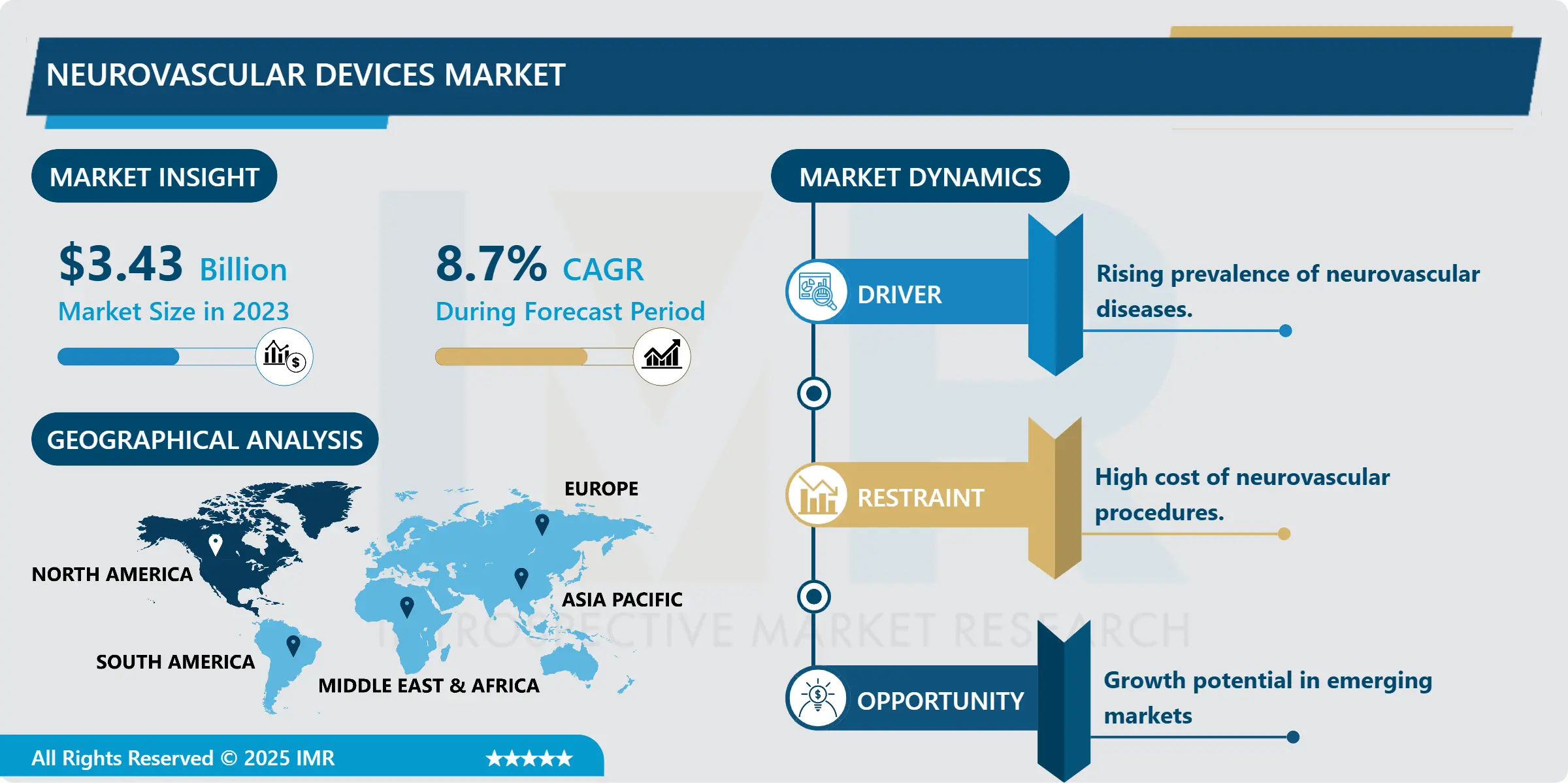
Neurovascular Devices Market Size Was Valued at USD 3.43 Billion in 2023, and is Projected to Reach USD 7.30 Billion by 2032, Growing at a CAGR of 8.7% From 2024-2032.

IMR Group
Description
Neurovascular Devices Market Synopsis:
Neurovascular Devices Market Size Was Valued at USD 3.43 Billion in 2023, and is Projected to Reach USD 7.30 Billion by 2032, Growing at a CAGR of 8.7% From 2024-2032.
The Neurovascular devices market entails all medical technologies that can be used for diagnosing, preventing, and treating neurological diseases that involve blood vessels in the brain and spinal cord. These devices help healthcare contributors when it comes to diseases like strokes, aneurisms, and arteriovenous malformations. The growth in categories and market is affected by increasing cases of neurological disorders, enhanced focus and spending on health systems and advanced technologies in surgical procedures.
The global market for neurovascular devices has been growing in the past few years; primarily due to the rising incidence of cerebrovascular diseases. Cerebrovascular accidents, including strokes and aneurysms, which tend to be fatal and cause severe disability, are among the most common diseases and a major cause of death in the world. As more people grow older and the rate of elderly people increase in most populace nations, there is the likelihood the occurrence of neurovascular disorders which in turn will increase the need for enhanced apparatuses. The increasing number of players in the neurovascular devices market has led to the advancement of innovative device development in the neurovascular industry to achieve better clinical results, lesser time for procedure and better recovery rates for the patient. Equipment like neurovascular stents, catheters, and FDA-approved flow diverters have become popular because of the versatility offering a solution in a number of neurovascular diseases.
Also, the availability of new neuroimaging techniques and robotics increases the efficacy and safety of neurovascular operations and, therefore, promotes their utilization by clinicians. The mentioned trend is supported by the continuously raising investments within the sphere of healthcare, especially in the rapidly developing countries. National and global health care institutions are also stressing on extension of better medical care facilities to manage the growing load of neurovascular diseases, which is boosting the market potentiality here. Therefore, it could infer that there will be upward trend in the neurovascular devices market on the global level with significant growth possible markets in both developed and developing countries.
Neurovascular Devices Market Trend Analysis:
Minimally Invasive Neurovascular Procedures on the Rise
The shift toward less invasive neurovascular interventions is on the rise primarily due to increased adoption of better practices by care stakeholders. Endovascular coiling and flow divergence are some of the minimally invasive procedures through which clinicians can treat neurovascular disorders with shorter rehabilitation periods, negligible scar tissue formation as well as few adverse effects. Thus, this shift is as a result of patient preference of minimally invasive treatment and providers’ desire to have technologies that can simplify invasive procedures. Market leaders in the neurovascular devices industry are expanding their investment in research with the intention of developing minimally invasive, high accuracy devices for these procedures.
The use of minimally invasive surgeries is also being driven by the growth in high definition neuroimaging and robotic surgical systems. The improved diagnostic means enable accurate assessments of neurovascular lesions and real-time visualization of the essential anatomical structures during the procedures. Advanced technologies comprising robotics, AI and computer-assisted technologies have enhanced the degree of command that surgeons get to access while performing neurovascular procedures, thereby eliminating human errors. It is predicated that this trend will continue growing in the future years as it defines the future advancement of neurovascular treatment providing patients with better safety and effectiveness.
Expansion in Emerging Markets
The increasing population along with establishing a greater need for more sophisticated devices, makes the emerging market of the neurovascular devices market more promising. The Asia-Pacific and Latin American nations are spending more on healthcare due to economic development, increase in the population density and rising growth of the middle-income group people. They are also experiencing an increasing incidence of such diseases as those affecting the neurological and vascular systems, which is attributed to shifts in life styles and aging populations. Thus, more demand has been created for the development of new neurovascular technologies, which can prove to be a large growth area for firms.
Neurovascular Devices Market Segment Analysis:
Neurovascular Devices Market is Segmented on the basis of type, application, end user, and Region.
By Type, Neurothrombectomy Devices segment is expected to dominate the market during the forecast period
High demand for minimally invasive surgical interventions combined with the growing incidence of ischemic strokes will drive the Neurothrombectomy Devices segment to be the market leader during the projected period.. The neurothrombectomy devices being utilised to open the clogged brain arteries and remove clots contributing to acute ischemic stroke have proved vital within the treatment process. A growing number of patients with ischemic stroke and the increasing understanding of the benefits of neurothrombectomy are important factors influencing its market growth due to innovations in device technology, including new types of clot retrieval systems and the optimization of procedural results. In addition, the growing patient population of stoke victims requiring immediate and appropriate neurovascular interventions will continue to drive the use of these dominant devices in the neurovascular devices market.
By Application, Stroke segment expected to held the largest share
The Stroke segment is believed to dominate the neurovascular devices market throughout the forecast period based on the global incidence rates of stroke cases.. Ischemic strokes are among the most frequent causes of disability and mortality, so neurovascular devices used in diagnosis, prevention, and management of such conditions are in high demand globally. Neurothrombectomy tools, and stents/ EPDs that are used during operations contribute majorly to this factor because patients have shorter recovery times, and fewer cases of complication from the treatments. With the pace of awareness overall stroke management and with more advance in the application of health care systems, the stroke application segment also expected to retain its major market share owing to the emerging trends toward early diagnosis and coming of non-invasive.
Neurovascular Devices Market Regional Insights:
North America is Expected to Dominate the Market Over the Forecast period
North America remained the largest consumer of neurovascular devices in 2023 because of its advanced health care system, high incidence of neurovascular issues, and increasing acceptance of new generation medical devices. The United States has a large share in the size of the global market due to its well-developed healthcare infrastructure, a skilled number of stakeholders, and persistent advancements in technologies utilized in the neurovascular area. As per the latest information, North America accounted for about 35% of the total neurovascular devices market in 2023; given the principles of improving healthcare and managing the changing epidemiology of neurovascular disorders.
Active Key Players in the Neurovascular Devices Market:
Abbott Laboratories (USA)
Acandis GmbH (Germany)
Asahi Intecc Co., Ltd. (Japan)
Balt (France)
Boston Scientific Corporation (USA)
Cook Medical (USA)
Johnson & Johnson (USA)
Medtronic (Ireland)
Merit Medical Systems (USA)
MicroPort Scientific Corporation (China)
Penumbra Inc. (USA)
Phenox GmbH (Germany)
Stryker Corporation (USA)
Terumo Corporation (Japan)
W. L. Gore & Associates (USA)
Other Active Players
Chapter 1: Introduction
1.1 Scope and Coverage
Chapter 2:Executive Summary
Chapter 3: Market Landscape
3.1 Market Dynamics
3.1.1 Drivers
3.1.2 Restraints
3.1.3 Opportunities
3.1.4 Challenges
3.2 Market Trend Analysis
3.3 PESTLE Analysis
3.4 Porter’s Five Forces Analysis
3.5 Industry Value Chain Analysis
3.6 Ecosystem
3.7 Regulatory Landscape
3.8 Price Trend Analysis
3.9 Patent Analysis
3.10 Technology Evolution
3.11 Investment Pockets
3.12 Import-Export Analysis
Chapter 4: Neurovascular Devices Market by Type
4.1 Neurovascular Devices Market Snapshot and Growth Engine
4.2 Neurovascular Devices Market Overview
4.3 Neurothrombectomy Devices
4.3.1 Introduction and Market Overview
4.3.2 Historic and Forecasted Market Size in Value USD and Volume Units (2017-2032F)
4.3.3 Key Market Trends, Growth Factors and Opportunities
4.3.4 Neurothrombectomy Devices: Geographic Segmentation Analysis
4.4 Support Devices
4.4.1 Introduction and Market Overview
4.4.2 Historic and Forecasted Market Size in Value USD and Volume Units (2017-2032F)
4.4.3 Key Market Trends, Growth Factors and Opportunities
4.4.4 Support Devices: Geographic Segmentation Analysis
Chapter 5: Neurovascular Devices Market by Application
5.1 Neurovascular Devices Market Snapshot and Growth Engine
5.2 Neurovascular Devices Market Overview
5.3 Stroke
5.3.1 Introduction and Market Overview
5.3.2 Historic and Forecasted Market Size in Value USD and Volume Units (2017-2032F)
5.3.3 Key Market Trends, Growth Factors and Opportunities
5.3.4 Stroke: Geographic Segmentation Analysis
5.4 Cerebral Artery Stenosis
5.4.1 Introduction and Market Overview
5.4.2 Historic and Forecasted Market Size in Value USD and Volume Units (2017-2032F)
5.4.3 Key Market Trends, Growth Factors and Opportunities
5.4.4 Cerebral Artery Stenosis: Geographic Segmentation Analysis
Chapter 6: Neurovascular Devices Market by End User
6.1 Neurovascular Devices Market Snapshot and Growth Engine
6.2 Neurovascular Devices Market Overview
6.3 Hospitals
6.3.1 Introduction and Market Overview
6.3.2 Historic and Forecasted Market Size in Value USD and Volume Units (2017-2032F)
6.3.3 Key Market Trends, Growth Factors and Opportunities
6.3.4 Hospitals: Geographic Segmentation Analysis
6.4 Specialty Clinics
6.4.1 Introduction and Market Overview
6.4.2 Historic and Forecasted Market Size in Value USD and Volume Units (2017-2032F)
6.4.3 Key Market Trends, Growth Factors and Opportunities
6.4.4 Specialty Clinics: Geographic Segmentation Analysis
6.5 and Others
6.5.1 Introduction and Market Overview
6.5.2 Historic and Forecasted Market Size in Value USD and Volume Units (2017-2032F)
6.5.3 Key Market Trends, Growth Factors and Opportunities
6.5.4 and Others: Geographic Segmentation Analysis
Chapter 7: Company Profiles and Competitive Analysis
7.1 Competitive Landscape
7.1.1 Competitive Benchmarking
7.1.2 Neurovascular Devices Market Share by Manufacturer (2023)
7.1.3 Industry BCG Matrix
7.1.4 Heat Map Analysis
7.1.5 Mergers and Acquisitions
7.2 ABBOTT LABORATORIES (USA)
7.2.1 Company Overview
7.2.2 Key Executives
7.2.3 Company Snapshot
7.2.4 Role of the Company in the Market
7.2.5 Sustainability and Social Responsibility
7.2.6 Operating Business Segments
7.2.7 Product Portfolio
7.2.8 Business Performance
7.2.9 Key Strategic Moves and Recent Developments
7.2.10 SWOT Analysis
7.3 ACANDIS GMBH (GERMANY)
7.4 ASAHI INTECC CO. LTD. (JAPAN)
7.5 BALT (FRANCE)
7.6 BOSTON SCIENTIFIC CORPORATION (USA)
7.7 COOK MEDICAL (USA)
7.8 JOHNSON & JOHNSON (USA)
7.9 MEDTRONIC (IRELAND)
7.10 MERIT MEDICAL SYSTEMS (USA)
7.11 MICROPORT SCIENTIFIC CORPORATION (CHINA)
7.12 PENUMBRA INC. (USA)
7.13 PHENOX GMBH (GERMANY)
7.14 STRYKER CORPORATION (USA)
7.15 TERUMO CORPORATION (JAPAN)
7.16 W. L. GORE & ASSOCIATES (USA)
7.17 OTHER ACTIVE PLAYERS
Chapter 8: Global Neurovascular Devices Market By Region
8.1 Overview
8.2. North America Neurovascular Devices Market
8.2.1 Key Market Trends, Growth Factors and Opportunities
8.2.2 Top Key Companies
8.2.3 Historic and Forecasted Market Size by Segments
8.2.4 Historic and Forecasted Market Size By Type
8.2.4.1 Neurothrombectomy Devices
8.2.4.2 Support Devices
8.2.5 Historic and Forecasted Market Size By Application
8.2.5.1 Stroke
8.2.5.2 Cerebral Artery Stenosis
8.2.6 Historic and Forecasted Market Size By End User
8.2.6.1 Hospitals
8.2.6.2 Specialty Clinics
8.2.6.3 and Others
8.2.7 Historic and Forecast Market Size by Country
8.2.7.1 US
8.2.7.2 Canada
8.2.7.3 Mexico
8.3. Eastern Europe Neurovascular Devices Market
8.3.1 Key Market Trends, Growth Factors and Opportunities
8.3.2 Top Key Companies
8.3.3 Historic and Forecasted Market Size by Segments
8.3.4 Historic and Forecasted Market Size By Type
8.3.4.1 Neurothrombectomy Devices
8.3.4.2 Support Devices
8.3.5 Historic and Forecasted Market Size By Application
8.3.5.1 Stroke
8.3.5.2 Cerebral Artery Stenosis
8.3.6 Historic and Forecasted Market Size By End User
8.3.6.1 Hospitals
8.3.6.2 Specialty Clinics
8.3.6.3 and Others
8.3.7 Historic and Forecast Market Size by Country
8.3.7.1 Russia
8.3.7.2 Bulgaria
8.3.7.3 The Czech Republic
8.3.7.4 Hungary
8.3.7.5 Poland
8.3.7.6 Romania
8.3.7.7 Rest of Eastern Europe
8.4. Western Europe Neurovascular Devices Market
8.4.1 Key Market Trends, Growth Factors and Opportunities
8.4.2 Top Key Companies
8.4.3 Historic and Forecasted Market Size by Segments
8.4.4 Historic and Forecasted Market Size By Type
8.4.4.1 Neurothrombectomy Devices
8.4.4.2 Support Devices
8.4.5 Historic and Forecasted Market Size By Application
8.4.5.1 Stroke
8.4.5.2 Cerebral Artery Stenosis
8.4.6 Historic and Forecasted Market Size By End User
8.4.6.1 Hospitals
8.4.6.2 Specialty Clinics
8.4.6.3 and Others
8.4.7 Historic and Forecast Market Size by Country
8.4.7.1 Germany
8.4.7.2 UK
8.4.7.3 France
8.4.7.4 The Netherlands
8.4.7.5 Italy
8.4.7.6 Spain
8.4.7.7 Rest of Western Europe
8.5. Asia Pacific Neurovascular Devices Market
8.5.1 Key Market Trends, Growth Factors and Opportunities
8.5.2 Top Key Companies
8.5.3 Historic and Forecasted Market Size by Segments
8.5.4 Historic and Forecasted Market Size By Type
8.5.4.1 Neurothrombectomy Devices
8.5.4.2 Support Devices
8.5.5 Historic and Forecasted Market Size By Application
8.5.5.1 Stroke
8.5.5.2 Cerebral Artery Stenosis
8.5.6 Historic and Forecasted Market Size By End User
8.5.6.1 Hospitals
8.5.6.2 Specialty Clinics
8.5.6.3 and Others
8.5.7 Historic and Forecast Market Size by Country
8.5.7.1 China
8.5.7.2 India
8.5.7.3 Japan
8.5.7.4 South Korea
8.5.7.5 Malaysia
8.5.7.6 Thailand
8.5.7.7 Vietnam
8.5.7.8 The Philippines
8.5.7.9 Australia
8.5.7.10 New Zealand
8.5.7.11 Rest of APAC
8.6. Middle East & Africa Neurovascular Devices Market
8.6.1 Key Market Trends, Growth Factors and Opportunities
8.6.2 Top Key Companies
8.6.3 Historic and Forecasted Market Size by Segments
8.6.4 Historic and Forecasted Market Size By Type
8.6.4.1 Neurothrombectomy Devices
8.6.4.2 Support Devices
8.6.5 Historic and Forecasted Market Size By Application
8.6.5.1 Stroke
8.6.5.2 Cerebral Artery Stenosis
8.6.6 Historic and Forecasted Market Size By End User
8.6.6.1 Hospitals
8.6.6.2 Specialty Clinics
8.6.6.3 and Others
8.6.7 Historic and Forecast Market Size by Country
8.6.7.1 Turkiye
8.6.7.2 Bahrain
8.6.7.3 Kuwait
8.6.7.4 Saudi Arabia
8.6.7.5 Qatar
8.6.7.6 UAE
8.6.7.7 Israel
8.6.7.8 South Africa
8.7. South America Neurovascular Devices Market
8.7.1 Key Market Trends, Growth Factors and Opportunities
8.7.2 Top Key Companies
8.7.3 Historic and Forecasted Market Size by Segments
8.7.4 Historic and Forecasted Market Size By Type
8.7.4.1 Neurothrombectomy Devices
8.7.4.2 Support Devices
8.7.5 Historic and Forecasted Market Size By Application
8.7.5.1 Stroke
8.7.5.2 Cerebral Artery Stenosis
8.7.6 Historic and Forecasted Market Size By End User
8.7.6.1 Hospitals
8.7.6.2 Specialty Clinics
8.7.6.3 and Others
8.7.7 Historic and Forecast Market Size by Country
8.7.7.1 Brazil
8.7.7.2 Argentina
8.7.7.3 Rest of SA
Chapter 9 Analyst Viewpoint and Conclusion
9.1 Recommendations and Concluding Analysis
9.2 Potential Market Strategies
Chapter 10 Research Methodology
10.1 Research Process
10.2 Primary Research
10.3 Secondary Research
Q1: What would be the forecast period in the Neurovascular Devices Market research report?
A1: The forecast period in the Neurovascular Devices Market research report is 2024-2032.
Q2: Who are the key players in the Neurovascular Devices Market?
A2: Abbott Laboratories (USA), Acandis GmbH (Germany), Asahi Intecc Co., Ltd. (Japan), Balt (France), Boston Scientific Corporation (USA), Cook Medical (USA), Johnson & Johnson (USA), Medtronic (Ireland), Merit Medical Systems (USA), MicroPort Scientific Corporation (China), Penumbra Inc. (USA), Phenox GmbH (Germany), Stryker Corporation (USA), Terumo Corporation (Japan), W. L. Gore & Associates (USA), and Other Active Players.
Q3: What are the segments of the Neurovascular Devices Market?
A3: The Neurovascular Devices Market is segmented into Type, Application, End User and region. By Type, the market is categorized into Neurothrombectomy Devices, Support Devices. By Application, the market is categorized into Stroke, Cerebral Artery Stenosis. By End User, the market is categorized into Hospitals, Specialty Clinics, and Others. By region, it is analyzed across North America (U.S., Canada, Mexico), Eastern Europe (Russia, Bulgaria, The Czech Republic, Hungary, Poland, Romania, Rest of Eastern Europe), Western Europe (Germany, UK, France, The Netherlands, Italy, Russia, Spain, Rest of Western Europe), Asia Pacific (China, India, Japan, South Korea, Malaysia, Thailand, Vietnam, The Philippines, Australia, New-Zealand, Rest of APAC), Middle East & Africa (Turkiye, Bahrain, Kuwait, Saudi Arabia, Qatar, UAE, Israel, South Africa), South America (Brazil, Argentina, Rest of SA).
Q4: What is the Neurovascular Devices Market?
A4: The Neurovascular devices market entails all medical technologies that can be used for diagnosing, preventing, and treating neurological diseases that involve blood vessels in the brain and spinal cord. These devices help healthcare contributors when it comes to diseases like strokes, aneurisms, and arteriovenous malformations. The growth in categories and market is affected by increasing cases of neurological disorders, enhanced focus and spending on health systems and advanced technologies in surgical procedures.
Q5: How big is the Neurovascular Devices Market?
A5: Neurovascular Devices Market Size Was Valued at USD 3.43 Billion in 2023, and is Projected to Reach USD 7.30 Billion by 2032, Growing at a CAGR of 8.7% From 2024-2032.
How to Buy a Report from eminsights.jp
On the product page, choose the license you want: Single-User License, Multi-User License or Enterprise License.
If you required report in your native language, then you can click on Translated Report button and fill out the form with report name and language you want, then our team will contact you as soon as possible.
Click the Buy Now button.
You will be redirected to the checkout page. Enter your company details and payment information.
Click Place Order to complete the purchase.
Confirmation: You’ll receive an order confirmation and our team will contact you shortly with your ordered report.
If you have any questions, fill out the contact form below or email us at bizdev@eminsights.net.
Thank you for choosing eminsights.jp!