Stay Ahead in Fast-Growing Economies.
Browse Reports Now




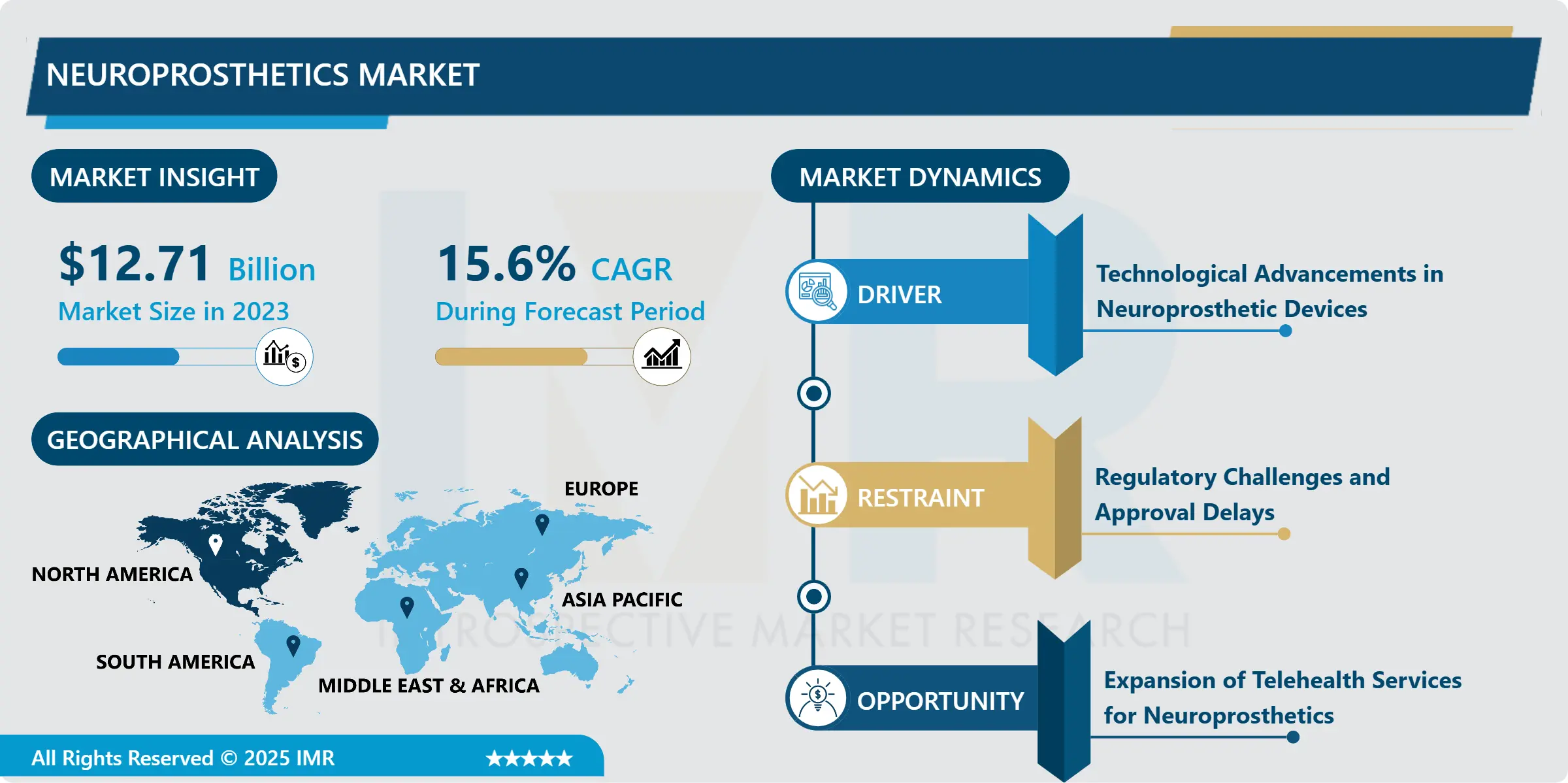
Neuroprosthetics Market Size, Share, Growth & Forecast (2024-2032)
Neuroprosthetics Market Size Was Valued at USD 12.71 Billion in 2023, and is Projected to Reach USD 46.85 Billion by 2032, Growing at a CAGR of 15.60% From 2024-2032.

IMR Group
Description
Neuroprosthetics Market Synopsis:
Neuroprosthetics Market Size Was Valued at USD 12.71 Billion in 2023, and is Projected to Reach USD 46.85 Billion by 2032, Growing at a CAGR of 15.60% From 2024-2032.
Neuroprosthetics are used bundles of products that need to be designed and implemented in order to help those with neurological disorders or injuries. These devices may interact with neural circuits as well as help in motor and sensory functions, as well as the cognitive abilities augmentation. Neuroprosthetics are devices that can be implanted into the body such as in the case of brain computer interfaces and non-implantable such as transcranial magnetic stimulation Neuroprosthetics are used clinically for rehabilitation and management of neurological disorders.
A major growth influencing factor in the neuroprosthetics market is the increase in neurological disorders such as Parkinson’s disease, stroke and spinal cord injuries among others. These diseases are on the increase owing to the aging population of the world’s population and this has increases pressure on manufacturers to come up with better treatments. Moreover, by using new technologies and knowing more regarding the human brain, those sophisticated neuroprosthetics devices are likely to fuse new incredible inventions, causing it to attract both public and private investments.
Another key driver within this market is the growing demand from the healthcare client base, and the subsequent evolution in terms of acceptance of neuroprosthetics as an established field. As research continues to show that neuroprosthetics devices such as cochlear implants help patients to lead much improved lives, the devices’ use continues to grow among practitioners. Such positive changes in perception, along with beneficial government policies and funding opportunities targeting neurotechnology advancement, are extending a further boost to the market.
Neuroprosthetics Market Trend Analysis:
The shift towards miniaturization and portability of devices.
An important factor on the current market of neuroprocessing is a tendency to reduce the size of implantable equipment. This is to say that manufacturers are keen on creating neuroprosthetics solutions that are portable and simple to use with an aim of fitting seamlessly into the life of the patient. The need for enhanced anatomical freedom, as well as for elements of design who take into equal account both efficiency and pervasiveness translate into this tendency.
Another useful classification criterion is the augmentations of the given neuroprosthetics: there has been increasing growth in wireless and remotely controlled monitoring. These advances enable the monitoring of the patient’s performance in real-time and the functionality of the device to improve custom continual treatment plans. The use of big data analytics & artificial intelligence, ensure that the right decisions are made in addressing the need of the patients hence increasing patient satisfaction.
The realm of research and development.
Current market of neuroprosthetics still has a vast potential for development and a lot of prospects mainly targeting the field of research. Businesses are continuously exploring ways and means of creating better neuroprosthetics that have enhanced technologies, including BCIs, along with neurostimulation strategies. Such an emphasis of R&D not only increases the efficiency of currently popular devices, but also creates opportunities for the implementation of fundamentally new therapies for neurological diseases.
Moreover, the growth of tele-thermatics is also a new avenue for the neuroprosthetics market expansion. Thus, rapid development of the telemedicine concept enables healthcare providers to monitor the status of patients and make necessary corrections to neuroprosthetic systems. Its implementation in this way can result in better processes of compliance to recommended treatment regimes, enhanced access to future health care, as well as overall health improvement among humans with neurological disorders.
Neuroprosthetics Market Segment Analysis:
Neuroprosthetics Market is Segmented on the basis of Product type, Technology, Application, End User, and Region.
By Product Type, Motor Neuroprosthetics segment is expected to dominate the market during the forecast period
Motor, sensory, and cognitive neuroprosthetics make up the neuroprosthetics market by product type since they serve different therapeutic functions. Motor neuroprosthetics are designed to enable persons with motor disabilities including spinal cord injuries and stroke, to regain or improve on their movement abilities. These devices directly interact with the nerve system in most cases so as to allow for voluntary movement. Sensory neuroprosthetics are intended to restore or enhance a patient’s capacity to receive tactile, auditory or visual signals. One example is HI cochlear implant for hearing and the other is RETinal implant to help enhance vision. Cognitive neuroprosthetics are, in contrast, aimed at providing support to more complex human mental processes, such as memory, attention or decision making. It is especially helpful in patients with neurological disorders such as Alzheimer’s dementia, or brain injury: there may be measurable gains in life quality and functioning.
By Application, Pain Management segment expected to held the largest share
This landscape is split into pain relief, motor disorder, sensory disorder, and cognitive disorder, where each submarket caters to certain neurological issues . Examples of applications include the employment of neuroprosthetic devices for the delivery of treatments on the nervous system targeting the pain signals which for cases of chronic pain, there is use of neuromodulation. Concerning motor disorders, neuroprosthetics or biosensors are being used in cases like Parkinson’s disease, a stroke or spinal cord injury so as to restore voluntary and fine motor movements. Sensory disorders applications are oriented at the rehabilitation or enhancement of the individuals’ perception, using devices for hearing and vision impaired patients, such as cochlea implants or retinal stimulators, respectively. Lastly, cognitive disorders applications require telecommunication equipment that aids patients in completing cognitive exercises including; memory and attention for patients with neurological disorders such as TBI or neurodegenerative diseases retuning their cognition and normal daily functioning.
Neuroprosthetics Market Regional Insights:
North America is Expected to Dominate the Market Over the Forecast period
North America is at present leading the neuroprosthetics market and controls nearly 40% of the global market. This domination is attributed to the existing sophisticated health care, high level of investment on medical technologies and a strong research network on neurotechnology. Some of the factors favoring the growth of North America market includes the existence of leading industry participants reimbursement policies.
Also, using neuroprosthetics has the greatest number of clinical trials as well as studies carried out in the United States, making it the pioneer of neuroprosthetics technology and development. It, therefore, goes without saying that the partnership between Academic institutions and Industry players creates a suitable environment that breeds technological development thereby making North America the best place to launch neuroprosthetics. At the same time, further advancements in research are being made, and the demand from patients increases steadily, North America will remain the leader of the neuroprosthetics market in the near future.
Active Key Players in the Neuroprosthetics Market:
Medtronic (United States)
Boston Scientific (United States)
Abbott Laboratories (United States)
Cochlear Limited (Australia)
Nervous System (United States)
NeuroPace (United States)
Ceregate (Germany)
Bioness Inc. (United States)
Synapse Biomedical (United States)
Blackrock Neurotech (United States)
Other Active Players
Chapter 1: Introduction
1.1 Scope and Coverage
Chapter 2:Executive Summary
Chapter 3: Market Landscape
3.1 Market Dynamics
3.1.1 Drivers
3.1.2 Restraints
3.1.3 Opportunities
3.1.4 Challenges
3.2 Market Trend Analysis
3.3 PESTLE Analysis
3.4 Porter’s Five Forces Analysis
3.5 Industry Value Chain Analysis
3.6 Ecosystem
3.7 Regulatory Landscape
3.8 Price Trend Analysis
3.9 Patent Analysis
3.10 Technology Evolution
3.11 Investment Pockets
3.12 Import-Export Analysis
Chapter 4: Neuroprosthetics Market by Product Type
4.1 Neuroprosthetics Market Snapshot and Growth Engine
4.2 Neuroprosthetics Market Overview
4.3 Motor Neuroprosthetics
4.3.1 Introduction and Market Overview
4.3.2 Historic and Forecasted Market Size in Value USD and Volume Units (2017-2032F)
4.3.3 Key Market Trends, Growth Factors and Opportunities
4.3.4 Motor Neuroprosthetics: Geographic Segmentation Analysis
4.4 Sensory Neuroprosthetics
4.4.1 Introduction and Market Overview
4.4.2 Historic and Forecasted Market Size in Value USD and Volume Units (2017-2032F)
4.4.3 Key Market Trends, Growth Factors and Opportunities
4.4.4 Sensory Neuroprosthetics: Geographic Segmentation Analysis
4.5 Cognitive Neuroprosthetics
4.5.1 Introduction and Market Overview
4.5.2 Historic and Forecasted Market Size in Value USD and Volume Units (2017-2032F)
4.5.3 Key Market Trends, Growth Factors and Opportunities
4.5.4 Cognitive Neuroprosthetics: Geographic Segmentation Analysis
Chapter 5: Neuroprosthetics Market by Technology
5.1 Neuroprosthetics Market Snapshot and Growth Engine
5.2 Neuroprosthetics Market Overview
5.3 Invasive Neuroprosthetics
5.3.1 Introduction and Market Overview
5.3.2 Historic and Forecasted Market Size in Value USD and Volume Units (2017-2032F)
5.3.3 Key Market Trends, Growth Factors and Opportunities
5.3.4 Invasive Neuroprosthetics: Geographic Segmentation Analysis
5.4 Non-Invasive Neuroprosthetics
5.4.1 Introduction and Market Overview
5.4.2 Historic and Forecasted Market Size in Value USD and Volume Units (2017-2032F)
5.4.3 Key Market Trends, Growth Factors and Opportunities
5.4.4 Non-Invasive Neuroprosthetics: Geographic Segmentation Analysis
Chapter 6: Neuroprosthetics Market by Application
6.1 Neuroprosthetics Market Snapshot and Growth Engine
6.2 Neuroprosthetics Market Overview
6.3 Pain Management
6.3.1 Introduction and Market Overview
6.3.2 Historic and Forecasted Market Size in Value USD and Volume Units (2017-2032F)
6.3.3 Key Market Trends, Growth Factors and Opportunities
6.3.4 Pain Management: Geographic Segmentation Analysis
6.4 Motor Disorders
6.4.1 Introduction and Market Overview
6.4.2 Historic and Forecasted Market Size in Value USD and Volume Units (2017-2032F)
6.4.3 Key Market Trends, Growth Factors and Opportunities
6.4.4 Motor Disorders: Geographic Segmentation Analysis
6.5 Sensory Disorders
6.5.1 Introduction and Market Overview
6.5.2 Historic and Forecasted Market Size in Value USD and Volume Units (2017-2032F)
6.5.3 Key Market Trends, Growth Factors and Opportunities
6.5.4 Sensory Disorders: Geographic Segmentation Analysis
6.6 Cognitive Disorders
6.6.1 Introduction and Market Overview
6.6.2 Historic and Forecasted Market Size in Value USD and Volume Units (2017-2032F)
6.6.3 Key Market Trends, Growth Factors and Opportunities
6.6.4 Cognitive Disorders: Geographic Segmentation Analysis
Chapter 7: Neuroprosthetics Market by End User
7.1 Neuroprosthetics Market Snapshot and Growth Engine
7.2 Neuroprosthetics Market Overview
7.3 Hospitals
7.3.1 Introduction and Market Overview
7.3.2 Historic and Forecasted Market Size in Value USD and Volume Units (2017-2032F)
7.3.3 Key Market Trends, Growth Factors and Opportunities
7.3.4 Hospitals: Geographic Segmentation Analysis
7.4 Rehabilitation Centers
7.4.1 Introduction and Market Overview
7.4.2 Historic and Forecasted Market Size in Value USD and Volume Units (2017-2032F)
7.4.3 Key Market Trends, Growth Factors and Opportunities
7.4.4 Rehabilitation Centers: Geographic Segmentation Analysis
7.5 Research Institutions
7.5.1 Introduction and Market Overview
7.5.2 Historic and Forecasted Market Size in Value USD and Volume Units (2017-2032F)
7.5.3 Key Market Trends, Growth Factors and Opportunities
7.5.4 Research Institutions: Geographic Segmentation Analysis
Chapter 8: Company Profiles and Competitive Analysis
8.1 Competitive Landscape
8.1.1 Competitive Benchmarking
8.1.2 Neuroprosthetics Market Share by Manufacturer (2023)
8.1.3 Industry BCG Matrix
8.1.4 Heat Map Analysis
8.1.5 Mergers and Acquisitions
8.2 MEDTRONIC (UNITED STATES)
8.2.1 Company Overview
8.2.2 Key Executives
8.2.3 Company Snapshot
8.2.4 Role of the Company in the Market
8.2.5 Sustainability and Social Responsibility
8.2.6 Operating Business Segments
8.2.7 Product Portfolio
8.2.8 Business Performance
8.2.9 Key Strategic Moves and Recent Developments
8.2.10 SWOT Analysis
8.3 BOSTON SCIENTIFIC (UNITED STATES)
8.4 ABBOTT LABORATORIES (UNITED STATES)
8.5 COCHLEAR LIMITED (AUSTRALIA)
8.6 NERVOUS SYSTEM (UNITED STATES)
8.7 NEUROPACE (UNITED STATES)
8.8 CEREGATE (GERMANY)
8.9 BIONESS INC. (UNITED STATES)
8.10 SYNAPSE BIOMEDICAL (UNITED STATES)
8.11 BLACKROCK NEUROTECH (UNITED STATES)
8.12 OTHER ACTIVE PLAYERS
Chapter 9: Global Neuroprosthetics Market By Region
9.1 Overview
9.2. North America Neuroprosthetics Market
9.2.1 Key Market Trends, Growth Factors and Opportunities
9.2.2 Top Key Companies
9.2.3 Historic and Forecasted Market Size by Segments
9.2.4 Historic and Forecasted Market Size By Product Type
9.2.4.1 Motor Neuroprosthetics
9.2.4.2 Sensory Neuroprosthetics
9.2.4.3 Cognitive Neuroprosthetics
9.2.5 Historic and Forecasted Market Size By Technology
9.2.5.1 Invasive Neuroprosthetics
9.2.5.2 Non-Invasive Neuroprosthetics
9.2.6 Historic and Forecasted Market Size By Application
9.2.6.1 Pain Management
9.2.6.2 Motor Disorders
9.2.6.3 Sensory Disorders
9.2.6.4 Cognitive Disorders
9.2.7 Historic and Forecasted Market Size By End User
9.2.7.1 Hospitals
9.2.7.2 Rehabilitation Centers
9.2.7.3 Research Institutions
9.2.8 Historic and Forecast Market Size by Country
9.2.8.1 US
9.2.8.2 Canada
9.2.8.3 Mexico
9.3. Eastern Europe Neuroprosthetics Market
9.3.1 Key Market Trends, Growth Factors and Opportunities
9.3.2 Top Key Companies
9.3.3 Historic and Forecasted Market Size by Segments
9.3.4 Historic and Forecasted Market Size By Product Type
9.3.4.1 Motor Neuroprosthetics
9.3.4.2 Sensory Neuroprosthetics
9.3.4.3 Cognitive Neuroprosthetics
9.3.5 Historic and Forecasted Market Size By Technology
9.3.5.1 Invasive Neuroprosthetics
9.3.5.2 Non-Invasive Neuroprosthetics
9.3.6 Historic and Forecasted Market Size By Application
9.3.6.1 Pain Management
9.3.6.2 Motor Disorders
9.3.6.3 Sensory Disorders
9.3.6.4 Cognitive Disorders
9.3.7 Historic and Forecasted Market Size By End User
9.3.7.1 Hospitals
9.3.7.2 Rehabilitation Centers
9.3.7.3 Research Institutions
9.3.8 Historic and Forecast Market Size by Country
9.3.8.1 Russia
9.3.8.2 Bulgaria
9.3.8.3 The Czech Republic
9.3.8.4 Hungary
9.3.8.5 Poland
9.3.8.6 Romania
9.3.8.7 Rest of Eastern Europe
9.4. Western Europe Neuroprosthetics Market
9.4.1 Key Market Trends, Growth Factors and Opportunities
9.4.2 Top Key Companies
9.4.3 Historic and Forecasted Market Size by Segments
9.4.4 Historic and Forecasted Market Size By Product Type
9.4.4.1 Motor Neuroprosthetics
9.4.4.2 Sensory Neuroprosthetics
9.4.4.3 Cognitive Neuroprosthetics
9.4.5 Historic and Forecasted Market Size By Technology
9.4.5.1 Invasive Neuroprosthetics
9.4.5.2 Non-Invasive Neuroprosthetics
9.4.6 Historic and Forecasted Market Size By Application
9.4.6.1 Pain Management
9.4.6.2 Motor Disorders
9.4.6.3 Sensory Disorders
9.4.6.4 Cognitive Disorders
9.4.7 Historic and Forecasted Market Size By End User
9.4.7.1 Hospitals
9.4.7.2 Rehabilitation Centers
9.4.7.3 Research Institutions
9.4.8 Historic and Forecast Market Size by Country
9.4.8.1 Germany
9.4.8.2 UK
9.4.8.3 France
9.4.8.4 The Netherlands
9.4.8.5 Italy
9.4.8.6 Spain
9.4.8.7 Rest of Western Europe
9.5. Asia Pacific Neuroprosthetics Market
9.5.1 Key Market Trends, Growth Factors and Opportunities
9.5.2 Top Key Companies
9.5.3 Historic and Forecasted Market Size by Segments
9.5.4 Historic and Forecasted Market Size By Product Type
9.5.4.1 Motor Neuroprosthetics
9.5.4.2 Sensory Neuroprosthetics
9.5.4.3 Cognitive Neuroprosthetics
9.5.5 Historic and Forecasted Market Size By Technology
9.5.5.1 Invasive Neuroprosthetics
9.5.5.2 Non-Invasive Neuroprosthetics
9.5.6 Historic and Forecasted Market Size By Application
9.5.6.1 Pain Management
9.5.6.2 Motor Disorders
9.5.6.3 Sensory Disorders
9.5.6.4 Cognitive Disorders
9.5.7 Historic and Forecasted Market Size By End User
9.5.7.1 Hospitals
9.5.7.2 Rehabilitation Centers
9.5.7.3 Research Institutions
9.5.8 Historic and Forecast Market Size by Country
9.5.8.1 China
9.5.8.2 India
9.5.8.3 Japan
9.5.8.4 South Korea
9.5.8.5 Malaysia
9.5.8.6 Thailand
9.5.8.7 Vietnam
9.5.8.8 The Philippines
9.5.8.9 Australia
9.5.8.10 New Zealand
9.5.8.11 Rest of APAC
9.6. Middle East & Africa Neuroprosthetics Market
9.6.1 Key Market Trends, Growth Factors and Opportunities
9.6.2 Top Key Companies
9.6.3 Historic and Forecasted Market Size by Segments
9.6.4 Historic and Forecasted Market Size By Product Type
9.6.4.1 Motor Neuroprosthetics
9.6.4.2 Sensory Neuroprosthetics
9.6.4.3 Cognitive Neuroprosthetics
9.6.5 Historic and Forecasted Market Size By Technology
9.6.5.1 Invasive Neuroprosthetics
9.6.5.2 Non-Invasive Neuroprosthetics
9.6.6 Historic and Forecasted Market Size By Application
9.6.6.1 Pain Management
9.6.6.2 Motor Disorders
9.6.6.3 Sensory Disorders
9.6.6.4 Cognitive Disorders
9.6.7 Historic and Forecasted Market Size By End User
9.6.7.1 Hospitals
9.6.7.2 Rehabilitation Centers
9.6.7.3 Research Institutions
9.6.8 Historic and Forecast Market Size by Country
9.6.8.1 Turkiye
9.6.8.2 Bahrain
9.6.8.3 Kuwait
9.6.8.4 Saudi Arabia
9.6.8.5 Qatar
9.6.8.6 UAE
9.6.8.7 Israel
9.6.8.8 South Africa
9.7. South America Neuroprosthetics Market
9.7.1 Key Market Trends, Growth Factors and Opportunities
9.7.2 Top Key Companies
9.7.3 Historic and Forecasted Market Size by Segments
9.7.4 Historic and Forecasted Market Size By Product Type
9.7.4.1 Motor Neuroprosthetics
9.7.4.2 Sensory Neuroprosthetics
9.7.4.3 Cognitive Neuroprosthetics
9.7.5 Historic and Forecasted Market Size By Technology
9.7.5.1 Invasive Neuroprosthetics
9.7.5.2 Non-Invasive Neuroprosthetics
9.7.6 Historic and Forecasted Market Size By Application
9.7.6.1 Pain Management
9.7.6.2 Motor Disorders
9.7.6.3 Sensory Disorders
9.7.6.4 Cognitive Disorders
9.7.7 Historic and Forecasted Market Size By End User
9.7.7.1 Hospitals
9.7.7.2 Rehabilitation Centers
9.7.7.3 Research Institutions
9.7.8 Historic and Forecast Market Size by Country
9.7.8.1 Brazil
9.7.8.2 Argentina
9.7.8.3 Rest of SA
Chapter 10 Analyst Viewpoint and Conclusion
10.1 Recommendations and Concluding Analysis
10.2 Potential Market Strategies
Chapter 11 Research Methodology
11.1 Research Process
11.2 Primary Research
11.3 Secondary Research
Q1: What would be the forecast period in the Neuroprosthetics Market research report?
A1: The forecast period in the Neuroprosthetics Market research report is 2024-2032.
Q2: Who are the key players in the Neuroprosthetics Market?
A2: Medtronic (United States), Boston Scientific (United States), Abbott Laboratories (United States), Cochlear Limited (Australia), Nervous System (United States), NeuroPace (United States), Ceregate (Germany), Bioness Inc. (United States), Synapse Biomedical (United States), Blackrock Neurotech (United States), and Other Active Players.
Q3: What are the segments of the Neuroprosthetics Market?
A3: The Neuroprosthetics Market is segmented into by Product Type (Motor Neuroprosthetics, Sensory Neuroprosthetics, Cognitive Neuroprosthetics), Technology (Invasive Neuroprosthetics, Non-Invasive Neuroprosthetics), Application (Pain Management, Motor Disorders, Sensory Disorders, Cognitive Disorders), End User (Hospitals, Rehabilitation Centers, Research Institutions). By region, it is analyzed across North America (U.S., Canada, Mexico), Eastern Europe (Russia, Bulgaria, The Czech Republic, Hungary, Poland, Romania, Rest of Eastern Europe), Western Europe (Germany, UK, France, The Netherlands, Italy, Russia, Spain, Rest of Western Europe), Asia Pacific (China, India, Japan, South Korea, Malaysia, Thailand, Vietnam, The Philippines, Australia, New-Zealand, Rest of APAC), Middle East & Africa (Turkiye, Bahrain, Kuwait, Saudi Arabia, Qatar, UAE, Israel, South Africa), South America (Brazil, Argentina, Rest of SA).
Q4: What is the Neuroprosthetics Market?
A4: Neuroprosthetics are used bundles of products that need to be designed and implemented in order to help those with neurological disorders or injuries. These devices may interact with neural circuits as well as help in motor and sensory functions, as well as the cognitive abilities augmentation. Neuroprosthetics are devices that can be implanted into the body such as in the case of brain computer interfaces and non-implantable such as transcranial magnetic stimulation Neuroprosthetics are used clinically for rehabilitation and management of neurological disorders.
Q5: How big is the Neuroprosthetics Market?
A5: Neuroprosthetics Market Size Was Valued at USD 12.71 Billion in 2023, and is Projected to Reach USD 46.85 Billion by 2032, Growing at a CAGR of 15.60% From 2024-2032.
How to Buy a Report from eminsights.jp
On the product page, choose the license you want: Single-User License, Multi-User License or Enterprise License.
If you required report in your native language, then you can click on Translated Report button and fill out the form with report name and language you want, then our team will contact you as soon as possible.
Click the Buy Now button.
You will be redirected to the checkout page. Enter your company details and payment information.
Click Place Order to complete the purchase.
Confirmation: You’ll receive an order confirmation and our team will contact you shortly with your ordered report.
If you have any questions, fill out the contact form below or email us at bizdev@eminsights.net.
Thank you for choosing eminsights.jp!