Stay Ahead in Fast-Growing Economies.
Browse Reports Now




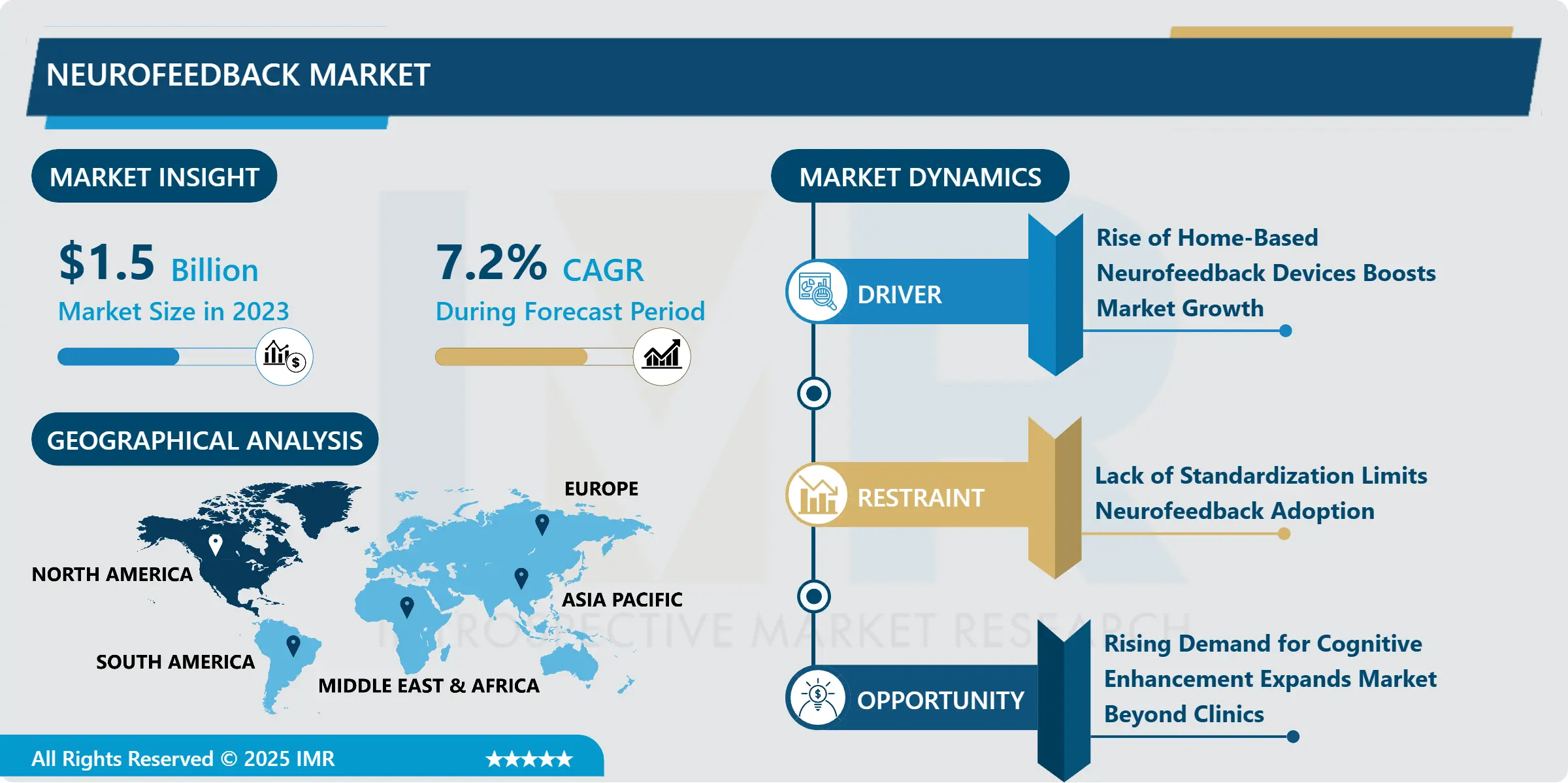
Neurofeedback Market Emerging Trends, Challenges & Strategic Forecast (2024-2032)
Neurofeedback Market Synopsis: Neurofeedback Market Size Was Valued at USD 1.50 Billion in 2023, and is Projected to Reach USD 2.40 Billion by 2032, Growing at a CAGR of 7.20 % From 2024-2032. The Neurofeedback Market is a growing subfield of Brain and Mental Health area that is dedicated to the use of biofeedback to teach people how to control their brain waves for enhanced brain performance

IMR Group
Description
Neurofeedback Market Synopsis:
Neurofeedback Market Size Was Valued at USD 1.50 Billion in 2023, and is Projected to Reach USD 2.40 Billion by 2032, Growing at a CAGR of 7.20 % From 2024-2032.
The Neurofeedback Market is a growing subfield of Brain and Mental Health area that is dedicated to the use of biofeedback to teach people how to control their brain waves for enhanced brain performance. Neurofeedback, with the help of EEG technology, provides immediate visualization of the brainwave activity, and therefore allows users to have a certain level of control over the desired brain states to provide treatment for ADHD, anxiety, depression, sleep disorders, and stress-related disorders all without the use of drugs. The technology is also being employed for brain enhancement and performance optimization in both normal and healthy people, such as sportsmen, managers and business people who would want to heighten their areas of concentration, relax or enhance their memory. Main drivers of the market are the increasing need for the minimally invasive and non-pharmacological treatments, improvement in neurosciences and BCI technology, and increased awareness of mental disorders. Approaches supporting the efficacy of neurofeedback are gradually filling the market and are used both in clinical as well as research practice, and at the consumer level such as home-use equipment. The major market participants are manufacturers of neurofeedback devices, software solutions and clinical services; leaders in this market are North America, Europe and Asia Pacific that seek mental health solutions and cognitive performance enhancement technologies.
Neurofeedback Market is a new and fast growing area of the neuroscience and brain training for the enhancement of brain activity and mental health. Neurofeedback, using EEG (electro encephalography) technology, makes it possible for users to learn to regulate the activity of the brain in real time. It is a safe procedure, which has been found helpful in cases like ADHD, anxiety, depression, sleep problems and stress among others and can be done without drugs. There is also new demand from ‘asymptomatic’ people simply wanting to ‘perform better,’ whether these are other athletes, CEOs, or anyone wanting better focus, memory, rest, or inspiration. With increasing consciousness of mental illnesses neurofeedback is being accepted in place of conventional drug therapies adding to the insignificance of neurofeedback’s adoption by diverse industries.
Several factors are behind the growth of the neurofeedback consumers and outlook, including the increase in patient preference for non-drug solutions, the development of neuroscience and brain computer interface (BCI), and growing awareness of mental illness. With the trends of neurofeedback furthering techniques across school, clinical and consumer laboratories, their institutional as well as clinic, research hospital and home usage is growing. Technology is getting more and more prevalent; they are not only available as more devices and software platforms; clinical services are becoming more available to the public. Three regions are most developed in this market; North America Europe Asia Pacific, these regions have the demand for solutions for mental health and enhancement of cognitive performance technologies. This is because due to optimistic progress in neurofeedback hardware and software advancements the global market is planning to rum a high growth rate in coming years as there is a shortage of technology to treat and improve brain functions in the current global healthcare industry.
Neurofeedback Market Trend Analysis:
AI and Machine Learning Transform Neurofeedback with Enhanced Accuracy and Personalization
The inclusion of AI and ML has become the dominant trend in the neurofeedback market and reshapes the sphere of brain training and non-pharmacological mental health treatment. The algorithms applied by AI system can provide much finer and more detailed view on the patterns in the brainwave data and its reaction to stimuli. Neurofeedback involves a system where machine learning models can take interfaces to process large databases and learn from previous inputs. This leads to more accurate amendments to the neurofeedback training meaning that the system can more easily point out parts of the brain that need intervention and modify the process for each patient. Consequently, a patient or user can optimize his/her progress more quickly and steadily, so neurofeedback is really a useful method of treating such diseases as ADHD or anxiety, depression, and sleep disorders, and etc. AI and ML are improving data analysis, through which, neurofeedback is becoming an individualized approach – which is difficult with regular systems.
Furthermore, the use of AI and ML does enhance not only the effectiveness of NF for clinical practice but also the reach and utilization of NF for household consumers. Progress being made in technology mean that new technologies such as those that use artificial intelligence in the neurofeedback can now provide feedback and even more personalized training sessions according to the user’s brain activity progress, without the interventions of professionals. Such advancements makes neurofeedback more accessible to the general public – people looking for therapy for neurological disorders to athletes desiring enhanced performance. For instance, athletes and business people, as well as students may need to boost cognitive performance; concentration, memory, and focus that can be helped through AI neurofeedback systems. More so as AI and ML advance further, it is expected that the neurofeedback market will undergo more qualitative improvements to present advanced, easily deployable, effective, and efficient brain training tools to clinicians and consumers.
Increasing Demand for Personalized Mental Health Solutions Drives Neurofeedback Growth
Growing consumer reliance on targeted mental health treatments is another factor that helps to explain the market growth for neurofeedback products. Since people require personal solutions that concentrate on their specific mental disorders, neuro-feedback provides the most personalized method to enhance activities within the brain in combination with disorders such as anxiety, depression, adult attention deficit hyperactivity disorder and stress. It is a meticulous procedure in contrast with other treatment methods that usually involve generalized etiquettes of treatment regimes, making neurofeedback more accurate in the treatment process. The principle which has made neurofeedback a preferred approach is the possibility to provide the treatment depending on the individual’s EEG activity which has been liberalized due to the demand for private approaches to treatment in the recent world.
Moreover, people pay more attention to the concept of Mental Health and well-being and therefore treatments focus more on the specific needs of the patient with most of the focus given to the causes of the mental health problem than addressing the symptoms. With increasing loads of mental health problems and as the taboo around it is gradually being removed, consumers consciously seek adjuncts that can better be incorporated into their lives. Indeed, neurofeedback occupies a particularly suitable position for this change: it is an individual treatment that is free from any type of medications and attracts more and more people interested in non-pharmacological approaches. Moreover, availability of accurate and easy to use neurofeedback devices that is on the rise due to roots in advancement in technological systems, more customers are expected to be attracted to personalized target at-home neurological devices hence boosting the market . This trend is most prominent in areas such as North Amerika and Europe where there is high consciousness of mental health issues and availability of technology making neurofeedback the best solution for individualized mental health.
Neurofeedback Market Segment Analysis:
Neurofeedback Market is Segmented on the basis of Type, Application, End User, and Region
By Type, Neurofeedback Devices segment is expected to dominate the market during the forecast period
Again on the basis of product types, the Neurofeedback Devices segment is expected to dominate the market during the forecast period. EEG based systems, wearable brainwave sensors and other biofeedback technologies are some of the widely applied methods in neurofeedback training and are recognized as the primary instruments of neurofeedback training. These devices offer biofeedback information on the brain waves so that people can be trained on how to control brainwave patterns to suit different disorders or even sharpen performance. With the advancement in technology and better availability of such devices, the market is expected to boom especially with the knowledge that many mental disorders such as anxiety, depression and even ADHD can be treated non-pharmacologically using the devices. Also, the continued growth of affordable consumer-grade neurofeedback devices marketed for home use is also adding to this segment’s dominance.
The growth in the use of neurofeedback devices is also attributed to the increased demand for nonmedication remedies, heightened motivation in individualized health solutions and improvements in gadget sophistication that improve usability and efficiency. Clinicians are bedazzled by these devices because they can deliver customized and real-time interventions unlike traditional intervention approaches. Finally, the feasibility of those devices’ interfacing to other systems like AI and machine learning for more accurate tracking and optimization is anticipated to spur the adoption. Therefore, the Neurofeedback Devices segment will have an inclination for growth and can be estimated as a market leader during the forecast period.
By Application, Cognitive Enhancement segment expected to held the largest share
It is anticipated that during the forecast period the market for Cognitive Enhancement segment will remain as the largest segment in the neurofeedback market. Neurofeedback has become very popular in the area of improvement in cognition and more often used by people that want to enhance their concentration, memory and general performance. This spans from the patient as a result of Alzheimer disease, stroke, head injury, depression or any other neurological disorder both the inpatient and outpatient, to the ‘normal’ person who for instance is a student, a working professional, a sporting person etc who wants to enhance brain functioning using neurofeedback. Given that the concern for the ways to enhance cognition other than the administration of psychotropic drugs is on the rise, neurofeedback appears to be a promising option because of such tangible added values as enhanced attention, focus, and mental flexibility.
With the shift to embracing brain health and people embracing lifestyles that improve their performances cognitive enhancement has become one of the most sought after application of neurofeedback. In clinical as well as consumer orientated markets, neurofeedback is becoming more utilized as a tool for improving learning, memorizing, and concentration, most notably in areas of learning and work. Furthermore, the growing trend of its use in sports because the neurofeedback application allows athletes to enhance mental toughness, attention, and speed of response is a strong argument in the position of the company on the market of neurofeedback applications. Therefore, the market is envisioned to be equally compelled by clinical usage and consumer interest in Cognitive Enhancement, which is already the market’s biggest segment.
Neurofeedback Market Regional Insights:
North America is Expected to Dominate the Market Over the Forecast period
North America is foreseen to lead the neurofeedback market throughout the forecast period. Several factors have contributed towards the robust growth of this region such as high prevalence of awareness on mental health, rising trends in the use of non intrusive treatments measures and sound health care systems. The United States is especially noteworthy as the primary market for neurofeedback because of the highly developed health care system, strong tradition of investment in research on the brain and neuroscience, and the increased interest in the application of cognitive training and neuro-optimization. Moreover, higher anxiety, depression, ADHD, and sleep disorders rates in people of North America also have influenced the requirement of non-drug therapies, which comprise neurofeedback. The market is also highly concentrated with manufacturers of neurofeedback devices, software developers, and clinical service providers in North America.
Moreover, in North America there is intensive investments in the R&D of neurotechnology, as well as a purchasing society actively interested in new and unique wellness and cognitive enhancement solutions. Particularly, the region has attracted many clinical psychologist, mental health practices, wellness centers, and rehabilitation clinics applying neurofeedback. With increased understanding of the advantages of neurofeedback, North America is expected to retain its position of a marke leader and experience a continuous increase in demand for neurofeedback services in clinical practice as well as home use equipment. North America is the market leader within the neurofeedback type due to growing public awareness, a supportive regulatory framework, and the constant strengthening of technological progress.
Active Key Players in the Neurofeedback Market:
Advanced Neurotherapy (United States)
Biometrics Ltd (United Kingdom)
Brain Tech (United States)
Brain Training Institute (United States)
BrainMaster Technologies (United States)
Cygnet Health Care (United Kingdom)
EEG Info (United States)
Mind Alive Inc. (Canada)
Mind Media (Netherlands)
Nervana (United States)
Neurobalance (United States)
Neurocore (United States)
Neurofeedback Solutions (United States)
Neurofeedback Training & Research (Germany)
Neurotherapy Center of New York (United States)
Peak Brain Training (United States)
Thought Technology Ltd. (Canada)
Zengar Institute Inc. (Canada)
Other Active Players
Chapter 1: Introduction
1.1 Scope and Coverage
Chapter 2:Executive Summary
Chapter 3: Market Landscape
3.1 Market Dynamics
3.1.1 Drivers
3.1.2 Restraints
3.1.3 Opportunities
3.1.4 Challenges
3.2 Market Trend Analysis
3.3 PESTLE Analysis
3.4 Porter’s Five Forces Analysis
3.5 Industry Value Chain Analysis
3.6 Ecosystem
3.7 Regulatory Landscape
3.8 Price Trend Analysis
3.9 Patent Analysis
3.10 Technology Evolution
3.11 Investment Pockets
3.12 Import-Export Analysis
Chapter 4: Neurofeedback Market by Type
4.1 Neurofeedback Market Snapshot and Growth Engine
4.2 Neurofeedback Market Overview
4.3 Neurofeedback Devices
4.3.1 Introduction and Market Overview
4.3.2 Historic and Forecasted Market Size in Value USD and Volume Units (2017-2032F)
4.3.3 Key Market Trends, Growth Factors and Opportunities
4.3.4 Neurofeedback Devices: Geographic Segmentation Analysis
4.4 Neurofeedback Software
4.4.1 Introduction and Market Overview
4.4.2 Historic and Forecasted Market Size in Value USD and Volume Units (2017-2032F)
4.4.3 Key Market Trends, Growth Factors and Opportunities
4.4.4 Neurofeedback Software: Geographic Segmentation Analysis
4.5 Clinical Services
4.5.1 Introduction and Market Overview
4.5.2 Historic and Forecasted Market Size in Value USD and Volume Units (2017-2032F)
4.5.3 Key Market Trends, Growth Factors and Opportunities
4.5.4 Clinical Services: Geographic Segmentation Analysis
Chapter 5: Neurofeedback Market by Application
5.1 Neurofeedback Market Snapshot and Growth Engine
5.2 Neurofeedback Market Overview
5.3 Mental Health Disorders
5.3.1 Introduction and Market Overview
5.3.2 Historic and Forecasted Market Size in Value USD and Volume Units (2017-2032F)
5.3.3 Key Market Trends, Growth Factors and Opportunities
5.3.4 Mental Health Disorders: Geographic Segmentation Analysis
5.4 Cognitive Enhancement
5.4.1 Introduction and Market Overview
5.4.2 Historic and Forecasted Market Size in Value USD and Volume Units (2017-2032F)
5.4.3 Key Market Trends, Growth Factors and Opportunities
5.4.4 Cognitive Enhancement: Geographic Segmentation Analysis
5.5 Sleep Disorders
5.5.1 Introduction and Market Overview
5.5.2 Historic and Forecasted Market Size in Value USD and Volume Units (2017-2032F)
5.5.3 Key Market Trends, Growth Factors and Opportunities
5.5.4 Sleep Disorders: Geographic Segmentation Analysis
5.6 Pain
5.6.1 Introduction and Market Overview
5.6.2 Historic and Forecasted Market Size in Value USD and Volume Units (2017-2032F)
5.6.3 Key Market Trends, Growth Factors and Opportunities
5.6.4 Pain: Geographic Segmentation Analysis
5.7 Management
5.7.1 Introduction and Market Overview
5.7.2 Historic and Forecasted Market Size in Value USD and Volume Units (2017-2032F)
5.7.3 Key Market Trends, Growth Factors and Opportunities
5.7.4 Management: Geographic Segmentation Analysis
5.8 Rehabilitation and Recovery
5.8.1 Introduction and Market Overview
5.8.2 Historic and Forecasted Market Size in Value USD and Volume Units (2017-2032F)
5.8.3 Key Market Trends, Growth Factors and Opportunities
5.8.4 Rehabilitation and Recovery: Geographic Segmentation Analysis
Chapter 6: Neurofeedback Market by End User
6.1 Neurofeedback Market Snapshot and Growth Engine
6.2 Neurofeedback Market Overview
6.3 Clinics and Hospitals
6.3.1 Introduction and Market Overview
6.3.2 Historic and Forecasted Market Size in Value USD and Volume Units (2017-2032F)
6.3.3 Key Market Trends, Growth Factors and Opportunities
6.3.4 Clinics and Hospitals: Geographic Segmentation Analysis
6.4 Research and Academia
6.4.1 Introduction and Market Overview
6.4.2 Historic and Forecasted Market Size in Value USD and Volume Units (2017-2032F)
6.4.3 Key Market Trends, Growth Factors and Opportunities
6.4.4 Research and Academia: Geographic Segmentation Analysis
6.5 Home Care
6.5.1 Introduction and Market Overview
6.5.2 Historic and Forecasted Market Size in Value USD and Volume Units (2017-2032F)
6.5.3 Key Market Trends, Growth Factors and Opportunities
6.5.4 Home Care: Geographic Segmentation Analysis
6.6 Sports and Wellness Centres
6.6.1 Introduction and Market Overview
6.6.2 Historic and Forecasted Market Size in Value USD and Volume Units (2017-2032F)
6.6.3 Key Market Trends, Growth Factors and Opportunities
6.6.4 Sports and Wellness Centres: Geographic Segmentation Analysis
Chapter 7: Company Profiles and Competitive Analysis
7.1 Competitive Landscape
7.1.1 Competitive Benchmarking
7.1.2 Neurofeedback Market Share by Manufacturer (2023)
7.1.3 Industry BCG Matrix
7.1.4 Heat Map Analysis
7.1.5 Mergers and Acquisitions
7.2 ADVANCED NEUROTHERAPY (UNITED STATES)
7.2.1 Company Overview
7.2.2 Key Executives
7.2.3 Company Snapshot
7.2.4 Role of the Company in the Market
7.2.5 Sustainability and Social Responsibility
7.2.6 Operating Business Segments
7.2.7 Product Portfolio
7.2.8 Business Performance
7.2.9 Key Strategic Moves and Recent Developments
7.2.10 SWOT Analysis
7.3 BIOMETRICS LTD (UNITED KINGDOM)
7.4 BRAIN TECH (UNITED STATES)
7.5 BRAIN TRAINING INSTITUTE (UNITED STATES)
7.6 BRAINMASTER TECHNOLOGIES (UNITED STATES)
7.7 CYGNET HEALTH CARE (UNITED KINGDOM)
7.8 EEG INFO (UNITED STATES)
7.9 MIND ALIVE INC. (CANADA)
7.10 MIND MEDIA (NETHERLANDS)
7.11 NERVANA (UNITED STATES)
7.12 NEUROBALANCE (UNITED STATES)
7.13 NEUROCORE (UNITED STATES)
7.14 NEUROFEEDBACK SOLUTIONS (UNITED STATES)
7.15 NEUROFEEDBACK TRAINING & RESEARCH (GERMANY)
7.16 NEUROTHERAPY CENTER OF NEW YORK (UNITED STATES)
7.17 PEAK BRAIN TRAINING (UNITED STATES)
7.18 THOUGHT TECHNOLOGY LTD. (CANADA)
7.19 ZENGAR INSTITUTE INC. (CANADA)
7.20 OTHER ACTIVE PLAYERS
Chapter 8: Global Neurofeedback Market By Region
8.1 Overview
8.2. North America Neurofeedback Market
8.2.1 Key Market Trends, Growth Factors and Opportunities
8.2.2 Top Key Companies
8.2.3 Historic and Forecasted Market Size by Segments
8.2.4 Historic and Forecasted Market Size By Type
8.2.4.1 Neurofeedback Devices
8.2.4.2 Neurofeedback Software
8.2.4.3 Clinical Services
8.2.5 Historic and Forecasted Market Size By Application
8.2.5.1 Mental Health Disorders
8.2.5.2 Cognitive Enhancement
8.2.5.3 Sleep Disorders
8.2.5.4 Pain
8.2.5.5 Management
8.2.5.6 Rehabilitation and Recovery
8.2.6 Historic and Forecasted Market Size By End User
8.2.6.1 Clinics and Hospitals
8.2.6.2 Research and Academia
8.2.6.3 Home Care
8.2.6.4 Sports and Wellness Centres
8.2.7 Historic and Forecast Market Size by Country
8.2.7.1 US
8.2.7.2 Canada
8.2.7.3 Mexico
8.3. Eastern Europe Neurofeedback Market
8.3.1 Key Market Trends, Growth Factors and Opportunities
8.3.2 Top Key Companies
8.3.3 Historic and Forecasted Market Size by Segments
8.3.4 Historic and Forecasted Market Size By Type
8.3.4.1 Neurofeedback Devices
8.3.4.2 Neurofeedback Software
8.3.4.3 Clinical Services
8.3.5 Historic and Forecasted Market Size By Application
8.3.5.1 Mental Health Disorders
8.3.5.2 Cognitive Enhancement
8.3.5.3 Sleep Disorders
8.3.5.4 Pain
8.3.5.5 Management
8.3.5.6 Rehabilitation and Recovery
8.3.6 Historic and Forecasted Market Size By End User
8.3.6.1 Clinics and Hospitals
8.3.6.2 Research and Academia
8.3.6.3 Home Care
8.3.6.4 Sports and Wellness Centres
8.3.7 Historic and Forecast Market Size by Country
8.3.7.1 Russia
8.3.7.2 Bulgaria
8.3.7.3 The Czech Republic
8.3.7.4 Hungary
8.3.7.5 Poland
8.3.7.6 Romania
8.3.7.7 Rest of Eastern Europe
8.4. Western Europe Neurofeedback Market
8.4.1 Key Market Trends, Growth Factors and Opportunities
8.4.2 Top Key Companies
8.4.3 Historic and Forecasted Market Size by Segments
8.4.4 Historic and Forecasted Market Size By Type
8.4.4.1 Neurofeedback Devices
8.4.4.2 Neurofeedback Software
8.4.4.3 Clinical Services
8.4.5 Historic and Forecasted Market Size By Application
8.4.5.1 Mental Health Disorders
8.4.5.2 Cognitive Enhancement
8.4.5.3 Sleep Disorders
8.4.5.4 Pain
8.4.5.5 Management
8.4.5.6 Rehabilitation and Recovery
8.4.6 Historic and Forecasted Market Size By End User
8.4.6.1 Clinics and Hospitals
8.4.6.2 Research and Academia
8.4.6.3 Home Care
8.4.6.4 Sports and Wellness Centres
8.4.7 Historic and Forecast Market Size by Country
8.4.7.1 Germany
8.4.7.2 UK
8.4.7.3 France
8.4.7.4 The Netherlands
8.4.7.5 Italy
8.4.7.6 Spain
8.4.7.7 Rest of Western Europe
8.5. Asia Pacific Neurofeedback Market
8.5.1 Key Market Trends, Growth Factors and Opportunities
8.5.2 Top Key Companies
8.5.3 Historic and Forecasted Market Size by Segments
8.5.4 Historic and Forecasted Market Size By Type
8.5.4.1 Neurofeedback Devices
8.5.4.2 Neurofeedback Software
8.5.4.3 Clinical Services
8.5.5 Historic and Forecasted Market Size By Application
8.5.5.1 Mental Health Disorders
8.5.5.2 Cognitive Enhancement
8.5.5.3 Sleep Disorders
8.5.5.4 Pain
8.5.5.5 Management
8.5.5.6 Rehabilitation and Recovery
8.5.6 Historic and Forecasted Market Size By End User
8.5.6.1 Clinics and Hospitals
8.5.6.2 Research and Academia
8.5.6.3 Home Care
8.5.6.4 Sports and Wellness Centres
8.5.7 Historic and Forecast Market Size by Country
8.5.7.1 China
8.5.7.2 India
8.5.7.3 Japan
8.5.7.4 South Korea
8.5.7.5 Malaysia
8.5.7.6 Thailand
8.5.7.7 Vietnam
8.5.7.8 The Philippines
8.5.7.9 Australia
8.5.7.10 New Zealand
8.5.7.11 Rest of APAC
8.6. Middle East & Africa Neurofeedback Market
8.6.1 Key Market Trends, Growth Factors and Opportunities
8.6.2 Top Key Companies
8.6.3 Historic and Forecasted Market Size by Segments
8.6.4 Historic and Forecasted Market Size By Type
8.6.4.1 Neurofeedback Devices
8.6.4.2 Neurofeedback Software
8.6.4.3 Clinical Services
8.6.5 Historic and Forecasted Market Size By Application
8.6.5.1 Mental Health Disorders
8.6.5.2 Cognitive Enhancement
8.6.5.3 Sleep Disorders
8.6.5.4 Pain
8.6.5.5 Management
8.6.5.6 Rehabilitation and Recovery
8.6.6 Historic and Forecasted Market Size By End User
8.6.6.1 Clinics and Hospitals
8.6.6.2 Research and Academia
8.6.6.3 Home Care
8.6.6.4 Sports and Wellness Centres
8.6.7 Historic and Forecast Market Size by Country
8.6.7.1 Turkiye
8.6.7.2 Bahrain
8.6.7.3 Kuwait
8.6.7.4 Saudi Arabia
8.6.7.5 Qatar
8.6.7.6 UAE
8.6.7.7 Israel
8.6.7.8 South Africa
8.7. South America Neurofeedback Market
8.7.1 Key Market Trends, Growth Factors and Opportunities
8.7.2 Top Key Companies
8.7.3 Historic and Forecasted Market Size by Segments
8.7.4 Historic and Forecasted Market Size By Type
8.7.4.1 Neurofeedback Devices
8.7.4.2 Neurofeedback Software
8.7.4.3 Clinical Services
8.7.5 Historic and Forecasted Market Size By Application
8.7.5.1 Mental Health Disorders
8.7.5.2 Cognitive Enhancement
8.7.5.3 Sleep Disorders
8.7.5.4 Pain
8.7.5.5 Management
8.7.5.6 Rehabilitation and Recovery
8.7.6 Historic and Forecasted Market Size By End User
8.7.6.1 Clinics and Hospitals
8.7.6.2 Research and Academia
8.7.6.3 Home Care
8.7.6.4 Sports and Wellness Centres
8.7.7 Historic and Forecast Market Size by Country
8.7.7.1 Brazil
8.7.7.2 Argentina
8.7.7.3 Rest of SA
Chapter 9 Analyst Viewpoint and Conclusion
9.1 Recommendations and Concluding Analysis
9.2 Potential Market Strategies
Chapter 10 Research Methodology
10.1 Research Process
10.2 Primary Research
10.3 Secondary Research
Q1: What would be the forecast period in the Neurofeedback Market research report?
A1: The forecast period in the Neurofeedback Market research report is 2024-2032.
Q2: Who are the key players in the Neurofeedback Market?
A2: Advanced Neurotherapy (United States), Biometrics Ltd (United Kingdom), Brain Tech (United States), Brain Training Institute (United States), BrainMaster Technologies (United States), Cygnet Health Care (United Kingdom), EEG Info (United States), Mind Alive Inc. (Canada), Mind Media (Netherlands), Nervana (United States), Neurobalance (United States), Neurocore (United States), Neurofeedback Solutions (United States), Neurofeedback Training & Research (Germany), Neurotherapy Center of New York (United States), Peak Brain Training (United States), Thought Technology Ltd. (Canada), Zengar Institute Inc. (Canada), and Other Active Players.
Q3: What are the segments of the Neurofeedback Market?
A3: The Neurofeedback Market is segmented into Type, Application, End User and region. By Type, the market is categorized into Neurofeedback Devices, Neurofeedback Software, Clinical Services. By Application, the market is categorized into Mental Health Disorders, Cognitive Enhancement, Sleep Disorders, Pain Management, Rehabilitation and Recovery. By End User, the market is categorized into v. By region, it is analyzed across North America (U.S., Canada, Mexico), Eastern Europe (Russia, Bulgaria, The Czech Republic, Hungary, Poland, Romania, Rest of Eastern Europe), Western Europe (Germany, UK, France, The Netherlands, Italy, Russia, Spain, Rest of Western Europe), Asia Pacific (China, India, Japan, South Korea, Malaysia, Thailand, Vietnam, The Philippines, Australia, New-Zealand, Rest of APAC), Middle East & Africa (Turkiye, Bahrain, Kuwait, Saudi Arabia, Qatar, UAE, Israel, South Africa), South America (Brazil, Argentina, Rest of SA).
Q4: What is the Neurofeedback Market?
A4: The Neurofeedback Market is a growing subfield of Brain and Mental Health area that is dedicated to the use of biofeedback to teach people how to control their brain waves for enhanced brain performance. Neurofeedback, with the help of EEG technology, provides immediate visualization of the brainwave activity, and therefore allows users to have a certain level of control over the desired brain states to provide treatment for ADHD, anxiety, depression, sleep disorders, and stress-related disorders all without the use of drugs. The technology is also being employed for brain enhancement and performance optimization in both normal and healthy people, such as sportsmen, managers and business people who would want to heighten their areas of concentration, relax or enhance their memory. Main drivers of the market are the increasing need for the minimally invasive and non-pharmacological treatments, improvement in neurosciences and BCI technology, and increased awareness of mental disorders. Approaches supporting the efficacy of neurofeedback are gradually filling the market and are used both in clinical as well as research practice, and at the consumer level such as home-use equipment. The major market participants are manufacturers of neurofeedback devices, software solutions and clinical services; leaders in this market are North America, Europe and Asia Pacific that seek mental health solutions and cognitive performance enhancement technologies.
Q5: How big is the Neurofeedback Market?
A5: Neurofeedback Market Size Was Valued at USD 1.50 Billion in 2023, and is Projected to Reach USD 2.40 Billion by 2032, Growing at a CAGR of 7.20 % From 2024-2032.
How to Buy a Report from eminsights.jp
On the product page, choose the license you want: Single-User License, Multi-User License or Enterprise License.
If you required report in your native language, then you can click on Translated Report button and fill out the form with report name and language you want, then our team will contact you as soon as possible.
Click the Buy Now button.
You will be redirected to the checkout page. Enter your company details and payment information.
Click Place Order to complete the purchase.
Confirmation: You’ll receive an order confirmation and our team will contact you shortly with your ordered report.
If you have any questions, fill out the contact form below or email us at bizdev@eminsights.net.
Thank you for choosing eminsights.jp!