Stay Ahead in Fast-Growing Economies.
Browse Reports Now




Music Publishing Market Current Scenario & Forecast Growth Report (2024-2032)
Music Publishing Market includes the management, protection, and monetization of musical works, lyrics and notation.

IMR Group
Description
Music Publishing Market Synopsis:
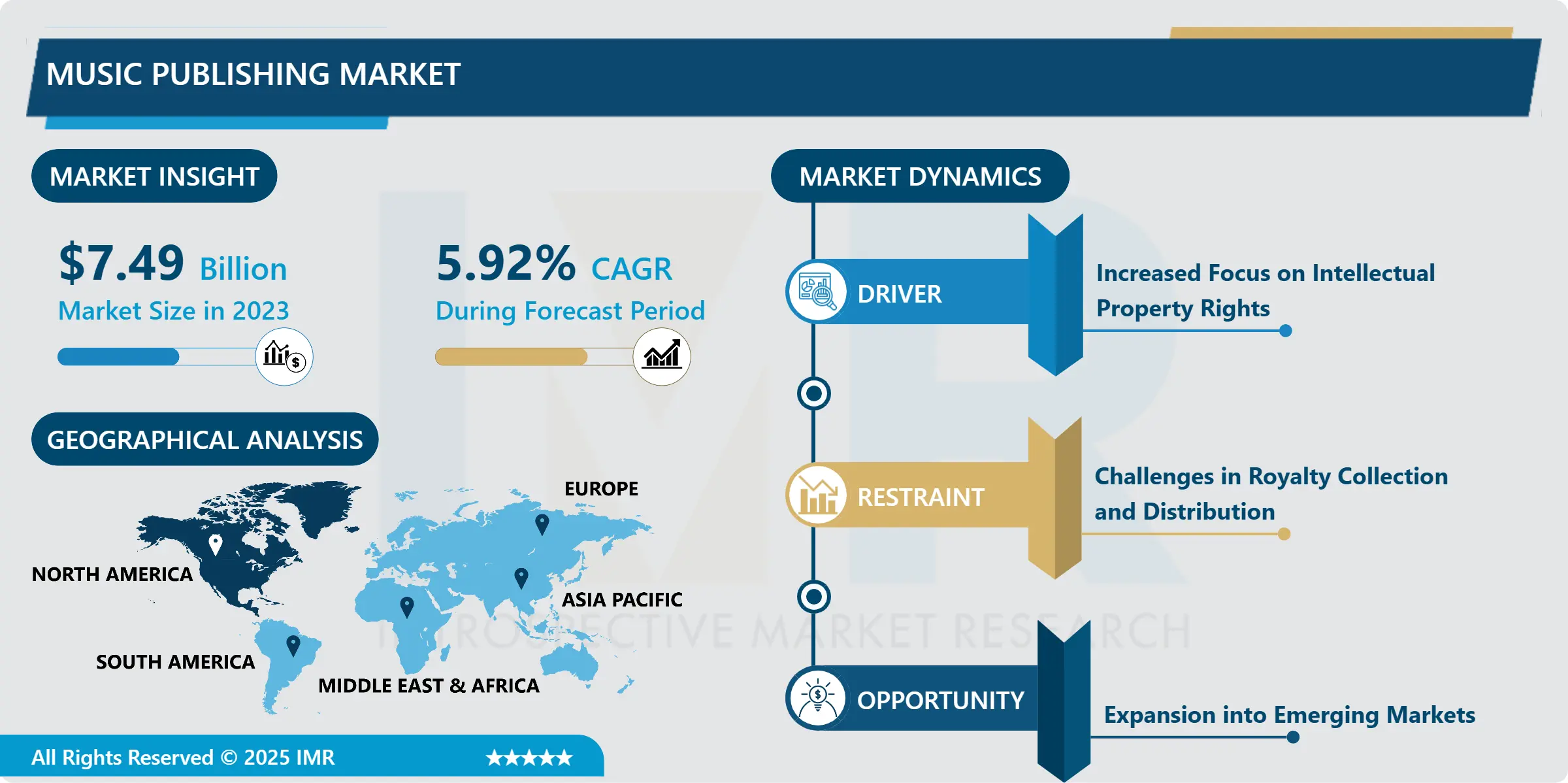
Music Publishing Market Size Was Valued at USD 7.49 Billion in 2023, and is Projected to Reach USD 12.57 Billion by 2032, Growing at a CAGR of 5.92% From 2024-2032.
Music Publishing Market includes the management, protection, and monetization of musical works, lyrics and notation. It concentrates on the licensing of those rights to secure payment for songs, specifically, for the songwriters & composers, when their compositions are utilized for commercial purposes such as, records, films, TV & radio & even advertisements & concerts.
The market at issue here is the music publishing market and it involves the buying and selling of music between composers and users. It refers to the granting and control of rights to musical creation so that creators are fairly paid and their works exploited Across several channels and in different media. There are music publishers who obtain copyrights and licenses, seek synch licenses and then, collect royalties on behalf of composers or song writers.
Many experts, literary in the past few years, have noted the unprecedented disruption of the music business affecting the music publishing market. The accessibility for consumers of streaming platforms and digital downloads has created new sources of income but at the same time new difficulties, for example, piracy and correct division of royalties. Furthermore, the increasing use of user content and sharing sites that has become the new way of consuming music put more pressure on the publishers to find ways of making money out of these changes.
Music Publishing Market Trend Analysis:
Growth of Streaming and Digital Platforms
The emergence of net streaming and other digital platforms is becoming the queen of the music publishing market. Modern online music streaming services, including Spotify, Apple Music, and YouTube, have brought music closer to the audience than has ever been the case before and at the same time opened new business opportunities for publishers.
Trend has added to the call for favorable measures to right management to meet the increasing complexity. They now enter into complicated licensing regimes so as to receive reasonable remuneration from the digital firms. In addition, the emergence of streaming services has increased opportunities to Jews the size of pieces so that many cross national boundaries and international collaborations and royalty. But the trend also brings more requirements to popularize revenue sharing and create better approaches to monitor music in digital space.
Expansion into Emerging Markets
The consumption of music in developing markets as a unique opportunity for music publishers. Asia-Pacific, Latin America, and Africa remain the primary markets experiencing emerging digital because internet costs have reduced significantly, and smart devices are popular.
Local streaming platforms and telecommunication service providers should work closely with the music publishers in order to capture the opportunity of licensing content. On the same note, the local music genres should be promoted and the company should fully engage artists in the region in a bid to expand revenue making initiatives. The future will see these markets become increasingly valuable as programmes and genres mature; for the publishers that enter first, it will mean an entire spectrum of increased successful opportunities to popularise and maintain culturally diverse music.
Music Publishing Market Segment Analysis:
Music Publishing Market is Segmented on the basis of Type, Ownership, Revenue Source, Application, End User, and Region.
By Type, Major Publishers segment is expected to dominate the market during the forecast period
Record companies control most of the market since most of them have vast library and geographical coverage. Larger players such as Universal Music Publishing or Sony Music Publishing buy rights on much larger scale and with larger budgets as they use their position to set competitive benchmarks. It allows them to sign-up most renowned talents and receive exclusivity for their pieces used in movies, commercials, and video games.
Self-published authors have a very important function of discovering fresh voices and supporting the commercialization of narrowly focused categories. These companies pay plenty of attention to artists and are oriented at developing close-knit ties with the markets in given territories. Others are still developing rather new strategies of agents for various customers, mainly independent designers and technology firms focusing on internet marketplaces. Such players can be more focused on niche markets, and generally they are more adaptable as for the rights management and licensing.
By Application, Commercial segment expected to held the largest share
The commercial segment is by far the most significant contributor to the overall market share of music publishing due to the continued demand from advertisement, films, television, and streaming. Music synchronization licensing, through which compositions can be used in multimedia projects, remains a big market. Publishers help advertisers and filmmakers to find the most suitable music for target audiences, and, thus, there is mutual cooperation between creative businesses.
The individual segment is already massive as people employ platforms like TikTok and YouTube to share content they produce during their leisure time. Many of these applications demand complex licensing systems that are not very manageable hence evoking the creation of micro-licensing solutions by the publishers. The segment is also made of other uses including music in performances and in educational activities as illustrated by the diverse functions of music publishing.
Music Publishing Market Regional Insights:
North America is Expected to Dominate the Market Over the Forecast period
The largest market for music publishing is North America due to an exceptionally developed music industry along with a highly concentrated number of publishers. The region enjoys strong legal protection of IP, there is a culture of listening to music, and the control of digital streaming services like Spotify, and Apple music.
For media and entertainment industries dominated by North America, music synchronization rights offers a powerful revenue stream for publishers. The region’s more inclination towards innovation and embracing of new technologies like – the blockchain for tracking royalties also adds a layer of strength to the region’s position in the global music publishing market.
Active Key Players in the Music Publishing Market:
Universal Music Publishing Group (United States)
Sony Music Publishing (United States)
Warner Chappell Music (United States)
BMG Rights Management (Germany)
Kobalt Music Group (United Kingdom)
Concord Music Publishing (United States)
Downtown Music Publishing (United States)
Peer Music (United States)
Round Hill Music (United States)
Reservoir Media Management (United States)
Songtrust (United States)
ABKCO Music & Records (United States), and Other Active Players
Key Industry Developments in the Music Publishing Market:
In May 2024, The Estate of Otis Redding, operating as Big O Holdings LLC, announced a strategic partnership with Sony Music Publishing. Under this agreement, Sony Music will manage the US publishing rights for Redding’s music catalog, which includes notable tracks such as “These Arms of Mine,” “Respect,” “Try A Little Tenderness,” and “(Sittin’ On) The Dock of the Bay.”
In April 2024, Warner Chappell Music (WCM), a global music publisher, and ICE, a music rights administration company, announced an expansion of their long-standing partnership. Following a comprehensive 10-month review process, WCM decided to entrust ICE with managing all its online licensing and royalty administration across Europe, the Middle East, and Africa.
Chapter 1: Introduction
1.1 Scope and Coverage
Chapter 2:Executive Summary
Chapter 3: Market Landscape
3.1 Market Dynamics
3.1.1 Drivers
3.1.2 Restraints
3.1.3 Opportunities
3.1.4 Challenges
3.2 Market Trend Analysis
3.3 PESTLE Analysis
3.4 Porter’s Five Forces Analysis
3.5 Industry Value Chain Analysis
3.6 Ecosystem
3.7 Regulatory Landscape
3.8 Price Trend Analysis
3.9 Patent Analysis
3.10 Technology Evolution
3.11 Investment Pockets
3.12 Import-Export Analysis
Chapter 4: Music Publishing Market by Type
4.1 Music Publishing Market Snapshot and Growth Engine
4.2 Music Publishing Market Overview
4.3 Major Publishers
4.3.1 Introduction and Market Overview
4.3.2 Historic and Forecasted Market Size in Value USD and Volume Units (2017-2032F)
4.3.3 Key Market Trends, Growth Factors and Opportunities
4.3.4 Major Publishers: Geographic Segmentation Analysis
4.4 Independent Publishers
4.4.1 Introduction and Market Overview
4.4.2 Historic and Forecasted Market Size in Value USD and Volume Units (2017-2032F)
4.4.3 Key Market Trends, Growth Factors and Opportunities
4.4.4 Independent Publishers: Geographic Segmentation Analysis
4.5 Others
4.5.1 Introduction and Market Overview
4.5.2 Historic and Forecasted Market Size in Value USD and Volume Units (2017-2032F)
4.5.3 Key Market Trends, Growth Factors and Opportunities
4.5.4 Others: Geographic Segmentation Analysis
Chapter 5: Music Publishing Market by Ownership
5.1 Music Publishing Market Snapshot and Growth Engine
5.2 Music Publishing Market Overview
5.3 Full Ownership
5.3.1 Introduction and Market Overview
5.3.2 Historic and Forecasted Market Size in Value USD and Volume Units (2017-2032F)
5.3.3 Key Market Trends, Growth Factors and Opportunities
5.3.4 Full Ownership: Geographic Segmentation Analysis
5.4 Co-Publishing
5.4.1 Introduction and Market Overview
5.4.2 Historic and Forecasted Market Size in Value USD and Volume Units (2017-2032F)
5.4.3 Key Market Trends, Growth Factors and Opportunities
5.4.4 Co-Publishing: Geographic Segmentation Analysis
5.5 Administration Agreement
5.5.1 Introduction and Market Overview
5.5.2 Historic and Forecasted Market Size in Value USD and Volume Units (2017-2032F)
5.5.3 Key Market Trends, Growth Factors and Opportunities
5.5.4 Administration Agreement: Geographic Segmentation Analysis
Chapter 6: Music Publishing Market by Application
6.1 Music Publishing Market Snapshot and Growth Engine
6.2 Music Publishing Market Overview
6.3 Commercial
6.3.1 Introduction and Market Overview
6.3.2 Historic and Forecasted Market Size in Value USD and Volume Units (2017-2032F)
6.3.3 Key Market Trends, Growth Factors and Opportunities
6.3.4 Commercial: Geographic Segmentation Analysis
6.4 Personal
6.4.1 Introduction and Market Overview
6.4.2 Historic and Forecasted Market Size in Value USD and Volume Units (2017-2032F)
6.4.3 Key Market Trends, Growth Factors and Opportunities
6.4.4 Personal: Geographic Segmentation Analysis
6.5 Others
6.5.1 Introduction and Market Overview
6.5.2 Historic and Forecasted Market Size in Value USD and Volume Units (2017-2032F)
6.5.3 Key Market Trends, Growth Factors and Opportunities
6.5.4 Others: Geographic Segmentation Analysis
Chapter 7: Music Publishing Market by Revenue Source
7.1 Music Publishing Market Snapshot and Growth Engine
7.2 Music Publishing Market Overview
7.3 Performance
7.3.1 Introduction and Market Overview
7.3.2 Historic and Forecasted Market Size in Value USD and Volume Units (2017-2032F)
7.3.3 Key Market Trends, Growth Factors and Opportunities
7.3.4 Performance: Geographic Segmentation Analysis
7.4 Mechanical
7.4.1 Introduction and Market Overview
7.4.2 Historic and Forecasted Market Size in Value USD and Volume Units (2017-2032F)
7.4.3 Key Market Trends, Growth Factors and Opportunities
7.4.4 Mechanical: Geographic Segmentation Analysis
7.5 Synchronization
7.5.1 Introduction and Market Overview
7.5.2 Historic and Forecasted Market Size in Value USD and Volume Units (2017-2032F)
7.5.3 Key Market Trends, Growth Factors and Opportunities
7.5.4 Synchronization: Geographic Segmentation Analysis
7.6 Digital
7.6.1 Introduction and Market Overview
7.6.2 Historic and Forecasted Market Size in Value USD and Volume Units (2017-2032F)
7.6.3 Key Market Trends, Growth Factors and Opportunities
7.6.4 Digital: Geographic Segmentation Analysis
Chapter 8: Company Profiles and Competitive Analysis
8.1 Competitive Landscape
8.1.1 Competitive Benchmarking
8.1.2 Music Publishing Market Share by Manufacturer (2023)
8.1.3 Industry BCG Matrix
8.1.4 Heat Map Analysis
8.1.5 Mergers and Acquisitions
8.2 UNIVERSAL MUSIC PUBLISHING GROUP (UNITED STATES)
8.2.1 Company Overview
8.2.2 Key Executives
8.2.3 Company Snapshot
8.2.4 Role of the Company in the Market
8.2.5 Sustainability and Social Responsibility
8.2.6 Operating Business Segments
8.2.7 Product Portfolio
8.2.8 Business Performance
8.2.9 Key Strategic Moves and Recent Developments
8.2.10 SWOT Analysis
8.3 SONY MUSIC PUBLISHING (UNITED STATES)
8.4 WARNER CHAPPELL MUSIC (UNITED STATES)
8.5 BMG RIGHTS MANAGEMENT (GERMANY)
8.6 KOBALT MUSIC GROUP (UNITED KINGDOM)
8.7 CONCORD MUSIC PUBLISHING (UNITED STATES)
8.8 DOWNTOWN MUSIC PUBLISHING (UNITED STATES)
8.9 PEER MUSIC (UNITED STATES)
8.10 ROUND HILL MUSIC (UNITED STATES)
8.11 RESERVOIR MEDIA MANAGEMENT (UNITED STATES)
8.12 SONGTRUST (UNITED STATES)
8.13 ABKCO MUSIC & RECORDS (UNITED STATES)
8.14 OTHER ACTIVE PLAYERS
Chapter 9: Global Music Publishing Market By Region
9.1 Overview
9.2. North America Music Publishing Market
9.2.1 Key Market Trends, Growth Factors and Opportunities
9.2.2 Top Key Companies
9.2.3 Historic and Forecasted Market Size by Segments
9.2.4 Historic and Forecasted Market Size By Type
9.2.4.1 Major Publishers
9.2.4.2 Independent Publishers
9.2.4.3 Others
9.2.5 Historic and Forecasted Market Size By Ownership
9.2.5.1 Full Ownership
9.2.5.2 Co-Publishing
9.2.5.3 Administration Agreement
9.2.6 Historic and Forecasted Market Size By Application
9.2.6.1 Commercial
9.2.6.2 Personal
9.2.6.3 Others
9.2.7 Historic and Forecasted Market Size By Revenue Source
9.2.7.1 Performance
9.2.7.2 Mechanical
9.2.7.3 Synchronization
9.2.7.4 Digital
9.2.8 Historic and Forecast Market Size by Country
9.2.8.1 US
9.2.8.2 Canada
9.2.8.3 Mexico
9.3. Eastern Europe Music Publishing Market
9.3.1 Key Market Trends, Growth Factors and Opportunities
9.3.2 Top Key Companies
9.3.3 Historic and Forecasted Market Size by Segments
9.3.4 Historic and Forecasted Market Size By Type
9.3.4.1 Major Publishers
9.3.4.2 Independent Publishers
9.3.4.3 Others
9.3.5 Historic and Forecasted Market Size By Ownership
9.3.5.1 Full Ownership
9.3.5.2 Co-Publishing
9.3.5.3 Administration Agreement
9.3.6 Historic and Forecasted Market Size By Application
9.3.6.1 Commercial
9.3.6.2 Personal
9.3.6.3 Others
9.3.7 Historic and Forecasted Market Size By Revenue Source
9.3.7.1 Performance
9.3.7.2 Mechanical
9.3.7.3 Synchronization
9.3.7.4 Digital
9.3.8 Historic and Forecast Market Size by Country
9.3.8.1 Russia
9.3.8.2 Bulgaria
9.3.8.3 The Czech Republic
9.3.8.4 Hungary
9.3.8.5 Poland
9.3.8.6 Romania
9.3.8.7 Rest of Eastern Europe
9.4. Western Europe Music Publishing Market
9.4.1 Key Market Trends, Growth Factors and Opportunities
9.4.2 Top Key Companies
9.4.3 Historic and Forecasted Market Size by Segments
9.4.4 Historic and Forecasted Market Size By Type
9.4.4.1 Major Publishers
9.4.4.2 Independent Publishers
9.4.4.3 Others
9.4.5 Historic and Forecasted Market Size By Ownership
9.4.5.1 Full Ownership
9.4.5.2 Co-Publishing
9.4.5.3 Administration Agreement
9.4.6 Historic and Forecasted Market Size By Application
9.4.6.1 Commercial
9.4.6.2 Personal
9.4.6.3 Others
9.4.7 Historic and Forecasted Market Size By Revenue Source
9.4.7.1 Performance
9.4.7.2 Mechanical
9.4.7.3 Synchronization
9.4.7.4 Digital
9.4.8 Historic and Forecast Market Size by Country
9.4.8.1 Germany
9.4.8.2 UK
9.4.8.3 France
9.4.8.4 The Netherlands
9.4.8.5 Italy
9.4.8.6 Spain
9.4.8.7 Rest of Western Europe
9.5. Asia Pacific Music Publishing Market
9.5.1 Key Market Trends, Growth Factors and Opportunities
9.5.2 Top Key Companies
9.5.3 Historic and Forecasted Market Size by Segments
9.5.4 Historic and Forecasted Market Size By Type
9.5.4.1 Major Publishers
9.5.4.2 Independent Publishers
9.5.4.3 Others
9.5.5 Historic and Forecasted Market Size By Ownership
9.5.5.1 Full Ownership
9.5.5.2 Co-Publishing
9.5.5.3 Administration Agreement
9.5.6 Historic and Forecasted Market Size By Application
9.5.6.1 Commercial
9.5.6.2 Personal
9.5.6.3 Others
9.5.7 Historic and Forecasted Market Size By Revenue Source
9.5.7.1 Performance
9.5.7.2 Mechanical
9.5.7.3 Synchronization
9.5.7.4 Digital
9.5.8 Historic and Forecast Market Size by Country
9.5.8.1 China
9.5.8.2 India
9.5.8.3 Japan
9.5.8.4 South Korea
9.5.8.5 Malaysia
9.5.8.6 Thailand
9.5.8.7 Vietnam
9.5.8.8 The Philippines
9.5.8.9 Australia
9.5.8.10 New Zealand
9.5.8.11 Rest of APAC
9.6. Middle East & Africa Music Publishing Market
9.6.1 Key Market Trends, Growth Factors and Opportunities
9.6.2 Top Key Companies
9.6.3 Historic and Forecasted Market Size by Segments
9.6.4 Historic and Forecasted Market Size By Type
9.6.4.1 Major Publishers
9.6.4.2 Independent Publishers
9.6.4.3 Others
9.6.5 Historic and Forecasted Market Size By Ownership
9.6.5.1 Full Ownership
9.6.5.2 Co-Publishing
9.6.5.3 Administration Agreement
9.6.6 Historic and Forecasted Market Size By Application
9.6.6.1 Commercial
9.6.6.2 Personal
9.6.6.3 Others
9.6.7 Historic and Forecasted Market Size By Revenue Source
9.6.7.1 Performance
9.6.7.2 Mechanical
9.6.7.3 Synchronization
9.6.7.4 Digital
9.6.8 Historic and Forecast Market Size by Country
9.6.8.1 Turkiye
9.6.8.2 Bahrain
9.6.8.3 Kuwait
9.6.8.4 Saudi Arabia
9.6.8.5 Qatar
9.6.8.6 UAE
9.6.8.7 Israel
9.6.8.8 South Africa
9.7. South America Music Publishing Market
9.7.1 Key Market Trends, Growth Factors and Opportunities
9.7.2 Top Key Companies
9.7.3 Historic and Forecasted Market Size by Segments
9.7.4 Historic and Forecasted Market Size By Type
9.7.4.1 Major Publishers
9.7.4.2 Independent Publishers
9.7.4.3 Others
9.7.5 Historic and Forecasted Market Size By Ownership
9.7.5.1 Full Ownership
9.7.5.2 Co-Publishing
9.7.5.3 Administration Agreement
9.7.6 Historic and Forecasted Market Size By Application
9.7.6.1 Commercial
9.7.6.2 Personal
9.7.6.3 Others
9.7.7 Historic and Forecasted Market Size By Revenue Source
9.7.7.1 Performance
9.7.7.2 Mechanical
9.7.7.3 Synchronization
9.7.7.4 Digital
9.7.8 Historic and Forecast Market Size by Country
9.7.8.1 Brazil
9.7.8.2 Argentina
9.7.8.3 Rest of SA
Chapter 10 Analyst Viewpoint and Conclusion
10.1 Recommendations and Concluding Analysis
10.2 Potential Market Strategies
Chapter 11 Research Methodology
11.1 Research Process
11.2 Primary Research
11.3 Secondary Research
Q1: What would be the forecast period in the Music Publishing Market research report?
A1: The forecast period in the Music Publishing Market research report is 2024-2032.
Q2: Who are the key players in the Music Publishing Market?
A2: Universal Music Publishing Group (United States), Sony Music Publishing (United States), Warner Chappell Music (United States), BMG Rights Management (Germany), Kobalt Music Group (United Kingdom), Concord Music Publishing (United States), Downtown Music Publishing (United States), Peer Music (United States), Round Hill Music (United States), Reservoir Media Management (United States), Songtrust (United States), ABKCO Music & Records (United States), and Other Active Players
Q3: What are the segments of the Music Publishing Market?
A3: Music Publishing Market is Segmented on the basis of Type, Ownership, Revenue Source, Application, End User, and Region. By Type, the market is categorized into Major Publishers, Independent Publishers, and Others. By Ownership, the market is categorized into Full Ownership, Co-Publishing, and Administration Agreement. By Application, the market is categorized into Commercial, Personal, Others. By Revenue Source, the market is categorized into Performance, Mechanical, Synchronization, and Digital. By region, it is analyzed across North America (U.S., Canada, Mexico), Eastern Europe (Russia, Bulgaria, The Czech Republic, Hungary, Poland, Romania, Rest of Eastern Europe), Western Europe (Germany, UK, France, Netherlands, Italy, Spain, Rest of Western Europe), Asia Pacific (China, India, Japan, South Korea, Malaysia, Thailand, Vietnam, The Philippines, Australia, New Zealand, Rest of APAC), Middle East & Africa (Turkiye, Bahrain, Kuwait, Saudi Arabia, Qatar, UAE, Israel, South Africa), South America (Brazil, Argentina, Rest of SA).
Q4: What is the Music Publishing Market?
A4: Music Publishing Market includes the management, protection, and monetization of musical works, lyrics and notation. It concentrates on the licensing of those rights to secure payment for songs, specifically, for the songwriters & composers, when their compositions are utilized for commercial purposes such as, records, films, TV & radio & even advertisements & concerts.
Q5: How big is the Music Publishing Market?
A5: Music Publishing Market Size Was Valued at USD 7.49 Billion in 2023, and is Projected to Reach USD 12.57 Billion by 2032, Growing at a CAGR of 5.92% From 2024-2032.
How to Buy a Report from eminsights.jp
On the product page, choose the license you want: Single-User License, Multi-User License or Enterprise License.
If you required report in your native language, then you can click on Translated Report button and fill out the form with report name and language you want, then our team will contact you as soon as possible.
Click the Buy Now button.
You will be redirected to the checkout page. Enter your company details and payment information.
Click Place Order to complete the purchase.
Confirmation: You’ll receive an order confirmation and our team will contact you shortly with your ordered report.
If you have any questions, fill out the contact form below or email us at bizdev@eminsights.net.
Thank you for choosing eminsights.jp!