Stay Ahead in Fast-Growing Economies.
Browse Reports Now




Muscle Spasticity Market Future Outlook, Trends & Forecast Analysis (2024-2032)
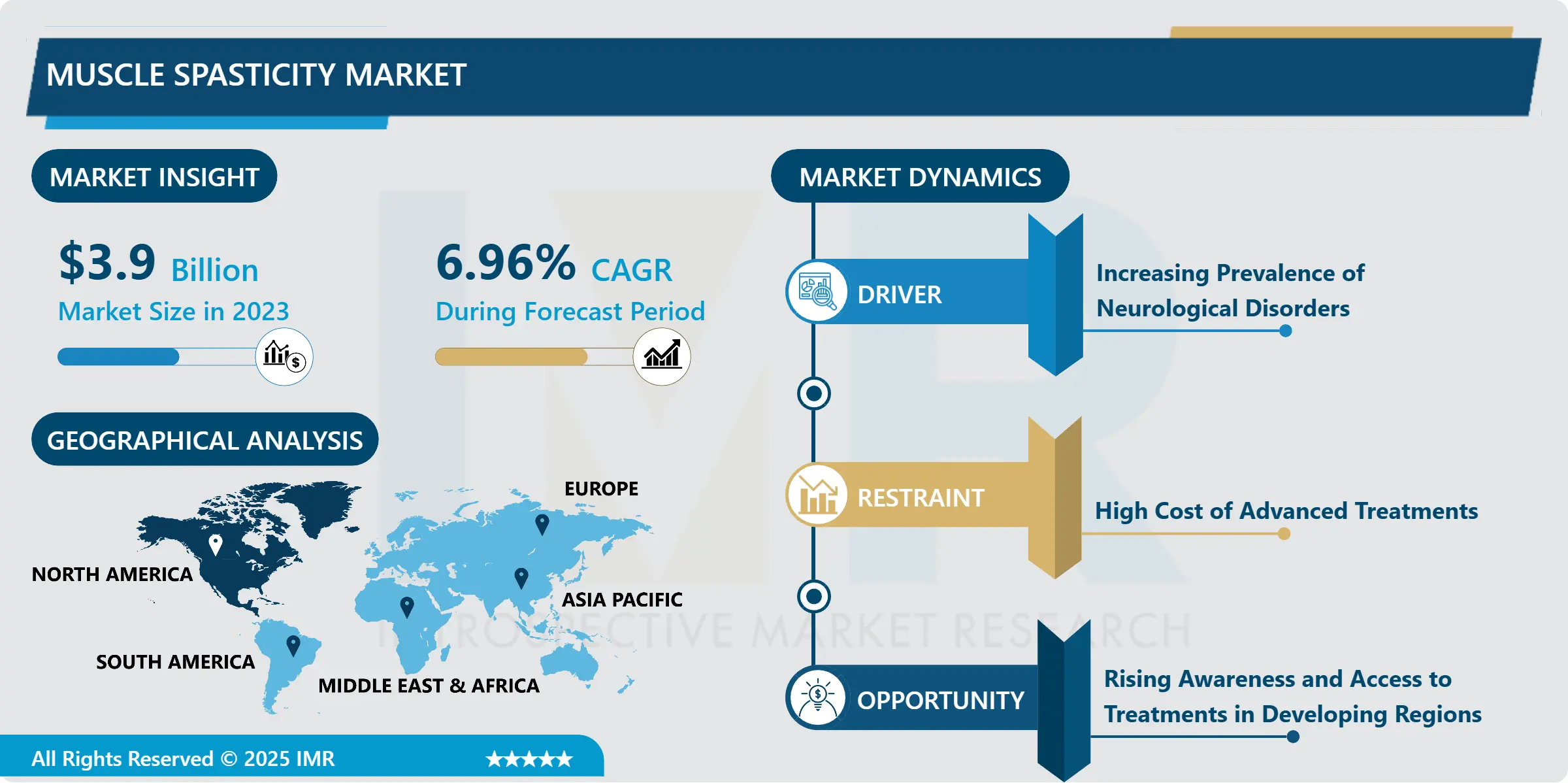
Muscle Spasticity Market Size Was Valued at USD 3.9 Billion in 2023, and is Projected to Reach USD 7.1 Billion by 2032, Growing at a CAGR of 6.96% From 2024-2032. Muscle spasticity means an increased tone and /or involuntary contraction of the muscles due to lesion in the pathways of the nervous system from the brain to spinal chord and muscle fibers.

IMR Group
Description
Muscle Spasticity Market Synopsis:
Muscle Spasticity Market Size Was Valued at USD 3.9 Billion in 2023, and is Projected to Reach USD 7.1 Billion by 2032, Growing at a CAGR of 6.96% From 2024-2032.
Muscle spasticity means an increased tone and /or involuntary contraction of the muscles due to lesion in the pathways of the nervous system from the brain to spinal chord and muscle fibers. This condition is attendant on those with neurological issues like cerebral palsy, multiple sclerosis, stroke, or spine injuries and leads to severe physical and functional disabilities. Muscle spasticity market includes therapies intended to improve muscle components, reduce pain, and increase the range of motion.
The Market for Muscle Spasticity is growing steadily because of the rising incidence of neurological disorders and growing awareness about improved forms of treatment. Trettigmillioner of people are sensitized by it primarilythose with cerebral palsy, stroke, and multiple sclerosis and the likes. The condition can hugely affect the quality of life, ability to move around, and diminish one’s independence, and this puts pressure on finding good therapies. ,the vapal and non vapal options for managing the condition are oral medications, botulinum toxin injections, intrathecal baclofen therapy (ITB), physiotherapy, and surgical procedures.
The market has benefitted from the increased use of technology and there is an increase in the use of less invasive procedures and drug formulations. Furthermore, more opportunities provided by robotics and AI in physiotherapy and rehabilitation have appeared. People in the health care delivery systems and those in policy making institutions are being pressured to enhance the access to treatment through reimbursement plans and cooperation with business entities in the health sector. Still, barriers like the high cost of treating the conditions, or low knowledge of services in the developing world distort the growth and development of the industry significantly.
Muscle Spasticity Market Trend Analysis:
Technological Advancements in Treatment Modalities
The muscle spasticity market is slowly incorporating technology into treatment processes in order to increase the efficacy of interventions. Robot aided physiotherapy is on the horizon as a value addition due its ability to offer precise repetitive movements that enhance muscle strength. Together with the application of the feedback systems that are based on the artificial intelligence, the specified technologies make it possible to design the respective programs of the rehabilitation of the patients.
Innovations in drug delivery systems: Injection, Pump and Catheter for intrathecal baclofen therapy is enhancing patient satisfaction index by delivering medicines intrathecally in a continuous manner. In addition to efficiency, all these innovations contribute to decreasing side effects and therefore increase patient compliance. The use of technology will be seen as a key factor as the market’s sign of long-term business improvement and consequently the muscle spasticity market.
Rising Awareness and Access to Treatments in Developing Regions
Emerging markets have the greatest potential for growth since people become knowledgeable about the availability of products, as well as healthcare facilities continue to expand. Neurological disorders are increasing in Asia-Pacific and Latin America due to increasing life expectancy of citizens in these countries. This trend is seen to be pushing demand for spasticity treatments.
Bureaucracies and health care systems are now initiating public sensitisation to let patients and carers know what treatment options are available. Also, original equipment manufacturers of the pharmaceutical industries around the globe are venturing into these regions and providing affordable options coupled by partnership with local service providers. These efforts are developing an enabling environment for market development and its expansion to the unexploited regions.
Muscle Spasticity Market Segment Analysis:
Muscle Spasticity Market is Segmented on the basis of Treatment Type, Distribution Channel, Application, End User, and Region.
By Treatment Type, Oral Medications segment is expected to dominate the market during the forecast period
The market for muscle spasticity treatments is classified by the treatment type into oral agents, ITB, BTX-A injections, physiotherapy and occupational therapy, surgeries. Muscle relaxant oral agents are the most commonly used owing to their availability and ease of administration. However these diseases have side effects and are effective in mild cases, hence the need for better treatments.
The use of BTX injections and intrathecal balofen are now preferred due ITB focus for treating spasms in persons with severe and complex conditions. Medical treatment continues to be complemented by both physiotherapy and occupational therapy throughout the rehabilitation processes. Surgical solutions, are the least chosen, and are usually applied in extreme circumstances only, therefore being a part of a smaller market share. It clearly indicates that further treatment methods are needed that more or less target patient’s seriousness and requirement.
By Application, Cerebral Palsy segment expected to held the largest share
The market has been divided based on application such as cerebral palsy, multiple sclerosis, TBI, SCI, stroke and others. Of these, cerebral palsy and stroke account for the greatest market shares as these are most prevalent in the world and also display a high spasticity rate.
Other important application areas include sever muscular dystrophy and multiple sclerosis, as well as spinal cord injury, with increased need for distinct treatments. New markets of the usage, for example, spasticity management in the elderly population, are opening for the market. This segmentation also underlines that spasticity can be a sign of various disorders and require treatments tailored to the disease.
Muscle Spasticity Market Regional Insights:
North America is Expected to Dominate the Market Over the Forecast period
North America holds the highest revenue in the muscle spasticity market because it has developed health care facilities and higher incidence rate of neurological disorders and favourable attitude towards innovative treatments. Reimbursement policies are also well developed in the region, meaning patients have a fairly easy access to expensive therapies namely ITB and botulinum toxin injections.
Moreover, high R&D spends accompanied by key market players to foster innovation and capability to offer new solutions. Increasing the importance of the patient’s needs, including increasing the attention to the patient experience along with the integration of technologies in healthcare will help North America to remain the leader in the market.
Active Key Players in the Muscle Spasticity Market:
Allergan (Ireland)
Ipsen (France)
Merz Pharmaceuticals (Germany)
Medtronic (USA)
Boston Scientific Corporation (USA)
Pfizer Inc. (USA)
Teva Pharmaceutical Industries Ltd. (Israel)
Novartis AG (Switzerland)
AbbVie Inc. (USA)
Sanofi (France)
Bayer AG (Germany)
Eli Lilly and Company (USA), and Other Active Players
Chapter 1: Introduction
1.1 Scope and Coverage
Chapter 2:Executive Summary
Chapter 3: Market Landscape
3.1 Market Dynamics
3.1.1 Drivers
3.1.2 Restraints
3.1.3 Opportunities
3.1.4 Challenges
3.2 Market Trend Analysis
3.3 PESTLE Analysis
3.4 Porter’s Five Forces Analysis
3.5 Industry Value Chain Analysis
3.6 Ecosystem
3.7 Regulatory Landscape
3.8 Price Trend Analysis
3.9 Patent Analysis
3.10 Technology Evolution
3.11 Investment Pockets
3.12 Import-Export Analysis
Chapter 4: Muscle Spasticity Market by Treatment Type
4.1 Muscle Spasticity Market Snapshot and Growth Engine
4.2 Muscle Spasticity Market Overview
4.3 Oral Medications
4.3.1 Introduction and Market Overview
4.3.2 Historic and Forecasted Market Size in Value USD and Volume Units (2017-2032F)
4.3.3 Key Market Trends, Growth Factors and Opportunities
4.3.4 Oral Medications: Geographic Segmentation Analysis
4.4 Intrathecal Baclofen Therapy
4.4.1 Introduction and Market Overview
4.4.2 Historic and Forecasted Market Size in Value USD and Volume Units (2017-2032F)
4.4.3 Key Market Trends, Growth Factors and Opportunities
4.4.4 Intrathecal Baclofen Therapy: Geographic Segmentation Analysis
4.5 ITB
4.5.1 Introduction and Market Overview
4.5.2 Historic and Forecasted Market Size in Value USD and Volume Units (2017-2032F)
4.5.3 Key Market Trends, Growth Factors and Opportunities
4.5.4 ITB: Geographic Segmentation Analysis
4.6 Botulinum Toxin Injections
4.6.1 Introduction and Market Overview
4.6.2 Historic and Forecasted Market Size in Value USD and Volume Units (2017-2032F)
4.6.3 Key Market Trends, Growth Factors and Opportunities
4.6.4 Botulinum Toxin Injections: Geographic Segmentation Analysis
4.7 Physiotherapy and Occupational Therapy
4.7.1 Introduction and Market Overview
4.7.2 Historic and Forecasted Market Size in Value USD and Volume Units (2017-2032F)
4.7.3 Key Market Trends, Growth Factors and Opportunities
4.7.4 Physiotherapy and Occupational Therapy: Geographic Segmentation Analysis
4.8 Surgical Treatments
4.8.1 Introduction and Market Overview
4.8.2 Historic and Forecasted Market Size in Value USD and Volume Units (2017-2032F)
4.8.3 Key Market Trends, Growth Factors and Opportunities
4.8.4 Surgical Treatments: Geographic Segmentation Analysis
Chapter 5: Muscle Spasticity Market by Application
5.1 Muscle Spasticity Market Snapshot and Growth Engine
5.2 Muscle Spasticity Market Overview
5.3 Cerebral Palsy
5.3.1 Introduction and Market Overview
5.3.2 Historic and Forecasted Market Size in Value USD and Volume Units (2017-2032F)
5.3.3 Key Market Trends, Growth Factors and Opportunities
5.3.4 Cerebral Palsy: Geographic Segmentation Analysis
5.4 Multiple Sclerosis
5.4.1 Introduction and Market Overview
5.4.2 Historic and Forecasted Market Size in Value USD and Volume Units (2017-2032F)
5.4.3 Key Market Trends, Growth Factors and Opportunities
5.4.4 Multiple Sclerosis: Geographic Segmentation Analysis
5.5 Traumatic Brain Injury
5.5.1 Introduction and Market Overview
5.5.2 Historic and Forecasted Market Size in Value USD and Volume Units (2017-2032F)
5.5.3 Key Market Trends, Growth Factors and Opportunities
5.5.4 Traumatic Brain Injury: Geographic Segmentation Analysis
5.6 Spinal Cord Injury
5.6.1 Introduction and Market Overview
5.6.2 Historic and Forecasted Market Size in Value USD and Volume Units (2017-2032F)
5.6.3 Key Market Trends, Growth Factors and Opportunities
5.6.4 Spinal Cord Injury: Geographic Segmentation Analysis
5.7 Stroke
5.7.1 Introduction and Market Overview
5.7.2 Historic and Forecasted Market Size in Value USD and Volume Units (2017-2032F)
5.7.3 Key Market Trends, Growth Factors and Opportunities
5.7.4 Stroke: Geographic Segmentation Analysis
5.8 Others
5.8.1 Introduction and Market Overview
5.8.2 Historic and Forecasted Market Size in Value USD and Volume Units (2017-2032F)
5.8.3 Key Market Trends, Growth Factors and Opportunities
5.8.4 Others: Geographic Segmentation Analysis
Chapter 6: Muscle Spasticity Market by End User
6.1 Muscle Spasticity Market Snapshot and Growth Engine
6.2 Muscle Spasticity Market Overview
6.3 Hospitals
6.3.1 Introduction and Market Overview
6.3.2 Historic and Forecasted Market Size in Value USD and Volume Units (2017-2032F)
6.3.3 Key Market Trends, Growth Factors and Opportunities
6.3.4 Hospitals: Geographic Segmentation Analysis
6.4 Clinics
6.4.1 Introduction and Market Overview
6.4.2 Historic and Forecasted Market Size in Value USD and Volume Units (2017-2032F)
6.4.3 Key Market Trends, Growth Factors and Opportunities
6.4.4 Clinics: Geographic Segmentation Analysis
6.5 Ambulatory Surgical Centers
6.5.1 Introduction and Market Overview
6.5.2 Historic and Forecasted Market Size in Value USD and Volume Units (2017-2032F)
6.5.3 Key Market Trends, Growth Factors and Opportunities
6.5.4 Ambulatory Surgical Centers: Geographic Segmentation Analysis
6.6 Rehabilitation Centers
6.6.1 Introduction and Market Overview
6.6.2 Historic and Forecasted Market Size in Value USD and Volume Units (2017-2032F)
6.6.3 Key Market Trends, Growth Factors and Opportunities
6.6.4 Rehabilitation Centers: Geographic Segmentation Analysis
Chapter 7: Muscle Spasticity Market by Distribution Channel
7.1 Muscle Spasticity Market Snapshot and Growth Engine
7.2 Muscle Spasticity Market Overview
7.3 Hospital Pharmacies
7.3.1 Introduction and Market Overview
7.3.2 Historic and Forecasted Market Size in Value USD and Volume Units (2017-2032F)
7.3.3 Key Market Trends, Growth Factors and Opportunities
7.3.4 Hospital Pharmacies: Geographic Segmentation Analysis
7.4 Retail Pharmacies
7.4.1 Introduction and Market Overview
7.4.2 Historic and Forecasted Market Size in Value USD and Volume Units (2017-2032F)
7.4.3 Key Market Trends, Growth Factors and Opportunities
7.4.4 Retail Pharmacies: Geographic Segmentation Analysis
7.5 Online Pharmacies
7.5.1 Introduction and Market Overview
7.5.2 Historic and Forecasted Market Size in Value USD and Volume Units (2017-2032F)
7.5.3 Key Market Trends, Growth Factors and Opportunities
7.5.4 Online Pharmacies: Geographic Segmentation Analysis
Chapter 8: Company Profiles and Competitive Analysis
8.1 Competitive Landscape
8.1.1 Competitive Benchmarking
8.1.2 Muscle Spasticity Market Share by Manufacturer (2023)
8.1.3 Industry BCG Matrix
8.1.4 Heat Map Analysis
8.1.5 Mergers and Acquisitions
8.2 ALLERGAN (IRELAND)
8.2.1 Company Overview
8.2.2 Key Executives
8.2.3 Company Snapshot
8.2.4 Role of the Company in the Market
8.2.5 Sustainability and Social Responsibility
8.2.6 Operating Business Segments
8.2.7 Product Portfolio
8.2.8 Business Performance
8.2.9 Key Strategic Moves and Recent Developments
8.2.10 SWOT Analysis
8.3 IPSEN (FRANCE)
8.4 MERZ PHARMACEUTICALS (GERMANY)
8.5 MEDTRONIC (USA)
8.6 BOSTON SCIENTIFIC CORPORATION (USA)
8.7 PFIZER INC. (USA)
8.8 TEVA PHARMACEUTICAL INDUSTRIES LTD. (ISRAEL)
8.9 NOVARTIS AG (SWITZERLAND)
8.10 ABBVIE INC. (USA)
8.11 SANOFI (FRANCE)
8.12 BAYER AG (GERMANY)
8.13 ELI LILLY AND COMPANY (USA)
8.14 OTHER ACTIVE PLAYERS
Chapter 9: Global Muscle Spasticity Market By Region
9.1 Overview
9.2. North America Muscle Spasticity Market
9.2.1 Key Market Trends, Growth Factors and Opportunities
9.2.2 Top Key Companies
9.2.3 Historic and Forecasted Market Size by Segments
9.2.4 Historic and Forecasted Market Size By Treatment Type
9.2.4.1 Oral Medications
9.2.4.2 Intrathecal Baclofen Therapy
9.2.4.3 ITB
9.2.4.4 Botulinum Toxin Injections
9.2.4.5 Physiotherapy and Occupational Therapy
9.2.4.6 Surgical Treatments
9.2.5 Historic and Forecasted Market Size By Application
9.2.5.1 Cerebral Palsy
9.2.5.2 Multiple Sclerosis
9.2.5.3 Traumatic Brain Injury
9.2.5.4 Spinal Cord Injury
9.2.5.5 Stroke
9.2.5.6 Others
9.2.6 Historic and Forecasted Market Size By End User
9.2.6.1 Hospitals
9.2.6.2 Clinics
9.2.6.3 Ambulatory Surgical Centers
9.2.6.4 Rehabilitation Centers
9.2.7 Historic and Forecasted Market Size By Distribution Channel
9.2.7.1 Hospital Pharmacies
9.2.7.2 Retail Pharmacies
9.2.7.3 Online Pharmacies
9.2.8 Historic and Forecast Market Size by Country
9.2.8.1 US
9.2.8.2 Canada
9.2.8.3 Mexico
9.3. Eastern Europe Muscle Spasticity Market
9.3.1 Key Market Trends, Growth Factors and Opportunities
9.3.2 Top Key Companies
9.3.3 Historic and Forecasted Market Size by Segments
9.3.4 Historic and Forecasted Market Size By Treatment Type
9.3.4.1 Oral Medications
9.3.4.2 Intrathecal Baclofen Therapy
9.3.4.3 ITB
9.3.4.4 Botulinum Toxin Injections
9.3.4.5 Physiotherapy and Occupational Therapy
9.3.4.6 Surgical Treatments
9.3.5 Historic and Forecasted Market Size By Application
9.3.5.1 Cerebral Palsy
9.3.5.2 Multiple Sclerosis
9.3.5.3 Traumatic Brain Injury
9.3.5.4 Spinal Cord Injury
9.3.5.5 Stroke
9.3.5.6 Others
9.3.6 Historic and Forecasted Market Size By End User
9.3.6.1 Hospitals
9.3.6.2 Clinics
9.3.6.3 Ambulatory Surgical Centers
9.3.6.4 Rehabilitation Centers
9.3.7 Historic and Forecasted Market Size By Distribution Channel
9.3.7.1 Hospital Pharmacies
9.3.7.2 Retail Pharmacies
9.3.7.3 Online Pharmacies
9.3.8 Historic and Forecast Market Size by Country
9.3.8.1 Russia
9.3.8.2 Bulgaria
9.3.8.3 The Czech Republic
9.3.8.4 Hungary
9.3.8.5 Poland
9.3.8.6 Romania
9.3.8.7 Rest of Eastern Europe
9.4. Western Europe Muscle Spasticity Market
9.4.1 Key Market Trends, Growth Factors and Opportunities
9.4.2 Top Key Companies
9.4.3 Historic and Forecasted Market Size by Segments
9.4.4 Historic and Forecasted Market Size By Treatment Type
9.4.4.1 Oral Medications
9.4.4.2 Intrathecal Baclofen Therapy
9.4.4.3 ITB
9.4.4.4 Botulinum Toxin Injections
9.4.4.5 Physiotherapy and Occupational Therapy
9.4.4.6 Surgical Treatments
9.4.5 Historic and Forecasted Market Size By Application
9.4.5.1 Cerebral Palsy
9.4.5.2 Multiple Sclerosis
9.4.5.3 Traumatic Brain Injury
9.4.5.4 Spinal Cord Injury
9.4.5.5 Stroke
9.4.5.6 Others
9.4.6 Historic and Forecasted Market Size By End User
9.4.6.1 Hospitals
9.4.6.2 Clinics
9.4.6.3 Ambulatory Surgical Centers
9.4.6.4 Rehabilitation Centers
9.4.7 Historic and Forecasted Market Size By Distribution Channel
9.4.7.1 Hospital Pharmacies
9.4.7.2 Retail Pharmacies
9.4.7.3 Online Pharmacies
9.4.8 Historic and Forecast Market Size by Country
9.4.8.1 Germany
9.4.8.2 UK
9.4.8.3 France
9.4.8.4 The Netherlands
9.4.8.5 Italy
9.4.8.6 Spain
9.4.8.7 Rest of Western Europe
9.5. Asia Pacific Muscle Spasticity Market
9.5.1 Key Market Trends, Growth Factors and Opportunities
9.5.2 Top Key Companies
9.5.3 Historic and Forecasted Market Size by Segments
9.5.4 Historic and Forecasted Market Size By Treatment Type
9.5.4.1 Oral Medications
9.5.4.2 Intrathecal Baclofen Therapy
9.5.4.3 ITB
9.5.4.4 Botulinum Toxin Injections
9.5.4.5 Physiotherapy and Occupational Therapy
9.5.4.6 Surgical Treatments
9.5.5 Historic and Forecasted Market Size By Application
9.5.5.1 Cerebral Palsy
9.5.5.2 Multiple Sclerosis
9.5.5.3 Traumatic Brain Injury
9.5.5.4 Spinal Cord Injury
9.5.5.5 Stroke
9.5.5.6 Others
9.5.6 Historic and Forecasted Market Size By End User
9.5.6.1 Hospitals
9.5.6.2 Clinics
9.5.6.3 Ambulatory Surgical Centers
9.5.6.4 Rehabilitation Centers
9.5.7 Historic and Forecasted Market Size By Distribution Channel
9.5.7.1 Hospital Pharmacies
9.5.7.2 Retail Pharmacies
9.5.7.3 Online Pharmacies
9.5.8 Historic and Forecast Market Size by Country
9.5.8.1 China
9.5.8.2 India
9.5.8.3 Japan
9.5.8.4 South Korea
9.5.8.5 Malaysia
9.5.8.6 Thailand
9.5.8.7 Vietnam
9.5.8.8 The Philippines
9.5.8.9 Australia
9.5.8.10 New Zealand
9.5.8.11 Rest of APAC
9.6. Middle East & Africa Muscle Spasticity Market
9.6.1 Key Market Trends, Growth Factors and Opportunities
9.6.2 Top Key Companies
9.6.3 Historic and Forecasted Market Size by Segments
9.6.4 Historic and Forecasted Market Size By Treatment Type
9.6.4.1 Oral Medications
9.6.4.2 Intrathecal Baclofen Therapy
9.6.4.3 ITB
9.6.4.4 Botulinum Toxin Injections
9.6.4.5 Physiotherapy and Occupational Therapy
9.6.4.6 Surgical Treatments
9.6.5 Historic and Forecasted Market Size By Application
9.6.5.1 Cerebral Palsy
9.6.5.2 Multiple Sclerosis
9.6.5.3 Traumatic Brain Injury
9.6.5.4 Spinal Cord Injury
9.6.5.5 Stroke
9.6.5.6 Others
9.6.6 Historic and Forecasted Market Size By End User
9.6.6.1 Hospitals
9.6.6.2 Clinics
9.6.6.3 Ambulatory Surgical Centers
9.6.6.4 Rehabilitation Centers
9.6.7 Historic and Forecasted Market Size By Distribution Channel
9.6.7.1 Hospital Pharmacies
9.6.7.2 Retail Pharmacies
9.6.7.3 Online Pharmacies
9.6.8 Historic and Forecast Market Size by Country
9.6.8.1 Turkiye
9.6.8.2 Bahrain
9.6.8.3 Kuwait
9.6.8.4 Saudi Arabia
9.6.8.5 Qatar
9.6.8.6 UAE
9.6.8.7 Israel
9.6.8.8 South Africa
9.7. South America Muscle Spasticity Market
9.7.1 Key Market Trends, Growth Factors and Opportunities
9.7.2 Top Key Companies
9.7.3 Historic and Forecasted Market Size by Segments
9.7.4 Historic and Forecasted Market Size By Treatment Type
9.7.4.1 Oral Medications
9.7.4.2 Intrathecal Baclofen Therapy
9.7.4.3 ITB
9.7.4.4 Botulinum Toxin Injections
9.7.4.5 Physiotherapy and Occupational Therapy
9.7.4.6 Surgical Treatments
9.7.5 Historic and Forecasted Market Size By Application
9.7.5.1 Cerebral Palsy
9.7.5.2 Multiple Sclerosis
9.7.5.3 Traumatic Brain Injury
9.7.5.4 Spinal Cord Injury
9.7.5.5 Stroke
9.7.5.6 Others
9.7.6 Historic and Forecasted Market Size By End User
9.7.6.1 Hospitals
9.7.6.2 Clinics
9.7.6.3 Ambulatory Surgical Centers
9.7.6.4 Rehabilitation Centers
9.7.7 Historic and Forecasted Market Size By Distribution Channel
9.7.7.1 Hospital Pharmacies
9.7.7.2 Retail Pharmacies
9.7.7.3 Online Pharmacies
9.7.8 Historic and Forecast Market Size by Country
9.7.8.1 Brazil
9.7.8.2 Argentina
9.7.8.3 Rest of SA
Chapter 10 Analyst Viewpoint and Conclusion
10.1 Recommendations and Concluding Analysis
10.2 Potential Market Strategies
Chapter 11 Research Methodology
11.1 Research Process
11.2 Primary Research
11.3 Secondary Research
Q1: What would be the forecast period in the Muscle Spasticity Market research report?
A1: The forecast period in the Muscle Spasticity Market research report is 2024-2032.
Q2: Who are the key players in the Muscle Spasticity Market?
A2: Allergan (Ireland), Ipsen (France), Merz Pharmaceuticals (Germany), Medtronic (USA), Boston Scientific Corporation (USA), Pfizer Inc. (USA), Teva Pharmaceutical Industries Ltd. (Israel), Novartis AG (Switzerland), AbbVie Inc. (USA) and Other Active Players.
Q3: What are the segments of the Muscle Spasticity Market?
A3: The Muscle Spasticity Market is segmented into Treatment Type, Distribution Channel, Application, End User and region. By Treatment Type, the market is categorized into Oral Medications, Intrathecal Baclofen Therapy (ITB), Botulinum Toxin Injections, Physiotherapy and Occupational Therapy, Surgical Treatments. By Application, the market is categorized into Cerebral Palsy, Multiple Sclerosis, Traumatic Brain Injury, Spinal Cord Injury, Stroke, Others. By End User, the market is categorized into Hospitals, Clinics, Ambulatory Surgical Centers, Rehabilitation Centers. By Distribution Channel, the market is categorized into Hospital Pharmacies, Retail Pharmacies, Online Pharmacies. By region, it is analyzed across North America (U.S., Canada, Mexico), Eastern Europe (Russia, Bulgaria, The Czech Republic, Hungary, Poland, Romania, Rest of Eastern Europe), Western Europe (Germany, UK, France, Netherlands, Italy, Spain, Rest of Western Europe), Asia Pacific (China, India, Japan, South Korea, Malaysia, Thailand, Vietnam, The Philippines, Australia, New Zealand, Rest of APAC), Middle East & Africa (Turkiye, Bahrain, Kuwait, Saudi Arabia, Qatar, UAE, Israel, South Africa), South America (Brazil, Argentina, Rest of SA).
Q4: What is the Muscle Spasticity Market?
A4: Muscle spasticity means an increased tone and /or involuntary contraction of the muscles due to lesion in the pathways of the nervous system from the brain to spinal chord and muscle fibers. This condition is attendant on those with neurological issues like cerebral palsy, multiple sclerosis, stroke, or spine injuries and leads to severe physical and functional disabilities. Muscle spasticity market includes therapies intended to improve muscle components, reduce pain, and increase the range of motion.
Q5: How big is the Muscle Spasticity Market?
A5: Muscle Spasticity Market Size Was Valued at USD 3.9 Billion in 2023, and is Projected to Reach USD 7.1 Billion by 2032, Growing at a CAGR of 6.96% From 2024-2032.
How to Buy a Report from eminsights.jp
On the product page, choose the license you want: Single-User License, Multi-User License or Enterprise License.
If you required report in your native language, then you can click on Translated Report button and fill out the form with report name and language you want, then our team will contact you as soon as possible.
Click the Buy Now button.
You will be redirected to the checkout page. Enter your company details and payment information.
Click Place Order to complete the purchase.
Confirmation: You’ll receive an order confirmation and our team will contact you shortly with your ordered report.
If you have any questions, fill out the contact form below or email us at bizdev@eminsights.net.
Thank you for choosing eminsights.jp!