Stay Ahead in Fast-Growing Economies.
Browse Reports Now
Multimodal AI Market Future Outlook, Trends & Forecast Analysis (2024-2032)
A multimodal model is an ML (machine learning) model that is capable of processing information from different modalities, including images, videos, and text. For example, Google’s multimodal model, Gemini, can receive a photo of a plate of cookies and generate a written recipe as a response and vice versa. Generative AI is an umbrella term for the use of ML models to create new content, like text, images, music, audio, and videos typically from a prompt of a single type. Multimodal AI expands on these generative capabilities, processing information from multiple modalities, including images, videos, and text. Multimodality can be thought of as giving AI the ability to process and understand different sensory modes. Practically this means users are not limited to one input and one output type and can prompt a model with virtually any input to generate virtually any content type.

IMR Group
Description
Multimodal AI Market Synopsis
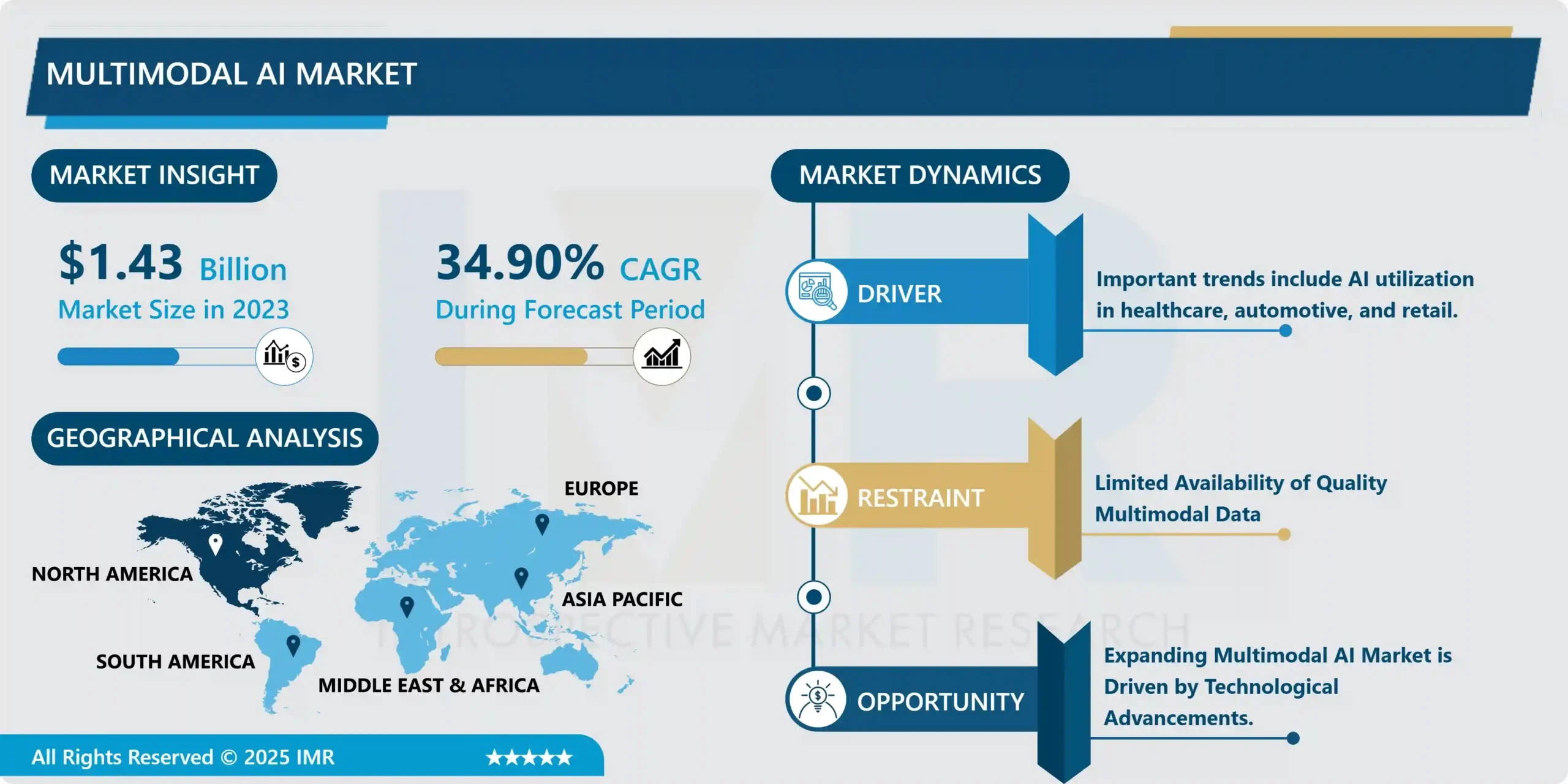
Multimodal AI Market Size Was Valued at USD 1.43 Billion in 2023 and is Projected to Reach USD 21.16 Billion by 2032, Growing at a CAGR of 34.9% From 2024-2032.
A multimodal model is an ML (machine learning) model that is capable of processing information from different modalities, including images, videos, and text. For example, Google’s multimodal model, Gemini, can receive a photo of a plate of cookies and generate a written recipe as a response and vice versa. Generative AI is an umbrella term for the use of ML models to create new content, like text, images, music, audio, and videos typically from a prompt of a single type. Multimodal AI expands on these generative capabilities, processing information from multiple modalities, including images, videos, and text. Multimodality can be thought of as giving AI the ability to process and understand different sensory modes. Practically this means users are not limited to one input and one output type and can prompt a model with virtually any input to generate virtually any content type.
The benefits of multimodal AI are that it offers developers and users an AI with more advanced reasoning, problem-solving, and generation capabilities. These advancements offer endless possibilities for how next-generation applications can change the way we work and live. For developers looking to start building, Vertex AI Gemini API offers features such as enterprise security, data residency, performance, and technical support. Existing Google Cloud customers can start prompting with Gemini in Vertex AI right now.
Multimodal AI Market Trend Analysis
Important trends include AI utilization in healthcare, automotive, and retail.
The multimodal AI market is quickly expanding because of technological advancements and wider adoption in various industries. There is a great need for AI solutions that can analyze data from different modes of input. Important trends involve the utilization of artificial intelligence in the healthcare sector to enhance diagnostics and treatment planning, in the automotive industry for self-driving vehicles, and in retail for tailored customer experiences. Cutting-edge AI models such as unified models and transformer-based models are currently under development.
The combination of Cloud and Edge AI is leading to the acceptance of multimodal AI in industries, enabling the implementation of scalable and convenient AI solutions without initial infrastructure expenses. The attention is also directed towards ethical AI practices, ensuring fairness, transparency, and explainability in AI systems in order to establish trust and adhere to regulations.
AI is currently improving human abilities in fields such as healthcare, education, and customer service through the provision of insights and the automation of tasks. AI systems that are aware of context are enhancing user experiences by providing personalized services, whereas multimodal interfaces enable more natural interactions through voice, gestures, and visual inputs.
Expanding Multimodal AI Market is Driven by Technological Advancements.
Multimodal AI is growing in the field of agriculture to enhance crop management and predict yields by utilizing data collected from drones and sensors. AI is improving project management and safety in construction by combining images and sensor information. Tailored AI solutions are being created for the finance, retail, manufacturing, and healthcare sectors to tackle specific obstacles and adhere to regulatory standards for small and medium-sized enterprises.
AIaaS platforms are expanding, simplifying the adoption of AI for businesses. AIaaS providers offer tailor-made solutions that allow for the development of additional sources of income. Partnerships among technology companies, businesses, and educational institutions are fueling advancements in multimodal artificial intelligence for self-driving cars, smart cities, and healthcare.
Progress in protecting data privacy and security is fueling the creation of AI solutions that safeguard privacy, such as federated learning and differential privacy methods. Adhering to international data protection laws can distinguish companies in the market. Advancements in AI hardware, like dedicated AI processors and the promise of quantum computing, are also influencing the direction of AI technology in the future.
Multimodal AI Market Segment Analysis:
Multimodal AI Market Segmented on the basis of Technology, Modality, Type, Offering, Industry Vertical, And End-User.
By Industry Vertical, BFSI Segment Is Expected to Dominate the Market During the Forecast Period
The BFSI industry uses a mix of AI technologies to detect fraud in real time by integrating different types of data such as transaction records, customer habits, and biometric information. It improves security by using voice recognition, facial recognition, and behavioral analytics. It also enhances customer service through virtual assistants and provides personalized financial products.
The use of multifaceted AI in risk management aids financial institutions in effectively evaluating risk by examining both structured and unstructured data. AI systems help with following regulations by monitoring large amounts of data to minimize fines. AI analyzes data in algorithmic trading for smart decisions, while sentiment analysis forecasts market trends.
AI improves customer onboarding and KYC by confirming identity with different data points. AI enhances fraud detection by identifying discrepancies. Forecasting analytics help in determining credit ratings and making investment choices. AI also improves customer satisfaction and efficiency in operations, resulting in market dominance and innovation in the BFSI industry through partnerships and collaborations.
By Offering, Solutions Segment Held the Largest Share In 2023
End-to-end solutions and customization make the solutions segment the leading force in the multimodal AI market. The accessibility of these solutions, along with their plug-and-play features and ability to grow, is attractive to businesses of any size looking to utilize AI in different ways.
Multimodal AI solutions effortlessly merge with existing systems, backing cross-platform integration and applications tailored to specific industries. Service providers offer industry-specific solutions that meet regulatory standards to cater to specific needs and stay ahead in different sectors.
AI solution providers provide continuous support, updates, and maintenance to ensure peak performance and flexibility in response to evolving business requirements. Constantly updating with new features using advancing AI technologies allows organizations to remain ahead of the curve. Multimodal AI solutions are highly proficient in integrating data, performing analysis, and making precise predictions. Advanced analytics abilities forecast future results and recommend best actions for improved decision-making, lowering expenses, and streamlining tasks.
Multimodal AI Market Regional Insights:
North America is Expected to Dominate the Market Over the Forecast Period
North America leads the multimodal AI market due to technological leadership and high investment levels. With top technology companies like Google and Microsoft driving innovation, the region’s advanced research institutions and strong funding support fuel the development of cutting-edge multimodal AI solutions. Government initiatives further contribute to maintaining leadership in key sectors.
The BFSI sector, healthcare, and retail industries in North America are enthusiastic users of multimodal AI, employing it for tasks like fraud prevention, medical imaging, and improving customer experiences. The area is advantaged by a proficient pool of AI professionals, backed by high-quality educational establishments which produce graduates who help boost the AI industry. Moreover, the advanced IT infrastructure and flourishing tech ecosystem in North America support the growth and expansion of AI solutions. As regulations change, there are attempts to establish structures that blend creativity with ethical factors, guaranteeing responsible advancement and application of diverse AI technologies.
Businesses in North America are motivated to invest in multimodal AI solutions due to consumer knowledge and market requirements. Businesses across different industries understand the benefits of AI and are increasingly incorporating it into their operations to gain a competitive edge. Effective partnerships between academia and industry, as well as collaborations across different industries, play a key role in quickly bringing research results into the market as AI products. North America leads the way in setting global standards for AI technologies and exporting AI solutions, cementing its position as a leader in the multimodal AI market.
Multimodal AI Market Active Players
Google (USA)
Microsoft (USA)
Amazon (USA)
IBM (USA)
Apple (USA)
Meta (Facebook) (USA)
OpenAI (USA)
NVIDIA (USA)
Tesla (USA)
Salesforce (USA)
Baidu (China)
Tencent (China)
Alibaba (China)
SenseTime (China)
Huawei (China)
Samsung (South Korea)
LG AI Research (South Korea)
Sony AI (Japan)
Fujitsu (Japan)
Hitachi (Japan)
DeepMind (UK)
Graphcore (UK)
Arm Holdings (UK)
Siemens (Germany)
SAP (Germany)
Ericsson (Sweden)
Philips (Netherlands)
Thales (France)
Capgemini (France)
Infosys (India) and Other Active Players.
Key Industry Developments in the Multimodal AI Market:
In April 2023, JARVIS, a multimodal AI-powered platform, was introduced by Microsoft Corporation. JARVIS is designed to work together and establish connections with several AI models, including ChatGPT and t5-base. Huggingface, an AI platform, allows users to take a JARVIS demo. JARVIS extends OpenAI’s GPT-4 multimodal capabilities, as demonstrated through text and image processing, by adding several open-source LLMs for images, videos, audio, and more.
In August 2023, the Modern AI translation model SeamlessM4T from Meta Platform Inc. is excellent at translating between multiple languages and modes. Through a research license, the company has made this solution available to researchers and developers, allowing them to take advantage of the platform and enable smooth cross-language text and speech communication. In addition to speech-to-speech translation support for 100 input and 30 output languages, SeamlessM4T offers speech-to-text translation capabilities for over 100 input and output languages.
Chapter 1: Introduction
1.1 Scope and Coverage
Chapter 2:Executive Summary
Chapter 3: Market Landscape
3.1 Market Dynamics
3.1.1 Drivers
3.1.2 Restraints
3.1.3 Opportunities
3.1.4 Challenges
3.2 Market Trend Analysis
3.3 PESTLE Analysis
3.4 Porter’s Five Forces Analysis
3.5 Industry Value Chain Analysis
3.6 Ecosystem
3.7 Regulatory Landscape
3.8 Price Trend Analysis
3.9 Patent Analysis
3.10 Technology Evolution
3.11 Investment Pockets
3.12 Import-Export Analysis
Chapter 4: Multimodal AI Market by Technology (2018-2032)
4.1 Multimodal AI Market Snapshot and Growth Engine
4.2 Market Overview
4.3 Machine Learning {ML}
4.3.1 Introduction and Market Overview
4.3.2 Historic and Forecasted Market Size in Value USD and Volume Units
4.3.3 Key Market Trends, Growth Factors, and Opportunities
4.3.4 Geographic Segmentation Analysis
4.4 Natural Language Processing {NLP}
4.5 Computer Vision
4.6 Speech Recognition
4.7 Generative AI
Chapter 5: Multimodal AI Market by Modality (2018-2032)
5.1 Multimodal AI Market Snapshot and Growth Engine
5.2 Market Overview
5.3 Text-based
5.3.1 Introduction and Market Overview
5.3.2 Historic and Forecasted Market Size in Value USD and Volume Units
5.3.3 Key Market Trends, Growth Factors, and Opportunities
5.3.4 Geographic Segmentation Analysis
5.4 Image-based
5.5 Audio-based
5.6 Video-based
5.7 Sensor-based
Chapter 6: Multimodal AI Market by Type (2018-2032)
6.1 Multimodal AI Market Snapshot and Growth Engine
6.2 Market Overview
6.3 Generative
6.3.1 Introduction and Market Overview
6.3.2 Historic and Forecasted Market Size in Value USD and Volume Units
6.3.3 Key Market Trends, Growth Factors, and Opportunities
6.3.4 Geographic Segmentation Analysis
6.4 Translative
6.5 Explanatory
6.6 Interactive
Chapter 7: Multimodal AI Market by Offering (2018-2032)
7.1 Multimodal AI Market Snapshot and Growth Engine
7.2 Market Overview
7.3 Solutions
7.3.1 Introduction and Market Overview
7.3.2 Historic and Forecasted Market Size in Value USD and Volume Units
7.3.3 Key Market Trends, Growth Factors, and Opportunities
7.3.4 Geographic Segmentation Analysis
7.4 Services
Chapter 8: Multimodal AI Market by Industry Vertical (2018-2032)
8.1 Multimodal AI Market Snapshot and Growth Engine
8.2 Market Overview
8.3 BFSI
8.3.1 Introduction and Market Overview
8.3.2 Historic and Forecasted Market Size in Value USD and Volume Units
8.3.3 Key Market Trends, Growth Factors, and Opportunities
8.3.4 Geographic Segmentation Analysis
8.4 Healthcare
8.5 Media & Entertainment
8.6 Automotive & Transportation
8.7 IT & Telecommunication
8.8 Energy & Utilities
Chapter 9: Multimodal AI Market by End-User (2018-2032)
9.1 Multimodal AI Market Snapshot and Growth Engine
9.2 Market Overview
9.3 Large Enterprises
9.3.1 Introduction and Market Overview
9.3.2 Historic and Forecasted Market Size in Value USD and Volume Units
9.3.3 Key Market Trends, Growth Factors, and Opportunities
9.3.4 Geographic Segmentation Analysis
9.4 Small & Medium Enterprises {SMEs}
9.5 Public Sector
Chapter 10: Company Profiles and Competitive Analysis
10.1 Competitive Landscape
10.1.1 Competitive Benchmarking
10.1.2 Multimodal AI Market Share by Manufacturer (2024)
10.1.3 Industry BCG Matrix
10.1.4 Heat Map Analysis
10.1.5 Mergers and Acquisitions
10.2 GOOGLE (USA)
10.2.1 Company Overview
10.2.2 Key Executives
10.2.3 Company Snapshot
10.2.4 Role of the Company in the Market
10.2.5 Sustainability and Social Responsibility
10.2.6 Operating Business Segments
10.2.7 Product Portfolio
10.2.8 Business Performance
10.2.9 Key Strategic Moves and Recent Developments
10.2.10 SWOT Analysis
10.3 MICROSOFT (USA)
10.4 AMAZON (USA)
10.5 IBM (USA)
10.6 APPLE (USA)
10.7 META (FACEBOOK) (USA)
10.8 OPENAI (USA)
10.9 NVIDIA (USA)
10.10 TESLA (USA)
10.11 SALESFORCE (USA)
10.12 BAIDU (CHINA)
10.13 TENCENT (CHINA)
10.14 ALIBABA (CHINA)
10.15 SENSETIME (CHINA)
10.16 HUAWEI (CHINA)
10.17 SAMSUNG (SOUTH KOREA)
10.18 LG AI RESEARCH (SOUTH KOREA)
10.19 SONY AI (JAPAN)
10.20 FUJITSU (JAPAN)
10.21 HITACHI (JAPAN)
10.22 DEEPMIND (UK)
10.23 GRAPHCORE (UK)
10.24 ARM HOLDINGS (UK)
10.25 SIEMENS (GERMANY)
10.26 SAP (GERMANY)
10.27 ERICSSON (SWEDEN)
10.28 PHILIPS (NETHERLANDS)
10.29 THALES (FRANCE)
10.30 CAPGEMINI (FRANCE)
10.31 INFOSYS (INDIA)
Chapter 11: Global Multimodal AI Market By Region
11.1 Overview
11.2. North America Multimodal AI Market
11.2.1 Key Market Trends, Growth Factors and Opportunities
11.2.2 Top Key Companies
11.2.3 Historic and Forecasted Market Size by Segments
11.2.4 Historic and Forecasted Market Size by Technology
11.2.4.1 Machine Learning {ML}
11.2.4.2 Natural Language Processing {NLP}
11.2.4.3 Computer Vision
11.2.4.4 Speech Recognition
11.2.4.5 Generative AI
11.2.5 Historic and Forecasted Market Size by Modality
11.2.5.1 Text-based
11.2.5.2 Image-based
11.2.5.3 Audio-based
11.2.5.4 Video-based
11.2.5.5 Sensor-based
11.2.6 Historic and Forecasted Market Size by Type
11.2.6.1 Generative
11.2.6.2 Translative
11.2.6.3 Explanatory
11.2.6.4 Interactive
11.2.7 Historic and Forecasted Market Size by Offering
11.2.7.1 Solutions
11.2.7.2 Services
11.2.8 Historic and Forecasted Market Size by Industry Vertical
11.2.8.1 BFSI
11.2.8.2 Healthcare
11.2.8.3 Media & Entertainment
11.2.8.4 Automotive & Transportation
11.2.8.5 IT & Telecommunication
11.2.8.6 Energy & Utilities
11.2.9 Historic and Forecasted Market Size by End-User
11.2.9.1 Large Enterprises
11.2.9.2 Small & Medium Enterprises {SMEs}
11.2.9.3 Public Sector
11.2.10 Historic and Forecast Market Size by Country
11.2.10.1 US
11.2.10.2 Canada
11.2.10.3 Mexico
11.3. Eastern Europe Multimodal AI Market
11.3.1 Key Market Trends, Growth Factors and Opportunities
11.3.2 Top Key Companies
11.3.3 Historic and Forecasted Market Size by Segments
11.3.4 Historic and Forecasted Market Size by Technology
11.3.4.1 Machine Learning {ML}
11.3.4.2 Natural Language Processing {NLP}
11.3.4.3 Computer Vision
11.3.4.4 Speech Recognition
11.3.4.5 Generative AI
11.3.5 Historic and Forecasted Market Size by Modality
11.3.5.1 Text-based
11.3.5.2 Image-based
11.3.5.3 Audio-based
11.3.5.4 Video-based
11.3.5.5 Sensor-based
11.3.6 Historic and Forecasted Market Size by Type
11.3.6.1 Generative
11.3.6.2 Translative
11.3.6.3 Explanatory
11.3.6.4 Interactive
11.3.7 Historic and Forecasted Market Size by Offering
11.3.7.1 Solutions
11.3.7.2 Services
11.3.8 Historic and Forecasted Market Size by Industry Vertical
11.3.8.1 BFSI
11.3.8.2 Healthcare
11.3.8.3 Media & Entertainment
11.3.8.4 Automotive & Transportation
11.3.8.5 IT & Telecommunication
11.3.8.6 Energy & Utilities
11.3.9 Historic and Forecasted Market Size by End-User
11.3.9.1 Large Enterprises
11.3.9.2 Small & Medium Enterprises {SMEs}
11.3.9.3 Public Sector
11.3.10 Historic and Forecast Market Size by Country
11.3.10.1 Russia
11.3.10.2 Bulgaria
11.3.10.3 The Czech Republic
11.3.10.4 Hungary
11.3.10.5 Poland
11.3.10.6 Romania
11.3.10.7 Rest of Eastern Europe
11.4. Western Europe Multimodal AI Market
11.4.1 Key Market Trends, Growth Factors and Opportunities
11.4.2 Top Key Companies
11.4.3 Historic and Forecasted Market Size by Segments
11.4.4 Historic and Forecasted Market Size by Technology
11.4.4.1 Machine Learning {ML}
11.4.4.2 Natural Language Processing {NLP}
11.4.4.3 Computer Vision
11.4.4.4 Speech Recognition
11.4.4.5 Generative AI
11.4.5 Historic and Forecasted Market Size by Modality
11.4.5.1 Text-based
11.4.5.2 Image-based
11.4.5.3 Audio-based
11.4.5.4 Video-based
11.4.5.5 Sensor-based
11.4.6 Historic and Forecasted Market Size by Type
11.4.6.1 Generative
11.4.6.2 Translative
11.4.6.3 Explanatory
11.4.6.4 Interactive
11.4.7 Historic and Forecasted Market Size by Offering
11.4.7.1 Solutions
11.4.7.2 Services
11.4.8 Historic and Forecasted Market Size by Industry Vertical
11.4.8.1 BFSI
11.4.8.2 Healthcare
11.4.8.3 Media & Entertainment
11.4.8.4 Automotive & Transportation
11.4.8.5 IT & Telecommunication
11.4.8.6 Energy & Utilities
11.4.9 Historic and Forecasted Market Size by End-User
11.4.9.1 Large Enterprises
11.4.9.2 Small & Medium Enterprises {SMEs}
11.4.9.3 Public Sector
11.4.10 Historic and Forecast Market Size by Country
11.4.10.1 Germany
11.4.10.2 UK
11.4.10.3 France
11.4.10.4 The Netherlands
11.4.10.5 Italy
11.4.10.6 Spain
11.4.10.7 Rest of Western Europe
11.5. Asia Pacific Multimodal AI Market
11.5.1 Key Market Trends, Growth Factors and Opportunities
11.5.2 Top Key Companies
11.5.3 Historic and Forecasted Market Size by Segments
11.5.4 Historic and Forecasted Market Size by Technology
11.5.4.1 Machine Learning {ML}
11.5.4.2 Natural Language Processing {NLP}
11.5.4.3 Computer Vision
11.5.4.4 Speech Recognition
11.5.4.5 Generative AI
11.5.5 Historic and Forecasted Market Size by Modality
11.5.5.1 Text-based
11.5.5.2 Image-based
11.5.5.3 Audio-based
11.5.5.4 Video-based
11.5.5.5 Sensor-based
11.5.6 Historic and Forecasted Market Size by Type
11.5.6.1 Generative
11.5.6.2 Translative
11.5.6.3 Explanatory
11.5.6.4 Interactive
11.5.7 Historic and Forecasted Market Size by Offering
11.5.7.1 Solutions
11.5.7.2 Services
11.5.8 Historic and Forecasted Market Size by Industry Vertical
11.5.8.1 BFSI
11.5.8.2 Healthcare
11.5.8.3 Media & Entertainment
11.5.8.4 Automotive & Transportation
11.5.8.5 IT & Telecommunication
11.5.8.6 Energy & Utilities
11.5.9 Historic and Forecasted Market Size by End-User
11.5.9.1 Large Enterprises
11.5.9.2 Small & Medium Enterprises {SMEs}
11.5.9.3 Public Sector
11.5.10 Historic and Forecast Market Size by Country
11.5.10.1 China
11.5.10.2 India
11.5.10.3 Japan
11.5.10.4 South Korea
11.5.10.5 Malaysia
11.5.10.6 Thailand
11.5.10.7 Vietnam
11.5.10.8 The Philippines
11.5.10.9 Australia
11.5.10.10 New Zealand
11.5.10.11 Rest of APAC
11.6. Middle East & Africa Multimodal AI Market
11.6.1 Key Market Trends, Growth Factors and Opportunities
11.6.2 Top Key Companies
11.6.3 Historic and Forecasted Market Size by Segments
11.6.4 Historic and Forecasted Market Size by Technology
11.6.4.1 Machine Learning {ML}
11.6.4.2 Natural Language Processing {NLP}
11.6.4.3 Computer Vision
11.6.4.4 Speech Recognition
11.6.4.5 Generative AI
11.6.5 Historic and Forecasted Market Size by Modality
11.6.5.1 Text-based
11.6.5.2 Image-based
11.6.5.3 Audio-based
11.6.5.4 Video-based
11.6.5.5 Sensor-based
11.6.6 Historic and Forecasted Market Size by Type
11.6.6.1 Generative
11.6.6.2 Translative
11.6.6.3 Explanatory
11.6.6.4 Interactive
11.6.7 Historic and Forecasted Market Size by Offering
11.6.7.1 Solutions
11.6.7.2 Services
11.6.8 Historic and Forecasted Market Size by Industry Vertical
11.6.8.1 BFSI
11.6.8.2 Healthcare
11.6.8.3 Media & Entertainment
11.6.8.4 Automotive & Transportation
11.6.8.5 IT & Telecommunication
11.6.8.6 Energy & Utilities
11.6.9 Historic and Forecasted Market Size by End-User
11.6.9.1 Large Enterprises
11.6.9.2 Small & Medium Enterprises {SMEs}
11.6.9.3 Public Sector
11.6.10 Historic and Forecast Market Size by Country
11.6.10.1 Turkiye
11.6.10.2 Bahrain
11.6.10.3 Kuwait
11.6.10.4 Saudi Arabia
11.6.10.5 Qatar
11.6.10.6 UAE
11.6.10.7 Israel
11.6.10.8 South Africa
11.7. South America Multimodal AI Market
11.7.1 Key Market Trends, Growth Factors and Opportunities
11.7.2 Top Key Companies
11.7.3 Historic and Forecasted Market Size by Segments
11.7.4 Historic and Forecasted Market Size by Technology
11.7.4.1 Machine Learning {ML}
11.7.4.2 Natural Language Processing {NLP}
11.7.4.3 Computer Vision
11.7.4.4 Speech Recognition
11.7.4.5 Generative AI
11.7.5 Historic and Forecasted Market Size by Modality
11.7.5.1 Text-based
11.7.5.2 Image-based
11.7.5.3 Audio-based
11.7.5.4 Video-based
11.7.5.5 Sensor-based
11.7.6 Historic and Forecasted Market Size by Type
11.7.6.1 Generative
11.7.6.2 Translative
11.7.6.3 Explanatory
11.7.6.4 Interactive
11.7.7 Historic and Forecasted Market Size by Offering
11.7.7.1 Solutions
11.7.7.2 Services
11.7.8 Historic and Forecasted Market Size by Industry Vertical
11.7.8.1 BFSI
11.7.8.2 Healthcare
11.7.8.3 Media & Entertainment
11.7.8.4 Automotive & Transportation
11.7.8.5 IT & Telecommunication
11.7.8.6 Energy & Utilities
11.7.9 Historic and Forecasted Market Size by End-User
11.7.9.1 Large Enterprises
11.7.9.2 Small & Medium Enterprises {SMEs}
11.7.9.3 Public Sector
11.7.10 Historic and Forecast Market Size by Country
11.7.10.1 Brazil
11.7.10.2 Argentina
11.7.10.3 Rest of SA
Chapter 12 Analyst Viewpoint and Conclusion
12.1 Recommendations and Concluding Analysis
12.2 Potential Market Strategies
Chapter 13 Research Methodology
13.1 Research Process
13.2 Primary Research
13.3 Secondary Research
Q1: What would be the forecast period in the Multimodal AI Market research report?
A1: The forecast period in the Multimodal AI Market research report is 2024-2032.
Q2: Who are the key players in the Multimodal AI Market?
A2: Google (USA), Microsoft (USA), Amazon (USA), IBM (USA), Apple (USA), Meta (Facebook) (USA), OpenAI (USA), NVIDIA (USA), Tesla (USA), Salesforce (USA), Baidu (China), Tencent (China), Alibaba (China), SenseTime (China), Huawei (China), Samsung (South Korea), LG AI Research (South Korea), Sony AI (Japan), Fujitsu (Japan), Hitachi (Japan), DeepMind (UK), Graphcore (UK), Arm Holdings (UK), Siemens (Germany), SAP (Germany), Ericsson (Sweden), Philips (Netherlands), Thales (France), Capgemini (France), Infosys (India) and Other Active Players.
Q3: What is the Multimodal AI Market?
A3: A multimodal model is a ML (machine learning) model that is capable of processing information from different modalities, including images, videos, and text. For example, Google's multimodal model, Gemini, can receive a photo of a plate of cookies and generate a written recipe as a response and vice versa.
Q4: How big is the Multimodal AI Market?
A4: Multimodal AI Market Size Was Valued at USD 1.43 Billion in 2023 and is Projected to Reach USD 21.16 Billion by 2032, Growing at a CAGR of 34.9% From 2024-2032.
Q5: What are the segments of the Multimodal AI Market?
A5: The Multimodal AI Market is segmented across a diverse range of technologies, modalities, types, offerings, industry verticals, end-users, and regions to provide a comprehensive understanding of its scope. By technology, the market includes Machine Learning (ML), Natural Language Processing (NLP), Computer Vision, Speech Recognition, and Generative AI. In terms of modality, AI solutions are categorized as text-based, image-based, audio-based, video-based, and sensor-based. Based on type, AI applications are classified into generative, translative, explanatory, and interactive models. The market is further divided by offering into solutions and services. Key industry verticals leveraging AI include BFSI, healthcare, media & entertainment, automotive & transportation, IT & telecommunication, and energy & utilities. By end-user, the segmentation includes large enterprises, small & medium enterprises (SMEs), and the public sector. By region, it is analyzed across North America (U.S., Canada, Mexico), Eastern Europe (Russia, Bulgaria, The Czech Republic, Hungary, Poland, Romania, Rest of Eastern Europe), Western Europe (Germany, UK, France, The Netherlands, Italy, Spain, Rest of Western Europe), Asia Pacific (China, India, Japan, South Korea, Malaysia, Thailand, Vietnam, The Philippines, Australia, New-Zealand, Rest of APAC), Middle East & Africa (Turkiye, Bahrain, Kuwait, Saudi Arabia, Qatar, UAE, Israel, South Africa), South America (Brazil, Argentina, Rest of SA).
How to Buy a Report from eminsights.jp
On the product page, choose the license you want: Single-User License, Multi-User License or Enterprise License.
If you required report in your native language, then you can click on Translated Report button and fill out the form with report name and language you want, then our team will contact you as soon as possible.
Click the Buy Now button.
You will be redirected to the checkout page. Enter your company details and payment information.
Click Place Order to complete the purchase.
Confirmation: You’ll receive an order confirmation and our team will contact you shortly with your ordered report.
If you have any questions, fill out the contact form below or email us at bizdev@eminsights.net.
Thank you for choosing eminsights.jp!