Stay Ahead in Fast-Growing Economies.
Browse Reports Now
Motorcycle Antilock Braking System (ABS) Market Report
The Motorcycle Antilock Braking System (ABS) Market refers to the segment of the automotive industry focused on producing, implementing, and enhancing ABS technology specifically tailored for motorcycles. ABS is a safety feature designed to prevent wheels from locking up during braking, thereby maintaining traction and stability on the road.

IMR Group
Description
Motorcycle Antilock Braking System (ABS) Market Overview
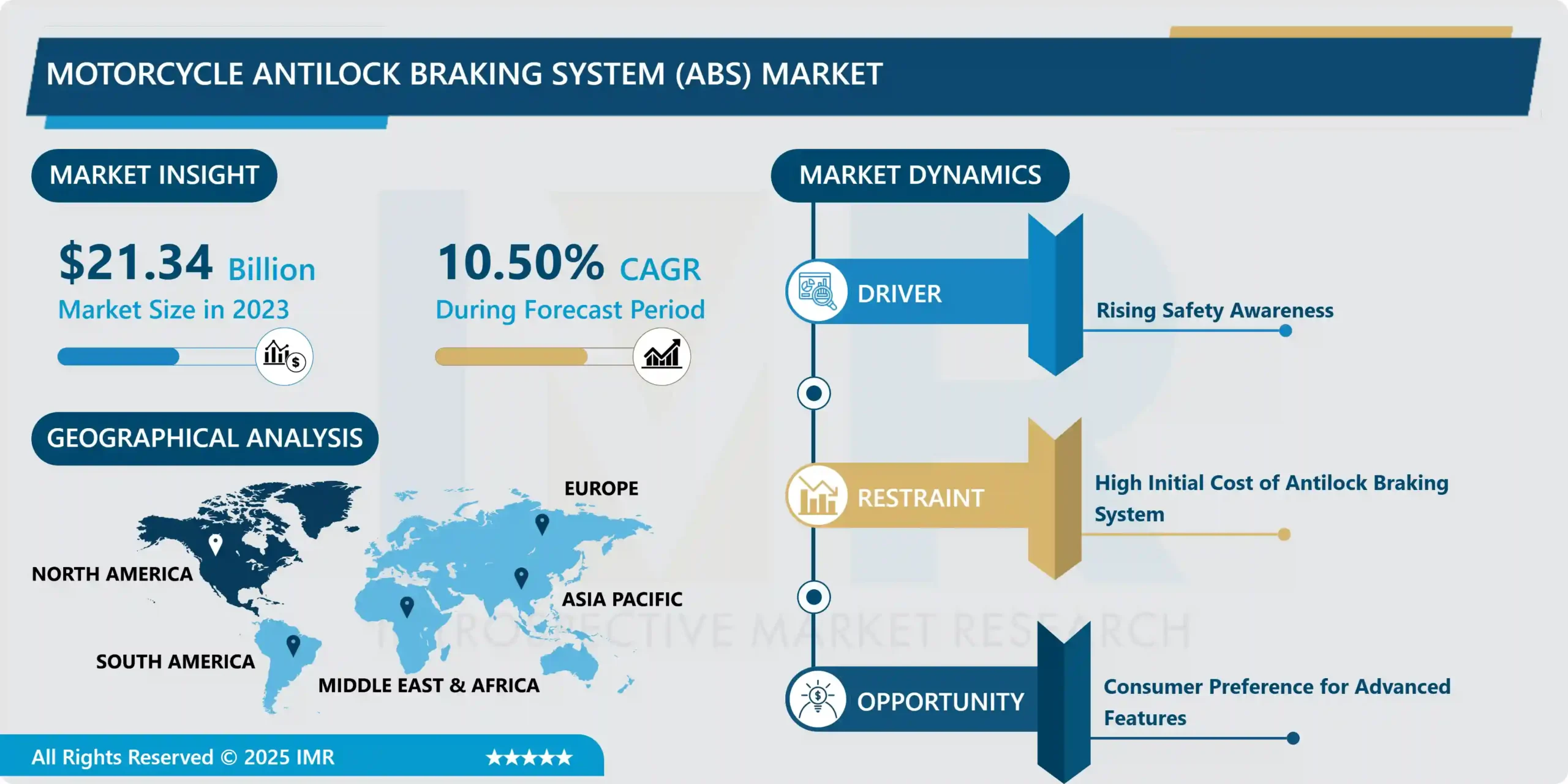
Motorcycle Antilock Braking System (ABS) Market size is expected to grow from USD 21.34 Billion in 2023 to USD 52.41 Billion by 2032, at a CAGR of 10.5% during the forecast period (2024-2032).
The Motorcycle Antilock Braking System (ABS) Market refers to the segment of the automotive industry focused on producing, implementing, and enhancing ABS technology specifically tailored for motorcycles. ABS is a safety feature designed to prevent wheels from locking up during braking, thereby maintaining traction and stability on the road.
This system works by modulating brake pressure to each wheel independently, ensuring that the rider can maintain control and maneuverability even in emergency braking situations or slippery road conditions. The Motorcycle ABS Market encompasses a range of manufacturers, suppliers, and innovators striving to improve rider safety through the advancement and adoption of ABS technology in motorcycles.
Safety features become important in the motorcycle industry as riders actively seek advanced mechanisms to mitigate risks associated with abrupt braking. Global rules and regulation frameworks are influencing the market. Motorcycle manufacturers are increasing the ABS systems in their models.
The global Motorcycle ABS market is rising along with technological innovations, with manufacturers investing in research and development to introduce advanced ABS systems featuring enhanced performance, responsiveness, and adaptability to diverse riding conditions.
The Motorcycle ABS market is experiencing growth in focus with rider safety and regulation for safety features, and continuous technological advancements. The integration of ABS systems in motorcycles has become important due to improved rider safety and road safety standards.
Motorcycle Antilock Braking System (ABS) Market Trend Analysis:
Rising Safety Awareness
The Motorcycle Antilock Braking System (ABS) market is growing due to increased safety awareness among riders. ABS technology prevents wheel lock-up during braking, ensuring optimal traction and stability driving the demand for advanced safety features in motorcycles. Safety Awareness has transformed ABS from a desirable feature to a fundamental component in the motorcycle industry. Motorcycle enthusiasts and safety-conscious consumers actively seek ABS-equipped bikes, prompting manufacturers to make ABS a standard feature in their models. The evolving perception of ABS as a vital safety mechanism aligns with the broader trend of prioritizing rider safety, contributing significantly to the market’s growth.
Consumer Preference for Advanced Features
Consumer preference for advanced features represents a significant opportunity factor for the Motorcycle Antilock Braking System (ABS) Market. Consumers are increasingly valuing safety and technological advancements in their vehicles, and the demand for motorcycles equipped with ABS has seen a prominent growth. Modern consumers are more conscious about their well-being on the road, and ABS has emerged as a key safety feature that enhances braking performance and overall motorcycle safety.
The growing awareness of the benefits of ABS, such as preventing wheel lock-up during sudden braking, gives consumers confidence in their ability to handle diverse riding conditions. Motorcycle manufacturers gain a competitive advantage by aligning products with evolving consumer preferences for enhanced safety features. The changing mindset drives market growth for ABS systems, prompting manufacturers to include them as standard or optional features in a broader range of models
Motorcycle Antilock Braking System (ABS) Market Segment Analysis:
Motorcycle Antilock Braking System (ABS) Market Segmented based on Type, Motorcycle type, Component, Technology, Distribution Channel and End-user
By Type, Large Displacement segment is expected to dominate the market during the forecast Period
Larger displacement motorcycles are associated with higher-performance machines, appealing to motorcycle enthusiasts who prioritize power and advanced features. These motorcycles are favored for long-distance touring, cruising, and sports riding, contributing to a robust market demand. The Large Displacement segment is linked to premium and luxury motorcycle categories, where riders are willing to invest in cutting-edge technology and top-notch performance. The demand for these high-end motorcycles is obsessed by a combination of the thrill-seeking desires of riders and the perception of larger displacement bikes as status symbols. Manufacturers in the Large Displacement segment goal to capitalize on consumers’ willingness to pay a premium for superior performance, comfort, and innovative features.
Motorcycle Antilock Braking System (ABS) Market Regional Insights:
Asia Pacific is expected to dominate the Market over the Forecast Period
Asia Pacific is expected to dominate the Motorcycle Antilock Braking System (ABS) market due to rising disposable incomes, urbanization, and a growing middle class, highlighting its crucial role in the global motorcycle industry. Countries like India, China, and Southeast Asian nations have witnessed a surge in motorcycle sales, fuelled by increasing urbanization and the need for affordable and efficient transportation. As the motorcycle market expands, the demand for safety features like ABS reflects a growing awareness of the importance of rider safety. Government initiatives and regulations are contributing to Asia Pacific’s dominance in the ABS market. Several countries in the region have implemented or are considering regulations that mandate the inclusion of ABS in motorcycles above a certain displacement. These regulatory pushes align with a broader global trend toward enhancing road safety and contribute to the widespread adoption of ABS in the region.
The motorcycle culture in Asia Pacific prioritizes performance and safety, leading to a growing demand for advanced safety features like ABS. Motorcycle manufacturers in the region are responding to the demand by integrating ABS into a wide range of models, from entry-level to premium bikes. The Asia Pacific dominates the Motorcycle ABS market due to its growing market, supportive government policies, and evolving safety-conscious consumer base. As the leader in motorcycle production and consumption, it can influence domestic and international market trends and determine ABS adoption.
Key Players Covered in Motorcycle Antilock Braking System (ABS) Market:
Bosch (Germany)
Continental (Germany)
Knorr-Bremse (Germany)
ZF Friedrichshafen (Germany)
BMW (Germany)
NXP (Netherlands)
Honda (Japan)
Aisin Corporation (Japan)
Hitachi (Japan)
Johnson Electric Group (China), and Other Major Players
Key Industry Developments in the Motorcycle Antilock Braking System (ABS) Market:
In October 2023, Hitachi Astemo, Ltd. will participate in EICMA 2023, a major global motorcycle exhibition in Milan, Italy, from November 7–12. The company will showcase diverse technologies and products, focusing on ADAS and EVs, to innovate motorcycles for carbon neutrality and enhanced comfort.
In August 2023 – Bosch, a global leader in technology and engineering solutions, proudly announces its groundbreaking range of modular Motorcycle Stability Control (MSC) solutions. These cutting-edge systems, tailored to diverse application needs, combine Advanced Braking Systems (ABS) with state-of-the-art Inertial Measurement Units (IMU) for unprecedented performance and safety.
Chapter 1: Introduction
1.1 Scope and Coverage
Chapter 2:Executive Summary
Chapter 3: Market Landscape
3.1 Market Dynamics
3.1.1 Drivers
3.1.2 Restraints
3.1.3 Opportunities
3.1.4 Challenges
3.2 Market Trend Analysis
3.3 PESTLE Analysis
3.4 Porter’s Five Forces Analysis
3.5 Industry Value Chain Analysis
3.6 Ecosystem
3.7 Regulatory Landscape
3.8 Price Trend Analysis
3.9 Patent Analysis
3.10 Technology Evolution
3.11 Investment Pockets
3.12 Import-Export Analysis
Chapter 4: Motorcycle Antilock Braking System (ABS) Market by Type (2018-2032)
4.1 Motorcycle Antilock Braking System (ABS) Market Snapshot and Growth Engine
4.2 Market Overview
4.3 Large Displacement
4.3.1 Introduction and Market Overview
4.3.2 Historic and Forecasted Market Size in Value USD and Volume Units
4.3.3 Key Market Trends, Growth Factors, and Opportunities
4.3.4 Geographic Segmentation Analysis
4.4 Small Displacement
Chapter 5: Motorcycle Antilock Braking System (ABS) Market by Motorcycle Type (2018-2032)
5.1 Motorcycle Antilock Braking System (ABS) Market Snapshot and Growth Engine
5.2 Market Overview
5.3 Sport Bikes
5.3.1 Introduction and Market Overview
5.3.2 Historic and Forecasted Market Size in Value USD and Volume Units
5.3.3 Key Market Trends, Growth Factors, and Opportunities
5.3.4 Geographic Segmentation Analysis
5.4 Touring Bikes
5.5 Off-road Motorcycles
5.6 Cruisers
Chapter 6: Motorcycle Antilock Braking System (ABS) Market by Component (2018-2032)
6.1 Motorcycle Antilock Braking System (ABS) Market Snapshot and Growth Engine
6.2 Market Overview
6.3 Sensors
6.3.1 Introduction and Market Overview
6.3.2 Historic and Forecasted Market Size in Value USD and Volume Units
6.3.3 Key Market Trends, Growth Factors, and Opportunities
6.3.4 Geographic Segmentation Analysis
6.4 Electronic Control Unit
6.5 Hydraulic Unit
Chapter 7: Motorcycle Antilock Braking System (ABS) Market by Technology (2018-2032)
7.1 Motorcycle Antilock Braking System (ABS) Market Snapshot and Growth Engine
7.2 Market Overview
7.3 Single Channel ABS
7.3.1 Introduction and Market Overview
7.3.2 Historic and Forecasted Market Size in Value USD and Volume Units
7.3.3 Key Market Trends, Growth Factors, and Opportunities
7.3.4 Geographic Segmentation Analysis
7.4 Dual Channel ABS
Chapter 8: Motorcycle Antilock Braking System (ABS) Market by Distribution Channel (2018-2032)
8.1 Motorcycle Antilock Braking System (ABS) Market Snapshot and Growth Engine
8.2 Market Overview
8.3 Online Retail
8.3.1 Introduction and Market Overview
8.3.2 Historic and Forecasted Market Size in Value USD and Volume Units
8.3.3 Key Market Trends, Growth Factors, and Opportunities
8.3.4 Geographic Segmentation Analysis
8.4 Offline Retail
Chapter 9: Motorcycle Antilock Braking System (ABS) Market by End-user (2018-2032)
9.1 Motorcycle Antilock Braking System (ABS) Market Snapshot and Growth Engine
9.2 Market Overview
9.3 OEM
9.3.1 Introduction and Market Overview
9.3.2 Historic and Forecasted Market Size in Value USD and Volume Units
9.3.3 Key Market Trends, Growth Factors, and Opportunities
9.3.4 Geographic Segmentation Analysis
9.4 Aftermarket
Chapter 10: Company Profiles and Competitive Analysis
10.1 Competitive Landscape
10.1.1 Competitive Benchmarking
10.1.2 Motorcycle Antilock Braking System (ABS) Market Share by Manufacturer (2024)
10.1.3 Industry BCG Matrix
10.1.4 Heat Map Analysis
10.1.5 Mergers and Acquisitions
10.2 AMERICAN SPIRALWELD PIPE COMPANY (U.S)
10.2.1 Company Overview
10.2.2 Key Executives
10.2.3 Company Snapshot
10.2.4 Role of the Company in the Market
10.2.5 Sustainability and Social Responsibility
10.2.6 Operating Business Segments
10.2.7 Product Portfolio
10.2.8 Business Performance
10.2.9 Key Strategic Moves and Recent Developments
10.2.10 SWOT Analysis
10.3 EVRAZ (U.K)
10.4 EUROPIPE GROUP (GERMANY)
10.5 BORUSAN MANNESMANN (TURKEY)
10.6 TENARIS (LUXEMBOURG)
10.7 BAOJI PETROLEUM STEEL PIPE (CHINA)
10.8 JFE (JAPAN)
10.9 JINDAL SAW LTD (INDIA)
10.10 ESSAR STEEL (INDIA)
10.11 JIANGSU YULONG STEEL PIPE (CHINA)
10.12 ZHEJIANG KINGLAND (CHINA)
10.13 SHENGLI OIL & GAS PIPE (CHINA)
10.14 CNPC BOHAI EQUIPMENT MANUFACTURING (CHINA)
10.15 CHU KONG PIPE (CHINA)
10.16 BAOSTEEL (CHINA)
10.17
Chapter 11: Global Motorcycle Antilock Braking System (ABS) Market By Region
11.1 Overview
11.2. North America Motorcycle Antilock Braking System (ABS) Market
11.2.1 Key Market Trends, Growth Factors and Opportunities
11.2.2 Top Key Companies
11.2.3 Historic and Forecasted Market Size by Segments
11.2.4 Historic and Forecasted Market Size by Type
11.2.4.1 Large Displacement
11.2.4.2 Small Displacement
11.2.5 Historic and Forecasted Market Size by Motorcycle Type
11.2.5.1 Sport Bikes
11.2.5.2 Touring Bikes
11.2.5.3 Off-road Motorcycles
11.2.5.4 Cruisers
11.2.6 Historic and Forecasted Market Size by Component
11.2.6.1 Sensors
11.2.6.2 Electronic Control Unit
11.2.6.3 Hydraulic Unit
11.2.7 Historic and Forecasted Market Size by Technology
11.2.7.1 Single Channel ABS
11.2.7.2 Dual Channel ABS
11.2.8 Historic and Forecasted Market Size by Distribution Channel
11.2.8.1 Online Retail
11.2.8.2 Offline Retail
11.2.9 Historic and Forecasted Market Size by End-user
11.2.9.1 OEM
11.2.9.2 Aftermarket
11.2.10 Historic and Forecast Market Size by Country
11.2.10.1 US
11.2.10.2 Canada
11.2.10.3 Mexico
11.3. Eastern Europe Motorcycle Antilock Braking System (ABS) Market
11.3.1 Key Market Trends, Growth Factors and Opportunities
11.3.2 Top Key Companies
11.3.3 Historic and Forecasted Market Size by Segments
11.3.4 Historic and Forecasted Market Size by Type
11.3.4.1 Large Displacement
11.3.4.2 Small Displacement
11.3.5 Historic and Forecasted Market Size by Motorcycle Type
11.3.5.1 Sport Bikes
11.3.5.2 Touring Bikes
11.3.5.3 Off-road Motorcycles
11.3.5.4 Cruisers
11.3.6 Historic and Forecasted Market Size by Component
11.3.6.1 Sensors
11.3.6.2 Electronic Control Unit
11.3.6.3 Hydraulic Unit
11.3.7 Historic and Forecasted Market Size by Technology
11.3.7.1 Single Channel ABS
11.3.7.2 Dual Channel ABS
11.3.8 Historic and Forecasted Market Size by Distribution Channel
11.3.8.1 Online Retail
11.3.8.2 Offline Retail
11.3.9 Historic and Forecasted Market Size by End-user
11.3.9.1 OEM
11.3.9.2 Aftermarket
11.3.10 Historic and Forecast Market Size by Country
11.3.10.1 Russia
11.3.10.2 Bulgaria
11.3.10.3 The Czech Republic
11.3.10.4 Hungary
11.3.10.5 Poland
11.3.10.6 Romania
11.3.10.7 Rest of Eastern Europe
11.4. Western Europe Motorcycle Antilock Braking System (ABS) Market
11.4.1 Key Market Trends, Growth Factors and Opportunities
11.4.2 Top Key Companies
11.4.3 Historic and Forecasted Market Size by Segments
11.4.4 Historic and Forecasted Market Size by Type
11.4.4.1 Large Displacement
11.4.4.2 Small Displacement
11.4.5 Historic and Forecasted Market Size by Motorcycle Type
11.4.5.1 Sport Bikes
11.4.5.2 Touring Bikes
11.4.5.3 Off-road Motorcycles
11.4.5.4 Cruisers
11.4.6 Historic and Forecasted Market Size by Component
11.4.6.1 Sensors
11.4.6.2 Electronic Control Unit
11.4.6.3 Hydraulic Unit
11.4.7 Historic and Forecasted Market Size by Technology
11.4.7.1 Single Channel ABS
11.4.7.2 Dual Channel ABS
11.4.8 Historic and Forecasted Market Size by Distribution Channel
11.4.8.1 Online Retail
11.4.8.2 Offline Retail
11.4.9 Historic and Forecasted Market Size by End-user
11.4.9.1 OEM
11.4.9.2 Aftermarket
11.4.10 Historic and Forecast Market Size by Country
11.4.10.1 Germany
11.4.10.2 UK
11.4.10.3 France
11.4.10.4 The Netherlands
11.4.10.5 Italy
11.4.10.6 Spain
11.4.10.7 Rest of Western Europe
11.5. Asia Pacific Motorcycle Antilock Braking System (ABS) Market
11.5.1 Key Market Trends, Growth Factors and Opportunities
11.5.2 Top Key Companies
11.5.3 Historic and Forecasted Market Size by Segments
11.5.4 Historic and Forecasted Market Size by Type
11.5.4.1 Large Displacement
11.5.4.2 Small Displacement
11.5.5 Historic and Forecasted Market Size by Motorcycle Type
11.5.5.1 Sport Bikes
11.5.5.2 Touring Bikes
11.5.5.3 Off-road Motorcycles
11.5.5.4 Cruisers
11.5.6 Historic and Forecasted Market Size by Component
11.5.6.1 Sensors
11.5.6.2 Electronic Control Unit
11.5.6.3 Hydraulic Unit
11.5.7 Historic and Forecasted Market Size by Technology
11.5.7.1 Single Channel ABS
11.5.7.2 Dual Channel ABS
11.5.8 Historic and Forecasted Market Size by Distribution Channel
11.5.8.1 Online Retail
11.5.8.2 Offline Retail
11.5.9 Historic and Forecasted Market Size by End-user
11.5.9.1 OEM
11.5.9.2 Aftermarket
11.5.10 Historic and Forecast Market Size by Country
11.5.10.1 China
11.5.10.2 India
11.5.10.3 Japan
11.5.10.4 South Korea
11.5.10.5 Malaysia
11.5.10.6 Thailand
11.5.10.7 Vietnam
11.5.10.8 The Philippines
11.5.10.9 Australia
11.5.10.10 New Zealand
11.5.10.11 Rest of APAC
11.6. Middle East & Africa Motorcycle Antilock Braking System (ABS) Market
11.6.1 Key Market Trends, Growth Factors and Opportunities
11.6.2 Top Key Companies
11.6.3 Historic and Forecasted Market Size by Segments
11.6.4 Historic and Forecasted Market Size by Type
11.6.4.1 Large Displacement
11.6.4.2 Small Displacement
11.6.5 Historic and Forecasted Market Size by Motorcycle Type
11.6.5.1 Sport Bikes
11.6.5.2 Touring Bikes
11.6.5.3 Off-road Motorcycles
11.6.5.4 Cruisers
11.6.6 Historic and Forecasted Market Size by Component
11.6.6.1 Sensors
11.6.6.2 Electronic Control Unit
11.6.6.3 Hydraulic Unit
11.6.7 Historic and Forecasted Market Size by Technology
11.6.7.1 Single Channel ABS
11.6.7.2 Dual Channel ABS
11.6.8 Historic and Forecasted Market Size by Distribution Channel
11.6.8.1 Online Retail
11.6.8.2 Offline Retail
11.6.9 Historic and Forecasted Market Size by End-user
11.6.9.1 OEM
11.6.9.2 Aftermarket
11.6.10 Historic and Forecast Market Size by Country
11.6.10.1 Turkiye
11.6.10.2 Bahrain
11.6.10.3 Kuwait
11.6.10.4 Saudi Arabia
11.6.10.5 Qatar
11.6.10.6 UAE
11.6.10.7 Israel
11.6.10.8 South Africa
11.7. South America Motorcycle Antilock Braking System (ABS) Market
11.7.1 Key Market Trends, Growth Factors and Opportunities
11.7.2 Top Key Companies
11.7.3 Historic and Forecasted Market Size by Segments
11.7.4 Historic and Forecasted Market Size by Type
11.7.4.1 Large Displacement
11.7.4.2 Small Displacement
11.7.5 Historic and Forecasted Market Size by Motorcycle Type
11.7.5.1 Sport Bikes
11.7.5.2 Touring Bikes
11.7.5.3 Off-road Motorcycles
11.7.5.4 Cruisers
11.7.6 Historic and Forecasted Market Size by Component
11.7.6.1 Sensors
11.7.6.2 Electronic Control Unit
11.7.6.3 Hydraulic Unit
11.7.7 Historic and Forecasted Market Size by Technology
11.7.7.1 Single Channel ABS
11.7.7.2 Dual Channel ABS
11.7.8 Historic and Forecasted Market Size by Distribution Channel
11.7.8.1 Online Retail
11.7.8.2 Offline Retail
11.7.9 Historic and Forecasted Market Size by End-user
11.7.9.1 OEM
11.7.9.2 Aftermarket
11.7.10 Historic and Forecast Market Size by Country
11.7.10.1 Brazil
11.7.10.2 Argentina
11.7.10.3 Rest of SA
Chapter 12 Analyst Viewpoint and Conclusion
12.1 Recommendations and Concluding Analysis
12.2 Potential Market Strategies
Chapter 13 Research Methodology
13.1 Research Process
13.2 Primary Research
13.3 Secondary Research
Q1: What would be the forecast period in the Motorcycle Antilock Braking System (ABS) Market research report?
A1: The forecast period in the Motorcycle Antilock Braking System (ABS) Market research report is 2024-2032.
Q2: Who are the key players in the Motorcycle Antilock Braking System (ABS) Market?
A2: Bosch (Germany), Continental (Germany), Knorr-Bremse (Germany), ZF Friedrichshafen (Germany), BMW (Germany), NXP (Netherlands), Honda (Japan), Aisin Corporation (Japan), Hitachi (Japan), and Johnson Electric Group (China), and Other Major Players.
Q3: What are the segments of the Motorcycle Antilock Braking System (ABS) Market?
A3: The Motorcycle Antilock Braking System (ABS) Market is segmented into Type, Motorcycle type, Component, Technology, Distribution Channel, End-user, and region. By Type, the market is categorized as Large Displacement and Small Displacement. By Motorcycle type, the market is categorized into Sport Bikes, Touring Bikes, Off-road Motorcycles and Cruisers. By Component, the market is categorized into Sensors, Electronic Control Units, and Hydraulic Units. By Technology, the market is categorized into Single Channel ABS and Dual Channel ABS. By Distribution Channel, the market is categorized into Online Retail and Offline Retail. By End-Users, the market is categorized into OEM and Aftermarket. By region, it is analyzed across North America (U.S.; Canada; Mexico), Eastern Europe (Bulgaria; The Czech Republic; Hungary; Poland; Romania; Rest of Eastern Europe), Western Europe (Germany; UK; France; Netherlands; Italy; Russia; Spain; Rest of Western Europe), Asia-Pacific (China; India; Japan; Southeast Asia, etc.), South America (Brazil; Argentina, etc.), Middle East & Africa (Saudi Arabia; South Africa, etc.).
Q4: What is the Motorcycle Antilock Braking System (ABS) Market?
A4: The Motorcycle Anti-Lock Braking System (ABS) is a safety feature designed to prevent wheel lock-up during braking, enhancing rider control and reducing the risk of accidents. ABS utilizes sensors to monitor wheel speed and automatically modulates brake pressure, preventing skidding and maintaining traction on slippery surfaces. The locking system intervenes by momentarily releasing and reapplying brake pressure, allowing the rider to maintain steering control.
Q5: How big is the Motorcycle Antilock Braking System (ABS) Market?
A5: Motorcycle Antilock Braking System (ABS) Market size is expected to grow from USD 21.34 Billion in 2023 to USD 52.41 Billion by 2032, at a CAGR of 10.5% during the forecast period (2024-2032).
How to Buy a Report from eminsights.jp
On the product page, choose the license you want: Single-User License, Multi-User License or Enterprise License.
If you required report in your native language, then you can click on Translated Report button and fill out the form with report name and language you want, then our team will contact you as soon as possible.
Click the Buy Now button.
You will be redirected to the checkout page. Enter your company details and payment information.
Click Place Order to complete the purchase.
Confirmation: You’ll receive an order confirmation and our team will contact you shortly with your ordered report.
If you have any questions, fill out the contact form below or email us at bizdev@eminsights.net.
Thank you for choosing eminsights.jp!