Stay Ahead in Fast-Growing Economies.
Browse Reports Now




Molybdenum Rod Market | Global Size, Share & Industry Trends 2024-2032
A molybdenum rod is a cylindrical piece of molybdenum, a metallic element with the chemical symbol Mo and atomic number 42. Molybdenum rods are known for their high melting point, excellent mechanical properties, and resistance to corrosion. They find extensive use in various applications such as aerospace, electrical contacts, heating elements, and as structural components in high-temperature environments due to their strength and ability to withstand extreme conditions.

IMR Group
Description
Molybdenum Rod Market Synopsis
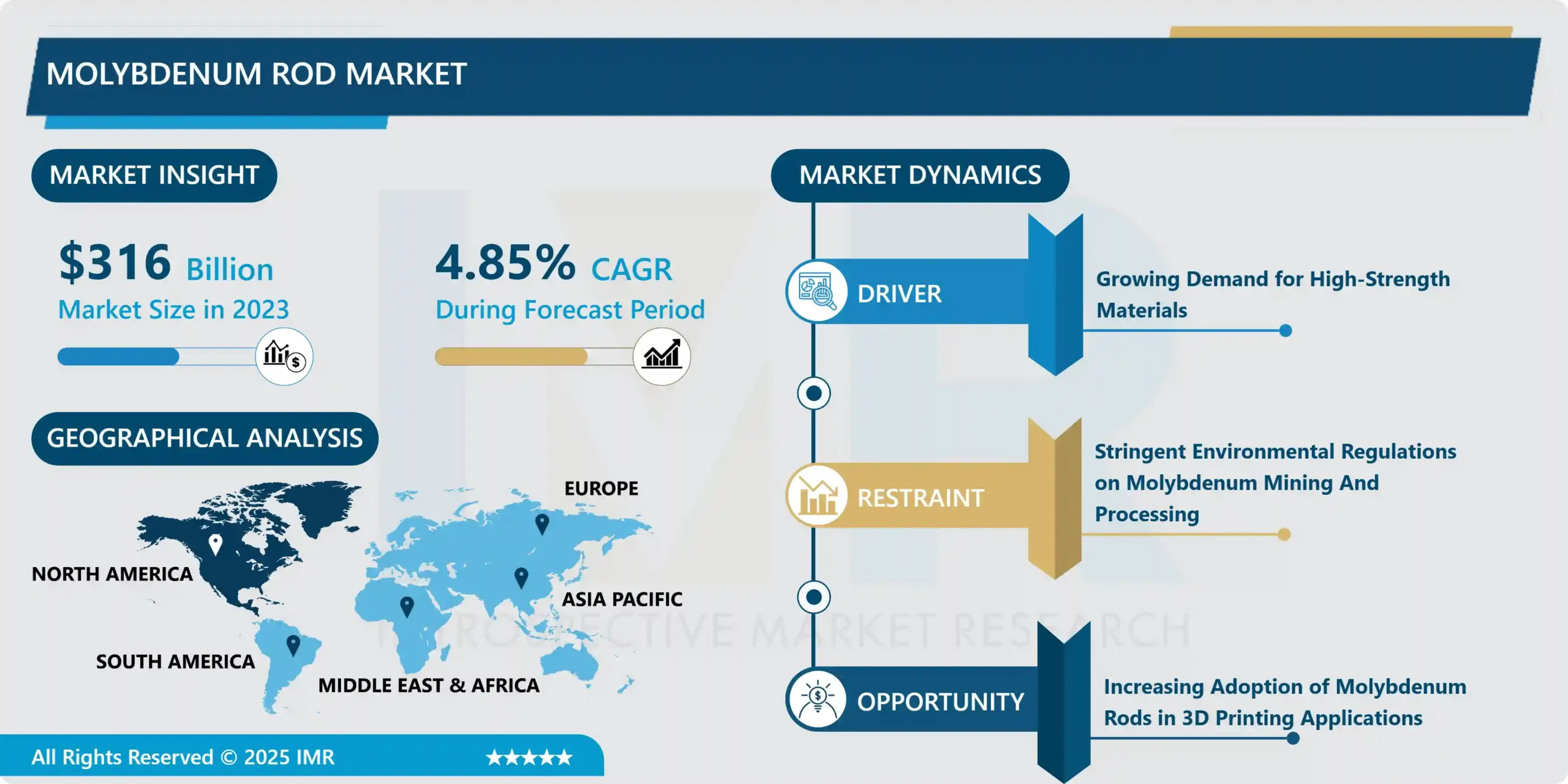
Molybdenum Rod Market Size Was Valued at USD 316 Billion in 2023, and is Projected to Reach USD 483.95 Billion by 2032, Growing at a CAGR of 4.85% From 2024-2032.
A molybdenum rod is a cylindrical piece of molybdenum, a metallic element with the chemical symbol Mo and atomic number 42. Molybdenum rods are known for their high melting point, excellent mechanical properties, and resistance to corrosion. They find extensive use in various applications such as aerospace, electrical contacts, heating elements, and as structural components in high-temperature environments due to their strength and ability to withstand extreme conditions.
The molybdenum rod market encompasses the production, distribution, and utilization of cylindrical molybdenum components across various industries worldwide. Molybdenum rods are sought after for their exceptional properties, including high melting point, strength, corrosion resistance, and thermal conductivity, making them indispensable in numerous applications.
These rods are utilized in aerospace components such as engine parts, structural elements, and high-temperature applications due to their ability to withstand extreme conditions encountered during flight.
Another key market for molybdenum rods is the electronics and electrical industry. Molybdenum rods are used in electrical contacts, heating elements, and semiconductor manufacturing due to their excellent electrical conductivity and resistance to thermal expansion.
The energy sector also plays a crucial role in the molybdenum rod market. Molybdenum rods are utilized in the production of equipment for oil and gas exploration, as well as in nuclear power plants due to their ability to withstand high temperatures and corrosive environments.
Furthermore, molybdenum rods find applications in chemical processing, automotive manufacturing, and medical devices, among others. As industries continue to demand materials capable of withstanding harsh conditions while maintaining reliability and performance, the molybdenum rod market is expected to witness steady growth.
Factors such as technological advancements, increased investments in infrastructure development, and the growing emphasis on renewable energy sources are anticipated to drive further expansion in the molybdenum rod market. The fluctuations in raw material prices and regulatory challenges may pose constraints to market growth in certain regions. The molybdenum rod market is poised for continued development, driven by its diverse range of applications and exceptional properties.
Molybdenum Rod Market Trend Analysis
Growing Demand for High-Strength Materials
The growing demand for high-strength materials is a significant driving force behind the expansion of the molybdenum rod market. As industries continue to push the boundaries of performance and efficiency, the need for materials capable of withstanding extreme conditions becomes increasingly crucial. Molybdenum, with its exceptional strength, durability, and resistance to corrosion, stands out as a preferred choice in various applications where reliability and performance are paramount.
In sectors such as aerospace, automotive, and construction, where safety and structural integrity are top priorities, molybdenum rods play a pivotal role. These rods are utilized in critical components such as aircraft engines, automotive parts, and high-rise buildings, where they enhance strength, reduce weight, and improve overall performance.
Moreover, the rapid advancements in technology and engineering are driving the demand for molybdenum rods even further. Emerging fields like renewable energy, electronics, and medical devices require materials that can withstand harsh environments and demanding operational conditions, further bolstering the market for molybdenum rods.
The global trend towards sustainable practices is amplifying the use of molybdenum in various green technologies such as wind turbines and electric vehicles, contributing to the market’s growth.
The growing demand for high-strength materials, coupled with the versatility and reliability of molybdenum rods, positions them as indispensable components across a wide range of industries, thereby fueling the expansion of the molybdenum rod market.
Increasing Adoption of Molybdenum Rods in 3D Printing Applications
The 3D printing continues to revolutionize manufacturing across various industries, the demand for high-performance materials compatible with this technology is on the rise. Molybdenum, known for its exceptional strength, high melting point, and excellent thermal conductivity, is an ideal material for 3D printing applications requiring precision, durability, and heat resistance. Molybdenum rods enable the production of intricate components with superior mechanical properties, making them indispensable in industries such as aerospace, automotive, healthcare, and electronics.
One of the key advantages of molybdenum rods in 3D printing is their ability to withstand extreme temperatures and harsh environments, ensuring the longevity and reliability of printed parts. This property makes them particularly suitable for aerospace and defense applications where components must endure rigorous operating conditions.
As 3D printing technology advances and becomes more accessible, the demand for molybdenum rods is expected to grow further. The versatility of 3D printing allows for the fabrication of complex geometries that traditional manufacturing methods struggle to achieve, opening up new possibilities for molybdenum rod usage in innovative designs and applications.
The synergy between molybdenum rods and 3D printing technology represents a compelling opportunity for manufacturers to expand their market presence and cater to the evolving needs of various industries seeking advanced materials for additive manufacturing processes.
Molybdenum Rod Market Segment Analysis:
Molybdenum Rod Market Segmented on the basis of Purity Level, End-User, and Distribution Channel.
By Purity Level, ?99.95% segment is expected to dominate the market during the forecast period
The segment characterized by a purity level of ?99.95% reigns supreme, commanding dominance due to its unparalleled quality and performance. This segment stands out as the preferred choice among consumers and industries alike, owing to its exceptional purity, which ensures optimal functionality and reliability in various applications.
With a purity level exceeding 99.95%, these molybdenum rods exhibit superior properties such as enhanced strength, durability, and corrosion resistance, making them indispensable in critical sectors such as aerospace, electronics, and manufacturing. Their exceptional purity level guarantees consistency and precision in performance, meeting the stringent demands of modern industrial processes and applications.
Furthermore, the dominance of this segment is reinforced by its ability to meet the evolving requirements of advanced technologies and innovations, driving its widespread adoption across diverse sectors globally. As a result, manufacturers and consumers gravitate towards molybdenum rods with ?99.95% purity, acknowledging their unmatched quality and value proposition in the market.
By End-User, Chemical Industry segment held the largest share of xx% in 2022
The Chemical Industry segment emerges as crucial role in various chemical processes owing to their exceptional corrosion resistance, high melting point, and strength properties. Within the chemical industry, molybdenum rods find extensive applications in catalysts, chemical reactors, and specialty chemicals production.
The demand within this segment is propelled by the relentless pursuit of innovation and efficiency in chemical manufacturing processes. Molybdenum rods enable the industry to withstand harsh operating conditions, ensuring enhanced productivity and longevity of equipment.
The stringent regulations regarding environmental sustainability drive the adoption of molybdenum rods, as they facilitate cleaner and more efficient chemical processes, reducing environmental impact.
Furthermore, advancements in chemical processing technologies continually expand the applications of molybdenum rods, fostering their integration into diverse chemical operations.
The Chemical Industry segment’s dominance in the Molybdenum Rod market underscores the pivotal role played by these rods in enabling progress and sustainability within the chemical manufacturing landscape.
Molybdenum Rod Market Regional Insights:
Asia Pacific is expected to dominate the Market over the Forecast period
The Asia Pacific region is set to dominate the global molybdenum rod market due to factors such as industrialization, infrastructural development, and the expansion of manufacturing, automotive, and electronics sectors, making it a vital player in the industry.
China, in particular, emerges as a pivotal force in shaping the trajectory of the molybdenum rod market, boasting significant reserves of molybdenum ore and a robust industrial base. The country’s insatiable demand for molybdenum, driven by its steel, energy, and chemical sectors, propels it to the forefront of production and consumption. Moreover, China’s proactive measures to modernize its industries and enhance technological capabilities further amplify its role in driving market growth.
Beyond China, other countries in the Asia Pacific region, including Japan, South Korea, and India, contribute significantly to the market dynamics. These nations exhibit a growing appetite for molybdenum rods, driven by their expanding manufacturing sectors and the increasing adoption of advanced materials in various applications.
Furthermore, supportive government policies, investments in research and development, and the presence of key market players further bolster the region’s position. Collaborations between industry stakeholders, advancements in production technologies, and a focus on product innovation contribute to the overall competitiveness of the Asia Pacific molybdenum rod market.
As the region continues to witness robust economic growth and industrial advancement, its dominance in the global molybdenum rod market is expected to strengthen further, consolidating its position as a powerhouse in this vital industry segment.
Molybdenum Rod Market Top Key Players:
Molymet (Chile)
Plansee (Austria)
Zigong Cemented Carbide MIDWEST TUNGSTEN (China)
Top Seiko Co Ltd (Japan)
China Molybdenum Co Ltd (China)
Jiangsu Dongpu Tungsten Products Limited Liability Company (China)
China Molybdenum Co Ltd (China)
Zibo Huaxiang Tungsten Molybdenum Products Co Ltd (China), and other major players.
Freeport-McMoRan Inc. (USA)
Centerra Gold Inc. (Canada)
Jinduicheng Molybdenum Group Co., Ltd. (China)
China Molybdenum Co., Ltd. (China)
Thompson Creek Metals Company Inc. (Canada)
Grupo Mexico (Mexico)
Antofagasta PLC (Chile)
KGHM Polska Mied? S.A. (Poland)
Southern Copper Corporation (Mexico)
BHP Group (Australia)
Teck Resources Limited (Canada)
Rio Tinto Group (UK/Australia)
Taseko Mines Limited (Canada)
Key Industry Development:
In October 2023, Molymex inaugurated its Innovation Center, aiming to foster creativity, collaboration, and innovative thinking. The event featured Edgar Pape, Vice President of Operations for the Americas, and Alfredo Ortega, General Director of Molymex. Ortega highlighted the center as a hub for transformative initiatives impacting all company processes. Led by Genaro Bojórquez and Leonel Bustamante, the center is equipped with advanced technology like 3D printers and an augmented reality station, enhancing efficiency and identifying opportunities.
Chapter 1: Introduction
1.1 Scope and Coverage
Chapter 2:Executive Summary
Chapter 3: Market Landscape
3.1 Market Dynamics
3.1.1 Drivers
3.1.2 Restraints
3.1.3 Opportunities
3.1.4 Challenges
3.2 Market Trend Analysis
3.3 PESTLE Analysis
3.4 Porter’s Five Forces Analysis
3.5 Industry Value Chain Analysis
3.6 Ecosystem
3.7 Regulatory Landscape
3.8 Price Trend Analysis
3.9 Patent Analysis
3.10 Technology Evolution
3.11 Investment Pockets
3.12 Import-Export Analysis
Chapter 4: Molybdenum Rod Market by Purity Level (2018-2032)
4.1 Molybdenum Rod Market Snapshot and Growth Engine
4.2 Market Overview
4.3 ≥99.95%
4.3.1 Introduction and Market Overview
4.3.2 Historic and Forecasted Market Size in Value USD and Volume Units
4.3.3 Key Market Trends, Growth Factors, and Opportunities
4.3.4 Geographic Segmentation Analysis
4.4 ≥99.50%
Chapter 5: Molybdenum Rod Market by End-User (2018-2032)
5.1 Molybdenum Rod Market Snapshot and Growth Engine
5.2 Market Overview
5.3 Chemical Industry
5.3.1 Introduction and Market Overview
5.3.2 Historic and Forecasted Market Size in Value USD and Volume Units
5.3.3 Key Market Trends, Growth Factors, and Opportunities
5.3.4 Geographic Segmentation Analysis
5.4 Steel Industry
5.5 Electronics
5.6 Aerospace
5.7 Medical
Chapter 6: Molybdenum Rod Market by Distribution Channel (2018-2032)
6.1 Molybdenum Rod Market Snapshot and Growth Engine
6.2 Market Overview
6.3 Direct Sales
6.3.1 Introduction and Market Overview
6.3.2 Historic and Forecasted Market Size in Value USD and Volume Units
6.3.3 Key Market Trends, Growth Factors, and Opportunities
6.3.4 Geographic Segmentation Analysis
6.4 Distributors
Chapter 7: Company Profiles and Competitive Analysis
7.1 Competitive Landscape
7.1.1 Competitive Benchmarking
7.1.2 Molybdenum Rod Market Share by Manufacturer (2024)
7.1.3 Industry BCG Matrix
7.1.4 Heat Map Analysis
7.1.5 Mergers and Acquisitions
7.2 GRAFTECH INTERNATIONAL LTD. (US)
7.2.1 Company Overview
7.2.2 Key Executives
7.2.3 Company Snapshot
7.2.4 Role of the Company in the Market
7.2.5 Sustainability and Social Responsibility
7.2.6 Operating Business Segments
7.2.7 Product Portfolio
7.2.8 Business Performance
7.2.9 Key Strategic Moves and Recent Developments
7.2.10 SWOT Analysis
7.3 TOYO TANSO CO. LTD. (JAPAN)
7.4 MERSEN (FRANCE)
7.5 SGL CARBON (GERMANY)
7.6 ENTEGRIS INC. (US)
7.7 POCO GRAPHITE INC. (US)
7.8 GEE GRAPHITE LTD. (UNITED KINGDOM)
7.9 XRD GRAPHITE MANUFACTURING CO. LTD. (CHINA)
7.10 PANASONIC CORPORATION (JAPAN)
7.11 HEXAGON COMPOSITES ASA (NORWAY)
7.12 BEIJING GREAT WALL CO. LTD. (CHINA)
7.13 MOMENTIVE PERFORMANCE MATERIALS INC. (US)
7.14 TEADIT (BRAZIL)
7.15 SAINT-GOBAIN PERFORMANCE PLASTICS (FRANCE)
7.16 PYROTEK INC. (US)
7.17 ZOLTEK CORPORATION (US)
7.18 THERMAL TRANSFER COMPOSITES LLC (US)
7.19 KUREHA CORPORATION (JAPAN)
7.20 SHENZHEN TOPRAY SOLAR CO. LTD. (CHINA)
7.21 GRAFMAX TECHNOLOGIES INC. (US)
7.22 IBIDEN CO. LTD. (JAPAN)
7.23 SHIN-ETSU CHEMICAL CO. LTD. (JAPAN)
7.24 TRITON SYSTEMS INC. (US)
7.25 LYDALL INC. (US)
7.26 ADVANCED ENERGY INDUSTRIES INC. (US)
7.27
Chapter 8: Global Molybdenum Rod Market By Region
8.1 Overview
8.2. North America Molybdenum Rod Market
8.2.1 Key Market Trends, Growth Factors and Opportunities
8.2.2 Top Key Companies
8.2.3 Historic and Forecasted Market Size by Segments
8.2.4 Historic and Forecasted Market Size by Purity Level
8.2.4.1 ≥99.95%
8.2.4.2 ≥99.50%
8.2.5 Historic and Forecasted Market Size by End-User
8.2.5.1 Chemical Industry
8.2.5.2 Steel Industry
8.2.5.3 Electronics
8.2.5.4 Aerospace
8.2.5.5 Medical
8.2.6 Historic and Forecasted Market Size by Distribution Channel
8.2.6.1 Direct Sales
8.2.6.2 Distributors
8.2.7 Historic and Forecast Market Size by Country
8.2.7.1 US
8.2.7.2 Canada
8.2.7.3 Mexico
8.3. Eastern Europe Molybdenum Rod Market
8.3.1 Key Market Trends, Growth Factors and Opportunities
8.3.2 Top Key Companies
8.3.3 Historic and Forecasted Market Size by Segments
8.3.4 Historic and Forecasted Market Size by Purity Level
8.3.4.1 ≥99.95%
8.3.4.2 ≥99.50%
8.3.5 Historic and Forecasted Market Size by End-User
8.3.5.1 Chemical Industry
8.3.5.2 Steel Industry
8.3.5.3 Electronics
8.3.5.4 Aerospace
8.3.5.5 Medical
8.3.6 Historic and Forecasted Market Size by Distribution Channel
8.3.6.1 Direct Sales
8.3.6.2 Distributors
8.3.7 Historic and Forecast Market Size by Country
8.3.7.1 Russia
8.3.7.2 Bulgaria
8.3.7.3 The Czech Republic
8.3.7.4 Hungary
8.3.7.5 Poland
8.3.7.6 Romania
8.3.7.7 Rest of Eastern Europe
8.4. Western Europe Molybdenum Rod Market
8.4.1 Key Market Trends, Growth Factors and Opportunities
8.4.2 Top Key Companies
8.4.3 Historic and Forecasted Market Size by Segments
8.4.4 Historic and Forecasted Market Size by Purity Level
8.4.4.1 ≥99.95%
8.4.4.2 ≥99.50%
8.4.5 Historic and Forecasted Market Size by End-User
8.4.5.1 Chemical Industry
8.4.5.2 Steel Industry
8.4.5.3 Electronics
8.4.5.4 Aerospace
8.4.5.5 Medical
8.4.6 Historic and Forecasted Market Size by Distribution Channel
8.4.6.1 Direct Sales
8.4.6.2 Distributors
8.4.7 Historic and Forecast Market Size by Country
8.4.7.1 Germany
8.4.7.2 UK
8.4.7.3 France
8.4.7.4 The Netherlands
8.4.7.5 Italy
8.4.7.6 Spain
8.4.7.7 Rest of Western Europe
8.5. Asia Pacific Molybdenum Rod Market
8.5.1 Key Market Trends, Growth Factors and Opportunities
8.5.2 Top Key Companies
8.5.3 Historic and Forecasted Market Size by Segments
8.5.4 Historic and Forecasted Market Size by Purity Level
8.5.4.1 ≥99.95%
8.5.4.2 ≥99.50%
8.5.5 Historic and Forecasted Market Size by End-User
8.5.5.1 Chemical Industry
8.5.5.2 Steel Industry
8.5.5.3 Electronics
8.5.5.4 Aerospace
8.5.5.5 Medical
8.5.6 Historic and Forecasted Market Size by Distribution Channel
8.5.6.1 Direct Sales
8.5.6.2 Distributors
8.5.7 Historic and Forecast Market Size by Country
8.5.7.1 China
8.5.7.2 India
8.5.7.3 Japan
8.5.7.4 South Korea
8.5.7.5 Malaysia
8.5.7.6 Thailand
8.5.7.7 Vietnam
8.5.7.8 The Philippines
8.5.7.9 Australia
8.5.7.10 New Zealand
8.5.7.11 Rest of APAC
8.6. Middle East & Africa Molybdenum Rod Market
8.6.1 Key Market Trends, Growth Factors and Opportunities
8.6.2 Top Key Companies
8.6.3 Historic and Forecasted Market Size by Segments
8.6.4 Historic and Forecasted Market Size by Purity Level
8.6.4.1 ≥99.95%
8.6.4.2 ≥99.50%
8.6.5 Historic and Forecasted Market Size by End-User
8.6.5.1 Chemical Industry
8.6.5.2 Steel Industry
8.6.5.3 Electronics
8.6.5.4 Aerospace
8.6.5.5 Medical
8.6.6 Historic and Forecasted Market Size by Distribution Channel
8.6.6.1 Direct Sales
8.6.6.2 Distributors
8.6.7 Historic and Forecast Market Size by Country
8.6.7.1 Turkiye
8.6.7.2 Bahrain
8.6.7.3 Kuwait
8.6.7.4 Saudi Arabia
8.6.7.5 Qatar
8.6.7.6 UAE
8.6.7.7 Israel
8.6.7.8 South Africa
8.7. South America Molybdenum Rod Market
8.7.1 Key Market Trends, Growth Factors and Opportunities
8.7.2 Top Key Companies
8.7.3 Historic and Forecasted Market Size by Segments
8.7.4 Historic and Forecasted Market Size by Purity Level
8.7.4.1 ≥99.95%
8.7.4.2 ≥99.50%
8.7.5 Historic and Forecasted Market Size by End-User
8.7.5.1 Chemical Industry
8.7.5.2 Steel Industry
8.7.5.3 Electronics
8.7.5.4 Aerospace
8.7.5.5 Medical
8.7.6 Historic and Forecasted Market Size by Distribution Channel
8.7.6.1 Direct Sales
8.7.6.2 Distributors
8.7.7 Historic and Forecast Market Size by Country
8.7.7.1 Brazil
8.7.7.2 Argentina
8.7.7.3 Rest of SA
Chapter 9 Analyst Viewpoint and Conclusion
9.1 Recommendations and Concluding Analysis
9.2 Potential Market Strategies
Chapter 10 Research Methodology
10.1 Research Process
10.2 Primary Research
10.3 Secondary Research
Q1: What would be the forecast period in the Molybdenum Rod Market research report?
A1: The forecast period in the Molybdenum Rod Market research report is 2024-2032.
Q2: Who are the key players in the Molybdenum Rod Market?
A2: The forecast period in the Molybdenum Rod Market research report is 2024-2032.
Q3: What are the segments of the Molybdenum Rod Market?
A3: The Molybdenum Rod Market is segmented into Purity Level, End-User, Distribution Channel, and region. By Purity Level, the market is categorized into ?99.95%, and ?99.50%. By End-User, the market is categorized into Chemical Industry, Steel Industry, Electronics, Aerospace, and Medical. By Distribution Channel, the market is categorized into Direct Sales, and Distributors. By region, it is analyzed across North America (U.S.; Canada; Mexico), Eastern Europe (Bulgaria; The Czech Republic; Hungary; Poland; Romania; Rest of Eastern Europe), Western Europe (Germany; UK; France; Netherlands; Italy; Russia; Spain; Rest of Western Europe), Asia-Pacific (China; India; Japan; Southeast Asia, etc.), South America (Brazil; Argentina, etc.), Middle East & Africa (Saudi Arabia; South Africa, etc.).
Q4: What is the Molybdenum Rod Market?
A4: A molybdenum rod is a cylindrical piece of molybdenum, a metallic element with the chemical symbol Mo and atomic number 42. Molybdenum rods are known for their high melting point, excellent mechanical properties, and resistance to corrosion. They find extensive use in various applications such as aerospace, electrical contacts, heating elements, and as structural components in high-temperature environments due to their strength and ability to withstand extreme conditions.
Q5: How big is the Molybdenum Rod Market?
A5: Molybdenum Rod Market Size Was Valued at USD 316 Billion in 2023, and is Projected to Reach USD 483.95 Billion by 2032, Growing at a CAGR of 4.85% From 2024-2032.
How to Buy a Report from eminsights.jp
On the product page, choose the license you want: Single-User License, Multi-User License or Enterprise License.
If you required report in your native language, then you can click on Translated Report button and fill out the form with report name and language you want, then our team will contact you as soon as possible.
Click the Buy Now button.
You will be redirected to the checkout page. Enter your company details and payment information.
Click Place Order to complete the purchase.
Confirmation: You’ll receive an order confirmation and our team will contact you shortly with your ordered report.
If you have any questions, fill out the contact form below or email us at bizdev@eminsights.net.
Thank you for choosing eminsights.jp!