Stay Ahead in Fast-Growing Economies.
Browse Reports Now
Mobile Payment Technologies Market | Key Opportunities & Insights
According to the Mobile Payment Forum, mobile payments are transactions with a monetary value that are conducted through a mobile telecommunications network through diverse mobile user devices, such as cellular telephones, smartphones or PDAs, and mobile terminals. Mobile payment is a transfer of funds in return for goods or services in which a mobile device is functionally involved in executing and confirming payment.

IMR Group
Description
Mobile Payment Technologies Market Synopsis
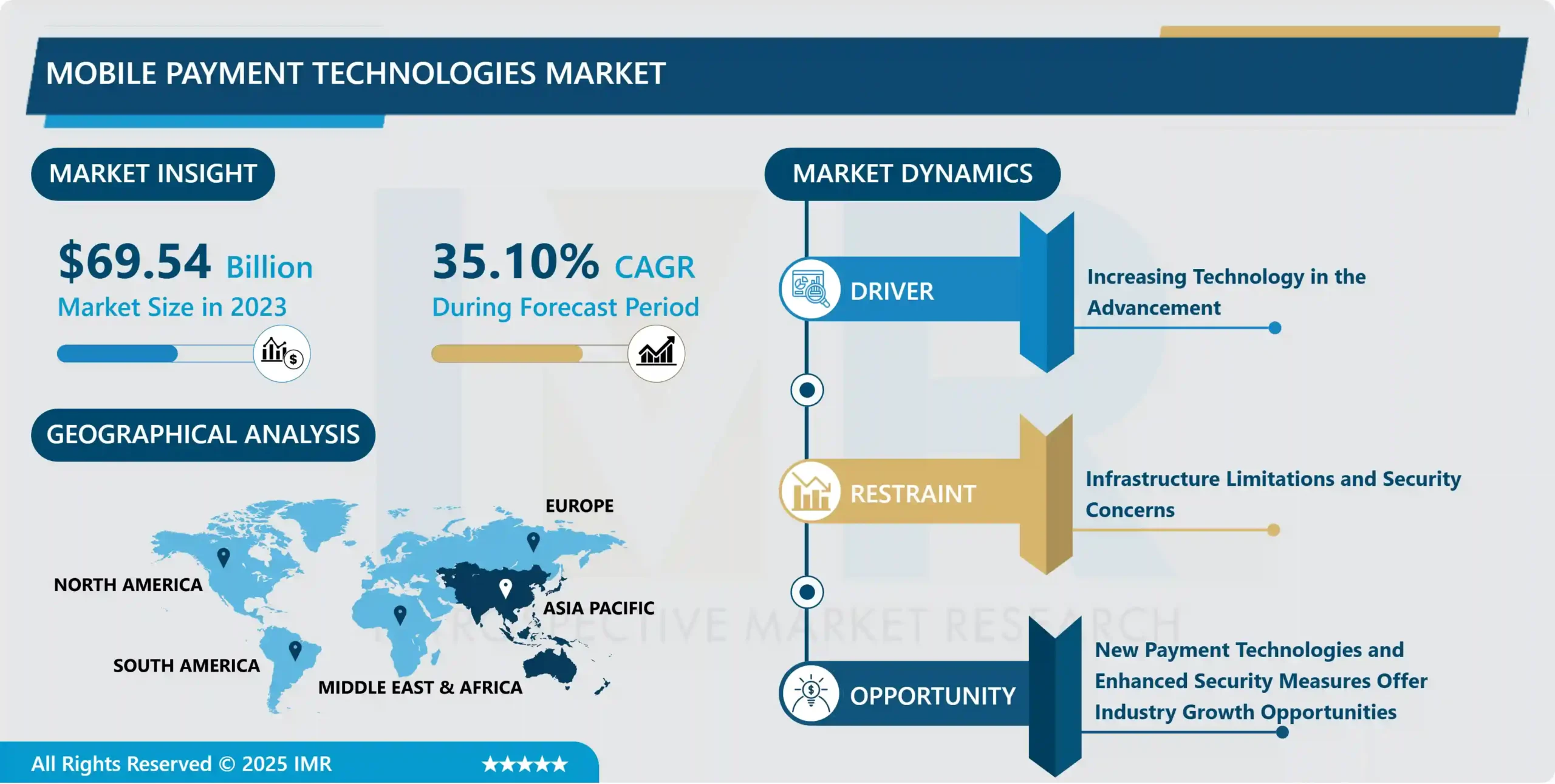
Mobile Payment Technologies Market Size Was Valued at USD 69.54 Billion in 2023 and is Projected to Reach USD 1048.63 Billion by 2032, Growing at a CAGR of 35.1% From 2024-2032.
According to the Mobile Payment Forum, mobile payments are transactions with a monetary value that are conducted through a mobile telecommunications network through diverse mobile user devices, such as cellular telephones, smartphones or PDAs, and mobile terminals. Mobile payment is a transfer of funds in return for goods or services in which a mobile device is functionally involved in executing and confirming payment. Doing financial transactions with mobile phones eliminates the need for auxiliary payment instruments (like POS devices) while using the security features of the SIM card (as a smart card) yields a great level of security and dependability. A mobile payment service comprises all technologies that are offered to the user as well as all tasks that the payment service provider(s) perform to commit payment transactions.
The International Finance Corporation of the World Bank Group has prepared mobile money scoping reports for a few countries in Asia and Africa. The reports assess the financial and telecom sectors and the policy and regulatory framework in place and evaluate existing mobile financial services to identify opportunities for support. In 2017, another focus group was created to discuss emerging questions about digital currency, especially digital fiat currency, like economic benefits, impact, interoperability, policy and regulation, and security and trust.38 The International Telecommunication Union also released a two-part Technology Watch report on mobile money in 2013 that focuses on NFC mobile payments and the financial inclusion aspect of such payments.
Mobile Payment Technologies Market Trend Analysis
Increasing Technological Advancement
Consumer demand for quick and secure payment options is pushing the rise of contactless payments, especially through NFC and QR code methods. The trend has been sped up even more post-pandemic as individuals seek to limit in-person interactions. Mobile banking apps are now incorporating digital wallets to offer a comprehensive financial management platform with enhanced services.
Facial recognition and fingerprint scanning are being adopted in mobile payment systems to enhance security and user convenience. Businesses are developing comprehensive payment ecosystems through a variety of methods and collaborations, improving user interaction and loyalty.
Mobile wallets and payment platforms are incorporating digital currencies such as Bitcoin and Ethereum into their systems. The potential for improving payment security is being investigated through the exploration of blockchain technology. AI and machine learning are employed for detecting fraud and customizing payment experiences. The growing use of mobile payment solutions is playing a key role in improving financial inclusion in underserved regions of emerging markets such as Asia-Pacific, Latin America, and Africa, due to the rise in mobile penetration.
New Payment Technologies and Enhanced Security Measures Offer Industry Growth Opportunities
Emerging payment technologies, such as biometric and voice-activated payments, provide chances for growth in the industry. Mobile payments can be combined with smart devices through the Internet of Things. Industry-specific implementations, such as in the fields of healthcare and education, have the potential to enhance effectiveness. The growth of digital content enables the use of mobile payment solutions for microtransactions.
Using data analysis for tailored promotions can enhance customer satisfaction and trust. User experience can be improved by integrating seamlessly with POS systems and adhering to regulations like GDPR and PCI-DSS. Improvements in cross-border payments can be directed towards the worldwide e-commerce sector and customers from different countries.
Utilizing digital wallets is essential for promoting financial inclusion among those without access to banking services. Combining mobile payments with microfinance can help people in underdeveloped areas. Forming alliances with banks, fintech firms, and technology providers can result in creative solutions and business growth.
Mobile Payment Technologies Market Segment Analysis:
The Mobile Payment Technologies Market is Segmented based on Payment Mode, Technology, Application, Security Type, Transaction Type, and End User.
By Technology, QR Code Segment Is Expected to Dominate the Market During the Forecast Period
QR Code payments are utilized worldwide, notably in Asia, where users scan a code to conduct transactions. They are convenient, affordable, and can be used without any special equipment. QR codes have multiple uses, from different transactions to being able to enhance customer engagement by integrating with loyalty programs. QR codes are more appealing to small businesses due to their lower implementation costs compared to NFC technology. Both merchants and consumers find them attractive due to their simplicity and convenience.
QR codes that utilize encryption and secure payment protocols provide increased security for transactions. Dynamic codes provide greater security in contrast to static codes. QR code payments in developing countries enhance financial inclusion by offering mobile payment options in areas with inadequate banking facilities, particularly in emerging markets.
The rise in QR code usage is largely attributed to the quick rise of digital payments and the greater need for contactless choices amid the pandemic. Governments and financial institutions are also backing the use of QR code payments. Key players such as Alipay and WeChat Pay, as well as fintech startups, are putting resources into QR code solutions, incorporating them into different digital environments to promote broad acceptance and creativity.
By Application, Retail Segment Held the Largest Share
Retailers control the mobile payment technologies market because of factors that are in line with the retail industry’s requirements and current tendencies. Mobile payments are advantageous for high transaction volumes and small purchases due to their convenience. Incorporating loyalty programs improves customer satisfaction, while utilizing data from mobile payments enables personalized marketing and shopping experiences, leading to the prevalence of mobile payments in retail.
Retailers have accepted NFC, QR codes, and mobile wallets for contactless payments to meet consumers’ need for convenience. Mobile payments are a crucial component of omnichannel retailing, providing a smooth checkout process. After the pandemic, retailers are increasingly relying on contactless interactions, using technology to ensure fast and secure transactions at different stores.
Retailers are using tokenization and biometric authentication to stop fraud and establish trust with consumers in mobile payments. Adherence to security regulations is essential when managing large transaction volumes. In countries such as China and India in Asia-Pacific, retailers are leading the way in embracing mobile payments through QR codes and mobile wallets. Emerging markets are using mobile payments to promote financial inclusion and access a broader customer demographic. The increase in contactless payments in retail has been driven by the COVID-19 pandemic, with mobile payments gaining popularity due to the growth of e-commerce. In general, mobile payment technologies are constantly changing the retail environment on a global scale.
Mobile Payment Technologies Market Regional Insights:
Asia Pacific is Expected to Dominate the Market Over the Forecast Period
China and India are at the forefront of utilizing mobile payments, experiencing swift expansion through the popular platforms Alipay, WeChat Pay, Paytm, Google Pay, and PhonePe. Countries in the Asia-Pacific region such as South Korea, Japan, and China have sophisticated telecommunications systems that enable smooth mobile payment transactions. The fintech ecosystem in the area is being advanced through NFC, QR codes, and blockchain, leading to a broad acceptance of mobile payment technologies.
The sizeable population in nations such as China and India leads to a significant number of users of mobile payment technologies in the Asia-Pacific region. Government initiatives and regulations promoting digital payments are driving the quick adoption of new payment technologies by the tech-savvy younger population.
In various regions of Asia-Pacific, there is a change in culture leaning towards digital payments instead of traditional methods because of convenience, security, and rewards. Super apps in China have incorporated mobile payments into a variety of services, increasing their popularity even more. The region saw a faster adoption of contactless payments during the COVID-19 pandemic as both consumers and businesses looked for safer ways to make transactions. This has further solidified the presence of mobile payments in the Asia-Pacific economy.
Mobile Payment Technologies Market Active Players
Alipay (Ant Group) – (China)
WeChat Pay (Tencent) – (China)
PayPal Holdings, Inc. – (United States)
Apple Pay (Apple Inc.) – (United States)
Google Pay (Alphabet Inc.) – (United States)
Samsung Pay (Samsung Electronics Co., Ltd.) – (South Korea)
Visa Inc. – (United States)
Mastercard Incorporated – (United States)
Square, Inc. (Block, Inc.) – (United States)
Paytm (One97 Communications) – (India)
PhonePe (Walmart Inc.) – (India)
Amazon Pay (Amazon.com, Inc.) – (United States)
Stripe, Inc. – (United States)
Rakuten Pay (Rakuten, Inc.) – (Japan)
M-Pesa (Vodafone Group and Safaricom) – (United Kingdom/Kenya)
Adyen N.V. – (Netherlands)
Tencent Holdings Ltd. – (China)
American Express Co. – (United States)
Boku, Inc. – (United States)
Kakao Pay (Kakao Corp.) – (South Korea)
Barclays PLC (Barclays Mobile Banking) – (United Kingdom)
Orange Money (Orange S.A.) – (France)
Tencent Fintech – (China)
Revolut Ltd. – (United Kingdom)
Zelle (Early Warning Services, LLC) – (United States)
Venmo (PayPal Holdings, Inc.) – (United States)
BitPay, Inc. – (United States)
Klarna Bank AB – (Sweden)
Gojek (GoPay) – (Indonesia)
Naver Pay (Naver Corporation) – (South Korea), and other Active Players.
Key Industry Developments in the Mobile Payment Technologies Market:
In April 2023, Visa announced it’s partnering with PayPal and Venmo to pilot Visa+. This innovative service aims to help individuals move money quickly and securely between different person-to-person (P2P) digital payment apps. Through this collaboration, Visa+ will expand its reach and enable more use cases, including gig, creator, and marketplace payouts. Participating digital wallets, neo-banks, and other payment apps reaching millions of US users will be able to enable interoperability through Visa.
Chapter 1: Introduction
1.1 Scope and Coverage
Chapter 2:Executive Summary
Chapter 3: Market Landscape
3.1 Market Dynamics
3.1.1 Drivers
3.1.2 Restraints
3.1.3 Opportunities
3.1.4 Challenges
3.2 Market Trend Analysis
3.3 PESTLE Analysis
3.4 Porter’s Five Forces Analysis
3.5 Industry Value Chain Analysis
3.6 Ecosystem
3.7 Regulatory Landscape
3.8 Price Trend Analysis
3.9 Patent Analysis
3.10 Technology Evolution
3.11 Investment Pockets
3.12 Import-Export Analysis
Chapter 4: Mobile Payment Technologies Market by Payment Mode (2018-2032)
4.1 Mobile Payment Technologies Market Snapshot and Growth Engine
4.2 Market Overview
4.3 Proximity Payments
4.3.1 Introduction and Market Overview
4.3.2 Historic and Forecasted Market Size in Value USD and Volume Units
4.3.3 Key Market Trends, Growth Factors, and Opportunities
4.3.4 Geographic Segmentation Analysis
4.4 Remote Payments
4.5 In-App Payments
Chapter 5: Mobile Payment Technologies Market by Technology (2018-2032)
5.1 Mobile Payment Technologies Market Snapshot and Growth Engine
5.2 Market Overview
5.3 NFC (Near Field Communication)
5.3.1 Introduction and Market Overview
5.3.2 Historic and Forecasted Market Size in Value USD and Volume Units
5.3.3 Key Market Trends, Growth Factors, and Opportunities
5.3.4 Geographic Segmentation Analysis
5.4 QR Code
5.5 SMS Payments
5.6 SMS Payments
5.7 HCE (Host Card Emulation)
Chapter 6: Mobile Payment Technologies Market by Application (2018-2032)
6.1 Mobile Payment Technologies Market Snapshot and Growth Engine
6.2 Market Overview
6.3 Retail
6.3.1 Introduction and Market Overview
6.3.2 Historic and Forecasted Market Size in Value USD and Volume Units
6.3.3 Key Market Trends, Growth Factors, and Opportunities
6.3.4 Geographic Segmentation Analysis
6.4 Transportation
6.5 Healthcare
6.6 Hospitality
6.7 Utilities
Chapter 7: Mobile Payment Technologies Market by Security Type (2018-2032)
7.1 Mobile Payment Technologies Market Snapshot and Growth Engine
7.2 Market Overview
7.3 Biometric Authentication
7.3.1 Introduction and Market Overview
7.3.2 Historic and Forecasted Market Size in Value USD and Volume Units
7.3.3 Key Market Trends, Growth Factors, and Opportunities
7.3.4 Geographic Segmentation Analysis
7.4 PIN-Based Authentication
7.5 Tokenization
Chapter 8: Mobile Payment Technologies Market by Transaction Type (2018-2032)
8.1 Mobile Payment Technologies Market Snapshot and Growth Engine
8.2 Market Overview
8.3 Person-to-Person (P2P)
8.3.1 Introduction and Market Overview
8.3.2 Historic and Forecasted Market Size in Value USD and Volume Units
8.3.3 Key Market Trends, Growth Factors, and Opportunities
8.3.4 Geographic Segmentation Analysis
8.4 Person-to-Merchant (P2M)
8.5 Business-to-Business (B2B)
Chapter 9: Mobile Payment Technologies Market by End User (2018-2032)
9.1 Mobile Payment Technologies Market Snapshot and Growth Engine
9.2 Market Overview
9.3 Consumer
9.3.1 Introduction and Market Overview
9.3.2 Historic and Forecasted Market Size in Value USD and Volume Units
9.3.3 Key Market Trends, Growth Factors, and Opportunities
9.3.4 Geographic Segmentation Analysis
9.4 Merchant
Chapter 10: Company Profiles and Competitive Analysis
10.1 Competitive Landscape
10.1.1 Competitive Benchmarking
10.1.2 Mobile Payment Technologies Market Share by Manufacturer (2024)
10.1.3 Industry BCG Matrix
10.1.4 Heat Map Analysis
10.1.5 Mergers and Acquisitions
10.2 ALIPAY (ANT GROUP) – (CHINA)
10.2.1 Company Overview
10.2.2 Key Executives
10.2.3 Company Snapshot
10.2.4 Role of the Company in the Market
10.2.5 Sustainability and Social Responsibility
10.2.6 Operating Business Segments
10.2.7 Product Portfolio
10.2.8 Business Performance
10.2.9 Key Strategic Moves and Recent Developments
10.2.10 SWOT Analysis
10.3 WECHAT PAY (TENCENT) – (CHINA)
10.4 PAYPAL HOLDINGS INC. – (UNITED STATES)
10.5 APPLE PAY (APPLE INC.) – (UNITED STATES)
10.6 GOOGLE PAY (ALPHABET INC.) – (UNITED STATES)
10.7 SAMSUNG PAY (SAMSUNG ELECTRONICS COLTD.) – (SOUTH KOREA)
10.8 VISA INC. – (UNITED STATES)
10.9 MASTERCARD INCORPORATED – (UNITED STATES)
10.10 SQUARE INC. (BLOCK INC.) – (UNITED STATES)
10.11 PAYTM (ONE97 COMMUNICATIONS) – (INDIA)
10.12 PHONEPE (WALMART INC.) – (INDIA)
10.13 AMAZON PAY (AMAZON.COM INC.) – (UNITED STATES)
10.14 STRIPE INC. – (UNITED STATES)
10.15 RAKUTEN PAY (RAKUTEN INC.) – (JAPAN)
10.16 M-PESA (VODAFONE GROUP AND SAFARICOM) – (UNITED KINGDOM/KENYA)
10.17 ADYEN N.V. – (NETHERLANDS)
10.18 TENCENT HOLDINGS LTD. – (CHINA)
10.19 AMERICAN EXPRESS CO. – (UNITED STATES)
10.20 BOKU INC. – (UNITED STATES)
10.21 KAKAO PAY (KAKAO CORP.) – (SOUTH KOREA)
10.22 BARCLAYS PLC (BARCLAYS MOBILE BANKING) – (UNITED KINGDOM)
10.23 ORANGE MONEY (ORANGE S.A.) – (FRANCE)
10.24 TENCENT FINTECH – (CHINA)
10.25 REVOLUT LTD. – (UNITED KINGDOM)
10.26 ZELLE (EARLY WARNING SERVICES
10.27 LLC) – (UNITED STATES)
10.28 VENMO (PAYPAL HOLDINGS INC.) – (UNITED STATES)
10.29 BITPAY INC. – (UNITED STATES)
10.30 KLARNA BANK AB – (SWEDEN)
10.31 GOJEK (GOPAY) – (INDONESIA)
10.32 NAVER PAY (NAVER CORPORATION) – (SOUTH KOREA)
10.33 AND
Chapter 11: Global Mobile Payment Technologies Market By Region
11.1 Overview
11.2. North America Mobile Payment Technologies Market
11.2.1 Key Market Trends, Growth Factors and Opportunities
11.2.2 Top Key Companies
11.2.3 Historic and Forecasted Market Size by Segments
11.2.4 Historic and Forecasted Market Size by Payment Mode
11.2.4.1 Proximity Payments
11.2.4.2 Remote Payments
11.2.4.3 In-App Payments
11.2.5 Historic and Forecasted Market Size by Technology
11.2.5.1 NFC (Near Field Communication)
11.2.5.2 QR Code
11.2.5.3 SMS Payments
11.2.5.4 SMS Payments
11.2.5.5 HCE (Host Card Emulation)
11.2.6 Historic and Forecasted Market Size by Application
11.2.6.1 Retail
11.2.6.2 Transportation
11.2.6.3 Healthcare
11.2.6.4 Hospitality
11.2.6.5 Utilities
11.2.7 Historic and Forecasted Market Size by Security Type
11.2.7.1 Biometric Authentication
11.2.7.2 PIN-Based Authentication
11.2.7.3 Tokenization
11.2.8 Historic and Forecasted Market Size by Transaction Type
11.2.8.1 Person-to-Person (P2P)
11.2.8.2 Person-to-Merchant (P2M)
11.2.8.3 Business-to-Business (B2B)
11.2.9 Historic and Forecasted Market Size by End User
11.2.9.1 Consumer
11.2.9.2 Merchant
11.2.10 Historic and Forecast Market Size by Country
11.2.10.1 US
11.2.10.2 Canada
11.2.10.3 Mexico
11.3. Eastern Europe Mobile Payment Technologies Market
11.3.1 Key Market Trends, Growth Factors and Opportunities
11.3.2 Top Key Companies
11.3.3 Historic and Forecasted Market Size by Segments
11.3.4 Historic and Forecasted Market Size by Payment Mode
11.3.4.1 Proximity Payments
11.3.4.2 Remote Payments
11.3.4.3 In-App Payments
11.3.5 Historic and Forecasted Market Size by Technology
11.3.5.1 NFC (Near Field Communication)
11.3.5.2 QR Code
11.3.5.3 SMS Payments
11.3.5.4 SMS Payments
11.3.5.5 HCE (Host Card Emulation)
11.3.6 Historic and Forecasted Market Size by Application
11.3.6.1 Retail
11.3.6.2 Transportation
11.3.6.3 Healthcare
11.3.6.4 Hospitality
11.3.6.5 Utilities
11.3.7 Historic and Forecasted Market Size by Security Type
11.3.7.1 Biometric Authentication
11.3.7.2 PIN-Based Authentication
11.3.7.3 Tokenization
11.3.8 Historic and Forecasted Market Size by Transaction Type
11.3.8.1 Person-to-Person (P2P)
11.3.8.2 Person-to-Merchant (P2M)
11.3.8.3 Business-to-Business (B2B)
11.3.9 Historic and Forecasted Market Size by End User
11.3.9.1 Consumer
11.3.9.2 Merchant
11.3.10 Historic and Forecast Market Size by Country
11.3.10.1 Russia
11.3.10.2 Bulgaria
11.3.10.3 The Czech Republic
11.3.10.4 Hungary
11.3.10.5 Poland
11.3.10.6 Romania
11.3.10.7 Rest of Eastern Europe
11.4. Western Europe Mobile Payment Technologies Market
11.4.1 Key Market Trends, Growth Factors and Opportunities
11.4.2 Top Key Companies
11.4.3 Historic and Forecasted Market Size by Segments
11.4.4 Historic and Forecasted Market Size by Payment Mode
11.4.4.1 Proximity Payments
11.4.4.2 Remote Payments
11.4.4.3 In-App Payments
11.4.5 Historic and Forecasted Market Size by Technology
11.4.5.1 NFC (Near Field Communication)
11.4.5.2 QR Code
11.4.5.3 SMS Payments
11.4.5.4 SMS Payments
11.4.5.5 HCE (Host Card Emulation)
11.4.6 Historic and Forecasted Market Size by Application
11.4.6.1 Retail
11.4.6.2 Transportation
11.4.6.3 Healthcare
11.4.6.4 Hospitality
11.4.6.5 Utilities
11.4.7 Historic and Forecasted Market Size by Security Type
11.4.7.1 Biometric Authentication
11.4.7.2 PIN-Based Authentication
11.4.7.3 Tokenization
11.4.8 Historic and Forecasted Market Size by Transaction Type
11.4.8.1 Person-to-Person (P2P)
11.4.8.2 Person-to-Merchant (P2M)
11.4.8.3 Business-to-Business (B2B)
11.4.9 Historic and Forecasted Market Size by End User
11.4.9.1 Consumer
11.4.9.2 Merchant
11.4.10 Historic and Forecast Market Size by Country
11.4.10.1 Germany
11.4.10.2 UK
11.4.10.3 France
11.4.10.4 The Netherlands
11.4.10.5 Italy
11.4.10.6 Spain
11.4.10.7 Rest of Western Europe
11.5. Asia Pacific Mobile Payment Technologies Market
11.5.1 Key Market Trends, Growth Factors and Opportunities
11.5.2 Top Key Companies
11.5.3 Historic and Forecasted Market Size by Segments
11.5.4 Historic and Forecasted Market Size by Payment Mode
11.5.4.1 Proximity Payments
11.5.4.2 Remote Payments
11.5.4.3 In-App Payments
11.5.5 Historic and Forecasted Market Size by Technology
11.5.5.1 NFC (Near Field Communication)
11.5.5.2 QR Code
11.5.5.3 SMS Payments
11.5.5.4 SMS Payments
11.5.5.5 HCE (Host Card Emulation)
11.5.6 Historic and Forecasted Market Size by Application
11.5.6.1 Retail
11.5.6.2 Transportation
11.5.6.3 Healthcare
11.5.6.4 Hospitality
11.5.6.5 Utilities
11.5.7 Historic and Forecasted Market Size by Security Type
11.5.7.1 Biometric Authentication
11.5.7.2 PIN-Based Authentication
11.5.7.3 Tokenization
11.5.8 Historic and Forecasted Market Size by Transaction Type
11.5.8.1 Person-to-Person (P2P)
11.5.8.2 Person-to-Merchant (P2M)
11.5.8.3 Business-to-Business (B2B)
11.5.9 Historic and Forecasted Market Size by End User
11.5.9.1 Consumer
11.5.9.2 Merchant
11.5.10 Historic and Forecast Market Size by Country
11.5.10.1 China
11.5.10.2 India
11.5.10.3 Japan
11.5.10.4 South Korea
11.5.10.5 Malaysia
11.5.10.6 Thailand
11.5.10.7 Vietnam
11.5.10.8 The Philippines
11.5.10.9 Australia
11.5.10.10 New Zealand
11.5.10.11 Rest of APAC
11.6. Middle East & Africa Mobile Payment Technologies Market
11.6.1 Key Market Trends, Growth Factors and Opportunities
11.6.2 Top Key Companies
11.6.3 Historic and Forecasted Market Size by Segments
11.6.4 Historic and Forecasted Market Size by Payment Mode
11.6.4.1 Proximity Payments
11.6.4.2 Remote Payments
11.6.4.3 In-App Payments
11.6.5 Historic and Forecasted Market Size by Technology
11.6.5.1 NFC (Near Field Communication)
11.6.5.2 QR Code
11.6.5.3 SMS Payments
11.6.5.4 SMS Payments
11.6.5.5 HCE (Host Card Emulation)
11.6.6 Historic and Forecasted Market Size by Application
11.6.6.1 Retail
11.6.6.2 Transportation
11.6.6.3 Healthcare
11.6.6.4 Hospitality
11.6.6.5 Utilities
11.6.7 Historic and Forecasted Market Size by Security Type
11.6.7.1 Biometric Authentication
11.6.7.2 PIN-Based Authentication
11.6.7.3 Tokenization
11.6.8 Historic and Forecasted Market Size by Transaction Type
11.6.8.1 Person-to-Person (P2P)
11.6.8.2 Person-to-Merchant (P2M)
11.6.8.3 Business-to-Business (B2B)
11.6.9 Historic and Forecasted Market Size by End User
11.6.9.1 Consumer
11.6.9.2 Merchant
11.6.10 Historic and Forecast Market Size by Country
11.6.10.1 Turkiye
11.6.10.2 Bahrain
11.6.10.3 Kuwait
11.6.10.4 Saudi Arabia
11.6.10.5 Qatar
11.6.10.6 UAE
11.6.10.7 Israel
11.6.10.8 South Africa
11.7. South America Mobile Payment Technologies Market
11.7.1 Key Market Trends, Growth Factors and Opportunities
11.7.2 Top Key Companies
11.7.3 Historic and Forecasted Market Size by Segments
11.7.4 Historic and Forecasted Market Size by Payment Mode
11.7.4.1 Proximity Payments
11.7.4.2 Remote Payments
11.7.4.3 In-App Payments
11.7.5 Historic and Forecasted Market Size by Technology
11.7.5.1 NFC (Near Field Communication)
11.7.5.2 QR Code
11.7.5.3 SMS Payments
11.7.5.4 SMS Payments
11.7.5.5 HCE (Host Card Emulation)
11.7.6 Historic and Forecasted Market Size by Application
11.7.6.1 Retail
11.7.6.2 Transportation
11.7.6.3 Healthcare
11.7.6.4 Hospitality
11.7.6.5 Utilities
11.7.7 Historic and Forecasted Market Size by Security Type
11.7.7.1 Biometric Authentication
11.7.7.2 PIN-Based Authentication
11.7.7.3 Tokenization
11.7.8 Historic and Forecasted Market Size by Transaction Type
11.7.8.1 Person-to-Person (P2P)
11.7.8.2 Person-to-Merchant (P2M)
11.7.8.3 Business-to-Business (B2B)
11.7.9 Historic and Forecasted Market Size by End User
11.7.9.1 Consumer
11.7.9.2 Merchant
11.7.10 Historic and Forecast Market Size by Country
11.7.10.1 Brazil
11.7.10.2 Argentina
11.7.10.3 Rest of SA
Chapter 12 Analyst Viewpoint and Conclusion
12.1 Recommendations and Concluding Analysis
12.2 Potential Market Strategies
Chapter 13 Research Methodology
13.1 Research Process
13.2 Primary Research
13.3 Secondary Research
Q1: What would be the forecast period in the Mobile Payment Technologies Market research report?
A1: The forecast period in the Mobile Payment Technologies Market research report is 2024-2032.
Q2: Who are the key players in the Mobile Payment Technologies Market?
A2: Alipay (Ant Group) – (China), WeChat Pay (Tencent) – (China), PayPal Holdings, Inc. – (United States), Apple Pay (Apple Inc.) – (United States), Google Pay (Alphabet Inc.) – (United States), Samsung Pay (Samsung Electronics Co., Ltd.) – (South Korea), Visa Inc. – (United States), Mastercard Incorporated – (United States), Square, Inc. (Block, Inc.) – (United States), Paytm (One97 Communications) – (India), PhonePe (Walmart Inc.) – (India), Amazon Pay (Amazon.com, Inc.) – (United States), Stripe, Inc. – (United States), Rakuten Pay (Rakuten, Inc.) – (Japan), M-Pesa (Vodafone Group and Safaricom) – (United Kingdom/Kenya), Adyen N.V. – (Netherlands), Tencent Holdings Ltd. – (China), American Express Co. – (United States), Boku, Inc. – (United States), Kakao Pay (Kakao Corp.) – (South Korea), Barclays PLC (Barclays Mobile Banking) – (United Kingdom), Orange Money (Orange S.A.) – (France), Tencent Fintech – (China), Revolut Ltd. – (United Kingdom), Zelle (Early Warning Services, LLC) – (United States), Venmo (PayPal Holdings, Inc.) – (United States), BitPay, Inc. – (United States), Klarna Bank AB – (Sweden), Gojek (GoPay) – (Indonesia), Naver Pay (Naver Corporation) – (South Korea) and Other Active Players.
Q3: What are the segments of the Mobile Payment Technologies Market?
A3: The Mobile Payment Technologies Market is segmented into Payment Mode, Technology, Application, Security Type, Transaction Type, End User, and Region. By Payment Mode, the market is categorized into Proximity Payments, Remote Payments, and In-App Payments. By Technology, the market is categorized into NFC (Near Field Communication), QR Code, SMS Payments, SMS Payments, and HCE (Host Card Emulation). By Application, the market is categorized into Retail, Transportation, Healthcare, Hospitality, and Utilities. By Security Type, the market is categorized into Biometric Authentication, PIN-Based Authentication, and Tokenization. By Transaction Type, The Market Is Categorized into Person-to-Person (P2P), Person-to-Merchant (P2M), and Business-to-Business (B2B). By End User, the market is categorized into Consumer and merchant. By region, it is analyzed across North America (U.S.; Canada; Mexico), Eastern Europe (Bulgaria; The Czech Republic; Hungary; Poland; Romania; Rest of Eastern Europe), Western Europe (Germany; UK; France; Netherlands; Italy; Russia; Spain; Rest of Western Europe), Asia-Pacific (China; India; Japan; Southeast Asia, etc.), South America (Brazil; Argentina, etc.), Middle East & Africa (Saudi Arabia; South Africa, etc.).
Q4: What is the Mobile Payment Technologies Market?
A4: According to the Mobile Payment Forum, mobile payments are transactions with a monetary value that are conducted through a mobile telecommunications network through diverse mobile user devices, such as cellular telephones, smartphones or PDAs, and mobile terminals. Mobile payment is a transfer of funds in return for goods or services in which a mobile device is functionally involved in executing and confirming payment.
Q5: How big is the Mobile Payment Technologies Market?
A5: Mobile Payment Technologies Market Size Was Valued at USD 69.54 Billion in 2023 and is Projected to Reach USD 1048.63 Billion by 2032, Growing at a CAGR of 35.1% From 2024-2032.
How to Buy a Report from eminsights.jp
On the product page, choose the license you want: Single-User License, Multi-User License or Enterprise License.
If you required report in your native language, then you can click on Translated Report button and fill out the form with report name and language you want, then our team will contact you as soon as possible.
Click the Buy Now button.
You will be redirected to the checkout page. Enter your company details and payment information.
Click Place Order to complete the purchase.
Confirmation: You’ll receive an order confirmation and our team will contact you shortly with your ordered report.
If you have any questions, fill out the contact form below or email us at bizdev@eminsights.net.
Thank you for choosing eminsights.jp!