Stay Ahead in Fast-Growing Economies.
Browse Reports Now

Microwave Ovens Market Growth Report 2024-2032
Microwave ovens, also known as electronic ovens, have become a staple in modern kitchens. These appliances utilize high-frequency electromagnetic waves, called microwaves, to cook food efficiently. The design typically features a compact, boxlike oven that leverages a high-frequency electromagnetic field to elevate the temperature of food.

IMR Group
Description
Microwave Ovens Market Synopsis
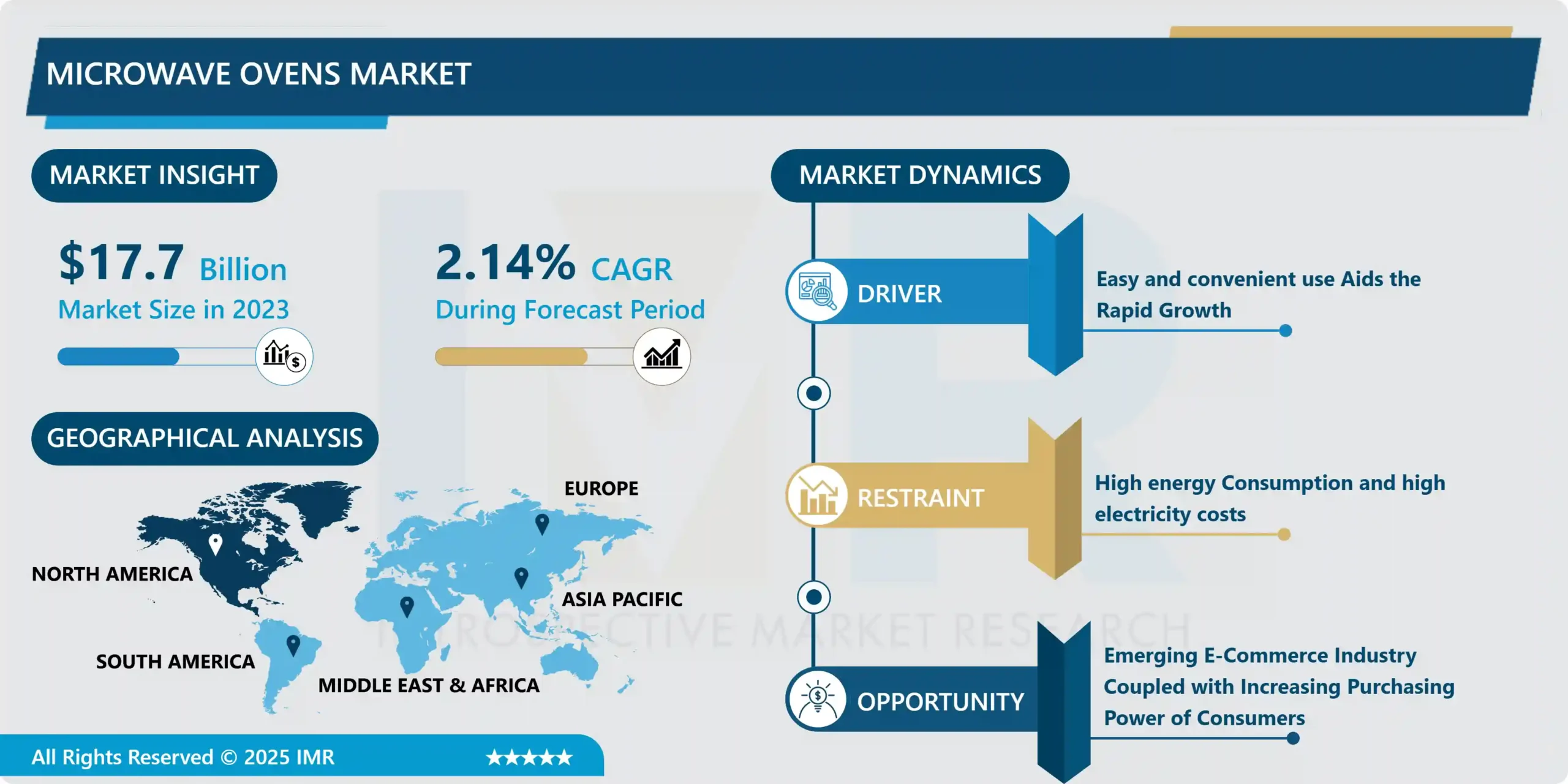
Microwave Ovens Market Size Was Valued at USD 17.7 Billion in 2023 and is Projected to Reach USD 21.42 Billion by 2032, Growing at a CAGR of 2.14 % From 2024-2032.
Microwave ovens, also known as electronic ovens, have become a staple in modern kitchens. These appliances utilize high-frequency electromagnetic waves, called microwaves, to cook food efficiently. The design typically features a compact, boxlike oven that leverages a high-frequency electromagnetic field to elevate the temperature of food.
This innovation allows for rapid cooking by inducing heat within the food itself, a process facilitated by the absorption of microwaves by water, fats, sugars, and select molecules. The result is a notable reduction in cooking time compared to a traditional oven.
This unique cooking method translates to remarkable time savings, as tasks such as baking that traditionally required hours in conventional ovens can now be completed within minutes. The microwave oven’s efficiency stems from its focused heating mechanism, making it an indispensable kitchen appliance for individuals seeking quick and convenient cooking solutions.
Microwave ovens operate by generating radiation at a frequency of approximately 2,450 megahertz. This radiation is produced through a specialized component known as a magnetron, which functions as an electron tube. The magnetron’s role is crucial in emitting the microwaves necessary for the cooking process. By harnessing this technology, microwave ovens have revolutionized cooking practices, providing consumers with a versatile and time-saving solution for various culinary needs.
Microwave Ovens Market Trend Analysis
Easy and convenient use Aids the Rapid Growth
The microwave ovens market is experiencing rapid growth, primarily fueled by the easy and convenient usability of these appliances. Unlike traditional ovens, microwave ovens simplify the cooking process, allowing users to effortlessly heat or cook food with just a few button presses. The user-friendly interfaces and preset cooking options eliminate the need for intricate culinary skills, making microwave ovens accessible to a wide range of consumers. This ease of use has played a pivotal role in the market’s expansion as it caters to the demands of busy lifestyles where convenience is paramount.
The surge in microwave oven popularity can be attributed to the unparalleled convenience they bring to the kitchen. With the ability to complete cooking tasks in a fraction of the time required by conventional methods, microwave ovens have become an indispensable tool for individuals seeking quick, efficient, and hassle-free meal preparation. The rapid growth in the market is a testament to the alignment of microwave oven technology with the evolving needs of modern consumers who prioritize time efficiency without compromising on the quality of their culinary experiences.
Emerging E-Commerce Industry Coupled with Increasing Purchasing Power of Consumers
The burgeoning e-commerce industry presents a significant opportunity for the microwave ovens market. As online shopping gains momentum, consumers are increasingly turning to digital platforms to explore and purchase home appliances, including microwave ovens. The convenience of browsing a wide array of product options, comparing features, and reading customer reviews online has propelled the e-commerce sector as a preferred avenue for appliance purchases. Microwave oven manufacturers and retailers can capitalize on this trend by establishing a robust online presence, leveraging e-commerce platforms, and enhancing digital marketing strategies to reach a broader audience.
The microwave ovens market stands to benefit from the growing purchasing power of consumers. As disposable incomes rise globally, individuals are more inclined to invest in premium and technologically advanced kitchen appliances. Microwave ovens, with their diverse features and innovative technologies, cater to the evolving needs of consumers seeking efficiency and convenience in cooking. Manufacturers can seize this opportunity by introducing high-end microwave models that align with the discerning tastes of the market.
Microwave Ovens Market Segment Analysis:
Microwave Ovens Market Segmented on the basis of type, Structure, application, and Distribution Channel.
By Type, Convection segment is expected to dominate the market during the forecast period
The Convection segment is poised to dominate the microwave oven market based on its versatile cooking capabilities. Convection microwave ovens combine the features of a regular microwave with those of a convection oven, allowing for not only quick reheating and defrosting but also baking, roasting, and grilling. This multifunctionality has resonated well with consumers seeking a single appliance that can cater to a wide range of cooking needs. The popularity of convection microwave ovens is further fueled by the trend of compact and efficient kitchen appliances, making them a preferred choice for households looking to maximize space without compromising on cooking versatility.
Modern consumers, with diverse culinary interests, are inclined towards appliances that offer a broader spectrum of cooking options. Convection microwave ovens, with their ability to bake crispy cookies, roast meats, and prepare a variety of dishes beyond basic microwave functions, align well with the lifestyle and preferences of today’s households.
By Application, Countertop segment held the largest share of 48.2% in 2022
The countertop segment has secured the largest share in the microwave ovens market, primarily due to its consumer-friendly design and unmatched convenience. Countertop microwave ovens are standalone units that sit on kitchen countertops, providing easy accessibility and eliminating the need for complex installation processes. This simplicity resonates well with consumers seeking hassle-free kitchen appliances that can seamlessly integrate into their living spaces.
Countertop microwave ovens come in a variety of sizes and power capacities, catering to different cooking needs and budgets. This adaptability makes them an attractive choice for a broad consumer base. Additionally, countertop models often feature user-friendly controls and a range of cooking presets, enhancing their appeal to consumers who appreciate straightforward operation without compromising on functionality.
Microwave Ovens Market Regional Insights:
North America is Expected to Dominate the Market Over the Forecast period
In the North American Microwave Ovens Market, the remarkable dominance of built-in microwaves, claiming a majority share exceeding 60%, is attributed to several factors. Firstly, the prevalence of spacious kitchens and open floor plans in North American households has significantly influenced consumer preferences. Built-in microwaves seamlessly integrate into these modern kitchen designs, offering a sleek and cohesive appearance. This aesthetic appeal aligns with the evolving tastes of consumers who prioritize not only functionality but also the overall look and feel of their kitchens. Additionally, the preference for built-in microwaves is indicative of a shift towards a more streamlined and integrated kitchen environment, reflecting contemporary lifestyle choices.
North American market. Rising disposable income levels among consumers have led to an increased inclination towards premium and customized kitchen appliances, where built-in microwaves find a strong market foothold. Moreover, the ongoing trend of urbanization has resulted in smaller living spaces, prompting homeowners to opt for compact and space-saving kitchen solutions, making built-in microwaves a practical choice.
Microwave Ovens Market Top Key Players:
Whirlpool Corporation (United States)
GE Appliances (United States)
Panasonic Corporation (United States)
LG Electronics (United States)
Samsung Electronics (United States)
Sharp Electronics Corporation (United States)
Wolf Appliance, Inc. (United States)
Viking Range, LLC (United States)
Electrolux (Sweden)
Siemens (Germany)
Bosch (Germany)
Candy (Italy)
Gorenje (Slovenia)
Viking Range, LLC (United Kingdom)
Midea (China)
Galanz (China)
LG (South Korea)
Samsung (South Korea)
Panasonic (Japan)
Toshiba (Japan)
Sharp (Japan)
Haier (China)
Breville (Australia)
IFB (India)
Defy (South Africa)
Key Industry Developments in the Microwave Ovens Market:
In March 2024, GE Appliances (GEA), a Haier company, introduced a new robust portfolio of slide-in gas and electric ranges featuring 36 models designed to streamline and enhance home cooking with innovative features and intuitive designs. The top-of-the-line model was the GE® 30″ Slide-In Electric Convection Range with No Preheat Air Fry and EasyWash™ Oven Tray (600 series), which aimed to save time and effort by reducing cooking time and expediting clean-up.
In January 2024, Panasonic, a leading provider of consumer lifestyle technologies, announced an expanded partnership with Fresco, the top smart kitchen platform for the world’s leading appliance brands. The companies collaborated to deliver a revolutionary cooking assistant for Panasonic kitchen appliances, beginning with the Panasonic HomeCHEF 4-in-1 multi-oven. Panasonic showcased the new smart appliance and connected cooking experience at the Consumer Electronics Show (CES) 2024.
Chapter 1: Introduction
1.1 Scope and Coverage
Chapter 2:Executive Summary
Chapter 3: Market Landscape
3.1 Market Dynamics
3.1.1 Drivers
3.1.2 Restraints
3.1.3 Opportunities
3.1.4 Challenges
3.2 Market Trend Analysis
3.3 PESTLE Analysis
3.4 Porter’s Five Forces Analysis
3.5 Industry Value Chain Analysis
3.6 Ecosystem
3.7 Regulatory Landscape
3.8 Price Trend Analysis
3.9 Patent Analysis
3.10 Technology Evolution
3.11 Investment Pockets
3.12 Import-Export Analysis
Chapter 4: Microwave Ovens Market by Type (2018-2032)
4.1 Microwave Ovens Market Snapshot and Growth Engine
4.2 Market Overview
4.3 Convection
4.3.1 Introduction and Market Overview
4.3.2 Historic and Forecasted Market Size in Value USD and Volume Units
4.3.3 Key Market Trends, Growth Factors, and Opportunities
4.3.4 Geographic Segmentation Analysis
4.4 Grill
4.5 Solo
Chapter 5: Microwave Ovens Market by Structure (2018-2032)
5.1 Microwave Ovens Market Snapshot and Growth Engine
5.2 Market Overview
5.3 Built-in
5.3.1 Introduction and Market Overview
5.3.2 Historic and Forecasted Market Size in Value USD and Volume Units
5.3.3 Key Market Trends, Growth Factors, and Opportunities
5.3.4 Geographic Segmentation Analysis
5.4 Counter Top
Chapter 6: Microwave Ovens Market by Application (2018-2032)
6.1 Microwave Ovens Market Snapshot and Growth Engine
6.2 Market Overview
6.3 Commercial
6.3.1 Introduction and Market Overview
6.3.2 Historic and Forecasted Market Size in Value USD and Volume Units
6.3.3 Key Market Trends, Growth Factors, and Opportunities
6.3.4 Geographic Segmentation Analysis
6.4 Household
Chapter 7: Microwave Ovens Market by Distribution Channel (2018-2032)
7.1 Microwave Ovens Market Snapshot and Growth Engine
7.2 Market Overview
7.3 Multiband Stores
7.3.1 Introduction and Market Overview
7.3.2 Historic and Forecasted Market Size in Value USD and Volume Units
7.3.3 Key Market Trends, Growth Factors, and Opportunities
7.3.4 Geographic Segmentation Analysis
7.4 Exclusive Stores
7.5 Online
7.6 Other Distribution Channels
Chapter 8: Company Profiles and Competitive Analysis
8.1 Competitive Landscape
8.1.1 Competitive Benchmarking
8.1.2 Microwave Ovens Market Share by Manufacturer (2024)
8.1.3 Industry BCG Matrix
8.1.4 Heat Map Analysis
8.1.5 Mergers and Acquisitions
8.2 TIMBERLAND (UNITED STATES)
8.2.1 Company Overview
8.2.2 Key Executives
8.2.3 Company Snapshot
8.2.4 Role of the Company in the Market
8.2.5 Sustainability and Social Responsibility
8.2.6 Operating Business Segments
8.2.7 Product Portfolio
8.2.8 Business Performance
8.2.9 Key Strategic Moves and Recent Developments
8.2.10 SWOT Analysis
8.3 RED WING SHOES (UNITED STATES)
8.4 WOLVERINE WORLDWIDE (UNITED STATES)
8.5 KEEN FOOTWEAR (UNITED STATES)
8.6 CATERPILLAR INC. (UNITED STATES)
8.7 SKETCHERS USA INC. (UNITED STATES)
8.8 REEBOK INTERNATIONAL LTD. (UNITED STATES)
8.9 NIKE INC. (UNITED STATES)
8.10 BROOKS SPORTS INC. (UNITED STATES)
8.11 UNDER ARMOUR INC. (UNITED STATES)
8.12 COLUMBIA SPORTSWEAR COMPANY (UNITED STATES)
8.13 NEW BALANCE ATHLETICS INC. (UNITED STATES)
8.14 CROCS INC. (UNITED STATES)
8.15 VIONIC SHOES (UNITED STATES)
8.16 DANSKO
8.17 LLC (UNITED STATES)
8.18 MERRELL (UNITED STATES)
8.19 ROCKPORT GROUP (UNITED STATES)
8.20 BIRKENSTOCK GROUP (GERMANY)
8.21 ADIDAS AG (GERMANY)
8.22 PUMA SE (GERMANY)
8.23 CLARKS (UNITED KINGDOM)
8.24 DR. MARTENS (UNITED KINGDOM)
8.25 ASICS CORPORATION (JAPAN)
8.26
Chapter 9: Global Microwave Ovens Market By Region
9.1 Overview
9.2. North America Microwave Ovens Market
9.2.1 Key Market Trends, Growth Factors and Opportunities
9.2.2 Top Key Companies
9.2.3 Historic and Forecasted Market Size by Segments
9.2.4 Historic and Forecasted Market Size by Type
9.2.4.1 Convection
9.2.4.2 Grill
9.2.4.3 Solo
9.2.5 Historic and Forecasted Market Size by Structure
9.2.5.1 Built-in
9.2.5.2 Counter Top
9.2.6 Historic and Forecasted Market Size by Application
9.2.6.1 Commercial
9.2.6.2 Household
9.2.7 Historic and Forecasted Market Size by Distribution Channel
9.2.7.1 Multiband Stores
9.2.7.2 Exclusive Stores
9.2.7.3 Online
9.2.7.4 Other Distribution Channels
9.2.8 Historic and Forecast Market Size by Country
9.2.8.1 US
9.2.8.2 Canada
9.2.8.3 Mexico
9.3. Eastern Europe Microwave Ovens Market
9.3.1 Key Market Trends, Growth Factors and Opportunities
9.3.2 Top Key Companies
9.3.3 Historic and Forecasted Market Size by Segments
9.3.4 Historic and Forecasted Market Size by Type
9.3.4.1 Convection
9.3.4.2 Grill
9.3.4.3 Solo
9.3.5 Historic and Forecasted Market Size by Structure
9.3.5.1 Built-in
9.3.5.2 Counter Top
9.3.6 Historic and Forecasted Market Size by Application
9.3.6.1 Commercial
9.3.6.2 Household
9.3.7 Historic and Forecasted Market Size by Distribution Channel
9.3.7.1 Multiband Stores
9.3.7.2 Exclusive Stores
9.3.7.3 Online
9.3.7.4 Other Distribution Channels
9.3.8 Historic and Forecast Market Size by Country
9.3.8.1 Russia
9.3.8.2 Bulgaria
9.3.8.3 The Czech Republic
9.3.8.4 Hungary
9.3.8.5 Poland
9.3.8.6 Romania
9.3.8.7 Rest of Eastern Europe
9.4. Western Europe Microwave Ovens Market
9.4.1 Key Market Trends, Growth Factors and Opportunities
9.4.2 Top Key Companies
9.4.3 Historic and Forecasted Market Size by Segments
9.4.4 Historic and Forecasted Market Size by Type
9.4.4.1 Convection
9.4.4.2 Grill
9.4.4.3 Solo
9.4.5 Historic and Forecasted Market Size by Structure
9.4.5.1 Built-in
9.4.5.2 Counter Top
9.4.6 Historic and Forecasted Market Size by Application
9.4.6.1 Commercial
9.4.6.2 Household
9.4.7 Historic and Forecasted Market Size by Distribution Channel
9.4.7.1 Multiband Stores
9.4.7.2 Exclusive Stores
9.4.7.3 Online
9.4.7.4 Other Distribution Channels
9.4.8 Historic and Forecast Market Size by Country
9.4.8.1 Germany
9.4.8.2 UK
9.4.8.3 France
9.4.8.4 The Netherlands
9.4.8.5 Italy
9.4.8.6 Spain
9.4.8.7 Rest of Western Europe
9.5. Asia Pacific Microwave Ovens Market
9.5.1 Key Market Trends, Growth Factors and Opportunities
9.5.2 Top Key Companies
9.5.3 Historic and Forecasted Market Size by Segments
9.5.4 Historic and Forecasted Market Size by Type
9.5.4.1 Convection
9.5.4.2 Grill
9.5.4.3 Solo
9.5.5 Historic and Forecasted Market Size by Structure
9.5.5.1 Built-in
9.5.5.2 Counter Top
9.5.6 Historic and Forecasted Market Size by Application
9.5.6.1 Commercial
9.5.6.2 Household
9.5.7 Historic and Forecasted Market Size by Distribution Channel
9.5.7.1 Multiband Stores
9.5.7.2 Exclusive Stores
9.5.7.3 Online
9.5.7.4 Other Distribution Channels
9.5.8 Historic and Forecast Market Size by Country
9.5.8.1 China
9.5.8.2 India
9.5.8.3 Japan
9.5.8.4 South Korea
9.5.8.5 Malaysia
9.5.8.6 Thailand
9.5.8.7 Vietnam
9.5.8.8 The Philippines
9.5.8.9 Australia
9.5.8.10 New Zealand
9.5.8.11 Rest of APAC
9.6. Middle East & Africa Microwave Ovens Market
9.6.1 Key Market Trends, Growth Factors and Opportunities
9.6.2 Top Key Companies
9.6.3 Historic and Forecasted Market Size by Segments
9.6.4 Historic and Forecasted Market Size by Type
9.6.4.1 Convection
9.6.4.2 Grill
9.6.4.3 Solo
9.6.5 Historic and Forecasted Market Size by Structure
9.6.5.1 Built-in
9.6.5.2 Counter Top
9.6.6 Historic and Forecasted Market Size by Application
9.6.6.1 Commercial
9.6.6.2 Household
9.6.7 Historic and Forecasted Market Size by Distribution Channel
9.6.7.1 Multiband Stores
9.6.7.2 Exclusive Stores
9.6.7.3 Online
9.6.7.4 Other Distribution Channels
9.6.8 Historic and Forecast Market Size by Country
9.6.8.1 Turkiye
9.6.8.2 Bahrain
9.6.8.3 Kuwait
9.6.8.4 Saudi Arabia
9.6.8.5 Qatar
9.6.8.6 UAE
9.6.8.7 Israel
9.6.8.8 South Africa
9.7. South America Microwave Ovens Market
9.7.1 Key Market Trends, Growth Factors and Opportunities
9.7.2 Top Key Companies
9.7.3 Historic and Forecasted Market Size by Segments
9.7.4 Historic and Forecasted Market Size by Type
9.7.4.1 Convection
9.7.4.2 Grill
9.7.4.3 Solo
9.7.5 Historic and Forecasted Market Size by Structure
9.7.5.1 Built-in
9.7.5.2 Counter Top
9.7.6 Historic and Forecasted Market Size by Application
9.7.6.1 Commercial
9.7.6.2 Household
9.7.7 Historic and Forecasted Market Size by Distribution Channel
9.7.7.1 Multiband Stores
9.7.7.2 Exclusive Stores
9.7.7.3 Online
9.7.7.4 Other Distribution Channels
9.7.8 Historic and Forecast Market Size by Country
9.7.8.1 Brazil
9.7.8.2 Argentina
9.7.8.3 Rest of SA
Chapter 10 Analyst Viewpoint and Conclusion
10.1 Recommendations and Concluding Analysis
10.2 Potential Market Strategies
Chapter 11 Research Methodology
11.1 Research Process
11.2 Primary Research
11.3 Secondary Research
Q1: What would be the forecast period in the Microwave Ovens Market research report?
A1: The forecast period in the Microwave Ovens Market research report is 2024-2032.
Q2: Who are the key players in the Microwave oven market?
A2: Whirlpool Corporation, GE Appliances, Panasonic Corporation, LG Electronics, Samsung Electronics, Sharp Electronics Corporation, Wolf Appliance Inc., Viking Range LLC, Electrolux, Siemens, Bosch, Candy, Gorenje, Viking Range LLC, Midea, Galanz, LG, Samsung, Panasonic, Toshiba, Sharp, Haier, Breville, IFB, Defy and Other Major Players.
Q3: What are the segments of the Microwave oven market?
A3: The Microwave oven market is segmented into Type, Structure, Application, Distribution Channel, and region. By Type, the market is categorized into Convection, Grill, and Solo. By Structure, the market is categorized into Built-in and Counter Top. By Distribution Channel, the market is categorized into Multiband Stores, Exclusive Stores, Online, and Other Distribution Channels. By Application, the market is categorized into Commercial and household. By region, it is analyzed across North America (U.S.; Canada; Mexico), Eastern Europe (Bulgaria; The Czech Republic; Hungary; Poland; Romania; Rest of Eastern Europe), Western Europe (Germany; UK; France; Netherlands; Italy; Russia; Spain; Rest of Western Europe), Asia-Pacific (China; India; Japan; Southeast Asia, etc.), South America (Brazil; Argentina, etc.), Middle East & Africa (Saudi Arabia; South Africa, etc.).
Q4: What is the Microwave Ovens Market?
A4: Microwave ovens, also known as electronic ovens, have become a staple in modern kitchens. These appliances utilize high-frequency electromagnetic waves, called microwaves, to cook food efficiently. The design typically features a compact, boxlike oven that leverages a high-frequency electromagnetic field to elevate the temperature of food.
Q5: How big is the Microwave oven market?
A5: Microwave Ovens Market Size Was Valued at USD 17.7 Billion in 2023 and is Projected to Reach USD 21.42 Billion by 2032, Growing at a CAGR of 2.14 % From 2024-2032.
How to Buy a Report from eminsights.jp
On the product page, choose the license you want: Single-User License, Multi-User License or Enterprise License.
If you required report in your native language, then you can click on Translated Report button and fill out the form with report name and language you want, then our team will contact you as soon as possible.
Click the Buy Now button.
You will be redirected to the checkout page. Enter your company details and payment information.
Click Place Order to complete the purchase.
Confirmation: You’ll receive an order confirmation and our team will contact you shortly with your ordered report.
If you have any questions, fill out the contact form below or email us at bizdev@eminsights.net.
Thank you for choosing eminsights.jp!