Stay Ahead in Fast-Growing Economies.
Browse Reports Now
Microgrid Market – Global Size, Share And Industry Trends
Microgrid is a list generation electrical network which may be interconnected with the utility grid or may not. It comprises loads and DERs that are capable of generation, storage, and control of electricity at a particular site or geographical location like a campus or a hospital or even a community. They also offer a means of achieving energy security due to their capacity to support power during network disruptions, losses during power distribution are minimized, and renewable energy can be incorporated hence helping to promote a more distributed generation system.

IMR Group
Description
Microgrid Market Synopsis
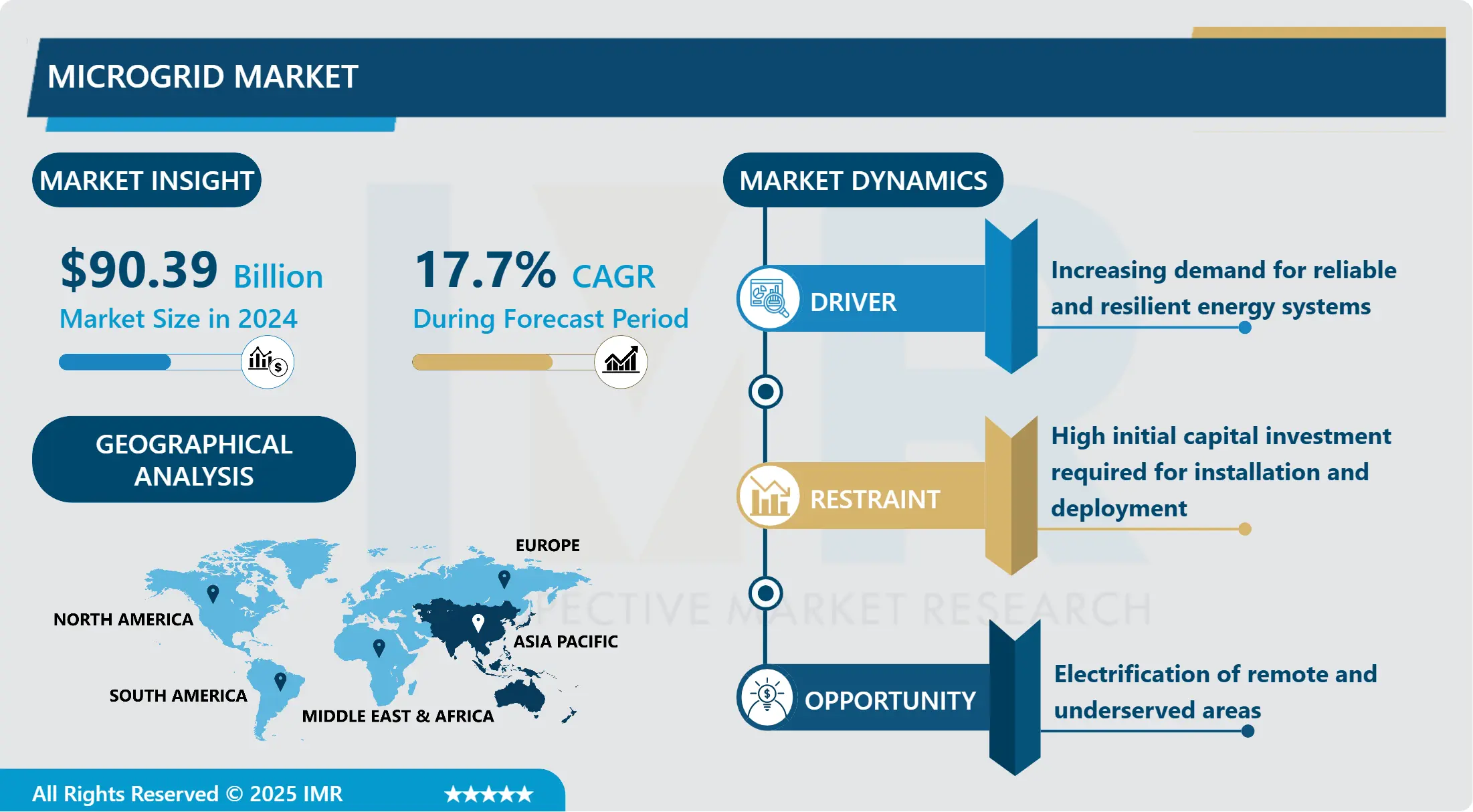
Microgrid Market Size Was Valued at USD 90.39 Billion in 2024, and is Projected to Reach USD 332.91 Billion by 2032, Growing at a CAGR of 17.7% From 2025-2032.
Microgrid is a list generation electrical network which may be interconnected with the utility grid or may not. It comprises loads and DERs that are capable of generation, storage, and control of electricity at a particular site or geographical location like a campus or a hospital or even a community. They also offer a means of achieving energy security due to their capacity to support power during network disruptions, losses during power distribution are minimized, and renewable energy can be incorporated hence helping to promote a more distributed generation system.
The market for microgrids has been on the rise over the past years given the need for reliable, resilient and sustainable energy sources. Microgrids can be described as an embedded electricity network that can be connected to and can also run in parallel and/or in isolation to the main electricity grid so as to power buildings in the event that the main grid is no longer supplying current. Due to this, they are especially useful in security-sensitive areas like facility: hospitals, military compounds, and data centers. Further, use of renewable energy sources such as solar and wind along with improvement in the energy storage facility has improved the micro grid systems. Countries and organizations across the globe are now directing their focus on the microgrid projects to attain energy security objectives, to bring down their carbon emissions and to popularize clean energy.
In addition, the market is stimulated by technological developments, approvals and sanctions from the government authorities, and demand for modernization of electrical utility infrastructure. Earlier, microgrids were limited because of high cost and low scalability but with advancements in different control systems, energy management software, battery storage, and advanced power electronics devices; microgrids have become more efficient. In addition, supportive policies and healthy incentives from the governments are pushing the demand of microgrids mainly in the remote and rural regions where extension of the grid infrastructure is difficult and cost ineffective. Another factor moving the market forward is the increasing rate of natural calamities, which in turn provides demand for utilizing energy structures that are resistant to disasters. Therefore, it can be concluded that the global microgrid market is expected to experience extraordinary growth in the near future with an increasing use in commercial, industrial and residential microgrid applications.
Microgrid Market Trend Analysis
Microgrid Market Growth Driver- Increasing adoption of hybrid microgrids
A trend that is observable in microgrid market today is that microgrid is increasingly implementing a combination of different energy sources and multiple storage systems to provide the best performance, reliability, and cost. These composite systems often include many renewable power sources – PV, wind and many others, combined with regular working generators and modern kinds of energy storage systems, like lithium-ion. This is due to the fact that an integration of the two forms of energies and management increases the flexibility in energy switching and enhances the general reliability of the microgrid. This trend is due to the improvement of both the energy management software as well as the control systems, since they are able to efficiently tackle hybrid systems and provide accurate real time results. This is because as more renewable energy and battery storage become cheaper, more people are going to embrace hybrid microgrids hence boosting the decentralization of energy systems.
Microgrid Market Expansion Opportunity- Electrification of remote and underserved areas
Another interesting and untapped area in microgrid market is electrification of the remote and hard-to-reach regions. In many parts of the world especially the developing ones, there is no or very limited access to electricity because providing physical electricity infrastructure is expensive and time-consuming. Self contained energy structures obtained with microgrids can provide a solution that is entirely integrated, able to generate and distribute electricity on its own. This not only provides the electrical power to the distant regions but also contributes to the economic growth, raises the standard of living, formal necessities such as education and healthcare.
Moreover, it can also decrease the dependency on pricy and environmentally unfriendly diesel generators while integrating renewable energy in these microgrids for the advancement of world Sustainability. International investors – private companies and governments – who are involved in microgrid solutions for remote electrification can possibly find a huge market that requires their services while doing a lot of social and environment good.
Microgrid Market Segment Analysis:
Microgrid Market Segmented on the basis of Product, Power Source, Application, and Region.
By Product, Remote segment is expected to dominate the market during the forecast period
The remote segment is anticipated to control the microgrid market in the forecast period due to the rising concern for efficient and renewable power in isolated and unconnected zones. Microgrids offering to deliver power from remote locations are especially beneficial in the areas for which connection to the central power grid is impracticable or expensive like islands, villages, mining fields, and military camps. Such smart microgrids can work in isolation and maintain a steady electricity supply and cut the use of expensive and carbon-emitting diesel diesel generators. Introducing the high degree of renewable energy like solar and wind, and energy storage extended the advantages and reliability of the remote microgrids.
By Power Source, Diesel segment expected to held the largest share
Currently, the diesel segment is expected to signify the largest market share in microgrid mainly because of the diesel model’s proven efficiency and flexibility. Diesel generators are especially popular and well known as the traditional reliable source of energy, this is mainly due to their capacity to deliver power throughout numerous circumstances, especially in cases of low supply or in situations where the supply of electricity from other forms of power may not be feasible. The two are established technologies that are ubiquitous: therefore, they control the microgrid market.
Microgrids that run on diesel are appreciated more for the dependability in providing backup power and for the capability that supports the variable load. Therefore, the use diesel generators is still prominent in the current structures focusing more in the hybrid microgrids where they are used to support the renewable energy sources in the provision of power. However, the segment’s share may come under threat of competition from cleaner energy sources over time, depending on emerging technologies and polices.
Microgrid Market Regional Insights:
Asia Pacific is Expected to Dominate the Market Over the Forecast period
The microgrid market is expected to witness strong growth from the Asia Pacific region during the forecast period because of high level of industrialization and urbanization coupled with the increasing focus on security of energy and emission reductions. It is revealed that the trend of using microgrid technologies is highly observed in the power sectors of the countries like India, China, and Japan, which are in a demand of integrated solutions for their power related problems.
India and china are two countries that are experiencing a rise in the demand for reliable power in the present days especially in the emerging town and rural areas not forgetting that the two countries have invested heavily in renewable energy and smart grid technologies which has boost the use of microgrids. Japan has also invested heavily in microgrids in a bid to improve power reliability especially after disasters. Also, government policies and incentives present in these countries are for the development of the microgrid market and encouraging the use of technology in the innovation field. Thus, the Asia Pacific region is expected to significantly influence the microgrid market in the future.
Active Key Players in the Microgrid Market
ABB Ltd. (Switzerland)
Ballard Power Systems (Canada)
Bloom Energy (United States)
Caterpillar Inc. (United States)
Eaton Corporation (United States)
Enel X (Italy)
General Electric (GE) (United States)
Honeywell International Inc. (United States)
Huawei Technologies Co., Ltd. (China)
Microgrid Labs (United States)
Mitsubishi Electric Corporation (Japan)
S&C Electric Company (United States)
Schneider Electric (France)
Siemens AG (Germany)
Tesla Inc. (United States)
Other Active Players
Chapter 1: Introduction
1.1 Scope and Coverage
Chapter 2:Executive Summary
Chapter 3: Market Landscape
3.1 Market Dynamics
3.1.1 Drivers
3.1.2 Restraints
3.1.3 Opportunities
3.1.4 Challenges
3.2 Market Trend Analysis
3.3 PESTLE Analysis
3.4 Porter’s Five Forces Analysis
3.5 Industry Value Chain Analysis
3.6 Ecosystem
3.7 Regulatory Landscape
3.8 Price Trend Analysis
3.9 Patent Analysis
3.10 Technology Evolution
3.11 Investment Pockets
3.12 Import-Export Analysis
Chapter 4: Microgrid Market by Product (2018-2032)
4.1 Microgrid Market Snapshot and Growth Engine
4.2 Market Overview
4.3 Remote
4.3.1 Introduction and Market Overview
4.3.2 Historic and Forecasted Market Size in Value USD and Volume Units
4.3.3 Key Market Trends, Growth Factors, and Opportunities
4.3.4 Geographic Segmentation Analysis
4.4 Grid Connected
4.5 Hybrid
Chapter 5: Microgrid Market by Power Source (2018-2032)
5.1 Microgrid Market Snapshot and Growth Engine
5.2 Market Overview
5.3 CHP
5.3.1 Introduction and Market Overview
5.3.2 Historic and Forecasted Market Size in Value USD and Volume Units
5.3.3 Key Market Trends, Growth Factors, and Opportunities
5.3.4 Geographic Segmentation Analysis
5.4 Natural Gas
5.5 Solar PV
5.6 Diesel
5.7 Fuel Cell
5.8 Others
Chapter 6: Microgrid Market by Application (2018-2032)
6.1 Microgrid Market Snapshot and Growth Engine
6.2 Market Overview
6.3 Government
6.3.1 Introduction and Market Overview
6.3.2 Historic and Forecasted Market Size in Value USD and Volume Units
6.3.3 Key Market Trends, Growth Factors, and Opportunities
6.3.4 Geographic Segmentation Analysis
6.4 Education
6.5 Commercial
6.6 Utility
6.7 Defense
6.8 Others
Chapter 7: Company Profiles and Competitive Analysis
7.1 Competitive Landscape
7.1.1 Competitive Benchmarking
7.1.2 Microgrid Market Share by Manufacturer (2024)
7.1.3 Industry BCG Matrix
7.1.4 Heat Map Analysis
7.1.5 Mergers and Acquisitions
7.2 ABB LTD. (SWITZERLAND)
7.2.1 Company Overview
7.2.2 Key Executives
7.2.3 Company Snapshot
7.2.4 Role of the Company in the Market
7.2.5 Sustainability and Social Responsibility
7.2.6 Operating Business Segments
7.2.7 Product Portfolio
7.2.8 Business Performance
7.2.9 Key Strategic Moves and Recent Developments
7.2.10 SWOT Analysis
7.3 BALLARD POWER SYSTEMS (CANADA)
7.4 BLOOM ENERGY (UNITED STATES)
7.5 CATERPILLAR INC. (UNITED STATES)
7.6 EATON CORPORATION (UNITED STATES)
7.7 ENEL X (ITALY)
7.8 GENERAL ELECTRIC (GE) (UNITED STATES)
7.9 HONEYWELL INTERNATIONAL INC. (UNITED STATES)
7.10 HUAWEI TECHNOLOGIES COLTD. (CHINA)
7.11 MICROGRID LABS (UNITED STATES)
7.12 MITSUBISHI ELECTRIC CORPORATION (JAPAN)
7.13 S&C ELECTRIC COMPANY (UNITED STATES)
7.14 SCHNEIDER ELECTRIC (FRANCE)
7.15 SIEMENS AG (GERMANY)
7.16 TESLA INC. (UNITED STATES)
7.17 OTHER KEY PLAYERS
Chapter 8: Global Microgrid Market By Region
8.1 Overview
8.2. North America Microgrid Market
8.2.1 Key Market Trends, Growth Factors and Opportunities
8.2.2 Top Key Companies
8.2.3 Historic and Forecasted Market Size by Segments
8.2.4 Historic and Forecasted Market Size by Product
8.2.4.1 Remote
8.2.4.2 Grid Connected
8.2.4.3 Hybrid
8.2.5 Historic and Forecasted Market Size by Power Source
8.2.5.1 CHP
8.2.5.2 Natural Gas
8.2.5.3 Solar PV
8.2.5.4 Diesel
8.2.5.5 Fuel Cell
8.2.5.6 Others
8.2.6 Historic and Forecasted Market Size by Application
8.2.6.1 Government
8.2.6.2 Education
8.2.6.3 Commercial
8.2.6.4 Utility
8.2.6.5 Defense
8.2.6.6 Others
8.2.7 Historic and Forecast Market Size by Country
8.2.7.1 US
8.2.7.2 Canada
8.2.7.3 Mexico
8.3. Eastern Europe Microgrid Market
8.3.1 Key Market Trends, Growth Factors and Opportunities
8.3.2 Top Key Companies
8.3.3 Historic and Forecasted Market Size by Segments
8.3.4 Historic and Forecasted Market Size by Product
8.3.4.1 Remote
8.3.4.2 Grid Connected
8.3.4.3 Hybrid
8.3.5 Historic and Forecasted Market Size by Power Source
8.3.5.1 CHP
8.3.5.2 Natural Gas
8.3.5.3 Solar PV
8.3.5.4 Diesel
8.3.5.5 Fuel Cell
8.3.5.6 Others
8.3.6 Historic and Forecasted Market Size by Application
8.3.6.1 Government
8.3.6.2 Education
8.3.6.3 Commercial
8.3.6.4 Utility
8.3.6.5 Defense
8.3.6.6 Others
8.3.7 Historic and Forecast Market Size by Country
8.3.7.1 Russia
8.3.7.2 Bulgaria
8.3.7.3 The Czech Republic
8.3.7.4 Hungary
8.3.7.5 Poland
8.3.7.6 Romania
8.3.7.7 Rest of Eastern Europe
8.4. Western Europe Microgrid Market
8.4.1 Key Market Trends, Growth Factors and Opportunities
8.4.2 Top Key Companies
8.4.3 Historic and Forecasted Market Size by Segments
8.4.4 Historic and Forecasted Market Size by Product
8.4.4.1 Remote
8.4.4.2 Grid Connected
8.4.4.3 Hybrid
8.4.5 Historic and Forecasted Market Size by Power Source
8.4.5.1 CHP
8.4.5.2 Natural Gas
8.4.5.3 Solar PV
8.4.5.4 Diesel
8.4.5.5 Fuel Cell
8.4.5.6 Others
8.4.6 Historic and Forecasted Market Size by Application
8.4.6.1 Government
8.4.6.2 Education
8.4.6.3 Commercial
8.4.6.4 Utility
8.4.6.5 Defense
8.4.6.6 Others
8.4.7 Historic and Forecast Market Size by Country
8.4.7.1 Germany
8.4.7.2 UK
8.4.7.3 France
8.4.7.4 The Netherlands
8.4.7.5 Italy
8.4.7.6 Spain
8.4.7.7 Rest of Western Europe
8.5. Asia Pacific Microgrid Market
8.5.1 Key Market Trends, Growth Factors and Opportunities
8.5.2 Top Key Companies
8.5.3 Historic and Forecasted Market Size by Segments
8.5.4 Historic and Forecasted Market Size by Product
8.5.4.1 Remote
8.5.4.2 Grid Connected
8.5.4.3 Hybrid
8.5.5 Historic and Forecasted Market Size by Power Source
8.5.5.1 CHP
8.5.5.2 Natural Gas
8.5.5.3 Solar PV
8.5.5.4 Diesel
8.5.5.5 Fuel Cell
8.5.5.6 Others
8.5.6 Historic and Forecasted Market Size by Application
8.5.6.1 Government
8.5.6.2 Education
8.5.6.3 Commercial
8.5.6.4 Utility
8.5.6.5 Defense
8.5.6.6 Others
8.5.7 Historic and Forecast Market Size by Country
8.5.7.1 China
8.5.7.2 India
8.5.7.3 Japan
8.5.7.4 South Korea
8.5.7.5 Malaysia
8.5.7.6 Thailand
8.5.7.7 Vietnam
8.5.7.8 The Philippines
8.5.7.9 Australia
8.5.7.10 New Zealand
8.5.7.11 Rest of APAC
8.6. Middle East & Africa Microgrid Market
8.6.1 Key Market Trends, Growth Factors and Opportunities
8.6.2 Top Key Companies
8.6.3 Historic and Forecasted Market Size by Segments
8.6.4 Historic and Forecasted Market Size by Product
8.6.4.1 Remote
8.6.4.2 Grid Connected
8.6.4.3 Hybrid
8.6.5 Historic and Forecasted Market Size by Power Source
8.6.5.1 CHP
8.6.5.2 Natural Gas
8.6.5.3 Solar PV
8.6.5.4 Diesel
8.6.5.5 Fuel Cell
8.6.5.6 Others
8.6.6 Historic and Forecasted Market Size by Application
8.6.6.1 Government
8.6.6.2 Education
8.6.6.3 Commercial
8.6.6.4 Utility
8.6.6.5 Defense
8.6.6.6 Others
8.6.7 Historic and Forecast Market Size by Country
8.6.7.1 Turkiye
8.6.7.2 Bahrain
8.6.7.3 Kuwait
8.6.7.4 Saudi Arabia
8.6.7.5 Qatar
8.6.7.6 UAE
8.6.7.7 Israel
8.6.7.8 South Africa
8.7. South America Microgrid Market
8.7.1 Key Market Trends, Growth Factors and Opportunities
8.7.2 Top Key Companies
8.7.3 Historic and Forecasted Market Size by Segments
8.7.4 Historic and Forecasted Market Size by Product
8.7.4.1 Remote
8.7.4.2 Grid Connected
8.7.4.3 Hybrid
8.7.5 Historic and Forecasted Market Size by Power Source
8.7.5.1 CHP
8.7.5.2 Natural Gas
8.7.5.3 Solar PV
8.7.5.4 Diesel
8.7.5.5 Fuel Cell
8.7.5.6 Others
8.7.6 Historic and Forecasted Market Size by Application
8.7.6.1 Government
8.7.6.2 Education
8.7.6.3 Commercial
8.7.6.4 Utility
8.7.6.5 Defense
8.7.6.6 Others
8.7.7 Historic and Forecast Market Size by Country
8.7.7.1 Brazil
8.7.7.2 Argentina
8.7.7.3 Rest of SA
Chapter 9 Analyst Viewpoint and Conclusion
9.1 Recommendations and Concluding Analysis
9.2 Potential Market Strategies
Chapter 10 Research Methodology
10.1 Research Process
10.2 Primary Research
10.3 Secondary Research
Q1: What would be the forecast period in the Microgrid Market research report?
A1: The forecast period in the Microgrid Market research report is 2025-2032.
Q2: Who are the key players in the Microgrid Market?
A2: ABB Ltd. (Switzerland), Ballard Power Systems (Canada), Bloom Energy (United States), Caterpillar Inc. (United States) and Other Active Players.
Q3: What are the segments of the Microgrid Market?
A3: The Microgrid Market is segmented into Product, Power Source, Application and region. By Product, the market is categorized into Remote, Grid Connected, Hybrid. By Power Source, the market is categorized into CHP, Natural Gas, Solar PV, Diesel, Fuel Cell, Others. By Application, the market is categorized into Government, Education, Commercial, Utility, Defense, Others. By Region, it is analyzed across North America (U.S.; Canada; Mexico), Eastern Europe (Russia; Bulgaria; The Czech Republic; Hungary; Poland; Romania; Rest of Eastern Europe), Western Europe (Germany; UK; France; The Netherlands; Italy; Spain; Rest of Western Europe), Asia-Pacific (China; India; Japan; South Korea; Malaysia; Thailand; Vietnam; The Philippines; Australia; New Zealand; Rest of APAC), Middle East & Africa (Türkiye; Bahrain; Kuwait; Saudi Arabia; Qatar; UAE; Israel; South Africa), South America (Brazil; Argentina; Rest of SA.).
Q4: What is the Microgrid Market?
A4: Microgrid is a list generation electrical network which may be interconnected with the utility grid or may not. It comprises loads and DERs which are capable of generation, storage, and control of electricity at a particular site or geographical location like a campus or a hospital or even a community. They also offer a means of achieving energy security due to their capacity to support power during network disruptions, losses during power distribution are minimized, and renewable energy can be incorporated hence helping to promote a more distributed generation system.
Q5: How big is the Microgrid Market?
A5: Microgrid Market Size Was Valued at USD 90.39 Billion in 2024, and is Projected to Reach USD 332.91 Billion by 2032, Growing at a CAGR of 17.7% From 2025-2032.
How to Buy a Report from eminsights.jp
On the product page, choose the license you want: Single-User License, Multi-User License or Enterprise License.
If you required report in your native language, then you can click on Translated Report button and fill out the form with report name and language you want, then our team will contact you as soon as possible.
Click the Buy Now button.
You will be redirected to the checkout page. Enter your company details and payment information.
Click Place Order to complete the purchase.
Confirmation: You’ll receive an order confirmation and our team will contact you shortly with your ordered report.
If you have any questions, fill out the contact form below or email us at bizdev@eminsights.net.
Thank you for choosing eminsights.jp!