Stay Ahead in Fast-Growing Economies.
Browse Reports Now

Maintenance Vehicle Market Size, Share And Industry Trends
The maintenance vehicle market encompasses a diverse range of specialized vehicles designed for the upkeep, repair, and servicing of infrastructure, machinery, and equipment across various industries such as transportation, construction, and utilities. These vehicles are equipped with tools, machinery, and features tailored to specific maintenance tasks, including road repair, railway track maintenance, airport runway upkeep, and utility line servicing. The market includes products such as service trucks, utility vehicles, railway maintenance vehicles, and airport ground support vehicles, and is driven by the need for efficient, reliable, and safe maintenance operations in both public and private sectors.

IMR Group
Description
Maintenance Vehicle Market Synopsis
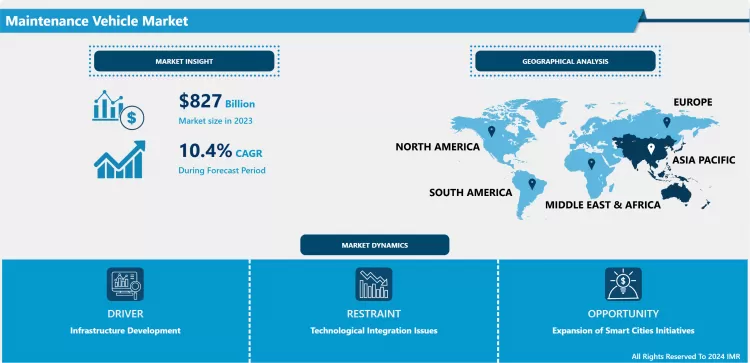
Maintenance Vehicle Market Size Was Valued at USD 827 Billion in 2023, and is Projected to Reach USD 2014.78 Billion by 2032, Growing at a CAGR of 10.4 % From 2024-2032.
The maintenance vehicle market encompasses a diverse range of specialized vehicles designed for the upkeep, repair, and servicing of infrastructure, machinery, and equipment across various industries such as transportation, construction, and utilities. These vehicles are equipped with tools, machinery, and features tailored to specific maintenance tasks, including road repair, railway track maintenance, airport runway upkeep, and utility line servicing. The market includes products such as service trucks, utility vehicles, railway maintenance vehicles, and airport ground support vehicles, and is driven by the need for efficient, reliable, and safe maintenance operations in both public and private sectors.
The market for maintenance vehicles is expected to increase significantly because to the expansion of infrastructure and the growing requirement for effective maintenance operations across many industries. Technological developments, such as the fusion of IoT and AI to improve vehicle capabilities and operational efficiency, are major trends influencing this industry. Thanks to these advancements, vehicles can now carry out predictive maintenance, which minimizes downtime and maximizes resource utilization.
In addition, stricter emissions and sustainability rules are driving manufacturers to create environmentally friendly maintenance vehicles with electric or hybrid engines. This move toward sustainability complies with legal obligations and is in line with the increasing emphasis on environmental responsibility around the world.
In terms of market dynamics, there is an increasing need for specialized maintenance vehicles made for particular industries, such construction, agricultural, and municipal services. These cars have specialist tools and systems installed to effectively handle particular maintenance issues.
In addition, fleet management systems that allow for real-time tracking of vehicle performance and maintenance requirements are becoming more and more popular in the market. The requirement for operational transparency, cost effectiveness, and adherence to safety regulations is what’s driving this movement.
All things considered, the market for maintenance vehicles is expanding rapidly due to pressure from regulations, industry-specific needs, and technical improvements. To meet changing client demands and take advantage of new opportunities in this fast-paced industry, manufacturers and service providers are putting more of an emphasis on innovation and personalization.
Maintenance Vehicle Market Trend Analysis
Rise of Electric and Hybrid Maintenance Vehicles
The increasing adoption of electric and hybrid maintenance vehicles marks a pivotal shift in the transportation sector, driven by both environmental imperatives and economic benefits. As governments worldwide tighten emissions regulations and commit to ambitious carbon reduction targets, industries reliant on fleet operations are increasingly turning to electric alternatives. Electric maintenance vehicles, powered by rechargeable batteries or hybrids combining electric and internal combustion engines, offer significant reductions in carbon emissions compared to their traditional counterparts. This reduction is crucial for municipalities and organizations aiming to meet sustainability goals and improve air quality in urban areas.
Beyond environmental advantages, electric maintenance vehicles also present compelling economic incentives. They typically have lower operational costs due to reduced fuel dependency and maintenance requirements. Electric vehicles have fewer moving parts compared to internal combustion engines, translating into fewer breakdowns and lower servicing costs over their lifespan. Moreover, as battery technology advances and economies of scale drive down production costs, the initial price gap between electric and conventional vehicles continues to narrow, making electric options increasingly cost-competitive.
Fleet managers are also attracted to electric maintenance vehicles for their quieter operation and smoother driving experience, enhancing worker comfort and reducing noise pollution in populated areas. Furthermore, government incentives and subsidies aimed at promoting electric vehicle adoption further sweeten the deal for organizations transitioning their fleets. As these trends accelerate, electric and hybrid maintenance vehicles are poised to play a crucial role in the future of sustainable urban transportation infrastructure, paving the way for cleaner, more efficient fleet operations globally.
Integration of Telematics and IoT in Maintenance Vehicles
The integration of advanced telematics and IoT technologies in maintenance vehicles represents a significant leap forward in optimizing fleet management and operational efficiency. Telematics systems enable real-time monitoring of crucial vehicle metrics such as engine performance, fuel consumption, and maintenance schedules. This real-time data collection allows fleet managers to proactively address issues before they escalate, thereby reducing unplanned downtime and minimizing costly repairs. Predictive maintenance capabilities, enabled by IoT sensors and data analytics, further enhance operational reliability by detecting potential failures early based on performance trends and usage patterns.
Moreover, IoT technologies empower maintenance vehicles with connectivity that extends beyond basic monitoring. Vehicles equipped with IoT can communicate seamlessly with centralized fleet management systems, enabling remote diagnostics, software updates, and even remote control functionalities in some cases. This connectivity not only streamlines operations but also facilitates dynamic route optimization based on real-time traffic conditions and vehicle locations. This capability is particularly valuable in industries such as logistics, where optimizing delivery routes can significantly reduce fuel consumption and operational costs while improving delivery time reliability.
Furthermore, the data collected through telematics and IoT can be leveraged for comprehensive fleet analytics. By analyzing historical data trends, organizations can identify areas for operational improvement, such as optimizing maintenance schedules or refining driver behaviors to maximize fuel efficiency. This data-driven approach not only enhances cost savings but also supports sustainable practices by minimizing environmental impact through more efficient resource utilization. As telematics and IoT technologies continue to evolve, their integration into maintenance vehicles is expected to redefine fleet management paradigms, driving greater efficiency, reliability, and sustainability across industries.
Maintenance Vehicle Market Segment Analysis:
Maintenance Vehicle Market Segmented based on By Vehicle Type, By Maintenance Type, By Application, By Fuel Type and By End-User.
By Maintenance Type, Preventive Maintenance segment is expected to dominate the market during the forecast period
Preventive maintenance stands as the cornerstone of reliability and operational efficiency across diverse vehicle types and industries. Its dominance stems from its proactive approach, which involves scheduled inspections, servicing, and parts replacement to prevent potential failures before they occur. This methodology ensures that vehicles operate at peak performance levels, minimizing the risk of unexpected breakdowns and associated downtime. In sectors where continuous operation is crucial, such as commercial fleets and industrial applications, preventive maintenance not only enhances reliability but also extends the lifespan of vehicles and equipment. By adhering to regular maintenance schedules, organizations can reduce overall operating costs by avoiding costly repairs and unplanned interruptions to business operations.
Moreover, preventive maintenance fosters a culture of proactive management of assets, optimizing their efficiency and reducing the likelihood of major repairs or replacements. This approach is particularly beneficial in industries where equipment downtime can lead to significant financial losses and operational disruptions. For instance, in commercial logistics, timely maintenance of delivery vehicles ensures that goods are transported on schedule, maintaining customer satisfaction and service reliability. Similarly, in manufacturing settings, where heavy machinery is essential for production processes, preventive maintenance plays a critical role in preventing costly breakdowns that could halt manufacturing operations and affect production output. Ultimately, by prioritizing preventive maintenance, organizations not only safeguard their investments in vehicles and equipment but also uphold their commitments to efficiency, safety, and customer satisfaction across their operations.
By Vehicle Type, Heavy-duty vehiclessegment held the largest share in 2023
Heavy-duty vehicles occupy a pivotal role in industries such as construction and transportation due to their robust construction and capability to handle substantial loads over extensive distances. In the construction sector, these vehicles are essential for transporting materials like gravel, cement, and heavy machinery to and from construction sites. Their sturdy build allows them to navigate rough terrain and operate under challenging conditions, making them indispensable for large-scale projects where reliability and load-bearing capacity are paramount. From dump trucks to specialized cranes and excavators, heavy-duty vehicles enable construction companies to execute tasks efficiently and meet project deadlines.
Similarly, in the industrial sector, heavy-duty vehicles are crucial for logistics and material handling. They facilitate the movement of raw materials, finished goods, and equipment within industrial facilities and between different sites. Whether it’s hauling raw materials for manufacturing processes or transporting finished products to distribution centers, these vehicles ensure smooth operations and timely delivery. Their ability to withstand heavy use and operate reliably under demanding conditions makes them the preferred choice in industries where productivity and operational efficiency are critical. Moreover, heavy-duty vehicles often incorporate advanced technologies and robust engineering to enhance performance, safety, and fuel efficiency, further solidifying their dominance in applications requiring sustained performance and durability.
Maintenance Vehicle Market Regional Insights:
Asia-Pacific’s is Expected to Dominate the Market Over the Forecast period
Asia-Pacific’s maintenance vehicle market is characterized by dynamic growth driven by rapid urbanization and expansive infrastructure projects, particularly in countries like China and India. As urban populations swell and cities expand, there is an escalating demand for construction and maintenance equipment to support infrastructure development. This includes a significant need for road sweepers, garbage trucks, and asphalt maintenance machinery to ensure the upkeep and efficiency of transportation networks. Government initiatives aimed at improving road safety and operational efficiency further propel the market forward, encouraging investments in advanced technologies and modern fleet management systems.
In China, as one of the largest and fastest-growing economies globally, the demand for maintenance vehicles is amplified by massive urbanization initiatives and ambitious infrastructure projects such as the Belt and Road Initiative. Cities are continually investing in advanced equipment like automated street sweepers and electric-powered maintenance vehicles to address environmental concerns and enhance operational efficiency. The Chinese market also sees a rising adoption of smart technologies in maintenance vehicles, integrating GPS tracking and real-time monitoring systems to optimize fleet performance and resource allocation.
India, similarly, experiences robust growth in the maintenance vehicle sector fueled by urban expansion and infrastructure modernization efforts. The government’s emphasis on initiatives like Smart Cities Mission and the National Highway Development Program (NHDP) stimulates demand for specialized vehicles capable of efficient waste management, road cleaning, and maintenance activities. The market sees a diversity of vehicles ranging from compact sweepers for narrow urban streets to heavy-duty equipment for highway maintenance, catering to the varied needs of different regions and urban settings across the country.
Active Key Players in the Maintenance Vehicle Market
Firestone Complete Auto Care (USA)
Jiffy Lube International Inc. (USA)
Asbury Automotive Group Inc. (USA)
Sumitomo Corporation (Japan)
Belron International Ltd. (South Africa)
Driven Brands Inc. (USA)
Goodyear Tire & Rubber (USA)
Monro Muffler Brake Inc. (USA)
Ashland Automotive (USA)
Carmax Autocare Center (Nigeria)
AAMCO Transmissions Inc. (USA)
Tata Motors (India)
Other Key Players
Chapter 1: Introduction
1.1 Scope and Coverage
Chapter 2:Executive Summary
Chapter 3: Market Landscape
3.1 Market Dynamics
3.1.1 Drivers
3.1.2 Restraints
3.1.3 Opportunities
3.1.4 Challenges
3.2 Market Trend Analysis
3.3 PESTLE Analysis
3.4 Porter’s Five Forces Analysis
3.5 Industry Value Chain Analysis
3.6 Ecosystem
3.7 Regulatory Landscape
3.8 Price Trend Analysis
3.9 Patent Analysis
3.10 Technology Evolution
3.11 Investment Pockets
3.12 Import-Export Analysis
Chapter 4: Maintenance Vehicle Market by Vehicle Type (2018-2032)
4.1 Maintenance Vehicle Market Snapshot and Growth Engine
4.2 Market Overview
4.3 Heavy-duty vehicles
4.3.1 Introduction and Market Overview
4.3.2 Historic and Forecasted Market Size in Value USD and Volume Units
4.3.3 Key Market Trends, Growth Factors, and Opportunities
4.3.4 Geographic Segmentation Analysis
4.4 Medium-duty vehicles
4.5 Light-duty vehicles
Chapter 5: Maintenance Vehicle Market by Maintenance Type (2018-2032)
5.1 Maintenance Vehicle Market Snapshot and Growth Engine
5.2 Market Overview
5.3 Preventive Maintenance
5.3.1 Introduction and Market Overview
5.3.2 Historic and Forecasted Market Size in Value USD and Volume Units
5.3.3 Key Market Trends, Growth Factors, and Opportunities
5.3.4 Geographic Segmentation Analysis
5.4 Corrective Maintenance.
5.5 Predictive Maintenance
Chapter 6: Maintenance Vehicle Market by Application (2018-2032)
6.1 Maintenance Vehicle Market Snapshot and Growth Engine
6.2 Market Overview
6.3 Construction
6.3.1 Introduction and Market Overview
6.3.2 Historic and Forecasted Market Size in Value USD and Volume Units
6.3.3 Key Market Trends, Growth Factors, and Opportunities
6.3.4 Geographic Segmentation Analysis
6.4 Municipal
6.5 Industrial
6.6 Agricultural
6.7 Airport.
6.8 Railway
Chapter 7: Maintenance Vehicle Market by Fuel Type (2018-2032)
7.1 Maintenance Vehicle Market Snapshot and Growth Engine
7.2 Market Overview
7.3 Diesel
7.3.1 Introduction and Market Overview
7.3.2 Historic and Forecasted Market Size in Value USD and Volume Units
7.3.3 Key Market Trends, Growth Factors, and Opportunities
7.3.4 Geographic Segmentation Analysis
7.4 Petrol/Gasoline
7.5 Electric
7.6 Hybrid
7.7 Natural Gas
Chapter 8: Maintenance Vehicle Market by End-User (2018-2032)
8.1 Maintenance Vehicle Market Snapshot and Growth Engine
8.2 Market Overview
8.3 Government
8.3.1 Introduction and Market Overview
8.3.2 Historic and Forecasted Market Size in Value USD and Volume Units
8.3.3 Key Market Trends, Growth Factors, and Opportunities
8.3.4 Geographic Segmentation Analysis
8.4 Commercial
8.5 Individuals
Chapter 9: Company Profiles and Competitive Analysis
9.1 Competitive Landscape
9.1.1 Competitive Benchmarking
9.1.2 Maintenance Vehicle Market Share by Manufacturer (2024)
9.1.3 Industry BCG Matrix
9.1.4 Heat Map Analysis
9.1.5 Mergers and Acquisitions
9.2 FIRESTONE COMPLETE AUTO CARE (USA)
9.2.1 Company Overview
9.2.2 Key Executives
9.2.3 Company Snapshot
9.2.4 Role of the Company in the Market
9.2.5 Sustainability and Social Responsibility
9.2.6 Operating Business Segments
9.2.7 Product Portfolio
9.2.8 Business Performance
9.2.9 Key Strategic Moves and Recent Developments
9.2.10 SWOT Analysis
9.3 JIFFY LUBE INTERNATIONAL INC. (USA)
9.4 ASBURY AUTOMOTIVE GROUP INC. (USA)
9.5 SUMITOMO CORPORATION (JAPAN)
9.6 BELRON INTERNATIONAL LTD. (SOUTH AFRICA)
9.7 DRIVEN BRANDS INC. (USA)
9.8 GOODYEAR TIRE & RUBBER (USA)
9.9 MONRO MUFFLER BRAKE INC. (USA)
9.10 ASHLAND AUTOMOTIVE (USA)
9.11 CARMAX AUTOCARE CENTER (NIGERIA)
9.12 AAMCO TRANSMISSIONS INC. (USA)
9.13 TATA MOTORS (INDIA)
9.14 OTHER KEY PLAYERS
9.15
Chapter 10: Global Maintenance Vehicle Market By Region
10.1 Overview
10.2. North America Maintenance Vehicle Market
10.2.1 Key Market Trends, Growth Factors and Opportunities
10.2.2 Top Key Companies
10.2.3 Historic and Forecasted Market Size by Segments
10.2.4 Historic and Forecasted Market Size by Vehicle Type
10.2.4.1 Heavy-duty vehicles
10.2.4.2 Medium-duty vehicles
10.2.4.3 Light-duty vehicles
10.2.5 Historic and Forecasted Market Size by Maintenance Type
10.2.5.1 Preventive Maintenance
10.2.5.2 Corrective Maintenance.
10.2.5.3 Predictive Maintenance
10.2.6 Historic and Forecasted Market Size by Application
10.2.6.1 Construction
10.2.6.2 Municipal
10.2.6.3 Industrial
10.2.6.4 Agricultural
10.2.6.5 Airport.
10.2.6.6 Railway
10.2.7 Historic and Forecasted Market Size by Fuel Type
10.2.7.1 Diesel
10.2.7.2 Petrol/Gasoline
10.2.7.3 Electric
10.2.7.4 Hybrid
10.2.7.5 Natural Gas
10.2.8 Historic and Forecasted Market Size by End-User
10.2.8.1 Government
10.2.8.2 Commercial
10.2.8.3 Individuals
10.2.9 Historic and Forecast Market Size by Country
10.2.9.1 US
10.2.9.2 Canada
10.2.9.3 Mexico
10.3. Eastern Europe Maintenance Vehicle Market
10.3.1 Key Market Trends, Growth Factors and Opportunities
10.3.2 Top Key Companies
10.3.3 Historic and Forecasted Market Size by Segments
10.3.4 Historic and Forecasted Market Size by Vehicle Type
10.3.4.1 Heavy-duty vehicles
10.3.4.2 Medium-duty vehicles
10.3.4.3 Light-duty vehicles
10.3.5 Historic and Forecasted Market Size by Maintenance Type
10.3.5.1 Preventive Maintenance
10.3.5.2 Corrective Maintenance.
10.3.5.3 Predictive Maintenance
10.3.6 Historic and Forecasted Market Size by Application
10.3.6.1 Construction
10.3.6.2 Municipal
10.3.6.3 Industrial
10.3.6.4 Agricultural
10.3.6.5 Airport.
10.3.6.6 Railway
10.3.7 Historic and Forecasted Market Size by Fuel Type
10.3.7.1 Diesel
10.3.7.2 Petrol/Gasoline
10.3.7.3 Electric
10.3.7.4 Hybrid
10.3.7.5 Natural Gas
10.3.8 Historic and Forecasted Market Size by End-User
10.3.8.1 Government
10.3.8.2 Commercial
10.3.8.3 Individuals
10.3.9 Historic and Forecast Market Size by Country
10.3.9.1 Russia
10.3.9.2 Bulgaria
10.3.9.3 The Czech Republic
10.3.9.4 Hungary
10.3.9.5 Poland
10.3.9.6 Romania
10.3.9.7 Rest of Eastern Europe
10.4. Western Europe Maintenance Vehicle Market
10.4.1 Key Market Trends, Growth Factors and Opportunities
10.4.2 Top Key Companies
10.4.3 Historic and Forecasted Market Size by Segments
10.4.4 Historic and Forecasted Market Size by Vehicle Type
10.4.4.1 Heavy-duty vehicles
10.4.4.2 Medium-duty vehicles
10.4.4.3 Light-duty vehicles
10.4.5 Historic and Forecasted Market Size by Maintenance Type
10.4.5.1 Preventive Maintenance
10.4.5.2 Corrective Maintenance.
10.4.5.3 Predictive Maintenance
10.4.6 Historic and Forecasted Market Size by Application
10.4.6.1 Construction
10.4.6.2 Municipal
10.4.6.3 Industrial
10.4.6.4 Agricultural
10.4.6.5 Airport.
10.4.6.6 Railway
10.4.7 Historic and Forecasted Market Size by Fuel Type
10.4.7.1 Diesel
10.4.7.2 Petrol/Gasoline
10.4.7.3 Electric
10.4.7.4 Hybrid
10.4.7.5 Natural Gas
10.4.8 Historic and Forecasted Market Size by End-User
10.4.8.1 Government
10.4.8.2 Commercial
10.4.8.3 Individuals
10.4.9 Historic and Forecast Market Size by Country
10.4.9.1 Germany
10.4.9.2 UK
10.4.9.3 France
10.4.9.4 The Netherlands
10.4.9.5 Italy
10.4.9.6 Spain
10.4.9.7 Rest of Western Europe
10.5. Asia Pacific Maintenance Vehicle Market
10.5.1 Key Market Trends, Growth Factors and Opportunities
10.5.2 Top Key Companies
10.5.3 Historic and Forecasted Market Size by Segments
10.5.4 Historic and Forecasted Market Size by Vehicle Type
10.5.4.1 Heavy-duty vehicles
10.5.4.2 Medium-duty vehicles
10.5.4.3 Light-duty vehicles
10.5.5 Historic and Forecasted Market Size by Maintenance Type
10.5.5.1 Preventive Maintenance
10.5.5.2 Corrective Maintenance.
10.5.5.3 Predictive Maintenance
10.5.6 Historic and Forecasted Market Size by Application
10.5.6.1 Construction
10.5.6.2 Municipal
10.5.6.3 Industrial
10.5.6.4 Agricultural
10.5.6.5 Airport.
10.5.6.6 Railway
10.5.7 Historic and Forecasted Market Size by Fuel Type
10.5.7.1 Diesel
10.5.7.2 Petrol/Gasoline
10.5.7.3 Electric
10.5.7.4 Hybrid
10.5.7.5 Natural Gas
10.5.8 Historic and Forecasted Market Size by End-User
10.5.8.1 Government
10.5.8.2 Commercial
10.5.8.3 Individuals
10.5.9 Historic and Forecast Market Size by Country
10.5.9.1 China
10.5.9.2 India
10.5.9.3 Japan
10.5.9.4 South Korea
10.5.9.5 Malaysia
10.5.9.6 Thailand
10.5.9.7 Vietnam
10.5.9.8 The Philippines
10.5.9.9 Australia
10.5.9.10 New Zealand
10.5.9.11 Rest of APAC
10.6. Middle East & Africa Maintenance Vehicle Market
10.6.1 Key Market Trends, Growth Factors and Opportunities
10.6.2 Top Key Companies
10.6.3 Historic and Forecasted Market Size by Segments
10.6.4 Historic and Forecasted Market Size by Vehicle Type
10.6.4.1 Heavy-duty vehicles
10.6.4.2 Medium-duty vehicles
10.6.4.3 Light-duty vehicles
10.6.5 Historic and Forecasted Market Size by Maintenance Type
10.6.5.1 Preventive Maintenance
10.6.5.2 Corrective Maintenance.
10.6.5.3 Predictive Maintenance
10.6.6 Historic and Forecasted Market Size by Application
10.6.6.1 Construction
10.6.6.2 Municipal
10.6.6.3 Industrial
10.6.6.4 Agricultural
10.6.6.5 Airport.
10.6.6.6 Railway
10.6.7 Historic and Forecasted Market Size by Fuel Type
10.6.7.1 Diesel
10.6.7.2 Petrol/Gasoline
10.6.7.3 Electric
10.6.7.4 Hybrid
10.6.7.5 Natural Gas
10.6.8 Historic and Forecasted Market Size by End-User
10.6.8.1 Government
10.6.8.2 Commercial
10.6.8.3 Individuals
10.6.9 Historic and Forecast Market Size by Country
10.6.9.1 Turkiye
10.6.9.2 Bahrain
10.6.9.3 Kuwait
10.6.9.4 Saudi Arabia
10.6.9.5 Qatar
10.6.9.6 UAE
10.6.9.7 Israel
10.6.9.8 South Africa
10.7. South America Maintenance Vehicle Market
10.7.1 Key Market Trends, Growth Factors and Opportunities
10.7.2 Top Key Companies
10.7.3 Historic and Forecasted Market Size by Segments
10.7.4 Historic and Forecasted Market Size by Vehicle Type
10.7.4.1 Heavy-duty vehicles
10.7.4.2 Medium-duty vehicles
10.7.4.3 Light-duty vehicles
10.7.5 Historic and Forecasted Market Size by Maintenance Type
10.7.5.1 Preventive Maintenance
10.7.5.2 Corrective Maintenance.
10.7.5.3 Predictive Maintenance
10.7.6 Historic and Forecasted Market Size by Application
10.7.6.1 Construction
10.7.6.2 Municipal
10.7.6.3 Industrial
10.7.6.4 Agricultural
10.7.6.5 Airport.
10.7.6.6 Railway
10.7.7 Historic and Forecasted Market Size by Fuel Type
10.7.7.1 Diesel
10.7.7.2 Petrol/Gasoline
10.7.7.3 Electric
10.7.7.4 Hybrid
10.7.7.5 Natural Gas
10.7.8 Historic and Forecasted Market Size by End-User
10.7.8.1 Government
10.7.8.2 Commercial
10.7.8.3 Individuals
10.7.9 Historic and Forecast Market Size by Country
10.7.9.1 Brazil
10.7.9.2 Argentina
10.7.9.3 Rest of SA
Chapter 11 Analyst Viewpoint and Conclusion
11.1 Recommendations and Concluding Analysis
11.2 Potential Market Strategies
Chapter 12 Research Methodology
12.1 Research Process
12.2 Primary Research
12.3 Secondary Research
Q1: What would be the forecast period in the Maintenance Vehicle Market research report?
A1: The forecast period in the Maintenance Vehicle Market research report is 2024-2032.
Q2: Who are the key players in the Maintenance Vehicle Market?
A2: Firestone Complete Auto Care (USA),Jiffy Lube International Inc. (USA), Asbury Automotive Group Inc. (USA), Sumitomo Corporation (Japan), Belron International Ltd. (South Africa), Driven Brands Inc. (USA), Goodyear Tire & Rubber (USA),Monro Muffler Brake Inc. (USA), Ashland Automotive (USA), Carmax Autocare Center (Nigeria), AAMCO Transmissions Inc. (USA), Tata Motors (India), and Other Major Players.
Q3: What are the segments of the Maintenance Vehicle Market?
A3: The Maintenance Vehicle Market is segmented into By Vehicle Type, By Maintenance Type, By Application, By Fuel Type, By End-User and region. By Vehicle Type, the market is categorized into Heavy-duty vehicles, Medium-duty vehicles and Light-duty vehicles.By Maintenance Type, the market is categorized into Preventive Maintenance, Corrective Maintenance and Predictive Maintenance. By Application, the market is categorized intoz Construction, Municipal, Industrial, Agricultural, Airport and Railway. By Fuel Type, the market is categorized into Diesel, Petrol/Gasoline, Electric, Hybrid and Natural Gas. By End-User, the market is categorized into Government, Commercial and Individuals. By region, it is analyzed across North America (U.S.; Canada; Mexico), Europe (Germany; U.K.; France; Italy; Russia; Spain, etc.), Asia-Pacific (China; India; Japan; Southeast Asia, etc.), South America (Brazil; Argentina, etc.), Middle East & Africa (Saudi Arabia; South Africa, etc.).
Q4: What is the Maintenance Vehicle Market?
A4: The maintenance vehicle market encompasses a diverse range of specialized vehicles designed for the upkeep, repair, and servicing of infrastructure, machinery, and equipment across various industries such as transportation, construction, and utilities. These vehicles are equipped with tools, machinery, and features tailored to specific maintenance tasks, including road repair, railway track maintenance, airport runway upkeep, and utility line servicing. The market includes products such as service trucks, utility vehicles, railway maintenance vehicles, and airport ground support vehicles, and is driven by the need for efficient, reliable, and safe maintenance operations in both public and private sectors.
Q5: How big is the Maintenance Vehicle Market?
A5: Maintenance Vehicle Market Size Was Valued at USD 827 Billion in 2023, and is Projected to Reach USD 2014.78 Billion by 2032, Growing at a CAGR of 10.4 % From 2024-2032.
How to Buy a Report from eminsights.jp
On the product page, choose the license you want: Single-User License, Multi-User License or Enterprise License.
If you required report in your native language, then you can click on Translated Report button and fill out the form with report name and language you want, then our team will contact you as soon as possible.
Click the Buy Now button.
You will be redirected to the checkout page. Enter your company details and payment information.
Click Place Order to complete the purchase.
Confirmation: You’ll receive an order confirmation and our team will contact you shortly with your ordered report.
If you have any questions, fill out the contact form below or email us at bizdev@eminsights.net.
Thank you for choosing eminsights.jp!