Stay Ahead in Fast-Growing Economies.
Browse Reports Now
Machine Vision Camera Market – Overview & Growth Outlook
The Machine Vision Camera Market is the part of manufactures industry that creates, produces and uses cameras for machine vision systems. These are used for automation in industries, automobiles, health care, manufacturing, and many more to capture and analyse the sight for functions like inspection measurement, identification etc Machine vision cameras are provided with its own sensors and lenses also provides its own software to ensure genuine and fast image processing to support productivity, quality inspection and optimisation of operations in many applications.

IMR Group
Description
Machine Vision Camera Market Synopsis
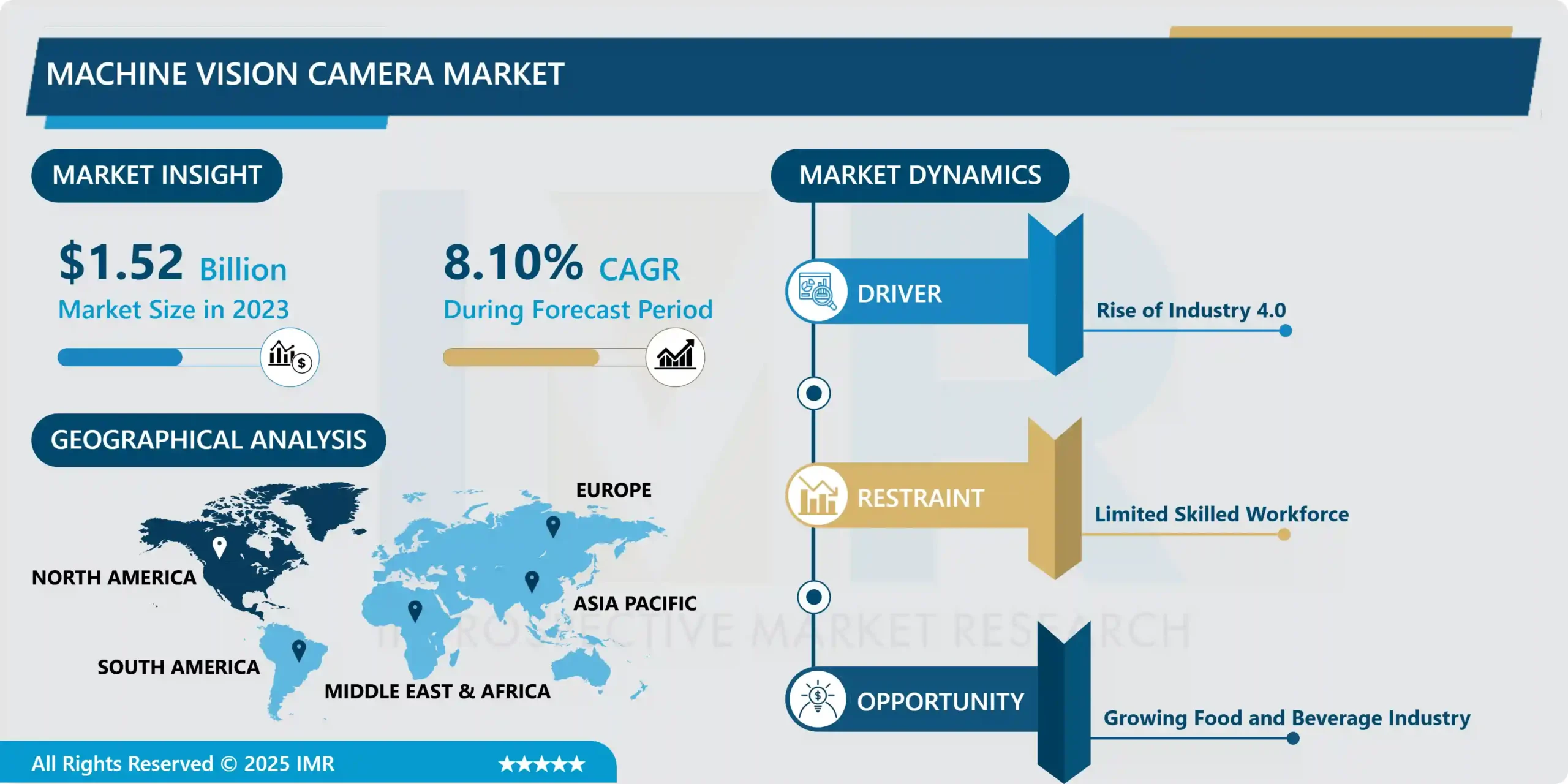
Machine Vision Camera Market Size Was Valued at USD 1.52 Billion in 2023, and is Projected to Reach USD 3.06 Billion by 2032, Growing at a CAGR of 8.1% From 2024-2032.
The Machine Vision Camera Market is the part of manufactures industry that creates, produces and uses cameras for machine vision systems. These are used for automation in industries, automobiles, health care, manufacturing, and many more to capture and analyse the sight for functions like inspection measurement, identification etc Machine vision cameras are provided with its own sensors and lenses also provides its own software to ensure genuine and fast image processing to support productivity, quality inspection and optimisation of operations in many applications.
Chart 1 reveals that there are expectations that the market for machine vision cameras will rise because of the trends in the market such as the automation, quality of the products being manufactured, automobiles, pharmaceuticals, and electronics. Machine vision cameras which are part of intelligent inspection and process control are also changing and offering higher resolution, faster frame rate and higher feature/defect identification/recognition along with locating precision. There is more and more popularity of smart manufacturing and industry four point four point zero projects in which such cameras are fundamental spearheads for solving specific problems, reducing errors, and improving production. Additionally, the scientific advancements of such technologies as artificial intelligence (AI) and/or machine learning are making the machine vision systems better making the demand for the systems to grow rapidly.
regionally, North American market is significant with Europe where there is high degrees of automation technologies’ perseverance. However, the Asia-Pacific region will grow the fastest due to industrialization, and the focus on the importance of boosting manufacturing performance across countries such as China, Japan, and South Korea. The use of robots in areas such as robotics, packaging and inspection industries has grown and has been a factor for growth of this market. They also include the costly process of creating complex machine vision system and many other challenges including compatibility with legacy applications; these are some of the challenges that are currently threatening the growth of the market, however; latest advancements in the technological aspects and continually dropping cost of developing such systems are expected to drive this market in future.
Machine Vision Camera Trend Analysis
Rising Demand for High-Resolution and Compact Machine Vision Cameras in Industrial Applications
Industry is now demanding high resolutions of machine vision cameras as processes have to be made more precise. For example, in manufacturing, high resolution, 4K and higher, of machine vision cameras are becoming essential for applications as simple as quality control and defects identification. These cameras enables the manufacturers to see slight defects on the products they produce hence selling only perfect products. Similarly, high-resolution cameras are most advantageous for industries that demand highly polished quality such as automotive and Aerospace where defects can probably pose significant effects. In healthcare for instance the cameras are very useful especially in generating clear images that are required for diagnosis through electronic microscopy. Therefore, it has become highly important that the various industries must call for improved imaging solutions.
Beside the resolution improvements, it is also noted the concern for generating new machine vision cameras with reduced sizes and weight. These are much smaller cameras than the regular custom vision cameras; as is the case with most Vision Systems, they are meant to blend into small, enclosed environments like the robotic arms used in assembly line manufactured goods, and are therefore, more versatile for a range of manufacturing uses. Small size and low weight of compact cameras also contribute to the general decrease in mass of machine vision systems that can be easily integrated into other devices without significant adjustments. This trend is perfectly apparent in the logistics industry where cameras are used for tasks such as sorting and bar-coding in confined areas. As the sizes and weights of these systems are shrunk, there are options to boost the general performance, which makes greater adoption of machine vision technologies possible in various industries.
The Integration of Machine Learning and 3D Vision Technology
The integration of machine learning as a part of ML algorithms with machine vision camera has been evolved as a new system that changes the characteristics of the image processing and defines the real-time data analysis. Newer models are integrated within machine vision cameras; hence, these devices can analyze stored images and patterns, defects, and other important data points as and when they are captured no more need for the URL processing. This shift also enables industries make decisions independently with little or no human interference on most of the activities. For instance, logistics and warehousing industries with the help of ML enabled machine vision cameras that are used for recognizing barcodes, for monitoring inventory and for segregating based on size and delivery location among others. In retail actually, cameras are smart through the use of Machine learning to monitor store shelves for cases of stock out to alert staffs thus improve the inventory status as per the customers’ needs.
The integration of 3D machine vision cameras with ML popularly called 3D-Machine Vision is also pushing the limits of advanced applications that depend on spatial discrimination such as robotics and self-driven cars. They are able to capture depth or 3D information about any objects in their field of view and not just the size, shape and position, but also the spatial location of an object in reference to the environment. This capability is particularly relevant to computing systems in robotics applications mainly involved in object recognition and navigation these may include pick – and – place of parts in the manufacturing line, or guidance of autonomous vehicles in general use. It is possible to integrate the 3D machine vision systems into improving the everyday performance and even gain the characteristic of learning from the new data and therefore optimizing the object detection, obstacle avoidance, and the planning of the routes erratically. With the integration of machine vision and artificial intelligence, numerous industries are experiencing a new face in smart and automated systems that can handle environments that are ever-changing and complex as the current world.
Machine Vision Camera Market Segment Analysis:
Machine Vision Camera Market Segmented based on By Product, By Hardware Standards, By Pixel Type, By Type of Sensor, By Process Type, By Spectrum Type, By Detection, By Lens Type, By Platform Type and By Applications.
By Product, Line Scan Cameras segment is expected to dominate the market during the forecast period
Line scan cameras are an especially important element of high-speed inspection that can be useful in production lines. While the area scan cameras produce images that have height and width, like the conventional cameras, the line scan cameras produce images line by line. This unique capability ensures they provide high resolution and clarity even as they scan fast moving products, and thus is perfect for use in web inspection where continuous webs such as paper, plastics or metal sheets require constant inspection. Real time image capturing allows the manufacturers to identify a defect or an inconsistency or even a foreign object that is within the product and eliminate them at once so as to avoid compromising the quality of the product or to reduce on wastage.
Besides web inspection, line scan cameras find their applications in assessing the surface characteristics of products in the worldwide food and beverage, pharmaceuticals, and textiles industries. They can get highly defined images of a sustained surface making it possible to inspect product surfaces for potential features such as scratches, discoloration, or contamination. In addition, line scan cameras are extendable with high level software tools that help to perform more sophisticated image analysis works, including color identification, shape identification, and measurement of sizes. This flexibility extends their usefulness in use, finally resulting in increased efficiencies in terms of quality control and production and line productivity in applications of automated systems in manufacturing industries.
By Platform Type, Wireless Cameras segment held the largest share in 2023
Wireless cameras are helpful for implementing surveillance and monitoring systems in large areas and for those whose networks cannot be made with cables due to various reasoned’s. This not only cuts the costs of installation but also the complexities inherent in putting up wires, screwing some holes or conduits, pulling wires through walls, and dealing with large cable networks. This flexibility would enable a faster deployment of the system in large industrial environments, retail business facilities, exterior spaces, and remote locations. Also, cameras installed with wireless mechanism are flexible and can be moved to different or changed in position whenever there is change in monitoring process, is ideal especially for places which operations frequently change.
Nonetheless, wireless cameras often have specific features like cloud, meaning the camera can be monitored on the go via a smartphone, tablet, or pc. This functionality increases situational awareness because operations can oversee the premises in real-time, notwithstanding their location. In addition, most of the wireless camera systems come with in-built motion sensors and alert functions, which send immediate notifications of the strange movement making security responses better. As technology continue to imporve wireless cameras becomes smart systems and can be driven by artificial intelligenxe making it a go to security and monitor for modern technolgy in many industries.
Machine Vision Camera Market Regional Insights:
North America is Expected to Dominate the Market Over the Forecast period
The machine vision camera market in North America is growing steadily at a CAGR of more than 11% due to the on-going upgradation toward advanced technologies including AI and deep learning. These technologies are being incorporated in to machine vision systems for improving automation characteristics in production industries. Given the fact that many industries such as automotive, aerospace, and electronics industries are already established in the region, a number of them are already employing machine vision cameras for uses such as quality assurance or defect identification or for use in the guidance of robotics. Most of all, this new focus for integrating automated production technologies to gain accuracy and speed is raising the sales of machine vision systems to new levels in the United States and Canada.
Furthermore, North America has many players in the market and has a high research and development environment that continuously develops machine vision technology. Manufacturers in this region are increasingly enhancing the camera, sensors, and algorithm requirements for companies in the industry. Ventures by the government and investments in smart manufacturing and industrial automation add to the market growth. Owing to heightened awareness of AI applications and complexity of industrial processes, growth trend of North America machine vision camera market remains steady.
Active Key Players in the Machine Vision Camera Market
Basler AG (Germany)
Cognex Corporation (U.S.)
KEYENCE CORPORATION (Japan)
NATIONAL INSTRUMENTS CORP (U.S.)
OMRON Corporation (Japan)
Teledyne Digital Imaging Inc.(U.S.)
Sony Corporation (Japan)
SICK AG (Germany)
Hitachi Kokusai Electric America, Ltd. (U.S.)
Allied Vision Technologies GmbH (Germany)
Hermary (Canada)
ISRA VISION AG (Germany)
Omron Microscan Systems, Inc. (U.S.)
Toshiba Teli Corporation (Japan)
Datalogic S.p.A. (Italy)
LMI TECHNOLOGIES INC. (Canada)
MVTec Software GmbH (Germany)
Canon Inc. (Japan)
Nikon India Pvt Ltd (India)
JAI A/S (Denmark)
Teledyne UK Limited (U.K.)
Baumer (Switzerland)
Teledyne FLIR LLC (U.S.)
Vieworks Co., Ltd. (South Korea)
IDS Imaging Development Systems GmbH (Germany)
Other Key Players
Chapter 1: Introduction
1.1 Scope and Coverage
Chapter 2:Executive Summary
Chapter 3: Market Landscape
3.1 Market Dynamics
3.1.1 Drivers
3.1.2 Restraints
3.1.3 Opportunities
3.1.4 Challenges
3.2 Market Trend Analysis
3.3 PESTLE Analysis
3.4 Porter’s Five Forces Analysis
3.5 Industry Value Chain Analysis
3.6 Ecosystem
3.7 Regulatory Landscape
3.8 Price Trend Analysis
3.9 Patent Analysis
3.10 Technology Evolution
3.11 Investment Pockets
3.12 Import-Export Analysis
Chapter 4: Machine Vision Camera Market by Product (2018-2032)
4.1 Machine Vision Camera Market Snapshot and Growth Engine
4.2 Market Overview
4.3 Line Scan Cameras
4.3.1 Introduction and Market Overview
4.3.2 Historic and Forecasted Market Size in Value USD and Volume Units
4.3.3 Key Market Trends, Growth Factors, and Opportunities
4.3.4 Geographic Segmentation Analysis
4.4 Area Scan Cameras
4.5 3D Cameras
Chapter 5: Machine Vision Camera Market by Hardware Standards (2018-2032)
5.1 Machine Vision Camera Market Snapshot and Growth Engine
5.2 Market Overview
5.3 Camera Link HS
5.3.1 Introduction and Market Overview
5.3.2 Historic and Forecasted Market Size in Value USD and Volume Units
5.3.3 Key Market Trends, Growth Factors, and Opportunities
5.3.4 Geographic Segmentation Analysis
5.4 Camera Link
5.5 GigE Vision
5.6 CoaXPress
5.7 USB3 Vision
5.8 Others
Chapter 6: Machine Vision Camera Market by Pixel Type (2018-2032)
6.1 Machine Vision Camera Market Snapshot and Growth Engine
6.2 Market Overview
6.3 Less than 1MP
6.3.1 Introduction and Market Overview
6.3.2 Historic and Forecasted Market Size in Value USD and Volume Units
6.3.3 Key Market Trends, Growth Factors, and Opportunities
6.3.4 Geographic Segmentation Analysis
6.4 1 to 3 MP
6.5 3 to 5 MP
6.6 5 to 8 MP
6.7 8 to 12 MP
6.8 12 MP
Chapter 7: Machine Vision Camera Market by Type of Sensor (2018-2032)
7.1 Machine Vision Camera Market Snapshot and Growth Engine
7.2 Market Overview
7.3 Charged Coupled Device Technology
7.3.1 Introduction and Market Overview
7.3.2 Historic and Forecasted Market Size in Value USD and Volume Units
7.3.3 Key Market Trends, Growth Factors, and Opportunities
7.3.4 Geographic Segmentation Analysis
7.4 Complementary Metal–Oxide–Semiconductor Technology
7.5 Modified Internal Gate Sensor Technology
7.6 N-type metal-oxide-semiconductor Sensor Technology
Chapter 8: Machine Vision Camera Market by Process Type (2018-2032)
8.1 Machine Vision Camera Market Snapshot and Growth Engine
8.2 Market Overview
8.3 1D Image Sensor
8.3.1 Introduction and Market Overview
8.3.2 Historic and Forecasted Market Size in Value USD and Volume Units
8.3.3 Key Market Trends, Growth Factors, and Opportunities
8.3.4 Geographic Segmentation Analysis
8.4 2D Image Sensor
8.5 3D Image Sensor
Chapter 9: Machine Vision Camera Market by Spectrum Type (2018-2032)
9.1 Machine Vision Camera Market Snapshot and Growth Engine
9.2 Market Overview
9.3 Infrared Spectrum
9.3.1 Introduction and Market Overview
9.3.2 Historic and Forecasted Market Size in Value USD and Volume Units
9.3.3 Key Market Trends, Growth Factors, and Opportunities
9.3.4 Geographic Segmentation Analysis
9.4 X- Ray Spectrum
9.5 Visible Light Spectrum
9.6 Others
Chapter 10: Company Profiles and Competitive Analysis
10.1 Competitive Landscape
10.1.1 Competitive Benchmarking
10.1.2 Machine Vision Camera Market Share by Manufacturer (2024)
10.1.3 Industry BCG Matrix
10.1.4 Heat Map Analysis
10.1.5 Mergers and Acquisitions
10.2 BASLER AG (GERMANY)
10.2.1 Company Overview
10.2.2 Key Executives
10.2.3 Company Snapshot
10.2.4 Role of the Company in the Market
10.2.5 Sustainability and Social Responsibility
10.2.6 Operating Business Segments
10.2.7 Product Portfolio
10.2.8 Business Performance
10.2.9 Key Strategic Moves and Recent Developments
10.2.10 SWOT Analysis
10.3 COGNEX CORPORATION (U.S.)
10.4 KEYENCE CORPORATION (JAPAN)
10.5 NATIONAL INSTRUMENTS CORP (U.S.)
10.6 OMRON CORPORATION (JAPAN)
10.7 TELEDYNE DIGITAL IMAGING INC.(U.S.)
10.8 SONY CORPORATION (JAPAN)
10.9 SICK AG (GERMANY)
10.10 HITACHI KOKUSAI ELECTRIC AMERICA LTD. (U.S.)
10.11 ALLIED VISION TECHNOLOGIES GMBH (GERMANY)
10.12 HERMARY (CANADA)
10.13 ISRA VISION AG (GERMANY)
10.14 OMRON MICROSCAN SYSTEMS INC. (U.S.)
10.15 TOSHIBA TELI CORPORATION (JAPAN)
10.16 DATALOGIC S.P.A. (ITALY)
10.17 LMI TECHNOLOGIES INC. (CANADA)
10.18 MVTEC SOFTWARE GMBH (GERMANY)
10.19 CANON INC. (JAPAN)
10.20 NIKON INDIA PVT LTD (INDIA)
10.21 JAI A/S (DENMARK)
10.22 TELEDYNE UK LIMITED (U.K.)
10.23 BAUMER (SWITZERLAND)
10.24 TELEDYNE FLIR LLC (U.S.)
10.25 VIEWORKS COLTD. (SOUTH KOREA)
10.26 IDS IMAGING DEVELOPMENT SYSTEMS GMBH (GERMANY)
10.27 OTHER KEY PLAYERS
10.28
Chapter 11: Global Machine Vision Camera Market By Region
11.1 Overview
11.2. North America Machine Vision Camera Market
11.2.1 Key Market Trends, Growth Factors and Opportunities
11.2.2 Top Key Companies
11.2.3 Historic and Forecasted Market Size by Segments
11.2.4 Historic and Forecasted Market Size by Product
11.2.4.1 Line Scan Cameras
11.2.4.2 Area Scan Cameras
11.2.4.3 3D Cameras
11.2.5 Historic and Forecasted Market Size by Hardware Standards
11.2.5.1 Camera Link HS
11.2.5.2 Camera Link
11.2.5.3 GigE Vision
11.2.5.4 CoaXPress
11.2.5.5 USB3 Vision
11.2.5.6 Others
11.2.6 Historic and Forecasted Market Size by Pixel Type
11.2.6.1 Less than 1MP
11.2.6.2 1 to 3 MP
11.2.6.3 3 to 5 MP
11.2.6.4 5 to 8 MP
11.2.6.5 8 to 12 MP
11.2.6.6 12 MP
11.2.7 Historic and Forecasted Market Size by Type of Sensor
11.2.7.1 Charged Coupled Device Technology
11.2.7.2 Complementary Metal–Oxide–Semiconductor Technology
11.2.7.3 Modified Internal Gate Sensor Technology
11.2.7.4 N-type metal-oxide-semiconductor Sensor Technology
11.2.8 Historic and Forecasted Market Size by Process Type
11.2.8.1 1D Image Sensor
11.2.8.2 2D Image Sensor
11.2.8.3 3D Image Sensor
11.2.9 Historic and Forecasted Market Size by Spectrum Type
11.2.9.1 Infrared Spectrum
11.2.9.2 X- Ray Spectrum
11.2.9.3 Visible Light Spectrum
11.2.9.4 Others
11.2.10 Historic and Forecast Market Size by Country
11.2.10.1 US
11.2.10.2 Canada
11.2.10.3 Mexico
11.3. Eastern Europe Machine Vision Camera Market
11.3.1 Key Market Trends, Growth Factors and Opportunities
11.3.2 Top Key Companies
11.3.3 Historic and Forecasted Market Size by Segments
11.3.4 Historic and Forecasted Market Size by Product
11.3.4.1 Line Scan Cameras
11.3.4.2 Area Scan Cameras
11.3.4.3 3D Cameras
11.3.5 Historic and Forecasted Market Size by Hardware Standards
11.3.5.1 Camera Link HS
11.3.5.2 Camera Link
11.3.5.3 GigE Vision
11.3.5.4 CoaXPress
11.3.5.5 USB3 Vision
11.3.5.6 Others
11.3.6 Historic and Forecasted Market Size by Pixel Type
11.3.6.1 Less than 1MP
11.3.6.2 1 to 3 MP
11.3.6.3 3 to 5 MP
11.3.6.4 5 to 8 MP
11.3.6.5 8 to 12 MP
11.3.6.6 12 MP
11.3.7 Historic and Forecasted Market Size by Type of Sensor
11.3.7.1 Charged Coupled Device Technology
11.3.7.2 Complementary Metal–Oxide–Semiconductor Technology
11.3.7.3 Modified Internal Gate Sensor Technology
11.3.7.4 N-type metal-oxide-semiconductor Sensor Technology
11.3.8 Historic and Forecasted Market Size by Process Type
11.3.8.1 1D Image Sensor
11.3.8.2 2D Image Sensor
11.3.8.3 3D Image Sensor
11.3.9 Historic and Forecasted Market Size by Spectrum Type
11.3.9.1 Infrared Spectrum
11.3.9.2 X- Ray Spectrum
11.3.9.3 Visible Light Spectrum
11.3.9.4 Others
11.3.10 Historic and Forecast Market Size by Country
11.3.10.1 Russia
11.3.10.2 Bulgaria
11.3.10.3 The Czech Republic
11.3.10.4 Hungary
11.3.10.5 Poland
11.3.10.6 Romania
11.3.10.7 Rest of Eastern Europe
11.4. Western Europe Machine Vision Camera Market
11.4.1 Key Market Trends, Growth Factors and Opportunities
11.4.2 Top Key Companies
11.4.3 Historic and Forecasted Market Size by Segments
11.4.4 Historic and Forecasted Market Size by Product
11.4.4.1 Line Scan Cameras
11.4.4.2 Area Scan Cameras
11.4.4.3 3D Cameras
11.4.5 Historic and Forecasted Market Size by Hardware Standards
11.4.5.1 Camera Link HS
11.4.5.2 Camera Link
11.4.5.3 GigE Vision
11.4.5.4 CoaXPress
11.4.5.5 USB3 Vision
11.4.5.6 Others
11.4.6 Historic and Forecasted Market Size by Pixel Type
11.4.6.1 Less than 1MP
11.4.6.2 1 to 3 MP
11.4.6.3 3 to 5 MP
11.4.6.4 5 to 8 MP
11.4.6.5 8 to 12 MP
11.4.6.6 12 MP
11.4.7 Historic and Forecasted Market Size by Type of Sensor
11.4.7.1 Charged Coupled Device Technology
11.4.7.2 Complementary Metal–Oxide–Semiconductor Technology
11.4.7.3 Modified Internal Gate Sensor Technology
11.4.7.4 N-type metal-oxide-semiconductor Sensor Technology
11.4.8 Historic and Forecasted Market Size by Process Type
11.4.8.1 1D Image Sensor
11.4.8.2 2D Image Sensor
11.4.8.3 3D Image Sensor
11.4.9 Historic and Forecasted Market Size by Spectrum Type
11.4.9.1 Infrared Spectrum
11.4.9.2 X- Ray Spectrum
11.4.9.3 Visible Light Spectrum
11.4.9.4 Others
11.4.10 Historic and Forecast Market Size by Country
11.4.10.1 Germany
11.4.10.2 UK
11.4.10.3 France
11.4.10.4 The Netherlands
11.4.10.5 Italy
11.4.10.6 Spain
11.4.10.7 Rest of Western Europe
11.5. Asia Pacific Machine Vision Camera Market
11.5.1 Key Market Trends, Growth Factors and Opportunities
11.5.2 Top Key Companies
11.5.3 Historic and Forecasted Market Size by Segments
11.5.4 Historic and Forecasted Market Size by Product
11.5.4.1 Line Scan Cameras
11.5.4.2 Area Scan Cameras
11.5.4.3 3D Cameras
11.5.5 Historic and Forecasted Market Size by Hardware Standards
11.5.5.1 Camera Link HS
11.5.5.2 Camera Link
11.5.5.3 GigE Vision
11.5.5.4 CoaXPress
11.5.5.5 USB3 Vision
11.5.5.6 Others
11.5.6 Historic and Forecasted Market Size by Pixel Type
11.5.6.1 Less than 1MP
11.5.6.2 1 to 3 MP
11.5.6.3 3 to 5 MP
11.5.6.4 5 to 8 MP
11.5.6.5 8 to 12 MP
11.5.6.6 12 MP
11.5.7 Historic and Forecasted Market Size by Type of Sensor
11.5.7.1 Charged Coupled Device Technology
11.5.7.2 Complementary Metal–Oxide–Semiconductor Technology
11.5.7.3 Modified Internal Gate Sensor Technology
11.5.7.4 N-type metal-oxide-semiconductor Sensor Technology
11.5.8 Historic and Forecasted Market Size by Process Type
11.5.8.1 1D Image Sensor
11.5.8.2 2D Image Sensor
11.5.8.3 3D Image Sensor
11.5.9 Historic and Forecasted Market Size by Spectrum Type
11.5.9.1 Infrared Spectrum
11.5.9.2 X- Ray Spectrum
11.5.9.3 Visible Light Spectrum
11.5.9.4 Others
11.5.10 Historic and Forecast Market Size by Country
11.5.10.1 China
11.5.10.2 India
11.5.10.3 Japan
11.5.10.4 South Korea
11.5.10.5 Malaysia
11.5.10.6 Thailand
11.5.10.7 Vietnam
11.5.10.8 The Philippines
11.5.10.9 Australia
11.5.10.10 New Zealand
11.5.10.11 Rest of APAC
11.6. Middle East & Africa Machine Vision Camera Market
11.6.1 Key Market Trends, Growth Factors and Opportunities
11.6.2 Top Key Companies
11.6.3 Historic and Forecasted Market Size by Segments
11.6.4 Historic and Forecasted Market Size by Product
11.6.4.1 Line Scan Cameras
11.6.4.2 Area Scan Cameras
11.6.4.3 3D Cameras
11.6.5 Historic and Forecasted Market Size by Hardware Standards
11.6.5.1 Camera Link HS
11.6.5.2 Camera Link
11.6.5.3 GigE Vision
11.6.5.4 CoaXPress
11.6.5.5 USB3 Vision
11.6.5.6 Others
11.6.6 Historic and Forecasted Market Size by Pixel Type
11.6.6.1 Less than 1MP
11.6.6.2 1 to 3 MP
11.6.6.3 3 to 5 MP
11.6.6.4 5 to 8 MP
11.6.6.5 8 to 12 MP
11.6.6.6 12 MP
11.6.7 Historic and Forecasted Market Size by Type of Sensor
11.6.7.1 Charged Coupled Device Technology
11.6.7.2 Complementary Metal–Oxide–Semiconductor Technology
11.6.7.3 Modified Internal Gate Sensor Technology
11.6.7.4 N-type metal-oxide-semiconductor Sensor Technology
11.6.8 Historic and Forecasted Market Size by Process Type
11.6.8.1 1D Image Sensor
11.6.8.2 2D Image Sensor
11.6.8.3 3D Image Sensor
11.6.9 Historic and Forecasted Market Size by Spectrum Type
11.6.9.1 Infrared Spectrum
11.6.9.2 X- Ray Spectrum
11.6.9.3 Visible Light Spectrum
11.6.9.4 Others
11.6.10 Historic and Forecast Market Size by Country
11.6.10.1 Turkiye
11.6.10.2 Bahrain
11.6.10.3 Kuwait
11.6.10.4 Saudi Arabia
11.6.10.5 Qatar
11.6.10.6 UAE
11.6.10.7 Israel
11.6.10.8 South Africa
11.7. South America Machine Vision Camera Market
11.7.1 Key Market Trends, Growth Factors and Opportunities
11.7.2 Top Key Companies
11.7.3 Historic and Forecasted Market Size by Segments
11.7.4 Historic and Forecasted Market Size by Product
11.7.4.1 Line Scan Cameras
11.7.4.2 Area Scan Cameras
11.7.4.3 3D Cameras
11.7.5 Historic and Forecasted Market Size by Hardware Standards
11.7.5.1 Camera Link HS
11.7.5.2 Camera Link
11.7.5.3 GigE Vision
11.7.5.4 CoaXPress
11.7.5.5 USB3 Vision
11.7.5.6 Others
11.7.6 Historic and Forecasted Market Size by Pixel Type
11.7.6.1 Less than 1MP
11.7.6.2 1 to 3 MP
11.7.6.3 3 to 5 MP
11.7.6.4 5 to 8 MP
11.7.6.5 8 to 12 MP
11.7.6.6 12 MP
11.7.7 Historic and Forecasted Market Size by Type of Sensor
11.7.7.1 Charged Coupled Device Technology
11.7.7.2 Complementary Metal–Oxide–Semiconductor Technology
11.7.7.3 Modified Internal Gate Sensor Technology
11.7.7.4 N-type metal-oxide-semiconductor Sensor Technology
11.7.8 Historic and Forecasted Market Size by Process Type
11.7.8.1 1D Image Sensor
11.7.8.2 2D Image Sensor
11.7.8.3 3D Image Sensor
11.7.9 Historic and Forecasted Market Size by Spectrum Type
11.7.9.1 Infrared Spectrum
11.7.9.2 X- Ray Spectrum
11.7.9.3 Visible Light Spectrum
11.7.9.4 Others
11.7.10 Historic and Forecast Market Size by Country
11.7.10.1 Brazil
11.7.10.2 Argentina
11.7.10.3 Rest of SA
Chapter 12 Analyst Viewpoint and Conclusion
12.1 Recommendations and Concluding Analysis
12.2 Potential Market Strategies
Chapter 13 Research Methodology
13.1 Research Process
13.2 Primary Research
13.3 Secondary Research
Q1: What would be the forecast period in the Machine Vision Camera Market research report?
A1: The forecast period in the Market research report is 2024-2032.
Q2: Who are the key players in the Machine Vision Camera Market?
A2: Basler AG (Germany), Cognex Corporation (U.S.), KEYENCE CORPORATION (Japan), NATIONAL INSTRUMENTS CORP (U.S.), OMRON Corporation (Japan), Teledyne Digital Imaging Inc.(U.S.), Sony Corporation (Japan), SICK AG (Germany) Hitachi Kokusai Electric America, Ltd. (U.S.), Allied Vision Technologies GmbH (Germany) Hermary (Canada), ISRA VISION AG (Germany), Omron Microscan Systems, Inc. (U.S.), Toshiba Teli Corporation (Japan), Datalogic S.p.A. (Italy), LMI TECHNOLOGIES INC. (Canada), MVTec Software GmbH (Germany), Canon Inc. (Japan), Nikon India Pvt Ltd (India), JAI A/S (Denmark), Teledyne UK Limited (U.K.), Baumer (Switzerland), Teledyne FLIR LLC (U.S.), Vieworks Co., Ltd. (South Korea), and IDS Imaging Development Systems GmbH (Germany) and among others.
Q3: What are the segments of the Machine Vision Camera Market?
A3: The Machine Vision Camera Market is segmented into By Product, By Hardware Standards, By Pixel Type, By Type of Sensor, By Process Type, By Spectrum Type, By Detection, By Lens Type, By Platform Type, By Applications and region.By Product, the market is categorized into Line Scan Cameras, Area Scan Cameras, and 3D Cameras. By Hardware Standards, the market is categorized into Camera Link HS, Camera Link, GigE Vision, CoaXPress, USB3 Vision, and Others.By Pixel Type, the market is categorized into Less Than 1MP, 1 to 3 MP, 3 to 5 MP, 5 to 8 MP, 8 to 12 MP, and 12 MP.By Type of Sensor, the market is categorized into Charged Coupled Device Technology, Complementary Metal–Oxide–Semiconductor Technology, Modified Internal Gate Sensor Technology, and N-type metal-oxide-semiconductor Sensor Technology. By Process Type, the market is categorized into 1D Image Sensor, 2D Image Sensor, and 3D Image Sensor. By Spectrum Type, the market is categorized into Infrared Spectrum, X- Ray Spectrum, Visible Light Spectrum, and Others. By Detection, the market is categorized into Contour Detection, Color Detection, Text / Barcode Detection and Others. By Lens Type, the market is categorized into Normal Lens, Tele Lens, and Wide Angle Lens. By Platform Type, the market is categorized into Wireless Cameras, Smart Camera / Portable, PC based Camera, and Wearable Cameras. By Applications, the market is categorized into Guidance, Inspection, Gauging, Identification, and Others.By region, it is analyzed across North America (U.S.; Canada; Mexico), Europe (Germany; U.K.; France; Italy; Russia; Spain, etc.), Asia-Pacific (China; India; Japan; Southeast Asia, etc.), South America (Brazil; Argentina, etc.), Middle East & Africa (Saudi Arabia; South Africa, etc.).
Q4: What is the Machine Vision Camera Market?
A4: The Machine Vision Camera Market is the category of the manufacturing industry specializing in the design, production, and utilization of the cameras for the application in the machine vision systems. These cameras are used for automation in industries, automobiles, healthcare, manufacturing and other sectors for either taking or analyzing the sight information for functions like inspection, measurement, identification etc. MVCs come with their own sensors, lenses and software to ensure the image processing is accurate and very fast to support productivity, inspections, and optimizing performance in many applications.
Q5: How big is the Machine Vision Camera Market?
A5: Machine Vision Camera Market Size Was Valued at USD 1.52 Billion in 2023, and is Projected to Reach USD 3.06 Billion by 2032, Growing at a CAGR of 8.1% From 2024-2032.
How to Buy a Report from eminsights.jp
On the product page, choose the license you want: Single-User License, Multi-User License or Enterprise License.
If you required report in your native language, then you can click on Translated Report button and fill out the form with report name and language you want, then our team will contact you as soon as possible.
Click the Buy Now button.
You will be redirected to the checkout page. Enter your company details and payment information.
Click Place Order to complete the purchase.
Confirmation: You’ll receive an order confirmation and our team will contact you shortly with your ordered report.
If you have any questions, fill out the contact form below or email us at bizdev@eminsights.net.
Thank you for choosing eminsights.jp!