Stay Ahead in Fast-Growing Economies.
Browse Reports Now
Liquid Feed Market 2024 – Overview and Outlook by Potential Growth By 2032
Liquid feed supplements refer to those supplements which are molasses-based products developed to be fed to both feedlot and grass-fed cattle, using various formulations in each segment. Liquid feed supplement has two categories such as blended liquid supplements and suspension liquid supplements. Due to the good digestion process of animals and cheaper costs of by-products, the liquid feed supplement market is expected to grow remarkably in projected period. An increasing the meat production and their consumption, beef consumption, chicken and chicken-based products and milk and milk-based products leads to growth of liquid feed market over period.

IMR Group
Description
Liquid Feed Market Synopsis
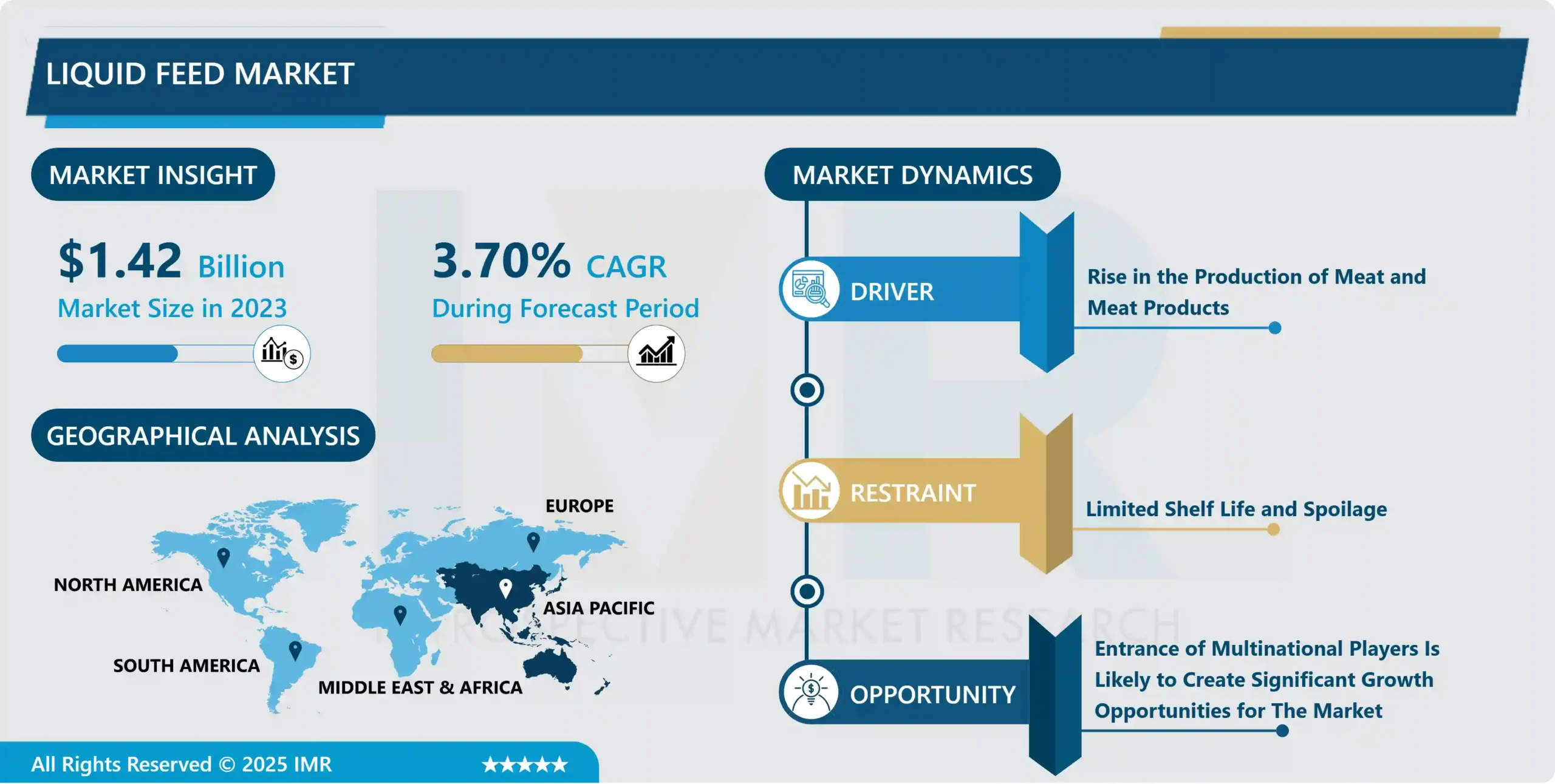
Liquid Feed Market Size Was Valued at USD 1.42 Billion in 2023, and is Projected to Reach USD 1.76 Billion by 2032, Growing at a CAGR of 3.70% From 2024-2032.
Liquid feed supplements refer to those supplements which are molasses-based products developed to be fed to both feedlot and grass-fed cattle, using various formulations in each segment. Liquid feed supplement has two categories such as blended liquid supplements and suspension liquid supplements.
The rising global population and the subsequent increase in meat consumption have fueled the demand for efficient and sustainable livestock production methods. Liquid feed supplements play a crucial role in meeting the nutritional requirements of animals, promoting growth, and optimizing feed conversion rates. As the demand for high-quality animal products continues to surge, the liquid feed market is positioned to grow as an essential component of modern livestock management practices.
In addition, the focus on animal welfare and health has become a prominent factor in the agriculture industry. Liquid feed formulations can be customized to include additives such as vitamins, minerals, and supplements that support the overall health and well-being of animals. This emphasis on animal health aligns with consumer preferences for ethically produced and high-quality animal products, further boosting the market for liquid feed solutions.
Moreover, technological advancements in feed formulation and manufacturing processes have facilitated the development of innovative liquid feed products. These advancements enable manufacturers to create customized formulations tailored to specific animal requirements, contributing to the market’s growth by providing diverse and specialized solutions.
Liquid Feed Market Trend Analysis
Rise in the Production of Meat and Meat Products
As global population continues to grow, there is an increasing demand for protein-rich food sources, and meat has become a staple in diets around the world. This surge in demand has led to a proportional increase in livestock farming and, consequently, a higher need for efficient and nutritious animal feed. ?
Liquid feed, which includes various forms of liquid supplements and additives added to the animal’s diet, has gained prominence in the livestock industry due to its convenience and effectiveness. It serves as a valuable nutritional solution, offering a balanced mix of vitamins, minerals, and other essential nutrients for livestock. This has become especially crucial in intensive animal farming systems where ensuring optimal nutrition is vital for the health, growth, and productivity of the animals. ?
Livestock producers are increasingly recognizing the benefits of incorporating liquid feed into their operations. Liquid feed provides a flexible and easily digestible source of nutrients, allowing for precise control over the animals’ diet. Additionally, it helps improve feed efficiency, enhances the absorption of nutrients, and contributes to the overall well-being of the animals. ?
As the global population continues to rise and dietary preferences shift towards meat consumption, the demand for livestock products will persist. This sustained demand is expected to further fuel the growth of the liquid feed market, making it an integral component of modern livestock farming practices aimed at maximizing productivity and ensuring the health of the animals in the production chain.
Entrance of Multinational Players Is Likely to Create Significant Growth Opportunities for The Market
The commitment to innovation can lead to the introduction of novel liquid feed formulations, fortified with essential nutrients and additives. This not only enhances the nutritional value of the feed but also addresses specific health and performance concerns in livestock.
Furthermore, the global footprint of multinational corporations allows for efficient distribution networks and streamlined supply chains. This can result in improved accessibility to liquid feed products in diverse regions, benefiting farmers and livestock producers around the world. The increased availability of high-quality liquid feed options can contribute to the overall improvement of animal health, productivity, and ultimately, the quality of derived products such as meat and dairy.
Moreover, the entry of multinational players often brings about healthy competition, encouraging local players to elevate their standards and offerings. This competitive landscape fosters an environment where continuous improvement and customer satisfaction become paramount, ultimately benefiting end-users.
Liquid Feed Market Segment Analysis:
Liquid Feed Market Segmented on the basis of type, ingredients, and livestock.
By Type, Protein segment is expected to dominate the market during the forecast period
There is a rising awareness among livestock producers about the importance of protein supplementation in animal nutrition for optimal growth, reproduction, and overall health. Protein is a crucial component in the diet of livestock, and liquid feed provides a convenient and effective way to deliver essential proteins directly to animals. Moreover, as the global demand for animal products such as meat and dairy continue to rise, farmers are increasingly adopting liquid protein supplements to enhance the productivity and efficiency of their livestock operations. This growing recognition of the benefits associated with liquid protein feed solutions is driving the expansion of the Protein segment within the Liquid Feed Market
By Ingredients, Molasses segment held the largest share in 2022
Molasses, a byproduct of the sugar refining process, is rich in essential nutrients such as carbohydrates, vitamins, and minerals, making it an attractive ingredient for liquid animal feed formulations. Its popularity is driven by its cost-effectiveness and nutritional benefits, providing a readily available energy source for livestock. Additionally, molasses enhances palatability, promoting better feed intake and digestion in animals. As the demand for high-quality and nutritionally balanced animal feed rises globally, the Molasses segment sees increased adoption, reflecting a broader industry trend towards optimizing animal nutrition for improved health and productivity.
Liquid Feed Market Regional Insights:
Asia Pacific is Expected to Dominate the Market Over the Forecast period
The Asia-Pacific area has the leading position in the global production and consumption of animal feed, which has a direct impact on the liquid feed industry. Due in significant part to the expansion of industrial livestock production in the region, major economies have seen increases in their capacity to generate liquid feed.
The growth of the feed industry in China has led global compound feed players like Archer Daniels Midland and Cargill to expand and open their new facilities in China. The Zhangzhou feed factory of Archer Daniels Midland Company in China is the fourth compound production facility of the company, which has an annual capacity of 30,000 metric tonnes of feed premixes and 80,000 metric tonnes of complete feed and concentrates. Cargill has invested in a new premix facility in China to continue growing its feed presence in the region. Sorghum growers in the United States got a big boost when the USDA revealed record sales to China in 2020.
Liquid Feed Market Top Key Players:
Cargill Incorporated (U.S.)
Archer Daniels Midland Company (U.S.)
Land O’ Lakes (U.S.)
Double S Liquid Feed Services, Inc (U.S)
Foster Farms (U.S)
Midwest Liquid Feeds (U.S)
Alliance Liquid Feeds Inc. (U.S)
Performance Seeds LLC (U.S)
Quality Liquid Feeds Inc. (U.S)
Westway Feed Products (U.S)
Masterfeeds LP (Canada)
BASF SE (Germany)
DLG Group (Denmark)
Grain Corp. Ltd. (Austria)
BEC Feed Solutions (Australia)
Agridyne LLC (UK)
Dallas Keith Ltd (Uk)
Bundaberg Molasses (Australia)
Ridley Corporation (Australia)
Voermol Feeds (South Africa)
Key Industry Developments in the Liquid Feed Market:
In December 2021 – BASF SE launched the new enzyme product Natupulse TS for animal feed. Natupulse TS is a non-starch polysaccharide (NSP) enzyme. The addition of ß-mannanase to the feed decreases digesta viscosity, increases the digestibility of the feed, and ensures a more sustainable production. Natupulse TS is available in powder and liquid form. Both formulations deliver very good overall stability during storage, in premix, and under challenging conditions in the pelleting process.
In May 2024, The American Feed Industry Association host the 2024 Liquid Feed Symposium (LFS) on Sept. 10-12 in Salt Lake City, Utah. The LFS, hosted by AFIA’s Liquid Feed Committee, focuses on current issues, growth, education, and development specifically geared toward the liquid feed industry.
Chapter 1: Introduction
1.1 Scope and Coverage
Chapter 2:Executive Summary
Chapter 3: Market Landscape
3.1 Market Dynamics
3.1.1 Drivers
3.1.2 Restraints
3.1.3 Opportunities
3.1.4 Challenges
3.2 Market Trend Analysis
3.3 PESTLE Analysis
3.4 Porter’s Five Forces Analysis
3.5 Industry Value Chain Analysis
3.6 Ecosystem
3.7 Regulatory Landscape
3.8 Price Trend Analysis
3.9 Patent Analysis
3.10 Technology Evolution
3.11 Investment Pockets
3.12 Import-Export Analysis
Chapter 4: Liquid Feed Market by Type (2018-2032)
4.1 Liquid Feed Market Snapshot and Growth Engine
4.2 Market Overview
4.3 Protein
4.3.1 Introduction and Market Overview
4.3.2 Historic and Forecasted Market Size in Value USD and Volume Units
4.3.3 Key Market Trends, Growth Factors, and Opportunities
4.3.4 Geographic Segmentation Analysis
4.4 Minerals
4.5 Vitamins
4.6 Others
Chapter 5: Liquid Feed Market by Ingredients (2018-2032)
5.1 Liquid Feed Market Snapshot and Growth Engine
5.2 Market Overview
5.3 Molasses
5.3.1 Introduction and Market Overview
5.3.2 Historic and Forecasted Market Size in Value USD and Volume Units
5.3.3 Key Market Trends, Growth Factors, and Opportunities
5.3.4 Geographic Segmentation Analysis
5.4 Corn
5.5 Urea
5.6 Others
Chapter 6: Liquid Feed Market by Livestock (2018-2032)
6.1 Liquid Feed Market Snapshot and Growth Engine
6.2 Market Overview
6.3 Ruminants
6.3.1 Introduction and Market Overview
6.3.2 Historic and Forecasted Market Size in Value USD and Volume Units
6.3.3 Key Market Trends, Growth Factors, and Opportunities
6.3.4 Geographic Segmentation Analysis
6.4 Poultry
6.5 Swine
6.6 Aquaculture
6.7 Others
Chapter 7: Company Profiles and Competitive Analysis
7.1 Competitive Landscape
7.1.1 Competitive Benchmarking
7.1.2 Liquid Feed Market Share by Manufacturer (2024)
7.1.3 Industry BCG Matrix
7.1.4 Heat Map Analysis
7.1.5 Mergers and Acquisitions
7.2 AVEDA (US)
7.2.1 Company Overview
7.2.2 Key Executives
7.2.3 Company Snapshot
7.2.4 Role of the Company in the Market
7.2.5 Sustainability and Social Responsibility
7.2.6 Operating Business Segments
7.2.7 Product Portfolio
7.2.8 Business Performance
7.2.9 Key Strategic Moves and Recent Developments
7.2.10 SWOT Analysis
7.3 CHERRY ESSENTIALS (US)
7.4 YOUNG LIVING (US)
7.5 DOTERRA (US)
7.6 MOUNTAIN ROSE HERBS (US)
7.7 NOW FOODS (US)
7.8 AURA CACIA (US)
7.9 EDENS GARDEN (US)
7.10 PLANT THERAPY (US)
7.11 NATURE’S SUNSHINE (US)
7.12 FLORACOPEIA (US)
7.13 STILLPOINT AROMATICS (US)
7.14 AVICENNA AROMATHERAPY (CANADA)
7.15 ALTEYA ORGANICS (BULGARIA)
7.16 OSHADHI (BELGIUM)
7.17 FRAGRANT EARTH (UK)
7.18 NEAL’S YARD REMEDIES (UK)
7.19 HERMITAGE OILS (UK)
7.20 NHR ORGANIC OILS (UK)
7.21 KOBASHI (UK)
7.22 EVE TAYLOR (UK)
7.23 TISSERAND AROMATHERAPY (UK)
7.24 L’ERBOLARIO (ITALY)
7.25 QUALITERBE (ITALY)
7.26 FLORIHANA (FRANCE)
7.27 BOTANICAL INNOVATIONS (AUSTRALIA)
Chapter 8: Global Liquid Feed Market By Region
8.1 Overview
8.2. North America Liquid Feed Market
8.2.1 Key Market Trends, Growth Factors and Opportunities
8.2.2 Top Key Companies
8.2.3 Historic and Forecasted Market Size by Segments
8.2.4 Historic and Forecasted Market Size by Type
8.2.4.1 Protein
8.2.4.2 Minerals
8.2.4.3 Vitamins
8.2.4.4 Others
8.2.5 Historic and Forecasted Market Size by Ingredients
8.2.5.1 Molasses
8.2.5.2 Corn
8.2.5.3 Urea
8.2.5.4 Others
8.2.6 Historic and Forecasted Market Size by Livestock
8.2.6.1 Ruminants
8.2.6.2 Poultry
8.2.6.3 Swine
8.2.6.4 Aquaculture
8.2.6.5 Others
8.2.7 Historic and Forecast Market Size by Country
8.2.7.1 US
8.2.7.2 Canada
8.2.7.3 Mexico
8.3. Eastern Europe Liquid Feed Market
8.3.1 Key Market Trends, Growth Factors and Opportunities
8.3.2 Top Key Companies
8.3.3 Historic and Forecasted Market Size by Segments
8.3.4 Historic and Forecasted Market Size by Type
8.3.4.1 Protein
8.3.4.2 Minerals
8.3.4.3 Vitamins
8.3.4.4 Others
8.3.5 Historic and Forecasted Market Size by Ingredients
8.3.5.1 Molasses
8.3.5.2 Corn
8.3.5.3 Urea
8.3.5.4 Others
8.3.6 Historic and Forecasted Market Size by Livestock
8.3.6.1 Ruminants
8.3.6.2 Poultry
8.3.6.3 Swine
8.3.6.4 Aquaculture
8.3.6.5 Others
8.3.7 Historic and Forecast Market Size by Country
8.3.7.1 Russia
8.3.7.2 Bulgaria
8.3.7.3 The Czech Republic
8.3.7.4 Hungary
8.3.7.5 Poland
8.3.7.6 Romania
8.3.7.7 Rest of Eastern Europe
8.4. Western Europe Liquid Feed Market
8.4.1 Key Market Trends, Growth Factors and Opportunities
8.4.2 Top Key Companies
8.4.3 Historic and Forecasted Market Size by Segments
8.4.4 Historic and Forecasted Market Size by Type
8.4.4.1 Protein
8.4.4.2 Minerals
8.4.4.3 Vitamins
8.4.4.4 Others
8.4.5 Historic and Forecasted Market Size by Ingredients
8.4.5.1 Molasses
8.4.5.2 Corn
8.4.5.3 Urea
8.4.5.4 Others
8.4.6 Historic and Forecasted Market Size by Livestock
8.4.6.1 Ruminants
8.4.6.2 Poultry
8.4.6.3 Swine
8.4.6.4 Aquaculture
8.4.6.5 Others
8.4.7 Historic and Forecast Market Size by Country
8.4.7.1 Germany
8.4.7.2 UK
8.4.7.3 France
8.4.7.4 The Netherlands
8.4.7.5 Italy
8.4.7.6 Spain
8.4.7.7 Rest of Western Europe
8.5. Asia Pacific Liquid Feed Market
8.5.1 Key Market Trends, Growth Factors and Opportunities
8.5.2 Top Key Companies
8.5.3 Historic and Forecasted Market Size by Segments
8.5.4 Historic and Forecasted Market Size by Type
8.5.4.1 Protein
8.5.4.2 Minerals
8.5.4.3 Vitamins
8.5.4.4 Others
8.5.5 Historic and Forecasted Market Size by Ingredients
8.5.5.1 Molasses
8.5.5.2 Corn
8.5.5.3 Urea
8.5.5.4 Others
8.5.6 Historic and Forecasted Market Size by Livestock
8.5.6.1 Ruminants
8.5.6.2 Poultry
8.5.6.3 Swine
8.5.6.4 Aquaculture
8.5.6.5 Others
8.5.7 Historic and Forecast Market Size by Country
8.5.7.1 China
8.5.7.2 India
8.5.7.3 Japan
8.5.7.4 South Korea
8.5.7.5 Malaysia
8.5.7.6 Thailand
8.5.7.7 Vietnam
8.5.7.8 The Philippines
8.5.7.9 Australia
8.5.7.10 New Zealand
8.5.7.11 Rest of APAC
8.6. Middle East & Africa Liquid Feed Market
8.6.1 Key Market Trends, Growth Factors and Opportunities
8.6.2 Top Key Companies
8.6.3 Historic and Forecasted Market Size by Segments
8.6.4 Historic and Forecasted Market Size by Type
8.6.4.1 Protein
8.6.4.2 Minerals
8.6.4.3 Vitamins
8.6.4.4 Others
8.6.5 Historic and Forecasted Market Size by Ingredients
8.6.5.1 Molasses
8.6.5.2 Corn
8.6.5.3 Urea
8.6.5.4 Others
8.6.6 Historic and Forecasted Market Size by Livestock
8.6.6.1 Ruminants
8.6.6.2 Poultry
8.6.6.3 Swine
8.6.6.4 Aquaculture
8.6.6.5 Others
8.6.7 Historic and Forecast Market Size by Country
8.6.7.1 Turkiye
8.6.7.2 Bahrain
8.6.7.3 Kuwait
8.6.7.4 Saudi Arabia
8.6.7.5 Qatar
8.6.7.6 UAE
8.6.7.7 Israel
8.6.7.8 South Africa
8.7. South America Liquid Feed Market
8.7.1 Key Market Trends, Growth Factors and Opportunities
8.7.2 Top Key Companies
8.7.3 Historic and Forecasted Market Size by Segments
8.7.4 Historic and Forecasted Market Size by Type
8.7.4.1 Protein
8.7.4.2 Minerals
8.7.4.3 Vitamins
8.7.4.4 Others
8.7.5 Historic and Forecasted Market Size by Ingredients
8.7.5.1 Molasses
8.7.5.2 Corn
8.7.5.3 Urea
8.7.5.4 Others
8.7.6 Historic and Forecasted Market Size by Livestock
8.7.6.1 Ruminants
8.7.6.2 Poultry
8.7.6.3 Swine
8.7.6.4 Aquaculture
8.7.6.5 Others
8.7.7 Historic and Forecast Market Size by Country
8.7.7.1 Brazil
8.7.7.2 Argentina
8.7.7.3 Rest of SA
Chapter 9 Analyst Viewpoint and Conclusion
9.1 Recommendations and Concluding Analysis
9.2 Potential Market Strategies
Chapter 10 Research Methodology
10.1 Research Process
10.2 Primary Research
10.3 Secondary Research
Q1: What would be the forecast period in the Liquid Feed Market research report?
A1: The forecast period in the Liquid Feed Market research report is 2024-2032.
Q2: Who are the key players in the Liquid Feed Market?
A2: Cargill Incorporated (U.S.), Archer Daniels Midland Company (U.S.), Land O' Lakes (U.S.), Double S Liquid Feed Services, Inc (US), Foster Farms (US), Midwest Liquid Feeds (U.S), Alliance Liquid Feeds Inc. (U.S), Performance Seeds LLC (U.S), Quality Liquid Feeds Inc. (U.S), Westway Feed Products (U.S), Masterfeeds LP (Canada), BASF SE (Germany), DLG Group (Denmark), Grain Corp. Ltd. (Austria), BEC Feed Solutions (Australia), Agridyne LLC (UK), Dallas Keith Ltd (UK), Bundaberg Molasses (Australia), Ridley Corporation (Australia), Voermol Feeds (South Africa), and Other Major Players.
Q3: What are the segments of the Liquid Feed Market?
A3: The Liquid Feed Market is segmented into Type, Nature, Application, and region. By Type, the market is categorized into Protein, Minerals, Vitamins, and Others. By Ingredients, the market is categorized into Molasses, Corn, Urea, and Others. By Livestock, the market is categorized into Ruminants, Poultry, Swine, Aquaculture, and Others. By region, it is analyzed across North America (U.S.; Canada; Mexico), Eastern Europe (Bulgaria; The Czech Republic; Hungary; Poland; Romania; Rest of Eastern Europe), Western Europe (Germany; UK; France; Netherlands; Italy; Russia; Spain; Rest of Western Europe), Asia-Pacific (China; India; Japan; Southeast Asia, etc.), South America (Brazil; Argentina, etc.), Middle East & Africa (Saudi Arabia; South Africa, etc.).
Q4: What is the Liquid Feed Market?
A4: Liquid feed supplements refer to those supplements which are molasses-based products developed to be fed to both feedlot and grass-fed cattle, using various formulations in each segment. Liquid feed supplement has two categories such as blended liquid supplements and suspension liquid supplements.
Q5: How big is the Liquid Feed Market?
A5: Liquid Feed Market Size Was Valued at USD 1.42 Billion in 2023, and is Projected to Reach USD 1.76 Billion by 2032, Growing at a CAGR of 3.70% From 2024-2032.
How to Buy a Report from eminsights.jp
On the product page, choose the license you want: Single-User License, Multi-User License or Enterprise License.
If you required report in your native language, then you can click on Translated Report button and fill out the form with report name and language you want, then our team will contact you as soon as possible.
Click the Buy Now button.
You will be redirected to the checkout page. Enter your company details and payment information.
Click Place Order to complete the purchase.
Confirmation: You’ll receive an order confirmation and our team will contact you shortly with your ordered report.
If you have any questions, fill out the contact form below or email us at bizdev@eminsights.net.
Thank you for choosing eminsights.jp!