Stay Ahead in Fast-Growing Economies.
Browse Reports Now
Lipstick Market – Comprehensive Study Report & Recent Trends 2024-2032
Within the cosmetics industry, the lipstick market provides a variety of products such as traditional lipsticks, liquid lipsticks, lip stains, glosses, balms, and liners.

IMR Group
Description
Lipstick Market Synopsis
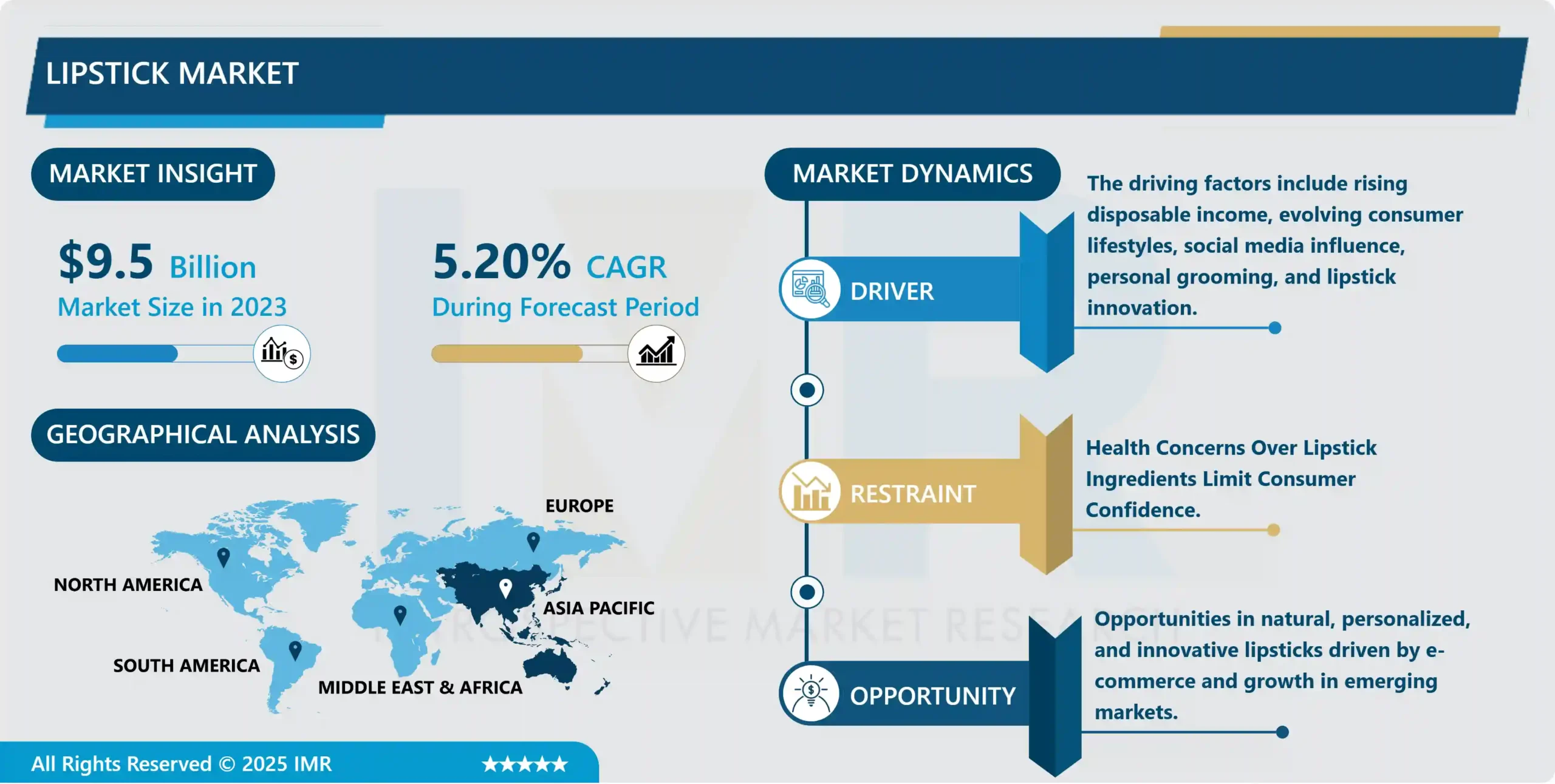
Lipstick Market Size Was Valued at USD 9.5 Billion in 2023 and is Projected to Reach USD 14.99 Billion by 2032, Growing at a CAGR of 5.2% From 2024-2032.
Within the cosmetics industry, the lipstick market provides a variety of products such as traditional lipsticks, liquid lipsticks, lip stains, glosses, balms, and liners. It appeals to a wide range of consumer tastes with its different formulations, finishes, and colors available at various prices.
The lipstick industry serves a wide range of customers, with a primary focus on women but also reaching out to men and non-binary individuals. Things such as current fashion trends, endorsements from celebrities, social media influence, product advancements, and personal grooming habits all play a role in shaping buying choices. Innovation and trends have a significant influence on the lipstick market, particularly emphasizing natural, organic, vegan, and multifunctional products.
Social networking platforms and social media figures influence the choices of consumers as advancements in technology enhance the quality and packaging of products. The lipstick industry serves a wide range of people, focusing on women while also reaching out to men and non-binary individuals. Fashion trends, celebrity endorsements, social media, innovation, and personal expression have an impact on consumers from various age groups, income levels, and geographic locations. Prominent companies in the industry are L’Oréal, Estée Lauder, and Shiseido, as well as smaller independent brands targeting specific market segments. Competition flourishes through innovation, marketing, and distinguishing brands.
Lipstick Market Trend Analysis
Emerging Trends in Herbal Lipsticks: Enhancing Beauty with Natural, Safe, and Chemical-Free Ingredients
Recently, the use of herbs in the production of cosmeceutical products for personal care has been on the rise. Herbal cosmetics, also known as natural cosmetics, are the modern trend that encircles both health and beauty care [4]. These products are experiencing more demand in the market, as nowadays most people prefer natural over chemical products. Natural cosmetics not only provide satisfaction, as these products are free from synthetic chemicals and have relatively fewer side effects but also supply the body with nutrients and enhance the health of a person
On some occasions, regular usage of synthetic products that contain ingredients such as lead, petrolatum, and phthalates may be harmful to consumers. These products may cause lip irritations and dry, chapped lips and can lead to health problems such as allergies, asthma, and cancer. The habits of licking lips or eating and drinking while wearing lipstick can worsen the problems. Due to chronic exposure and their neurotoxic nature, harmful chemicals such as lead in lipsticks should not be ignored.
Therefore, the present review aims to look at the data on lipsticks, to provide information on the history of lipsticks, materials used in lipstick preparation (with an emphasis on natural and artificial ingredients), preparation methods, and characterization. In the present research work, ethanolic extracts of flowers of Royal Poinciana and Canna indica separately were used for the formulation of two herbal lipsticks.
The present study proves that the extract of two flowers Royal Poinciana and Canna Indica acts as a natural coloring agent for the formation of herbal lipsticks. This is well confirmed by the prepared lipstick showing excellent properties like shining, spreading, and smoothness of lips. The prepared lipsticks showed no side effects and great acceptability.
Opportunities in natural, personalized, and innovative lipsticks driven by e-commerce and growth in emerging markets.
Increasing consumer demand for natural and organic lipsticks, devoid of artificial chemicals such as parabens and sulfates. Companies are taking advantage of this movement by creating natural lipsticks with materials such as beeswax, beetroot juice, and castor oil. E-commerce revolutionizes cosmetics, offering easy access to lipstick at home. Brands expand globally, target markets, and gather customer insights online. Social media and influencers drive brand exposure and growth.
Customized lipstick options are becoming more popular as they cater to consumers’ needs for personalized shades, formulas, and packaging. Technology such as virtual try-on tools and AI suggestions enable brands to provide personalized experiences, improving customer satisfaction and loyalty while differentiating themselves in the market. Creative lipstick formulas can satisfy consumer demands by blending color with skincare advantages such as moisturization, SPF, and anti-aging features. Brands can grow sustainably by offering long-wearing, transfer-resistant formulas with various textures such as matte, satin, and metallic, which are highly sought after by customers.
Growth opportunities for the lipstick market are present in emerging markets in Asia-Pacific, Latin America, and Africa because of urbanization, increasing incomes, and beauty consciousness. The demand is driven by demographic changes in favor of self-expression among Gen Z and millennials. Brands can achieve success by providing a variety of products and implementing marketing tactics tailored to specific regions.
Lipstick Market Segment Analysis:
The Lipstick Market is Segmented on the basis of Product Type, Applicator, Gender, End-user, and Distribution Channel.
By Product Type, Matte Segment Is Expected to Dominate the Market During the Forecast Period
Matte lipsticks are in vogue and widely loved for their stylish look and durable, smooth texture. Fashion influencers, celebrities, and beauty enthusiasts support them for their trendy appeal and versatility. Consumers value lipsticks that have a long-lasting formula. Matte formulas are known for their remarkable long-lasting effect, preventing smudging and fading for prolonged wear, which is why they are favored by busy people and those who appreciate effortless beauty routines.
The matte lipstick category offers a diverse range of colors, such as traditional nudes, vivid reds, fashionable mauves, and rich berries, to suit various skin tones and consumer preferences. Matte lipsticks provide flexibility for achieving various looks, whether it be full coverage or a subtle tint. Individuals have the option to try out methods such as lip lining, layering, or blending to personalize their appearance.
Revolutionary matte lipsticks containing moisturizing elements such as hyaluronic acid and shea butter provide comfort, hydration, and flexibility, leading to their strong presence in the industry. Innovations in cosmetic technology have resulted in enhanced formulas for a superior lipstick application. Matte lipsticks give a sophisticated and sleek appearance suitable for professional environments like offices, meetings, and events. The smooth feel enhances the elegance and increases self-assurance, so they are essential in beauty bags for experts. Matte lipsticks are a favorite choice for social media influencers and people who post pictures online because of their camera-friendly appearance. The dull finish improves the lips’ definition and brightness in photos, creating a perfect look.
By Applicator, Stick Segment Held the Largest Share In 2023
Stick lipsticks provide simple application on the move with handy stick applicators that are easy to carry. Consumers appreciate the small size for convenient touch-ups without the need for additional tools. Stick applicators provide accurate and easy application for well-defined lip edges. Pointed edges guarantee precise, expert outcomes when outlining lips.
Different preferences and desired looks can be accommodated with stick lipsticks that come in a range of textures and finishes, such as matte, satin, glossy, and sheer. Lipstick stays inside its container to ensure clean and hygienic use, preventing any contamination. Stick applicators are advantageous for consumers as they reduce product spillage, thus providing convenience. Lipstick remains clean and hygienic for multiple applications. Stick makeup is available in a range of colors and types to cater to various tastes and complexions. A diverse range features timeless neutral, striking statement colors, and specific choices such as hydrating or long-lasting formulas.
Stick lipsticks provide prolonged wear and strength due to a sturdy formula that ensures improved adherence, lasting results, and resistance to daily activities and environmental elements. No need for frequent touch-ups. Stick lipsticks are in high demand because of their distinctive packaging featuring brand logos, smooth metallic coatings, exquisite decorations, and unique branding components. This visual attractiveness increases their attraction for fans of makeup and collectors.
Lipstick Market Regional Insights:
Asia Pacific is Expected to Dominate the Market Over the Forecast Period
The Asia-Pacific region is home to a vast and diverse population, including some of the world’s most populous countries such as China and India. This large consumer base provides a significant market for cosmetics, including lipsticks.
APAC countries have seen evolving beauty standards that emphasize flawless skin and well-groomed appearances. Lipstick, is a key product in achieving these beauty ideals. The influence of K-beauty (Korean beauty trends) and J-beauty (Japanese beauty trends) has also played a role in popularizing makeup products, including lipsticks.
Economic growth in many APAC countries has led to an increase in disposable income levels. As people’s income rises, they tend to spend more on personal grooming and beauty products, including lipsticks. This has contributed to the growth of the cosmetics market in the region.
The expansion of the middle class in APAC countries has created a growing consumer segment with the purchasing power to invest in cosmetics. Many people in this segment prioritize makeup and skincare products, contributing to the growth of the moist lipstick market.
A significant portion of the APAC population is young, and young consumers often drive trends in the cosmetics industry. The desire to experiment with makeup and follow beauty trends has contributed to the popularity of moist lipsticks among younger consumers.
Lipstick Market Active Players
L’Oréal S.A. (France)
Estée Lauder Companies Inc. (US)
Coty Inc. (US)
Shiseido Company, Limited (Japan)
Revlon Inc. (US)
Avon Products Inc. (UK)
Christian Dior SE (France)
Chanel S.A. (France)
Johnson & Johnson Services, Inc. (US)
Unilever Group (UK/Netherlands)
Kao Corporation (Japan)
LVMH Moët Hennessy Louis Vuitton SE (France)
Yves Saint Laurent SAS (France)
Beiersdorf AG (Germany)
Amway Corporation (US)
Oriflame Holding AG (Sweden)
The Clorox Company (US)
Mary Kay Inc. (US)
The Procter & Gamble Company (US)
Guerlain (France)
Inglot Sp. Z. O. O (Poland)
Relouis (Belarus)
Natura &Co (Brazil)
Inglot Cosmetics (Poland)
Amorepacific Corporation (South Korea)
Rohto (Japan)
Sugar Cosmetics (India)
Jala (China), and Other Active Players.
Chapter 1: Introduction
1.1 Scope and Coverage
Chapter 2:Executive Summary
Chapter 3: Market Landscape
3.1 Market Dynamics
3.1.1 Drivers
3.1.2 Restraints
3.1.3 Opportunities
3.1.4 Challenges
3.2 Market Trend Analysis
3.3 PESTLE Analysis
3.4 Porter’s Five Forces Analysis
3.5 Industry Value Chain Analysis
3.6 Ecosystem
3.7 Regulatory Landscape
3.8 Price Trend Analysis
3.9 Patent Analysis
3.10 Technology Evolution
3.11 Investment Pockets
3.12 Import-Export Analysis
Chapter 4: Lipstick Market by Product Type (2018-2032)
4.1 Lipstick Market Snapshot and Growth Engine
4.2 Market Overview
4.3 Satin/Sheer
4.3.1 Introduction and Market Overview
4.3.2 Historic and Forecasted Market Size in Value USD and Volume Units
4.3.3 Key Market Trends, Growth Factors, and Opportunities
4.3.4 Geographic Segmentation Analysis
4.4 Matte
4.5 Crème
4.6 Gloss
4.7 Shimmer
Chapter 5: Lipstick Market by Applicator (2018-2032)
5.1 Lipstick Market Snapshot and Growth Engine
5.2 Market Overview
5.3 Lipstick Cream
5.3.1 Introduction and Market Overview
5.3.2 Historic and Forecasted Market Size in Value USD and Volume Units
5.3.3 Key Market Trends, Growth Factors, and Opportunities
5.3.4 Geographic Segmentation Analysis
5.4 Lipstick Palette
5.5 Lipstick Pencil
5.6 Lipstick Tube/Stick
5.7 Liquid Lipstick
Chapter 6: Lipstick Market by Gender (2018-2032)
6.1 Lipstick Market Snapshot and Growth Engine
6.2 Market Overview
6.3 Female
6.3.1 Introduction and Market Overview
6.3.2 Historic and Forecasted Market Size in Value USD and Volume Units
6.3.3 Key Market Trends, Growth Factors, and Opportunities
6.3.4 Geographic Segmentation Analysis
6.4 Unisex
Chapter 7: Lipstick Market by End-user (2018-2032)
7.1 Lipstick Market Snapshot and Growth Engine
7.2 Market Overview
7.3 Kids
7.3.1 Introduction and Market Overview
7.3.2 Historic and Forecasted Market Size in Value USD and Volume Units
7.3.3 Key Market Trends, Growth Factors, and Opportunities
7.3.4 Geographic Segmentation Analysis
7.4 Adults
Chapter 8: Lipstick Market by Distribution Channel (2018-2032)
8.1 Lipstick Market Snapshot and Growth Engine
8.2 Market Overview
8.3 Departmental/Grocery Stores
8.3.1 Introduction and Market Overview
8.3.2 Historic and Forecasted Market Size in Value USD and Volume Units
8.3.3 Key Market Trends, Growth Factors, and Opportunities
8.3.4 Geographic Segmentation Analysis
8.4 Multi Branded Retail Store
8.5 Supermarkets and Hypermarkets
8.6 Speciality Stores
8.7 Online Channels
Chapter 9: Company Profiles and Competitive Analysis
9.1 Competitive Landscape
9.1.1 Competitive Benchmarking
9.1.2 Lipstick Market Share by Manufacturer (2024)
9.1.3 Industry BCG Matrix
9.1.4 Heat Map Analysis
9.1.5 Mergers and Acquisitions
9.2 L’ORÉAL S.A. (FRANCE)
9.2.1 Company Overview
9.2.2 Key Executives
9.2.3 Company Snapshot
9.2.4 Role of the Company in the Market
9.2.5 Sustainability and Social Responsibility
9.2.6 Operating Business Segments
9.2.7 Product Portfolio
9.2.8 Business Performance
9.2.9 Key Strategic Moves and Recent Developments
9.2.10 SWOT Analysis
9.3 ESTÉE LAUDER COMPANIES INC. (US)
9.4 COTY INC. (US)
9.5 SHISEIDO COMPANY
9.6 LIMITED (JAPAN)
9.7 REVLON INC. (US)
9.8 AVON PRODUCTS INC. (UK)
9.9 CHRISTIAN DIOR SE (FRANCE)
9.10 CHANEL S.A. (FRANCE)
9.11 JOHNSON & JOHNSON SERVICES INC. (US)
9.12 UNILEVER GROUP (UK/NETHERLANDS)
9.13 KAO CORPORATION (JAPAN)
9.14 LVMH MOËT HENNESSY LOUIS VUITTON SE (FRANCE)
9.15 YVES SAINT LAURENT SAS (FRANCE)
9.16 BEIERSDORF AG (GERMANY)
9.17 AMWAY CORPORATION (US)
9.18 ORIFLAME HOLDING AG (SWEDEN)
9.19 THE CLOROX COMPANY (US)
9.20 MARY KAY INC. (US)
9.21 THE PROCTER & GAMBLE COMPANY (US)
9.22 GUERLAIN (FRANCE)
9.23 INGLOT SP. Z. O. O (POLAND)
9.24 RELOUIS (BELARUS)
9.25 NATURA &CO (BRAZIL)
9.26 INGLOT COSMETICS (POLAND)
9.27 AMOREPACIFIC CORPORATION (SOUTH KOREA)
9.28 ROHTO (JAPAN)
9.29 SUGAR COSMETICS (INDIA)
9.30 JALA (CHINA)
9.31 AND
Chapter 10: Global Lipstick Market By Region
10.1 Overview
10.2. North America Lipstick Market
10.2.1 Key Market Trends, Growth Factors and Opportunities
10.2.2 Top Key Companies
10.2.3 Historic and Forecasted Market Size by Segments
10.2.4 Historic and Forecasted Market Size by Product Type
10.2.4.1 Satin/Sheer
10.2.4.2 Matte
10.2.4.3 Crème
10.2.4.4 Gloss
10.2.4.5 Shimmer
10.2.5 Historic and Forecasted Market Size by Applicator
10.2.5.1 Lipstick Cream
10.2.5.2 Lipstick Palette
10.2.5.3 Lipstick Pencil
10.2.5.4 Lipstick Tube/Stick
10.2.5.5 Liquid Lipstick
10.2.6 Historic and Forecasted Market Size by Gender
10.2.6.1 Female
10.2.6.2 Unisex
10.2.7 Historic and Forecasted Market Size by End-user
10.2.7.1 Kids
10.2.7.2 Adults
10.2.8 Historic and Forecasted Market Size by Distribution Channel
10.2.8.1 Departmental/Grocery Stores
10.2.8.2 Multi Branded Retail Store
10.2.8.3 Supermarkets and Hypermarkets
10.2.8.4 Speciality Stores
10.2.8.5 Online Channels
10.2.9 Historic and Forecast Market Size by Country
10.2.9.1 US
10.2.9.2 Canada
10.2.9.3 Mexico
10.3. Eastern Europe Lipstick Market
10.3.1 Key Market Trends, Growth Factors and Opportunities
10.3.2 Top Key Companies
10.3.3 Historic and Forecasted Market Size by Segments
10.3.4 Historic and Forecasted Market Size by Product Type
10.3.4.1 Satin/Sheer
10.3.4.2 Matte
10.3.4.3 Crème
10.3.4.4 Gloss
10.3.4.5 Shimmer
10.3.5 Historic and Forecasted Market Size by Applicator
10.3.5.1 Lipstick Cream
10.3.5.2 Lipstick Palette
10.3.5.3 Lipstick Pencil
10.3.5.4 Lipstick Tube/Stick
10.3.5.5 Liquid Lipstick
10.3.6 Historic and Forecasted Market Size by Gender
10.3.6.1 Female
10.3.6.2 Unisex
10.3.7 Historic and Forecasted Market Size by End-user
10.3.7.1 Kids
10.3.7.2 Adults
10.3.8 Historic and Forecasted Market Size by Distribution Channel
10.3.8.1 Departmental/Grocery Stores
10.3.8.2 Multi Branded Retail Store
10.3.8.3 Supermarkets and Hypermarkets
10.3.8.4 Speciality Stores
10.3.8.5 Online Channels
10.3.9 Historic and Forecast Market Size by Country
10.3.9.1 Russia
10.3.9.2 Bulgaria
10.3.9.3 The Czech Republic
10.3.9.4 Hungary
10.3.9.5 Poland
10.3.9.6 Romania
10.3.9.7 Rest of Eastern Europe
10.4. Western Europe Lipstick Market
10.4.1 Key Market Trends, Growth Factors and Opportunities
10.4.2 Top Key Companies
10.4.3 Historic and Forecasted Market Size by Segments
10.4.4 Historic and Forecasted Market Size by Product Type
10.4.4.1 Satin/Sheer
10.4.4.2 Matte
10.4.4.3 Crème
10.4.4.4 Gloss
10.4.4.5 Shimmer
10.4.5 Historic and Forecasted Market Size by Applicator
10.4.5.1 Lipstick Cream
10.4.5.2 Lipstick Palette
10.4.5.3 Lipstick Pencil
10.4.5.4 Lipstick Tube/Stick
10.4.5.5 Liquid Lipstick
10.4.6 Historic and Forecasted Market Size by Gender
10.4.6.1 Female
10.4.6.2 Unisex
10.4.7 Historic and Forecasted Market Size by End-user
10.4.7.1 Kids
10.4.7.2 Adults
10.4.8 Historic and Forecasted Market Size by Distribution Channel
10.4.8.1 Departmental/Grocery Stores
10.4.8.2 Multi Branded Retail Store
10.4.8.3 Supermarkets and Hypermarkets
10.4.8.4 Speciality Stores
10.4.8.5 Online Channels
10.4.9 Historic and Forecast Market Size by Country
10.4.9.1 Germany
10.4.9.2 UK
10.4.9.3 France
10.4.9.4 The Netherlands
10.4.9.5 Italy
10.4.9.6 Spain
10.4.9.7 Rest of Western Europe
10.5. Asia Pacific Lipstick Market
10.5.1 Key Market Trends, Growth Factors and Opportunities
10.5.2 Top Key Companies
10.5.3 Historic and Forecasted Market Size by Segments
10.5.4 Historic and Forecasted Market Size by Product Type
10.5.4.1 Satin/Sheer
10.5.4.2 Matte
10.5.4.3 Crème
10.5.4.4 Gloss
10.5.4.5 Shimmer
10.5.5 Historic and Forecasted Market Size by Applicator
10.5.5.1 Lipstick Cream
10.5.5.2 Lipstick Palette
10.5.5.3 Lipstick Pencil
10.5.5.4 Lipstick Tube/Stick
10.5.5.5 Liquid Lipstick
10.5.6 Historic and Forecasted Market Size by Gender
10.5.6.1 Female
10.5.6.2 Unisex
10.5.7 Historic and Forecasted Market Size by End-user
10.5.7.1 Kids
10.5.7.2 Adults
10.5.8 Historic and Forecasted Market Size by Distribution Channel
10.5.8.1 Departmental/Grocery Stores
10.5.8.2 Multi Branded Retail Store
10.5.8.3 Supermarkets and Hypermarkets
10.5.8.4 Speciality Stores
10.5.8.5 Online Channels
10.5.9 Historic and Forecast Market Size by Country
10.5.9.1 China
10.5.9.2 India
10.5.9.3 Japan
10.5.9.4 South Korea
10.5.9.5 Malaysia
10.5.9.6 Thailand
10.5.9.7 Vietnam
10.5.9.8 The Philippines
10.5.9.9 Australia
10.5.9.10 New Zealand
10.5.9.11 Rest of APAC
10.6. Middle East & Africa Lipstick Market
10.6.1 Key Market Trends, Growth Factors and Opportunities
10.6.2 Top Key Companies
10.6.3 Historic and Forecasted Market Size by Segments
10.6.4 Historic and Forecasted Market Size by Product Type
10.6.4.1 Satin/Sheer
10.6.4.2 Matte
10.6.4.3 Crème
10.6.4.4 Gloss
10.6.4.5 Shimmer
10.6.5 Historic and Forecasted Market Size by Applicator
10.6.5.1 Lipstick Cream
10.6.5.2 Lipstick Palette
10.6.5.3 Lipstick Pencil
10.6.5.4 Lipstick Tube/Stick
10.6.5.5 Liquid Lipstick
10.6.6 Historic and Forecasted Market Size by Gender
10.6.6.1 Female
10.6.6.2 Unisex
10.6.7 Historic and Forecasted Market Size by End-user
10.6.7.1 Kids
10.6.7.2 Adults
10.6.8 Historic and Forecasted Market Size by Distribution Channel
10.6.8.1 Departmental/Grocery Stores
10.6.8.2 Multi Branded Retail Store
10.6.8.3 Supermarkets and Hypermarkets
10.6.8.4 Speciality Stores
10.6.8.5 Online Channels
10.6.9 Historic and Forecast Market Size by Country
10.6.9.1 Turkiye
10.6.9.2 Bahrain
10.6.9.3 Kuwait
10.6.9.4 Saudi Arabia
10.6.9.5 Qatar
10.6.9.6 UAE
10.6.9.7 Israel
10.6.9.8 South Africa
10.7. South America Lipstick Market
10.7.1 Key Market Trends, Growth Factors and Opportunities
10.7.2 Top Key Companies
10.7.3 Historic and Forecasted Market Size by Segments
10.7.4 Historic and Forecasted Market Size by Product Type
10.7.4.1 Satin/Sheer
10.7.4.2 Matte
10.7.4.3 Crème
10.7.4.4 Gloss
10.7.4.5 Shimmer
10.7.5 Historic and Forecasted Market Size by Applicator
10.7.5.1 Lipstick Cream
10.7.5.2 Lipstick Palette
10.7.5.3 Lipstick Pencil
10.7.5.4 Lipstick Tube/Stick
10.7.5.5 Liquid Lipstick
10.7.6 Historic and Forecasted Market Size by Gender
10.7.6.1 Female
10.7.6.2 Unisex
10.7.7 Historic and Forecasted Market Size by End-user
10.7.7.1 Kids
10.7.7.2 Adults
10.7.8 Historic and Forecasted Market Size by Distribution Channel
10.7.8.1 Departmental/Grocery Stores
10.7.8.2 Multi Branded Retail Store
10.7.8.3 Supermarkets and Hypermarkets
10.7.8.4 Speciality Stores
10.7.8.5 Online Channels
10.7.9 Historic and Forecast Market Size by Country
10.7.9.1 Brazil
10.7.9.2 Argentina
10.7.9.3 Rest of SA
Chapter 11 Analyst Viewpoint and Conclusion
11.1 Recommendations and Concluding Analysis
11.2 Potential Market Strategies
Chapter 12 Research Methodology
12.1 Research Process
12.2 Primary Research
12.3 Secondary Research
Q1: What would be the forecast period in the Lipstick Market research report?
A1: The forecast period in the Lipstick Market research report is 2024-2032.
Q2: Who are the key players in the Lipstick Market?
A2: L'Oréal S.A. (France), Estée Lauder Companies Inc. (US), Coty Inc. (US), Shiseido Company, Limited (Japan), Revlon Inc. (US), Avon Products Inc. (UK), Christian Dior SE (France), Chanel S.A. (France), Johnson & Johnson Services, Inc. (US), Unilever Group (UK/Netherlands), Kao Corporation (Japan), LVMH Moët Hennessy Louis Vuitton SE (France), Yves Saint Laurent SAS (France), Beiersdorf AG (Germany), Amway Corporation (US), Oriflame Holding AG (Sweden), The Clorox Company (US), Mary Kay Inc. (US), The Procter & Gamble Company (US), Guerlain (France), Inglot Sp. Z. O. O (Poland), Relouis (Belarus), Natura &Co (Brazil), Inglot Cosmetics (Poland), Amorepacific Corporation (South Korea), Rohto (Japan), Sugar Cosmetics (India), Jala (China), and Other Active Players.
Q3: What are the segments of the Lipstick Market?
A3: The Lipstick Market is segmented into Product Type, Applicator, Gender, End-user, Distribution Channel, and region. By Product Type, the market is categorized into Satin/Sheer, Matte, Crème, Gloss, Shimmer, And Product. By Applicator, the market is categorized into Lipstick Cream, Lipstick Palette, Lipstick Pencil, Lipstick Tube/Stick, and Liquid Lipstick. By Gender, the market is categorized into Female and unisex. By End-user, the market is categorized into Kids and adults. By Distribution Channel, The Market Is Categorized Into Departmental/Grocery Stores, Multi Branded Retail Stores, Supermarkets and Hypermarkets, Speciality Stores, and Online Channels. By region, it is analyzed across North America (U.S.; Canada; Mexico), Eastern Europe (Bulgaria; The Czech Republic; Hungary; Poland; Romania; Rest of Eastern Europe), Western Europe (Germany; UK; France; Netherlands; Italy; Russia; Spain; Rest of Western Europe), Asia-Pacific (China; India; Japan; Southeast Asia, etc.), South America (Brazil; Argentina, etc.), Middle East & Africa (Saudi Arabia; South Africa, etc.).
Q4: What is the Lipstick Market?
A4: The lipstick market refers to the segment of the cosmetics industry that focuses on the production, distribution, and sale of lip color products. This market includes various types of lipsticks, such as matte, gloss, satin, and liquid lipsticks, as well as lip liners and lip balms. It encompasses both mass-market and premium segments, catering to diverse consumer preferences and trends.
Q5: How big is the Lipstick Market?
A5: Lipstick Market Size Was Valued at USD 9.5 Billion in 2023 and is Projected to Reach USD 14.99 Billion by 2032, Growing at a CAGR of 5.2% From 2024-2032.
How to Buy a Report from eminsights.jp
On the product page, choose the license you want: Single-User License, Multi-User License or Enterprise License.
If you required report in your native language, then you can click on Translated Report button and fill out the form with report name and language you want, then our team will contact you as soon as possible.
Click the Buy Now button.
You will be redirected to the checkout page. Enter your company details and payment information.
Click Place Order to complete the purchase.
Confirmation: You’ll receive an order confirmation and our team will contact you shortly with your ordered report.
If you have any questions, fill out the contact form below or email us at bizdev@eminsights.net.
Thank you for choosing eminsights.jp!