Stay Ahead in Fast-Growing Economies.
Browse Reports Now
Light Commercial Vehicle Market Analysis, Share, and Future Forecast (2024-2032)
Light Commercial Vehicle (LCV) market is defined as the class of vehicles utilized in commercial operations with GVW below 3.5 Ton.

IMR Group
Description
Light Commercial Vehicle Market Synopsis:
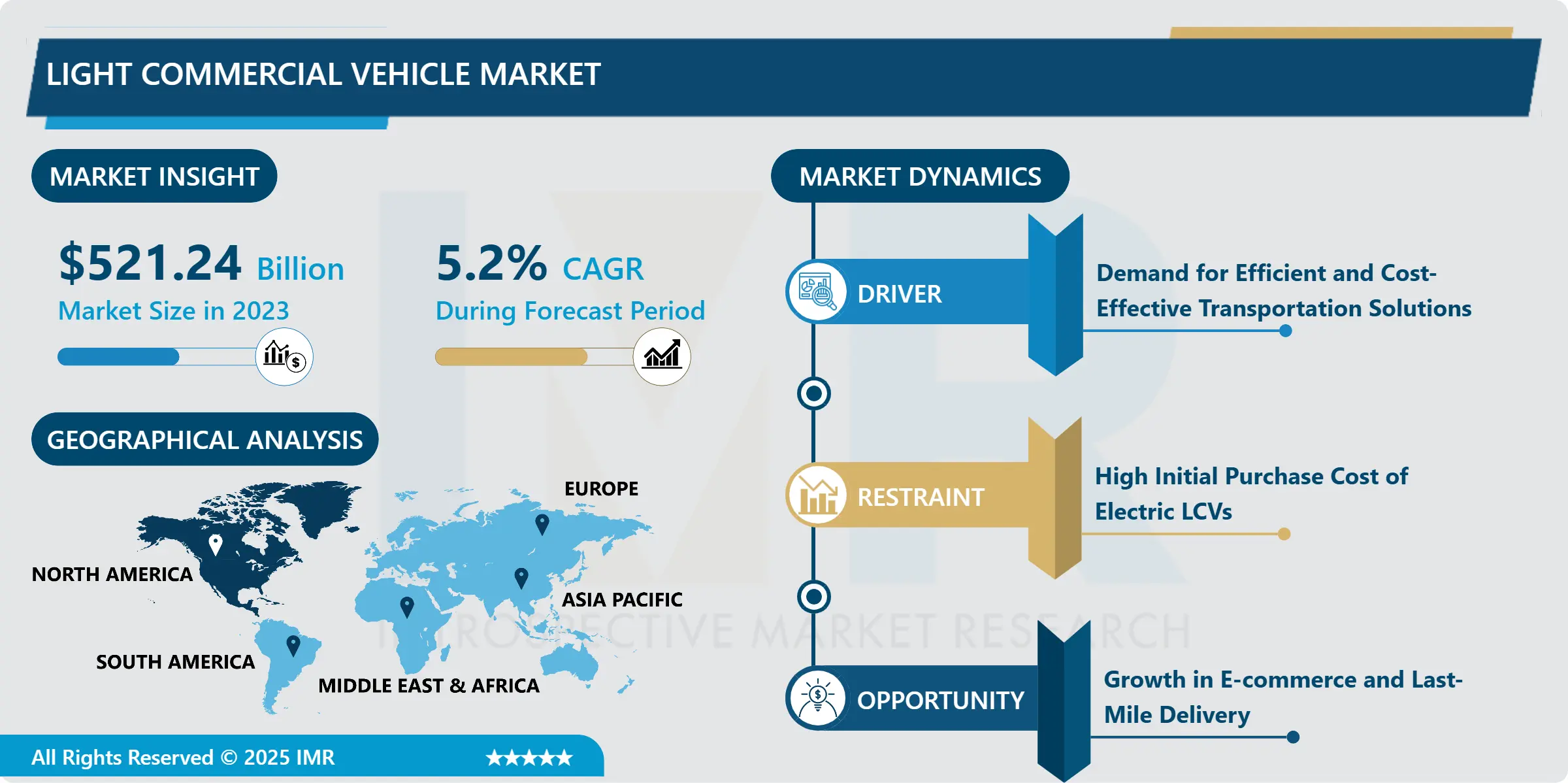
Light Commercial Vehicle Market Size Was Valued at USD 521.24 Billion in 2023, and is Projected to Reach USD 822.58 Billion by 2032, Growing at a CAGR of 5.2% From 2024-2032.
Light Commercial Vehicle (LCV) market is defined as the class of vehicles utilized in commercial operations with GVW below 3.5 Ton. These include pickup trucks , vans, minivans and light trucks all of which are utilized for goods or passenger transport in areas such as cargo transport, construction & construction, emergency services and many other industries.
LCV market have been experiencing considerable growth over the recent past mainly because of the growing demand for efficient transport throughout the logistics, e- commerce, and construction industries. LCVs are very flexible and these vehicles have a great significance in the transportation of products and/or services across different sectors. As the global economy is improving steadily and the urban population is growing faster in the emergent countries, the demand for cars that correspond to both passenger and cargo transport functions is increasing as well. Furthermore, the major trend of the LCV market involves the increasing focus of LCV manufacturers on the development of fuel-efficient and environmentally friendly vehicles that are also relatively affordable, with electric and hybrid options taking centre stage.
This has greatly contributed to the high growth of LCV’s as e-commerce continues to expand, thus increasing demand for last mile delivery solutions. The LCV market is also a growing one because there is an increasing requirement for versatility as far as operations are concerned; from refrigerated transportation to emergency services. Governments throughout the world are also helping by laying down policies that would help motivate manufacturers to develop technologies that bring clean and fuel efficient vehicles to the road and make available incentives for EV and HEV LCVs. With the progress of urban development, these LCVs are gaining importance in narrow urban streets to deliver goods or indeed transport people quickly.
Accordingly, LCVs are undergoing change with the present technological improvements as possess connectivity, autonomous driving and electric vehicle features. In addition, technological advancements in fleet management systems has seen commercial fleets improved in the commercial sector hence making these vehicle assets essential in all companies across the globe. The market is predicted to sustain gradual growth in the following years thanks to the development of new commercial enterprises, increasing concerns for environmentally friendly vehicles, and the development of intelligent transport systems in cities.
Light Commercial Vehicle Market Trend Analysis:
Electric Light Commercial Vehicles (e-LCVs)
This new generation of light commercial vehicles (LCVs) has started to grow in popularity thanks to company and government goals to cut emissions. As the world faces the increasing challenges of environmental degradation and the changes that come with the emission control standards the world over companies are opting for the electric LCVs to cut costs they associate with emissions. As the new electric vehicles (EVs) are gaining traction in the consumer market, they are also going in the commercial market also. These vehicles provide methodologies for lower cost of operation in terms of fuel and maintenance making them suitable for businesses.
Electric LCVs is in line with the global drive of reducing greenhouse emissions and enhancing cleaner urban air quality.
As the extent of the ev As the ev charging infrastructure develops in the future such as through the increased establishment of charging points and advancement in battery systems, the usage of e-LCVs is likely to increase. This evolution is being propelled by developments in affordable electric light commercial Vehicles that has made various automakers to design, build and deploy them for business operations based on the requirements for payload, range and utility. Given the fact that Governments all over the world are providing incentives and policies, which supports the environment friendly products, such as e-LCVs; the light commercial vehicle market is expected to tap a bright future.
Growth in E-commerce and Last-Mile Delivery
The other obvious trend which presents one of the biggest opportunities for the light commercial vehicle market is the increasing popularity of e-commerce and the subsequent need for last mile delivery services. Given that more and more people today opt for the online mode when purchasing products, there is a growing demand for vehicles that will effectively and quickly deliver the goods from the shops to the customers’ homes, with light commercial vehicles being especially in demand in urban areas. Some of the biggest companies (and their competitors) such as Amazon and other online markets use LCVs for their deliveries as well as traditional shops. It has promoted the expansion of the car market and demand for various types of NV, small vans, pickups, and light trucks adapted to narrow urban roads and deliver products directly to consumers.
The increase in urbanization is also pacing this opportunity. The world population is rapidly growing urban, e-commerce is becoming more popular, and flexible, efficient, and agile delivery systems are essential. LCV’s attributes of a compact form and high versatility allow to increase its market coverage in the context of developing last-mile delivery services. E-commerce companies require methods that will make them efficient and these requires use efficient and cheap lcv fleets. It is anticipated that this trend will also steadily grow in the future as the online selling format increasingly makes up the global selling format of retail sales, thus providing numerous growth prospects for the light commercial vehicle market.
Light Commercial Vehicle Market Segment Analysis:
Light Commercial Vehicle Market is Segmented on the basis of Vehicle Type, Fuel Type, Drive Type, Application, End User, and Region.
By Vehicle Type, Pickup Trucks segment is expected to dominate the market during the forecast period
To begin with, this market segment of light Commercial Vehicles consists of various types of vehicles- pickup trucks, vans, minivans, light trucks. One of the most typical forms of LCV is a pickup truck, well-known in the territories such as North America, which may be utilized for numerous business functions, namely, construction, delivery, servicing etc. There is also rising demand for vans and minivans especially to be used in urban delivery purposes and passenger carrying services. Their small dimensions and larger carrying capacities make them suitable particularly for businesses requiring movement of Inventory or individuals in density populated regions.
Light trucks constitute another category of LCVs they are mainly used for carrying both goods and passengers. These vehicles come in a wide range of models orange and are widely applied in fields that include transport, farming and construction. They can accommodate larger cargo than vans or minivans, while satisfying the need for the manoeuvrability that is vital in the congested city. Forecast that the demand for these vehicle types will remain high with the boost of e-commerce, increase in urban population, and requirement of convenient and efficient means of transport.
By Application, Cargo Transport segment expected to held the largest share
The light commercial vehicle market is also divided by its application, major of them are cargo and carrying, passengers, cold chain transportation, construction and mining vehicle and rescue car. One of the biggest uses for LCVs is in cargo transportation, given the demand of all industries worldwide for better logistics and supply chain capabilities. LCV section is crucial to the delivery from the last mile as this is the most viable option for firms to transport consumer products to the populace in the urban and suburban centers.
Another important use is the passenger transport, especially minivans and light buses. They are applied in the taxi, shuttles services and ride-hailing, mainly in populated regions or central business districts. Refrigerated transport is gradually experiencing an upswing given the increasing consumption of perishable goods particularly foods and medication. Further, LCVs find their use in construction and mining industries for transferring consumables and plant equipment out to the working site. The extent of use that LCVs receive in these categories of use makes them essential in many industries.
Light Commercial Vehicle Market Regional Insights:
North America is Expected to Dominate the Market Over the Forecast period
North America region has been identified as the leading region in the global light commercial vehicle market. The US has many establishments that use LCVs for goods carriage, construction, and disaster management and handling. Another reason, stimulating the demand for LCVs, is the high degree of infrastructure, a high level of penetration of pick-ups, and the emergence of a developed e-commerce market. Another added advantage is that the region boasts of an advanced fleet management environment thus enabling LCV fleet owners manage their fleets efficiently and at a low cost.
The government policies in North America such as incentive on taxation for electric vehicle and increased stringency of emission norms are enlarging the demand for fuel efficient and Eco friendly LCVs. The main players from the automotive market such as Ford, General Motors and more recently Stellantis are located in North America which further consolidates its position as the authour’s identified global leader in LCV market. Further investments in the EV sector and enduring interest from the logistic and service industries will ensure that North America remains the market leader of LCVs in the near future.
Active Key Players in the Light Commercial Vehicle Market:
Ford Motor Company (USA)
General Motors (USA)
Fiat Chrysler Automobiles (FCA) (Italy)
Toyota Motor Corporation (Japan)
Volkswagen Group (Germany)
Nissan Motor Co., Ltd. (Japan)
Mercedes-Benz Group AG (Germany)
BMW AG (Germany)
Renault Group (France)
Isuzu Motors Ltd. (Japan)
Honda Motor Co., Ltd. (Japan)
Hyundai Motor Company (South Korea), and Other Active Players
Key Industry Developments in the Light Commercial Vehicle Market:
In March 2023, Rivian expanded its footprint in the commercial vehicle sector by partnering with Morgan Olson to co-create electric delivery vehicles. This collaboration entails integrating Rivian’s cutting-edge technology, particularly its chassis platform, into vehicles like the Morgan Olson C250E, specifically tailored for Canada Post.
In October 2023, Stellantis revealed its plans to introduce four electric pickup trucks in the North American market. This lineup will encompass six brands: Ram, Citroën, Fiat, Opel, Peugeot, and Vauxhall, offering a diverse range of vehicles including 10 pickup trucks, five vans, and a micro-mobility solution.
Chapter 1: Introduction
1.1 Scope and Coverage
Chapter 2:Executive Summary
Chapter 3: Market Landscape
3.1 Market Dynamics
3.1.1 Drivers
3.1.2 Restraints
3.1.3 Opportunities
3.1.4 Challenges
3.2 Market Trend Analysis
3.3 PESTLE Analysis
3.4 Porter’s Five Forces Analysis
3.5 Industry Value Chain Analysis
3.6 Ecosystem
3.7 Regulatory Landscape
3.8 Price Trend Analysis
3.9 Patent Analysis
3.10 Technology Evolution
3.11 Investment Pockets
3.12 Import-Export Analysis
Chapter 4: Light Commercial Vehicle Market by Vehicle Type
4.1 Light Commercial Vehicle Market Snapshot and Growth Engine
4.2 Light Commercial Vehicle Market Overview
4.3 Pickup Trucks
4.3.1 Introduction and Market Overview
4.3.2 Historic and Forecasted Market Size in Value USD and Volume Units (2017-2032F)
4.3.3 Key Market Trends, Growth Factors and Opportunities
4.3.4 Pickup Trucks: Geographic Segmentation Analysis
4.4 Vans
4.4.1 Introduction and Market Overview
4.4.2 Historic and Forecasted Market Size in Value USD and Volume Units (2017-2032F)
4.4.3 Key Market Trends, Growth Factors and Opportunities
4.4.4 Vans: Geographic Segmentation Analysis
4.5 Minivans
4.5.1 Introduction and Market Overview
4.5.2 Historic and Forecasted Market Size in Value USD and Volume Units (2017-2032F)
4.5.3 Key Market Trends, Growth Factors and Opportunities
4.5.4 Minivans: Geographic Segmentation Analysis
4.6 Light Trucks
4.6.1 Introduction and Market Overview
4.6.2 Historic and Forecasted Market Size in Value USD and Volume Units (2017-2032F)
4.6.3 Key Market Trends, Growth Factors and Opportunities
4.6.4 Light Trucks: Geographic Segmentation Analysis
Chapter 5: Light Commercial Vehicle Market by Fuel Type
5.1 Light Commercial Vehicle Market Snapshot and Growth Engine
5.2 Light Commercial Vehicle Market Overview
5.3 Internal Combustion Engine (ICE)
5.3.1 Introduction and Market Overview
5.3.2 Historic and Forecasted Market Size in Value USD and Volume Units (2017-2032F)
5.3.3 Key Market Trends, Growth Factors and Opportunities
5.3.4 Internal Combustion Engine (ICE): Geographic Segmentation Analysis
5.4 Electric Vehicles (EV)
5.4.1 Introduction and Market Overview
5.4.2 Historic and Forecasted Market Size in Value USD and Volume Units (2017-2032F)
5.4.3 Key Market Trends, Growth Factors and Opportunities
5.4.4 Electric Vehicles (EV): Geographic Segmentation Analysis
5.5 Hybrid Vehicles
5.5.1 Introduction and Market Overview
5.5.2 Historic and Forecasted Market Size in Value USD and Volume Units (2017-2032F)
5.5.3 Key Market Trends, Growth Factors and Opportunities
5.5.4 Hybrid Vehicles: Geographic Segmentation Analysis
Chapter 6: Light Commercial Vehicle Market by Application
6.1 Light Commercial Vehicle Market Snapshot and Growth Engine
6.2 Light Commercial Vehicle Market Overview
6.3 Cargo Transport
6.3.1 Introduction and Market Overview
6.3.2 Historic and Forecasted Market Size in Value USD and Volume Units (2017-2032F)
6.3.3 Key Market Trends, Growth Factors and Opportunities
6.3.4 Cargo Transport: Geographic Segmentation Analysis
6.4 Passenger Transport
6.4.1 Introduction and Market Overview
6.4.2 Historic and Forecasted Market Size in Value USD and Volume Units (2017-2032F)
6.4.3 Key Market Trends, Growth Factors and Opportunities
6.4.4 Passenger Transport: Geographic Segmentation Analysis
6.5 Refrigerated Transport
6.5.1 Introduction and Market Overview
6.5.2 Historic and Forecasted Market Size in Value USD and Volume Units (2017-2032F)
6.5.3 Key Market Trends, Growth Factors and Opportunities
6.5.4 Refrigerated Transport: Geographic Segmentation Analysis
6.6 Construction & Mining
6.6.1 Introduction and Market Overview
6.6.2 Historic and Forecasted Market Size in Value USD and Volume Units (2017-2032F)
6.6.3 Key Market Trends, Growth Factors and Opportunities
6.6.4 Construction & Mining: Geographic Segmentation Analysis
6.7 Emergency Services
6.7.1 Introduction and Market Overview
6.7.2 Historic and Forecasted Market Size in Value USD and Volume Units (2017-2032F)
6.7.3 Key Market Trends, Growth Factors and Opportunities
6.7.4 Emergency Services: Geographic Segmentation Analysis
Chapter 7: Light Commercial Vehicle Market by End-User
7.1 Light Commercial Vehicle Market Snapshot and Growth Engine
7.2 Light Commercial Vehicle Market Overview
7.3 Logistics & Transportation
7.3.1 Introduction and Market Overview
7.3.2 Historic and Forecasted Market Size in Value USD and Volume Units (2017-2032F)
7.3.3 Key Market Trends, Growth Factors and Opportunities
7.3.4 Logistics & Transportation: Geographic Segmentation Analysis
7.4 Retail & E-commerce
7.4.1 Introduction and Market Overview
7.4.2 Historic and Forecasted Market Size in Value USD and Volume Units (2017-2032F)
7.4.3 Key Market Trends, Growth Factors and Opportunities
7.4.4 Retail & E-commerce: Geographic Segmentation Analysis
7.5 Construction & Infrastructure
7.5.1 Introduction and Market Overview
7.5.2 Historic and Forecasted Market Size in Value USD and Volume Units (2017-2032F)
7.5.3 Key Market Trends, Growth Factors and Opportunities
7.5.4 Construction & Infrastructure: Geographic Segmentation Analysis
7.6 Government & Public Services
7.6.1 Introduction and Market Overview
7.6.2 Historic and Forecasted Market Size in Value USD and Volume Units (2017-2032F)
7.6.3 Key Market Trends, Growth Factors and Opportunities
7.6.4 Government & Public Services: Geographic Segmentation Analysis
7.7 Healthcare
7.7.1 Introduction and Market Overview
7.7.2 Historic and Forecasted Market Size in Value USD and Volume Units (2017-2032F)
7.7.3 Key Market Trends, Growth Factors and Opportunities
7.7.4 Healthcare: Geographic Segmentation Analysis
Chapter 8: Company Profiles and Competitive Analysis
8.1 Competitive Landscape
8.1.1 Competitive Benchmarking
8.1.2 Light Commercial Vehicle Market Share by Manufacturer (2023)
8.1.3 Industry BCG Matrix
8.1.4 Heat Map Analysis
8.1.5 Mergers and Acquisitions
8.2 FORD MOTOR COMPANY (USA)
8.2.1 Company Overview
8.2.2 Key Executives
8.2.3 Company Snapshot
8.2.4 Role of the Company in the Market
8.2.5 Sustainability and Social Responsibility
8.2.6 Operating Business Segments
8.2.7 Product Portfolio
8.2.8 Business Performance
8.2.9 Key Strategic Moves and Recent Developments
8.2.10 SWOT Analysis
8.3 GENERAL MOTORS (USA)
8.4 FIAT CHRYSLER AUTOMOBILES (FCA) (ITALY)
8.5 TOYOTA MOTOR CORPORATION (JAPAN)
8.6 VOLKSWAGEN GROUP (GERMANY)
8.7 NISSAN MOTOR CO. LTD. (JAPAN)
8.8 MERCEDES-BENZ GROUP AG (GERMANY)
8.9 BMW AG (GERMANY)
8.10 RENAULT GROUP (FRANCE)
8.11 ISUZU MOTORS LTD. (JAPAN)
8.12 HONDA MOTOR CO. LTD. (JAPAN)
8.13 HYUNDAI MOTOR COMPANY (SOUTH KOREA)
8.14 OTHER ACTIVE PLAYERS
Chapter 9: Global Light Commercial Vehicle Market By Region
9.1 Overview
9.2. North America Light Commercial Vehicle Market
9.2.1 Key Market Trends, Growth Factors and Opportunities
9.2.2 Top Key Companies
9.2.3 Historic and Forecasted Market Size by Segments
9.2.4 Historic and Forecasted Market Size By Vehicle Type
9.2.4.1 Pickup Trucks
9.2.4.2 Vans
9.2.4.3 Minivans
9.2.4.4 Light Trucks
9.2.5 Historic and Forecasted Market Size By Fuel Type
9.2.5.1 Internal Combustion Engine (ICE)
9.2.5.2 Electric Vehicles (EV)
9.2.5.3 Hybrid Vehicles
9.2.6 Historic and Forecasted Market Size By Application
9.2.6.1 Cargo Transport
9.2.6.2 Passenger Transport
9.2.6.3 Refrigerated Transport
9.2.6.4 Construction & Mining
9.2.6.5 Emergency Services
9.2.7 Historic and Forecasted Market Size By End-User
9.2.7.1 Logistics & Transportation
9.2.7.2 Retail & E-commerce
9.2.7.3 Construction & Infrastructure
9.2.7.4 Government & Public Services
9.2.7.5 Healthcare
9.2.8 Historic and Forecast Market Size by Country
9.2.8.1 US
9.2.8.2 Canada
9.2.8.3 Mexico
9.3. Eastern Europe Light Commercial Vehicle Market
9.3.1 Key Market Trends, Growth Factors and Opportunities
9.3.2 Top Key Companies
9.3.3 Historic and Forecasted Market Size by Segments
9.3.4 Historic and Forecasted Market Size By Vehicle Type
9.3.4.1 Pickup Trucks
9.3.4.2 Vans
9.3.4.3 Minivans
9.3.4.4 Light Trucks
9.3.5 Historic and Forecasted Market Size By Fuel Type
9.3.5.1 Internal Combustion Engine (ICE)
9.3.5.2 Electric Vehicles (EV)
9.3.5.3 Hybrid Vehicles
9.3.6 Historic and Forecasted Market Size By Application
9.3.6.1 Cargo Transport
9.3.6.2 Passenger Transport
9.3.6.3 Refrigerated Transport
9.3.6.4 Construction & Mining
9.3.6.5 Emergency Services
9.3.7 Historic and Forecasted Market Size By End-User
9.3.7.1 Logistics & Transportation
9.3.7.2 Retail & E-commerce
9.3.7.3 Construction & Infrastructure
9.3.7.4 Government & Public Services
9.3.7.5 Healthcare
9.3.8 Historic and Forecast Market Size by Country
9.3.8.1 Russia
9.3.8.2 Bulgaria
9.3.8.3 The Czech Republic
9.3.8.4 Hungary
9.3.8.5 Poland
9.3.8.6 Romania
9.3.8.7 Rest of Eastern Europe
9.4. Western Europe Light Commercial Vehicle Market
9.4.1 Key Market Trends, Growth Factors and Opportunities
9.4.2 Top Key Companies
9.4.3 Historic and Forecasted Market Size by Segments
9.4.4 Historic and Forecasted Market Size By Vehicle Type
9.4.4.1 Pickup Trucks
9.4.4.2 Vans
9.4.4.3 Minivans
9.4.4.4 Light Trucks
9.4.5 Historic and Forecasted Market Size By Fuel Type
9.4.5.1 Internal Combustion Engine (ICE)
9.4.5.2 Electric Vehicles (EV)
9.4.5.3 Hybrid Vehicles
9.4.6 Historic and Forecasted Market Size By Application
9.4.6.1 Cargo Transport
9.4.6.2 Passenger Transport
9.4.6.3 Refrigerated Transport
9.4.6.4 Construction & Mining
9.4.6.5 Emergency Services
9.4.7 Historic and Forecasted Market Size By End-User
9.4.7.1 Logistics & Transportation
9.4.7.2 Retail & E-commerce
9.4.7.3 Construction & Infrastructure
9.4.7.4 Government & Public Services
9.4.7.5 Healthcare
9.4.8 Historic and Forecast Market Size by Country
9.4.8.1 Germany
9.4.8.2 UK
9.4.8.3 France
9.4.8.4 The Netherlands
9.4.8.5 Italy
9.4.8.6 Spain
9.4.8.7 Rest of Western Europe
9.5. Asia Pacific Light Commercial Vehicle Market
9.5.1 Key Market Trends, Growth Factors and Opportunities
9.5.2 Top Key Companies
9.5.3 Historic and Forecasted Market Size by Segments
9.5.4 Historic and Forecasted Market Size By Vehicle Type
9.5.4.1 Pickup Trucks
9.5.4.2 Vans
9.5.4.3 Minivans
9.5.4.4 Light Trucks
9.5.5 Historic and Forecasted Market Size By Fuel Type
9.5.5.1 Internal Combustion Engine (ICE)
9.5.5.2 Electric Vehicles (EV)
9.5.5.3 Hybrid Vehicles
9.5.6 Historic and Forecasted Market Size By Application
9.5.6.1 Cargo Transport
9.5.6.2 Passenger Transport
9.5.6.3 Refrigerated Transport
9.5.6.4 Construction & Mining
9.5.6.5 Emergency Services
9.5.7 Historic and Forecasted Market Size By End-User
9.5.7.1 Logistics & Transportation
9.5.7.2 Retail & E-commerce
9.5.7.3 Construction & Infrastructure
9.5.7.4 Government & Public Services
9.5.7.5 Healthcare
9.5.8 Historic and Forecast Market Size by Country
9.5.8.1 China
9.5.8.2 India
9.5.8.3 Japan
9.5.8.4 South Korea
9.5.8.5 Malaysia
9.5.8.6 Thailand
9.5.8.7 Vietnam
9.5.8.8 The Philippines
9.5.8.9 Australia
9.5.8.10 New Zealand
9.5.8.11 Rest of APAC
9.6. Middle East & Africa Light Commercial Vehicle Market
9.6.1 Key Market Trends, Growth Factors and Opportunities
9.6.2 Top Key Companies
9.6.3 Historic and Forecasted Market Size by Segments
9.6.4 Historic and Forecasted Market Size By Vehicle Type
9.6.4.1 Pickup Trucks
9.6.4.2 Vans
9.6.4.3 Minivans
9.6.4.4 Light Trucks
9.6.5 Historic and Forecasted Market Size By Fuel Type
9.6.5.1 Internal Combustion Engine (ICE)
9.6.5.2 Electric Vehicles (EV)
9.6.5.3 Hybrid Vehicles
9.6.6 Historic and Forecasted Market Size By Application
9.6.6.1 Cargo Transport
9.6.6.2 Passenger Transport
9.6.6.3 Refrigerated Transport
9.6.6.4 Construction & Mining
9.6.6.5 Emergency Services
9.6.7 Historic and Forecasted Market Size By End-User
9.6.7.1 Logistics & Transportation
9.6.7.2 Retail & E-commerce
9.6.7.3 Construction & Infrastructure
9.6.7.4 Government & Public Services
9.6.7.5 Healthcare
9.6.8 Historic and Forecast Market Size by Country
9.6.8.1 Turkiye
9.6.8.2 Bahrain
9.6.8.3 Kuwait
9.6.8.4 Saudi Arabia
9.6.8.5 Qatar
9.6.8.6 UAE
9.6.8.7 Israel
9.6.8.8 South Africa
9.7. South America Light Commercial Vehicle Market
9.7.1 Key Market Trends, Growth Factors and Opportunities
9.7.2 Top Key Companies
9.7.3 Historic and Forecasted Market Size by Segments
9.7.4 Historic and Forecasted Market Size By Vehicle Type
9.7.4.1 Pickup Trucks
9.7.4.2 Vans
9.7.4.3 Minivans
9.7.4.4 Light Trucks
9.7.5 Historic and Forecasted Market Size By Fuel Type
9.7.5.1 Internal Combustion Engine (ICE)
9.7.5.2 Electric Vehicles (EV)
9.7.5.3 Hybrid Vehicles
9.7.6 Historic and Forecasted Market Size By Application
9.7.6.1 Cargo Transport
9.7.6.2 Passenger Transport
9.7.6.3 Refrigerated Transport
9.7.6.4 Construction & Mining
9.7.6.5 Emergency Services
9.7.7 Historic and Forecasted Market Size By End-User
9.7.7.1 Logistics & Transportation
9.7.7.2 Retail & E-commerce
9.7.7.3 Construction & Infrastructure
9.7.7.4 Government & Public Services
9.7.7.5 Healthcare
9.7.8 Historic and Forecast Market Size by Country
9.7.8.1 Brazil
9.7.8.2 Argentina
9.7.8.3 Rest of SA
Chapter 10 Analyst Viewpoint and Conclusion
10.1 Recommendations and Concluding Analysis
10.2 Potential Market Strategies
Chapter 11 Research Methodology
11.1 Research Process
11.2 Primary Research
11.3 Secondary Research
Q1: What would be the forecast period in the Light Commercial Vehicle Market research report?
A1: The forecast period in the Light Commercial Vehicle Market research report is 2024-2032.
Q2: Who are the key players in the Light Commercial Vehicle Market?
A2: Ford Motor Company (USA), General Motors (USA), Fiat Chrysler Automobiles (FCA) (Italy), Toyota Motor Corporation (Japan), Volkswagen Group (Germany), Nissan Motor Co., Ltd. (Japan), Mercedes-Benz Group AG (Germany), BMW AG (Germany), Renault Group (France), Isuzu Motors Ltd. (Japan), Honda Motor Co., Ltd. (Japan), Hyundai Motor Company (South Korea), and Other Active Players.
Q3: What are the segments of the Light Commercial Vehicle Market?
A3: The Light Commercial Vehicle Market is segmented into Vehicle Type, Fuel Type, Drive Type, Application, End User and Region. By Vehicle Type, the market is categorized into Pickup Trucks, Vans, Minivans, Light Trucks. By Fuel Type, the market is categorized into Internal Combustion Engine (ICE), Electric Vehicles (EV), Hybrid Vehicles. By Application, the market is categorized into Cargo Transport, Passenger Transport, Refrigerated Transport, Construction & Mining, Emergency Services. By End-User, the market is categorized into Logistics & Transportation, Retail & E-commerce, Construction & Infrastructure, Government & Public Services, Healthcare. By Drive Type, the market is categorized into Front-Wheel Drive (FWD), Rear-Wheel Drive (RWD), All-Wheel Drive (AWD). By region, it is analyzed across North America (U.S., Canada, Mexico), Eastern Europe (Russia, Bulgaria, The Czech Republic, Hungary, Poland, Romania, Rest of Eastern Europe), Western Europe (Germany, UK, France, Netherlands, Italy, Spain, Rest of Western Europe), Asia Pacific (China, India, Japan, South Korea, Malaysia, Thailand, Vietnam, The Philippines, Australia, New Zealand, Rest of APAC), Middle East & Africa (Turkiye, Bahrain, Kuwait, Saudi Arabia, Qatar, UAE, Israel, South Africa), South America (Brazil, Argentina, Rest of SA).
Q4: What is the Light Commercial Vehicle Market?
A4: Light Commercial Vehicle (LCV) market is defined as the class of vehicles utilized in commercial operations with GVW below 3.5 Ton. These include pickup trucks , vans, minivans and light trucks all of which are utilized for goods or passenger transport in areas such as cargo transport, construction & construction, emergency services and many other industries.
Q5: How big is the Light Commercial Vehicle Market?
A5: Light Commercial Vehicle Market Size Was Valued at USD 521.24 Billion in 2023, and is Projected to Reach USD 822.58 Billion by 2032, Growing at a CAGR of 5.2% From 2024-2032.
How to Buy a Report from eminsights.jp
On the product page, choose the license you want: Single-User License, Multi-User License or Enterprise License.
If you required report in your native language, then you can click on Translated Report button and fill out the form with report name and language you want, then our team will contact you as soon as possible.
Click the Buy Now button.
You will be redirected to the checkout page. Enter your company details and payment information.
Click Place Order to complete the purchase.
Confirmation: You’ll receive an order confirmation and our team will contact you shortly with your ordered report.
If you have any questions, fill out the contact form below or email us at bizdev@eminsights.net.
Thank you for choosing eminsights.jp!