Stay Ahead in Fast-Growing Economies.
Browse Reports Now
Lice Treatment Market: Global Size, Share & Industry Trends
Head lice, Pediculus human’s var capitis, are wingless insects that have been obligate parasites of humans for thousands of years. Since the oldest archaeological record is 8,000 years BC, some authors have proposed that lice were associated with pre-hominoid ancestors and were dispersed globally when humans migrated.

IMR Group
Description
Lice Treatment Market Synopsis
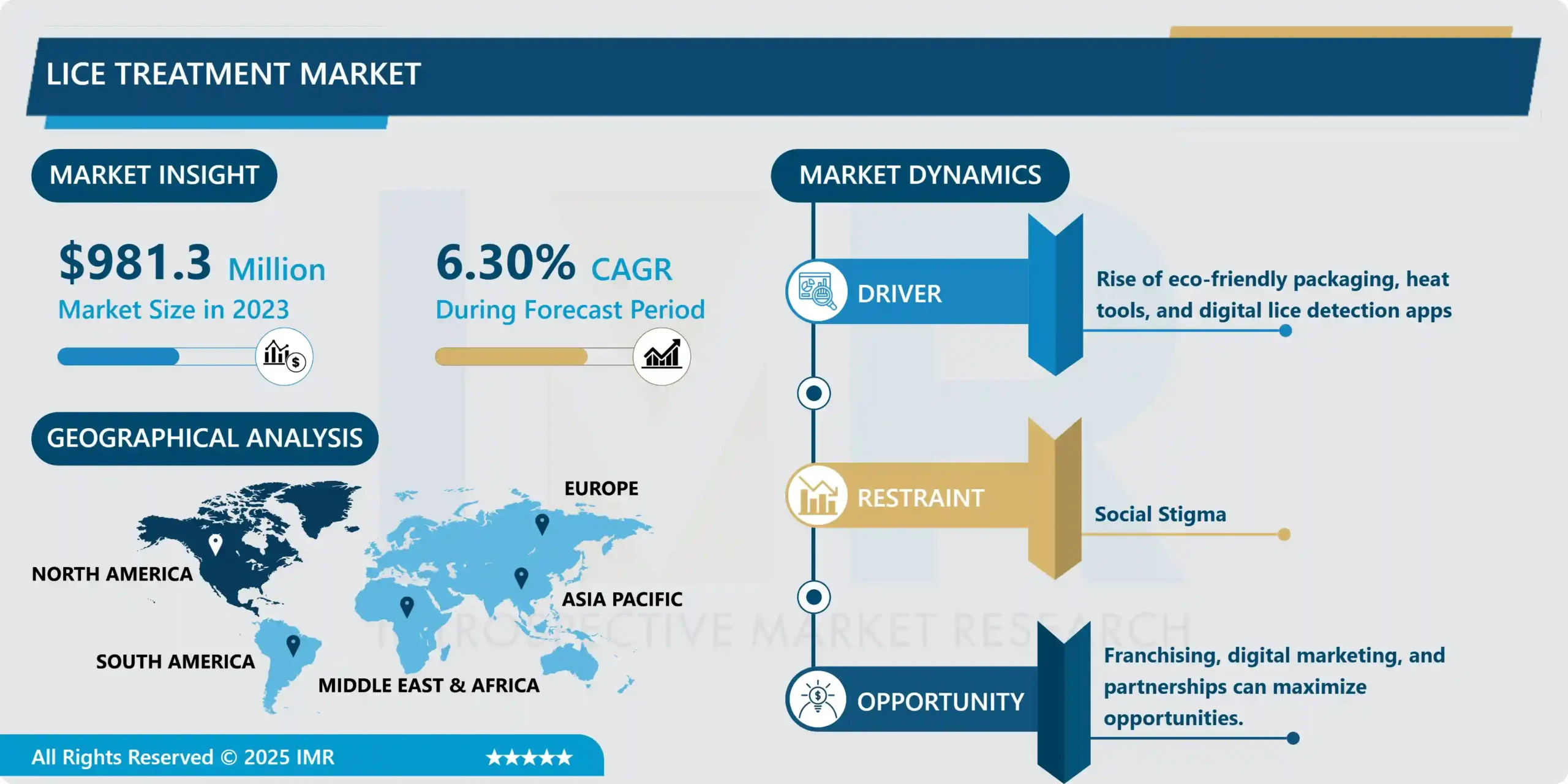
Lice Treatment Market Size Was Valued at USD 981.3 Million in 2023, and is Projected to Reach USD 1700.6 Million by 2032, Growing at a CAGR of 6.3% From 2024-2032.
Head lice, Pediculus human’s var capitis, are wingless insects that have been obligate parasites of humans for thousands of years. Since the oldest archaeological record is 8,000 years BC, some authors have proposed that lice were associated with pre-hominoid ancestors and were dispersed globally when humans migrated. Topical treatments applied to the hair using plant parts and plant derivatives, also known as ‘natural products’, would have been used in these times, but the archaeological record is inadequate. These botanicals likely contained insecticidal phytochemicals, predominantly secondary compounds, produced by plants as anti-herbivory agents. There is thus an urgent need to develop new effective pediculicidal products on the market. One reason that natural products are being increasingly looked at is that there is a general perception that they kill lice using alternative mechanisms to manufactured chemicals. However, the evidence for this belief is very limited, owing to a lack of research on the way natural products kill head lice.
Lice Treatment Market Trend Analysis
Rise of Eco-Friendly Packaging, Heat Tools, And Digital Lice Detection Apps
Increasing need for lice treatment products made from natural and organic ingredients as people become more aware of the negative effects of chemicals. The rising popularity of environmentally friendly packaging. Advanced heat-based tools and digital technology such as mobile applications for detecting lice and monitoring treatment are becoming more popular among consumers who prefer non-chemical options.
The rise in super lice, which are resistant to treatment, has led to the creation of new formulas and combined treatments. Businesses are increasing their investments in research and development to develop better products, resulting in new releases and enhanced treatment choices.
E-commerce platforms are seeing an increase in sales of lice treatment products as more people are turning to online shopping. Subscription plans provide periodic shipments, while educational efforts from schools and public health campaigns enhance knowledge and stimulate interest in efficient treatments.
Franchising, Digital Marketing, And Partnerships Can Maximize Opportunities.
Businesses can take advantage of growth opportunities by entering up-and-coming markets such as Asia-Pacific, Latin America, and Africa with their lice treatment products. Creating products tailored to specific regional preferences and including innovative formulations, like preventative items, can lead to success for companies in this market.
The growing need for professional lice removal services presents chances for collaborations and new product creation. Franchising and mobile units can serve busy families and high-traffic areas. Digital marketing and projects focused on communities aim to reach parents who are familiar with technology and establish trust in the brand.
Subscription and Membership Models can help businesses build customer loyalty and generate consistent revenue. Collaborating with healthcare providers and schools can enhance credibility, reach a broader audience, and boost product sales.
Lice Treatment Market Segment Analysis:
Lice Treatment Market is Segmented based on Type, Drug, Medication Type, Formulation, Mode of Administration, And End-Users.
By Type, Pediculosis Capitis Segment Is Expected to Dominate the Market During the Forecast Period
Head lice infestation, known as Pediculosis Capitis, is common in school environments among children between the ages of 3 and 11 because of proximity. The demand for treatments is driven by repeated outbreaks, with early detection resulting from increased awareness and educational campaigns. Social stigma contributes to timely treatment as well.
There are different treatments for Pediculosis Capitis, such as over-the-counter products, natural remedies, and prescription medications like ivermectin. Parents are vigilant in stopping head lice as they worry about their children’s well-being and the ease with which lice can pass from one person to another.
Innovative products such as heat-based devices and enzyme-based products have caused advancements in the lice treatment market, making Pediculosis Capitis the most popular segment. Mobile applications are currently in the works to assist parents in dealing with lice outbreaks. Anticipated growth in this market segment will persist due to continuous awareness campaigns and innovation in products. Public health organizations are offering no-cost or reduced-cost treatments in areas with restricted healthcare availability.
By Medication Type, the Over-the-counter Segment Held the Largest Share
Over-the-counter lice treatments are commonly used because they are easily accessible, efficient, and trusted by consumers. They can be easily found in pharmacies and online, with no prescription needed, and are reputable brands such as Nix and Rid. Consumers trust their ability to eliminate lice and nits, which is why they choose them for treatment.
Over-the-counter lice treatments provide a range of products like shampoos, lotions, creams, and sprays to meet various consumer needs. Certain items are currently being made with ingredients from nature such as tea tree oil. Households frequently make repeat purchases of cost-effective options over prescription treatments.
FDA-approved over-the-counter lice treatments in convenient packages are reliable and effective. Manufacturers develop new formulations to combat resistance. OTC companies invest in advertising and education. Health organizations recommend OTC products as the first line of defense against head lice, leading to widespread consumer reliance.
Lice Treatment Market Regional Insights:
North America is Expected to Dominate the Market Over the Forecast Period
High awareness and vigilance make North America the leading market for lice treatment. Public outreach efforts and regular screenings in schools increase the need for treatment products. The robust healthcare system allows convenient access to numerous products, with healthcare providers regularly suggesting treatments. Furthermore, the strong consumer purchasing power in the area also plays a role in the market’s leading position.
North American consumers have a substantial income per person, allowing them to purchase high-end products for treating lice. They value convenience and are ready to spend extra money on over-the-counter products that are efficient and user-friendly. Over-the-counter products are leading the market because of how accessible and efficient they are, as more people opt for natural and chemical-free options. The area is a center for research and development, resulting in ongoing improvements in lice treatment products, such as creative technology like mobile apps.
Stringent regulations set by the FDA and Health Canada guarantee the safety and efficacy of lice treatment products. Efficient approval procedures in North America result in vibrant market competition. Educational initiatives increase consumer consciousness. The high prevalence of lice in a large population of school-aged children maintains a steady demand. The market is dominated by prominent brands and local creativity.
Lice Treatment Market Active Players
Perrigo Company plc (Ireland)
Reckitt Benckiser Group plc (United Kingdom)
Bayer AG (Germany)
GlaxoSmithKline plc (United Kingdom)
Sanofi S.A. (France)
Johnson & Johnson (United States)
Pfizer Inc. (United States)
Prestige Consumer Healthcare Inc. (United States)
Teva Pharmaceutical Industries Ltd. (Israel)
Novartis AG (Switzerland)
Sun Pharmaceutical Industries Ltd. (India)
Torrent Pharmaceuticals Ltd. (India)
Endo International plc (Ireland)
Cipla Ltd. (India)
Ranbaxy Laboratories Ltd. (India)
Arbor Pharmaceuticals, LLC (United States)
Mission Pharmacal Company (United States)
Alliance Pharma plc (United Kingdom)
HRA Pharma (France)
Galderma S.A. (Switzerland)
Omega Pharma (Belgium)
Stada Arzneimittel AG (Germany)
Insight Pharmaceuticals LLC (United States)
Taro Pharmaceutical Industries Ltd. (United States)
Perrigo Israel Pharmaceuticals Ltd. (Israel)
Hyland’s (United States)
Meda AB (Sweden)
Eli Lilly and Company (United States)
Zydus Cadila (India)
Mylan N.V. (United States) and Other Active Players.
Chapter 1: Introduction
1.1 Scope and Coverage
Chapter 2:Executive Summary
Chapter 3: Market Landscape
3.1 Market Dynamics
3.1.1 Drivers
3.1.2 Restraints
3.1.3 Opportunities
3.1.4 Challenges
3.2 Market Trend Analysis
3.3 PESTLE Analysis
3.4 Porter’s Five Forces Analysis
3.5 Industry Value Chain Analysis
3.6 Ecosystem
3.7 Regulatory Landscape
3.8 Price Trend Analysis
3.9 Patent Analysis
3.10 Technology Evolution
3.11 Investment Pockets
3.12 Import-Export Analysis
Chapter 4: Lice Treatment Market by Type (2018-2032)
4.1 Lice Treatment Market Snapshot and Growth Engine
4.2 Market Overview
4.3 Pediculosis Capitis
4.3.1 Introduction and Market Overview
4.3.2 Historic and Forecasted Market Size in Value USD and Volume Units
4.3.3 Key Market Trends, Growth Factors, and Opportunities
4.3.4 Geographic Segmentation Analysis
4.4 Pediculosis Corporis
4.5 Pediculosis Pubis
Chapter 5: Lice Treatment Market by Drug (2018-2032)
5.1 Lice Treatment Market Snapshot and Growth Engine
5.2 Market Overview
5.3 Ivermectin
5.3.1 Introduction and Market Overview
5.3.2 Historic and Forecasted Market Size in Value USD and Volume Units
5.3.3 Key Market Trends, Growth Factors, and Opportunities
5.3.4 Geographic Segmentation Analysis
5.4 Spinosad
5.5 Permethrin
5.6 Pyrethrin
Chapter 6: Lice Treatment Market by Medication Type (2018-2032)
6.1 Lice Treatment Market Snapshot and Growth Engine
6.2 Market Overview
6.3 OTC Products
6.3.1 Introduction and Market Overview
6.3.2 Historic and Forecasted Market Size in Value USD and Volume Units
6.3.3 Key Market Trends, Growth Factors, and Opportunities
6.3.4 Geographic Segmentation Analysis
6.4 Prescription Medications
Chapter 7: Lice Treatment Market by Formulation (2018-2032)
7.1 Lice Treatment Market Snapshot and Growth Engine
7.2 Market Overview
7.3 Lotion
7.3.1 Introduction and Market Overview
7.3.2 Historic and Forecasted Market Size in Value USD and Volume Units
7.3.3 Key Market Trends, Growth Factors, and Opportunities
7.3.4 Geographic Segmentation Analysis
7.4 Oil
7.5 Shampoo
Chapter 8: Lice Treatment Market by Mode of Administration (2018-2032)
8.1 Lice Treatment Market Snapshot and Growth Engine
8.2 Market Overview
8.3 Injectable
8.3.1 Introduction and Market Overview
8.3.2 Historic and Forecasted Market Size in Value USD and Volume Units
8.3.3 Key Market Trends, Growth Factors, and Opportunities
8.3.4 Geographic Segmentation Analysis
8.4 Oral
8.5 Others
Chapter 9: Lice Treatment Market by End-Users (2018-2032)
9.1 Lice Treatment Market Snapshot and Growth Engine
9.2 Market Overview
9.3 Hospitals
9.3.1 Introduction and Market Overview
9.3.2 Historic and Forecasted Market Size in Value USD and Volume Units
9.3.3 Key Market Trends, Growth Factors, and Opportunities
9.3.4 Geographic Segmentation Analysis
9.4 Specialty Clinics
9.5 Homecare
Chapter 10: Company Profiles and Competitive Analysis
10.1 Competitive Landscape
10.1.1 Competitive Benchmarking
10.1.2 Lice Treatment Market Share by Manufacturer (2024)
10.1.3 Industry BCG Matrix
10.1.4 Heat Map Analysis
10.1.5 Mergers and Acquisitions
10.2 PERRIGO COMPANY PLC (IRELAND)
10.2.1 Company Overview
10.2.2 Key Executives
10.2.3 Company Snapshot
10.2.4 Role of the Company in the Market
10.2.5 Sustainability and Social Responsibility
10.2.6 Operating Business Segments
10.2.7 Product Portfolio
10.2.8 Business Performance
10.2.9 Key Strategic Moves and Recent Developments
10.2.10 SWOT Analysis
10.3 RECKITT BENCKISER GROUP PLC (UNITED KINGDOM)
10.4 BAYER AG (GERMANY)
10.5 GLAXOSMITHKLINE PLC (UNITED KINGDOM)
10.6 SANOFI S.A. (FRANCE)
10.7 JOHNSON & JOHNSON (UNITED STATES)
10.8 PFIZER INC. (UNITED STATES)
10.9 PRESTIGE CONSUMER HEALTHCARE INC. (UNITED STATES)
10.10 TEVA PHARMACEUTICAL INDUSTRIES LTD. (ISRAEL)
10.11 NOVARTIS AG (SWITZERLAND)
10.12 SUN PHARMACEUTICAL INDUSTRIES LTD. (INDIA)
10.13 TORRENT PHARMACEUTICALS LTD. (INDIA)
10.14 ENDO INTERNATIONAL PLC (IRELAND)
10.15 CIPLA LTD. (INDIA)
10.16 RANBAXY LABORATORIES LTD. (INDIA)
10.17 ARBOR PHARMACEUTICALS
10.18 LLC (UNITED STATES)
10.19 MISSION PHARMACAL COMPANY (UNITED STATES)
10.20 ALLIANCE PHARMA PLC (UNITED KINGDOM)
10.21 HRA PHARMA (FRANCE)
10.22 GALDERMA S.A. (SWITZERLAND)
10.23 OMEGA PHARMA (BELGIUM)
10.24 STADA ARZNEIMITTEL AG (GERMANY)
10.25 INSIGHT PHARMACEUTICALS LLC (UNITED STATES)
10.26 TARO PHARMACEUTICAL INDUSTRIES LTD. (UNITED STATES)
10.27 PERRIGO ISRAEL PHARMACEUTICALS LTD. (ISRAEL)
10.28 HYLAND’S (UNITED STATES)
10.29 MEDA AB (SWEDEN)
10.30 ELI LILLY AND COMPANY (UNITED STATES)
10.31 ZYDUS CADILA (INDIA)
10.32 MYLAN N.V. (UNITED STATES)
Chapter 11: Global Lice Treatment Market By Region
11.1 Overview
11.2. North America Lice Treatment Market
11.2.1 Key Market Trends, Growth Factors and Opportunities
11.2.2 Top Key Companies
11.2.3 Historic and Forecasted Market Size by Segments
11.2.4 Historic and Forecasted Market Size by Type
11.2.4.1 Pediculosis Capitis
11.2.4.2 Pediculosis Corporis
11.2.4.3 Pediculosis Pubis
11.2.5 Historic and Forecasted Market Size by Drug
11.2.5.1 Ivermectin
11.2.5.2 Spinosad
11.2.5.3 Permethrin
11.2.5.4 Pyrethrin
11.2.6 Historic and Forecasted Market Size by Medication Type
11.2.6.1 OTC Products
11.2.6.2 Prescription Medications
11.2.7 Historic and Forecasted Market Size by Formulation
11.2.7.1 Lotion
11.2.7.2 Oil
11.2.7.3 Shampoo
11.2.8 Historic and Forecasted Market Size by Mode of Administration
11.2.8.1 Injectable
11.2.8.2 Oral
11.2.8.3 Others
11.2.9 Historic and Forecasted Market Size by End-Users
11.2.9.1 Hospitals
11.2.9.2 Specialty Clinics
11.2.9.3 Homecare
11.2.10 Historic and Forecast Market Size by Country
11.2.10.1 US
11.2.10.2 Canada
11.2.10.3 Mexico
11.3. Eastern Europe Lice Treatment Market
11.3.1 Key Market Trends, Growth Factors and Opportunities
11.3.2 Top Key Companies
11.3.3 Historic and Forecasted Market Size by Segments
11.3.4 Historic and Forecasted Market Size by Type
11.3.4.1 Pediculosis Capitis
11.3.4.2 Pediculosis Corporis
11.3.4.3 Pediculosis Pubis
11.3.5 Historic and Forecasted Market Size by Drug
11.3.5.1 Ivermectin
11.3.5.2 Spinosad
11.3.5.3 Permethrin
11.3.5.4 Pyrethrin
11.3.6 Historic and Forecasted Market Size by Medication Type
11.3.6.1 OTC Products
11.3.6.2 Prescription Medications
11.3.7 Historic and Forecasted Market Size by Formulation
11.3.7.1 Lotion
11.3.7.2 Oil
11.3.7.3 Shampoo
11.3.8 Historic and Forecasted Market Size by Mode of Administration
11.3.8.1 Injectable
11.3.8.2 Oral
11.3.8.3 Others
11.3.9 Historic and Forecasted Market Size by End-Users
11.3.9.1 Hospitals
11.3.9.2 Specialty Clinics
11.3.9.3 Homecare
11.3.10 Historic and Forecast Market Size by Country
11.3.10.1 Russia
11.3.10.2 Bulgaria
11.3.10.3 The Czech Republic
11.3.10.4 Hungary
11.3.10.5 Poland
11.3.10.6 Romania
11.3.10.7 Rest of Eastern Europe
11.4. Western Europe Lice Treatment Market
11.4.1 Key Market Trends, Growth Factors and Opportunities
11.4.2 Top Key Companies
11.4.3 Historic and Forecasted Market Size by Segments
11.4.4 Historic and Forecasted Market Size by Type
11.4.4.1 Pediculosis Capitis
11.4.4.2 Pediculosis Corporis
11.4.4.3 Pediculosis Pubis
11.4.5 Historic and Forecasted Market Size by Drug
11.4.5.1 Ivermectin
11.4.5.2 Spinosad
11.4.5.3 Permethrin
11.4.5.4 Pyrethrin
11.4.6 Historic and Forecasted Market Size by Medication Type
11.4.6.1 OTC Products
11.4.6.2 Prescription Medications
11.4.7 Historic and Forecasted Market Size by Formulation
11.4.7.1 Lotion
11.4.7.2 Oil
11.4.7.3 Shampoo
11.4.8 Historic and Forecasted Market Size by Mode of Administration
11.4.8.1 Injectable
11.4.8.2 Oral
11.4.8.3 Others
11.4.9 Historic and Forecasted Market Size by End-Users
11.4.9.1 Hospitals
11.4.9.2 Specialty Clinics
11.4.9.3 Homecare
11.4.10 Historic and Forecast Market Size by Country
11.4.10.1 Germany
11.4.10.2 UK
11.4.10.3 France
11.4.10.4 The Netherlands
11.4.10.5 Italy
11.4.10.6 Spain
11.4.10.7 Rest of Western Europe
11.5. Asia Pacific Lice Treatment Market
11.5.1 Key Market Trends, Growth Factors and Opportunities
11.5.2 Top Key Companies
11.5.3 Historic and Forecasted Market Size by Segments
11.5.4 Historic and Forecasted Market Size by Type
11.5.4.1 Pediculosis Capitis
11.5.4.2 Pediculosis Corporis
11.5.4.3 Pediculosis Pubis
11.5.5 Historic and Forecasted Market Size by Drug
11.5.5.1 Ivermectin
11.5.5.2 Spinosad
11.5.5.3 Permethrin
11.5.5.4 Pyrethrin
11.5.6 Historic and Forecasted Market Size by Medication Type
11.5.6.1 OTC Products
11.5.6.2 Prescription Medications
11.5.7 Historic and Forecasted Market Size by Formulation
11.5.7.1 Lotion
11.5.7.2 Oil
11.5.7.3 Shampoo
11.5.8 Historic and Forecasted Market Size by Mode of Administration
11.5.8.1 Injectable
11.5.8.2 Oral
11.5.8.3 Others
11.5.9 Historic and Forecasted Market Size by End-Users
11.5.9.1 Hospitals
11.5.9.2 Specialty Clinics
11.5.9.3 Homecare
11.5.10 Historic and Forecast Market Size by Country
11.5.10.1 China
11.5.10.2 India
11.5.10.3 Japan
11.5.10.4 South Korea
11.5.10.5 Malaysia
11.5.10.6 Thailand
11.5.10.7 Vietnam
11.5.10.8 The Philippines
11.5.10.9 Australia
11.5.10.10 New Zealand
11.5.10.11 Rest of APAC
11.6. Middle East & Africa Lice Treatment Market
11.6.1 Key Market Trends, Growth Factors and Opportunities
11.6.2 Top Key Companies
11.6.3 Historic and Forecasted Market Size by Segments
11.6.4 Historic and Forecasted Market Size by Type
11.6.4.1 Pediculosis Capitis
11.6.4.2 Pediculosis Corporis
11.6.4.3 Pediculosis Pubis
11.6.5 Historic and Forecasted Market Size by Drug
11.6.5.1 Ivermectin
11.6.5.2 Spinosad
11.6.5.3 Permethrin
11.6.5.4 Pyrethrin
11.6.6 Historic and Forecasted Market Size by Medication Type
11.6.6.1 OTC Products
11.6.6.2 Prescription Medications
11.6.7 Historic and Forecasted Market Size by Formulation
11.6.7.1 Lotion
11.6.7.2 Oil
11.6.7.3 Shampoo
11.6.8 Historic and Forecasted Market Size by Mode of Administration
11.6.8.1 Injectable
11.6.8.2 Oral
11.6.8.3 Others
11.6.9 Historic and Forecasted Market Size by End-Users
11.6.9.1 Hospitals
11.6.9.2 Specialty Clinics
11.6.9.3 Homecare
11.6.10 Historic and Forecast Market Size by Country
11.6.10.1 Turkiye
11.6.10.2 Bahrain
11.6.10.3 Kuwait
11.6.10.4 Saudi Arabia
11.6.10.5 Qatar
11.6.10.6 UAE
11.6.10.7 Israel
11.6.10.8 South Africa
11.7. South America Lice Treatment Market
11.7.1 Key Market Trends, Growth Factors and Opportunities
11.7.2 Top Key Companies
11.7.3 Historic and Forecasted Market Size by Segments
11.7.4 Historic and Forecasted Market Size by Type
11.7.4.1 Pediculosis Capitis
11.7.4.2 Pediculosis Corporis
11.7.4.3 Pediculosis Pubis
11.7.5 Historic and Forecasted Market Size by Drug
11.7.5.1 Ivermectin
11.7.5.2 Spinosad
11.7.5.3 Permethrin
11.7.5.4 Pyrethrin
11.7.6 Historic and Forecasted Market Size by Medication Type
11.7.6.1 OTC Products
11.7.6.2 Prescription Medications
11.7.7 Historic and Forecasted Market Size by Formulation
11.7.7.1 Lotion
11.7.7.2 Oil
11.7.7.3 Shampoo
11.7.8 Historic and Forecasted Market Size by Mode of Administration
11.7.8.1 Injectable
11.7.8.2 Oral
11.7.8.3 Others
11.7.9 Historic and Forecasted Market Size by End-Users
11.7.9.1 Hospitals
11.7.9.2 Specialty Clinics
11.7.9.3 Homecare
11.7.10 Historic and Forecast Market Size by Country
11.7.10.1 Brazil
11.7.10.2 Argentina
11.7.10.3 Rest of SA
Chapter 12 Analyst Viewpoint and Conclusion
12.1 Recommendations and Concluding Analysis
12.2 Potential Market Strategies
Chapter 13 Research Methodology
13.1 Research Process
13.2 Primary Research
13.3 Secondary Research
Q1: What would be the forecast period in the Lice Treatment Market research report?
A1: The forecast period in the Lice Treatment Market research report is 2024-2032.
Q2: Who are the key players in the Lice Treatment Market?
A2: Perrigo Company plc (Ireland), Reckitt Benckiser Group plc (United Kingdom), Bayer AG (Germany), GlaxoSmithKline plc (United Kingdom), Sanofi S.A. (France), Johnson & Johnson (United States), Pfizer Inc. (United States), Prestige Consumer Healthcare Inc. (United States), Teva Pharmaceutical Industries Ltd. (Israel), Novartis AG (Switzerland), Sun Pharmaceutical Industries Ltd. (India), Torrent Pharmaceuticals Ltd. (India), Endo International plc (Ireland), Cipla Ltd. (India), Ranbaxy Laboratories Ltd. (India), Arbor Pharmaceuticals, LLC (United States), Mission Pharmacal Company (United States), Alliance Pharma plc (United Kingdom), HRA Pharma (France), Galderma S.A. (Switzerland), Omega Pharma (Belgium), Stada Arzneimittel AG (Germany), Insight Pharmaceuticals LLC (United States), Taro Pharmaceutical Industries Ltd. (United States), Perrigo Israel Pharmaceuticals Ltd. (Israel), Hyland's (United States), Meda AB (Sweden), Eli Lilly and Company (United States), Zydus Cadila (India), Mylan N.V. (United States) and Other Active Players.
Q3: What are the segments of the Lice Treatment Market?
A3: The Lice Treatment Market is segmented into Type, Drug, Medication Type, Formulation, Mode of Administration, End-Users, and region. By Type, the market is categorized into Pediculosis Capitis, Pediculosis Corporis, and Pediculosis Pubis. By Drug, the market is categorized into Ivermectin, Spinosad, Permethrin, and Pyrethrin. By Medication Type, the market is categorized into OTC Products and prescription Medications. By Formulation, the market is categorized into Lotion, Oil, and Shampoo. By Mode of Administration, The Market Is Categorized into Injectable, Oral, and Others. By End-Users, the market is categorized into Hospitals, Specialty Clinics, Homecare. By region, it is analyzed across North America (U.S.; Canada; Mexico), Eastern Europe (Bulgaria; The Czech Republic; Hungary; Poland; Romania; Rest of Eastern Europe), Western Europe (Germany; UK; France; Netherlands; Italy; Russia; Spain; Rest of Western Europe), Asia-Pacific (China; India; Japan; Southeast Asia, etc.), South America (Brazil; Argentina, etc.), Middle East & Africa (Saudi Arabia; South Africa, etc.).
Q4: What is the Lice Treatment Market?
A4: Head lice, Pediculus human’s var capitis, are wingless insects that have been obligate parasites of humans for thousands of years. Since the oldest archaeological record is 8,000 years BC, some authors have proposed that lice were associated with pre-hominoid ancestors and were dispersed globally when humans migrated.
Q5: How big is the Lice Treatment Market?
A5: Lice Treatment Market Size Was Valued at USD 981.3 Million in 2023, and is Projected to Reach USD 1700.6 Million by 2032, Growing at a CAGR of 6.3% From 2024-2032.
How to Buy a Report from eminsights.jp
On the product page, choose the license you want: Single-User License, Multi-User License or Enterprise License.
If you required report in your native language, then you can click on Translated Report button and fill out the form with report name and language you want, then our team will contact you as soon as possible.
Click the Buy Now button.
You will be redirected to the checkout page. Enter your company details and payment information.
Click Place Order to complete the purchase.
Confirmation: You’ll receive an order confirmation and our team will contact you shortly with your ordered report.
If you have any questions, fill out the contact form below or email us at bizdev@eminsights.net.
Thank you for choosing eminsights.jp!