Stay Ahead in Fast-Growing Economies.
Browse Reports Now
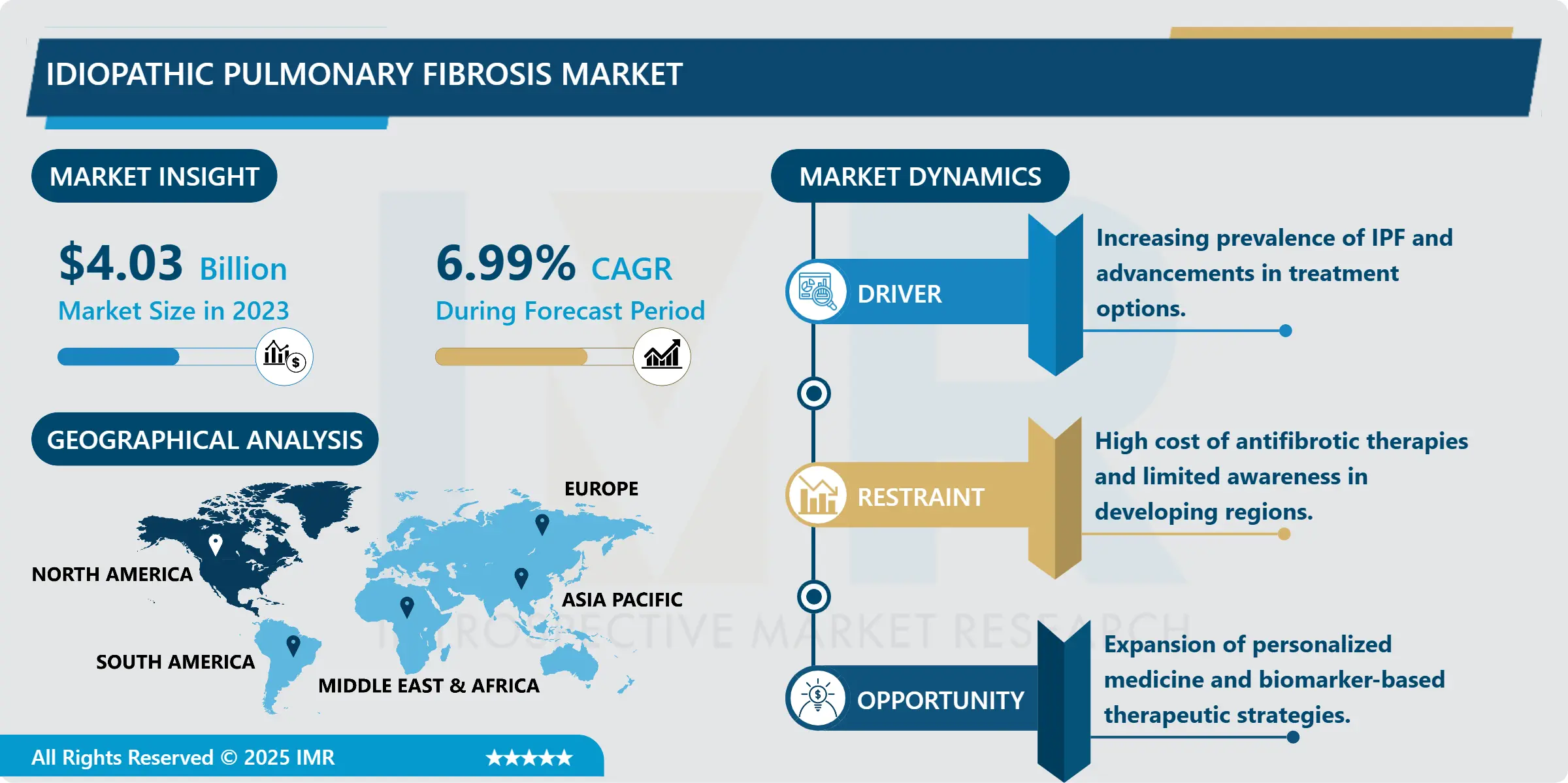
Idiopathic Pulmonary Fibrosis Market Growth Analysis & Forecast (2024-2032)
Idiopathic Pulmonary Fibrosis Market Size Was Valued at USD 4.03 Billion in 2023, and is Projected to Reach USD 7.40 Billion by 2032, Growing at a CAGR of 6.99 % From 2024-2032.

IMR Group
Description
Idiopathic Pulmonary Fibrosis Market Synopsis:
Idiopathic Pulmonary Fibrosis Market Size Was Valued at USD 4.03 Billion in 2023, and is Projected to Reach USD 7.40 Billion by 2032, Growing at a CAGR of 6.99 % From 2024-2032.
Such a market as idiopathic pulmonary fibrosis (IPF) means the sector which concerns the development, production, sales, and marketing of drugs and therapeutic products that can provide an adequate treatment for idiopathic pulmonary fibrosis – an internationally severe and constantly worsening illness that concerns a group of diseases that lead to scarring of lung tissue. This market includes antifibrotic agents, supportive care agents, and promising therapies for improving patients’ quality of life and their survival.
The market for IPF has gradually been on the rise over time and more so in recent years because of the growing prevalence of respiratory diseases as well as an improved knowledge of the disease within the healthcare professional community and the patient community at large. The introduction of antifibrotic therapies including but not limited to pirfenidone and nintedanib has revolutionised the management of IPF optimising strategies aimed at slowing the worsening of the condition. Nonetheless the market remains areas for growth with the constant search for synergistic therapy and other targeted and personalized treatment for enhancing therapeutic response.
Also, the approval as well as the number of treatments have made it easy to pass the best therapy since the increment will be regarded as the best too. However, the high cost of treatment – which makes the possibility of the treatment unrealistic in some parts of the world, and the relatively little-known fact concerning the disease may be its primary disadvantage. These barriers are being countered by industry players by encouraging research to develop cheap and efficient treatments while on the same note patient advocacy organisations for the condition have been striving in reminding world market awareness for the condition.
Idiopathic Pulmonary Fibrosis Market Trend Analysis
Growing Interest in Combination Therapies
Another factor on the IPF market is that there is a distinct shift towards comprehesive therapies over time. They are also looking at the combined strategy with antifibrotic agents with other new targets for example, immunity modulators or anti-inflammatory drugs. These combinations attempt to hit over one pathway that may lead to progression of the disease, hopefully helping the patent who has shown little response to single agents. Meta-chronic research methodologies have been used to analyze clinical trials of these combinations and the results point to a growing potential for altering the treatment management of IPF.
Rising Investments in Personalized Medicine
The epidemiological window in the case of IPF is favourable for personalized medicine, as Mr. Kanazawa expounded genetic and biomarker analysis form perhaps the core of ‘personalised medicine. These strategies do not only enhance the effectiveness of the employed treatment but also add lesser side effects to the general concern of which a gap was observed on how such high accurate specific type of therapies is achieved. To support this process, governments and private organisations are increasing stakes on research, to offer paths of innovation for solutions which are inevitable to change look at treatment.
Idiopathic Pulmonary Fibrosis Market Segment Analysis:
The Idiopathic Pulmonary Fibrosis Market is Segmented on the Basis of Drug, Route of Administration, Distribution Channel, and Region.
By Drug, the Pirfenidone segment is expected to dominate the market during the forecast period
The pirfenidone segment is considered to have a high IPF market share during the functional years because it has a potential treatment mechanism for halting the progression of the illness. Now the only available antifibrotic drug is pirfenidone which influences many aspects of fibrosis and has been shown to slow the deterioration of lung function and therefore, the quality of life of the patient. That is why the inclusion in the guidelines for the treatment of IPF across the world, makes it to be the nothing else but the foundational therapy. This is also rising in the number of regions that offer Generic formulations of various hence the push factor for segment.
By Route of Administration, Oral segment expected to held the largest share
The largest share is expected to be in the oral segment, because of its accessibility and better patient compliance. The approved molecular entities are found in oral dosing forms, which makes the administration of the treatment more manageable and reduces the number of hospital visits made by the patient. This neatly fits in with the new direction in the discharge of outpatient care and home treatment. Oral administrations, being conveniently and effectively marketed in the sustained-release formulations have helped increase patients’ outcomes, confirmed the leadership of the segment in the market.
Idiopathic Pulmonary Fibrosis Market Regional Insights:
North America is Expected to Dominate the Market Over the Forecast period
North America is expected to remain in the leading market position within the IPF market due to the sustained progressive development of health care systems, the increase in disease awareness, and the position of all the major market players. There is a good reimbursement program which improves on implementing central therapies for instance expensively expensive antifibrotic agents in the region. High percentages of investments in the R & D sectors and clinical splits Although these, the percentage of investments on the R & D sectors and clinical trials.
The US in particular leads development in the region: due to high IPF and active participation of patient’s organization to increase and improve the early registration. Canada also contributes to the regional supply because of growing measures aimed at improving the supply of IPF treatments. Due in part to the fact that numerous firms located in North America entrust research centers to help them create new medicines and enter this giant market.
Active Key Players in the Idiopathic Pulmonary Fibrosis Market
Boehringer Ingelheim (Germany)
Bristol-Myers Squibb (United States)
Cipla Inc. (India)
Cumberland Pharmaceuticals Inc. (United States)
F. Hoffmann-La Roche Ltd. (Switzerland)
FibroGen, Inc. (United States)
Galapagos NV (Belgium)
Gilead Sciences, Inc. (United States)
GlaxoSmithKline plc (United Kingdom)
Horizon Therapeutics plc (Ireland)
Kadmon Holdings, Inc. (United States)
Merck & Co., Inc. (United States)
Novartis AG (Switzerland)
Sanofi (France)
Veracyte, Inc. (United States)
Other Active Players.
Chapter 1: Introduction
1.1 Scope and Coverage
Chapter 2:Executive Summary
Chapter 3: Market Landscape
3.1 Market Dynamics
3.1.1 Drivers
3.1.2 Restraints
3.1.3 Opportunities
3.1.4 Challenges
3.2 Market Trend Analysis
3.3 PESTLE Analysis
3.4 Porter’s Five Forces Analysis
3.5 Industry Value Chain Analysis
3.6 Ecosystem
3.7 Regulatory Landscape
3.8 Price Trend Analysis
3.9 Patent Analysis
3.10 Technology Evolution
3.11 Investment Pockets
3.12 Import-Export Analysis
Chapter 4: Idiopathic Pulmonary Fibrosis Market by Drug
4.1 Idiopathic Pulmonary Fibrosis Market Snapshot and Growth Engine
4.2 Idiopathic Pulmonary Fibrosis Market Overview
4.3 Pirfenidone Nintedanib Others
4.3.1 Introduction and Market Overview
4.3.2 Historic and Forecasted Market Size in Value USD and Volume Units (2017-2032F)
4.3.3 Key Market Trends, Growth Factors and Opportunities
4.3.4 Pirfenidone Nintedanib Others: Geographic Segmentation Analysis
Chapter 5: Idiopathic Pulmonary Fibrosis Market by Route of Administration
5.1 Idiopathic Pulmonary Fibrosis Market Snapshot and Growth Engine
5.2 Idiopathic Pulmonary Fibrosis Market Overview
5.3 Oral Parenteral
5.3.1 Introduction and Market Overview
5.3.2 Historic and Forecasted Market Size in Value USD and Volume Units (2017-2032F)
5.3.3 Key Market Trends, Growth Factors and Opportunities
5.3.4 Oral Parenteral: Geographic Segmentation Analysis
Chapter 6: Idiopathic Pulmonary Fibrosis Market by Distribution Channel
6.1 Idiopathic Pulmonary Fibrosis Market Snapshot and Growth Engine
6.2 Idiopathic Pulmonary Fibrosis Market Overview
6.3 Hospital Pharmacies Retail Pharmacies Online Pharmacies
6.3.1 Introduction and Market Overview
6.3.2 Historic and Forecasted Market Size in Value USD and Volume Units (2017-2032F)
6.3.3 Key Market Trends, Growth Factors and Opportunities
6.3.4 Hospital Pharmacies Retail Pharmacies Online Pharmacies: Geographic Segmentation Analysis
Chapter 7: Company Profiles and Competitive Analysis
7.1 Competitive Landscape
7.1.1 Competitive Benchmarking
7.1.2 Idiopathic Pulmonary Fibrosis Market Share by Manufacturer (2023)
7.1.3 Industry BCG Matrix
7.1.4 Heat Map Analysis
7.1.5 Mergers and Acquisitions
7.2 BOEHRINGER INGELHEIM (GERMANY)
7.2.1 Company Overview
7.2.2 Key Executives
7.2.3 Company Snapshot
7.2.4 Role of the Company in the Market
7.2.5 Sustainability and Social Responsibility
7.2.6 Operating Business Segments
7.2.7 Product Portfolio
7.2.8 Business Performance
7.2.9 Key Strategic Moves and Recent Developments
7.2.10 SWOT Analysis
7.3 BRISTOL-MYERS SQUIBB (UNITED STATES)
7.4 CIPLA INC. (INDIA)
7.5 CUMBERLAND PHARMACEUTICALS INC. (UNITED STATES)
7.6 F. HOFFMANN-LA ROCHE LTD. (SWITZERLAND)
7.7 FIBROGEN INC. (UNITED STATES)
7.8 GALAPAGOS NV (BELGIUM)
7.9 GILEAD SCIENCES INC. (UNITED STATES)
7.10 GLAXOSMITHKLINE PLC (UNITED KINGDOM)
7.11 HORIZON THERAPEUTICS PLC (IRELAND)
7.12 KADMON HOLDINGS INC. (UNITED STATES)
7.13 MERCK & CO. INC. (UNITED STATES)
7.14 NOVARTIS AG (SWITZERLAND)
7.15 SANOFI (FRANCE)
7.16 VERACYTE INC. (UNITED STATES)
7.17 OTHER ACTIVE PLAYERS
Chapter 8: Global Idiopathic Pulmonary Fibrosis Market By Region
8.1 Overview
8.2. North America Idiopathic Pulmonary Fibrosis Market
8.2.1 Key Market Trends, Growth Factors and Opportunities
8.2.2 Top Key Companies
8.2.3 Historic and Forecasted Market Size by Segments
8.2.4 Historic and Forecasted Market Size By Drug
8.2.4.1 Pirfenidone Nintedanib Others
8.2.5 Historic and Forecasted Market Size By Route of Administration
8.2.5.1 Oral Parenteral
8.2.6 Historic and Forecasted Market Size By Distribution Channel
8.2.6.1 Hospital Pharmacies Retail Pharmacies Online Pharmacies
8.2.7 Historic and Forecast Market Size by Country
8.2.7.1 US
8.2.7.2 Canada
8.2.7.3 Mexico
8.3. Eastern Europe Idiopathic Pulmonary Fibrosis Market
8.3.1 Key Market Trends, Growth Factors and Opportunities
8.3.2 Top Key Companies
8.3.3 Historic and Forecasted Market Size by Segments
8.3.4 Historic and Forecasted Market Size By Drug
8.3.4.1 Pirfenidone Nintedanib Others
8.3.5 Historic and Forecasted Market Size By Route of Administration
8.3.5.1 Oral Parenteral
8.3.6 Historic and Forecasted Market Size By Distribution Channel
8.3.6.1 Hospital Pharmacies Retail Pharmacies Online Pharmacies
8.3.7 Historic and Forecast Market Size by Country
8.3.7.1 Russia
8.3.7.2 Bulgaria
8.3.7.3 The Czech Republic
8.3.7.4 Hungary
8.3.7.5 Poland
8.3.7.6 Romania
8.3.7.7 Rest of Eastern Europe
8.4. Western Europe Idiopathic Pulmonary Fibrosis Market
8.4.1 Key Market Trends, Growth Factors and Opportunities
8.4.2 Top Key Companies
8.4.3 Historic and Forecasted Market Size by Segments
8.4.4 Historic and Forecasted Market Size By Drug
8.4.4.1 Pirfenidone Nintedanib Others
8.4.5 Historic and Forecasted Market Size By Route of Administration
8.4.5.1 Oral Parenteral
8.4.6 Historic and Forecasted Market Size By Distribution Channel
8.4.6.1 Hospital Pharmacies Retail Pharmacies Online Pharmacies
8.4.7 Historic and Forecast Market Size by Country
8.4.7.1 Germany
8.4.7.2 UK
8.4.7.3 France
8.4.7.4 The Netherlands
8.4.7.5 Italy
8.4.7.6 Spain
8.4.7.7 Rest of Western Europe
8.5. Asia Pacific Idiopathic Pulmonary Fibrosis Market
8.5.1 Key Market Trends, Growth Factors and Opportunities
8.5.2 Top Key Companies
8.5.3 Historic and Forecasted Market Size by Segments
8.5.4 Historic and Forecasted Market Size By Drug
8.5.4.1 Pirfenidone Nintedanib Others
8.5.5 Historic and Forecasted Market Size By Route of Administration
8.5.5.1 Oral Parenteral
8.5.6 Historic and Forecasted Market Size By Distribution Channel
8.5.6.1 Hospital Pharmacies Retail Pharmacies Online Pharmacies
8.5.7 Historic and Forecast Market Size by Country
8.5.7.1 China
8.5.7.2 India
8.5.7.3 Japan
8.5.7.4 South Korea
8.5.7.5 Malaysia
8.5.7.6 Thailand
8.5.7.7 Vietnam
8.5.7.8 The Philippines
8.5.7.9 Australia
8.5.7.10 New Zealand
8.5.7.11 Rest of APAC
8.6. Middle East & Africa Idiopathic Pulmonary Fibrosis Market
8.6.1 Key Market Trends, Growth Factors and Opportunities
8.6.2 Top Key Companies
8.6.3 Historic and Forecasted Market Size by Segments
8.6.4 Historic and Forecasted Market Size By Drug
8.6.4.1 Pirfenidone Nintedanib Others
8.6.5 Historic and Forecasted Market Size By Route of Administration
8.6.5.1 Oral Parenteral
8.6.6 Historic and Forecasted Market Size By Distribution Channel
8.6.6.1 Hospital Pharmacies Retail Pharmacies Online Pharmacies
8.6.7 Historic and Forecast Market Size by Country
8.6.7.1 Turkiye
8.6.7.2 Bahrain
8.6.7.3 Kuwait
8.6.7.4 Saudi Arabia
8.6.7.5 Qatar
8.6.7.6 UAE
8.6.7.7 Israel
8.6.7.8 South Africa
8.7. South America Idiopathic Pulmonary Fibrosis Market
8.7.1 Key Market Trends, Growth Factors and Opportunities
8.7.2 Top Key Companies
8.7.3 Historic and Forecasted Market Size by Segments
8.7.4 Historic and Forecasted Market Size By Drug
8.7.4.1 Pirfenidone Nintedanib Others
8.7.5 Historic and Forecasted Market Size By Route of Administration
8.7.5.1 Oral Parenteral
8.7.6 Historic and Forecasted Market Size By Distribution Channel
8.7.6.1 Hospital Pharmacies Retail Pharmacies Online Pharmacies
8.7.7 Historic and Forecast Market Size by Country
8.7.7.1 Brazil
8.7.7.2 Argentina
8.7.7.3 Rest of SA
Chapter 9 Analyst Viewpoint and Conclusion
9.1 Recommendations and Concluding Analysis
9.2 Potential Market Strategies
Chapter 10 Research Methodology
10.1 Research Process
10.2 Primary Research
10.3 Secondary Research
Q1: What would be the forecast period in the Idiopathic Pulmonary Fibrosis Market research report?
A1: The forecast period in the Idiopathic Pulmonary Fibrosis Market research report is 2024-2032.
Q2: Who are the key players in the Idiopathic Pulmonary Fibrosis Market?
A2: Boehringer Ingelheim (Germany), Bristol-Myers Squibb (United States), Cipla Inc. (India), Cumberland Pharmaceuticals Inc. (United States), F. Hoffmann-La Roche Ltd. (Switzerland), FibroGen, Inc. (United States), Galapagos NV (Belgium), Gilead Sciences, Inc. (United States), GlaxoSmithKline plc (United Kingdom), Horizon Therapeutics plc (Ireland), Kadmon Holdings, Inc. (United States), Merck & Co., Inc. (United States), Novartis AG (Switzerland), Sanofi (France), Veracyte, Inc. (United States), Other Active Players.
Q3: What are the segments of the Idiopathic Pulmonary Fibrosis Market?
A3: The Idiopathic Pulmonary Fibrosis Market is segmented into Drug, Route of Administration, Distribution Channel, and region. By Drug, the market is categorized into Pirfenidone Nintedanib Others. By Route of Administration, the market is categorized into Oral Parenteral. By Distribution Channel, the market is categorized into Hospital Pharmacies Retail Pharmacies Online Pharmacies. By region, it is analyzed across North America (U.S., Canada, Mexico), Eastern Europe (Russia, Bulgaria, The Czech Republic, Hungary, Poland, Romania, Rest of Eastern Europe), Western Europe (Germany, UK, France, The Netherlands, Italy, Russia, Spain, Rest of Western Europe), Asia Pacific (China, India, Japan, South Korea, Malaysia, Thailand, Vietnam, The Philippines, Australia, New-Zealand, Rest of APAC), Middle East & Africa (Turkiye, Bahrain, Kuwait, Saudi Arabia, Qatar, UAE, Israel, South Africa), South America (Brazil, Argentina, Rest of SA).
Q4: What is the Idiopathic Pulmonary Fibrosis Market?
A4: Such a market as idiopathic pulmonary fibrosis (IPF) means the sector which concerns the development, production, sales, and marketing of drugs and therapeutic products that can provide an adequate treatment for idiopathic pulmonary fibrosis – an internationally severe and constantly worsening illness that concerns a group of diseases that lead to scarring of lung tissue. This market includes antifibrotic agents, supportive care agents, and promising therapies for improving patients’ quality of life and their survival.
Q5: How big is the Idiopathic Pulmonary Fibrosis Market?
A5: Idiopathic Pulmonary Fibrosis Market Size Was Valued at USD 4.03 Billion in 2023, and is Projected to Reach USD 7.40 Billion by 2032, Growing at a CAGR of 6.99 % From 2024-2032.
How to Buy a Report from eminsights.jp
On the product page, choose the license you want: Single-User License, Multi-User License or Enterprise License.
If you required report in your native language, then you can click on Translated Report button and fill out the form with report name and language you want, then our team will contact you as soon as possible.
Click the Buy Now button.
You will be redirected to the checkout page. Enter your company details and payment information.
Click Place Order to complete the purchase.
Confirmation: You’ll receive an order confirmation and our team will contact you shortly with your ordered report.
If you have any questions, fill out the contact form below or email us at bizdev@eminsights.net.
Thank you for choosing eminsights.jp!