Stay Ahead in Fast-Growing Economies.
Browse Reports Now




Hydroponic Vegetables Market – In-Depth Analysis by Size
Hydroponic vegetables refer to crops grown without soil, receiving essential minerals and nutrients directly through a nutrient-rich water solution delivered to the plant roots. This farming technique operates within controlled environments like greenhouses or indoor facilities, enabling precise control of temperature, humidity, and lighting. The growing demand from the educational sector is also driving the growth of the market. Hydroponic vegetables have wide-ranging applications across agricultural, commercial, and residential sectors.

IMR Group
Description
Hydroponic Vegetables Market Synopsis
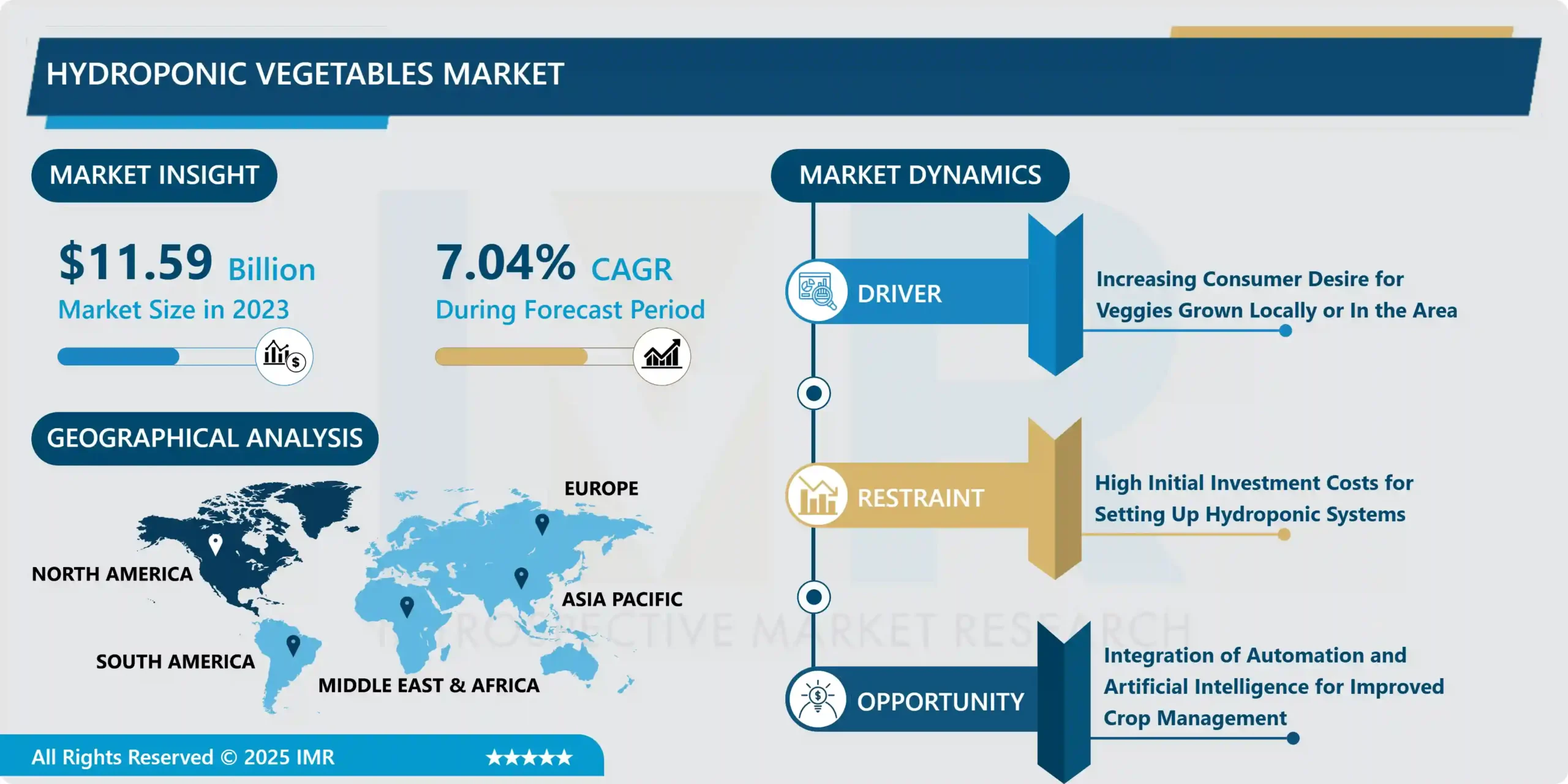
Hydroponic Vegetables Market Size Was Valued at USD 11.59 Billion in 2023, and is Projected to Reach USD 21.38 Billion by 2032, Growing at a CAGR of 7.04% From 2024-2032.
Hydroponic vegetables refer to crops grown without soil, receiving essential minerals and nutrients directly through a nutrient-rich water solution delivered to the plant roots. This farming technique operates within controlled environments like greenhouses or indoor facilities, enabling precise control of temperature, humidity, and lighting.
The growing demand from the educational sector is also driving the growth of the market. Hydroponic vegetables have wide-ranging applications across agricultural, commercial, and residential sectors. In agriculture, hydroponic systems provide a sustainable alternative for growing vegetables in regions with limited arable land or unsuitable soil conditions. Commercially, hydroponic farming facilitates the year-round production of high-quality vegetables, meeting the demands of consumers and eateries for fresh, locally sourced produce. Additionally, hydroponic setups are gaining popularity in residential settings, empowering individuals to cultivate their vegetables indoors or on rooftops, fostering self-sufficiency, and reducing dependence on store-bought produce.
The necessity for soil, reducing the risk of soil-borne diseases and pests, while also conserving water compared to conventional farming methods. Secondly, hydroponic systems offer precise control over environmental factors like temperature, humidity, and lighting, thereby optimizing plant growth and yield. Moreover, hydroponic farming often leads to accelerated growth rates and increased crop yields, allowing farmers to harvest vegetables more frequently throughout the year, thereby enhancing overall productivity.
The demand for hydroponic vegetables is expected to surge due to population growth, urbanization, and environmental concerns necessitating sustainable agricultural practices. With a growing emphasis on food security, water conservation, and locally grown produce, hydroponic farming emerges as a promising solution to address these challenges. Additionally, advancements in technology and heightened consumer awareness regarding the health and environmental benefits of hydroponic vegetables are poised to drive further market growth. Consequently, the hydroponic vegetable industry is primed for significant expansion in the coming years, meeting the evolving demands of global food systems.’
Hydroponic Vegetables Market Trend Analysis:
Increasing Consumer Desire for Veggies Grown Locally or In the Area
The increasing consumer preference for locally sourced or nearby-grown vegetables plays a pivotal role in driving the rapid expansion of the hydroponic vegetables market. As individuals become more environmentally conscious regarding food production and transportation impacts, they increasingly favor produce grown in controlled environments close to urban centers. Hydroponic farming facilitates this by allowing vegetables to be cultivated in such controlled settings, reducing the need for long-distance transportation and minimizing associated carbon emissions from food supply chains.
The demand for hydroponic vegetables stems from the desire for fresh, top-quality produce year-round. Unlike traditional farming methods, which are often limited by seasonal variations and adverse weather conditions, hydroponic systems ensure consistent and reliable yields regardless of external factors. This reliability ensures a continuous supply of fresh vegetables to meet consumer demands, thereby bolstering food security and accessibility.
The growth of urban agriculture and rooftop farming initiatives further propels the hydroponic vegetables market. Given the limited space for traditional farming in urban settings, hydroponic systems offer a practical solution for cultivating vegetables in vertical farms, greenhouses, and indoor spaces. This urban-focused farming approach not only promotes local food production but also encourages community involvement and sustainability efforts, contributing to the overall expansion and advancement of the hydroponic vegetables market.
Integration of Automation and Artificial Intelligence for Improved Crop Management
The integration of automation and artificial intelligence (AI) presents a significant growth opportunity for the hydroponic vegetables market. Automation technologies such as sensor systems, robotics, and automated nutrient delivery systems offer precise solutions for crop management. These technologies monitor environmental conditions, nutrient levels, and plant health in real-time, enabling immediate adjustments to enhance crop productivity and quality.
AI algorithms facilitate predictive analytics and decision-making in hydroponic farming. AI-powered systems analyze extensive data from various sources to optimize resource allocation, predict crop yields, and identify patterns. By leveraging these insights, hydroponic farmers can make informed decisions to maximize yields, minimize resource usage, and mitigate risks such as pests or diseases, ultimately enhancing crop management effectiveness and profitability.
The adoption of automation and AI streamlines operations reduces labor costs and enhances overall efficiency in hydroponic farming. With automation handling repetitive tasks and AI providing data-driven insights, farmers can focus on strategic planning and innovation. This increased operational efficiency drives productivity and scalability, empowering hydroponic vegetable producers to meet the growing demand for locally sourced, high-quality produce sustainably and cost-effectively.
Hydroponic Vegetables Market Segment Analysis:
Hydroponic Vegetables Market Segmented on the basis of Vegetable Type, Farming Type, Origin, and Distribution Channel
By Farming Type, Indoor segment is expected to dominate the market during the forecast period
The Indoor sector is positioned to lead the expansion of the Hydroponic Vegetables Market. This division specializes in cultivating vegetables within controlled indoor settings like greenhouses, vertical farms, and indoor hydroponic setups. Indoor farming boasts several advantages, such as year-round production, protection against adverse weather conditions, and precise management of environmental factors like temperature, humidity, and lighting. These controlled environments foster optimal plant growth and higher yields compared to conventional outdoor farming methods.
The Indoor sector addresses the rising demand for locally sourced, fresh produce in urban regions. With urbanization on the rise and limited available farmland, indoor farming emerges as a sustainable solution to meet the increasing demand for vegetables. Additionally, advancements in indoor farming technologies, including vertical stacking systems and LED grow lights, enhance productivity and efficiency, contributing to the dominance of the Indoor sector in the Hydroponic Vegetables Market. As consumers prioritize sustainability and seek healthier food alternatives, the Indoor segment is anticipated to sustain its growth momentum, providing a dependable and eco-friendly source of fresh vegetables throughout the year.
By Distribution Channel, Hypermarket/Supermarket segment held the largest share of 45.10% in 2022
Hypermarkets and supermarkets are driving growth in the Hydroponic Vegetables Market, offering a broad selection of hydroponically cultivated produce to meet the rising demand for fresh, locally sourced options. Leveraging their expansive distribution networks and large customer bases, these retail giants play a pivotal role in promoting hydroponic vegetables and increasing consumer awareness of their advantages.
Hypermarkets and supermarkets streamline the shopping experience by providing convenient, one-stop destinations where customers can access a diverse array of hydroponically grown vegetables alongside other grocery staples. This accessibility not only encourages consumer adoption but also contributes to market expansion. Furthermore, collaborations between hypermarkets, supermarkets, and hydroponic farms ensure a consistent supply of high-quality produce, reinforcing their influence as significant contributors to the Hydroponic Vegetables Market’s growth.
Hydroponic Vegetables Market Regional Insights:
Europe is Expected to Dominate the Market Over the Forecast Period
Europe is expected to take the lead in the expansion of the Hydroponic Vegetables market. The region’s forward-thinking agricultural methods, alongside the rising adoption of sustainable farming practices, drive the need for hydroponically grown vegetables. European countries are investing in contemporary farming technologies, such as hydroponic systems, to tackle issues like land scarcity, climate change, and water preservation.
Furthermore, Europe’s strong consumer preference for fresh, locally produced food fuels the demand for hydroponic vegetables. Consumers prioritize aspects like food safety, quality, and sustainability, leading to an increasing interest in hydroponically cultivated vegetables recognized for their freshness and eco-friendly attributes. Additionally, government support through initiatives and regulations promoting sustainable agriculture acts as a catalyst for market growth. With conducive market conditions and growing consumer awareness, Europe is positioned to sustain its dominance in the Hydroponic vegetable market, offering profitable prospects for industry stakeholders and fostering advancements in farming methodologies.
Hydroponic Vegetables Market Top Key Players:
Bright Farms Inc (U.S.)
Gotham Greens (U.S)
Soave Enterprises LLC (U.S)
Plenty Unlimited Inc (U.S.)
Bowery Farming (U.S.)
Hollandia Produce, L.P (U.S.)
AeroFarms (U.S.)
Millennium Pacific Greenhouses Ltd (Canada)
Platinum Produce Company (Canada)
Village Farms International, Inc (Canada)
TruLeaf Sustainable Agriculture Ltd. (Canada)
AMCO Produce Inc (Canada)
Thanet Earth Ltd. (UK)
Heliospectra AB (Sweden)
Spread Co., Ltd. (Japan)
Sky Greens (Singapore)
VertiFarm (Israel)
Emirates Hydroponics Farms (UAE), and Other Major Players
Key Industry Developments in the Hydroponic Vegetables Market:
In December 2024, BrightFarms, a national leader in the indoor farming industry, announced the opening of its first greenhouse in Texas, bringing its fresh, locally-grown leafy greens to the South Central and Southwest for the first time. Building on the recent unveiling of its Illinois greenhouse, the Lorena, Texas site is the second of three regional hubs, marking an ambitious and rapid expansion.
In November 2023, Gotham Greens, an indoor farming company and fresh food brand, announced the launch of its new line of salad kits, available in three popular varieties: Green Goddess, Southwest Ranch and Caesar. Gotham Greens Salad Kits are packed with fresh ingredients, including Gotham Greens greenhouse-grown lettuce and fresh flavor-filled toppings and dressings, for convenient home-cooked meals.
Chapter 1: Introduction
1.1 Scope and Coverage
Chapter 2:Executive Summary
Chapter 3: Market Landscape
3.1 Market Dynamics
3.1.1 Drivers
3.1.2 Restraints
3.1.3 Opportunities
3.1.4 Challenges
3.2 Market Trend Analysis
3.3 PESTLE Analysis
3.4 Porter’s Five Forces Analysis
3.5 Industry Value Chain Analysis
3.6 Ecosystem
3.7 Regulatory Landscape
3.8 Price Trend Analysis
3.9 Patent Analysis
3.10 Technology Evolution
3.11 Investment Pockets
3.12 Import-Export Analysis
Chapter 4: Hydroponic Vegetables Market by Type (2018-2032)
4.1 Hydroponic Vegetables Market Snapshot and Growth Engine
4.2 Market Overview
4.3 Cucumber
4.3.1 Introduction and Market Overview
4.3.2 Historic and Forecasted Market Size in Value USD and Volume Units
4.3.3 Key Market Trends, Growth Factors, and Opportunities
4.3.4 Geographic Segmentation Analysis
4.4 Lettuce
4.5 Spinach
4.6 Peppers
4.7 Tomatoes
Chapter 5: Hydroponic Vegetables Market by Farming Type (2018-2032)
5.1 Hydroponic Vegetables Market Snapshot and Growth Engine
5.2 Market Overview
5.3 Indoor
5.3.1 Introduction and Market Overview
5.3.2 Historic and Forecasted Market Size in Value USD and Volume Units
5.3.3 Key Market Trends, Growth Factors, and Opportunities
5.3.4 Geographic Segmentation Analysis
5.4 Outdoor
Chapter 6: Hydroponic Vegetables Market by Origin (2018-2032)
6.1 Hydroponic Vegetables Market Snapshot and Growth Engine
6.2 Market Overview
6.3 Nature & Organic
6.3.1 Introduction and Market Overview
6.3.2 Historic and Forecasted Market Size in Value USD and Volume Units
6.3.3 Key Market Trends, Growth Factors, and Opportunities
6.3.4 Geographic Segmentation Analysis
6.4 Conventional
Chapter 7: Hydroponic Vegetables Market by Distribution Channel (2018-2032)
7.1 Hydroponic Vegetables Market Snapshot and Growth Engine
7.2 Market Overview
7.3 Hypermarket/Supermarket
7.3.1 Introduction and Market Overview
7.3.2 Historic and Forecasted Market Size in Value USD and Volume Units
7.3.3 Key Market Trends, Growth Factors, and Opportunities
7.3.4 Geographic Segmentation Analysis
7.4 Grocery Stores
7.5 Unorganized Small Stores
7.6 Whole Foods & Specialty Store
7.7 Bulk Suppliers & Distributors
Chapter 8: Company Profiles and Competitive Analysis
8.1 Competitive Landscape
8.1.1 Competitive Benchmarking
8.1.2 Hydroponic Vegetables Market Share by Manufacturer (2024)
8.1.3 Industry BCG Matrix
8.1.4 Heat Map Analysis
8.1.5 Mergers and Acquisitions
8.2 ALGAECYTES (U.S.)
8.2.1 Company Overview
8.2.2 Key Executives
8.2.3 Company Snapshot
8.2.4 Role of the Company in the Market
8.2.5 Sustainability and Social Responsibility
8.2.6 Operating Business Segments
8.2.7 Product Portfolio
8.2.8 Business Performance
8.2.9 Key Strategic Moves and Recent Developments
8.2.10 SWOT Analysis
8.3 ALGENOL (U.S.)
8.4 ALGAPRIME (U.S.)
8.5 HELIAE DEVELOPMENT (U.S.)
8.6 AURORA ALGAE (U.S.)
8.7 SAPPHIRE ENERGY (U.S.)
8.8 CYANOTECH (U.S.)
8.9 PHENOMETRICS INC (U.S)
8.10 NEOALGAE (U.S.)
8.11 CELLANA (U.S.)
8.12 ALGAENERGY (SPAIN)
8.13 MICROPHYT (FRANCE)
8.14 CORBION (NETHERLANDS)
8.15 DIC CORPORATION (JAPAN)
8.16
Chapter 9: Global Hydroponic Vegetables Market By Region
9.1 Overview
9.2. North America Hydroponic Vegetables Market
9.2.1 Key Market Trends, Growth Factors and Opportunities
9.2.2 Top Key Companies
9.2.3 Historic and Forecasted Market Size by Segments
9.2.4 Historic and Forecasted Market Size by Type
9.2.4.1 Cucumber
9.2.4.2 Lettuce
9.2.4.3 Spinach
9.2.4.4 Peppers
9.2.4.5 Tomatoes
9.2.5 Historic and Forecasted Market Size by Farming Type
9.2.5.1 Indoor
9.2.5.2 Outdoor
9.2.6 Historic and Forecasted Market Size by Origin
9.2.6.1 Nature & Organic
9.2.6.2 Conventional
9.2.7 Historic and Forecasted Market Size by Distribution Channel
9.2.7.1 Hypermarket/Supermarket
9.2.7.2 Grocery Stores
9.2.7.3 Unorganized Small Stores
9.2.7.4 Whole Foods & Specialty Store
9.2.7.5 Bulk Suppliers & Distributors
9.2.8 Historic and Forecast Market Size by Country
9.2.8.1 US
9.2.8.2 Canada
9.2.8.3 Mexico
9.3. Eastern Europe Hydroponic Vegetables Market
9.3.1 Key Market Trends, Growth Factors and Opportunities
9.3.2 Top Key Companies
9.3.3 Historic and Forecasted Market Size by Segments
9.3.4 Historic and Forecasted Market Size by Type
9.3.4.1 Cucumber
9.3.4.2 Lettuce
9.3.4.3 Spinach
9.3.4.4 Peppers
9.3.4.5 Tomatoes
9.3.5 Historic and Forecasted Market Size by Farming Type
9.3.5.1 Indoor
9.3.5.2 Outdoor
9.3.6 Historic and Forecasted Market Size by Origin
9.3.6.1 Nature & Organic
9.3.6.2 Conventional
9.3.7 Historic and Forecasted Market Size by Distribution Channel
9.3.7.1 Hypermarket/Supermarket
9.3.7.2 Grocery Stores
9.3.7.3 Unorganized Small Stores
9.3.7.4 Whole Foods & Specialty Store
9.3.7.5 Bulk Suppliers & Distributors
9.3.8 Historic and Forecast Market Size by Country
9.3.8.1 Russia
9.3.8.2 Bulgaria
9.3.8.3 The Czech Republic
9.3.8.4 Hungary
9.3.8.5 Poland
9.3.8.6 Romania
9.3.8.7 Rest of Eastern Europe
9.4. Western Europe Hydroponic Vegetables Market
9.4.1 Key Market Trends, Growth Factors and Opportunities
9.4.2 Top Key Companies
9.4.3 Historic and Forecasted Market Size by Segments
9.4.4 Historic and Forecasted Market Size by Type
9.4.4.1 Cucumber
9.4.4.2 Lettuce
9.4.4.3 Spinach
9.4.4.4 Peppers
9.4.4.5 Tomatoes
9.4.5 Historic and Forecasted Market Size by Farming Type
9.4.5.1 Indoor
9.4.5.2 Outdoor
9.4.6 Historic and Forecasted Market Size by Origin
9.4.6.1 Nature & Organic
9.4.6.2 Conventional
9.4.7 Historic and Forecasted Market Size by Distribution Channel
9.4.7.1 Hypermarket/Supermarket
9.4.7.2 Grocery Stores
9.4.7.3 Unorganized Small Stores
9.4.7.4 Whole Foods & Specialty Store
9.4.7.5 Bulk Suppliers & Distributors
9.4.8 Historic and Forecast Market Size by Country
9.4.8.1 Germany
9.4.8.2 UK
9.4.8.3 France
9.4.8.4 The Netherlands
9.4.8.5 Italy
9.4.8.6 Spain
9.4.8.7 Rest of Western Europe
9.5. Asia Pacific Hydroponic Vegetables Market
9.5.1 Key Market Trends, Growth Factors and Opportunities
9.5.2 Top Key Companies
9.5.3 Historic and Forecasted Market Size by Segments
9.5.4 Historic and Forecasted Market Size by Type
9.5.4.1 Cucumber
9.5.4.2 Lettuce
9.5.4.3 Spinach
9.5.4.4 Peppers
9.5.4.5 Tomatoes
9.5.5 Historic and Forecasted Market Size by Farming Type
9.5.5.1 Indoor
9.5.5.2 Outdoor
9.5.6 Historic and Forecasted Market Size by Origin
9.5.6.1 Nature & Organic
9.5.6.2 Conventional
9.5.7 Historic and Forecasted Market Size by Distribution Channel
9.5.7.1 Hypermarket/Supermarket
9.5.7.2 Grocery Stores
9.5.7.3 Unorganized Small Stores
9.5.7.4 Whole Foods & Specialty Store
9.5.7.5 Bulk Suppliers & Distributors
9.5.8 Historic and Forecast Market Size by Country
9.5.8.1 China
9.5.8.2 India
9.5.8.3 Japan
9.5.8.4 South Korea
9.5.8.5 Malaysia
9.5.8.6 Thailand
9.5.8.7 Vietnam
9.5.8.8 The Philippines
9.5.8.9 Australia
9.5.8.10 New Zealand
9.5.8.11 Rest of APAC
9.6. Middle East & Africa Hydroponic Vegetables Market
9.6.1 Key Market Trends, Growth Factors and Opportunities
9.6.2 Top Key Companies
9.6.3 Historic and Forecasted Market Size by Segments
9.6.4 Historic and Forecasted Market Size by Type
9.6.4.1 Cucumber
9.6.4.2 Lettuce
9.6.4.3 Spinach
9.6.4.4 Peppers
9.6.4.5 Tomatoes
9.6.5 Historic and Forecasted Market Size by Farming Type
9.6.5.1 Indoor
9.6.5.2 Outdoor
9.6.6 Historic and Forecasted Market Size by Origin
9.6.6.1 Nature & Organic
9.6.6.2 Conventional
9.6.7 Historic and Forecasted Market Size by Distribution Channel
9.6.7.1 Hypermarket/Supermarket
9.6.7.2 Grocery Stores
9.6.7.3 Unorganized Small Stores
9.6.7.4 Whole Foods & Specialty Store
9.6.7.5 Bulk Suppliers & Distributors
9.6.8 Historic and Forecast Market Size by Country
9.6.8.1 Turkiye
9.6.8.2 Bahrain
9.6.8.3 Kuwait
9.6.8.4 Saudi Arabia
9.6.8.5 Qatar
9.6.8.6 UAE
9.6.8.7 Israel
9.6.8.8 South Africa
9.7. South America Hydroponic Vegetables Market
9.7.1 Key Market Trends, Growth Factors and Opportunities
9.7.2 Top Key Companies
9.7.3 Historic and Forecasted Market Size by Segments
9.7.4 Historic and Forecasted Market Size by Type
9.7.4.1 Cucumber
9.7.4.2 Lettuce
9.7.4.3 Spinach
9.7.4.4 Peppers
9.7.4.5 Tomatoes
9.7.5 Historic and Forecasted Market Size by Farming Type
9.7.5.1 Indoor
9.7.5.2 Outdoor
9.7.6 Historic and Forecasted Market Size by Origin
9.7.6.1 Nature & Organic
9.7.6.2 Conventional
9.7.7 Historic and Forecasted Market Size by Distribution Channel
9.7.7.1 Hypermarket/Supermarket
9.7.7.2 Grocery Stores
9.7.7.3 Unorganized Small Stores
9.7.7.4 Whole Foods & Specialty Store
9.7.7.5 Bulk Suppliers & Distributors
9.7.8 Historic and Forecast Market Size by Country
9.7.8.1 Brazil
9.7.8.2 Argentina
9.7.8.3 Rest of SA
Chapter 10 Analyst Viewpoint and Conclusion
10.1 Recommendations and Concluding Analysis
10.2 Potential Market Strategies
Chapter 11 Research Methodology
11.1 Research Process
11.2 Primary Research
11.3 Secondary Research
Q1: What would be the forecast period in the Hydroponic Vegetables Market research report?
A1: The forecast period in the Hydroponic Vegetables Market research report is 2024-2032.
Q2: Who are the key players in the Hydroponic Vegetables Market?
A2: Bright Farms Inc (U.S.), Gotham Greens (U.S), Soave Enterprises LLC (U.S), Plenty Unlimited Inc (U.S.), Bowery Farming (U.S.), Hollandia Produce, L.P (U.S.), AeroFarms (U.S.), Millennium Pacific Greenhouses Ltd (Canada), Platinum Produce Company (Canada), Village Farms International, Inc (Canada), TruLeaf Sustainable Agriculture Ltd. (Canada), AMCO Produce Inc (Canada), Thanet Earth Ltd. (UK), Heliospectra AB (Sweden), Spread Co., Ltd. (Japan), Sky Greens (Singapore), VertiFarm (Israel), Emirates Hydroponics Farms (UAE), and Other Major Players.
Q3: What are the segments of the Hydroponic Vegetables Market?
A3: The Hydroponic Vegetables Market is segmented into Vegetable Type, Farming Type, Origin, Distribution Channel and region. By Vegetable Type, the market is categorized into Cucumber, Lettuce, Spinach, Peppers, and Tomatoes. By Farming Type, the market is categorized into Indoor and outdoor. By Origin, the market is categorized into Nature & Organic, Conventional. By Distribution Channel, the market is categorized into Hypermarket/Supermarket, Grocery Stores, Unorganized Small Stores, Whole Foods & Specialty Store, Bulk Suppliers & Distributors. By region, it is analyzed across North America (U.S.; Canada; Mexico), Eastern Europe (Bulgaria; The Czech Republic; Hungary; Poland; Romania; Rest of Eastern Europe), Western Europe (Germany; UK; France; Netherlands; Italy; Russia; Spain; Rest of Western Europe), Asia-Pacific (China; India; Japan; Southeast Asia, etc.), South America (Brazil; Argentina, etc.), Middle East & Africa (Saudi Arabia; South Africa, etc.).
Q4: What is the Hydroponic Vegetables Market?
A4: Hydroponic vegetables refer to crops grown without soil, receiving essential minerals and nutrients directly through a nutrient-rich water solution delivered to the plant roots. This farming technique operates within controlled environments like greenhouses or indoor facilities, enabling precise control of temperature, humidity, and lighting.
Q5: How big is the Hydroponic Vegetables Market?
A5: Hydroponic Vegetables Market Size Was Valued at USD 11.59 Billion in 2023, and is Projected to Reach USD 21.38 Billion by 2032, Growing at a CAGR of 7.04% From 2024-2032.
How to Buy a Report from eminsights.jp
On the product page, choose the license you want: Single-User License, Multi-User License or Enterprise License.
If you required report in your native language, then you can click on Translated Report button and fill out the form with report name and language you want, then our team will contact you as soon as possible.
Click the Buy Now button.
You will be redirected to the checkout page. Enter your company details and payment information.
Click Place Order to complete the purchase.
Confirmation: You’ll receive an order confirmation and our team will contact you shortly with your ordered report.
If you have any questions, fill out the contact form below or email us at bizdev@eminsights.net.
Thank you for choosing eminsights.jp!