Stay Ahead in Fast-Growing Economies.
Browse Reports Now




Hot Melt Adhesives Market-Global Industry Growth and Trend Analysis
Hot-melt adhesives (also known as hot glue) are generally 100% solid formulations based on thermoplastic polymers (no water or solvents are involved). Hot melts are sold in a solid state at room temperature and are ‘activated’ upon heating beyond their softening point which is usually between 50 and 160 degrees.

IMR Group
Description
Hot Melt Adhesives Market Synopsis
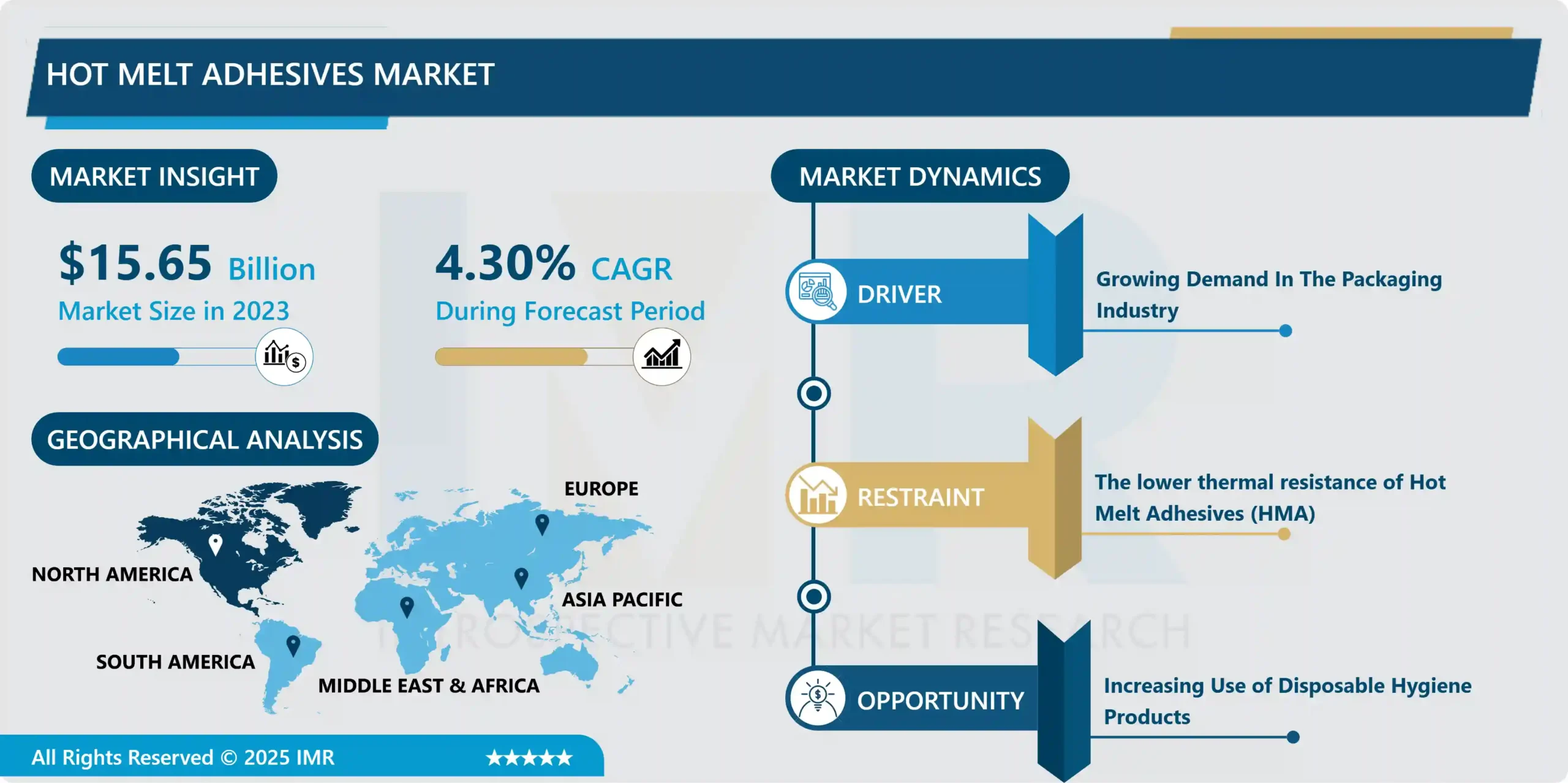
The Global Hot Melt Adhesives Market size was valued at USD 15.65 Billion in 2023 and is projected to reach USD 22.86 Billion by 2032, growing at a CAGR of 4.3% from 2024 to 2032.
Hot-melt adhesives (also known as hot glue) are generally 100% solid formulations based on thermoplastic polymers (no water or solvents are involved). Hot melts are sold in a solid state at room temperature and are ‘activated’ upon heating beyond their softening point which is usually between 50 and 160 degrees. Hot melt adhesives are applied using a hot glue gun.
The gun uses a continuous-duty heating element to melt the plastic glue, which the user pushes through the gun either with a mechanical trigger mechanism on the gun or with direct finger pressure. Hot melt adhesives are present in many forms in their solid state. They can be beads, blocks, pellets, chips, pillows, or glue sticks. Depending on the application, the holt melt can be extruded from a nozzle, sprayed, or rolled onto surfaces. Generally, the hot melt is made up of a polymer and many additives that can come in various forms. Polymers are considered to be the basic constituents of the hot melt.
Various types of glue are polymers. These are repetitive and long chains of specific molecules which have different properties. Polymers are responsible for most of the physical properties found in hot melts. Resins are responsible for the tack of the hot melt. Tack is defined as the measure of adhesive stickiness, which is generally the period the adhesive stays intact after its application. In addition, resins are in control of the wetting of an adhesive. This means resins control the period it remains a liquid while the hot melt is in contact with the surface substrate.
The Hot Melt Adhesives Market Trend Analysis
Growing Demand In The Packaging Industry
Hot melt adhesives for the packaging industry are used in carton and case sealing, paper goods, plastic container bonding, and labeling applications. The packaging industry covers a wide range of products and methods of production – from case sealing and construction of all types of paper products to structural strengthening of pallets and working with modern materials like polypropylene. All of these applications can be handled and improved with the use of adhesives. Hot melt adhesives in particular are a perfect fit for packaging, being simple and economical to apply, withstanding expected stresses, and offering excellent bonding, these factors are driving the growth of the market during the forecast period.
Carton and case sealing are major application areas for HMAs. EVA is frequently used for this application because of its excellent adhesion on paper and cardboard, ease of application, and low cost. Additives can alter the properties of EVA for use in extremely cold temperatures sometimes needed for beverage cases (down to -40F), as well as for higher temperature ranges.
Everything from paper cups to bags to spiral wound tubing can be adhered to with HMA adhesives. EVAs are also a common choice due to ease of use in high throughput assembly lines. Specialty formulations for products expected to reach high temperatures may be needed.
Hot Melt Adhesives can also be used in plastic containers. Polyolefin-based HMAs like HMPUR and polyester offer improved bonding to these low-energy surfaces. Care must be taken that the application temperature is low enough not to affect the substrate, so low-temperature HMAs are often used.
Increasing Uses of Disposable Hygiene Products
Disposable hygiene products have become an integral part of our modern lifestyle, offering convenience, comfort, and improved hygiene. From diapers and sanitary napkins to adult incontinence products and medical dressings, the increasing uses of disposable hygiene products have transformed personal care and healthcare practices worldwide.
A critical component that enables the assembly and functionality of these products is hot melt adhesives. These adhesives play a crucial role in the manufacturing process, ensuring the reliable and efficient bonding of various components, and contributing to the overall performance and durability of disposable hygiene products.
Hot melt adhesives have gained prominence in the manufacturing of disposable hygiene products due to their unique properties and advantages. These adhesives are solid at room temperature but become liquid upon heating, allowing for easy application and bonding during the manufacturing process. Unlike solvent-based adhesives, hot melt adhesives do not contain volatile organic compounds (VOCs), making them more environmentally friendly and safer for consumers.
The high-performance characteristics of hot melt adhesives have revolutionized the disposable hygiene industry. They offer excellent adhesion to a wide range of substrates, including nonwovens, films, and textiles, ensuring the structural integrity of the final product. Hot melt adhesives provide a secure bond that withstands the rigors of daily use, even under challenging conditions, such as exposure to moisture or body fluids.
Segmentation Analysis Of The Hot Melt Adhesives Market
Hot Melt Adhesives market segments cover the Type and Application. By Type, the Ethylene-Vinyl Acetate (EVA), segment is Anticipated to Dominate the Market Over the Forecast period.
EVA hot melt adhesives exhibit excellent compatibility with a wide range of substrates, including paper, cardboard, plastics, textiles, and wood. This versatility makes EVA adhesives suitable for diverse applications across various industries. EVA hot melt adhesives provide strong and reliable adhesion, ensuring durable bonds even under challenging conditions like temperature variations, moisture, and chemical exposure.
EVA hot melt adhesives have a quick-setting time, which translates to faster production processes and increased efficiency. This rapid setting allows for high-speed bonding, enabling manufacturers to optimize their production rates and reduce overall operational costs, also offers decent heat resistance, making them suitable for applications that may encounter elevated temperatures during use.
EVA hot melt adhesives have a relatively low viscosity when melted, making them easy to apply using various techniques, such as spray, slot coating, or roller coating. Compared to some other specialty hot melt adhesives, EVA is relatively cost-effective, which contributes to its widespread adoption across various industries and applications. The packaging industry, which relies heavily on adhesives for sealing and bonding applications, is a significant consumer of EVA hot melt adhesives. The high demand from this industry has contributed to EVA’s dominance in the hot melt adhesive market.
Regional Analysis of The Hot Melt Adhesives Market
Asia Pacific is Expected to Dominate the Market Over the Forecast Period.
APAC is the largest Hot Melt Adhesives Market (HMA Market) in terms of value and volume and is projected to be the fastest-growing market during the forecast period. The region has witnessed significant economic growth over the last decade. China continues to be an assembly hub for industrial products because of low labor costs. Thus, it consumes large volumes of HMA in appliances, footwear, and wood products, among other applications. Southeast Asian countries, including Vietnam and Cambodia, are witnessing increased adhesive consumption because of growth in footwear manufacturing.
The region is home to a robust manufacturing sector, which is a major consumer of hot melt adhesives. With a large number of industries producing a wide range of products, the demand for efficient and reliable bonding solutions like hot melt adhesives remains consistently high.
The packaging industry in the Asia Pacific is witnessing significant growth, driven by rising consumerism, e-commerce, and changing lifestyle trends. Hot melt adhesives are widely used in various packaging applications, such as carton sealing, case and tray forming, and labeling, further contributing to market dominance.
Asia Pacific is a major hub for automotive production, with several countries being prominent players in the global automotive industry. Hot melt adhesives are used extensively in automotive assembly and interior applications, including bonding parts, headliners, and carpets.
COVID-19 Impact Analysis On Hot Melt Adhesives Market
The effect of the pandemic on hot melt adhesives can differ across industries such as automotive, medical, and hygiene. Fast-growing sectors like medical, hygiene products, and food packaging are driving the market during the COVID-19 pandemic. The producers extend their production bases to benefit from the low manufacturing rates amid the coronavirus pandemic. Due to the COVID-19 outbreak, European carmakers had to shut down their manufacturing facilities. As to deal with the coronavirus outbreak, PSA, Renault, and Fiat Chrysler have to cut production at European plants. Renault halted manufacturing at 12 production sites affecting about 18,000 workers in France. However, increasing capital spending for roads and highways by the government to back businesses amid the coronavirus is likely to boost the building & construction industry, which will drive the market. Meanwhile, the need for hot melts also dropped due to plant shutdowns.
The middle class and young population will further contribute to the demand for adhesives & sealants in the forthcoming years for consumer goods. There was a marginal influence during the COVID-19 pandemic in terms of the supply of raw materials for the adhesives & sealants industry. The countrywide pandemic and lockdown conditions have caused immense disruption in the adhesives industry’s entire production and supply chain. Also, companies are facing the unavailability of skilled and unskilled labor, resulting in major losses.
Top Key Players Covered in The Hot Melt Adhesives Market
Henkel AG & Co. KGaA(Germany)
H.B. Fuller Company (U.S.)
3M Company (U.S.)
Arkema Group (France)
Sika AG (Switzerland)
Avery Dennison Corporation (U.S.)
Dow Chemical Company(U.S.)
Jowat SE (Germany)
Beardow Adams Group (U.K.)
Bostik (France)
Bühnen GmbH & Co. KG (Germany)
Sipol Adhesives (Spain)
Hexion Inc. (U.S.)
Tex Year Industries Inc. (Taiwan)
Kleiberit Adhesives (Germany), And Other Major Players.
Key Industry Developments in the Hot Melt Adhesives Market
In May 2024, 3M has expanded its facility in Valley, Nebraska, in a move aimed at boosting manufacturing capacity and job creation within the community. The expansion, which spans 90,000 square feet, involved a $67 million investment to incorporate new production lines, equipment, and a warehouse. This strategic initiative enables 3M to respond more promptly to customer demand for its personal safety products. The project has resulted in the creation of approximately 40 new jobs, further solidifying 3M’s commitment to local economic growth and development.
In December 2023, Arkema finalized the acquisition of Glenwood Private Equity’s 54% stake in the listed South Korean company PI Advanced Materials (PIAM) on December 1, 2023. This acquisition complemented Arkema’s portfolio of high-performance technologies for the high-growth markets of advanced electronics and electric mobility. With a market share exceeding 30%, PIAM, headquartered in South Korea, was the global leader in polyimide films used in the high-growth and high value-added markets of mobile devices and electric vehicles
Chapter 1: Introduction
1.1 Scope and Coverage
Chapter 2:Executive Summary
Chapter 3: Market Landscape
3.1 Market Dynamics
3.1.1 Drivers
3.1.2 Restraints
3.1.3 Opportunities
3.1.4 Challenges
3.2 Market Trend Analysis
3.3 PESTLE Analysis
3.4 Porter’s Five Forces Analysis
3.5 Industry Value Chain Analysis
3.6 Ecosystem
3.7 Regulatory Landscape
3.8 Price Trend Analysis
3.9 Patent Analysis
3.10 Technology Evolution
3.11 Investment Pockets
3.12 Import-Export Analysis
Chapter 4: Hot Melt Adhesives Market by Type (2018-2032)
4.1 Hot Melt Adhesives Market Snapshot and Growth Engine
4.2 Market Overview
4.3 Ethylene-Vinyl Acetate (EVA)
4.3.1 Introduction and Market Overview
4.3.2 Historic and Forecasted Market Size in Value USD and Volume Units
4.3.3 Key Market Trends, Growth Factors, and Opportunities
4.3.4 Geographic Segmentation Analysis
4.4 Styrenic Block Copolymers
4.5 Metallocene PO (mPO)
4.6 Polyamide
4.7 Polyolefins
4.8 Others
Chapter 5: Hot Melt Adhesives Market by Application (2018-2032)
5.1 Hot Melt Adhesives Market Snapshot and Growth Engine
5.2 Market Overview
5.3 Packaging Solutions
5.3.1 Introduction and Market Overview
5.3.2 Historic and Forecasted Market Size in Value USD and Volume Units
5.3.3 Key Market Trends, Growth Factors, and Opportunities
5.3.4 Geographic Segmentation Analysis
5.4 Nonwoven Hygiene Products
5.5 Furniture & Woodwork
5.6 Bookbinding
5.7 Other
Chapter 6: Company Profiles and Competitive Analysis
6.1 Competitive Landscape
6.1.1 Competitive Benchmarking
6.1.2 Hot Melt Adhesives Market Share by Manufacturer (2024)
6.1.3 Industry BCG Matrix
6.1.4 Heat Map Analysis
6.1.5 Mergers and Acquisitions
6.2 ARCHER DANIELS MIDLAND CO. (US)
6.2.1 Company Overview
6.2.2 Key Executives
6.2.3 Company Snapshot
6.2.4 Role of the Company in the Market
6.2.5 Sustainability and Social Responsibility
6.2.6 Operating Business Segments
6.2.7 Product Portfolio
6.2.8 Business Performance
6.2.9 Key Strategic Moves and Recent Developments
6.2.10 SWOT Analysis
6.3 LA TOURANGELLE (US)
6.4 BEST NATURES COSMETIC (CANADA)
6.5 HIGHER NATURE LIMITED (UK)
6.6 BIO PLANETE (GERMANY)
6.7 LOUIS DREYFUS COMPANY B.V. (NETHERLANDS)
6.8 BIOPURUS. CO. UK (UK)
6.9 AROMEX INDUSTRY (INDIA)
6.10 BYODO NATURKOST GMBH (GERMANY)
6.11 CARGILL INC.(US)
6.12 OILSEEDS AUSTRALIA PTY LTD. (AUSTRALIA)
6.13 RUCHI SOYA INDUSTRIES LTD. (INDIA)
6.14 ASSOCIATED BRITISH FOODS PLC (UK)
6.15 MATANGI COTTON INDUSTRIES (INDIA)
6.16 AND OTHER MAJOR PLAYERS
Chapter 7: Global Hot Melt Adhesives Market By Region
7.1 Overview
7.2. North America Hot Melt Adhesives Market
7.2.1 Key Market Trends, Growth Factors and Opportunities
7.2.2 Top Key Companies
7.2.3 Historic and Forecasted Market Size by Segments
7.2.4 Historic and Forecasted Market Size by Type
7.2.4.1 Ethylene-Vinyl Acetate (EVA)
7.2.4.2 Styrenic Block Copolymers
7.2.4.3 Metallocene PO (mPO)
7.2.4.4 Polyamide
7.2.4.5 Polyolefins
7.2.4.6 Others
7.2.5 Historic and Forecasted Market Size by Application
7.2.5.1 Packaging Solutions
7.2.5.2 Nonwoven Hygiene Products
7.2.5.3 Furniture & Woodwork
7.2.5.4 Bookbinding
7.2.5.5 Other
7.2.6 Historic and Forecast Market Size by Country
7.2.6.1 US
7.2.6.2 Canada
7.2.6.3 Mexico
7.3. Eastern Europe Hot Melt Adhesives Market
7.3.1 Key Market Trends, Growth Factors and Opportunities
7.3.2 Top Key Companies
7.3.3 Historic and Forecasted Market Size by Segments
7.3.4 Historic and Forecasted Market Size by Type
7.3.4.1 Ethylene-Vinyl Acetate (EVA)
7.3.4.2 Styrenic Block Copolymers
7.3.4.3 Metallocene PO (mPO)
7.3.4.4 Polyamide
7.3.4.5 Polyolefins
7.3.4.6 Others
7.3.5 Historic and Forecasted Market Size by Application
7.3.5.1 Packaging Solutions
7.3.5.2 Nonwoven Hygiene Products
7.3.5.3 Furniture & Woodwork
7.3.5.4 Bookbinding
7.3.5.5 Other
7.3.6 Historic and Forecast Market Size by Country
7.3.6.1 Russia
7.3.6.2 Bulgaria
7.3.6.3 The Czech Republic
7.3.6.4 Hungary
7.3.6.5 Poland
7.3.6.6 Romania
7.3.6.7 Rest of Eastern Europe
7.4. Western Europe Hot Melt Adhesives Market
7.4.1 Key Market Trends, Growth Factors and Opportunities
7.4.2 Top Key Companies
7.4.3 Historic and Forecasted Market Size by Segments
7.4.4 Historic and Forecasted Market Size by Type
7.4.4.1 Ethylene-Vinyl Acetate (EVA)
7.4.4.2 Styrenic Block Copolymers
7.4.4.3 Metallocene PO (mPO)
7.4.4.4 Polyamide
7.4.4.5 Polyolefins
7.4.4.6 Others
7.4.5 Historic and Forecasted Market Size by Application
7.4.5.1 Packaging Solutions
7.4.5.2 Nonwoven Hygiene Products
7.4.5.3 Furniture & Woodwork
7.4.5.4 Bookbinding
7.4.5.5 Other
7.4.6 Historic and Forecast Market Size by Country
7.4.6.1 Germany
7.4.6.2 UK
7.4.6.3 France
7.4.6.4 The Netherlands
7.4.6.5 Italy
7.4.6.6 Spain
7.4.6.7 Rest of Western Europe
7.5. Asia Pacific Hot Melt Adhesives Market
7.5.1 Key Market Trends, Growth Factors and Opportunities
7.5.2 Top Key Companies
7.5.3 Historic and Forecasted Market Size by Segments
7.5.4 Historic and Forecasted Market Size by Type
7.5.4.1 Ethylene-Vinyl Acetate (EVA)
7.5.4.2 Styrenic Block Copolymers
7.5.4.3 Metallocene PO (mPO)
7.5.4.4 Polyamide
7.5.4.5 Polyolefins
7.5.4.6 Others
7.5.5 Historic and Forecasted Market Size by Application
7.5.5.1 Packaging Solutions
7.5.5.2 Nonwoven Hygiene Products
7.5.5.3 Furniture & Woodwork
7.5.5.4 Bookbinding
7.5.5.5 Other
7.5.6 Historic and Forecast Market Size by Country
7.5.6.1 China
7.5.6.2 India
7.5.6.3 Japan
7.5.6.4 South Korea
7.5.6.5 Malaysia
7.5.6.6 Thailand
7.5.6.7 Vietnam
7.5.6.8 The Philippines
7.5.6.9 Australia
7.5.6.10 New Zealand
7.5.6.11 Rest of APAC
7.6. Middle East & Africa Hot Melt Adhesives Market
7.6.1 Key Market Trends, Growth Factors and Opportunities
7.6.2 Top Key Companies
7.6.3 Historic and Forecasted Market Size by Segments
7.6.4 Historic and Forecasted Market Size by Type
7.6.4.1 Ethylene-Vinyl Acetate (EVA)
7.6.4.2 Styrenic Block Copolymers
7.6.4.3 Metallocene PO (mPO)
7.6.4.4 Polyamide
7.6.4.5 Polyolefins
7.6.4.6 Others
7.6.5 Historic and Forecasted Market Size by Application
7.6.5.1 Packaging Solutions
7.6.5.2 Nonwoven Hygiene Products
7.6.5.3 Furniture & Woodwork
7.6.5.4 Bookbinding
7.6.5.5 Other
7.6.6 Historic and Forecast Market Size by Country
7.6.6.1 Turkiye
7.6.6.2 Bahrain
7.6.6.3 Kuwait
7.6.6.4 Saudi Arabia
7.6.6.5 Qatar
7.6.6.6 UAE
7.6.6.7 Israel
7.6.6.8 South Africa
7.7. South America Hot Melt Adhesives Market
7.7.1 Key Market Trends, Growth Factors and Opportunities
7.7.2 Top Key Companies
7.7.3 Historic and Forecasted Market Size by Segments
7.7.4 Historic and Forecasted Market Size by Type
7.7.4.1 Ethylene-Vinyl Acetate (EVA)
7.7.4.2 Styrenic Block Copolymers
7.7.4.3 Metallocene PO (mPO)
7.7.4.4 Polyamide
7.7.4.5 Polyolefins
7.7.4.6 Others
7.7.5 Historic and Forecasted Market Size by Application
7.7.5.1 Packaging Solutions
7.7.5.2 Nonwoven Hygiene Products
7.7.5.3 Furniture & Woodwork
7.7.5.4 Bookbinding
7.7.5.5 Other
7.7.6 Historic and Forecast Market Size by Country
7.7.6.1 Brazil
7.7.6.2 Argentina
7.7.6.3 Rest of SA
Chapter 8 Analyst Viewpoint and Conclusion
8.1 Recommendations and Concluding Analysis
8.2 Potential Market Strategies
Chapter 9 Research Methodology
9.1 Research Process
9.2 Primary Research
9.3 Secondary Research
Q1: What would be the forecast period in the Hot Melt Adhesives Market research report?
A1: The forecast period in the Hot Melt Adhesives Market research report is 2024-2032.
Q2: Who are the key players in Hot Melt Adhesives Market?
A2: Henkel AG & Co. KGaA (Germany), H.B. Fuller Company (U.S.), 3M Company (U.S.), Arkema Group (France), Sika AG (Switzerland), Avery Dennison Corporation (U.S.), Dow Chemical Company (U.S.), Jowat SE (Germany), Beardow Adams Group (U.K.), Bostik (France), Bühnen GmbH & Co. KG (Germany), Sipol Adhesives (Spain), Hexion Inc. (U.S.), Tex Year Industries Inc. (Taiwan), Kleiberit Adhesives (Germany), and Other Major Players.
Q3: What are the segments of the Hot Melt Adhesives Market?
A3: The Hot Melt Adhesives Market is segmented into Type, Application, and region. By Type, the market is categorized into (Ethylene-Vinyl Acetate (EVA), Styrenic Block Copolymers, Metallocene PO (mPO), Polyamide, Polyolefins, and Others. By Application, the market is categorized into Packaging Solutions, Nonwoven Hygiene Products, Furniture & Woodwork, Bookbinding, and Others. By region, it is analyzed across North America (U.S.; Canada; Mexico), Eastern Europe (Bulgaria; The Czech Republic; Hungary; Poland; Romania; Rest of Eastern Europe), Western Europe (Germany; UK; France; Netherlands; Italy; Russia; Spain; Rest of Western Europe), Asia-Pacific (China; India; Japan; Southeast Asia, etc.), South America (Brazil; Argentina, etc.), Middle East & Africa (Saudi Arabia; South Africa, etc.).
Q4: What is the Hot Melt Adhesives Market?
A4: Hot-melt adhesives (also known as hot glue) are generally 100% solid formulations based on thermoplastic polymers (no water or solvents are involved). Hot melts are sold in a solid state at room temperature and are 'activated' upon heating beyond their softening point which is usually between 50 and 160 degrees.
Q5: How big is the Hot Melt Adhesives Market?
A5: The Global Hot Melt Adhesives Market size was valued at USD 15.65 Billion in 2023 and is projected to reach USD 22.86 Billion by 2032, growing at a CAGR of 4.3% from 2024 to 2032.
How to Buy a Report from eminsights.jp
On the product page, choose the license you want: Single-User License, Multi-User License or Enterprise License.
If you required report in your native language, then you can click on Translated Report button and fill out the form with report name and language you want, then our team will contact you as soon as possible.
Click the Buy Now button.
You will be redirected to the checkout page. Enter your company details and payment information.
Click Place Order to complete the purchase.
Confirmation: You’ll receive an order confirmation and our team will contact you shortly with your ordered report.
If you have any questions, fill out the contact form below or email us at bizdev@eminsights.net.
Thank you for choosing eminsights.jp!