Stay Ahead in Fast-Growing Economies.
Browse Reports Now




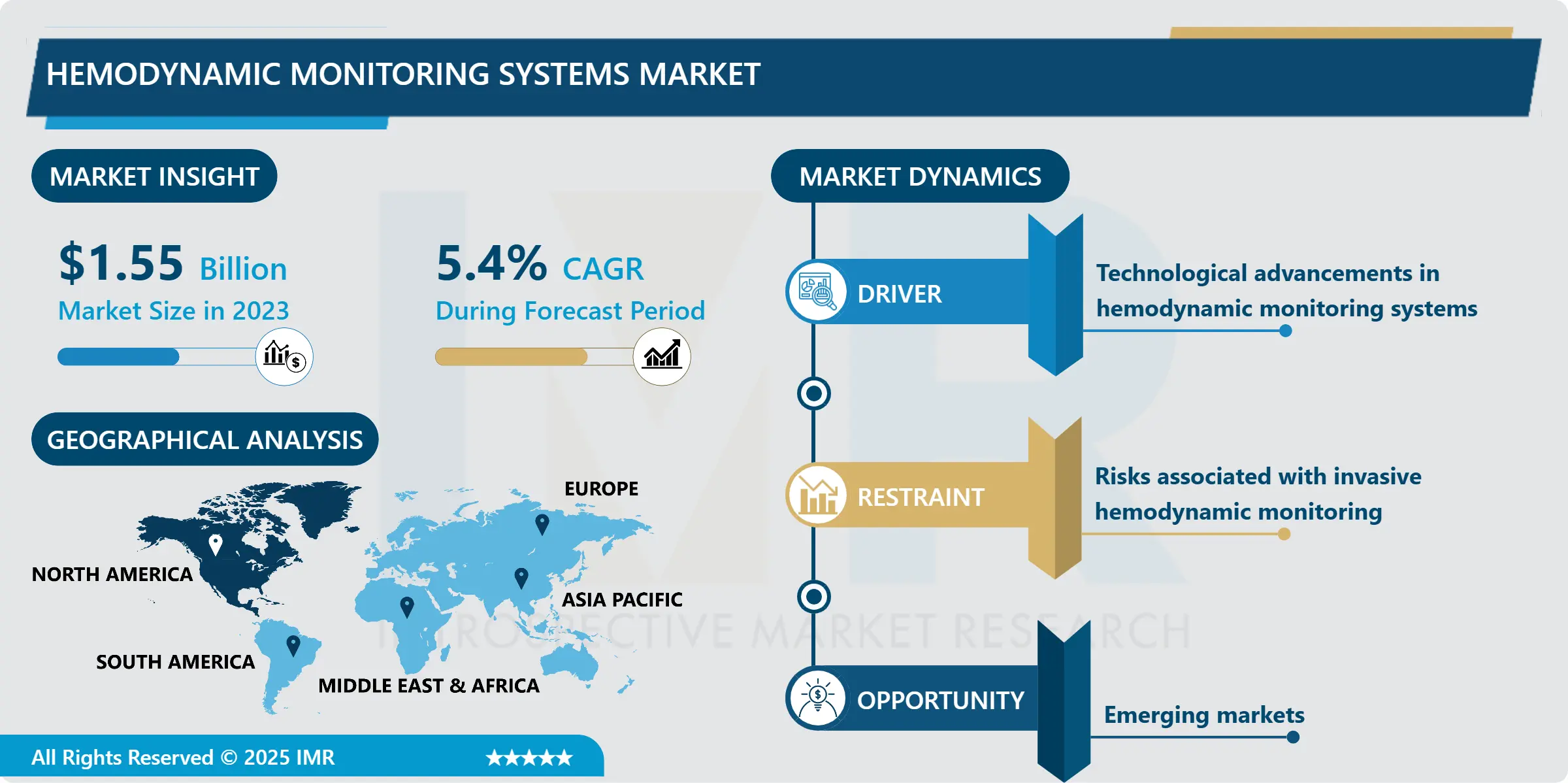
Hemodynamic Monitoring Systems Market – Latest Advancement & Future Trends (2024-2032)
Hemodynamic Monitoring Systems Market Size Was Valued at USD 1.55 Billion in 2023, and is Projected to Reach USD 2.49 Billion by 2032, Growing at a CAGR of xx% 5.40% From 2024-2032.

IMR Group
Description
Hemodynamic Monitoring Systems Market Synopsis:
Hemodynamic Monitoring Systems Market Size Was Valued at USD 1.55 Billion in 2023, and is Projected to Reach USD 2.49 Billion by 2032, Growing at a CAGR of 5.40% From 2024-2032.
Hemodynamic monitoring systems as a market is defined as a segment of the medical market which encompasses technologies and devices aimed at the evaluation and regulation of the cardiovascular performance in patients, particularly in intensive care and operating theatre environments. These systems usually keep track of the patient’s blood pressure, cardiac output and volume, all valuable data to the healthcare givers when determining the patient’s hemodynamic status. As such the system plays a crucial role in the medical care of patients by enhancing assessment and timely intervention especially among patients with trauma, surgical or critical illness needs thus the need to enhance advanced monitoring systems in Hospitals and facility all over the world.
The hemodynamic monitoring systems is a vital category of the medical device industry, which indicates the increasing requirement for accurate cardiovascular measurement and control in healthcare organizations. Hemodynamic measurement is a set of methods used for the determination of blood flow and blood pressure inside the cardiovascular system, helpful in creating a diagnosis of different cardiac pathologies. In addition, the increase in market adoption factors, including the escalating incidence of cardiovascular diseases, the aging population, and technology innovations related to monitoring, are revealed as well. The above systems are becoming popular with healthcare providers to improve the condition of patients, minimize adverse reactions during operations, and also detect underlying conditions at an early stage.
Ongoing technological developments have also fueled the future growth of the hemodynamic monitoring systems market, new product developments include non-invasive monitoring solutions, wireless connectivity, and EHR integration. It is important to mention that all these features do not only increase the accuracy and reliability of monitoring but also improve flow in the facilities providing healthcare. also has resulted in new opportunities for the further advancement of telemedical and long-distance patient care applications, especially concerning the application of innovative hemodynamic monitoring systems. These systems will include artificial intelligence, and more use of machine learning algorithms will help the healthcare providers to quickly intervene and respond whilst catering to individual patient needs.
Therefore, regional wise, North America has become the largest market for hemodynamic monitoring systems due to developed healthcare infrastructure, favourable health care expenditure and innovation culture. However, the Asia-Pacific region shows the highest growth rate over the forecast period is expected to the highest. Other drivers that may have led to the favourable growth include enhancement of health facilities, higher government expenditure on healthcare, and a developing consciousness regarding heart related ailments of the population. Accordingly, the main contenders in the market are being keen on forming partnerships, mergers and acquisitions and creating new product portfolios in order to capture a larger market share as well as being in a position to meet the emerging requirements of the health care stakeholders.
To sum up, focusing on the technological development, the enhancement in the amount of target diseases, as well as the shift to patient-centered medicine, the market of hemodynamic monitoring systems will continue to grow with every year. Hemodynamic monitoring will be a key determinant of patient care in the increasingly complex adaptive healthcare systems of the future, where accurate, efficient, and reliable data are vital to the future success of different healthcare organisations.
Hemodynamic Monitoring Systems Market Trend Analysis:
Impact of Aging Population on Hemodynamic Monitoring Systems Market
Due to continuously progressive aging of the global population, there has been observed an increase in the rates of cardiovascular diseases including heart failure and hypertension. This trend has forced healthcare providers to spend a lot of money on efficient and accurate hemodynamic monitoring systems that are crucial in assessing patients’ cardiovascular status and in creating the right treatment approaches for patients. Using such systems, clinicians will be in a position of improving the patients’ well-being, preventing complications and offering appropriate treatment on time. With the need for better tracking methods increasing, healthcare organizations are realizing that there is a valuable place for practical solutions to better address the complexities of cardiovascular disease.
The opportunities to introduce additional innovative technologies, especially non-invasive or minimally invasive continuous monitoring devices, are stimulating the hemodynamic monitoring systems market’s ongoing growth. Such changes not only improve patients’ comfort but also provide constantly acquired data necessary for timely and comprehensive evaluations. As the industry tends to deliver patients-oriented care, the need for simple and effective approaches to hemodynamic monitoring becomes critical. This change to higher level monitoring devices is representative of a larger move toward more effective, more immediate, and more constant means of tracking the status of patients in order to improve treatment and the quality of care.
Advancements in the Hemodynamic Monitoring Systems Market
The opportunities of using the new approaches in the frame of hemodynamic monitoring systems have been significantly influenced by the application of wearable sensors and telehealth functions. Through mobile health apps, efficient real-time patient tracking is possible so that appropriate actions can be taken when needed regardless of the healthcare provider’s location. This advancement is not only important for raising the level of services provided to patients by continuously monitoring the status of a patient, and predicting if there are signs of the development of complications, but also for minimizing the number of readmissions of patients into the medical center. Essentially, healthcare systems stand to gain significant cost savings while serving populations in a more efficient manner at the same time reducing the strains on in patient care facilities.
Also, as highlighted earlier, the increasing focus on minimally invasive techniques with a view to improving such areas as workflow, offers a great potential for the creation of complicated monitoring implements. As technical advances such as these continue to refine the monitoring of physiological markers in patients, these devices can provide accurate, timely information without the requirement for a great deal of surgery and operate in an environment where patients are putting greater and greater emphasis on the minimization of invasive procedures. The paradigm shift toward the patient-centered fashion of care delivery where the goals are optimized patient outcomes, and reduced harm from prevalent monitoring practices. By following these trends, manufactures of hemodynamic monitoring systems can align their self in this growing market to enhance healthcare system, and patient satisfaction.
Hemodynamic Monitoring Systems Market Segment Analysis:
Hemodynamic Monitoring Systems Market is Segmented on the basis of Product, Type, End User, and Region
By Product, Monitors segment is expected to dominate the market during the forecast period
Supervisory screens are mandatory tools used in many different health care settings to continuously observe and record important physical characteristics such as pulse, blood pressure, and oxygen saturation levels. The specified devices are indispensable in acute care settings, especially in ICU, where supervision has to be presented all the time. The fact of observing these parameters in real-time helps to reel health care professional in enhancing quality of care regarding changes within a patient’s state. Some of the reasons patients have difficulty accessing the use of monitors include; With the evolving complexity of cases and patients’, constant scrutiny is critical in their management the monitors are standard tools necessary for patient protection and clinical choices.
The available monitoring devices have also been heavily impacted by innovation over the past years resulting in portable and without wires monitors. They enhance convenience in emergencies or when the patient needs to be monitored remotely, in conditions other than rooms in a hospital. Decline in healthcare costs paid by hospitals and, therefore, increased emphasis on care integration and patient-centeredness means a continuous push to develop advanced surveillance systems. It also stimulates the evolution and development of the monitor technology and offers the patients optimized and adaptable management for the sake of engaging them along with the given general motivation towards the improved satisfaction of customers.
By End User, Hospitals segment expected to held the largest share
Hospitals are the largest consumers of monitoring devices since many patients admitted in the hospitals need close and complete supervision. The adoption of new technology in the management of hospitals has ensured that the health standards to be accorded to patients are determined due to the accurate results given by the monitoring of patients’ vital signs and general health status. Invasive and noninvasive trending solutions assist hospitals to monitor the critically ill patients in the ICU, patients’ recovery in wards, and post-operative in general wards, and assess critical patients all the time. This flexibility is important in health care noting that patient management needs to be individualized and monitored closely in order to reach the desired therapeutic goals on time.
Patient turnover continues to rise and the level of acuity has risen, this has made monitoring in healthcare facilities very sensitive requiring sophisticated monitoring mechanisms. In their attempt to increase patient safety and overall care, hospitals are expanding their investments in the modern technologies that serve for monitoring. Such investments are not only about enhancing the capability to monitor vital signs in real-time, but also adding the next layers of analytics and tele-support to make the decision support more detailed. With the help of sophisticated monitoring devices, the hospitals can effectively meet the needs of the highly diverse population of patients, provide critical care while providing efficient operation in the constantly changing environment of the healthcare system.
Hemodynamic Monitoring Systems Market Regional Insights:
North America is Expected to Dominate the Market Over the Forecast period
Hemodynamic monitoring systems market in North America is growing at a very positive rate mainly due to the increasing usage of advanced technologies in the regional healthcare industry. This is why the introduction of highly developed monitoring systems into clinical work is becoming more and more rank for its application and effectiveness especially in such specialized areas of treatment as intensive care. The tendency toward increased usage of Noninvasive technologies has particularly engaged the United States, a pioneer in introducing and developing new sur..
With the help of control algorithm, clinical indexes acquired from NICOM were compared with hemodynamic parameters reflected by PiCCP. These innovations do not only help in early response but also care for those with heart diseases in the hospital.
In addition, increased incidence of chronic diseases in this population pool has helped fuel the demand for hemodynamic monitoring systems, as people of a geriatric age bracket are more vulnerable to diseases that require close tracking. Reimbursement policies are also been friendly in a way that the healthcare providers are willing to spend in those advanced technologies and hence they have become more available. Furthermore, one notices the trend of understanding that it is possible to adapt the main strategies of the healthcare organization to the requirements of every patient, and this movement is called ‘personalized medicine’. This transformation of patients’ treatment plans to individualized is also increasing the use of hemodynamic monitoring systems even further and enables North America to significantly contribute to the growth of the market.
Active Key Players in the Hemodynamic Monitoring Systems Market:
Edwards Lifesciences Corporation
Getinge AB
Medtronic plc
Philips Healthcare
GE Healthcare
Siemens Healthineers
Nihon Kohden Corporation
Fukuda Denshi Co., Ltd
Hospira (a subsidiary of Pfizer Inc.)
Cardinal Health
Other Active Players
Chapter 1: Introduction
1.1 Scope and Coverage
Chapter 2:Executive Summary
Chapter 3: Market Landscape
3.1 Market Dynamics
3.1.1 Drivers
3.1.2 Restraints
3.1.3 Opportunities
3.1.4 Challenges
3.2 Market Trend Analysis
3.3 PESTLE Analysis
3.4 Porter’s Five Forces Analysis
3.5 Industry Value Chain Analysis
3.6 Ecosystem
3.7 Regulatory Landscape
3.8 Price Trend Analysis
3.9 Patent Analysis
3.10 Technology Evolution
3.11 Investment Pockets
3.12 Import-Export Analysis
Chapter 4: Hemodynamic Monitoring Systems Market by Product
4.1 Hemodynamic Monitoring Systems Market Snapshot and Growth Engine
4.2 Hemodynamic Monitoring Systems Market Overview
4.3 Monitors and Disposables
4.3.1 Introduction and Market Overview
4.3.2 Historic and Forecasted Market Size in Value USD and Volume Units (2017-2032F)
4.3.3 Key Market Trends, Growth Factors and Opportunities
4.3.4 Monitors and Disposables: Geographic Segmentation Analysis
Chapter 5: Hemodynamic Monitoring Systems Market by Type
5.1 Hemodynamic Monitoring Systems Market Snapshot and Growth Engine
5.2 Hemodynamic Monitoring Systems Market Overview
5.3 Invasive
5.3.1 Introduction and Market Overview
5.3.2 Historic and Forecasted Market Size in Value USD and Volume Units (2017-2032F)
5.3.3 Key Market Trends, Growth Factors and Opportunities
5.3.4 Invasive: Geographic Segmentation Analysis
5.4 minimally invasive and Noninvasive
5.4.1 Introduction and Market Overview
5.4.2 Historic and Forecasted Market Size in Value USD and Volume Units (2017-2032F)
5.4.3 Key Market Trends, Growth Factors and Opportunities
5.4.4 minimally invasive and Noninvasive: Geographic Segmentation Analysis
Chapter 6: Hemodynamic Monitoring Systems Market by End User
6.1 Hemodynamic Monitoring Systems Market Snapshot and Growth Engine
6.2 Hemodynamic Monitoring Systems Market Overview
6.3 Hospitals
6.3.1 Introduction and Market Overview
6.3.2 Historic and Forecasted Market Size in Value USD and Volume Units (2017-2032F)
6.3.3 Key Market Trends, Growth Factors and Opportunities
6.3.4 Hospitals: Geographic Segmentation Analysis
6.4 Clinics and ambulatory care centers and home care settings
6.4.1 Introduction and Market Overview
6.4.2 Historic and Forecasted Market Size in Value USD and Volume Units (2017-2032F)
6.4.3 Key Market Trends, Growth Factors and Opportunities
6.4.4 Clinics and ambulatory care centers and home care settings: Geographic Segmentation Analysis
Chapter 7: Company Profiles and Competitive Analysis
7.1 Competitive Landscape
7.1.1 Competitive Benchmarking
7.1.2 Hemodynamic Monitoring Systems Market Share by Manufacturer (2023)
7.1.3 Industry BCG Matrix
7.1.4 Heat Map Analysis
7.1.5 Mergers and Acquisitions
7.2 EDWARDS LIFESCIENCES CORPORATION
7.2.1 Company Overview
7.2.2 Key Executives
7.2.3 Company Snapshot
7.2.4 Role of the Company in the Market
7.2.5 Sustainability and Social Responsibility
7.2.6 Operating Business Segments
7.2.7 Product Portfolio
7.2.8 Business Performance
7.2.9 Key Strategic Moves and Recent Developments
7.2.10 SWOT Analysis
7.3 GETINGE AB
7.4 MEDTRONIC PLC
7.5 PHILIPS HEALTHCARE
7.6 GE HEALTHCARE
7.7 SIEMENS HEALTHINEERS
7.8 NIHON KOHDEN CORPORATION
7.9 FUKUDA DENSHI CO. LTD
7.10 HOSPIRA (A SUBSIDIARY OF PFIZER INC.)
7.11 CARDINAL HEALTH
7.12 …
7.13 OTHER ACTIVE PLAYERS
Chapter 8: Global Hemodynamic Monitoring Systems Market By Region
8.1 Overview
8.2. North America Hemodynamic Monitoring Systems Market
8.2.1 Key Market Trends, Growth Factors and Opportunities
8.2.2 Top Key Companies
8.2.3 Historic and Forecasted Market Size by Segments
8.2.4 Historic and Forecasted Market Size By Product
8.2.4.1 Monitors and Disposables
8.2.5 Historic and Forecasted Market Size By Type
8.2.5.1 Invasive
8.2.5.2 minimally invasive and Noninvasive
8.2.6 Historic and Forecasted Market Size By End User
8.2.6.1 Hospitals
8.2.6.2 Clinics and ambulatory care centers and home care settings
8.2.7 Historic and Forecast Market Size by Country
8.2.7.1 US
8.2.7.2 Canada
8.2.7.3 Mexico
8.3. Eastern Europe Hemodynamic Monitoring Systems Market
8.3.1 Key Market Trends, Growth Factors and Opportunities
8.3.2 Top Key Companies
8.3.3 Historic and Forecasted Market Size by Segments
8.3.4 Historic and Forecasted Market Size By Product
8.3.4.1 Monitors and Disposables
8.3.5 Historic and Forecasted Market Size By Type
8.3.5.1 Invasive
8.3.5.2 minimally invasive and Noninvasive
8.3.6 Historic and Forecasted Market Size By End User
8.3.6.1 Hospitals
8.3.6.2 Clinics and ambulatory care centers and home care settings
8.3.7 Historic and Forecast Market Size by Country
8.3.7.1 Russia
8.3.7.2 Bulgaria
8.3.7.3 The Czech Republic
8.3.7.4 Hungary
8.3.7.5 Poland
8.3.7.6 Romania
8.3.7.7 Rest of Eastern Europe
8.4. Western Europe Hemodynamic Monitoring Systems Market
8.4.1 Key Market Trends, Growth Factors and Opportunities
8.4.2 Top Key Companies
8.4.3 Historic and Forecasted Market Size by Segments
8.4.4 Historic and Forecasted Market Size By Product
8.4.4.1 Monitors and Disposables
8.4.5 Historic and Forecasted Market Size By Type
8.4.5.1 Invasive
8.4.5.2 minimally invasive and Noninvasive
8.4.6 Historic and Forecasted Market Size By End User
8.4.6.1 Hospitals
8.4.6.2 Clinics and ambulatory care centers and home care settings
8.4.7 Historic and Forecast Market Size by Country
8.4.7.1 Germany
8.4.7.2 UK
8.4.7.3 France
8.4.7.4 The Netherlands
8.4.7.5 Italy
8.4.7.6 Spain
8.4.7.7 Rest of Western Europe
8.5. Asia Pacific Hemodynamic Monitoring Systems Market
8.5.1 Key Market Trends, Growth Factors and Opportunities
8.5.2 Top Key Companies
8.5.3 Historic and Forecasted Market Size by Segments
8.5.4 Historic and Forecasted Market Size By Product
8.5.4.1 Monitors and Disposables
8.5.5 Historic and Forecasted Market Size By Type
8.5.5.1 Invasive
8.5.5.2 minimally invasive and Noninvasive
8.5.6 Historic and Forecasted Market Size By End User
8.5.6.1 Hospitals
8.5.6.2 Clinics and ambulatory care centers and home care settings
8.5.7 Historic and Forecast Market Size by Country
8.5.7.1 China
8.5.7.2 India
8.5.7.3 Japan
8.5.7.4 South Korea
8.5.7.5 Malaysia
8.5.7.6 Thailand
8.5.7.7 Vietnam
8.5.7.8 The Philippines
8.5.7.9 Australia
8.5.7.10 New Zealand
8.5.7.11 Rest of APAC
8.6. Middle East & Africa Hemodynamic Monitoring Systems Market
8.6.1 Key Market Trends, Growth Factors and Opportunities
8.6.2 Top Key Companies
8.6.3 Historic and Forecasted Market Size by Segments
8.6.4 Historic and Forecasted Market Size By Product
8.6.4.1 Monitors and Disposables
8.6.5 Historic and Forecasted Market Size By Type
8.6.5.1 Invasive
8.6.5.2 minimally invasive and Noninvasive
8.6.6 Historic and Forecasted Market Size By End User
8.6.6.1 Hospitals
8.6.6.2 Clinics and ambulatory care centers and home care settings
8.6.7 Historic and Forecast Market Size by Country
8.6.7.1 Turkiye
8.6.7.2 Bahrain
8.6.7.3 Kuwait
8.6.7.4 Saudi Arabia
8.6.7.5 Qatar
8.6.7.6 UAE
8.6.7.7 Israel
8.6.7.8 South Africa
8.7. South America Hemodynamic Monitoring Systems Market
8.7.1 Key Market Trends, Growth Factors and Opportunities
8.7.2 Top Key Companies
8.7.3 Historic and Forecasted Market Size by Segments
8.7.4 Historic and Forecasted Market Size By Product
8.7.4.1 Monitors and Disposables
8.7.5 Historic and Forecasted Market Size By Type
8.7.5.1 Invasive
8.7.5.2 minimally invasive and Noninvasive
8.7.6 Historic and Forecasted Market Size By End User
8.7.6.1 Hospitals
8.7.6.2 Clinics and ambulatory care centers and home care settings
8.7.7 Historic and Forecast Market Size by Country
8.7.7.1 Brazil
8.7.7.2 Argentina
8.7.7.3 Rest of SA
Chapter 9 Analyst Viewpoint and Conclusion
9.1 Recommendations and Concluding Analysis
9.2 Potential Market Strategies
Chapter 10 Research Methodology
10.1 Research Process
10.2 Primary Research
10.3 Secondary Research
Q1: What would be the forecast period in the Hemodynamic Monitoring Systems Market research report?
A1: The forecast period in the Hemodynamic Monitoring Systems Market research report is 2024-2032.
Q2: Who are the key players in the Hemodynamic Monitoring Systems Market?
A2: Edwards Lifesciences Corporation, Getinge AB, Medtronic plc, Philips Healthcare, GE Healthcare, Siemens Healthineers, Nihon Kohden Corporation, Fukuda Denshi Co., Ltd, Hospira (a subsidiary of Pfizer Inc.), Cardinal Health, and Other Active Players.
Q3: What are the segments of the Hemodynamic Monitoring Systems Market?
A3: The Hemodynamic Monitoring Systems Market is segmented into By Product, By Type, By End User and region. By Product, the market is categorized into Monitors and Disposables. By Type, the market is categorized into Invasive, minimally invasive and Noninvasive. By End User, the market is categorized into Hospitals, Clinics and ambulatory care centers and home care settings. By region, it is analyzed across North America (U.S., Canada, Mexico), Eastern Europe (Russia, Bulgaria, The Czech Republic, Hungary, Poland, Romania, Rest of Eastern Europe), Western Europe (Germany, UK, France, The Netherlands, Italy, Spain, Rest of Western Europe), Asia Pacific (China, India, Japan, South Korea, Malaysia, Thailand, Vietnam, The Philippines, Australia, New-Zealand, Rest of APAC), Middle East & Africa (Turkiye, Bahrain, Kuwait, Saudi Arabia, Qatar, UAE, Israel, South Africa), South America (Brazil, Argentina, Rest of SA).
Q4: What is the Hemodynamic Monitoring Systems Market?
A4: The hemodynamic monitoring systems market refers to the sector focused on technologies and devices designed to assess and manage cardiovascular dynamics in patients, primarily in critical care and surgical settings. These systems monitor parameters such as blood pressure, cardiac output, and blood volume to provide healthcare professionals with real-time data on a patient's hemodynamic status. By enabling precise evaluation and timely interventions, these systems are crucial in improving patient outcomes, especially in cases of trauma, surgery, or critical illness, thereby driving the demand for advanced monitoring solutions in hospitals and healthcare facilities worldwide.
Q5: How big is the Hemodynamic Monitoring Systems Market?
A5: Hemodynamic Monitoring Systems Market Size Was Valued at USD 1.55 Billion in 2023, and is Projected to Reach USD 2.49 Billion by 2032, Growing at a CAGR of 5.40% From 2024-2032.
How to Buy a Report from eminsights.jp
On the product page, choose the license you want: Single-User License, Multi-User License or Enterprise License.
If you required report in your native language, then you can click on Translated Report button and fill out the form with report name and language you want, then our team will contact you as soon as possible.
Click the Buy Now button.
You will be redirected to the checkout page. Enter your company details and payment information.
Click Place Order to complete the purchase.
Confirmation: You’ll receive an order confirmation and our team will contact you shortly with your ordered report.
If you have any questions, fill out the contact form below or email us at bizdev@eminsights.net.
Thank you for choosing eminsights.jp!