Stay Ahead in Fast-Growing Economies.
Browse Reports Now
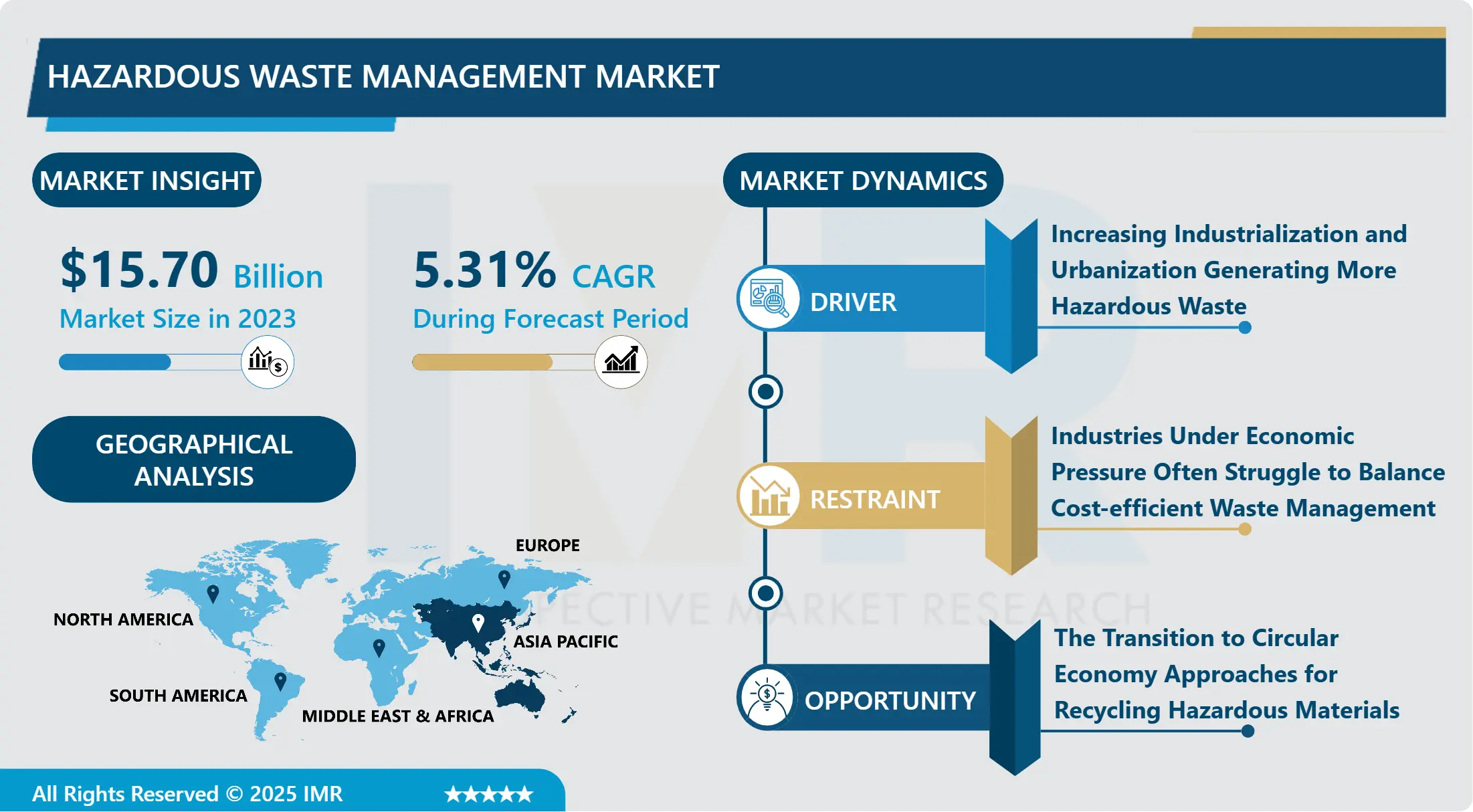
Hazardous Waste Management Market-Current Analysis by Market Share
The hazardous waste management market encompasses the systematic handling, treatment, disposal, and monitoring of materials that pose substantial risks to human health and the environment due to their toxicity, reactivity, corrosiveness, or ignitability.

IMR Group
Description
Hazardous Waste Management Market Synopsis
Hazardous Waste Management Market Size Was Valued at USD 16.53 Billion in 2024, and is Projected to Reach USD 25.01 Billion by 2032, Growing at a CAGR of 5.31% From 2025-2032.
The hazardous waste management market encompasses the systematic handling, treatment, disposal, and monitoring of materials that pose substantial risks to human health and the environment due to their toxicity, reactivity, corrosiveness, or ignitability. It involves a range of services and technologies aimed at mitigating the potential harm posed by hazardous waste, including collection, transportation, recycling, incineration, and landfilling. Regulatory frameworks play a crucial role in shaping this market, with government agencies imposing stringent requirements to ensure safe and responsible management practices. The market is driven by increasing industrialization, urbanization, and environmental awareness, prompting businesses and governments to invest in innovative solutions for hazardous waste management to minimize environmental pollution and safeguard public health.
The market for hazardous waste management is progressing at a steady rate across the international level due to various factors such as; increased industrialization, enhanced regulatory laws and structures regarding the environmental sector, and rising understanding about the correct way to manage wastes. As the impact of pollution on the environment and the enhancement of health related complications have become major concerns of governments in recent years, they have developed policies aimed at containing the production; storage; transport and disposal of such wastes. This has created a need for proper policy and management of hazardous waste hence the need for efficient hazardous waste management solutions and services. Also, advancement in treatment and recycling technology s also put another impetus into the market’s growth.
Current corporations in the industry are aiming at increasing efficient waste management to deal with the threats presented by different hazardous gases. This means that with increased production of hazardous wastes by industries, there will be development of more robust waste management systems and products thus contributing to expansion of the existing toxic waste management market. Also, with the increased focus on sustainability along with corporate social responsibility by various businesses deploying sustainable waste management systems, the global market for VFDs is set to receive a fillip. However, Megamer has to work through certain limitations within the industry like high initial investment, regulations, legal bindings, and so on However, the hazardous waste management market has a great opportunity for growth in the future.
Hazardous Waste Management Market Trend Analysis
Hazardous Waste Management Market Growth Driver- Advancements in Hazardous Waste Treatment and Disposal Technologies
The market for hazardous waste management is progressing at a steady rate across the international level due to various factors such as; increased industrialization, enhanced regulatory laws and structures regarding the environmental sector, and rising understanding about the correct way to manage wastes. As the impact of pollution on the environment and the enhancement of health related complications have become major concerns of governments in recent years, they have developed policies aimed at containing the production; storage; transport and disposal of such wastes. This has created a need for proper policy and management of hazardous waste hence the need for efficient hazardous waste management solutions and services. Also, advancement in treatment and recycling technology s also put another impetus into the market’s growth.
Current corporations in the industry are aiming at increasing efficient waste management to deal with the threats presented by different hazardous gases. This means that with increased production of hazardous wastes by industries, there will be development of more robust waste management systems and products thus contributing to expansion of the existing toxic waste management market. Also, with the increased focus on sustainability along with corporate social responsibility by various businesses deploying sustainable waste management systems, the global market for VFDs is set to receive a fillip. However, Megamer has to work through certain limitations within the industry like high initial investment, regulations, legal bindings, and so on However, the hazardous waste management market has a great opportunity for growth in the future.
Hazardous Waste Management Market Expansion Opportunity- The Shift Towards Circular Economy Models for Hazardous Material Recycling
The increasing focus on every element of recycling and recovery of dangerous materials is an absolute reversal in the perception of individuals concerning waste disposal. This development is apparent due to the increasing consciousness of damage debris causes to the environment including improper disposal methods. However, there is a shift towards ‘circular economy’ strategy where waste materials are not considered useless but rather as resources that can be; utilized again, recycled or reprocessed. The new shift has led to creation of specialized centers to recycle toxic commodities like electronic waste recycling centers and toxic material recovery centers. These plants use innovative methods and procedures to recover useful products from toxic and abrasive process flows, in turn, cutting down on their reliance on raw and primitive materials as well as preventing pollution of the environment.
Also, the expansion of the sectors of recycling of hazardous wastage requires setting up of new technologies and innovations for waste management systems. Businesses are engrossed in discovering optimal and innovative approaches on how to extract valuable materials from the potentially dangerous waste streams, including gold from electric equipment or chemicals from waste products among others. They also spoke of efforts to do so while at the same time affirming that these measures not only saved resources but also created new sources of income in the form of new markets in recycled products. Furthermore, the process of producing hazardous waste through recycling means also substantially decreases environmental pollution and the threats coming with the exposure to hazardous waste, as compared to landfilling or incineration. All in all, it can be noted that the elevated concern for the recycling and recovery of hazardous materials is a positive indication of a shift towards the embrace of a circular economy concept in waste management.
Hazardous Waste Management Market Segment Analysis:
Hazardous Waste Management Market is segmented based on Type, Treatment, Waste, Chemical Composition, Disposal Method, and Region.
By Type, Solid segment is expected to dominate the market during the forecast period
Solid waste management plays a pivotal role in the hazardous waste management market, commanding a dominant share due to its prevalence across various industries. Industries such as manufacturing, mining, and agriculture generate significant quantities of solid hazardous waste in the form of contaminated soil, sludge, and other byproducts. Contaminated soil, for instance, often results from industrial activities involving chemical spills, leakage from storage tanks, or improper disposal practices. This soil may contain heavy metals, toxic chemicals, or other harmful substances, posing risks to human health and the environment if left untreated. Similarly, sludge, a semi-solid residue from wastewater treatment plants or industrial processes, contains a mixture of organic and inorganic materials, including pathogens and pollutants. Managing and disposing of these solid wastes require specialized expertise and infrastructure, driving the dominance of solid waste management within the hazardous waste market.
Moreover, the increasing regulatory scrutiny and environmental awareness surrounding solid hazardous waste further contribute to its dominant share in the hazardous waste management market. Governments worldwide impose strict regulations on the handling, treatment, and disposal of solid hazardous waste to protect public health and the environment. Compliance with these regulations necessitates the implementation of advanced technologies and best practices for containment, treatment, and disposal. As a result, companies operating in the hazardous waste management sector focus significant resources on developing innovative solutions tailored to the unique challenges posed by solid waste. From soil remediation techniques to sludge dewatering and stabilization processes, the market for solid waste management continues to expand as industries seek sustainable and compliant methods for managing their hazardous waste streams.
By Treatment, the Physical and Chemical segment held the largest share in 2024
In the hazardous waste management market, the segment of physical and chemical treatment stands out as a significant contributor, often occupying the largest share due to its versatility and effectiveness in addressing a wide range of hazardous materials. This segment encompasses various techniques aimed at neutralizing or removing hazardous components from waste materials to render them less harmful to the environment and human health. Processes such as filtration play a crucial role in separating solid particles from liquid or gaseous waste streams, allowing for the removal of contaminants before disposal. Additionally, precipitation methods are employed to induce the formation of insoluble compounds, effectively trapping hazardous substances and facilitating their removal from the waste stream.
One of the cornerstone techniques within this segment is incineration, which involves subjecting hazardous waste to high temperatures in controlled environments to thermally break down its constituents. Incineration is particularly effective in destroying organic compounds, pathogens, and other hazardous materials, reducing their volume and toxicity. Modern incineration facilities are equipped with advanced pollution control technologies to mitigate emissions of harmful pollutants such as particulate matter, dioxins, and heavy metals. This ensures that the process is not only efficient in waste reduction but also environmentally responsible. Given its versatility and ability to handle a wide range of hazardous materials, coupled with stringent regulatory requirements for waste treatment and disposal, physical and chemical treatment, including incineration, continues to dominate the hazardous waste management market, holding the largest share as a preferred method for mitigating environmental and public health risks associated with hazardous waste.
Hazardous Waste Management Market Regional Insights:
Asia-Pacific is Expected to Dominate the Market Over the Forecast period
Asia-Pacific is poised to dominate the hazardous waste management market due to several key factors. The region’s rapid industrialization and urbanization, particularly in countries like China and India, have led to a significant increase in the generation of hazardous waste. China’s manufacturing sector, the largest in the world, produces a vast array of hazardous by-products, necessitating comprehensive waste management solutions. Similarly, India’s industrial growth and urban sprawl have resulted in substantial waste generation, driving demand for effective waste management services. This burgeoning industrial activity, combined with the region’s large and growing population, creates a critical need for advanced hazardous waste management infrastructure and services.
Despite challenges such as inadequate infrastructure, limited regulatory enforcement, and a general lack of awareness about proper waste management practices in some areas, the Asia-Pacific region is witnessing a shift towards better environmental stewardship. Increasing environmental concerns and awareness among the populace are compelling governments to take action. Initiatives to improve waste management infrastructure, coupled with stricter regulations and enforcement mechanisms, are being implemented across the region. For instance, China has introduced stringent regulations to control hazardous waste, and India is investing in the development of waste treatment facilities and public awareness campaigns. These efforts, supported by governmental policies and international cooperation, are expected to significantly bolster the hazardous waste management market in Asia-Pacific, ensuring it remains a dominant player in the global market for years to come.
Active Key Players in the Hazardous Waste Management Market
Chloros Environmental Ltd
Waste Management, Inc.
Recology Inc.
American Waste Management Services, Inc.
Bechtel Corporation
Suez
Environ India
Covanta Holding Corporation
Morgan Group
Veolia
Other Active Players.
Key Industry Development:
In June 2024, WM acquired Stericycle, a leading provider of medical waste services, for $7.2 billion. Waste Management, Inc. and Stericycle announced that they have entered into a definitive agreement under which WM will acquire all of Stericycle’s common stock for $62.00 per share in cash, valuing the company at approximately $7.2 billion, including approximately $1.4 billion in net profit from Stericycle. debts the stock price represents a 24% premium to Stericycle’s 60-day volume-weighted average price on May 23, 2024, the last trading day before the article said Stericycle was considering a possible sale.
In May 2023, WM announced plans to build a new CandD recycling facility at Southern Services Eco Park in Nashville. WM is building a new recycling facility in Nashville. As the region’s construction and demolition waste crisis continues.
Chapter 1: Introduction
1.1 Scope and Coverage
Chapter 2:Executive Summary
Chapter 3: Market Landscape
3.1 Market Dynamics
3.1.1 Drivers
3.1.2 Restraints
3.1.3 Opportunities
3.1.4 Challenges
3.2 Market Trend Analysis
3.3 PESTLE Analysis
3.4 Porter’s Five Forces Analysis
3.5 Industry Value Chain Analysis
3.6 Ecosystem
3.7 Regulatory Landscape
3.8 Price Trend Analysis
3.9 Patent Analysis
3.10 Technology Evolution
3.11 Investment Pockets
3.12 Import-Export Analysis
Chapter 4: Hazardous Waste Management Market by Type (2018-2032)
4.1 Hazardous Waste Management Market Snapshot and Growth Engine
4.2 Market Overview
4.3 Solid
4.3.1 Introduction and Market Overview
4.3.2 Historic and Forecasted Market Size in Value USD and Volume Units
4.3.3 Key Market Trends, Growth Factors, and Opportunities
4.3.4 Geographic Segmentation Analysis
4.4 Liquid
4.5 Sludge
Chapter 5: Hazardous Waste Management Market by Treatment (2018-2032)
5.1 Hazardous Waste Management Market Snapshot and Growth Engine
5.2 Market Overview
5.3 Physical and Chemical
5.3.1 Introduction and Market Overview
5.3.2 Historic and Forecasted Market Size in Value USD and Volume Units
5.3.3 Key Market Trends, Growth Factors, and Opportunities
5.3.4 Geographic Segmentation Analysis
5.4 Thermal
5.5 Biological
Chapter 6: Hazardous Waste Management Market by Waste (2018-2032)
6.1 Hazardous Waste Management Market Snapshot and Growth Engine
6.2 Market Overview
6.3 Nuclear
6.3.1 Introduction and Market Overview
6.3.2 Historic and Forecasted Market Size in Value USD and Volume Units
6.3.3 Key Market Trends, Growth Factors, and Opportunities
6.3.4 Geographic Segmentation Analysis
6.4 Chemical
6.5 Biomedical
6.6 Flammable
6.7 Explosive
6.8 Others
Chapter 7: Hazardous Waste Management Market by Chemical Composition (2018-2032)
7.1 Hazardous Waste Management Market Snapshot and Growth Engine
7.2 Market Overview
7.3 Organic
7.3.1 Introduction and Market Overview
7.3.2 Historic and Forecasted Market Size in Value USD and Volume Units
7.3.3 Key Market Trends, Growth Factors, and Opportunities
7.3.4 Geographic Segmentation Analysis
7.4 Inorganic
Chapter 8: Hazardous Waste Management Market by Disposal Method (2018-2032)
8.1 Hazardous Waste Management Market Snapshot and Growth Engine
8.2 Market Overview
8.3 Deep Well Injection
8.3.1 Introduction and Market Overview
8.3.2 Historic and Forecasted Market Size in Value USD and Volume Units
8.3.3 Key Market Trends, Growth Factors, and Opportunities
8.3.4 Geographic Segmentation Analysis
8.4 Detonation
8.5 Engineered Storage
8.6 Land Burial
8.7 Ocean Dumping
Chapter 9: Company Profiles and Competitive Analysis
9.1 Competitive Landscape
9.1.1 Competitive Benchmarking
9.1.2 Hazardous Waste Management Market Share by Manufacturer (2024)
9.1.3 Industry BCG Matrix
9.1.4 Heat Map Analysis
9.1.5 Mergers and Acquisitions
9.2 CHLOROS ENVIRONMENTAL LTD
9.2.1 Company Overview
9.2.2 Key Executives
9.2.3 Company Snapshot
9.2.4 Role of the Company in the Market
9.2.5 Sustainability and Social Responsibility
9.2.6 Operating Business Segments
9.2.7 Product Portfolio
9.2.8 Business Performance
9.2.9 Key Strategic Moves and Recent Developments
9.2.10 SWOT Analysis
9.3 WASTE MANAGEMENT INCRECOLOGY INCAMERICAN WASTE MANAGEMENT SERVICES INCBECHTEL CORPORATION
9.4 SUEZ
9.5 ENVIRON INDIA
9.6 COVANTA HOLDING CORPORATION
9.7 MORGAN GROUP
9.8 VEOLIA & OTHER MAJOR PLAYERS.
Chapter 10: Global Hazardous Waste Management Market By Region
10.1 Overview
10.2. North America Hazardous Waste Management Market
10.2.1 Key Market Trends, Growth Factors and Opportunities
10.2.2 Top Key Companies
10.2.3 Historic and Forecasted Market Size by Segments
10.2.4 Historic and Forecasted Market Size by Type
10.2.4.1 Solid
10.2.4.2 Liquid
10.2.4.3 Sludge
10.2.5 Historic and Forecasted Market Size by Treatment
10.2.5.1 Physical and Chemical
10.2.5.2 Thermal
10.2.5.3 Biological
10.2.6 Historic and Forecasted Market Size by Waste
10.2.6.1 Nuclear
10.2.6.2 Chemical
10.2.6.3 Biomedical
10.2.6.4 Flammable
10.2.6.5 Explosive
10.2.6.6 Others
10.2.7 Historic and Forecasted Market Size by Chemical Composition
10.2.7.1 Organic
10.2.7.2 Inorganic
10.2.8 Historic and Forecasted Market Size by Disposal Method
10.2.8.1 Deep Well Injection
10.2.8.2 Detonation
10.2.8.3 Engineered Storage
10.2.8.4 Land Burial
10.2.8.5 Ocean Dumping
10.2.9 Historic and Forecast Market Size by Country
10.2.9.1 US
10.2.9.2 Canada
10.2.9.3 Mexico
10.3. Eastern Europe Hazardous Waste Management Market
10.3.1 Key Market Trends, Growth Factors and Opportunities
10.3.2 Top Key Companies
10.3.3 Historic and Forecasted Market Size by Segments
10.3.4 Historic and Forecasted Market Size by Type
10.3.4.1 Solid
10.3.4.2 Liquid
10.3.4.3 Sludge
10.3.5 Historic and Forecasted Market Size by Treatment
10.3.5.1 Physical and Chemical
10.3.5.2 Thermal
10.3.5.3 Biological
10.3.6 Historic and Forecasted Market Size by Waste
10.3.6.1 Nuclear
10.3.6.2 Chemical
10.3.6.3 Biomedical
10.3.6.4 Flammable
10.3.6.5 Explosive
10.3.6.6 Others
10.3.7 Historic and Forecasted Market Size by Chemical Composition
10.3.7.1 Organic
10.3.7.2 Inorganic
10.3.8 Historic and Forecasted Market Size by Disposal Method
10.3.8.1 Deep Well Injection
10.3.8.2 Detonation
10.3.8.3 Engineered Storage
10.3.8.4 Land Burial
10.3.8.5 Ocean Dumping
10.3.9 Historic and Forecast Market Size by Country
10.3.9.1 Russia
10.3.9.2 Bulgaria
10.3.9.3 The Czech Republic
10.3.9.4 Hungary
10.3.9.5 Poland
10.3.9.6 Romania
10.3.9.7 Rest of Eastern Europe
10.4. Western Europe Hazardous Waste Management Market
10.4.1 Key Market Trends, Growth Factors and Opportunities
10.4.2 Top Key Companies
10.4.3 Historic and Forecasted Market Size by Segments
10.4.4 Historic and Forecasted Market Size by Type
10.4.4.1 Solid
10.4.4.2 Liquid
10.4.4.3 Sludge
10.4.5 Historic and Forecasted Market Size by Treatment
10.4.5.1 Physical and Chemical
10.4.5.2 Thermal
10.4.5.3 Biological
10.4.6 Historic and Forecasted Market Size by Waste
10.4.6.1 Nuclear
10.4.6.2 Chemical
10.4.6.3 Biomedical
10.4.6.4 Flammable
10.4.6.5 Explosive
10.4.6.6 Others
10.4.7 Historic and Forecasted Market Size by Chemical Composition
10.4.7.1 Organic
10.4.7.2 Inorganic
10.4.8 Historic and Forecasted Market Size by Disposal Method
10.4.8.1 Deep Well Injection
10.4.8.2 Detonation
10.4.8.3 Engineered Storage
10.4.8.4 Land Burial
10.4.8.5 Ocean Dumping
10.4.9 Historic and Forecast Market Size by Country
10.4.9.1 Germany
10.4.9.2 UK
10.4.9.3 France
10.4.9.4 The Netherlands
10.4.9.5 Italy
10.4.9.6 Spain
10.4.9.7 Rest of Western Europe
10.5. Asia Pacific Hazardous Waste Management Market
10.5.1 Key Market Trends, Growth Factors and Opportunities
10.5.2 Top Key Companies
10.5.3 Historic and Forecasted Market Size by Segments
10.5.4 Historic and Forecasted Market Size by Type
10.5.4.1 Solid
10.5.4.2 Liquid
10.5.4.3 Sludge
10.5.5 Historic and Forecasted Market Size by Treatment
10.5.5.1 Physical and Chemical
10.5.5.2 Thermal
10.5.5.3 Biological
10.5.6 Historic and Forecasted Market Size by Waste
10.5.6.1 Nuclear
10.5.6.2 Chemical
10.5.6.3 Biomedical
10.5.6.4 Flammable
10.5.6.5 Explosive
10.5.6.6 Others
10.5.7 Historic and Forecasted Market Size by Chemical Composition
10.5.7.1 Organic
10.5.7.2 Inorganic
10.5.8 Historic and Forecasted Market Size by Disposal Method
10.5.8.1 Deep Well Injection
10.5.8.2 Detonation
10.5.8.3 Engineered Storage
10.5.8.4 Land Burial
10.5.8.5 Ocean Dumping
10.5.9 Historic and Forecast Market Size by Country
10.5.9.1 China
10.5.9.2 India
10.5.9.3 Japan
10.5.9.4 South Korea
10.5.9.5 Malaysia
10.5.9.6 Thailand
10.5.9.7 Vietnam
10.5.9.8 The Philippines
10.5.9.9 Australia
10.5.9.10 New Zealand
10.5.9.11 Rest of APAC
10.6. Middle East & Africa Hazardous Waste Management Market
10.6.1 Key Market Trends, Growth Factors and Opportunities
10.6.2 Top Key Companies
10.6.3 Historic and Forecasted Market Size by Segments
10.6.4 Historic and Forecasted Market Size by Type
10.6.4.1 Solid
10.6.4.2 Liquid
10.6.4.3 Sludge
10.6.5 Historic and Forecasted Market Size by Treatment
10.6.5.1 Physical and Chemical
10.6.5.2 Thermal
10.6.5.3 Biological
10.6.6 Historic and Forecasted Market Size by Waste
10.6.6.1 Nuclear
10.6.6.2 Chemical
10.6.6.3 Biomedical
10.6.6.4 Flammable
10.6.6.5 Explosive
10.6.6.6 Others
10.6.7 Historic and Forecasted Market Size by Chemical Composition
10.6.7.1 Organic
10.6.7.2 Inorganic
10.6.8 Historic and Forecasted Market Size by Disposal Method
10.6.8.1 Deep Well Injection
10.6.8.2 Detonation
10.6.8.3 Engineered Storage
10.6.8.4 Land Burial
10.6.8.5 Ocean Dumping
10.6.9 Historic and Forecast Market Size by Country
10.6.9.1 Turkiye
10.6.9.2 Bahrain
10.6.9.3 Kuwait
10.6.9.4 Saudi Arabia
10.6.9.5 Qatar
10.6.9.6 UAE
10.6.9.7 Israel
10.6.9.8 South Africa
10.7. South America Hazardous Waste Management Market
10.7.1 Key Market Trends, Growth Factors and Opportunities
10.7.2 Top Key Companies
10.7.3 Historic and Forecasted Market Size by Segments
10.7.4 Historic and Forecasted Market Size by Type
10.7.4.1 Solid
10.7.4.2 Liquid
10.7.4.3 Sludge
10.7.5 Historic and Forecasted Market Size by Treatment
10.7.5.1 Physical and Chemical
10.7.5.2 Thermal
10.7.5.3 Biological
10.7.6 Historic and Forecasted Market Size by Waste
10.7.6.1 Nuclear
10.7.6.2 Chemical
10.7.6.3 Biomedical
10.7.6.4 Flammable
10.7.6.5 Explosive
10.7.6.6 Others
10.7.7 Historic and Forecasted Market Size by Chemical Composition
10.7.7.1 Organic
10.7.7.2 Inorganic
10.7.8 Historic and Forecasted Market Size by Disposal Method
10.7.8.1 Deep Well Injection
10.7.8.2 Detonation
10.7.8.3 Engineered Storage
10.7.8.4 Land Burial
10.7.8.5 Ocean Dumping
10.7.9 Historic and Forecast Market Size by Country
10.7.9.1 Brazil
10.7.9.2 Argentina
10.7.9.3 Rest of SA
Chapter 11 Analyst Viewpoint and Conclusion
11.1 Recommendations and Concluding Analysis
11.2 Potential Market Strategies
Chapter 12 Research Methodology
12.1 Research Process
12.2 Primary Research
12.3 Secondary Research
Q1: What would be the forecast period in the Hazardous Waste Management Market research report?
A1: The forecast period in the Hazardous Waste Management Market research report is 2025-2032.
Q2: Who are the key players in the Hazardous Waste Management Market?
A2: Chloros Environmental Ltd, Waste Management, Inc., Recology Inc., American Waste Management Services, Inc., Bechtel Corporation, Suez, Environ India, Covanta Holding Corporation, Morgan Group, Veolia and Other Active Players.
Q3: What are the segments of the Hazardous Waste Management Market?
A3: The Hazardous Waste Management Market is segmented into By Type, By Treatment, By Waste, By Chemical Composition, By Disposal Method and region. By Type, the market is categorized into Solid, Liquid and Sludge. By Treatment, the market is categorized into Physical and Chemical, Thermal and Biological. By Waste, the market is categorized into Nuclear, Chemical, Biomedical, Flammable, Explosive and Others. By Chemical Composition, the market is categorized into Organic and Inorganic. By Disposal Method, the market is categorized into Deep Well Injection, Detonation, Engineered Storage, Land Burial and Ocean Dumping. By Region, it is analyzed across North America (U.S.; Canada; Mexico), Eastern Europe (Russia; Bulgaria; The Czech Republic; Hungary; Poland; Romania; Rest of Eastern Europe), Western Europe (Germany; UK; France; The Netherlands; Italy; Spain; Rest of Western Europe), Asia-Pacific (China; India; Japan; South Korea; Malaysia; Thailand; Vietnam; The Philippines; Australia; New Zealand; Rest of APAC), Middle East & Africa (Türkiye; Bahrain; Kuwait; Saudi Arabia; Qatar; UAE; Israel; South Africa), South America (Brazil; Argentina; Rest of SA.).
Q4: What is the Hazardous Waste Management Market?
A4: The hazardous waste management market encompasses the systematic handling, treatment, disposal, and monitoring of materials that pose substantial risks to human health and the environment due to their toxicity, reactivity, corrosiveness, or ignitability. It involves a range of services and technologies aimed at mitigating the potential harm posed by hazardous waste, including collection, transportation, recycling, incineration, and landfilling. Regulatory frameworks play a crucial role in shaping this market, with government agencies imposing stringent requirements to ensure safe and responsible management practices. The market is driven by increasing industrialization, urbanization, and environmental awareness, prompting businesses and governments to invest in innovative solutions for hazardous waste management to minimize environmental pollution and safeguard public health.
Q5: How big is the Hazardous Waste Management Market?
A5: Hazardous Waste Management Market Size Was Valued at USD 16.53 Billion in 2024, and is Projected to Reach USD 25.01 Billion by 2032, Growing at a CAGR of 5.31% From 2025-2032.
How to Buy a Report from eminsights.jp
On the product page, choose the license you want: Single-User License, Multi-User License or Enterprise License.
If you required report in your native language, then you can click on Translated Report button and fill out the form with report name and language you want, then our team will contact you as soon as possible.
Click the Buy Now button.
You will be redirected to the checkout page. Enter your company details and payment information.
Click Place Order to complete the purchase.
Confirmation: You’ll receive an order confirmation and our team will contact you shortly with your ordered report.
If you have any questions, fill out the contact form below or email us at bizdev@eminsights.net.
Thank you for choosing eminsights.jp!