Stay Ahead in Fast-Growing Economies.
Browse Reports Now




GCC Air Purifiers Market-Comprehensive Study Report
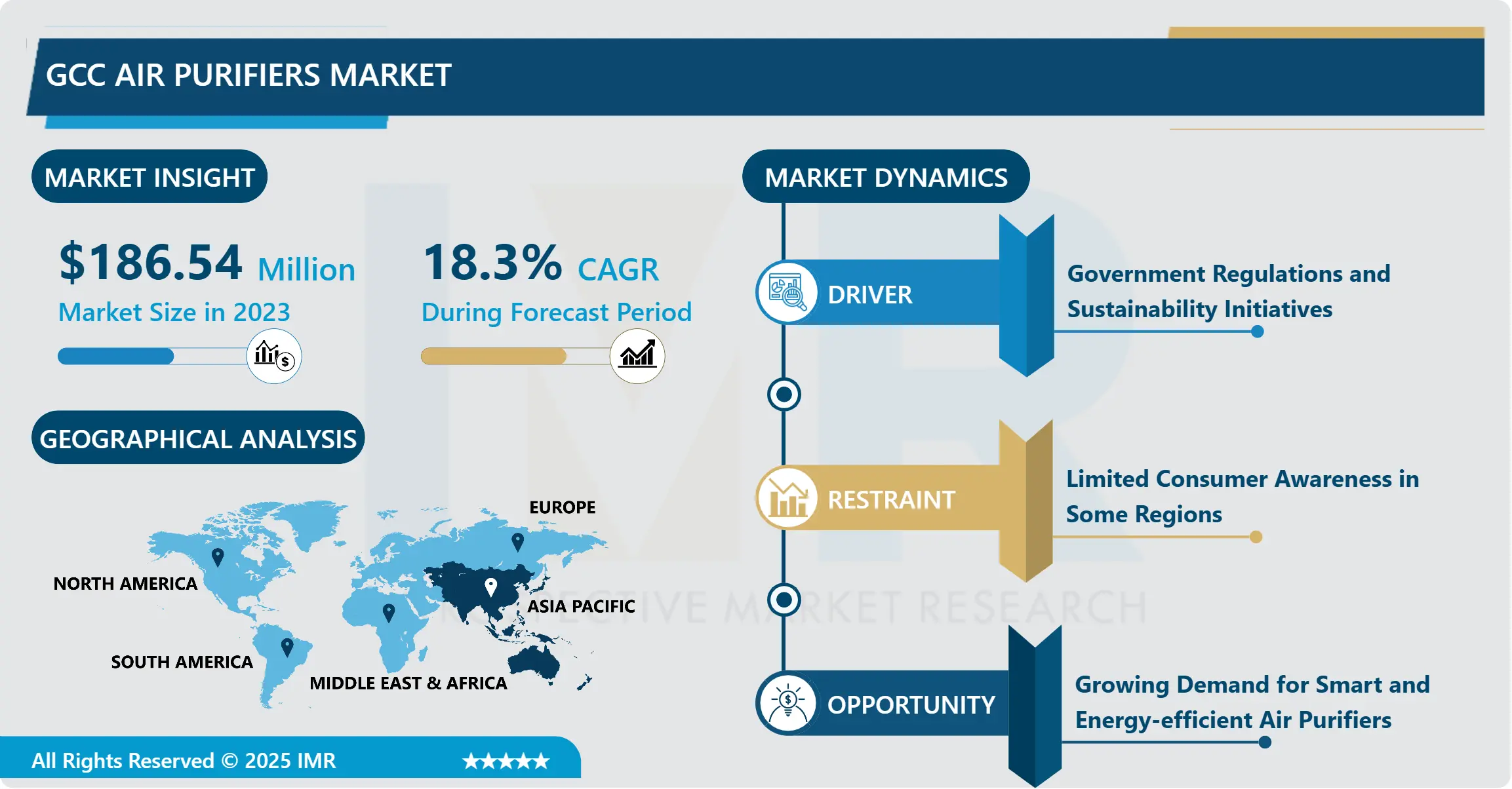
GCC Air Purifiers Market Size Was Valued at USD 186.54 Million in 2023, and is Projected to Reach USD 846.52 Million by 2032, Growing at a CAGR of 18.3% From 2024-2032

IMR Group
Description
GCC Air Purifiers Market Synopsis:
GCC Air Purifiers Market Size Was Valued at USD 186.54 Million in 2023, and is Projected to Reach USD 846.52 Million by 2032, Growing at a CAGR of 18.3% From 2024-2032
The GCC Air Purifiers market means the business activity within the Gulf Cooperation Council states that relates to the development, supply and distribution of air purifiers which are used to clean the air and eliminate pollutants, allergens and other irritants. These purifiers are developed for home, business, and industrial use for the GCC countries, Saudi Arabia, UAE, Qatar, Kuwait, Oman, and Bahrain. The market includes different types of products including HEPA, activated carbon, ionizers, UV based products, ozone and other solutions. Rising awareness of the air quality and health concerns and environmental issues have led to increased demand for air purifiers region.
The significant factor catalyzing the growth of the GCC Air Purifiers market includes a substantial increase in air pollutant concentrations. Population growth, increase in industries, growing urbanization and number of cars degrade the quality of the air. This has therefore created a demand for means to provide efficient air purification for both homes as well as business places. Also, the environmental conditions of this region leaning towards hot, especially those in Saudi Arabia and the UAE make pollution worse, forcing more consumers and corporations to invest in air purifiers to improve Indoor Air Quality (IAQ).
The other is rising awareness of citizens’ health issues whereby citizens are exposed to respiratory diseases and allergies due to dust, smoke and pollen. As the number of asthmas, chronic respiratory diseases, and other maladies associated with bad air is on the rise, people are likely to purchase air purifiers as they reduce such risks. This trend is more popular in health-related facilities, learning institutions, and households with persons with disability or the aged.
GCC Air Purifiers Market Trend Analysis:
Rise of new age technology features
The pursuing aspects present a few significant trends in the context of the GCC Air Purifiers market: A steady rise of new age technology features. People are looking for greater purification capacity, corresponding connectivity, and extra functionality such as air purity sensors, Wi-Fi capabilities, and applications. Customer also tend to buy models that are energy efficient and easy to maintain the models in the refrigerator. Manufacturers are aiming at developing products that are smart, which can be operated remotely using a mobile app, in line with other smart home devices in the region.
Besides, the market is also moving more to green and sustainable products. People in the GCC are increasingly becoming sensitive to environmental conservation, and they prefer to use air purifiers that employ does not use toxic agents such as HEPA filters, and activated carbon filters. It also should be mentioned that the penetration of air purified solutions has also increased due to government regulations to protect environment and its effects on products.
The increasing knowledge about the adverse impact
The increasing knowledge about the adverse impact of poor-quality air in the GCC region is a major boon for the growth of the Air Purifiers market in the region. There is a lot of opportunity for market growth in meeting consumers requirements of health and well-being for residential as well as the business world. New opportunities for growth and expansion for air purifying manufacturers include the increasing need for the product in residential spaces because many people work from home and stay indoors.
Furthermore, the government measures promoting better air quality and decreasing pollution rates are the chance for air purifier manufacturers on public and private partnerships. There is increasing trend toward green technology which will result in incentives for using air purification systems in public areas, health facilities, schools, and workplace. The escalating cases of large-scale structures such as high rise building and commercial facilities within the influential urban areas also provide manufacturers with opportunities to market their products for large-scale facility installations.
GCC Air Purifiers Market Segment Analysis:
GCC Air Purifiers Market is Segmented on the basis of Product Type, Application, End-User, and Region
By Product Type, HEPA Air Purifiers segment is expected to dominate the market during the forecast period
The GCC Air Purifiers market has been divided into several types in terms of the filtration technology used. There are several different types of air purifiers, but some of the most familiar and effective, include the HEPA or High-Efficiency Particle Arresting air purifiers, capable of trapping at least 99.97% of airborne particles including dust, pollen and pet dander. Activated carbon air purifiers are aimed to eliminate smells, gases and chemicals including volatile organic compounds (VOC). According to a study ionizer air purifiers function through the emission of negative ions that pull in particles in the air. UV air purifiers employ ultraviolet light to eliminate bacteria and viruses, germs in the environment while ozone air purifiers create ozone to remove odors and pollutants. Other specialty air cleansers may use this approach and incorporate several technologies at the same time.
By Application, Residential segment expected to held the largest share
The GCC Air Purifiers market is segmented on the basis of application – residential, commercial and industrial. In homes, air purifiers are familiar devices that help to fresh the air inside homes that have been infected or influenced by pollution or allergens. In official business premises, hotels, supermarket and supermarket air conditioner, they assist in providing a healthy surrounding to the employees and clients. Industrial sector embraces air purification systems used in industries, production facilities plants where dusty environment requires air management for worker health and/or compliance with health regulatory provisions.
GCC Air Purifiers Market Regional Insights:
Asia Pacific is Expected to Dominate the Market Over the Forecast period
The APAC (Asia-Pacific) region is dominating country in the air purifiers market. This dominance is mainly driven by severe air pollution problems caused by rapid industrialization, urbanization, and the heavy use of coal for energy. Rising public awareness about the health risks associated with poor air quality, such as respiratory diseases and allergies, has fueled strong consumer demand for air purifiers in homes, schools, and offices.
Additionally, government regulations and initiatives to control indoor air quality have further encouraged both residential and commercial adoption. China’s massive population, growing middle class with higher disposable incomes, and increasing focus on health and wellness products solidify its position as the largest market for air purifiers in APAC. Major local and international brands also prioritize China due to its sheer market size and growth potential.
Active Key Players in the GCC Air Purifiers Market:
Blueair (UAE)
Daikin Industries (UAE)
Honeywell (UAE)
LG Electronics (UAE)
Midea Group (UAE)
Panasonic Corporation (UAE)
Philips (UAE)
Samsung Electronics (UAE)
Sharp Corporation (UAE)
Xiaomi Corporation (UAE)
Other Active Players
Chapter 1: Introduction
1.1 Scope and Coverage
Chapter 2:Executive Summary
Chapter 3: Market Landscape
3.1 Market Dynamics
3.1.1 Drivers
3.1.2 Restraints
3.1.3 Opportunities
3.1.4 Challenges
3.2 Market Trend Analysis
3.3 PESTLE Analysis
3.4 Porter’s Five Forces Analysis
3.5 Industry Value Chain Analysis
3.6 Ecosystem
3.7 Regulatory Landscape
3.8 Price Trend Analysis
3.9 Patent Analysis
3.10 Technology Evolution
3.11 Investment Pockets
3.12 Import-Export Analysis
Chapter 4: GCC Air Purifiers Market by Product Type
4.1 GCC Air Purifiers Market Snapshot and Growth Engine
4.2 GCC Air Purifiers Market Overview
4.3 HEPA Air Purifiers
4.3.1 Introduction and Market Overview
4.3.2 Historic and Forecasted Market Size in Value USD and Volume Units (2017-2032F)
4.3.3 Key Market Trends, Growth Factors and Opportunities
4.3.4 HEPA Air Purifiers: Geographic Segmentation Analysis
4.4 Activated Carbon Air Purifiers
4.4.1 Introduction and Market Overview
4.4.2 Historic and Forecasted Market Size in Value USD and Volume Units (2017-2032F)
4.4.3 Key Market Trends, Growth Factors and Opportunities
4.4.4 Activated Carbon Air Purifiers: Geographic Segmentation Analysis
4.5 Ionizer Air Purifiers
4.5.1 Introduction and Market Overview
4.5.2 Historic and Forecasted Market Size in Value USD and Volume Units (2017-2032F)
4.5.3 Key Market Trends, Growth Factors and Opportunities
4.5.4 Ionizer Air Purifiers: Geographic Segmentation Analysis
4.6 UV Air Purifiers
4.6.1 Introduction and Market Overview
4.6.2 Historic and Forecasted Market Size in Value USD and Volume Units (2017-2032F)
4.6.3 Key Market Trends, Growth Factors and Opportunities
4.6.4 UV Air Purifiers: Geographic Segmentation Analysis
4.7 Ozone Air Purifiers
4.7.1 Introduction and Market Overview
4.7.2 Historic and Forecasted Market Size in Value USD and Volume Units (2017-2032F)
4.7.3 Key Market Trends, Growth Factors and Opportunities
4.7.4 Ozone Air Purifiers: Geographic Segmentation Analysis
4.8 Others
4.8.1 Introduction and Market Overview
4.8.2 Historic and Forecasted Market Size in Value USD and Volume Units (2017-2032F)
4.8.3 Key Market Trends, Growth Factors and Opportunities
4.8.4 Others: Geographic Segmentation Analysis
Chapter 5: GCC Air Purifiers Market by Application
5.1 GCC Air Purifiers Market Snapshot and Growth Engine
5.2 GCC Air Purifiers Market Overview
5.3 Residential
5.3.1 Introduction and Market Overview
5.3.2 Historic and Forecasted Market Size in Value USD and Volume Units (2017-2032F)
5.3.3 Key Market Trends, Growth Factors and Opportunities
5.3.4 Residential: Geographic Segmentation Analysis
5.4 Commercial
5.4.1 Introduction and Market Overview
5.4.2 Historic and Forecasted Market Size in Value USD and Volume Units (2017-2032F)
5.4.3 Key Market Trends, Growth Factors and Opportunities
5.4.4 Commercial: Geographic Segmentation Analysis
5.5 Industrial
5.5.1 Introduction and Market Overview
5.5.2 Historic and Forecasted Market Size in Value USD and Volume Units (2017-2032F)
5.5.3 Key Market Trends, Growth Factors and Opportunities
5.5.4 Industrial: Geographic Segmentation Analysis
Chapter 6: GCC Air Purifiers Market by End-User
6.1 GCC Air Purifiers Market Snapshot and Growth Engine
6.2 GCC Air Purifiers Market Overview
6.3 Households
6.3.1 Introduction and Market Overview
6.3.2 Historic and Forecasted Market Size in Value USD and Volume Units (2017-2032F)
6.3.3 Key Market Trends, Growth Factors and Opportunities
6.3.4 Households: Geographic Segmentation Analysis
6.4 Offices
6.4.1 Introduction and Market Overview
6.4.2 Historic and Forecasted Market Size in Value USD and Volume Units (2017-2032F)
6.4.3 Key Market Trends, Growth Factors and Opportunities
6.4.4 Offices: Geographic Segmentation Analysis
6.5 Hospitals & Healthcare
6.5.1 Introduction and Market Overview
6.5.2 Historic and Forecasted Market Size in Value USD and Volume Units (2017-2032F)
6.5.3 Key Market Trends, Growth Factors and Opportunities
6.5.4 Hospitals & Healthcare: Geographic Segmentation Analysis
6.6 Hotels & Restaurants
6.6.1 Introduction and Market Overview
6.6.2 Historic and Forecasted Market Size in Value USD and Volume Units (2017-2032F)
6.6.3 Key Market Trends, Growth Factors and Opportunities
6.6.4 Hotels & Restaurants: Geographic Segmentation Analysis
6.7 Educational Institutions
6.7.1 Introduction and Market Overview
6.7.2 Historic and Forecasted Market Size in Value USD and Volume Units (2017-2032F)
6.7.3 Key Market Trends, Growth Factors and Opportunities
6.7.4 Educational Institutions: Geographic Segmentation Analysis
6.8 Others
6.8.1 Introduction and Market Overview
6.8.2 Historic and Forecasted Market Size in Value USD and Volume Units (2017-2032F)
6.8.3 Key Market Trends, Growth Factors and Opportunities
6.8.4 Others: Geographic Segmentation Analysis
Chapter 7: Company Profiles and Competitive Analysis
7.1 Competitive Landscape
7.1.1 Competitive Benchmarking
7.1.2 GCC Air Purifiers Market Share by Manufacturer (2023)
7.1.3 Industry BCG Matrix
7.1.4 Heat Map Analysis
7.1.5 Mergers and Acquisitions
7.2 BLUEAIR (UAE)
7.2.1 Company Overview
7.2.2 Key Executives
7.2.3 Company Snapshot
7.2.4 Role of the Company in the Market
7.2.5 Sustainability and Social Responsibility
7.2.6 Operating Business Segments
7.2.7 Product Portfolio
7.2.8 Business Performance
7.2.9 Key Strategic Moves and Recent Developments
7.2.10 SWOT Analysis
7.3 HONEYWELL (UAE)
7.4 PHILIPS (UAE)
7.5 SHARP CORPORATION (UAE)
7.6 LG ELECTRONICS (UAE)
7.7 SAMSUNG ELECTRONICS (UAE)
7.8 DAIKIN INDUSTRIES (UAE)
7.9 PANASONIC CORPORATION (UAE)
7.10 XIAOMI CORPORATION (UAE)
7.11 MIDEA GROUP (UAE)
7.12 OTHER ACTIVE PLAYERS
Chapter 8: Global GCC Air Purifiers Market By Region
8.1 Overview
8.2. North America GCC Air Purifiers Market
8.2.1 Key Market Trends, Growth Factors and Opportunities
8.2.2 Top Key Companies
8.2.3 Historic and Forecasted Market Size by Segments
8.2.4 Historic and Forecasted Market Size By Product Type
8.2.4.1 HEPA Air Purifiers
8.2.4.2 Activated Carbon Air Purifiers
8.2.4.3 Ionizer Air Purifiers
8.2.4.4 UV Air Purifiers
8.2.4.5 Ozone Air Purifiers
8.2.4.6 Others
8.2.5 Historic and Forecasted Market Size By Application
8.2.5.1 Residential
8.2.5.2 Commercial
8.2.5.3 Industrial
8.2.6 Historic and Forecasted Market Size By End-User
8.2.6.1 Households
8.2.6.2 Offices
8.2.6.3 Hospitals & Healthcare
8.2.6.4 Hotels & Restaurants
8.2.6.5 Educational Institutions
8.2.6.6 Others
8.2.7 Historic and Forecast Market Size by Country
8.2.7.1 US
8.2.7.2 Canada
8.2.7.3 Mexico
8.3. Eastern Europe GCC Air Purifiers Market
8.3.1 Key Market Trends, Growth Factors and Opportunities
8.3.2 Top Key Companies
8.3.3 Historic and Forecasted Market Size by Segments
8.3.4 Historic and Forecasted Market Size By Product Type
8.3.4.1 HEPA Air Purifiers
8.3.4.2 Activated Carbon Air Purifiers
8.3.4.3 Ionizer Air Purifiers
8.3.4.4 UV Air Purifiers
8.3.4.5 Ozone Air Purifiers
8.3.4.6 Others
8.3.5 Historic and Forecasted Market Size By Application
8.3.5.1 Residential
8.3.5.2 Commercial
8.3.5.3 Industrial
8.3.6 Historic and Forecasted Market Size By End-User
8.3.6.1 Households
8.3.6.2 Offices
8.3.6.3 Hospitals & Healthcare
8.3.6.4 Hotels & Restaurants
8.3.6.5 Educational Institutions
8.3.6.6 Others
8.3.7 Historic and Forecast Market Size by Country
8.3.7.1 Russia
8.3.7.2 Bulgaria
8.3.7.3 The Czech Republic
8.3.7.4 Hungary
8.3.7.5 Poland
8.3.7.6 Romania
8.3.7.7 Rest of Eastern Europe
8.4. Western Europe GCC Air Purifiers Market
8.4.1 Key Market Trends, Growth Factors and Opportunities
8.4.2 Top Key Companies
8.4.3 Historic and Forecasted Market Size by Segments
8.4.4 Historic and Forecasted Market Size By Product Type
8.4.4.1 HEPA Air Purifiers
8.4.4.2 Activated Carbon Air Purifiers
8.4.4.3 Ionizer Air Purifiers
8.4.4.4 UV Air Purifiers
8.4.4.5 Ozone Air Purifiers
8.4.4.6 Others
8.4.5 Historic and Forecasted Market Size By Application
8.4.5.1 Residential
8.4.5.2 Commercial
8.4.5.3 Industrial
8.4.6 Historic and Forecasted Market Size By End-User
8.4.6.1 Households
8.4.6.2 Offices
8.4.6.3 Hospitals & Healthcare
8.4.6.4 Hotels & Restaurants
8.4.6.5 Educational Institutions
8.4.6.6 Others
8.4.7 Historic and Forecast Market Size by Country
8.4.7.1 Germany
8.4.7.2 UK
8.4.7.3 France
8.4.7.4 The Netherlands
8.4.7.5 Italy
8.4.7.6 Spain
8.4.7.7 Rest of Western Europe
8.5. Asia Pacific GCC Air Purifiers Market
8.5.1 Key Market Trends, Growth Factors and Opportunities
8.5.2 Top Key Companies
8.5.3 Historic and Forecasted Market Size by Segments
8.5.4 Historic and Forecasted Market Size By Product Type
8.5.4.1 HEPA Air Purifiers
8.5.4.2 Activated Carbon Air Purifiers
8.5.4.3 Ionizer Air Purifiers
8.5.4.4 UV Air Purifiers
8.5.4.5 Ozone Air Purifiers
8.5.4.6 Others
8.5.5 Historic and Forecasted Market Size By Application
8.5.5.1 Residential
8.5.5.2 Commercial
8.5.5.3 Industrial
8.5.6 Historic and Forecasted Market Size By End-User
8.5.6.1 Households
8.5.6.2 Offices
8.5.6.3 Hospitals & Healthcare
8.5.6.4 Hotels & Restaurants
8.5.6.5 Educational Institutions
8.5.6.6 Others
8.5.7 Historic and Forecast Market Size by Country
8.5.7.1 China
8.5.7.2 India
8.5.7.3 Japan
8.5.7.4 South Korea
8.5.7.5 Malaysia
8.5.7.6 Thailand
8.5.7.7 Vietnam
8.5.7.8 The Philippines
8.5.7.9 Australia
8.5.7.10 New Zealand
8.5.7.11 Rest of APAC
8.6. Middle East & Africa GCC Air Purifiers Market
8.6.1 Key Market Trends, Growth Factors and Opportunities
8.6.2 Top Key Companies
8.6.3 Historic and Forecasted Market Size by Segments
8.6.4 Historic and Forecasted Market Size By Product Type
8.6.4.1 HEPA Air Purifiers
8.6.4.2 Activated Carbon Air Purifiers
8.6.4.3 Ionizer Air Purifiers
8.6.4.4 UV Air Purifiers
8.6.4.5 Ozone Air Purifiers
8.6.4.6 Others
8.6.5 Historic and Forecasted Market Size By Application
8.6.5.1 Residential
8.6.5.2 Commercial
8.6.5.3 Industrial
8.6.6 Historic and Forecasted Market Size By End-User
8.6.6.1 Households
8.6.6.2 Offices
8.6.6.3 Hospitals & Healthcare
8.6.6.4 Hotels & Restaurants
8.6.6.5 Educational Institutions
8.6.6.6 Others
8.6.7 Historic and Forecast Market Size by Country
8.6.7.1 Turkiye
8.6.7.2 Bahrain
8.6.7.3 Kuwait
8.6.7.4 Saudi Arabia
8.6.7.5 Qatar
8.6.7.6 UAE
8.6.7.7 Israel
8.6.7.8 South Africa
8.7. South America GCC Air Purifiers Market
8.7.1 Key Market Trends, Growth Factors and Opportunities
8.7.2 Top Key Companies
8.7.3 Historic and Forecasted Market Size by Segments
8.7.4 Historic and Forecasted Market Size By Product Type
8.7.4.1 HEPA Air Purifiers
8.7.4.2 Activated Carbon Air Purifiers
8.7.4.3 Ionizer Air Purifiers
8.7.4.4 UV Air Purifiers
8.7.4.5 Ozone Air Purifiers
8.7.4.6 Others
8.7.5 Historic and Forecasted Market Size By Application
8.7.5.1 Residential
8.7.5.2 Commercial
8.7.5.3 Industrial
8.7.6 Historic and Forecasted Market Size By End-User
8.7.6.1 Households
8.7.6.2 Offices
8.7.6.3 Hospitals & Healthcare
8.7.6.4 Hotels & Restaurants
8.7.6.5 Educational Institutions
8.7.6.6 Others
8.7.7 Historic and Forecast Market Size by Country
8.7.7.1 Brazil
8.7.7.2 Argentina
8.7.7.3 Rest of SA
Chapter 9 Analyst Viewpoint and Conclusion
9.1 Recommendations and Concluding Analysis
9.2 Potential Market Strategies
Chapter 10 Research Methodology
10.1 Research Process
10.2 Primary Research
10.3 Secondary Research
Q1: What would be the forecast period in the GCC Air Purifiers Market research report?
A1: The forecast period in the GCC Air Purifiers Market research report is 2024-2032.
Q2: Who are the key players in the GCC Air Purifiers Market?
A2: Blueair (UAE), Honeywell (UAE), Philips (UAE), Sharp Corporation (UAE), LG Electronics (UAE), Samsung Electronics (UAE), Daikin Industries (UAE), Panasonic Corporation (UAE), Xiaomi Corporation (UAE), Midea Group (UAE) and Other Active Players.
Q3: What are the segments of the GCC Air Purifiers Market?
A3: The GCC Air Purifiers Market is segmented into By Product Type, By Application, By End-User and region. By Product Type, the market is categorized into HEPA Air Purifiers, Activated Carbon Air Purifiers, Ionizer Air Purifiers, UV Air Purifiers, Ozone Air Purifiers, Others, By Application, the market is categorized into Residential, Commercial, Industrial. By End-User, the market is categorized into Households, Offices, Hospitals & Healthcare, Hotels & Restaurants, Educational Institutions. By Region North America (U.S., Canada, Mexico), Eastern Europe (Russia, Bulgaria, The Czech Republic, Hungary, Poland, Romania, Rest of Eastern Europe), Western Europe (Germany, UK, France, The Netherlands, Italy, Russia, Spain, Rest of Western Europe), Asia Pacific (China, India, Japan, South Korea, Malaysia, Thailand, Vietnam, The Philippines, Australia, New-Zealand, Rest of APAC), Middle East & Africa (Turkiye, Bahrain, Kuwait, Saudi Arabia, Qatar, UAE, Israel, South Africa), South America (Brazil, Argentina, Rest of SA).
Q4: What is the GCC Air Purifiers Market?
A4: The GCC Air Purifiers market means the business activity within the Gulf Cooperation Council states that relates to the development, supply and distribution of air purifiers which are used to clean the air and eliminate pollutants, allergens and other irritants. These purifiers are developed for home, business, and industrial use for the GCC countries, Saudi Arabia, UAE, Qatar, Kuwait, Oman, and Bahrain. The market includes different types of products including HEPA, activated carbon, ionizers, UV based products, ozone and other solutions. Rising awareness of the air quality and health concerns and environmental issues have led to increased demand for air purifiers region
Q5: How big is theGCC Air Purifiers Market?
A5: Size Was Valued at USD 186.54 Million in 2023, and is Projected to Reach USD 846.52 Million by 2032, Growing at a CAGR of 18.3% From 2024-2032
How to Buy a Report from eminsights.jp
On the product page, choose the license you want: Single-User License, Multi-User License or Enterprise License.
If you required report in your native language, then you can click on Translated Report button and fill out the form with report name and language you want, then our team will contact you as soon as possible.
Click the Buy Now button.
You will be redirected to the checkout page. Enter your company details and payment information.
Click Place Order to complete the purchase.
Confirmation: You’ll receive an order confirmation and our team will contact you shortly with your ordered report.
If you have any questions, fill out the contact form below or email us at bizdev@eminsights.net.
Thank you for choosing eminsights.jp!