Stay Ahead in Fast-Growing Economies.
Browse Reports Now
Gamification Market – Global Analysis and Forecast (2024-2032)
Gamification market is defined as the application of game design and mechanics, including points, badges, and leader boards, in areas other than traditional games to increase motivation, stimulate progress, and improve processes in areas including education and healthcare, marketing, and corporate performance.

IMR Group
Description
Gamification Market Synopsis:
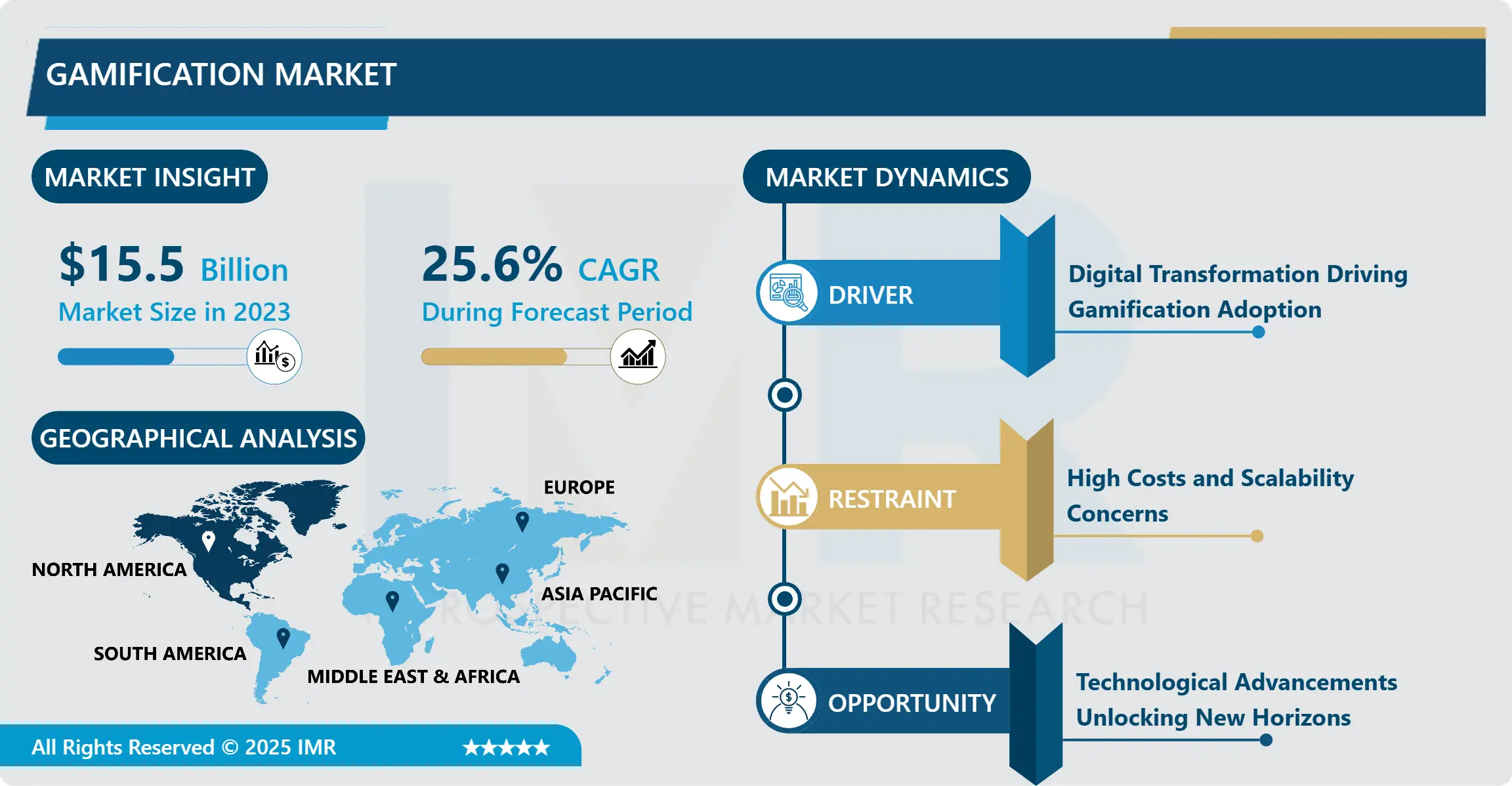
Gamification Market Size Was Valued at USD 15.50 Billion in 2023, and is Projected to Reach USD 120.57 Billion by 2032, Growing at a CAGR of 25.60% From 2024-2032.
Gamification market is defined as the application of game design and mechanics, including points, badges, and leader boards, in areas other than traditional games to increase motivation, stimulate progress, and improve processes in areas including education and healthcare, marketing, and corporate performance.
One of the greatest advantages of gamification is in using game design to design a certain way, use them to make tasks and processes more fun and exciting for the users. More organizations of the business sector are incorporating game elements in their operations to improve the customer relations, consumer loyalty and even employee productivity. A continued increase in the digitization of business processes and the widespread use of mobile devices has also stimulated the integration of gamification into companies’ models.
Using of games in business activities as well as in marketing management courses and promotional campaigns has been shown to enhance retention and performance. Schools are implementing play elements to enhance learners’ participation whereas companies and businesses apply gaming related methods to train their employees. These observations are further compounded by the progress made in the application of artificial intelligence and analytics which allows for real time consumer analysis.
Gamification Market Trend Analysis:
Expansion into Healthcare and BFSI
One of the trends in gamification systems is the introduction of artificial intelligence or AI which bring novel concepts of customization to the market. Machine intelligence facilitates the identification of the learning route, as well as its predictive and context-sensitive nature that enhances content customization and, accordingly, satisfaction rates. Companies are seeking to generate increased engagement and interaction with user by using AI driven gamified forms.
It is now implemented and applied, although in a limited method, across diverse orless expected industries such as healthcare and BFSI, which stands for Banking, Financial Services, and Insurance. In the area of application, popular healthcare applications such as fitness challenges and medication reminders have been gamified, and in the BFSI field, gamification has been applied to promote financial literacy, as well as to upgrade customers’ onboard journey process.
Integration with Emerging Technologies:
Combine this with advanced technologies such as AR/VR, blockchain, IoT, and many other related concepts, and the business potential is in the billions. Augmented and virtual reality offer credibility to gamified approaches to the environment, while blockchain sheds light and compliments security for rewards. This technology application is likely to create additional revenues and diverse applications in different industries.
Currently, the utilization of gamification is increasingly common in Asia-Pacific, Latin America, and Middle Eastern emerging markets thanks to the growing smartphone ownership rates and better internet connections. The increased demand of SMEs for applying gamification tools for boosting productivity and customer satisfaction expands opportunities in these regions.
Gamification Market Segment Analysis:
Gamification Market is Segmented on the basis of Component, Deployment, Application, End User, and Region
By Component, Services segment is expected to dominate the market during the forecast period
The market is divided into two primary categories along the solutions and services spectrum. Such software and platforms together with services are solutions within marketing, education and health care field in participation, entertainment and measurement. Consulting and implementation services work within the realm of gamification to help incorporate different strategies into current systems.
By Application, Marketing segment expected to held the largest share
Main areas where gamification is applied are marketing, which helps companies to involve customers and increase their loyalty due to the usage of gamified campaigns; sales, which motivates the sales force; product development, which increases the share of innovation; employee engagement, which increases motivation in the workplace; and customer support and training, which can be developed into gamified modules.
Gamification Market Regional Insights:
North America is Expected to Dominate the Market Over the Forecast period
At the present, North America has the largest market share since it has better technological support and the first company embraced the gamifying solutions. The embedding of the key actors of major industries and the increased usage of the smartphones and other digital platforms contribute to the rapid integration of gamification processes in the retail, educational and health-care settings.
In addition, the United States Is leading the growth rate of the region mainly because of the investments in new technologies, the high demand for the tools that engage employees and the availability of the startup culture. As integration of AI and big data advance, North America remains the most dynamic region in the advancement of gamification trends.
Active Key Players in the Gamification Market:
Badgeville (USA)
BI Worldwide (USA)
Bunchball Inc. (USA)
Centrical (Israel)
Gamify (Australia)
Kahoot! (Norway)
Mambo.IO (UK)
Microsoft Corporation (USA)
Salesforce (USA)
SAP SE (Germany)
Other Active Players
Chapter 1: Introduction
1.1 Scope and Coverage
Chapter 2:Executive Summary
Chapter 3: Market Landscape
3.1 Market Dynamics
3.1.1 Drivers
3.1.2 Restraints
3.1.3 Opportunities
3.1.4 Challenges
3.2 Market Trend Analysis
3.3 PESTLE Analysis
3.4 Porter’s Five Forces Analysis
3.5 Industry Value Chain Analysis
3.6 Ecosystem
3.7 Regulatory Landscape
3.8 Price Trend Analysis
3.9 Patent Analysis
3.10 Technology Evolution
3.11 Investment Pockets
3.12 Import-Export Analysis
Chapter 4: Gamification Market by Component
4.1 Gamification Market Snapshot and Growth Engine
4.2 Gamification Market Overview
4.3 Solutions
4.3.1 Introduction and Market Overview
4.3.2 Historic and Forecasted Market Size in Value USD and Volume Units (2017-2032F)
4.3.3 Key Market Trends, Growth Factors and Opportunities
4.3.4 Solutions: Geographic Segmentation Analysis
4.4 Services
4.4.1 Introduction and Market Overview
4.4.2 Historic and Forecasted Market Size in Value USD and Volume Units (2017-2032F)
4.4.3 Key Market Trends, Growth Factors and Opportunities
4.4.4 Services: Geographic Segmentation Analysis
Chapter 5: Gamification Market by Deployment
5.1 Gamification Market Snapshot and Growth Engine
5.2 Gamification Market Overview
5.3 Cloud
5.3.1 Introduction and Market Overview
5.3.2 Historic and Forecasted Market Size in Value USD and Volume Units (2017-2032F)
5.3.3 Key Market Trends, Growth Factors and Opportunities
5.3.4 Cloud: Geographic Segmentation Analysis
5.4 On-Premises
5.4.1 Introduction and Market Overview
5.4.2 Historic and Forecasted Market Size in Value USD and Volume Units (2017-2032F)
5.4.3 Key Market Trends, Growth Factors and Opportunities
5.4.4 On-Premises: Geographic Segmentation Analysis
Chapter 6: Gamification Market by Application
6.1 Gamification Market Snapshot and Growth Engine
6.2 Gamification Market Overview
6.3 ing
6.3.1 Introduction and Market Overview
6.3.2 Historic and Forecasted Market Size in Value USD and Volume Units (2017-2032F)
6.3.3 Key Market Trends, Growth Factors and Opportunities
6.3.4 ing: Geographic Segmentation Analysis
6.4 Sales
6.4.1 Introduction and Market Overview
6.4.2 Historic and Forecasted Market Size in Value USD and Volume Units (2017-2032F)
6.4.3 Key Market Trends, Growth Factors and Opportunities
6.4.4 Sales: Geographic Segmentation Analysis
6.5 Product Development
6.5.1 Introduction and Market Overview
6.5.2 Historic and Forecasted Market Size in Value USD and Volume Units (2017-2032F)
6.5.3 Key Market Trends, Growth Factors and Opportunities
6.5.4 Product Development: Geographic Segmentation Analysis
6.6 Employee Engagement
6.6.1 Introduction and Market Overview
6.6.2 Historic and Forecasted Market Size in Value USD and Volume Units (2017-2032F)
6.6.3 Key Market Trends, Growth Factors and Opportunities
6.6.4 Employee Engagement: Geographic Segmentation Analysis
6.7 Others
6.7.1 Introduction and Market Overview
6.7.2 Historic and Forecasted Market Size in Value USD and Volume Units (2017-2032F)
6.7.3 Key Market Trends, Growth Factors and Opportunities
6.7.4 Others: Geographic Segmentation Analysis
Chapter 7: Gamification Market by End User
7.1 Gamification Market Snapshot and Growth Engine
7.2 Gamification Market Overview
7.3 Retail
7.3.1 Introduction and Market Overview
7.3.2 Historic and Forecasted Market Size in Value USD and Volume Units (2017-2032F)
7.3.3 Key Market Trends, Growth Factors and Opportunities
7.3.4 Retail: Geographic Segmentation Analysis
7.4 Education
7.4.1 Introduction and Market Overview
7.4.2 Historic and Forecasted Market Size in Value USD and Volume Units (2017-2032F)
7.4.3 Key Market Trends, Growth Factors and Opportunities
7.4.4 Education: Geographic Segmentation Analysis
7.5 Healthcare
7.5.1 Introduction and Market Overview
7.5.2 Historic and Forecasted Market Size in Value USD and Volume Units (2017-2032F)
7.5.3 Key Market Trends, Growth Factors and Opportunities
7.5.4 Healthcare: Geographic Segmentation Analysis
7.6 Banking
7.6.1 Introduction and Market Overview
7.6.2 Historic and Forecasted Market Size in Value USD and Volume Units (2017-2032F)
7.6.3 Key Market Trends, Growth Factors and Opportunities
7.6.4 Banking: Geographic Segmentation Analysis
7.7 Financial Services
7.7.1 Introduction and Market Overview
7.7.2 Historic and Forecasted Market Size in Value USD and Volume Units (2017-2032F)
7.7.3 Key Market Trends, Growth Factors and Opportunities
7.7.4 Financial Services: Geographic Segmentation Analysis
7.8 and Insurance (BFSI
7.8.1 Introduction and Market Overview
7.8.2 Historic and Forecasted Market Size in Value USD and Volume Units (2017-2032F)
7.8.3 Key Market Trends, Growth Factors and Opportunities
7.8.4 and Insurance (BFSI: Geographic Segmentation Analysis
7.9 IT and Telecommunications
7.9.1 Introduction and Market Overview
7.9.2 Historic and Forecasted Market Size in Value USD and Volume Units (2017-2032F)
7.9.3 Key Market Trends, Growth Factors and Opportunities
7.9.4 IT and Telecommunications: Geographic Segmentation Analysis
7.10 Media and Entertainment
7.10.1 Introduction and Market Overview
7.10.2 Historic and Forecasted Market Size in Value USD and Volume Units (2017-2032F)
7.10.3 Key Market Trends, Growth Factors and Opportunities
7.10.4 Media and Entertainment: Geographic Segmentation Analysis
7.11 Others
7.11.1 Introduction and Market Overview
7.11.2 Historic and Forecasted Market Size in Value USD and Volume Units (2017-2032F)
7.11.3 Key Market Trends, Growth Factors and Opportunities
7.11.4 Others: Geographic Segmentation Analysis
Chapter 8: Company Profiles and Competitive Analysis
8.1 Competitive Landscape
8.1.1 Competitive Benchmarking
8.1.2 Gamification Market Share by Manufacturer (2023)
8.1.3 Industry BCG Matrix
8.1.4 Heat Map Analysis
8.1.5 Mergers and Acquisitions
8.2 MICROSOFT CORPORATION (USA)
8.2.1 Company Overview
8.2.2 Key Executives
8.2.3 Company Snapshot
8.2.4 Role of the Company in the Market
8.2.5 Sustainability and Social Responsibility
8.2.6 Operating Business Segments
8.2.7 Product Portfolio
8.2.8 Business Performance
8.2.9 Key Strategic Moves and Recent Developments
8.2.10 SWOT Analysis
8.3 SALESFORCE (USA)
8.4 BADGEVILLE (USA)
8.5 SAP SE (GERMANY)
8.6 BI WORLDWIDE (USA)
8.7 BUNCHBALL INC. (USA)
8.8 GAMIFY (AUSTRALIA)
8.9 MAMBO.IO (UK)
8.10 CENTRICAL (ISRAEL)
8.11 KAHOOT! (NORWAY)
8.12 OTHER ACTIVE PLAYERS
Chapter 9: Global Gamification Market By Region
9.1 Overview
9.2. North America Gamification Market
9.2.1 Key Market Trends, Growth Factors and Opportunities
9.2.2 Top Key Companies
9.2.3 Historic and Forecasted Market Size by Segments
9.2.4 Historic and Forecasted Market Size By Component
9.2.4.1 Solutions
9.2.4.2 Services
9.2.5 Historic and Forecasted Market Size By Deployment
9.2.5.1 Cloud
9.2.5.2 On-Premises
9.2.6 Historic and Forecasted Market Size By Application
9.2.6.1 ing
9.2.6.2 Sales
9.2.6.3 Product Development
9.2.6.4 Employee Engagement
9.2.6.5 Others
9.2.7 Historic and Forecasted Market Size By End User
9.2.7.1 Retail
9.2.7.2 Education
9.2.7.3 Healthcare
9.2.7.4 Banking
9.2.7.5 Financial Services
9.2.7.6 and Insurance (BFSI
9.2.7.7 IT and Telecommunications
9.2.7.8 Media and Entertainment
9.2.7.9 Others
9.2.8 Historic and Forecast Market Size by Country
9.2.8.1 US
9.2.8.2 Canada
9.2.8.3 Mexico
9.3. Eastern Europe Gamification Market
9.3.1 Key Market Trends, Growth Factors and Opportunities
9.3.2 Top Key Companies
9.3.3 Historic and Forecasted Market Size by Segments
9.3.4 Historic and Forecasted Market Size By Component
9.3.4.1 Solutions
9.3.4.2 Services
9.3.5 Historic and Forecasted Market Size By Deployment
9.3.5.1 Cloud
9.3.5.2 On-Premises
9.3.6 Historic and Forecasted Market Size By Application
9.3.6.1 ing
9.3.6.2 Sales
9.3.6.3 Product Development
9.3.6.4 Employee Engagement
9.3.6.5 Others
9.3.7 Historic and Forecasted Market Size By End User
9.3.7.1 Retail
9.3.7.2 Education
9.3.7.3 Healthcare
9.3.7.4 Banking
9.3.7.5 Financial Services
9.3.7.6 and Insurance (BFSI
9.3.7.7 IT and Telecommunications
9.3.7.8 Media and Entertainment
9.3.7.9 Others
9.3.8 Historic and Forecast Market Size by Country
9.3.8.1 Russia
9.3.8.2 Bulgaria
9.3.8.3 The Czech Republic
9.3.8.4 Hungary
9.3.8.5 Poland
9.3.8.6 Romania
9.3.8.7 Rest of Eastern Europe
9.4. Western Europe Gamification Market
9.4.1 Key Market Trends, Growth Factors and Opportunities
9.4.2 Top Key Companies
9.4.3 Historic and Forecasted Market Size by Segments
9.4.4 Historic and Forecasted Market Size By Component
9.4.4.1 Solutions
9.4.4.2 Services
9.4.5 Historic and Forecasted Market Size By Deployment
9.4.5.1 Cloud
9.4.5.2 On-Premises
9.4.6 Historic and Forecasted Market Size By Application
9.4.6.1 ing
9.4.6.2 Sales
9.4.6.3 Product Development
9.4.6.4 Employee Engagement
9.4.6.5 Others
9.4.7 Historic and Forecasted Market Size By End User
9.4.7.1 Retail
9.4.7.2 Education
9.4.7.3 Healthcare
9.4.7.4 Banking
9.4.7.5 Financial Services
9.4.7.6 and Insurance (BFSI
9.4.7.7 IT and Telecommunications
9.4.7.8 Media and Entertainment
9.4.7.9 Others
9.4.8 Historic and Forecast Market Size by Country
9.4.8.1 Germany
9.4.8.2 UK
9.4.8.3 France
9.4.8.4 The Netherlands
9.4.8.5 Italy
9.4.8.6 Spain
9.4.8.7 Rest of Western Europe
9.5. Asia Pacific Gamification Market
9.5.1 Key Market Trends, Growth Factors and Opportunities
9.5.2 Top Key Companies
9.5.3 Historic and Forecasted Market Size by Segments
9.5.4 Historic and Forecasted Market Size By Component
9.5.4.1 Solutions
9.5.4.2 Services
9.5.5 Historic and Forecasted Market Size By Deployment
9.5.5.1 Cloud
9.5.5.2 On-Premises
9.5.6 Historic and Forecasted Market Size By Application
9.5.6.1 ing
9.5.6.2 Sales
9.5.6.3 Product Development
9.5.6.4 Employee Engagement
9.5.6.5 Others
9.5.7 Historic and Forecasted Market Size By End User
9.5.7.1 Retail
9.5.7.2 Education
9.5.7.3 Healthcare
9.5.7.4 Banking
9.5.7.5 Financial Services
9.5.7.6 and Insurance (BFSI
9.5.7.7 IT and Telecommunications
9.5.7.8 Media and Entertainment
9.5.7.9 Others
9.5.8 Historic and Forecast Market Size by Country
9.5.8.1 China
9.5.8.2 India
9.5.8.3 Japan
9.5.8.4 South Korea
9.5.8.5 Malaysia
9.5.8.6 Thailand
9.5.8.7 Vietnam
9.5.8.8 The Philippines
9.5.8.9 Australia
9.5.8.10 New Zealand
9.5.8.11 Rest of APAC
9.6. Middle East & Africa Gamification Market
9.6.1 Key Market Trends, Growth Factors and Opportunities
9.6.2 Top Key Companies
9.6.3 Historic and Forecasted Market Size by Segments
9.6.4 Historic and Forecasted Market Size By Component
9.6.4.1 Solutions
9.6.4.2 Services
9.6.5 Historic and Forecasted Market Size By Deployment
9.6.5.1 Cloud
9.6.5.2 On-Premises
9.6.6 Historic and Forecasted Market Size By Application
9.6.6.1 ing
9.6.6.2 Sales
9.6.6.3 Product Development
9.6.6.4 Employee Engagement
9.6.6.5 Others
9.6.7 Historic and Forecasted Market Size By End User
9.6.7.1 Retail
9.6.7.2 Education
9.6.7.3 Healthcare
9.6.7.4 Banking
9.6.7.5 Financial Services
9.6.7.6 and Insurance (BFSI
9.6.7.7 IT and Telecommunications
9.6.7.8 Media and Entertainment
9.6.7.9 Others
9.6.8 Historic and Forecast Market Size by Country
9.6.8.1 Turkiye
9.6.8.2 Bahrain
9.6.8.3 Kuwait
9.6.8.4 Saudi Arabia
9.6.8.5 Qatar
9.6.8.6 UAE
9.6.8.7 Israel
9.6.8.8 South Africa
9.7. South America Gamification Market
9.7.1 Key Market Trends, Growth Factors and Opportunities
9.7.2 Top Key Companies
9.7.3 Historic and Forecasted Market Size by Segments
9.7.4 Historic and Forecasted Market Size By Component
9.7.4.1 Solutions
9.7.4.2 Services
9.7.5 Historic and Forecasted Market Size By Deployment
9.7.5.1 Cloud
9.7.5.2 On-Premises
9.7.6 Historic and Forecasted Market Size By Application
9.7.6.1 ing
9.7.6.2 Sales
9.7.6.3 Product Development
9.7.6.4 Employee Engagement
9.7.6.5 Others
9.7.7 Historic and Forecasted Market Size By End User
9.7.7.1 Retail
9.7.7.2 Education
9.7.7.3 Healthcare
9.7.7.4 Banking
9.7.7.5 Financial Services
9.7.7.6 and Insurance (BFSI
9.7.7.7 IT and Telecommunications
9.7.7.8 Media and Entertainment
9.7.7.9 Others
9.7.8 Historic and Forecast Market Size by Country
9.7.8.1 Brazil
9.7.8.2 Argentina
9.7.8.3 Rest of SA
Chapter 10 Analyst Viewpoint and Conclusion
10.1 Recommendations and Concluding Analysis
10.2 Potential Market Strategies
Chapter 11 Research Methodology
11.1 Research Process
11.2 Primary Research
11.3 Secondary Research
Q1: What would be the forecast period in the Gamification Market research report?
A1: The forecast period in the Gamification Market research report is 2024-2032.
Q2: Who are the key players in the Gamification Market?
A2: Microsoft Corporation (USA), Salesforce (USA), Badgeville (USA), SAP SE (Germany), BI Worldwide (USA), Bunchball Inc. (USA), Gamify (Australia), Mambo.IO (UK), Centrical (Israel), Kahoot! (Norway), and Other Active Players.
Q3: What are the segments of the Gamification Market?
A3: The Gamification Market is segmented into Component, Deployment, Application, End User and region. by Component (Solutions, Services), Deployment (Cloud, On-Premises), Application (Marketing, Sales, Product Development, Employee Engagement, Others), End User (Retail, Education, Healthcare, Banking, Financial Services, and Insurance (BFSI), IT and Telecommunications, Media and Entertainment, Others). By region, it is analyzed across North America (U.S., Canada, Mexico), Eastern Europe (Russia, Bulgaria, The Czech Republic, Hungary, Poland, Romania, Rest of Eastern Europe), Western Europe (Germany, UK, France, The Netherlands, Italy, Russia, Spain, Rest of Western Europe), Asia Pacific (China, India, Japan, South Korea, Malaysia, Thailand, Vietnam, The Philippines, Australia, New-Zealand, Rest of APAC), Middle East & Africa (Turkiye, Bahrain, Kuwait, Saudi Arabia, Qatar, UAE, Israel, South Africa), South America (Brazil, Argentina, Rest of SA).
Q4: What is the Gamification Market?
A4: Gamification market is defined as the application of game design and mechanics, including points, badges, and leader boards, in areas other than traditional games to increase motivation, stimulate progress, and improve processes in areas including education and healthcare, marketing, and corporate performance.
Q5: How big is the Gamification Market?
A5: Gamification Market Size Was Valued at USD 15.50 Billion in 2023, and is Projected to Reach USD 120.57 Billion by 2032, Growing at a CAGR of 25.60% From 2024-2032.
How to Buy a Report from eminsights.jp
On the product page, choose the license you want: Single-User License, Multi-User License or Enterprise License.
If you required report in your native language, then you can click on Translated Report button and fill out the form with report name and language you want, then our team will contact you as soon as possible.
Click the Buy Now button.
You will be redirected to the checkout page. Enter your company details and payment information.
Click Place Order to complete the purchase.
Confirmation: You’ll receive an order confirmation and our team will contact you shortly with your ordered report.
If you have any questions, fill out the contact form below or email us at bizdev@eminsights.net.
Thank you for choosing eminsights.jp!