Stay Ahead in Fast-Growing Economies.
Browse Reports Now
Fusion Splicer Market – Overview and Outlook by Potential Growth By 2032
Fusion splicing is used to physically join together two optical fiber ends. The process may vary, depending on the type of fusion splicer used. The S178 Single-Fiber Fusion Splicer has an active core aligning mechanism to align the fiber ends, and a controllable electric arc to melt the glass and butt the ends together. This results in a strong joint, with very low loss and very low back-reflection.

IMR Group
Description
Fusion Splicer Market Synopsis
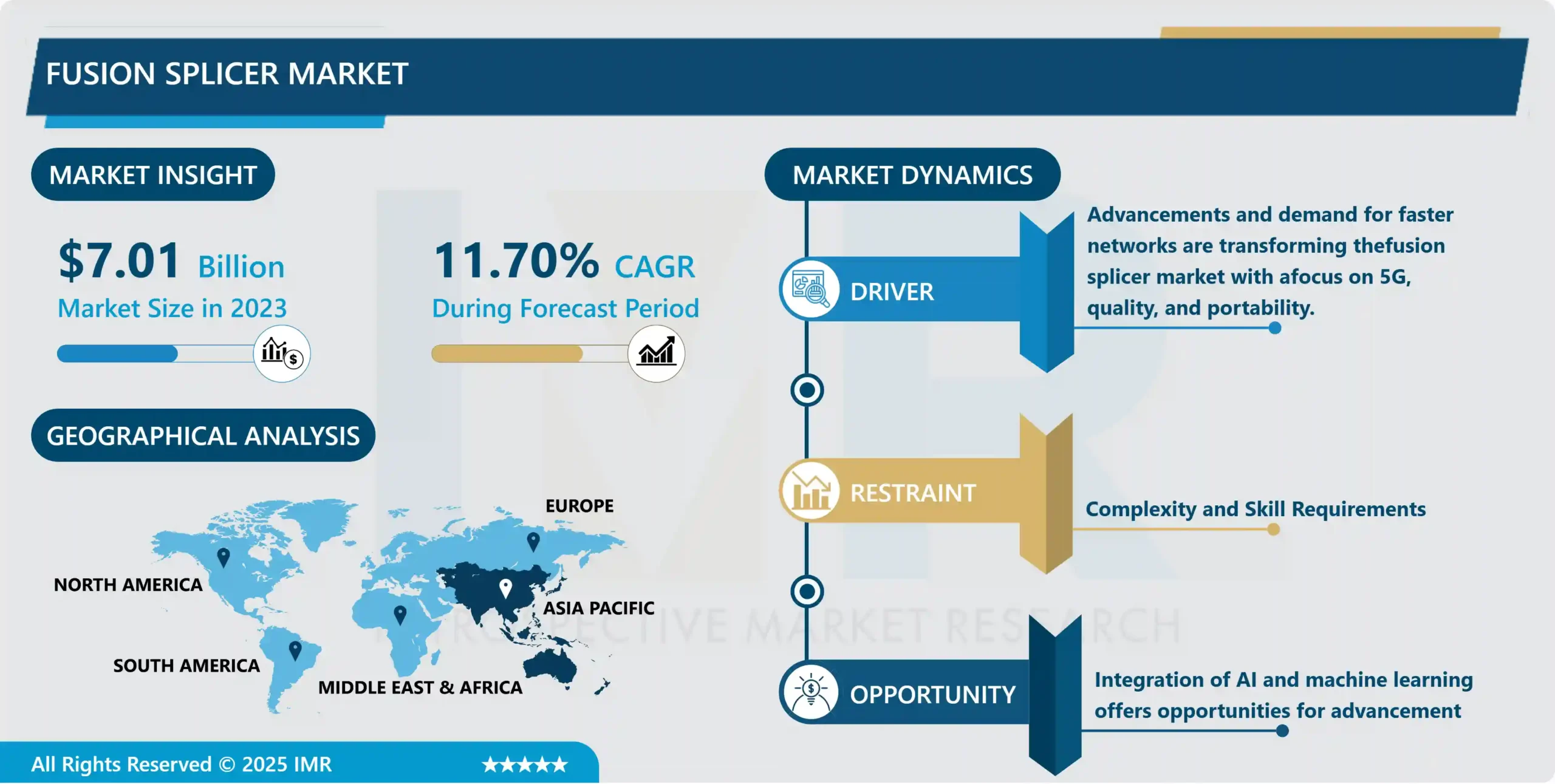
Fusion Splicer Market Size Was Valued at USD 7.01 Billion in 2023 and is Projected to Reach USD 18.99 Billion by 2032, Growing at a CAGR of 11.7% From 2024-2032.
Fusion splicing is used to physically join together two optical fiber ends. The process may vary, depending on the type of fusion splicer used. The S178 Single-Fiber Fusion Splicer has an active core aligning mechanism to align the fiber ends, and a controllable electric arc to melt the glass and butt the ends together. This results in a strong joint, with very low loss and very low back-reflection.
RECENTLY there has been considerable interest in using small core holey fibers (HF) for nonlinear applications. To fully integrate these fibers into device and sensor systems, low-loss robust splicing with conventional single-mode fiber (SMF) is required. Since the first demonstration of splicing HF and standard SMFs, many splicing techniques have been used, including the use of a filament splicer, a CO laser, and gradient index fiber lenses.
The most commonly used method is electric arc fusion because such splicers are widely available. In this letter, we demonstrate a simple method to splice HF with a subwavelength-diameter core and a high numerical aperture (NA) SMF by using a common arc fusion splicer. A splice loss of 1 dB was achieved.
Fusion Splicer Market Trend Analysis
Advancements and demand for faster networks are transforming the fusion splicer market with a focus on 5G, quality, and portability.
Technological advances and a growing need for fast internet and communication networks are driving rapid changes in the fusion splicer market, with key trends being the move to 5G networks and the demand for top-notch splicing quality.
The move towards making fusion splicers smaller and more portable enables technicians to maintain performance while working in tough environments. Automation and intelligent fusion capabilities, such as automated alignment and cloud integration, enhance efficiency and expedite the implementation of fiber networks.
The increasing need for fusion splicers in data centers is fueled by the rise in cloud computing, big data, and IoT. Improvements in core alignment technology and splice loss reduction are boosting the reliability and performance of fiber optic networks by focusing on quality and precision.
Integration of AI and machine learning offers opportunities for advancement.
Africa, the Middle East, and Southeast Asia offer potential for growth by investing in telecommunications infrastructure in emerging markets. The rise in global Fiber-to-the-Home (FTTH) services is anticipated to drive the growth of the fusion splicer market.
All-optical networks allow for faster data transmission by removing the need for converting electrical signals to optical signals. Fusion splicers are essential for installation, providing notable chances. The increasing need for fusion splicers in healthcare and military industries is fueling market expansion. Multi-fiber splicing technology is on the rise in enhancing efficacy and reducing expenses, particularly in extensive installations such as data centers.
Incorporating AI and machine learning in fusion splicers is a new chance to improve precision and effectiveness. Businesses that embrace change and come up with new ideas will benefit from the increasing need for fiber optic networks across different industries, resulting in more growth in the fusion splicer market.
Fusion Splicer Market Segment Analysis:
Fusion Splicer Market is Segmented on the basis of Type, Component Type, Alignment Type, Product, Application, And End-use.
By Alignment Type, Core Alignment Fusion Splicers Segment Is Expected to Dominate the Market During the Forecast Period
Core Alignment Fusion Splicers are the top choice in the market due to their precision, reliability, and wide range of industry uses. Advanced technology is utilized to ensure accurate core alignment, which is essential for maintaining low signal loss in industries such as telecommunications and data centers.
Core alignment fusion splicers have become more user-friendly thanks to recent developments, including automation and simple interfaces. Now, they are both easy to carry around and strong, providing a great return on investment due to their lasting dependability and enhanced network efficiency.
Core alignment fusion splicers play a critical role in ensuring signal integrity and network performance meet stringent regulatory and industry requirements, especially in the fields of telecommunications and data centers. Due to the growing implementation of strict regulations worldwide, these splicers are now necessary for the construction and upkeep of strong fiber optic networks. With the increasing use of the internet and IoT applications, the demand for fiber optic networks is on the rise, indicating that core alignment fusion splicers will remain the top choice in the market.
By End-use, IT and Telecommunication Segment Held the Largest Share
The IT and Telecommunication industries control the Fusion Splicer market because they heavily depend on fiber optic networks for fast data transmission and communication infrastructure. Expanding fiber networks, deploying 5G, and constructing data centers with high-capacity connections are increasing the need for Fusion Splicers.
The demand for fiber optic networks is increasing because of the growth of IoT and smart cities, along with the emergence of edge computing. Growing need for bandwidth due to video streaming, online
Investments and initiatives to ensure universal broadband access in emerging markets are fueling the need for fiber optic networks in the telecom industry. Advanced technologies are driving the development of next-generation networks such as FTTH and FTTP to improve network performance. Fusion splicers are necessary tools for establishing high-quality connections with minimal loss in these networks. The IT and telecommunication industries heavily depend on fusion splicers to uphold their growing infrastructure and new technologies, securing their market dominance. E-services and enterprise networks are fueling the adoption of fusion splicers.
Fusion Splicer Market Regional Insights:
Asia Pacific is Expected to Dominate the Market Over the Forecast Period
The infusion splicer market in the Asia-Pacific region is led by the high demand for fiber optic networks and technological advancements. Nations such as China, Japan, and South Korea are making investments in telecommunication infrastructure, leading to a growing demand for infusion splicers.
Governments and companies are putting money into fiber optic infrastructure to meet the growing demand for internet, increasing internet access, and the need for additional infusion splicers.
Introducing 5G networks in Asia-Pacific drives growth in the infusion splicer market. The need for splicing equipment is increasing because of the strong fiber optic infrastructure required for 5G. Major companies in Asia-Pacific, send products worldwide. Region’s dominance reinforced.
Fusion Splicer Market Active Players
Fujikura Ltd. (Japan)
Sumitomo Electric Industries, Ltd. (Japan)
Furukawa Electric Co., Ltd. (Japan)
Corning Incorporated (USA)
INNO Instrument Inc. (South Korea)
Nokia Corporation (Formerly Alcatel-Lucent) (Finland)
Fitel (A Furukawa Company) (Japan)
AFL (A subsidiary of Fujikura Ltd.) (USA)
Shenzhen TTI Fiber Communication Tech Co., Ltd. (China)
Skycom (China)
Ilsintech Co., Ltd. (South Korea)
Nanjing Jilong Optical Communication Co., Ltd. (China)
DVP OE Tech Communications Ltd. (China)
Ericsson AB (Sweden)
GAO Tek Inc. (Canada)
Signal Fire Technology Co., Ltd. (China)
Sumitomo Electric Lightwave Corp. (USA)
Fujikura Europe Ltd. (United Kingdom)
Rhomberg Sersa Rail Group (Switzerland)
Greenlee (A Textron Company) (USA)
CommScope (USA)
Anritsu Corporation (Japan)
OFS (A Furukawa Company) (USA)
AFL Telecommunications Europe (United Kingdom)
Dynamix Technologies Ltd. (New Zealand)
Fiberfox (South Korea)
Darkhorsechina (Beijing) Telecom. Tech Co., Ltd. (China)
Softel Optic Co., Ltd. (China)
Shanghai Xianghe Fiber Optic Communications Co., Ltd. (China)
Laser Components Germany GmbH (Germany), and other Active Players
Chapter 1: Introduction
1.1 Scope and Coverage
Chapter 2:Executive Summary
Chapter 3: Market Landscape
3.1 Market Dynamics
3.1.1 Drivers
3.1.2 Restraints
3.1.3 Opportunities
3.1.4 Challenges
3.2 Market Trend Analysis
3.3 PESTLE Analysis
3.4 Porter’s Five Forces Analysis
3.5 Industry Value Chain Analysis
3.6 Ecosystem
3.7 Regulatory Landscape
3.8 Price Trend Analysis
3.9 Patent Analysis
3.10 Technology Evolution
3.11 Investment Pockets
3.12 Import-Export Analysis
Chapter 4: Fusion Splicer Market by Type (2018-2032)
4.1 Fusion Splicer Market Snapshot and Growth Engine
4.2 Market Overview
4.3 Field Splicing
4.3.1 Introduction and Market Overview
4.3.2 Historic and Forecasted Market Size in Value USD and Volume Units
4.3.3 Key Market Trends, Growth Factors, and Opportunities
4.3.4 Geographic Segmentation Analysis
4.4 Factory Splicing
4.5 Laboratory Splicing
Chapter 5: Fusion Splicer Market by Component Type (2018-2032)
5.1 Fusion Splicer Market Snapshot and Growth Engine
5.2 Market Overview
5.3 Hardware
5.3.1 Introduction and Market Overview
5.3.2 Historic and Forecasted Market Size in Value USD and Volume Units
5.3.3 Key Market Trends, Growth Factors, and Opportunities
5.3.4 Geographic Segmentation Analysis
5.4 Software
5.5 Service
Chapter 6: Fusion Splicer Market by Alignment Type (2018-2032)
6.1 Fusion Splicer Market Snapshot and Growth Engine
6.2 Market Overview
6.3 Core Alignment
6.3.1 Introduction and Market Overview
6.3.2 Historic and Forecasted Market Size in Value USD and Volume Units
6.3.3 Key Market Trends, Growth Factors, and Opportunities
6.3.4 Geographic Segmentation Analysis
6.4 Cladding Alignment
Chapter 7: Fusion Splicer Market by Product (2018-2032)
7.1 Fusion Splicer Market Snapshot and Growth Engine
7.2 Market Overview
7.3 Single Fiber Fusion Splicer
7.3.1 Introduction and Market Overview
7.3.2 Historic and Forecasted Market Size in Value USD and Volume Units
7.3.3 Key Market Trends, Growth Factors, and Opportunities
7.3.4 Geographic Segmentation Analysis
7.4 Ribbon Fiber Fusion Splicer
7.5 Special Fiber Fusion Splicer
Chapter 8: Fusion Splicer Market by Application (2018-2032)
8.1 Fusion Splicer Market Snapshot and Growth Engine
8.2 Market Overview
8.3 Communication
8.3.1 Introduction and Market Overview
8.3.2 Historic and Forecasted Market Size in Value USD and Volume Units
8.3.3 Key Market Trends, Growth Factors, and Opportunities
8.3.4 Geographic Segmentation Analysis
8.4 Safety and security
8.5 Surveillance
Chapter 9: Fusion Splicer Market by End-use (2018-2032)
9.1 Fusion Splicer Market Snapshot and Growth Engine
9.2 Market Overview
9.3 Commercial
9.3.1 Introduction and Market Overview
9.3.2 Historic and Forecasted Market Size in Value USD and Volume Units
9.3.3 Key Market Trends, Growth Factors, and Opportunities
9.3.4 Geographic Segmentation Analysis
9.4 IT and Telecommunication
9.5 Aerospace & defence
9.6 Automotive
9.7 Healthcare
9.8 Residential
Chapter 10: Company Profiles and Competitive Analysis
10.1 Competitive Landscape
10.1.1 Competitive Benchmarking
10.1.2 Fusion Splicer Market Share by Manufacturer (2024)
10.1.3 Industry BCG Matrix
10.1.4 Heat Map Analysis
10.1.5 Mergers and Acquisitions
10.2 FUJIKURA LTD. (JAPAN)
10.2.1 Company Overview
10.2.2 Key Executives
10.2.3 Company Snapshot
10.2.4 Role of the Company in the Market
10.2.5 Sustainability and Social Responsibility
10.2.6 Operating Business Segments
10.2.7 Product Portfolio
10.2.8 Business Performance
10.2.9 Key Strategic Moves and Recent Developments
10.2.10 SWOT Analysis
10.3 SUMITOMO ELECTRIC INDUSTRIES LTD. (JAPAN)
10.4 FURUKAWA ELECTRIC COLTD. (JAPAN)
10.5 CORNING INCORPORATED (USA)
10.6 INNO INSTRUMENT INC. (SOUTH KOREA)
10.7 NOKIA CORPORATION (FORMERLY ALCATEL-LUCENT) (FINLAND)
10.8 FITEL (A FURUKAWA COMPANY) (JAPAN)
10.9 AFL (A SUBSIDIARY OF FUJIKURA LTD.) (USA)
10.10 SHENZHEN TTI FIBER COMMUNICATION TECH COLTD. (CHINA)
10.11 SKYCOM (CHINA)
10.12 ILSINTECH COLTD. (SOUTH KOREA)
10.13 NANJING JILONG OPTICAL COMMUNICATION COLTD. (CHINA)
10.14 DVP OE TECH COMMUNICATIONS LTD. (CHINA)
10.15 ERICSSON AB (SWEDEN)
10.16 GAO TEK INC. (CANADA)
10.17 SIGNAL FIRE TECHNOLOGY COLTD. (CHINA)
10.18 SUMITOMO ELECTRIC LIGHTWAVE CORP. (USA)
10.19 FUJIKURA EUROPE LTD. (UNITED KINGDOM)
10.20 RHOMBERG SERSA RAIL GROUP (SWITZERLAND)
10.21 GREENLEE (A TEXTRON COMPANY) (USA)
10.22 COMMSCOPE (USA)
10.23 ANRITSU CORPORATION (JAPAN)
10.24 OFS (A FURUKAWA COMPANY) (USA)
10.25 AFL TELECOMMUNICATIONS EUROPE (UNITED KINGDOM)
10.26 DYNAMIX TECHNOLOGIES LTD. (NEW ZEALAND)
10.27 FIBERFOX (SOUTH KOREA)
10.28 DARKHORSECHINA (BEIJING) TELECOM. TECH COLTD. (CHINA)
10.29 SOFTEL OPTIC COLTD. (CHINA)
10.30 SHANGHAI XIANGHE FIBER OPTIC COMMUNICATIONS COLTD. (CHINA)
10.31 LASER COMPONENTS GERMANY GMBH (GERMANY)
10.32 AND
Chapter 11: Global Fusion Splicer Market By Region
11.1 Overview
11.2. North America Fusion Splicer Market
11.2.1 Key Market Trends, Growth Factors and Opportunities
11.2.2 Top Key Companies
11.2.3 Historic and Forecasted Market Size by Segments
11.2.4 Historic and Forecasted Market Size by Type
11.2.4.1 Field Splicing
11.2.4.2 Factory Splicing
11.2.4.3 Laboratory Splicing
11.2.5 Historic and Forecasted Market Size by Component Type
11.2.5.1 Hardware
11.2.5.2 Software
11.2.5.3 Service
11.2.6 Historic and Forecasted Market Size by Alignment Type
11.2.6.1 Core Alignment
11.2.6.2 Cladding Alignment
11.2.7 Historic and Forecasted Market Size by Product
11.2.7.1 Single Fiber Fusion Splicer
11.2.7.2 Ribbon Fiber Fusion Splicer
11.2.7.3 Special Fiber Fusion Splicer
11.2.8 Historic and Forecasted Market Size by Application
11.2.8.1 Communication
11.2.8.2 Safety and security
11.2.8.3 Surveillance
11.2.9 Historic and Forecasted Market Size by End-use
11.2.9.1 Commercial
11.2.9.2 IT and Telecommunication
11.2.9.3 Aerospace & defence
11.2.9.4 Automotive
11.2.9.5 Healthcare
11.2.9.6 Residential
11.2.10 Historic and Forecast Market Size by Country
11.2.10.1 US
11.2.10.2 Canada
11.2.10.3 Mexico
11.3. Eastern Europe Fusion Splicer Market
11.3.1 Key Market Trends, Growth Factors and Opportunities
11.3.2 Top Key Companies
11.3.3 Historic and Forecasted Market Size by Segments
11.3.4 Historic and Forecasted Market Size by Type
11.3.4.1 Field Splicing
11.3.4.2 Factory Splicing
11.3.4.3 Laboratory Splicing
11.3.5 Historic and Forecasted Market Size by Component Type
11.3.5.1 Hardware
11.3.5.2 Software
11.3.5.3 Service
11.3.6 Historic and Forecasted Market Size by Alignment Type
11.3.6.1 Core Alignment
11.3.6.2 Cladding Alignment
11.3.7 Historic and Forecasted Market Size by Product
11.3.7.1 Single Fiber Fusion Splicer
11.3.7.2 Ribbon Fiber Fusion Splicer
11.3.7.3 Special Fiber Fusion Splicer
11.3.8 Historic and Forecasted Market Size by Application
11.3.8.1 Communication
11.3.8.2 Safety and security
11.3.8.3 Surveillance
11.3.9 Historic and Forecasted Market Size by End-use
11.3.9.1 Commercial
11.3.9.2 IT and Telecommunication
11.3.9.3 Aerospace & defence
11.3.9.4 Automotive
11.3.9.5 Healthcare
11.3.9.6 Residential
11.3.10 Historic and Forecast Market Size by Country
11.3.10.1 Russia
11.3.10.2 Bulgaria
11.3.10.3 The Czech Republic
11.3.10.4 Hungary
11.3.10.5 Poland
11.3.10.6 Romania
11.3.10.7 Rest of Eastern Europe
11.4. Western Europe Fusion Splicer Market
11.4.1 Key Market Trends, Growth Factors and Opportunities
11.4.2 Top Key Companies
11.4.3 Historic and Forecasted Market Size by Segments
11.4.4 Historic and Forecasted Market Size by Type
11.4.4.1 Field Splicing
11.4.4.2 Factory Splicing
11.4.4.3 Laboratory Splicing
11.4.5 Historic and Forecasted Market Size by Component Type
11.4.5.1 Hardware
11.4.5.2 Software
11.4.5.3 Service
11.4.6 Historic and Forecasted Market Size by Alignment Type
11.4.6.1 Core Alignment
11.4.6.2 Cladding Alignment
11.4.7 Historic and Forecasted Market Size by Product
11.4.7.1 Single Fiber Fusion Splicer
11.4.7.2 Ribbon Fiber Fusion Splicer
11.4.7.3 Special Fiber Fusion Splicer
11.4.8 Historic and Forecasted Market Size by Application
11.4.8.1 Communication
11.4.8.2 Safety and security
11.4.8.3 Surveillance
11.4.9 Historic and Forecasted Market Size by End-use
11.4.9.1 Commercial
11.4.9.2 IT and Telecommunication
11.4.9.3 Aerospace & defence
11.4.9.4 Automotive
11.4.9.5 Healthcare
11.4.9.6 Residential
11.4.10 Historic and Forecast Market Size by Country
11.4.10.1 Germany
11.4.10.2 UK
11.4.10.3 France
11.4.10.4 The Netherlands
11.4.10.5 Italy
11.4.10.6 Spain
11.4.10.7 Rest of Western Europe
11.5. Asia Pacific Fusion Splicer Market
11.5.1 Key Market Trends, Growth Factors and Opportunities
11.5.2 Top Key Companies
11.5.3 Historic and Forecasted Market Size by Segments
11.5.4 Historic and Forecasted Market Size by Type
11.5.4.1 Field Splicing
11.5.4.2 Factory Splicing
11.5.4.3 Laboratory Splicing
11.5.5 Historic and Forecasted Market Size by Component Type
11.5.5.1 Hardware
11.5.5.2 Software
11.5.5.3 Service
11.5.6 Historic and Forecasted Market Size by Alignment Type
11.5.6.1 Core Alignment
11.5.6.2 Cladding Alignment
11.5.7 Historic and Forecasted Market Size by Product
11.5.7.1 Single Fiber Fusion Splicer
11.5.7.2 Ribbon Fiber Fusion Splicer
11.5.7.3 Special Fiber Fusion Splicer
11.5.8 Historic and Forecasted Market Size by Application
11.5.8.1 Communication
11.5.8.2 Safety and security
11.5.8.3 Surveillance
11.5.9 Historic and Forecasted Market Size by End-use
11.5.9.1 Commercial
11.5.9.2 IT and Telecommunication
11.5.9.3 Aerospace & defence
11.5.9.4 Automotive
11.5.9.5 Healthcare
11.5.9.6 Residential
11.5.10 Historic and Forecast Market Size by Country
11.5.10.1 China
11.5.10.2 India
11.5.10.3 Japan
11.5.10.4 South Korea
11.5.10.5 Malaysia
11.5.10.6 Thailand
11.5.10.7 Vietnam
11.5.10.8 The Philippines
11.5.10.9 Australia
11.5.10.10 New Zealand
11.5.10.11 Rest of APAC
11.6. Middle East & Africa Fusion Splicer Market
11.6.1 Key Market Trends, Growth Factors and Opportunities
11.6.2 Top Key Companies
11.6.3 Historic and Forecasted Market Size by Segments
11.6.4 Historic and Forecasted Market Size by Type
11.6.4.1 Field Splicing
11.6.4.2 Factory Splicing
11.6.4.3 Laboratory Splicing
11.6.5 Historic and Forecasted Market Size by Component Type
11.6.5.1 Hardware
11.6.5.2 Software
11.6.5.3 Service
11.6.6 Historic and Forecasted Market Size by Alignment Type
11.6.6.1 Core Alignment
11.6.6.2 Cladding Alignment
11.6.7 Historic and Forecasted Market Size by Product
11.6.7.1 Single Fiber Fusion Splicer
11.6.7.2 Ribbon Fiber Fusion Splicer
11.6.7.3 Special Fiber Fusion Splicer
11.6.8 Historic and Forecasted Market Size by Application
11.6.8.1 Communication
11.6.8.2 Safety and security
11.6.8.3 Surveillance
11.6.9 Historic and Forecasted Market Size by End-use
11.6.9.1 Commercial
11.6.9.2 IT and Telecommunication
11.6.9.3 Aerospace & defence
11.6.9.4 Automotive
11.6.9.5 Healthcare
11.6.9.6 Residential
11.6.10 Historic and Forecast Market Size by Country
11.6.10.1 Turkiye
11.6.10.2 Bahrain
11.6.10.3 Kuwait
11.6.10.4 Saudi Arabia
11.6.10.5 Qatar
11.6.10.6 UAE
11.6.10.7 Israel
11.6.10.8 South Africa
11.7. South America Fusion Splicer Market
11.7.1 Key Market Trends, Growth Factors and Opportunities
11.7.2 Top Key Companies
11.7.3 Historic and Forecasted Market Size by Segments
11.7.4 Historic and Forecasted Market Size by Type
11.7.4.1 Field Splicing
11.7.4.2 Factory Splicing
11.7.4.3 Laboratory Splicing
11.7.5 Historic and Forecasted Market Size by Component Type
11.7.5.1 Hardware
11.7.5.2 Software
11.7.5.3 Service
11.7.6 Historic and Forecasted Market Size by Alignment Type
11.7.6.1 Core Alignment
11.7.6.2 Cladding Alignment
11.7.7 Historic and Forecasted Market Size by Product
11.7.7.1 Single Fiber Fusion Splicer
11.7.7.2 Ribbon Fiber Fusion Splicer
11.7.7.3 Special Fiber Fusion Splicer
11.7.8 Historic and Forecasted Market Size by Application
11.7.8.1 Communication
11.7.8.2 Safety and security
11.7.8.3 Surveillance
11.7.9 Historic and Forecasted Market Size by End-use
11.7.9.1 Commercial
11.7.9.2 IT and Telecommunication
11.7.9.3 Aerospace & defence
11.7.9.4 Automotive
11.7.9.5 Healthcare
11.7.9.6 Residential
11.7.10 Historic and Forecast Market Size by Country
11.7.10.1 Brazil
11.7.10.2 Argentina
11.7.10.3 Rest of SA
Chapter 12 Analyst Viewpoint and Conclusion
12.1 Recommendations and Concluding Analysis
12.2 Potential Market Strategies
Chapter 13 Research Methodology
13.1 Research Process
13.2 Primary Research
13.3 Secondary Research
Q1: What would be the forecast period in the Fusion Splicer Market research report?
A1: The forecast period in the Fusion Splicer Market research report is 2024-2032.
Q2: Who are the key players in the Fusion Splicer Market?
A2: Fujikura Ltd. (Japan), Sumitomo Electric Industries, Ltd. (Japan), Furukawa Electric Co., Ltd. (Japan), Corning Incorporated (USA), INNO Instrument Inc. (South Korea), Nokia Corporation (Formerly Alcatel-Lucent) (Finland), Fitel (A Furukawa Company) (Japan), AFL (A subsidiary of Fujikura Ltd.) (USA), Shenzhen TTI Fiber Communication Tech Co., Ltd. (China), Skycom (China), Ilsintech Co., Ltd. (South Korea), Nanjing Jilong Optical Communication Co., Ltd. (China), DVP OE Tech Communications Ltd. (China), Ericsson AB (Sweden), GAO Tek Inc. (Canada), Signal Fire Technology Co., Ltd. (China), Sumitomo Electric Lightwave Corp. (USA), Fujikura Europe Ltd. (United Kingdom), Rhomberg Sersa Rail Group (Switzerland), Greenlee (A Textron Company) (USA), CommScope (USA), Anritsu Corporation (Japan), OFS (A Furukawa Company) (USA), AFL Telecommunications Europe (United Kingdom), Dynamix Technologies Ltd. (New Zealand), Fiberfox (South Korea), Darkhorsechina (Beijing) Telecom. Tech Co., Ltd. (China), Softel Optic Co., Ltd. (China), Shanghai Xianghe Fiber Optic Communications Co., Ltd. (China), Laser Components Germany GmbH (Germany), and Other Active Players.
Q3: What are the segments of the Fusion Splicer Market?
A3: The Fusion Splicer Market is segmented into Type, Component Type, Alignment Type, Product, Application, End-use, and region. By Type, the market is categorized into Field Splicing, Factory Splicing, and Laboratory Splicing. By Component Type, the market is categorized into Hardware, Software, and Service. By Alignment Type, the market is categorized into Core Alignment and cladding Alignment. By Product, the market is categorized into Single Fiber Fusion Splicer, Ribbon Fiber Fusion Splicer, and Special Fiber Fusion Splicer. By Application, The Market Is Categorized Into Communication, Safety and Security, and Surveillance. By End-use, the market is categorized into Commercial, IT and Telecommunication, Aerospace & Defense, Automotive, Healthcare, And Residential. By region, it is analyzed across North America (U.S.; Canada; Mexico), Eastern Europe (Bulgaria; The Czech Republic; Hungary; Poland; Romania; Rest of Eastern Europe), Western Europe (Germany; UK; France; Netherlands; Italy; Russia; Spain; Rest of Western Europe), Asia-Pacific (China; India; Japan; Southeast Asia, etc.), South America (Brazil; Argentina, etc.), Middle East & Africa (Saudi Arabia; South Africa, etc.).
Q4: What is the Fusion Splicer Market?
A4: Fusion splicing is used to physically join together two optical fiber ends. The process may vary, depending on the type of fusion splicer used.
Q5: How big is the Fusion Splicer Market?
A5: Fusion Splicer Market Size Was Valued at USD 7.01 Billion in 2023 and is Projected to Reach USD 18.99 Billion by 2032, Growing at a CAGR of 11.7% From 2024-2032.
How to Buy a Report from eminsights.jp
On the product page, choose the license you want: Single-User License, Multi-User License or Enterprise License.
If you required report in your native language, then you can click on Translated Report button and fill out the form with report name and language you want, then our team will contact you as soon as possible.
Click the Buy Now button.
You will be redirected to the checkout page. Enter your company details and payment information.
Click Place Order to complete the purchase.
Confirmation: You’ll receive an order confirmation and our team will contact you shortly with your ordered report.
If you have any questions, fill out the contact form below or email us at bizdev@eminsights.net.
Thank you for choosing eminsights.jp!