Stay Ahead in Fast-Growing Economies.
Browse Reports Now
Fragrance Market – Trend, Growth, Forecast 2024–2032
Flavors and fragrances involve the creation and sale of scented products such as perfumes, deodorants, scented candles and all other products that give off good smells.

IMR Group
Description
Fragrance Market Synopsis:
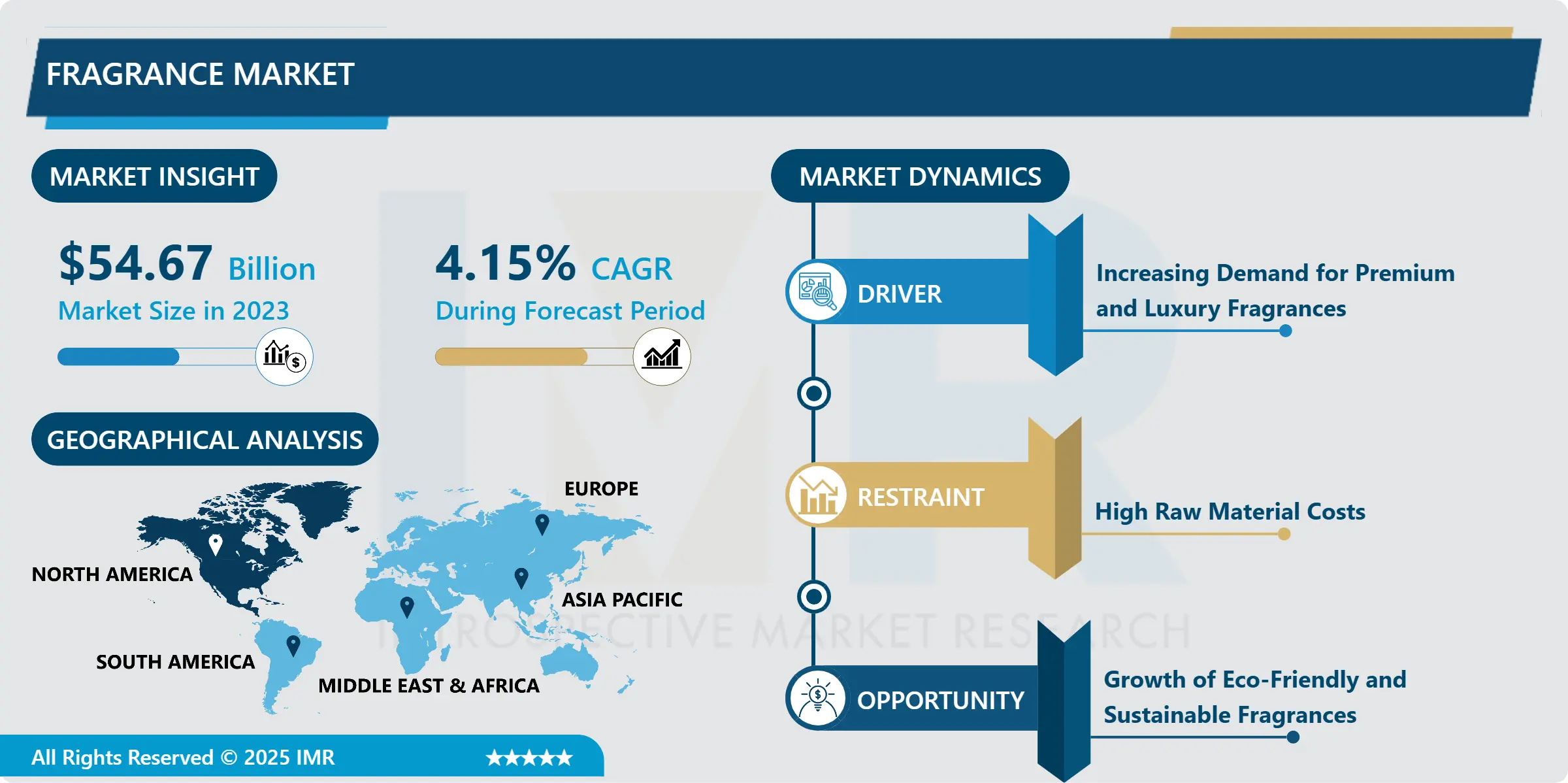
Fragrance Market Size Was Valued at USD 54.67 Billion in 2023, and is Projected to Reach USD 78.83 Billion by 2032, Growing at a CAGR of 4.15% From 2024-2032.
Flavors and fragrances involve the creation and sale of scented products such as perfumes, deodorants, scented candles and all other products that give off good smells. These are developed for individual use, home needs and for industries.
There current market of fragrance has shown a vast growth due to its massive utility in the cosmetic, personal care segments and household products. The tough competition has shifted the market to premium and luxury fragrances as the population in the Millennial bracket and the growing middle class increases. The need for more natural, organic ingredients especially in fragrances also shifts in consumer trends towards personalized products have pressed manufacturers to develop new products and fragrances. Increased … Pages: 54 Competitors’ strategies: Customer`s concern about environment and health make them turn to the desire for the clean and eco-friendly products, and in this case, it leads to the increased demand for the organic and non-GMO fragrance products.
The fragrance market can be segmented into fragrances, perfumes, body spray and other related scented products. This segmentation makes it easy for brands to target different needs, wants, and class in the society. Top brands tend to consider celebrity endorsing, innovative promotions and unique packaging to make their brands rebellion. Besides, e-Commerce plays a major role of letting the consumers search for a new types of fragrances and it has encouraged more use world over. Hence, there is also constant progress in demand for fragrances, attributable to its uses in Fashion, beauty products and other household products.
Fragrance Market Trend Analysis:
Customization and Personalization in Fragrance
As the focus on differentiation has increased in the perfume market in recent years, orientation to specific needs of customers has remained an important factor. Currently, brands allow consumers to put together their unique combinations of ingredients and fragrances that make up personal perfumes. Such a trend is most prominent in luxury brands and the high-end retailers, with such customer-consumers being able to come up with customized perfumes based on their ideals as well as feeling. With the help of technology, this trend has become even more available to the targeted customer base, as some of the companies have integrated online services which allow their clients to choose the most suitable set of fragrances.
It has come to the point where brands are generating more target market related avenues for consumers to add that personal touch like bespoke packaging and point of sale scent overlays. Furthermore, customized fragrances are more likely to be suit almost every person: starting from the one who desires to have or buy a different product up to the one whom desires to express her/his identity through the smells. This trend is expected to fuel demand for personalized fragrances in the personal use, as well as gift sections so that firms can connect with the target market and increase brand identity.
Growth of Eco-Friendly and Sustainable Fragrances
The opportunities that consumer demand for sustainable fragrances present could be summed up as follows. With issues such as environmental conservation taking root in most consumers, customers tend to look for products that have materials that are sourced in the right manner and are not tested on animals and are made from environmentally friendly materials. The fragrance industry is not idle either with the increasing use of biodegradable packaging, no animal testing, and using environmentally friendly ingredients including natural oils and flowers extracts. Those brands that are capable of integrating the above elements into their food items and other products, mainly in the reputed luxury and premium segments are expected to have an added competitive advantage.
In addition, it’s been projected that both natural scents and vegan-friendly solutions would continue to rise in demand, which is consistent with the rising global trend of seeking only safe beauty and personal care products. This growing segment could be easily given to fragrance companies who focus on sustainable practices in developing, sourcing and manufacturing their fragrances. Thus, an increase in demand for such products, coupled with market changes, legal requirements, makes this direction imperative for development in the industry.
Fragrance Market Segment Analysis:
Fragrance Market is Segmented on the basis of Type, Application, Distribution Channel, Product From, Price Range, End User, and Region
By Type, Perfume segment is expected to dominate the market during the forecast period
The fragrance market is divided into a number of categories such as perfume, perfume extract, perfume water, fragrance water, and perfume water. Both types have a different course of action of fragrance oil content, thus probably the possible actuating perseverance and density of the scent. Cosmetics are the least but perfumes are the most dependent and enduring thereby making them popular in the luxury cosmetics industry. Eau de parfum is less oily or stronger than both of the previously mentioned categories, yet the duration of the fragrance is 3-5 hours. Eau de toilette is worn casually and might contain less concentration of essential oils while eau de cologne is less concentrated, lighter and worn often by males. Eau fraiche has the least amount of components and is usually worn for a lighter scent.
This segmentation helps consumers to pick commodities through their own taste and requirements. Perfumes and eau de parfum are usually those that are bought on one’s special occasions or as luxury products while eau de toilette & eau de cologne are products of daily use cheap fragrances. In accordance with consumers’ changing trends, producers expand their product lines for meeting the needs of consumers with different preferences for high-end, lasting, Oriental scent, as well as those who would like to have gentle and easily lasting, daily scents.
By Application, Personal Care segment expected to held the largest share
Perfumery products are versatile and are used in consumer and commercial goods industry for hygiene, cosmetics, household care and institutional uses. Fragrances are used mostly in grooming products whose sales depend on the smell; perfumes, body spray, deodorants and soaps. Scented candles, air fresheners and cleaning products, part of the future household application, involve companies whose fragrances assist in creating favorable conditions within the house. In the industrial field, fragrances are added in products such as soaps, washing powders, deodorants and disinfectants, to make functional products attractive.
The use of the fragrances in personal care is expected to increase due to the increasing cultures of personal care among the consumers. On the other hand, the home care industry has been influenced modern trends in home decoration and living, where aroma of certain produces is used to set a particular mood. In the current world where consumers are becoming sensitive to the haptic experiences, brands in these applications are providing variability and quality scents. This versatility makes it easy for fragrance manufacturers to satisfy a wide market, and increase their target population span across all the segments.
Fragrance Market Regional Insights:
North America is Expected to Dominate the Market Over the Forecast period
North America particularly leads the fragrance market because consumers have the purchasing power; worldwide fragrance companies are situated; and high demand for prestige and luxury fragrance. The U.S remains the biggest consumer of personal care and beauty products and therefore the largest market for fragrances. On this basis, some segments have gained growth with specific conditions, such as luxury fragrances for perfumes and niche types, owning to the increased purchasing power in urban populations. The e-commerce platforms and various retail channels also contribute to more growth of the fragrance market in the region because customers can access different fragrances easily.
On the same note, there is an increasing focus on the need for sustainability in the region and natural, organic, and cruelty-free ingredients that have been factors that have led fragrance companies in North America to push for new opportunities. Consumers change behaviors in terms of purchasing products and, as result, fragrances brands pay more attention to environmental responsibility; such a factor contributes to the growth of the market in this region. North America’s dominance is expected to continue as luxury expenditure is forecasted to increase, and the shift towards more niche closer to nature fragrances is expected to be seen globally
Active Key Players in the Fragrance Market:
Amorepacific (South Korea)
Chanel (France)
Coty Inc. (USA)
Dior (France)
Estée Lauder (USA)
Gucci (Italy)
Hermès (France)
Inter Parfums, Inc. (USA)
L’Oréal (France)
LVMH (France)
Procter & Gamble (USA)
Shiseido (Japan)
Other Active Players
Key Industry Developments in the Fragrance Market:
In July 2024, Shiseido and Max Mara collaborated on a long-term fragrance partnership, granting Shiseido exclusive global rights to develop, manufacture, launch, and distribute perfumes under the Max Mara label. The agreement was formalized through a licensing contract, with Shiseido EMEA handling the license.
In September 2023, The Estée Lauder Companies (ELC) successfully opened an Atelier in Paris, France, by the end of 2024. The Atelier enabled ELC to expand its luxury fragrance capabilities, facilitating innovation, accelerated product launches, and high-quality production on a larger scale, leveraging connections across its brand portfolio.
Chapter 1: Introduction
1.1 Scope and Coverage
Chapter 2:Executive Summary
Chapter 3: Market Landscape
3.1 Market Dynamics
3.1.1 Drivers
3.1.2 Restraints
3.1.3 Opportunities
3.1.4 Challenges
3.2 Market Trend Analysis
3.3 PESTLE Analysis
3.4 Porter’s Five Forces Analysis
3.5 Industry Value Chain Analysis
3.6 Ecosystem
3.7 Regulatory Landscape
3.8 Price Trend Analysis
3.9 Patent Analysis
3.10 Technology Evolution
3.11 Investment Pockets
3.12 Import-Export Analysis
Chapter 4: Fragrance Market by Type
4.1 Fragrance Market Snapshot and Growth Engine
4.2 Fragrance Market Overview
4.3 Perfume
4.3.1 Introduction and Market Overview
4.3.2 Historic and Forecasted Market Size in Value USD and Volume Units (2017-2032F)
4.3.3 Key Market Trends, Growth Factors and Opportunities
4.3.4 Perfume: Geographic Segmentation Analysis
4.4 Eau de Parfum
4.4.1 Introduction and Market Overview
4.4.2 Historic and Forecasted Market Size in Value USD and Volume Units (2017-2032F)
4.4.3 Key Market Trends, Growth Factors and Opportunities
4.4.4 Eau de Parfum: Geographic Segmentation Analysis
4.5 Eau de Toilette
4.5.1 Introduction and Market Overview
4.5.2 Historic and Forecasted Market Size in Value USD and Volume Units (2017-2032F)
4.5.3 Key Market Trends, Growth Factors and Opportunities
4.5.4 Eau de Toilette: Geographic Segmentation Analysis
4.6 Eau de Cologne
4.6.1 Introduction and Market Overview
4.6.2 Historic and Forecasted Market Size in Value USD and Volume Units (2017-2032F)
4.6.3 Key Market Trends, Growth Factors and Opportunities
4.6.4 Eau de Cologne: Geographic Segmentation Analysis
4.7 Eau Fraiche
4.7.1 Introduction and Market Overview
4.7.2 Historic and Forecasted Market Size in Value USD and Volume Units (2017-2032F)
4.7.3 Key Market Trends, Growth Factors and Opportunities
4.7.4 Eau Fraiche: Geographic Segmentation Analysis
Chapter 5: Fragrance Market by End-User
5.1 Fragrance Market Snapshot and Growth Engine
5.2 Fragrance Market Overview
5.3 Male
5.3.1 Introduction and Market Overview
5.3.2 Historic and Forecasted Market Size in Value USD and Volume Units (2017-2032F)
5.3.3 Key Market Trends, Growth Factors and Opportunities
5.3.4 Male: Geographic Segmentation Analysis
5.4 Female
5.4.1 Introduction and Market Overview
5.4.2 Historic and Forecasted Market Size in Value USD and Volume Units (2017-2032F)
5.4.3 Key Market Trends, Growth Factors and Opportunities
5.4.4 Female: Geographic Segmentation Analysis
5.5 Unisex
5.5.1 Introduction and Market Overview
5.5.2 Historic and Forecasted Market Size in Value USD and Volume Units (2017-2032F)
5.5.3 Key Market Trends, Growth Factors and Opportunities
5.5.4 Unisex: Geographic Segmentation Analysis
Chapter 6: Fragrance Market by Application
6.1 Fragrance Market Snapshot and Growth Engine
6.2 Fragrance Market Overview
6.3 Personal Care
6.3.1 Introduction and Market Overview
6.3.2 Historic and Forecasted Market Size in Value USD and Volume Units (2017-2032F)
6.3.3 Key Market Trends, Growth Factors and Opportunities
6.3.4 Personal Care: Geographic Segmentation Analysis
6.4 Household
6.4.1 Introduction and Market Overview
6.4.2 Historic and Forecasted Market Size in Value USD and Volume Units (2017-2032F)
6.4.3 Key Market Trends, Growth Factors and Opportunities
6.4.4 Household: Geographic Segmentation Analysis
6.5 Industrial
6.5.1 Introduction and Market Overview
6.5.2 Historic and Forecasted Market Size in Value USD and Volume Units (2017-2032F)
6.5.3 Key Market Trends, Growth Factors and Opportunities
6.5.4 Industrial: Geographic Segmentation Analysis
Chapter 7: Fragrance Market by Distribution Channel
7.1 Fragrance Market Snapshot and Growth Engine
7.2 Fragrance Market Overview
7.3 Online Retail
7.3.1 Introduction and Market Overview
7.3.2 Historic and Forecasted Market Size in Value USD and Volume Units (2017-2032F)
7.3.3 Key Market Trends, Growth Factors and Opportunities
7.3.4 Online Retail: Geographic Segmentation Analysis
7.4 Supers/Hypers
7.4.1 Introduction and Market Overview
7.4.2 Historic and Forecasted Market Size in Value USD and Volume Units (2017-2032F)
7.4.3 Key Market Trends, Growth Factors and Opportunities
7.4.4 Supers/Hypers: Geographic Segmentation Analysis
7.5 Specialty Stores
7.5.1 Introduction and Market Overview
7.5.2 Historic and Forecasted Market Size in Value USD and Volume Units (2017-2032F)
7.5.3 Key Market Trends, Growth Factors and Opportunities
7.5.4 Specialty Stores: Geographic Segmentation Analysis
7.6 Department Stores
7.6.1 Introduction and Market Overview
7.6.2 Historic and Forecasted Market Size in Value USD and Volume Units (2017-2032F)
7.6.3 Key Market Trends, Growth Factors and Opportunities
7.6.4 Department Stores: Geographic Segmentation Analysis
7.7 Pharmacies/Drugstores
7.7.1 Introduction and Market Overview
7.7.2 Historic and Forecasted Market Size in Value USD and Volume Units (2017-2032F)
7.7.3 Key Market Trends, Growth Factors and Opportunities
7.7.4 Pharmacies/Drugstores: Geographic Segmentation Analysis
Chapter 8: Fragrance Market by Product Form
8.1 Fragrance Market Snapshot and Growth Engine
8.2 Fragrance Market Overview
8.3 Spray
8.3.1 Introduction and Market Overview
8.3.2 Historic and Forecasted Market Size in Value USD and Volume Units (2017-2032F)
8.3.3 Key Market Trends, Growth Factors and Opportunities
8.3.4 Spray: Geographic Segmentation Analysis
8.4 Roll-on
8.4.1 Introduction and Market Overview
8.4.2 Historic and Forecasted Market Size in Value USD and Volume Units (2017-2032F)
8.4.3 Key Market Trends, Growth Factors and Opportunities
8.4.4 Roll-on: Geographic Segmentation Analysis
8.5 Gel
8.5.1 Introduction and Market Overview
8.5.2 Historic and Forecasted Market Size in Value USD and Volume Units (2017-2032F)
8.5.3 Key Market Trends, Growth Factors and Opportunities
8.5.4 Gel: Geographic Segmentation Analysis
8.6 Solid
8.6.1 Introduction and Market Overview
8.6.2 Historic and Forecasted Market Size in Value USD and Volume Units (2017-2032F)
8.6.3 Key Market Trends, Growth Factors and Opportunities
8.6.4 Solid: Geographic Segmentation Analysis
Chapter 9: Fragrance Market by Price Range
9.1 Fragrance Market Snapshot and Growth Engine
9.2 Fragrance Market Overview
9.3 Luxury
9.3.1 Introduction and Market Overview
9.3.2 Historic and Forecasted Market Size in Value USD and Volume Units (2017-2032F)
9.3.3 Key Market Trends, Growth Factors and Opportunities
9.3.4 Luxury: Geographic Segmentation Analysis
9.4 Premium
9.4.1 Introduction and Market Overview
9.4.2 Historic and Forecasted Market Size in Value USD and Volume Units (2017-2032F)
9.4.3 Key Market Trends, Growth Factors and Opportunities
9.4.4 Premium: Geographic Segmentation Analysis
9.5 Mass
9.5.1 Introduction and Market Overview
9.5.2 Historic and Forecasted Market Size in Value USD and Volume Units (2017-2032F)
9.5.3 Key Market Trends, Growth Factors and Opportunities
9.5.4 Mass: Geographic Segmentation Analysis
Chapter 10: Company Profiles and Competitive Analysis
10.1 Competitive Landscape
10.1.1 Competitive Benchmarking
10.1.2 Fragrance Market Share by Manufacturer (2023)
10.1.3 Industry BCG Matrix
10.1.4 Heat Map Analysis
10.1.5 Mergers and Acquisitions
10.2 L’ORÉAL (FRANCE)
10.2.1 Company Overview
10.2.2 Key Executives
10.2.3 Company Snapshot
10.2.4 Role of the Company in the Market
10.2.5 Sustainability and Social Responsibility
10.2.6 Operating Business Segments
10.2.7 Product Portfolio
10.2.8 Business Performance
10.2.9 Key Strategic Moves and Recent Developments
10.2.10 SWOT Analysis
10.3 ESTÉE LAUDER (USA)
10.4 PROCTER & GAMBLE (USA)
10.5 COTY INC. (USA)
10.6 CHANEL (FRANCE)
10.7 DIOR (FRANCE)
10.8 GUCCI (ITALY)
10.9 SHISEIDO (JAPAN)
10.10 LVMH (FRANCE)
10.11 AMOREPACIFIC (SOUTH KOREA)
10.12 HERMÈS (FRANCE)
10.13 INTER PARFUMS INC. (USA)
10.14 OTHER ACTIVE PLAYERS
Chapter 11: Global Fragrance Market By Region
11.1 Overview
11.2. North America Fragrance Market
11.2.1 Key Market Trends, Growth Factors and Opportunities
11.2.2 Top Key Companies
11.2.3 Historic and Forecasted Market Size by Segments
11.2.4 Historic and Forecasted Market Size By Type
11.2.4.1 Perfume
11.2.4.2 Eau de Parfum
11.2.4.3 Eau de Toilette
11.2.4.4 Eau de Cologne
11.2.4.5 Eau Fraiche
11.2.5 Historic and Forecasted Market Size By End-User
11.2.5.1 Male
11.2.5.2 Female
11.2.5.3 Unisex
11.2.6 Historic and Forecasted Market Size By Application
11.2.6.1 Personal Care
11.2.6.2 Household
11.2.6.3 Industrial
11.2.7 Historic and Forecasted Market Size By Distribution Channel
11.2.7.1 Online Retail
11.2.7.2 Supers/Hypers
11.2.7.3 Specialty Stores
11.2.7.4 Department Stores
11.2.7.5 Pharmacies/Drugstores
11.2.8 Historic and Forecasted Market Size By Product Form
11.2.8.1 Spray
11.2.8.2 Roll-on
11.2.8.3 Gel
11.2.8.4 Solid
11.2.9 Historic and Forecasted Market Size By Price Range
11.2.9.1 Luxury
11.2.9.2 Premium
11.2.9.3 Mass
11.2.10 Historic and Forecast Market Size by Country
11.2.10.1 US
11.2.10.2 Canada
11.2.10.3 Mexico
11.3. Eastern Europe Fragrance Market
11.3.1 Key Market Trends, Growth Factors and Opportunities
11.3.2 Top Key Companies
11.3.3 Historic and Forecasted Market Size by Segments
11.3.4 Historic and Forecasted Market Size By Type
11.3.4.1 Perfume
11.3.4.2 Eau de Parfum
11.3.4.3 Eau de Toilette
11.3.4.4 Eau de Cologne
11.3.4.5 Eau Fraiche
11.3.5 Historic and Forecasted Market Size By End-User
11.3.5.1 Male
11.3.5.2 Female
11.3.5.3 Unisex
11.3.6 Historic and Forecasted Market Size By Application
11.3.6.1 Personal Care
11.3.6.2 Household
11.3.6.3 Industrial
11.3.7 Historic and Forecasted Market Size By Distribution Channel
11.3.7.1 Online Retail
11.3.7.2 Supers/Hypers
11.3.7.3 Specialty Stores
11.3.7.4 Department Stores
11.3.7.5 Pharmacies/Drugstores
11.3.8 Historic and Forecasted Market Size By Product Form
11.3.8.1 Spray
11.3.8.2 Roll-on
11.3.8.3 Gel
11.3.8.4 Solid
11.3.9 Historic and Forecasted Market Size By Price Range
11.3.9.1 Luxury
11.3.9.2 Premium
11.3.9.3 Mass
11.3.10 Historic and Forecast Market Size by Country
11.3.10.1 Russia
11.3.10.2 Bulgaria
11.3.10.3 The Czech Republic
11.3.10.4 Hungary
11.3.10.5 Poland
11.3.10.6 Romania
11.3.10.7 Rest of Eastern Europe
11.4. Western Europe Fragrance Market
11.4.1 Key Market Trends, Growth Factors and Opportunities
11.4.2 Top Key Companies
11.4.3 Historic and Forecasted Market Size by Segments
11.4.4 Historic and Forecasted Market Size By Type
11.4.4.1 Perfume
11.4.4.2 Eau de Parfum
11.4.4.3 Eau de Toilette
11.4.4.4 Eau de Cologne
11.4.4.5 Eau Fraiche
11.4.5 Historic and Forecasted Market Size By End-User
11.4.5.1 Male
11.4.5.2 Female
11.4.5.3 Unisex
11.4.6 Historic and Forecasted Market Size By Application
11.4.6.1 Personal Care
11.4.6.2 Household
11.4.6.3 Industrial
11.4.7 Historic and Forecasted Market Size By Distribution Channel
11.4.7.1 Online Retail
11.4.7.2 Supers/Hypers
11.4.7.3 Specialty Stores
11.4.7.4 Department Stores
11.4.7.5 Pharmacies/Drugstores
11.4.8 Historic and Forecasted Market Size By Product Form
11.4.8.1 Spray
11.4.8.2 Roll-on
11.4.8.3 Gel
11.4.8.4 Solid
11.4.9 Historic and Forecasted Market Size By Price Range
11.4.9.1 Luxury
11.4.9.2 Premium
11.4.9.3 Mass
11.4.10 Historic and Forecast Market Size by Country
11.4.10.1 Germany
11.4.10.2 UK
11.4.10.3 France
11.4.10.4 The Netherlands
11.4.10.5 Italy
11.4.10.6 Spain
11.4.10.7 Rest of Western Europe
11.5. Asia Pacific Fragrance Market
11.5.1 Key Market Trends, Growth Factors and Opportunities
11.5.2 Top Key Companies
11.5.3 Historic and Forecasted Market Size by Segments
11.5.4 Historic and Forecasted Market Size By Type
11.5.4.1 Perfume
11.5.4.2 Eau de Parfum
11.5.4.3 Eau de Toilette
11.5.4.4 Eau de Cologne
11.5.4.5 Eau Fraiche
11.5.5 Historic and Forecasted Market Size By End-User
11.5.5.1 Male
11.5.5.2 Female
11.5.5.3 Unisex
11.5.6 Historic and Forecasted Market Size By Application
11.5.6.1 Personal Care
11.5.6.2 Household
11.5.6.3 Industrial
11.5.7 Historic and Forecasted Market Size By Distribution Channel
11.5.7.1 Online Retail
11.5.7.2 Supers/Hypers
11.5.7.3 Specialty Stores
11.5.7.4 Department Stores
11.5.7.5 Pharmacies/Drugstores
11.5.8 Historic and Forecasted Market Size By Product Form
11.5.8.1 Spray
11.5.8.2 Roll-on
11.5.8.3 Gel
11.5.8.4 Solid
11.5.9 Historic and Forecasted Market Size By Price Range
11.5.9.1 Luxury
11.5.9.2 Premium
11.5.9.3 Mass
11.5.10 Historic and Forecast Market Size by Country
11.5.10.1 China
11.5.10.2 India
11.5.10.3 Japan
11.5.10.4 South Korea
11.5.10.5 Malaysia
11.5.10.6 Thailand
11.5.10.7 Vietnam
11.5.10.8 The Philippines
11.5.10.9 Australia
11.5.10.10 New Zealand
11.5.10.11 Rest of APAC
11.6. Middle East & Africa Fragrance Market
11.6.1 Key Market Trends, Growth Factors and Opportunities
11.6.2 Top Key Companies
11.6.3 Historic and Forecasted Market Size by Segments
11.6.4 Historic and Forecasted Market Size By Type
11.6.4.1 Perfume
11.6.4.2 Eau de Parfum
11.6.4.3 Eau de Toilette
11.6.4.4 Eau de Cologne
11.6.4.5 Eau Fraiche
11.6.5 Historic and Forecasted Market Size By End-User
11.6.5.1 Male
11.6.5.2 Female
11.6.5.3 Unisex
11.6.6 Historic and Forecasted Market Size By Application
11.6.6.1 Personal Care
11.6.6.2 Household
11.6.6.3 Industrial
11.6.7 Historic and Forecasted Market Size By Distribution Channel
11.6.7.1 Online Retail
11.6.7.2 Supers/Hypers
11.6.7.3 Specialty Stores
11.6.7.4 Department Stores
11.6.7.5 Pharmacies/Drugstores
11.6.8 Historic and Forecasted Market Size By Product Form
11.6.8.1 Spray
11.6.8.2 Roll-on
11.6.8.3 Gel
11.6.8.4 Solid
11.6.9 Historic and Forecasted Market Size By Price Range
11.6.9.1 Luxury
11.6.9.2 Premium
11.6.9.3 Mass
11.6.10 Historic and Forecast Market Size by Country
11.6.10.1 Turkiye
11.6.10.2 Bahrain
11.6.10.3 Kuwait
11.6.10.4 Saudi Arabia
11.6.10.5 Qatar
11.6.10.6 UAE
11.6.10.7 Israel
11.6.10.8 South Africa
11.7. South America Fragrance Market
11.7.1 Key Market Trends, Growth Factors and Opportunities
11.7.2 Top Key Companies
11.7.3 Historic and Forecasted Market Size by Segments
11.7.4 Historic and Forecasted Market Size By Type
11.7.4.1 Perfume
11.7.4.2 Eau de Parfum
11.7.4.3 Eau de Toilette
11.7.4.4 Eau de Cologne
11.7.4.5 Eau Fraiche
11.7.5 Historic and Forecasted Market Size By End-User
11.7.5.1 Male
11.7.5.2 Female
11.7.5.3 Unisex
11.7.6 Historic and Forecasted Market Size By Application
11.7.6.1 Personal Care
11.7.6.2 Household
11.7.6.3 Industrial
11.7.7 Historic and Forecasted Market Size By Distribution Channel
11.7.7.1 Online Retail
11.7.7.2 Supers/Hypers
11.7.7.3 Specialty Stores
11.7.7.4 Department Stores
11.7.7.5 Pharmacies/Drugstores
11.7.8 Historic and Forecasted Market Size By Product Form
11.7.8.1 Spray
11.7.8.2 Roll-on
11.7.8.3 Gel
11.7.8.4 Solid
11.7.9 Historic and Forecasted Market Size By Price Range
11.7.9.1 Luxury
11.7.9.2 Premium
11.7.9.3 Mass
11.7.10 Historic and Forecast Market Size by Country
11.7.10.1 Brazil
11.7.10.2 Argentina
11.7.10.3 Rest of SA
Chapter 12 Analyst Viewpoint and Conclusion
12.1 Recommendations and Concluding Analysis
12.2 Potential Market Strategies
Chapter 13 Research Methodology
13.1 Research Process
13.2 Primary Research
13.3 Secondary Research
Q1: What would be the forecast period in the Fragrance Market research report?
A1: The forecast period in the Fragrance Market research report is 2024-2032.
Q2: Who are the key players in the Fragrance Market?
A2: Amorepacific (South Korea), Chanel (France), Coty Inc. (USA), Dior (France), Estée Lauder (USA), Gucci (Italy), Hermès (France), Inter Parfums, Inc. (USA), L'Oréal (France), LVMH (France), Procter & Gamble (USA), Shiseido (Japan), and Other Active Players.
Q3: What are the segments of the Fragrance Market?
A3: The Fragrance Market is segmented into Type, Application, Distribution Channel, Product From, Price Range, End User and region. By Type, the market is categorized into Perfume, Eau de Parfum, Eau de Toilette, Eau de Cologne, Eau Fraiche. By End-User, the market is categorized into Male, Female, Unisex. By Application, the market is categorized into Personal Care, Household, Industrial. By Distribution Channel, the market is categorized into Online Retail, Supermarkets/Hypermarkets, Specialty Stores, Department Stores, Pharmacies/Drugstores. By Product Form, the market is categorized into Spray, Roll-on, Gel, Solid. By Price Range, the market is categorized into Luxury, Premium, Mass. By region, it is analyzed across North America (U.S., Canada, Mexico), Eastern Europe (Russia, Bulgaria, The Czech Republic, Hungary, Poland, Romania, Rest of Eastern Europe), Western Europe (Germany, UK, France, The Netherlands, Italy, Russia, Spain, Rest of Western Europe), Asia Pacific (China, India, Japan, South Korea, Malaysia, Thailand, Vietnam, The Philippines, Australia, New-Zealand, Rest of APAC), Middle East & Africa (Turkiye, Bahrain, Kuwait, Saudi Arabia, Qatar, UAE, Israel, South Africa), South America (Brazil, Argentina, Rest of SA).
Q4: What is the Fragrance Market?
A4: Flavors and fragrances involve the creation and sale of scented products such as perfumes, deodorants, scented candles and all other products that give off good smells. These are developed for individual use, home needs and for industries.
Q5: How big is the Fragrance Market?
A5: Fragrance Market Size Was Valued at USD 54.67 Billion in 2023, and is Projected to Reach USD 78.83 Billion by 2032, Growing at a CAGR of 4.15% From 2024-2032.
How to Buy a Report from eminsights.jp
On the product page, choose the license you want: Single-User License, Multi-User License or Enterprise License.
If you required report in your native language, then you can click on Translated Report button and fill out the form with report name and language you want, then our team will contact you as soon as possible.
Click the Buy Now button.
You will be redirected to the checkout page. Enter your company details and payment information.
Click Place Order to complete the purchase.
Confirmation: You’ll receive an order confirmation and our team will contact you shortly with your ordered report.
If you have any questions, fill out the contact form below or email us at bizdev@eminsights.net.
Thank you for choosing eminsights.jp!