Stay Ahead in Fast-Growing Economies.
Browse Reports Now
Food Delivery Software Market | Research Report Analysis
Food delivery software is a specialized technology designed to streamline and enhance the process of delivering food from restaurants to customers. It typically consists of a comprehensive system that integrates various components, such as user-friendly interfaces for customers to place orders, real-time tracking features, and efficient dispatch systems.

IMR Group
Description
Food Delivery Software Market Synopsis
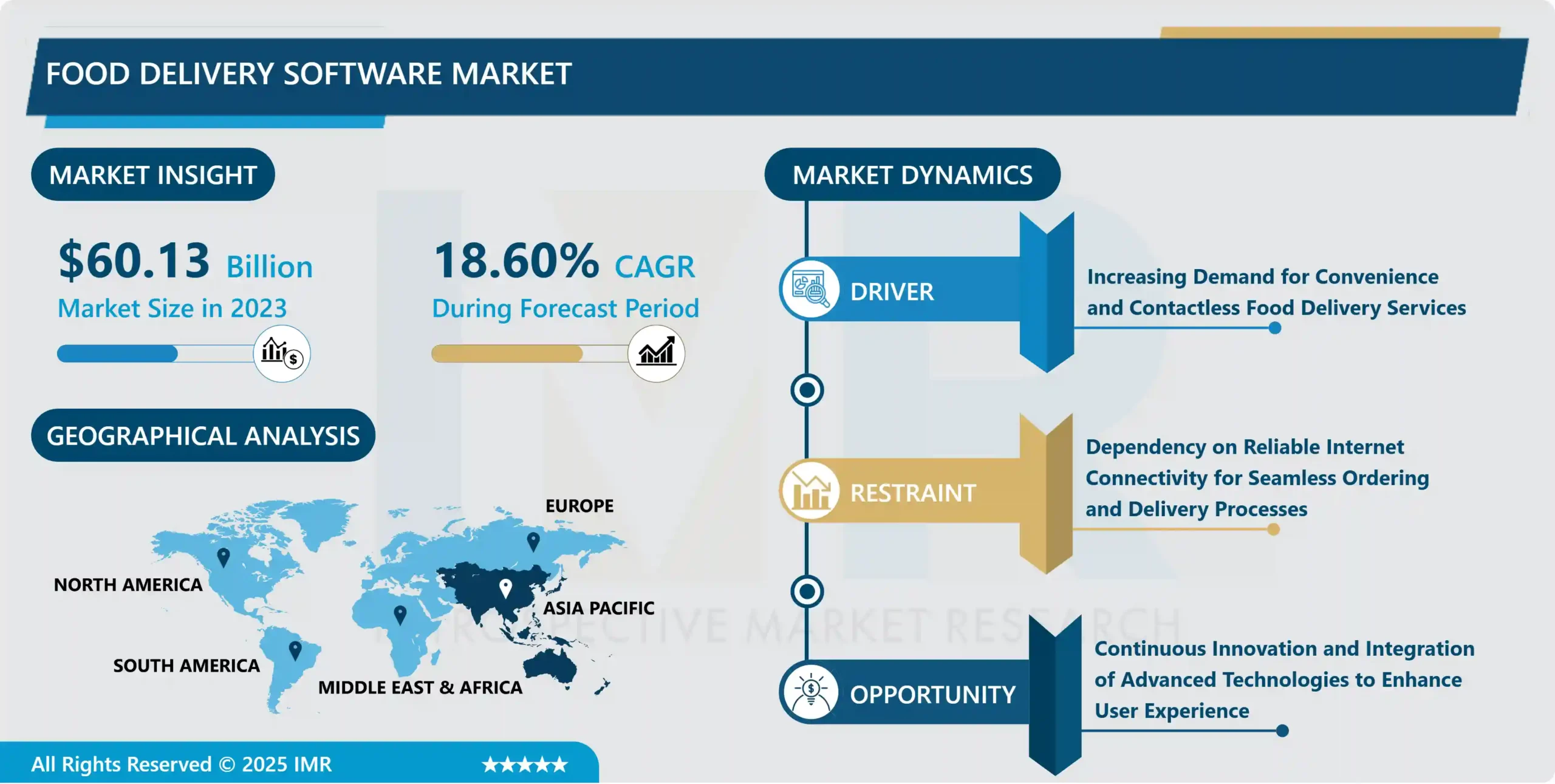
The Global Food Delivery Software Market Size Was Valued at USD 60.13 Billion in 2023 and is Projected to Reach USD 279.16 Billion by 2032, Growing at a CAGR of 18.60% From 2024-2032.
Food delivery software is a specialized technology designed to streamline and enhance the process of delivering food from restaurants to customers. It typically consists of a comprehensive system that integrates various components, such as user-friendly interfaces for customers to place orders, real-time tracking features, and efficient dispatch systems. These platforms often include restaurant management tools, allowing establishments to manage their menus, inventory, and order fulfillment seamlessly.
Food delivery software serves many essential purposes within the modern food industry. It streamlines the entire food delivery process, providing a convenient platform for customers to place orders from their favorite restaurants with ease. The food delivery software enhances operational efficiency for restaurants by optimizing order management, enabling them to keep track of inventory, update menus, and efficiently handle order fulfillment. Delivery drivers benefit from route optimization features, ensuring timely deliveries.
The software also facilitates secure online payment transactions, offering a seamless and cashless transaction experience for customers. Furthermore, it provides a valuable source of data and analytics for restaurants, allowing them to gain insights into customer preferences, track sales trends, and make informed business decisions. food delivery software is a vital tool that enhances the customer experience, improves operational efficiency, and contributes to the growth and success of businesses in the competitive food delivery landscape.
The Food Delivery Software market is experiencing significant growth due to several interconnected factors driving the evolution of the food industry. A key driver is the increasing consumer preference for online food ordering and delivery, fueled by the convenience it offers in today’s fast-paced lifestyle. The demand for diverse culinary experiences, coupled with the rise of virtual kitchens and cloud kitchens, has amplified the need for efficient food delivery solutions. Restaurants and food businesses recognize the importance of adapting to these changing consumer behaviors and are investing in technology to stay competitive.
Food delivery software caters to the demands of consumers and also helps restaurants optimize their operations, manage inventory, and improve overall efficiency. the growing awareness of these benefits, coupled with the ongoing digital transformation in the food industry.
Food Delivery Software Market Trend Analysis
Increasing demand for convenience and contactless food delivery services
The increasing demand for convenience and contactless food delivery services has been a notable trend in the food delivery industry. Busy lifestyles and the need for time-saving solutions have led consumers to seek convenient alternatives. Food delivery services offer the convenience of enjoying restaurant-quality meals without the hassle of cooking or dining out.
The availability of user-friendly apps made it easier for consumers to order food with just a few taps. Advanced GPS tracking also allows customers to monitor the delivery progress in real time, enhancing overall convenience. Food delivery services provide a wide variety of cuisines and menu options, allowing consumers to explore different flavors without leaving their homes. This variety contributes to the overall appeal of these services.
Food delivery services invested in optimizing their logistics and delivery processes. This results in quicker delivery times and improved overall service efficiency, enhancing convenience for customers. Online payment options and digital wallets simplify the payment process, eliminating the need for cash transactions.
Some customers may opt for food delivery as a way to reduce their carbon footprint by avoiding individual trips to restaurants. However, the environmental impact of delivery services is a consideration, and efforts to implement sustainable practices, such as eco-friendly packaging and efficient delivery routes, are becoming increasingly important to address these concerns.
Dependency on reliable internet connectivity for seamless ordering and delivery processes
Customers and restaurants rely on stable internet connections for the smooth placement and confirmation of orders. If the internet is unreliable, it may lead to delays, failed transactions, or difficulty in confirming orders in real time. Food delivery software relies on continuous communication between the customer’s device, the restaurant, and the delivery personnel. Unstable internet connections can result in communication breakdowns, leading to inaccurate order information, delayed updates, or failed delivery confirmations.
food delivery platforms offer real-time order tracking, allowing customers to monitor the status and location of their orders. Poor internet connectivity can disrupt this feature, causing frustration for both customers and delivery personnel. If the internet connection is unreliable, it may lead to payment failures, transaction errors, or delays in processing payments, affecting the overall efficiency of the ordering and delivery process. Inconsistent internet connectivity can disrupt this synchronization, leading to discrepancies in information.
Unreliable internet connectivity can result in a suboptimal customer experience. Customers may face challenges in placing orders, tracking deliveries, or accessing necessary information, negatively impacting their satisfaction with the food delivery service. For restaurants and delivery personnel, a dependable internet connection is essential for efficient order management and dispatch. Lack of reliable connectivity may lead to confusion, delays, or errors in processing orders, affecting the overall operational efficiency of the food delivery service.
Continuous innovation and integration of advanced technologies to enhance user experience
Advanced technologies enable the implementation of personalized features and recommendation engines. By analyzing user preferences, order history, and other relevant data, food delivery platforms can offer tailored suggestions, promotions, and discounts, providing a more personalized and engaging experience for customers.
Integration of AI and ML algorithms can optimize various aspects of food delivery, such as predicting customer preferences, streamlining delivery routes for efficiency, and enhancing order accuracy. These technologies contribute to a more intelligent and responsive system, improving overall service quality.
Continuous innovation allows for the refinement of real-time tracking features. Integrating GPS technology enables customers to track the status and location of their orders accurately. Moreover, improved communication tools facilitate seamless interactions between customers, restaurants, and delivery personnel, enhancing transparency and customer satisfaction.
Exploring robotics and automation in the delivery process can lead to increased efficiency and reduced delivery times. Autonomous delivery vehicles or drones, for example, represent innovative solutions that can further enhance the convenience and speed of food delivery services.
Managing high competition and market saturation among various delivery platforms
The high demand in a saturated market can strain the operational efficiency of food delivery platforms. Ensuring timely and accurate deliveries becomes more challenging as order volumes increase, potentially leading to service quality issues. To stand out in a crowded market, platforms often invest heavily in marketing campaigns. The cost of customer acquisition can be high, and sustaining a competitive presence requires continuous promotional efforts.
As platforms compete to partner with popular restaurants, maintaining positive relationships with these establishments becomes crucial. Exclusive partnerships and favorable terms may become more difficult to negotiate in a market where restaurants have multiple options. platforms need to continuously invest in technological innovations, such as user-friendly apps, efficient order management systems, and advanced delivery tracking. The rapid pace of technological advancements can be challenging.
Finding unique selling points beyond price, such as superior customer service, innovative features, or exclusive partnerships, becomes crucial but difficult to achieve. Market saturation can lead to a situation where numerous platforms are competing for the same pool of customers, making it difficult for individual companies to achieve sustainable profitability. This challenge becomes more significant as new entrants continue to join the market.
Food Delivery Software Market Segment Analysis:
Food Delivery Software Market Segmented Based on Type and End-Users.
By Type, Mobile- based segment is expected to dominate the market during the forecast period
The mobile-based segment is expected to dominate the food delivery software market due to the pervasive use of smartphones and the associated benefits offered by mobile applications. With the majority of the global population owning smartphones, mobile apps provide unparalleled convenience and accessibility for users seeking food delivery services.
The on-the-go nature of modern lifestyles aligns seamlessly with the quick and efficient experience provided by mobile apps, allowing users to browse menus, place orders, and track deliveries from the palm of their hands. The user-friendly interfaces, integration of advanced features like GPS tracking and push notifications, and the ability to facilitate secure in-app payments contribute to an enhanced overall experience.
The continuous evolution of mobile technology, including faster internet speeds and improved app capabilities, propels the dominance of mobile-based platforms. As consumers increasingly prioritize convenience and instant access, the mobile-based segment is poised to maintain its dominance in the food delivery software market.
By End User, Restaurant segment held the largest share of 48.12% in 2022
The restaurant segment plays a pivotal role as it represents the core suppliers and partners for these platforms. the growing consumer preference for dining at home and the convenience of ordering restaurant-quality food has significantly increased the demand for food delivery services. food delivery platforms heavily rely on a diverse and extensive network of restaurants to cater to varied culinary preferences. Moreover, exclusive partnerships with popular and sought-after restaurants can give a delivery platform a competitive edge, attracting a larger customer base.
With the evolution of technology, food delivery software has become an integral part of restaurant operations, streamlining order management, optimizing delivery routes, and enhancing overall efficiency. the symbiotic relationship between food delivery platforms and the restaurant segment positions the latter as a crucial driver in the competitive landscape of the food delivery software market.
Food Delivery Software Market Regional Insights:
Asia Pacific is Expected to Dominate the Market Over the Forecast Period
Asia-Pacific, particularly countries like China and India, has been a notable region where food delivery software has seen substantial growth. In these countries, a combination of factors such as large populations, urbanization, and rising disposable income has contributed to the popularity of food delivery services. Moreover, the presence of well-established food delivery platforms and a culture that embraces digital solutions further fueled the dominance of food delivery software in the market.
China and India are two of the most populous countries globally, providing a vast market for food delivery services. The population creates a significant demand for convenient dining options, which food delivery platforms can fulfill. Rapid urbanization in China and India has led to a concentration of people in cities, where busy lifestyles and long work hours make food delivery a convenient choice for many urban dwellers.
This region has a large population of tech-savvy consumers who readily adopt new technologies. The widespread use of smartphones and internet connectivity has facilitated the growth of mobile-based food delivery apps, making it easier for consumers to order food with just a few taps on their phones. Economic development in these countries has led to changes in lifestyle and dietary habits.
Food Delivery Software Market Top Key Players:
DoorDash (USA)
Uber Eats (USA)
Grubhub (USA)
Postmates (USA)
Cognizant (USA)
IBM Corporation (USA)
Apple Inc. (USA)
Microsoft Corporation (USA)
Google Inc. (USA)
Aldelo (USA)
Deliveroo (UK)
SAP SE (Germany)
Zomato (India)
Swiggy (India)
Just Eat Takeaway.com (Netherlands)
Mendix (Netherland)
Ele. me (China)
Zoho Corporation Pvt. Ltd. (India)
Meituan (China), and Other Major Players
Key Industry Developments in the Food Delivery Software Market:
In May 2024, Amazon and Grubhub announced a partnership for US food delivery, integrating Grubhub’s services with Amazon’s customer base. Prime members get a free Grubhub+ membership for benefits like no delivery fees and special offers.
In April 2024, Uber Eats introduced a short-form video feed to help 1
Chapter 1: Introduction
1.1 Scope and Coverage
Chapter 2:Executive Summary
Chapter 3: Market Landscape
3.1 Market Dynamics
3.1.1 Drivers
3.1.2 Restraints
3.1.3 Opportunities
3.1.4 Challenges
3.2 Market Trend Analysis
3.3 PESTLE Analysis
3.4 Porter’s Five Forces Analysis
3.5 Industry Value Chain Analysis
3.6 Ecosystem
3.7 Regulatory Landscape
3.8 Price Trend Analysis
3.9 Patent Analysis
3.10 Technology Evolution
3.11 Investment Pockets
3.12 Import-Export Analysis
Chapter 4: Food Delivery Software Market by Type (2018-2032)
4.1 Food Delivery Software Market Snapshot and Growth Engine
4.2 Market Overview
4.3 Website-Based
4.3.1 Introduction and Market Overview
4.3.2 Historic and Forecasted Market Size in Value USD and Volume Units
4.3.3 Key Market Trends, Growth Factors, and Opportunities
4.3.4 Geographic Segmentation Analysis
4.4 Mobile-Based
Chapter 5: Food Delivery Software Market by End User (2018-2032)
5.1 Food Delivery Software Market Snapshot and Growth Engine
5.2 Market Overview
5.3 Restaurants
5.3.1 Introduction and Market Overview
5.3.2 Historic and Forecasted Market Size in Value USD and Volume Units
5.3.3 Key Market Trends, Growth Factors, and Opportunities
5.3.4 Geographic Segmentation Analysis
5.4 Delivery Service Providers
5.5 Cloud Kitchen
Chapter 6: Company Profiles and Competitive Analysis
6.1 Competitive Landscape
6.1.1 Competitive Benchmarking
6.1.2 Food Delivery Software Market Share by Manufacturer (2024)
6.1.3 Industry BCG Matrix
6.1.4 Heat Map Analysis
6.1.5 Mergers and Acquisitions
6.2 PEGASYSTEMS INC. (US)
6.2.1 Company Overview
6.2.2 Key Executives
6.2.3 Company Snapshot
6.2.4 Role of the Company in the Market
6.2.5 Sustainability and Social Responsibility
6.2.6 Operating Business Segments
6.2.7 Product Portfolio
6.2.8 Business Performance
6.2.9 Key Strategic Moves and Recent Developments
6.2.10 SWOT Analysis
6.3 KOFAX INC. (US)
6.4 DELL TECHNOLOGIES INC. (US)
6.5 HYLAND SOFTWARE INC. (US)
6.6 APPIAN CORPORATION (US)
6.7 FILEVINE INC. (US)
6.8 CASEPEER LLC (US)
6.9 SMOKEBALL LLC (US)
6.10 MYCASE INC. (US)
6.11 ASSEMBLY SOFTWARE INC. (US)
6.12 ROCKET MATTER LLC (US)
6.13 INSZOOM TECHNOLOGIES INC. (US)
6.14 LEGAL FILES SOFTWARE INC. (US)
6.15 NEEDLES CASE MANAGEMENT SOFTWARE (US)
6.16 PRACTICEPANTHER LEGAL SOFTWARE (US)
6.17 ZOLA SUITE LLC (US)
6.18 ABACUS DATA SYSTEMS INC. (US)
6.19 PRIMEDICAL INC. (US)
6.20 CERNER CORPORATION (US)
6.21 BONTERRA SOLUTIONS INC. (CANADA)
6.22 NORTHERN CASE MANAGEMENT (UK)
6.23 NUXEO SA (FRANCE)
6.24 KISSFLOW INC. (INDIA)
6.25 NEWGEN SOFTWARE TECHNOLOGIES LIMITED (INDIA)
6.26 VONA CASE MANAGEMENT (AUSTRALIA)
6.27
Chapter 7: Global Food Delivery Software Market By Region
7.1 Overview
7.2. North America Food Delivery Software Market
7.2.1 Key Market Trends, Growth Factors and Opportunities
7.2.2 Top Key Companies
7.2.3 Historic and Forecasted Market Size by Segments
7.2.4 Historic and Forecasted Market Size by Type
7.2.4.1 Website-Based
7.2.4.2 Mobile-Based
7.2.5 Historic and Forecasted Market Size by End User
7.2.5.1 Restaurants
7.2.5.2 Delivery Service Providers
7.2.5.3 Cloud Kitchen
7.2.6 Historic and Forecast Market Size by Country
7.2.6.1 US
7.2.6.2 Canada
7.2.6.3 Mexico
7.3. Eastern Europe Food Delivery Software Market
7.3.1 Key Market Trends, Growth Factors and Opportunities
7.3.2 Top Key Companies
7.3.3 Historic and Forecasted Market Size by Segments
7.3.4 Historic and Forecasted Market Size by Type
7.3.4.1 Website-Based
7.3.4.2 Mobile-Based
7.3.5 Historic and Forecasted Market Size by End User
7.3.5.1 Restaurants
7.3.5.2 Delivery Service Providers
7.3.5.3 Cloud Kitchen
7.3.6 Historic and Forecast Market Size by Country
7.3.6.1 Russia
7.3.6.2 Bulgaria
7.3.6.3 The Czech Republic
7.3.6.4 Hungary
7.3.6.5 Poland
7.3.6.6 Romania
7.3.6.7 Rest of Eastern Europe
7.4. Western Europe Food Delivery Software Market
7.4.1 Key Market Trends, Growth Factors and Opportunities
7.4.2 Top Key Companies
7.4.3 Historic and Forecasted Market Size by Segments
7.4.4 Historic and Forecasted Market Size by Type
7.4.4.1 Website-Based
7.4.4.2 Mobile-Based
7.4.5 Historic and Forecasted Market Size by End User
7.4.5.1 Restaurants
7.4.5.2 Delivery Service Providers
7.4.5.3 Cloud Kitchen
7.4.6 Historic and Forecast Market Size by Country
7.4.6.1 Germany
7.4.6.2 UK
7.4.6.3 France
7.4.6.4 The Netherlands
7.4.6.5 Italy
7.4.6.6 Spain
7.4.6.7 Rest of Western Europe
7.5. Asia Pacific Food Delivery Software Market
7.5.1 Key Market Trends, Growth Factors and Opportunities
7.5.2 Top Key Companies
7.5.3 Historic and Forecasted Market Size by Segments
7.5.4 Historic and Forecasted Market Size by Type
7.5.4.1 Website-Based
7.5.4.2 Mobile-Based
7.5.5 Historic and Forecasted Market Size by End User
7.5.5.1 Restaurants
7.5.5.2 Delivery Service Providers
7.5.5.3 Cloud Kitchen
7.5.6 Historic and Forecast Market Size by Country
7.5.6.1 China
7.5.6.2 India
7.5.6.3 Japan
7.5.6.4 South Korea
7.5.6.5 Malaysia
7.5.6.6 Thailand
7.5.6.7 Vietnam
7.5.6.8 The Philippines
7.5.6.9 Australia
7.5.6.10 New Zealand
7.5.6.11 Rest of APAC
7.6. Middle East & Africa Food Delivery Software Market
7.6.1 Key Market Trends, Growth Factors and Opportunities
7.6.2 Top Key Companies
7.6.3 Historic and Forecasted Market Size by Segments
7.6.4 Historic and Forecasted Market Size by Type
7.6.4.1 Website-Based
7.6.4.2 Mobile-Based
7.6.5 Historic and Forecasted Market Size by End User
7.6.5.1 Restaurants
7.6.5.2 Delivery Service Providers
7.6.5.3 Cloud Kitchen
7.6.6 Historic and Forecast Market Size by Country
7.6.6.1 Turkiye
7.6.6.2 Bahrain
7.6.6.3 Kuwait
7.6.6.4 Saudi Arabia
7.6.6.5 Qatar
7.6.6.6 UAE
7.6.6.7 Israel
7.6.6.8 South Africa
7.7. South America Food Delivery Software Market
7.7.1 Key Market Trends, Growth Factors and Opportunities
7.7.2 Top Key Companies
7.7.3 Historic and Forecasted Market Size by Segments
7.7.4 Historic and Forecasted Market Size by Type
7.7.4.1 Website-Based
7.7.4.2 Mobile-Based
7.7.5 Historic and Forecasted Market Size by End User
7.7.5.1 Restaurants
7.7.5.2 Delivery Service Providers
7.7.5.3 Cloud Kitchen
7.7.6 Historic and Forecast Market Size by Country
7.7.6.1 Brazil
7.7.6.2 Argentina
7.7.6.3 Rest of SA
Chapter 8 Analyst Viewpoint and Conclusion
8.1 Recommendations and Concluding Analysis
8.2 Potential Market Strategies
Chapter 9 Research Methodology
9.1 Research Process
9.2 Primary Research
9.3 Secondary Research
Q1: What would be the forecast period in the Food Delivery Software Market research report?
A1: The forecast period in the Food Delivery Software Market research report is 2024-2032.
Q2: Who are the key players in the Food Delivery Software Market?
A2: DoorDash (USA), Uber Eats (USA), Grubhub (USA), Postmates (USA), Cognizant (USA), IBM Corporation (USA), Apple Inc. (USA), Microsoft Corporation (USA), Google Inc. (USA), Aldelo (USA), Deliveroo (UK), SAP SE (Germany), Zomato (India), Swiggy (India), Just Eat Takeaway.com (Netherlands), Mendix (Netherland), Ele. me (China), Zoho Corporation Pvt. Ltd. (India), Meituan (China) and Other Major Players.
Q3: What are the segments of the Food Delivery Software Market?
A3: The Food Delivery Software Market is segmented into Type, End User, and region. By Type, the market is categorized into Website-Based and Mobile-based. By End User, the market is categorized into Restaurants, Delivery Service Providers, and Cloud Kitchen. By region, it is analyzed across North America (U.S.; Canada; Mexico), Eastern Europe (Bulgaria; The Czech Republic; Hungary; Poland; Romania; Rest of Eastern Europe), Western Europe (Germany; UK; France; Netherlands; Italy; Russia; Spain; Rest of Western Europe), Asia-Pacific (China; India; Japan; Southeast Asia, etc.), South America (Brazil; Argentina, etc.), Middle East & Africa (Saudi Arabia; South Africa, etc.).
Q4: What is the Food Delivery Software Market?
A4: The Food Delivery Software Market refers to the segment of the software industry that provides technology solutions specifically tailored for the food delivery sector. This market encompasses a range of software applications and platforms designed to facilitate various aspects of the food delivery process, including order management, delivery tracking, inventory management, payment processing, and customer relationship management.
Q5: How big is the Food Delivery Software Market?
A5: The Global Food Delivery Software Market Size Was Valued at USD 60.13 Billion in 2023 and is Projected to Reach USD 279.16 Billion by 2032, Growing at a CAGR of 18.60% From 2024-2032.
How to Buy a Report from eminsights.jp
On the product page, choose the license you want: Single-User License, Multi-User License or Enterprise License.
If you required report in your native language, then you can click on Translated Report button and fill out the form with report name and language you want, then our team will contact you as soon as possible.
Click the Buy Now button.
You will be redirected to the checkout page. Enter your company details and payment information.
Click Place Order to complete the purchase.
Confirmation: You’ll receive an order confirmation and our team will contact you shortly with your ordered report.
If you have any questions, fill out the contact form below or email us at bizdev@eminsights.net.
Thank you for choosing eminsights.jp!