Stay Ahead in Fast-Growing Economies.
Browse Reports Now




Food Antimicrobial Additives Market – Global Industry Growth
Food Antimicrobial Additives are the type of food preservatives that inhibit the growth of spoilage and pathogenic microorganisms such as bacteria and fungus in food products. The rapid market growth is attributed to the continuous increase in demand for packaged as well as processed foods due to changing lifestyle trends, concern regarding synthetic chemical additives, foods preserved without artificial additives and an increase in awareness about health benefits among consumers worldwide. Antimicrobial food additives play an important role in the prevention and inhibition of microbial growth in food products.

IMR Group
Description
Food Antimicrobial Additives Market Synopsis
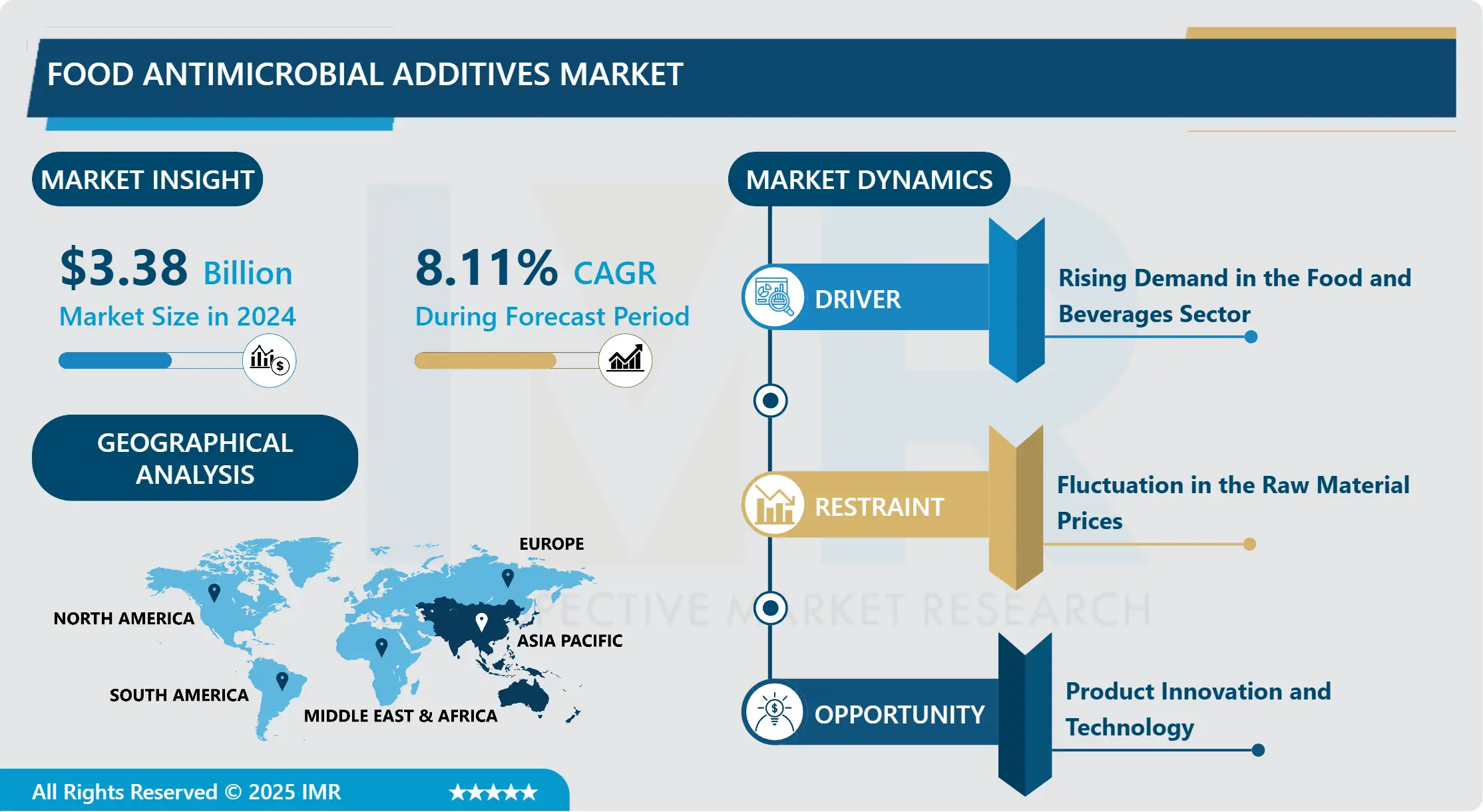
Food Antimicrobial Additives Market Size Was Valued at USD 3.38 Billion in 2024, and is Projected to Reach USD 6.31 Billion by 2032, Growing at a CAGR of 8.11 % From 2025-2032.
Food Antimicrobial Additives are the type of food preservatives that inhibit the growth of spoilage and pathogenic microorganisms such as bacteria and fungus in food products.
The rapid market growth is attributed to the continuous increase in demand for packaged as well as processed foods due to changing lifestyle trends, concern regarding synthetic chemical additives, foods preserved without artificial additives and an increase in awareness about health benefits among consumers worldwide. Antimicrobial food additives play an important role in the prevention and inhibition of microbial growth in food products.
However, in the meat and meat product industry, every large scale and small- scale producer is rigorously suspending the usage of nitrites due to their harmful carcinogenic effect; this further enhances the utilization of natural antimicrobial additives, like nisin and natamycin, to inhibit mold growth. The rise in utilization of food antimicrobial additives to prevent such harmful effects, is thus, inhibiting the market growth.
Moreover, the added benefits of these additives, such as enhancing the high dimensional stability, heat & chemical resistance, and chemical stability is further estimated to boost the market growth of food antimicrobial additives over the projected period.
Food Antimicrobial Additives Market Trend Analysis
Rising Demand in The Food and Beverages Sector
There is a strong demand for food antimicrobial additives in various applications with the number of COVID-19 positive cases increasing day by day globally. Rising consumer awareness prevailing of the importance of food antimicrobial additives is growing rapidly, which therefore increases the demand for antimicrobials in the food and beverages sector.
In addition, the global antimicrobial food additives market is mainly driven by the higher growth of the food & beverages industry due to emerging trends in various food products, beverages and confectionaries. Food antimicrobials play a crucial role in expanding shelf life and increasing product safety by ensuring better hygiene standards.
Also, the utilization of food antimicrobial additives in beverages to increase the shelf life, especially carbonated drinks and fruit juices leads to rise in demand, and thereby propelling growth of food antimicrobial additives market in the projected year.
Product Innovation and Technology creates an Opportunity
The current demand of the market is concentrated on food antimicrobial additives that meet the minimum regulations or standards which are mandatory in the region and are which are cost-effective.
The rising demand for non-toxic plastics with improved features such as, hardness, high antimicrobial activity, durability, and transparency is creating an opportunity for the manufacturers.
Many large-scale plastic and paint coating manufacturers are increasing the use of antimicrobial additives in their products such as medical equipment, bottles, and food packaging. Therefore, the rising demand for creative and innovative products directs to technological and product innovation, and are further expected to attain a rapid growth over the forecasted years.
Food Antimicrobial Additives Market Segment Analysis:
Food Antimicrobial Additives Market Segmented on the basis of type, application.
By Type, Benzoate segment is expected to dominate the market during the forecast period
Benzoate is estimated to dominate the market in the forecasted period. The growth is influenced as benzoates possess excellent antimicrobial and anti-fungal properties. They can also be used further as a preservative to increase the shelf life of various foods by preventing yeast, mold, or fungi growth.
The segment is expected to dominate as it is often found in fruit juices, salad dressings, soft drinks, and jams & jellies. Benzoate salts also helps in preventing the growth of bacteria from any harmful spoilage during production stages and maintaining freshness until consumption.
By Application, Beverages segment held the largest share
Beverages segment is estimated to dominate the market in the upcoming years. Food antimicrobial additives are commonly used in beverages to increase the shelf life of products, especially carbonated drinks and fruit juices. They prevent spoilage by impeding microbial growth, but without affecting the taste or smell of food items.
The bakery and confectionery sector witnessed a sudden rise in usage of antimicrobial additives owing to the preservative benefits offered by resisting the growth of unwanted microorganisms. Thus, the beverages segment is expected to continue its dominance in upcoming years.
Food Antimicrobial Additives Market Regional Insights:
Asia Pacific is Expected to Dominate the Market Over the Forecast period
Asia Pacific is the fastest growing region and is expected to dominate the global food antimicrobial additives market in the upcoming years. Owing to the growing consumer awareness about health-related safety standards and infections, growing population and rapid urbanization and expansion of key players in the region, the Asia Pacific is estimated to attain a sustainable growth.
Bakery products are used vastly in this region due to the evolving lifestyle and trend as well as growing awareness associated with the health benefits. Countries driving the Asia Pacific region include India, Japan and China where the sales of food and beverage products are increasing significantly has also fueled market growth. Japan, is valued as the second largest in South East Asia Pacific and among the top five markets for baked products and is further expected to gain high demand for antimicrobial food additives by end of forecast period.
Food Antimicrobial Additives Market Top Key Players:
Albemarle Corporation(United States)
Chemours (United States)
Dow (United States)
Milliken & Company (United States)
Nalco Water (United States)
Eastman (United States)
Huntsman International LLC (United States)
Chemtura Corporation (United States)
Southern Specialties (United States)
Performance Materials Group (United States)
3M (United States)
Ashland (United States)
Rhodia (France)
BASF (Germany)
Lanxess (Germany)
Evonik Industries (Germany)
Croda International plc (United Kingdom)
Clariant (Switzerland)
Lonza Group (Switzerland)
Solvay (Belgium)
Akzo Nobel (Netherlands)
Nippon Shokubai (Japan)
Nouryon (Netherlands)
Quantum Hitech (China)
Sanitized Group (Czech Republic)
Other Active Players
Key Industry Developments in the Food Antimicrobial Additives Market:
In March 2023, BASF announced the launch of its new antimicrobial additive, BASF Silwet Protect 3000. This additive is designed to protect surfaces from microbial growth and is suitable for use in a variety of applications, including food packaging, paints, and coatings.
In April 2023, Lonza announced the acquisition of Microcide, a company that specializes in the development and production of antimicrobial additives. This acquisition will expand Lonza’s portfolio of antimicrobial solutions and provide a platform for further growth in this market.
In May 2023, DuPont announced the launch of its new antimicrobial additive, DuPont Biofilm Shield. This additive is designed to protect surfaces from the growth of biofilm, which is a type of microbial community that is difficult to remove.
Chapter 1: Introduction
1.1 Scope and Coverage
Chapter 2:Executive Summary
Chapter 3: Market Landscape
3.1 Market Dynamics
3.1.1 Drivers
3.1.2 Restraints
3.1.3 Opportunities
3.1.4 Challenges
3.2 Market Trend Analysis
3.3 PESTLE Analysis
3.4 Porter’s Five Forces Analysis
3.5 Industry Value Chain Analysis
3.6 Ecosystem
3.7 Regulatory Landscape
3.8 Price Trend Analysis
3.9 Patent Analysis
3.10 Technology Evolution
3.11 Investment Pockets
3.12 Import-Export Analysis
Chapter 4: Food Antimicrobial Additives Market by Type (2018-2032)
4.1 Food Antimicrobial Additives Market Snapshot and Growth Engine
4.2 Market Overview
4.3 Benzoates
4.3.1 Introduction and Market Overview
4.3.2 Historic and Forecasted Market Size in Value USD and Volume Units
4.3.3 Key Market Trends, Growth Factors, and Opportunities
4.3.4 Geographic Segmentation Analysis
4.4 Sorbates
4.5 Propionates
4.6 Lactates
4.7 Nitrites
4.8 Acetates
Chapter 5: Food Antimicrobial Additives Market by Application (2018-2032)
5.1 Food Antimicrobial Additives Market Snapshot and Growth Engine
5.2 Market Overview
5.3 Bakery
5.3.1 Introduction and Market Overview
5.3.2 Historic and Forecasted Market Size in Value USD and Volume Units
5.3.3 Key Market Trends, Growth Factors, and Opportunities
5.3.4 Geographic Segmentation Analysis
5.4 Beverages
5.5 Dairy
5.6 Meat and Meat Products
Chapter 6: Company Profiles and Competitive Analysis
6.1 Competitive Landscape
6.1.1 Competitive Benchmarking
6.1.2 Food Antimicrobial Additives Market Share by Manufacturer (2024)
6.1.3 Industry BCG Matrix
6.1.4 Heat Map Analysis
6.1.5 Mergers and Acquisitions
6.2 MERIT FUNCTIONAL FOODS(WINNIPEG)
6.2.1 Company Overview
6.2.2 Key Executives
6.2.3 Company Snapshot
6.2.4 Role of the Company in the Market
6.2.5 Sustainability and Social Responsibility
6.2.6 Operating Business Segments
6.2.7 Product Portfolio
6.2.8 Business Performance
6.2.9 Key Strategic Moves and Recent Developments
6.2.10 SWOT Analysis
6.3 DANONE SA (FRANCE)
6.4 DEL MONTE PACIFIC LIMITED (DMPL) (SINGAPORE)
6.5 DR PEPPER SNAPPLE GROUP INC. (USA)
6.6 GENERAL MILLS INC. (USA)
6.7 GLANBIA NUTRITIONALS LIMITED (UK)
6.8 MAXINUTRITION (UK)
6.9 GNC HOLDINGS INC. (USA)
6.10 HANGZHOU WAHAHA GROUP COLTD. (CHINA)
6.11 HERBALIFE INTERNATIONAL INC. (USA)
6.12 KELLOGG COMPANY (USA)
6.13 MEIJI HOLDINGS COLTD. (JAPAN)
6.14 NATURAL PRODUCTS INC. (USA)
6.15 NESTLE NUTRITION (SWITZERLAND)
6.16
Chapter 7: Global Food Antimicrobial Additives Market By Region
7.1 Overview
7.2. North America Food Antimicrobial Additives Market
7.2.1 Key Market Trends, Growth Factors and Opportunities
7.2.2 Top Key Companies
7.2.3 Historic and Forecasted Market Size by Segments
7.2.4 Historic and Forecasted Market Size by Type
7.2.4.1 Benzoates
7.2.4.2 Sorbates
7.2.4.3 Propionates
7.2.4.4 Lactates
7.2.4.5 Nitrites
7.2.4.6 Acetates
7.2.5 Historic and Forecasted Market Size by Application
7.2.5.1 Bakery
7.2.5.2 Beverages
7.2.5.3 Dairy
7.2.5.4 Meat and Meat Products
7.2.6 Historic and Forecast Market Size by Country
7.2.6.1 US
7.2.6.2 Canada
7.2.6.3 Mexico
7.3. Eastern Europe Food Antimicrobial Additives Market
7.3.1 Key Market Trends, Growth Factors and Opportunities
7.3.2 Top Key Companies
7.3.3 Historic and Forecasted Market Size by Segments
7.3.4 Historic and Forecasted Market Size by Type
7.3.4.1 Benzoates
7.3.4.2 Sorbates
7.3.4.3 Propionates
7.3.4.4 Lactates
7.3.4.5 Nitrites
7.3.4.6 Acetates
7.3.5 Historic and Forecasted Market Size by Application
7.3.5.1 Bakery
7.3.5.2 Beverages
7.3.5.3 Dairy
7.3.5.4 Meat and Meat Products
7.3.6 Historic and Forecast Market Size by Country
7.3.6.1 Russia
7.3.6.2 Bulgaria
7.3.6.3 The Czech Republic
7.3.6.4 Hungary
7.3.6.5 Poland
7.3.6.6 Romania
7.3.6.7 Rest of Eastern Europe
7.4. Western Europe Food Antimicrobial Additives Market
7.4.1 Key Market Trends, Growth Factors and Opportunities
7.4.2 Top Key Companies
7.4.3 Historic and Forecasted Market Size by Segments
7.4.4 Historic and Forecasted Market Size by Type
7.4.4.1 Benzoates
7.4.4.2 Sorbates
7.4.4.3 Propionates
7.4.4.4 Lactates
7.4.4.5 Nitrites
7.4.4.6 Acetates
7.4.5 Historic and Forecasted Market Size by Application
7.4.5.1 Bakery
7.4.5.2 Beverages
7.4.5.3 Dairy
7.4.5.4 Meat and Meat Products
7.4.6 Historic and Forecast Market Size by Country
7.4.6.1 Germany
7.4.6.2 UK
7.4.6.3 France
7.4.6.4 The Netherlands
7.4.6.5 Italy
7.4.6.6 Spain
7.4.6.7 Rest of Western Europe
7.5. Asia Pacific Food Antimicrobial Additives Market
7.5.1 Key Market Trends, Growth Factors and Opportunities
7.5.2 Top Key Companies
7.5.3 Historic and Forecasted Market Size by Segments
7.5.4 Historic and Forecasted Market Size by Type
7.5.4.1 Benzoates
7.5.4.2 Sorbates
7.5.4.3 Propionates
7.5.4.4 Lactates
7.5.4.5 Nitrites
7.5.4.6 Acetates
7.5.5 Historic and Forecasted Market Size by Application
7.5.5.1 Bakery
7.5.5.2 Beverages
7.5.5.3 Dairy
7.5.5.4 Meat and Meat Products
7.5.6 Historic and Forecast Market Size by Country
7.5.6.1 China
7.5.6.2 India
7.5.6.3 Japan
7.5.6.4 South Korea
7.5.6.5 Malaysia
7.5.6.6 Thailand
7.5.6.7 Vietnam
7.5.6.8 The Philippines
7.5.6.9 Australia
7.5.6.10 New Zealand
7.5.6.11 Rest of APAC
7.6. Middle East & Africa Food Antimicrobial Additives Market
7.6.1 Key Market Trends, Growth Factors and Opportunities
7.6.2 Top Key Companies
7.6.3 Historic and Forecasted Market Size by Segments
7.6.4 Historic and Forecasted Market Size by Type
7.6.4.1 Benzoates
7.6.4.2 Sorbates
7.6.4.3 Propionates
7.6.4.4 Lactates
7.6.4.5 Nitrites
7.6.4.6 Acetates
7.6.5 Historic and Forecasted Market Size by Application
7.6.5.1 Bakery
7.6.5.2 Beverages
7.6.5.3 Dairy
7.6.5.4 Meat and Meat Products
7.6.6 Historic and Forecast Market Size by Country
7.6.6.1 Turkiye
7.6.6.2 Bahrain
7.6.6.3 Kuwait
7.6.6.4 Saudi Arabia
7.6.6.5 Qatar
7.6.6.6 UAE
7.6.6.7 Israel
7.6.6.8 South Africa
7.7. South America Food Antimicrobial Additives Market
7.7.1 Key Market Trends, Growth Factors and Opportunities
7.7.2 Top Key Companies
7.7.3 Historic and Forecasted Market Size by Segments
7.7.4 Historic and Forecasted Market Size by Type
7.7.4.1 Benzoates
7.7.4.2 Sorbates
7.7.4.3 Propionates
7.7.4.4 Lactates
7.7.4.5 Nitrites
7.7.4.6 Acetates
7.7.5 Historic and Forecasted Market Size by Application
7.7.5.1 Bakery
7.7.5.2 Beverages
7.7.5.3 Dairy
7.7.5.4 Meat and Meat Products
7.7.6 Historic and Forecast Market Size by Country
7.7.6.1 Brazil
7.7.6.2 Argentina
7.7.6.3 Rest of SA
Chapter 8 Analyst Viewpoint and Conclusion
8.1 Recommendations and Concluding Analysis
8.2 Potential Market Strategies
Chapter 9 Research Methodology
9.1 Research Process
9.2 Primary Research
9.3 Secondary Research
Q1: What would be the forecast period in the Food Antimicrobial Additives Market research report?
A1: The forecast period in the Food Antimicrobial Additives Market research report is 2025-2032.
Q2: Who are the key players in the Food Antimicrobial Additives Market?
A2: Albemarle Corporation (United States), Chemours (United States), Dow (United States), Milliken & Company (United States), Nalco Water (United States), Eastman (United States), Huntsman International LLC (United States), Chemtura Corporation (United States), Southern Specialties (United States), Performance Materials Group (United States), 3M (United States), Ashland (United States), Rhodia (France), BASF (Germany), Lanxess (Germany),Evonik Industries (Germany), Croda International plc (United Kingdom), Clariant (Switzerland), Lonza Group (Switzerland), Solvay (Belgium), Akzo Nobel (Netherlands), Nippon Shokubai (Japan), Nouryon (Netherlands), Quantum Hitech (China), Sanitized Group (Czech Republic) and Other Active Players.
Q3: What are the segments of the Food Antimicrobial Additives Market?
A3: The Food Antimicrobial Additives Market is segmented into Type, Application, region. By Type, the market is categorized into (Benzoates, Sorbates, Propionates, Lactates, Nitrites, Acetates). By Application, the market is categorized into (Bakery, Beverages, Dairy, Meat and meat products). By region, it is analyzed across North America (U.S.; Canada; Mexico), Eastern Europe (Bulgaria; The Czech Republic; Hungary; Poland; Romania; Rest of Eastern Europe), Western Europe (Germany; UK; France; Netherlands; Italy; Russia; Spain; Rest of Western Europe), Asia-Pacific (China; India; Japan; Southeast Asia, etc.), South America (Brazil; Argentina, etc.), Middle East & Africa (Saudi Arabia; South Africa, etc.).
Q4: What is the Food Antimicrobial Additives Market?
A4: Food Antimicrobial Additives are the type of food preservatives that inhibit the growth of spoilage and pathogenic microorganisms such as bacteria and fungus in food products.
Q5: How big is the Food Antimicrobial Additives Market?
A5: Food Antimicrobial Additives Market Size Was Valued at USD 3.38 Billion in 2024, and is Projected to Reach USD 6.31 Billion by 2032, Growing at a CAGR of 8.11 % From 2025-2032.
How to Buy a Report from eminsights.jp
On the product page, choose the license you want: Single-User License, Multi-User License or Enterprise License.
If you required report in your native language, then you can click on Translated Report button and fill out the form with report name and language you want, then our team will contact you as soon as possible.
Click the Buy Now button.
You will be redirected to the checkout page. Enter your company details and payment information.
Click Place Order to complete the purchase.
Confirmation: You’ll receive an order confirmation and our team will contact you shortly with your ordered report.
If you have any questions, fill out the contact form below or email us at bizdev@eminsights.net.
Thank you for choosing eminsights.jp!