Stay Ahead in Fast-Growing Economies.
Browse Reports Now
Food Additives Market – In Deep Analysis and Industry Share
Food additive refers to any of various natural or synthetic substances added to foods to produce specific desirable effects. Additives such as colorants, flavors, sweeteners, preservatives and others to add in food products or beverages to increase their shelf life, taste, smell, and texture. Moreover, food additives can be produced from plants, animals, minerals, or they can be synthetic and easily available at cheap cost, which gives manufacturers a cost advantage. Furthermore, natural additives require fewer processing than synthetic sources and provide nutritional benefits which leads the market growth during forecast period.

IMR Group
Description
Global Food Additives Market Overview
The Global Food Additives Market size is expected to grow from USD 54.54 billion in 2024 to USD 83.71 billion by 2032, at a CAGR of 5.5% during the forecast period (2025-2032).
Food additive refers to any of various natural or synthetic substances added to foods to produce specific desirable effects. Additives such as colorants, flavors, sweeteners, preservatives and others to add in food products or beverages to increase their shelf life, taste, smell, and texture. Moreover, food additives can be produced from plants, animals, minerals, or they can be synthetic and easily available at cheap cost, which gives manufacturers a cost advantage. Furthermore, natural additives require fewer processing than synthetic sources and provide nutritional benefits which leads the market growth during forecast period. For instance, about 15% of bakeries and 23% of dairy and candy are using food additives in Asia-Pacific region. However, food additives need to be checked for potential harmful effects on human health before they can be used and the Joint FAO/WHO Expert Committee on Food Additives (JECFA), is the international body accountable for evaluating the safety of food additives.
Market Dynamics And Factors
Drivers:
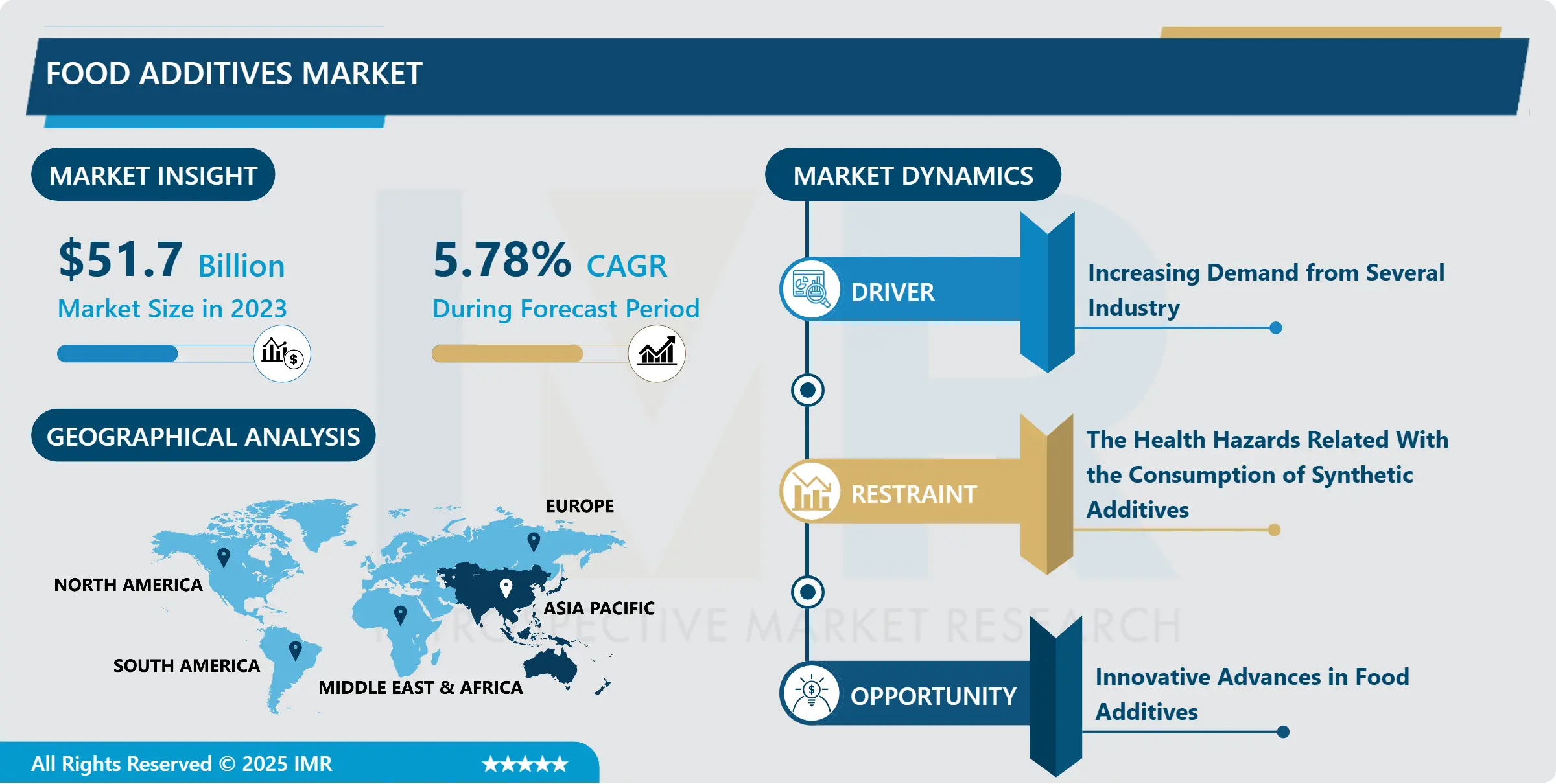
Rising the various range of food additives in a different application such as bakery, dairy products, meat and seafood, and others, which are being demanded by the consumers, is boosting the demand for different types of additives. In addition, there has been an increase in the number of propels demanding the processed and canned foods along with ready to eat and ready to cook varieties, which is being caused as a result of majority of the population getting busier in their work lives and have limited peace of time which leads to a spur in the market growth in projected period.
The growing consumers demand for high-value nutritional and exotic tasting products is affecting manufacturers to use ingredients that enrich the consumer experience is driving the demand for acidulated foods additives essential in the global food additive market. Rising urbanization and disposable incomes and leading a healthy lifestyle among populations are fueling the demand for the food additives market. The tendency of the individuals to spend on premium products and nutritional product due to their health benefits in order to stay fit and healthy is being facilitated and contributing to the market growth further.
Restraints:
The health hazards related with the consumption of synthetic additives, rising consumer demand for no additive food products or products with natural additives, scanty availability & high cost of naturally sourced additives, and the rising consumer shift to organic foods have resulted in hampering market growth during forecast period.
Opportunities:
Innovative advances in food additives and continuous R&D efforts are anticipated to open up growth opportunities for leading manufactures operating in the global market in upcoming years.
Market Segmentation
Regional Analysis:
In Asia Pacific region dominate the food additive market owing to high population, availability of natural food additives, growing demand for food preservatives, rising awareness of food safety and increasing consumption for food safety which leads to market growth over forecast period. The region’s large and growing population drives high demand for processed and packaged foods, boosting the need for natural additives. Additionally, Asia Pacific benefits from abundant availability of natural resources used to produce these additives, such as plant extracts and herbs. Rising consumer awareness regarding food safety and health has increased the preference for clean-label and preservative-free products. Governments and food manufacturers are also emphasizing stricter food safety regulations, encouraging the use of natural preservatives and additives. These trends, combined with increasing disposable incomes and urbanization, are propelling the growth of the natural food additive market in the region during the forecast period.
Players Covered in Food Additives Market are:
DuPont
Archer Danial Midland (ADM) Company
CHR Hansen Holding A/S
BASF SE
Cargill Incorporated
Kerry Group Plc.
Ashland Inc.
Tate and Lyle Inc.
Corbion NV
Royal DSM NV
Red Arrow International Inc.
McCormick and Company inc.
Associated British Food Plc.
International Flavors and Fragrance Inc. and other active players.
Key Industry Developments
March 2024, BASF announced the launch of Natural Beta-caryophyllene 80, an innovative addition to its Isobionics portfolio. This natural flavor product features an aromatic profile characterized by herbaceous notes, complemented by hints of green parsley, black pepper, grapefruit, and a subtle touch of clary sage. Designed to meet the evolving needs of the flavor and fragrance industry, Natural Beta-caryophyllene 80 highlights BASF’s commitment to delivering high-quality, nature-inspired solutions.
In May 2023, The National Health Commission of the People’s Republic of China (NHC) issued an announcement approving 14 products under the “Three New Foods” category. The approvals included two new food raw materials, six new food additives, and six food-related products. This step aimed to promote innovation and enhance food safety standards. The NHC’s announcement underscored its commitment to regulating the food industry by ensuring compliance with scientific and safety benchmarks.
Chapter 1: Introduction
1.1 Scope and Coverage
Chapter 2:Executive Summary
Chapter 3: Market Landscape
3.1 Market Dynamics
3.1.1 Drivers
3.1.2 Restraints
3.1.3 Opportunities
3.1.4 Challenges
3.2 Market Trend Analysis
3.3 PESTLE Analysis
3.4 Porter’s Five Forces Analysis
3.5 Industry Value Chain Analysis
3.6 Ecosystem
3.7 Regulatory Landscape
3.8 Price Trend Analysis
3.9 Patent Analysis
3.10 Technology Evolution
3.11 Investment Pockets
3.12 Import-Export Analysis
Chapter 4: Food Additives Market by Type (2018-2032)
4.1 Food Additives Market Snapshot and Growth Engine
4.2 Market Overview
4.3 Acidulants
4.3.1 Introduction and Market Overview
4.3.2 Historic and Forecasted Market Size in Value USD and Volume Units
4.3.3 Key Market Trends, Growth Factors, and Opportunities
4.3.4 Geographic Segmentation Analysis
4.4 Colors
4.5 Emulsifiers
4.6 Flavors
4.7 Sweeteners
4.8 Others
Chapter 5: Food Additives Market by Application (2018-2032)
5.1 Food Additives Market Snapshot and Growth Engine
5.2 Market Overview
5.3 Food & Beverages
5.3.1 Introduction and Market Overview
5.3.2 Historic and Forecasted Market Size in Value USD and Volume Units
5.3.3 Key Market Trends, Growth Factors, and Opportunities
5.3.4 Geographic Segmentation Analysis
5.4 Diary & Frozen Products
5.5 Bakery & Confectionary
5.6 Spices & Condiments
5.7 Sauces & Dressings
5.8 Convenience Foods
5.9 Others
Chapter 6: Food Additives Market by Source (2018-2032)
6.1 Food Additives Market Snapshot and Growth Engine
6.2 Market Overview
6.3 Natural
6.3.1 Introduction and Market Overview
6.3.2 Historic and Forecasted Market Size in Value USD and Volume Units
6.3.3 Key Market Trends, Growth Factors, and Opportunities
6.3.4 Geographic Segmentation Analysis
6.4 Synthetic
Chapter 7: Food Additives Market by Distribution Channels (2018-2032)
7.1 Food Additives Market Snapshot and Growth Engine
7.2 Market Overview
7.3 Specialty Store
7.3.1 Introduction and Market Overview
7.3.2 Historic and Forecasted Market Size in Value USD and Volume Units
7.3.3 Key Market Trends, Growth Factors, and Opportunities
7.3.4 Geographic Segmentation Analysis
7.4 Supermarket/Hypermarket
7.5 Online
7.6 Others
Chapter 8: Company Profiles and Competitive Analysis
8.1 Competitive Landscape
8.1.1 Competitive Benchmarking
8.1.2 Food Additives Market Share by Manufacturer (2024)
8.1.3 Industry BCG Matrix
8.1.4 Heat Map Analysis
8.1.5 Mergers and Acquisitions
8.2 JBT CORPORATION (US)
8.2.1 Company Overview
8.2.2 Key Executives
8.2.3 Company Snapshot
8.2.4 Role of the Company in the Market
8.2.5 Sustainability and Social Responsibility
8.2.6 Operating Business Segments
8.2.7 Product Portfolio
8.2.8 Business Performance
8.2.9 Key Strategic Moves and Recent Developments
8.2.10 SWOT Analysis
8.3 CONAGRA BRANDS (US)
8.4 THE KRAFT HEINZ COMPANY (US)
8.5 PEPSICO INC. (US)
8.6 DOLE FOOD (US)
8.7 SVZ INTERNATIONAL B.V. (US)
8.8 GEA GROUP AG (GERMANY)
8.9 SYNTEGON TECHNOLOGY GMBH (GERMANY)
8.10 KRONES AG (GERMANY)
8.11 FENCO FOOD MACHINERY S.R. L. (ITALY)
8.12 DIANA GROUP S.A.S.(FRANCE)
8.13 BONDUELLE (FRANCE)
8.14 FINIS (NETHERLANDS)
8.15 NESTLÉ S.A (SWITZERLAND)
8.16 BÜHLER (SWITZERLAND)
8.17 ALFA LAVAL (SWEDEN)
8.18 HEAT AND CONTROL INC. (SWEDEN)
8.19 GREENCORE GROUP (IRELAND)
8.20 MAREL (ICELAND)
8.21 AGRANA GROUP (AUSTRIA)
8.22 ANKO FOOD MACHINE CO.LTD (TAIWAN)
8.23 OLAM INTERNATIONAL (SINGAPORE)
8.24 SAHYADRI FARMS (INDIA)
8.25 RAJE AGRO FOODS PRIVET LIMITED (INDIA)
8.26 BIGTEM MAKINE A.S.(TURKEY)
8.27
Chapter 9: Global Food Additives Market By Region
9.1 Overview
9.2. North America Food Additives Market
9.2.1 Key Market Trends, Growth Factors and Opportunities
9.2.2 Top Key Companies
9.2.3 Historic and Forecasted Market Size by Segments
9.2.4 Historic and Forecasted Market Size by Type
9.2.4.1 Acidulants
9.2.4.2 Colors
9.2.4.3 Emulsifiers
9.2.4.4 Flavors
9.2.4.5 Sweeteners
9.2.4.6 Others
9.2.5 Historic and Forecasted Market Size by Application
9.2.5.1 Food & Beverages
9.2.5.2 Diary & Frozen Products
9.2.5.3 Bakery & Confectionary
9.2.5.4 Spices & Condiments
9.2.5.5 Sauces & Dressings
9.2.5.6 Convenience Foods
9.2.5.7 Others
9.2.6 Historic and Forecasted Market Size by Source
9.2.6.1 Natural
9.2.6.2 Synthetic
9.2.7 Historic and Forecasted Market Size by Distribution Channels
9.2.7.1 Specialty Store
9.2.7.2 Supermarket/Hypermarket
9.2.7.3 Online
9.2.7.4 Others
9.2.8 Historic and Forecast Market Size by Country
9.2.8.1 US
9.2.8.2 Canada
9.2.8.3 Mexico
9.3. Eastern Europe Food Additives Market
9.3.1 Key Market Trends, Growth Factors and Opportunities
9.3.2 Top Key Companies
9.3.3 Historic and Forecasted Market Size by Segments
9.3.4 Historic and Forecasted Market Size by Type
9.3.4.1 Acidulants
9.3.4.2 Colors
9.3.4.3 Emulsifiers
9.3.4.4 Flavors
9.3.4.5 Sweeteners
9.3.4.6 Others
9.3.5 Historic and Forecasted Market Size by Application
9.3.5.1 Food & Beverages
9.3.5.2 Diary & Frozen Products
9.3.5.3 Bakery & Confectionary
9.3.5.4 Spices & Condiments
9.3.5.5 Sauces & Dressings
9.3.5.6 Convenience Foods
9.3.5.7 Others
9.3.6 Historic and Forecasted Market Size by Source
9.3.6.1 Natural
9.3.6.2 Synthetic
9.3.7 Historic and Forecasted Market Size by Distribution Channels
9.3.7.1 Specialty Store
9.3.7.2 Supermarket/Hypermarket
9.3.7.3 Online
9.3.7.4 Others
9.3.8 Historic and Forecast Market Size by Country
9.3.8.1 Russia
9.3.8.2 Bulgaria
9.3.8.3 The Czech Republic
9.3.8.4 Hungary
9.3.8.5 Poland
9.3.8.6 Romania
9.3.8.7 Rest of Eastern Europe
9.4. Western Europe Food Additives Market
9.4.1 Key Market Trends, Growth Factors and Opportunities
9.4.2 Top Key Companies
9.4.3 Historic and Forecasted Market Size by Segments
9.4.4 Historic and Forecasted Market Size by Type
9.4.4.1 Acidulants
9.4.4.2 Colors
9.4.4.3 Emulsifiers
9.4.4.4 Flavors
9.4.4.5 Sweeteners
9.4.4.6 Others
9.4.5 Historic and Forecasted Market Size by Application
9.4.5.1 Food & Beverages
9.4.5.2 Diary & Frozen Products
9.4.5.3 Bakery & Confectionary
9.4.5.4 Spices & Condiments
9.4.5.5 Sauces & Dressings
9.4.5.6 Convenience Foods
9.4.5.7 Others
9.4.6 Historic and Forecasted Market Size by Source
9.4.6.1 Natural
9.4.6.2 Synthetic
9.4.7 Historic and Forecasted Market Size by Distribution Channels
9.4.7.1 Specialty Store
9.4.7.2 Supermarket/Hypermarket
9.4.7.3 Online
9.4.7.4 Others
9.4.8 Historic and Forecast Market Size by Country
9.4.8.1 Germany
9.4.8.2 UK
9.4.8.3 France
9.4.8.4 The Netherlands
9.4.8.5 Italy
9.4.8.6 Spain
9.4.8.7 Rest of Western Europe
9.5. Asia Pacific Food Additives Market
9.5.1 Key Market Trends, Growth Factors and Opportunities
9.5.2 Top Key Companies
9.5.3 Historic and Forecasted Market Size by Segments
9.5.4 Historic and Forecasted Market Size by Type
9.5.4.1 Acidulants
9.5.4.2 Colors
9.5.4.3 Emulsifiers
9.5.4.4 Flavors
9.5.4.5 Sweeteners
9.5.4.6 Others
9.5.5 Historic and Forecasted Market Size by Application
9.5.5.1 Food & Beverages
9.5.5.2 Diary & Frozen Products
9.5.5.3 Bakery & Confectionary
9.5.5.4 Spices & Condiments
9.5.5.5 Sauces & Dressings
9.5.5.6 Convenience Foods
9.5.5.7 Others
9.5.6 Historic and Forecasted Market Size by Source
9.5.6.1 Natural
9.5.6.2 Synthetic
9.5.7 Historic and Forecasted Market Size by Distribution Channels
9.5.7.1 Specialty Store
9.5.7.2 Supermarket/Hypermarket
9.5.7.3 Online
9.5.7.4 Others
9.5.8 Historic and Forecast Market Size by Country
9.5.8.1 China
9.5.8.2 India
9.5.8.3 Japan
9.5.8.4 South Korea
9.5.8.5 Malaysia
9.5.8.6 Thailand
9.5.8.7 Vietnam
9.5.8.8 The Philippines
9.5.8.9 Australia
9.5.8.10 New Zealand
9.5.8.11 Rest of APAC
9.6. Middle East & Africa Food Additives Market
9.6.1 Key Market Trends, Growth Factors and Opportunities
9.6.2 Top Key Companies
9.6.3 Historic and Forecasted Market Size by Segments
9.6.4 Historic and Forecasted Market Size by Type
9.6.4.1 Acidulants
9.6.4.2 Colors
9.6.4.3 Emulsifiers
9.6.4.4 Flavors
9.6.4.5 Sweeteners
9.6.4.6 Others
9.6.5 Historic and Forecasted Market Size by Application
9.6.5.1 Food & Beverages
9.6.5.2 Diary & Frozen Products
9.6.5.3 Bakery & Confectionary
9.6.5.4 Spices & Condiments
9.6.5.5 Sauces & Dressings
9.6.5.6 Convenience Foods
9.6.5.7 Others
9.6.6 Historic and Forecasted Market Size by Source
9.6.6.1 Natural
9.6.6.2 Synthetic
9.6.7 Historic and Forecasted Market Size by Distribution Channels
9.6.7.1 Specialty Store
9.6.7.2 Supermarket/Hypermarket
9.6.7.3 Online
9.6.7.4 Others
9.6.8 Historic and Forecast Market Size by Country
9.6.8.1 Turkiye
9.6.8.2 Bahrain
9.6.8.3 Kuwait
9.6.8.4 Saudi Arabia
9.6.8.5 Qatar
9.6.8.6 UAE
9.6.8.7 Israel
9.6.8.8 South Africa
9.7. South America Food Additives Market
9.7.1 Key Market Trends, Growth Factors and Opportunities
9.7.2 Top Key Companies
9.7.3 Historic and Forecasted Market Size by Segments
9.7.4 Historic and Forecasted Market Size by Type
9.7.4.1 Acidulants
9.7.4.2 Colors
9.7.4.3 Emulsifiers
9.7.4.4 Flavors
9.7.4.5 Sweeteners
9.7.4.6 Others
9.7.5 Historic and Forecasted Market Size by Application
9.7.5.1 Food & Beverages
9.7.5.2 Diary & Frozen Products
9.7.5.3 Bakery & Confectionary
9.7.5.4 Spices & Condiments
9.7.5.5 Sauces & Dressings
9.7.5.6 Convenience Foods
9.7.5.7 Others
9.7.6 Historic and Forecasted Market Size by Source
9.7.6.1 Natural
9.7.6.2 Synthetic
9.7.7 Historic and Forecasted Market Size by Distribution Channels
9.7.7.1 Specialty Store
9.7.7.2 Supermarket/Hypermarket
9.7.7.3 Online
9.7.7.4 Others
9.7.8 Historic and Forecast Market Size by Country
9.7.8.1 Brazil
9.7.8.2 Argentina
9.7.8.3 Rest of SA
Chapter 10 Analyst Viewpoint and Conclusion
10.1 Recommendations and Concluding Analysis
10.2 Potential Market Strategies
Chapter 11 Research Methodology
11.1 Research Process
11.2 Primary Research
11.3 Secondary Research
Q1: What would be the forecast period in the Food Additives Market research report?
A1: The forecast period in the Food Additives Market research report is 2025-2032.
Q2: Who are the key players in Food Additives Market?
A2: DuPont, Archer Danial Midland (ADM) Company, CHR Hansen Holding A/S, BASF SE, Cargill Incorporated, Kerry Group Plc., Ashland Inc., Tate and Lyle Inc., Corbion NV, Royal DSM NV, Red Arrow International Inc., McCormick and Company inc., Associated British Food Plc., International Flavors and Fragrance Inc, and Other Active Players.
Q3: What are the segments of Food Additives Market?
A3: Food Additives Market is segmented into Type, Application, Source, Distribution Channels and region. By Type, the market is categorized into Acidulants, Colors, Emulsifiers, Flavors, Sweeteners, Others. By Application, the market is categorized into Food & Beverages, Diary & Frozen Products, Bakery & Confectionary, Spices & Condiments, Sauces & Dressings, Convenience Foods, Others. By Source the market is categorized into Natural, Synthetic. By Distribution Channel, the market is categorized into Specialty Store, Supermarket/Hypermarket, Online, Others. By region, it is analysed across North America (U.S.; Canada; Mexico), Europe (Germany; U.K.; France; Italy; Russia; Spain, etc.), Asia-Pacific (China; India; Japan; Southeast Asia, etc.), South America (Brazil; Argentina, etc.), Middle East & Africa (Saudi Arabia; South Africa, etc.).
Q4: What is the Food Additives Market?
A4: Food additive refers to any of various natural or synthetic substances added to foods to produce specific desirable effects. Additives such as colorants, flavors, sweeteners, preservatives and others to add in food products or beverages to increase their shelf life, taste, smell, and texture.
Q5: How big is Food Additives Market?
A5: Asia Pacific dominates the natural food additive market due to several key factors. The region’s large and growing population drives high demand for processed and packaged foods, boosting the need for natural additives. Additionally, Asia Pacific benefits from abundant availability of natural resources used to produce these additives, such as plant extracts and herbs. Rising consumer awareness regarding food safety and health has increased the preference for clean-label and preservative-free products. Governments and food manufacturers are also emphasizing stricter food safety regulations, encouraging the use of natural preservatives and additives. These trends, combined with increasing disposable incomes and urbanization, are propelling the growth of the natural food additive market in the region during the forecast period.
How to Buy a Report from eminsights.jp
On the product page, choose the license you want: Single-User License, Multi-User License or Enterprise License.
If you required report in your native language, then you can click on Translated Report button and fill out the form with report name and language you want, then our team will contact you as soon as possible.
Click the Buy Now button.
You will be redirected to the checkout page. Enter your company details and payment information.
Click Place Order to complete the purchase.
Confirmation: You’ll receive an order confirmation and our team will contact you shortly with your ordered report.
If you have any questions, fill out the contact form below or email us at bizdev@eminsights.net.
Thank you for choosing eminsights.jp!