Stay Ahead in Fast-Growing Economies.
Browse Reports Now




Flying Bikes Market – Trend, Growth, Forecast 2024–2032
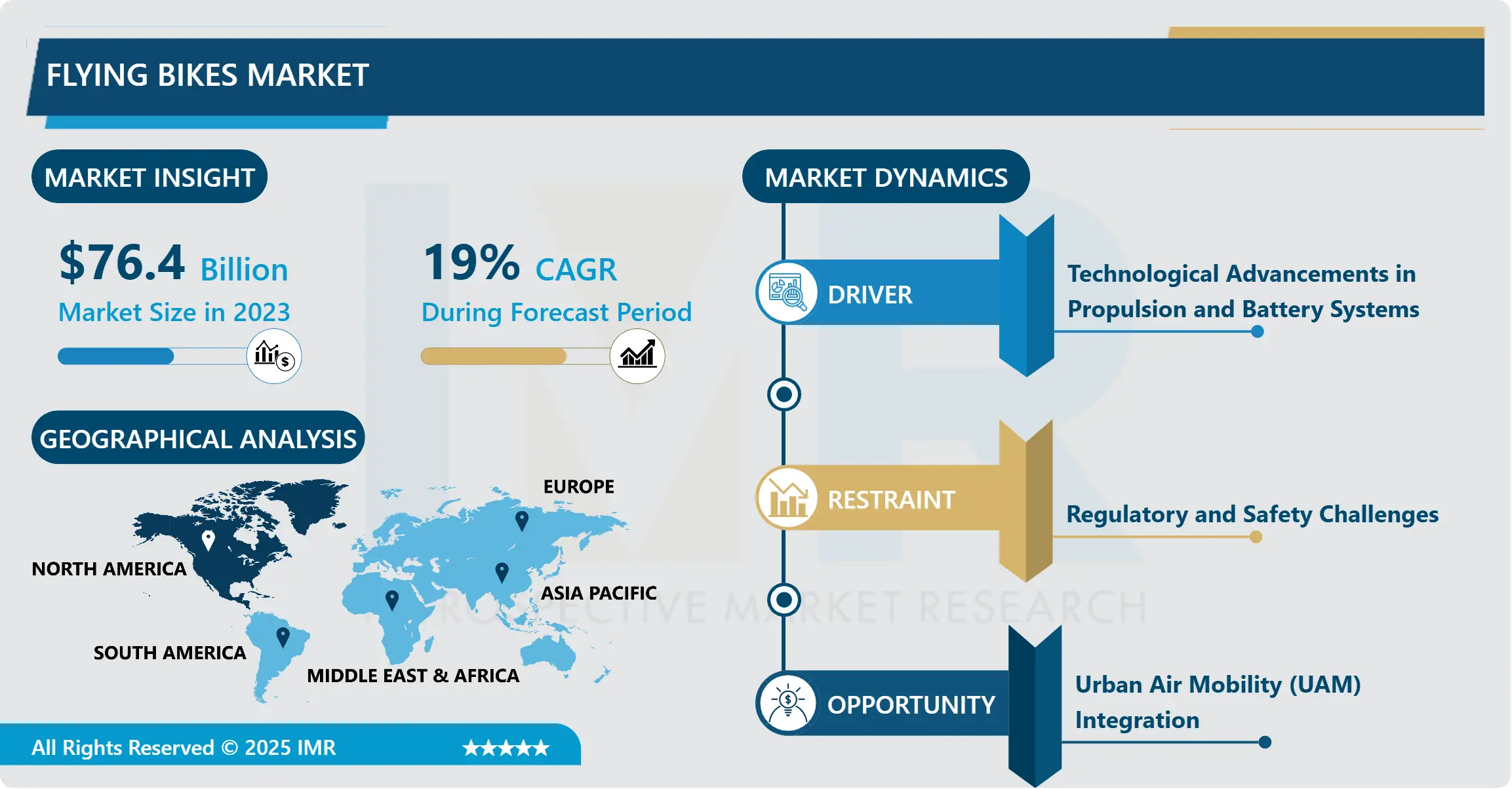
Flying Bikes Market Size Was Valued at USD 76.40 Billion in 2023, and is Projected to Reach USD 365.61 Billion by 2032, Growing at a CAGR of 19% From 2024-2032.

IMR Group
Description
Flying Bikes Market Synopsis:
Flying Bikes Market Size Was Valued at USD 76.40 Billion in 2023, and is Projected to Reach USD 365.61 Billion by 2032, Growing at a CAGR of 19% From 2024-2032.
The flying bikes market refers to the emerging segment in personal transportation that combines characteristics of motorcycles and aircraft in order to achieve VTOL capabilities. These vehicles powered by electricity or gas and designed for personal, commercial, and military use shall provide a futuristic solution overcoming traffic congestion and reaching distant areas.
The flying bikes market is an innovative and fast-changing sector, driven by developments in aviation technology, electric propulsion systems, and increased interest in alternative transportation solutions. The market is still at a nascent stage with several companies working on prototype designs and trials. Flying bikes are a combination of motorcycles with the ability to take flight, which could potentially revolutionize both urban mobility and recreational transportation. Several driving forces are there in terms of technical advances in battery technology, material development for weight reduction, and improvements in more efficient VTOL configurations.
UAM initiatives and increased traffic density within major cities as well as demand for environment-friendly and effective means of transport have been working well towards the promotion and commercialization of flying bicycles. In addition, advancements in AI-based navigation, autonomous flight systems, and sophisticated safety features enhance investor confidence in this industry. Governments and regulatory bodies are also taking more interest in this industry, with some cities looking to integrate flying vehicles into their transportation systems.
Personal and recreational flying bikes are viewed as the next big step, although commercial applications such as air taxis and delivery services may be more of a significant next step. However, this technology will still face numerous challenges in terms of regulation, infrastructure, and designing vehicles to be safe, affordable, and practical. The market still has a lot to offer, especially with many companies developing prototypes that prove to be workable and test flights.
Flying Bikes Market Trend Analysis:
Electrification of Flying Bikes
The most significant trend for the flying bikes market is that of increased electrification. As consumers and companies grow more conscious of their impact on the environment, electric flying bikes are gaining ground as they are clean, quiet, and energy-efficient. The rise of electric propulsion systems offers a host of advantages when it comes to sustainability and reduced emissions, making flying bikes more appealing in urban areas looking to reduce air pollution. Advancements in battery technology are also being leveraged to make electric flying bikes more energy dense, lightweight, and cheaper to produce, making them a feasible product for mass-market commercialization.
Electric flying bikes are changing the future of personal aerial mobility. Being envisioned as possibly revolutionary for transportation, they promise to provide quieter, cleaner, and less expensive alternatives to gas-powered models. In fact, these bikes benefit by saving on maintenance because their engines have fewer moving parts compared to the ones from the internal combustion system. These trends are expected to surge further as electric vehicle technology continues to advance, supported increasingly by governments due to their clean nature and therefore change the market in the future through the next decade.
Urban Air Mobility (UAM) Integration
One of the most important prospects in the flying bikes market relates to their potential integration into the urban air mobility (UAM) networks. UAM is defined as using the airspace for short-distance travels within urban environments, which might dramatically reduce traffic congestion and travel time while making it easier to improve urban transport efficiency. Flying bikes can easily take off and land vertically, making them a crucial component in this ecosystem. These are best suited for point-to-point rapid travel between city centres to the periphery or reach remote areas inaccessible by ordinary modes of transportation.
Currently, governments and private agencies alike are investing heavily in establishing UAM infrastructure, for instance, air traffic management systems and designated vertiports (small takeoff and landing zones). This provides a perfect opportunity for flying bike manufacturers to collaborate with urban planners and transportation authorities in designing and deploying vehicles that perfectly integrate into these networks. Demand for such vehicles is likely to increase in denser cities as governments and businesses continue pushing for solutions to urban mobility challenges. The success of such integration could lead to higher adoption rates and thus much larger market opportunities for flying bikes.
Flying Bikes Market Segment Analysis:
Flying Bikes Market is Segmented on the basis of Type, Technology, Component, Mode of Operation, Range, End User, and Region.
By Type, Electric Flying Bikes segment is expected to dominate the market during the forecast period
The flying bikes market can be divided into two major categories: electric flying bikes and gas-powered flying bikes. Electric flying bikes are the ones gaining traction because of their environmental-friendly nature, low running cost, and the ongoing innovations in the battery technology that have led to enhanced range and reliability. It is going to be more dominant in urban cities where environment regulations and noise pollution will make the option of an electric vehicle preferable. Electric flying bikes are quieter and smoother to ride compared to gas-powered flying bikes. This is an important consideration for urban and residential areas.
Gas-powered flying bikes still have their market, of course, because they give a greater range and have faster refueling times, so they are often more popular in commercial applications or for the recreational user who wants more power and endurance. While gas-powered bikes will probably continue to hold a big share of the market, the long-term direction is toward electric vehicles.
By End User, Commercial segment expected to held the largest share
The market for flying bikes is divided based on end-user applications into commercial, military and defense, and personal and recreational. Commercial includes air taxis, cargo delivery, and urban mobility services. This will grow rapidly with increasing demand for alternative transportation solutions in congested urban areas. Flying bikes in commercial use offer faster travel times, reduced congestion and open up a new outlet for logistics companies to supply goods quickly and efficiently.
The military and defense field is also a significant end-user sector as flying bikes are also unique solutions for reconnaissance, rapid deployment and fast troop transportation in hostile territory. The ability of flying bikes to fly over obstacles and reach remote locations makes them very valuable in defense operations. The personal and recreational segment caters to enthusiasts who are looking for a new form of adventure and transportation. While this segment may currently represent a smaller share of the market, it is expected to grow as technology advances and flying bikes become more accessible to consumers.
Flying Bikes Market Regional Insights:
North America is Expected to Dominate the Market Over the Forecast period
North America is poised to take a significant portion in flying bikes as it reflects increased investments in aviation and technology regarding transportation, thereby promoting new innovation for consumers to implement innovative solutions. An area in the region like developed infrastructure including existing air traffic control systems and opportunity with regards to urban mobility adds favor to the area, enhancing development and deployment for flying bikes. There is also an emerging regulatory framework for drones and other aerial vehicles, which is likely to make the approval and integration of flying bikes into mainstream transportation systems easier.
In the United States, companies are working on prototypes and pilot projects in relation to flying bikes. The country holds significant technological leadership, which adds to a strong startup ecosystem and investment in clean energy solutions. This makes the country stand at the leading end of this market. In the future, with its maturity and widespread adaptation, North America will maintain dominance in the global flying bikes market, with enormous demand expected from both commercial as well as personal end-users.
Active Key Players in the Flying Bikes Market:
AeroMobil (Slovakia)
Terrafugia (USA)
PAL-V (Netherlands)
Joby Aviation (USA)
Lilium (Germany)
Vertical Aerospace (UK)
AeroX (USA)
Urban Aeronautics (USA)
Maverick Aviation Group (USA)
Hyundai Urban Air Mobility (South Korea)
Vertical Aerospace (UK)
Alaka’i Technologies (USA)
Other Active Players
Key Industry Developments in the Flying Bikes Market:
In November 2024, EHang Holdings Limited announced the launch of an Urban Air Mobility (UAM) Hub at Luogang Central Park in Hefei, Anhui Province, marking the second vertiport established in Luogang Park following the opening of the Urban Air Mobility Operations Center in May, which will serve as a key infrastructure for the future operation of EH216-S pilotless passenger-carrying aerial vehicles.
Chapter 1: Introduction
1.1 Scope and Coverage
Chapter 2:Executive Summary
Chapter 3: Market Landscape
3.1 Market Dynamics
3.1.1 Drivers
3.1.2 Restraints
3.1.3 Opportunities
3.1.4 Challenges
3.2 Market Trend Analysis
3.3 PESTLE Analysis
3.4 Porter’s Five Forces Analysis
3.5 Industry Value Chain Analysis
3.6 Ecosystem
3.7 Regulatory Landscape
3.8 Price Trend Analysis
3.9 Patent Analysis
3.10 Technology Evolution
3.11 Investment Pockets
3.12 Import-Export Analysis
Chapter 4: Flying Bikes Market by Type
4.1 Flying Bikes Market Snapshot and Growth Engine
4.2 Flying Bikes Market Overview
4.3 Electric Flying Bikes
4.3.1 Introduction and Market Overview
4.3.2 Historic and Forecasted Market Size in Value USD and Volume Units (2017-2032F)
4.3.3 Key Market Trends, Growth Factors and Opportunities
4.3.4 Electric Flying Bikes: Geographic Segmentation Analysis
4.4 Gas-powered Flying Bikes
4.4.1 Introduction and Market Overview
4.4.2 Historic and Forecasted Market Size in Value USD and Volume Units (2017-2032F)
4.4.3 Key Market Trends, Growth Factors and Opportunities
4.4.4 Gas-powered Flying Bikes: Geographic Segmentation Analysis
Chapter 5: Flying Bikes Market by Technology
5.1 Flying Bikes Market Snapshot and Growth Engine
5.2 Flying Bikes Market Overview
5.3 Hovercraft Technology
5.3.1 Introduction and Market Overview
5.3.2 Historic and Forecasted Market Size in Value USD and Volume Units (2017-2032F)
5.3.3 Key Market Trends, Growth Factors and Opportunities
5.3.4 Hovercraft Technology: Geographic Segmentation Analysis
5.4 Vertical Take-Off and Landing (VTOL)
5.4.1 Introduction and Market Overview
5.4.2 Historic and Forecasted Market Size in Value USD and Volume Units (2017-2032F)
5.4.3 Key Market Trends, Growth Factors and Opportunities
5.4.4 Vertical Take-Off and Landing (VTOL): Geographic Segmentation Analysis
5.5 Multirotor Technology
5.5.1 Introduction and Market Overview
5.5.2 Historic and Forecasted Market Size in Value USD and Volume Units (2017-2032F)
5.5.3 Key Market Trends, Growth Factors and Opportunities
5.5.4 Multirotor Technology: Geographic Segmentation Analysis
5.6 Fixed-wing Technology
5.6.1 Introduction and Market Overview
5.6.2 Historic and Forecasted Market Size in Value USD and Volume Units (2017-2032F)
5.6.3 Key Market Trends, Growth Factors and Opportunities
5.6.4 Fixed-wing Technology: Geographic Segmentation Analysis
Chapter 6: Flying Bikes Market by End User
6.1 Flying Bikes Market Snapshot and Growth Engine
6.2 Flying Bikes Market Overview
6.3 Commercial
6.3.1 Introduction and Market Overview
6.3.2 Historic and Forecasted Market Size in Value USD and Volume Units (2017-2032F)
6.3.3 Key Market Trends, Growth Factors and Opportunities
6.3.4 Commercial: Geographic Segmentation Analysis
6.4 Military and Defense
6.4.1 Introduction and Market Overview
6.4.2 Historic and Forecasted Market Size in Value USD and Volume Units (2017-2032F)
6.4.3 Key Market Trends, Growth Factors and Opportunities
6.4.4 Military and Defense: Geographic Segmentation Analysis
6.5 Personal and Recreational
6.5.1 Introduction and Market Overview
6.5.2 Historic and Forecasted Market Size in Value USD and Volume Units (2017-2032F)
6.5.3 Key Market Trends, Growth Factors and Opportunities
6.5.4 Personal and Recreational: Geographic Segmentation Analysis
Chapter 7: Flying Bikes Market by Component
7.1 Flying Bikes Market Snapshot and Growth Engine
7.2 Flying Bikes Market Overview
7.3 Propulsion System
7.3.1 Introduction and Market Overview
7.3.2 Historic and Forecasted Market Size in Value USD and Volume Units (2017-2032F)
7.3.3 Key Market Trends, Growth Factors and Opportunities
7.3.4 Propulsion System: Geographic Segmentation Analysis
7.4 Power Supply
7.4.1 Introduction and Market Overview
7.4.2 Historic and Forecasted Market Size in Value USD and Volume Units (2017-2032F)
7.4.3 Key Market Trends, Growth Factors and Opportunities
7.4.4 Power Supply: Geographic Segmentation Analysis
7.5 Airframe
7.5.1 Introduction and Market Overview
7.5.2 Historic and Forecasted Market Size in Value USD and Volume Units (2017-2032F)
7.5.3 Key Market Trends, Growth Factors and Opportunities
7.5.4 Airframe: Geographic Segmentation Analysis
7.6 Control System
7.6.1 Introduction and Market Overview
7.6.2 Historic and Forecasted Market Size in Value USD and Volume Units (2017-2032F)
7.6.3 Key Market Trends, Growth Factors and Opportunities
7.6.4 Control System: Geographic Segmentation Analysis
Chapter 8: Flying Bikes Market by Mode of Operation
8.1 Flying Bikes Market Snapshot and Growth Engine
8.2 Flying Bikes Market Overview
8.3 Autonomous Flying Bikes
8.3.1 Introduction and Market Overview
8.3.2 Historic and Forecasted Market Size in Value USD and Volume Units (2017-2032F)
8.3.3 Key Market Trends, Growth Factors and Opportunities
8.3.4 Autonomous Flying Bikes: Geographic Segmentation Analysis
8.4 Manual Flying Bikes
8.4.1 Introduction and Market Overview
8.4.2 Historic and Forecasted Market Size in Value USD and Volume Units (2017-2032F)
8.4.3 Key Market Trends, Growth Factors and Opportunities
8.4.4 Manual Flying Bikes: Geographic Segmentation Analysis
Chapter 9: Flying Bikes Market by Range
9.1 Flying Bikes Market Snapshot and Growth Engine
9.2 Flying Bikes Market Overview
9.3 Short Range
9.3.1 Introduction and Market Overview
9.3.2 Historic and Forecasted Market Size in Value USD and Volume Units (2017-2032F)
9.3.3 Key Market Trends, Growth Factors and Opportunities
9.3.4 Short Range: Geographic Segmentation Analysis
9.4 Medium Range
9.4.1 Introduction and Market Overview
9.4.2 Historic and Forecasted Market Size in Value USD and Volume Units (2017-2032F)
9.4.3 Key Market Trends, Growth Factors and Opportunities
9.4.4 Medium Range: Geographic Segmentation Analysis
9.5 Long Range
9.5.1 Introduction and Market Overview
9.5.2 Historic and Forecasted Market Size in Value USD and Volume Units (2017-2032F)
9.5.3 Key Market Trends, Growth Factors and Opportunities
9.5.4 Long Range: Geographic Segmentation Analysis
Chapter 10: Company Profiles and Competitive Analysis
10.1 Competitive Landscape
10.1.1 Competitive Benchmarking
10.1.2 Flying Bikes Market Share by Manufacturer (2023)
10.1.3 Industry BCG Matrix
10.1.4 Heat Map Analysis
10.1.5 Mergers and Acquisitions
10.2 AEROMOBIL (SLOVAKIA)
10.2.1 Company Overview
10.2.2 Key Executives
10.2.3 Company Snapshot
10.2.4 Role of the Company in the Market
10.2.5 Sustainability and Social Responsibility
10.2.6 Operating Business Segments
10.2.7 Product Portfolio
10.2.8 Business Performance
10.2.9 Key Strategic Moves and Recent Developments
10.2.10 SWOT Analysis
10.3 TERRAFUGIA (USA)
10.4 PAL-V (NETHERLANDS)
10.5 JOBY AVIATION (USA)
10.6 LILIUM (GERMANY)
10.7 VERTICAL AEROSPACE (UK)
10.8 AEROX (USA)
10.9 URBAN AERONAUTICS (USA)
10.10 MAVERICK AVIATION GROUP (USA)
10.11 HYUNDAI URBAN AIR MOBILITY (SOUTH KOREA)
10.12 VERTICAL AEROSPACE (UK)
10.13 ALAKA’I TECHNOLOGIES (USA)
10.14 OTHER ACTIVE PLAYERS
Chapter 11: Global Flying Bikes Market By Region
11.1 Overview
11.2. North America Flying Bikes Market
11.2.1 Key Market Trends, Growth Factors and Opportunities
11.2.2 Top Key Companies
11.2.3 Historic and Forecasted Market Size by Segments
11.2.4 Historic and Forecasted Market Size By Type
11.2.4.1 Electric Flying Bikes
11.2.4.2 Gas-powered Flying Bikes
11.2.5 Historic and Forecasted Market Size By Technology
11.2.5.1 Hovercraft Technology
11.2.5.2 Vertical Take-Off and Landing (VTOL)
11.2.5.3 Multirotor Technology
11.2.5.4 Fixed-wing Technology
11.2.6 Historic and Forecasted Market Size By End User
11.2.6.1 Commercial
11.2.6.2 Military and Defense
11.2.6.3 Personal and Recreational
11.2.7 Historic and Forecasted Market Size By Component
11.2.7.1 Propulsion System
11.2.7.2 Power Supply
11.2.7.3 Airframe
11.2.7.4 Control System
11.2.8 Historic and Forecasted Market Size By Mode of Operation
11.2.8.1 Autonomous Flying Bikes
11.2.8.2 Manual Flying Bikes
11.2.9 Historic and Forecasted Market Size By Range
11.2.9.1 Short Range
11.2.9.2 Medium Range
11.2.9.3 Long Range
11.2.10 Historic and Forecast Market Size by Country
11.2.10.1 US
11.2.10.2 Canada
11.2.10.3 Mexico
11.3. Eastern Europe Flying Bikes Market
11.3.1 Key Market Trends, Growth Factors and Opportunities
11.3.2 Top Key Companies
11.3.3 Historic and Forecasted Market Size by Segments
11.3.4 Historic and Forecasted Market Size By Type
11.3.4.1 Electric Flying Bikes
11.3.4.2 Gas-powered Flying Bikes
11.3.5 Historic and Forecasted Market Size By Technology
11.3.5.1 Hovercraft Technology
11.3.5.2 Vertical Take-Off and Landing (VTOL)
11.3.5.3 Multirotor Technology
11.3.5.4 Fixed-wing Technology
11.3.6 Historic and Forecasted Market Size By End User
11.3.6.1 Commercial
11.3.6.2 Military and Defense
11.3.6.3 Personal and Recreational
11.3.7 Historic and Forecasted Market Size By Component
11.3.7.1 Propulsion System
11.3.7.2 Power Supply
11.3.7.3 Airframe
11.3.7.4 Control System
11.3.8 Historic and Forecasted Market Size By Mode of Operation
11.3.8.1 Autonomous Flying Bikes
11.3.8.2 Manual Flying Bikes
11.3.9 Historic and Forecasted Market Size By Range
11.3.9.1 Short Range
11.3.9.2 Medium Range
11.3.9.3 Long Range
11.3.10 Historic and Forecast Market Size by Country
11.3.10.1 Russia
11.3.10.2 Bulgaria
11.3.10.3 The Czech Republic
11.3.10.4 Hungary
11.3.10.5 Poland
11.3.10.6 Romania
11.3.10.7 Rest of Eastern Europe
11.4. Western Europe Flying Bikes Market
11.4.1 Key Market Trends, Growth Factors and Opportunities
11.4.2 Top Key Companies
11.4.3 Historic and Forecasted Market Size by Segments
11.4.4 Historic and Forecasted Market Size By Type
11.4.4.1 Electric Flying Bikes
11.4.4.2 Gas-powered Flying Bikes
11.4.5 Historic and Forecasted Market Size By Technology
11.4.5.1 Hovercraft Technology
11.4.5.2 Vertical Take-Off and Landing (VTOL)
11.4.5.3 Multirotor Technology
11.4.5.4 Fixed-wing Technology
11.4.6 Historic and Forecasted Market Size By End User
11.4.6.1 Commercial
11.4.6.2 Military and Defense
11.4.6.3 Personal and Recreational
11.4.7 Historic and Forecasted Market Size By Component
11.4.7.1 Propulsion System
11.4.7.2 Power Supply
11.4.7.3 Airframe
11.4.7.4 Control System
11.4.8 Historic and Forecasted Market Size By Mode of Operation
11.4.8.1 Autonomous Flying Bikes
11.4.8.2 Manual Flying Bikes
11.4.9 Historic and Forecasted Market Size By Range
11.4.9.1 Short Range
11.4.9.2 Medium Range
11.4.9.3 Long Range
11.4.10 Historic and Forecast Market Size by Country
11.4.10.1 Germany
11.4.10.2 UK
11.4.10.3 France
11.4.10.4 The Netherlands
11.4.10.5 Italy
11.4.10.6 Spain
11.4.10.7 Rest of Western Europe
11.5. Asia Pacific Flying Bikes Market
11.5.1 Key Market Trends, Growth Factors and Opportunities
11.5.2 Top Key Companies
11.5.3 Historic and Forecasted Market Size by Segments
11.5.4 Historic and Forecasted Market Size By Type
11.5.4.1 Electric Flying Bikes
11.5.4.2 Gas-powered Flying Bikes
11.5.5 Historic and Forecasted Market Size By Technology
11.5.5.1 Hovercraft Technology
11.5.5.2 Vertical Take-Off and Landing (VTOL)
11.5.5.3 Multirotor Technology
11.5.5.4 Fixed-wing Technology
11.5.6 Historic and Forecasted Market Size By End User
11.5.6.1 Commercial
11.5.6.2 Military and Defense
11.5.6.3 Personal and Recreational
11.5.7 Historic and Forecasted Market Size By Component
11.5.7.1 Propulsion System
11.5.7.2 Power Supply
11.5.7.3 Airframe
11.5.7.4 Control System
11.5.8 Historic and Forecasted Market Size By Mode of Operation
11.5.8.1 Autonomous Flying Bikes
11.5.8.2 Manual Flying Bikes
11.5.9 Historic and Forecasted Market Size By Range
11.5.9.1 Short Range
11.5.9.2 Medium Range
11.5.9.3 Long Range
11.5.10 Historic and Forecast Market Size by Country
11.5.10.1 China
11.5.10.2 India
11.5.10.3 Japan
11.5.10.4 South Korea
11.5.10.5 Malaysia
11.5.10.6 Thailand
11.5.10.7 Vietnam
11.5.10.8 The Philippines
11.5.10.9 Australia
11.5.10.10 New Zealand
11.5.10.11 Rest of APAC
11.6. Middle East & Africa Flying Bikes Market
11.6.1 Key Market Trends, Growth Factors and Opportunities
11.6.2 Top Key Companies
11.6.3 Historic and Forecasted Market Size by Segments
11.6.4 Historic and Forecasted Market Size By Type
11.6.4.1 Electric Flying Bikes
11.6.4.2 Gas-powered Flying Bikes
11.6.5 Historic and Forecasted Market Size By Technology
11.6.5.1 Hovercraft Technology
11.6.5.2 Vertical Take-Off and Landing (VTOL)
11.6.5.3 Multirotor Technology
11.6.5.4 Fixed-wing Technology
11.6.6 Historic and Forecasted Market Size By End User
11.6.6.1 Commercial
11.6.6.2 Military and Defense
11.6.6.3 Personal and Recreational
11.6.7 Historic and Forecasted Market Size By Component
11.6.7.1 Propulsion System
11.6.7.2 Power Supply
11.6.7.3 Airframe
11.6.7.4 Control System
11.6.8 Historic and Forecasted Market Size By Mode of Operation
11.6.8.1 Autonomous Flying Bikes
11.6.8.2 Manual Flying Bikes
11.6.9 Historic and Forecasted Market Size By Range
11.6.9.1 Short Range
11.6.9.2 Medium Range
11.6.9.3 Long Range
11.6.10 Historic and Forecast Market Size by Country
11.6.10.1 Turkiye
11.6.10.2 Bahrain
11.6.10.3 Kuwait
11.6.10.4 Saudi Arabia
11.6.10.5 Qatar
11.6.10.6 UAE
11.6.10.7 Israel
11.6.10.8 South Africa
11.7. South America Flying Bikes Market
11.7.1 Key Market Trends, Growth Factors and Opportunities
11.7.2 Top Key Companies
11.7.3 Historic and Forecasted Market Size by Segments
11.7.4 Historic and Forecasted Market Size By Type
11.7.4.1 Electric Flying Bikes
11.7.4.2 Gas-powered Flying Bikes
11.7.5 Historic and Forecasted Market Size By Technology
11.7.5.1 Hovercraft Technology
11.7.5.2 Vertical Take-Off and Landing (VTOL)
11.7.5.3 Multirotor Technology
11.7.5.4 Fixed-wing Technology
11.7.6 Historic and Forecasted Market Size By End User
11.7.6.1 Commercial
11.7.6.2 Military and Defense
11.7.6.3 Personal and Recreational
11.7.7 Historic and Forecasted Market Size By Component
11.7.7.1 Propulsion System
11.7.7.2 Power Supply
11.7.7.3 Airframe
11.7.7.4 Control System
11.7.8 Historic and Forecasted Market Size By Mode of Operation
11.7.8.1 Autonomous Flying Bikes
11.7.8.2 Manual Flying Bikes
11.7.9 Historic and Forecasted Market Size By Range
11.7.9.1 Short Range
11.7.9.2 Medium Range
11.7.9.3 Long Range
11.7.10 Historic and Forecast Market Size by Country
11.7.10.1 Brazil
11.7.10.2 Argentina
11.7.10.3 Rest of SA
Chapter 12 Analyst Viewpoint and Conclusion
12.1 Recommendations and Concluding Analysis
12.2 Potential Market Strategies
Chapter 13 Research Methodology
13.1 Research Process
13.2 Primary Research
13.3 Secondary Research
Q1: What would be the forecast period in the Flying Bikes Market research report?
A1: The forecast period in the Flying Bikes Market research report is 2024-2032.
Q2: Who are the key players in the Flying Bikes Market?
A2: AeroMobil (Slovakia), Terrafugia (USA), PAL-V (Netherlands), Joby Aviation (USA), Lilium (Germany), Vertical Aerospace (UK), AeroX (USA), and Other Active Players.
Q3: What are the segments of the Flying Bikes Market?
A3: The Flying Bikes Market is segmented into Type, Technology, Component, Mode of Operation, Range ,End User and region. By Type, the market is categorized into Electric Flying Bikes, Gas-powered Flying Bikes. By Technology, the market is categorized into Hovercraft Technology, Vertical Take-Off and Landing (VTOL), Multirotor Technology, Fixed-wing Technology. By End User, the market is categorized into Commercial, Military and Defense, Personal and Recreational. By Component, the market is categorized into Propulsion System, Power Supply, Airframe, Control System. By Mode of Operation, the market is categorized into Autonomous Flying Bikes, Manual Flying Bikes. By Range, the market is categorized into Short Range, Medium Range, Long Range. By region, it is analyzed across North America (U.S., Canada, Mexico), Eastern Europe (Russia, Bulgaria, The Czech Republic, Hungary, Poland, Romania, Rest of Eastern Europe), Western Europe (Germany, UK, France, The Netherlands, Italy, Russia, Spain, Rest of Western Europe), Asia Pacific (China, India, Japan, South Korea, Malaysia, Thailand, Vietnam, The Philippines, Australia, New-Zealand, Rest of APAC), Middle East & Africa (Turkiye, Bahrain, Kuwait, Saudi Arabia, Qatar, UAE, Israel, South Africa), South America (Brazil, Argentina, Rest of SA).
Q4: What is the Flying Bikes Market?
A4: The flying bikes market refers to the emerging segment in personal transportation that combines characteristics of motorcycles and aircraft in order to achieve VTOL capabilities. These vehicles powered by electricity or gas and designed for personal, commercial, and military use shall provide a futuristic solution overcoming traffic congestion and reaching distant areas.
Q5: How big is the Flying Bikes Market?
A5: Flying Bikes Market Size Was Valued at USD 76.40 Billion in 2023, and is Projected to Reach USD 365.61 Billion by 2032, Growing at a CAGR of 19% From 2024-2032.
How to Buy a Report from eminsights.jp
On the product page, choose the license you want: Single-User License, Multi-User License or Enterprise License.
If you required report in your native language, then you can click on Translated Report button and fill out the form with report name and language you want, then our team will contact you as soon as possible.
Click the Buy Now button.
You will be redirected to the checkout page. Enter your company details and payment information.
Click Place Order to complete the purchase.
Confirmation: You’ll receive an order confirmation and our team will contact you shortly with your ordered report.
If you have any questions, fill out the contact form below or email us at bizdev@eminsights.net.
Thank you for choosing eminsights.jp!