Stay Ahead in Fast-Growing Economies.
Browse Reports Now
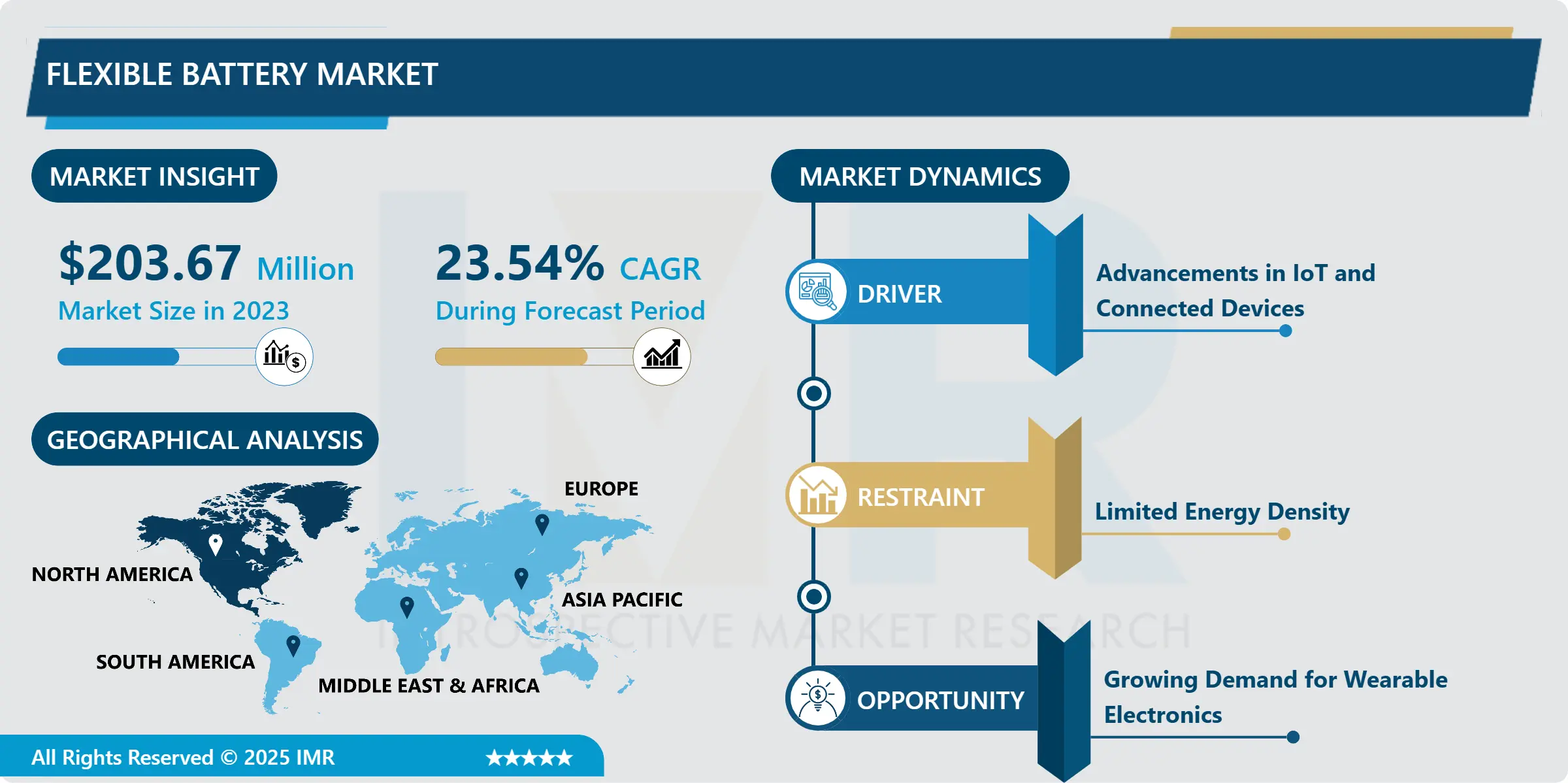
Flexible Battery Market Insights, Size, Share & Growth Forecast to 2032
The worldwide flexible battery market hence designates the business that centers on the manufacturing, research, development as well as the marketing of thin and flexible batteries. Such batteries are thin, and flexible batteries which can be shaped in any manner to fit the intended application. This incorporates the production and distribution of flexible batteries within a broad market of wearable electronics, IoT, portable electronics, medical devices, and other upcoming technologies.

IMR Group
Description
Flexible Battery Market Synopsis:
Flexible Battery Market Size Was Valued at USD 203.67 Million in 2023, and is Projected to Reach USD 1,365.20 Billion by 2032, Growing at a CAGR of 23.54% From 2024-2032
The worldwide flexible battery market hence designates the business that centers on the manufacturing, research, development as well as the marketing of thin and flexible batteries. Such batteries are thin, and flexible batteries which can be shaped in any manner to fit the intended application. This incorporates the production and distribution of flexible batteries within a broad market of wearable electronics, IoT, portable electronics, medical devices, and other upcoming technologies. It also embraces related services which range from battery testing, customization among others to integration of battery into end products.
It is important to note the market of flexible batteries is currently growing rapidly due to the need for lightweight power sources and higher energy density. As more consumer electronics, wearables, and IoT devices are developed the market demand for batteries that can be incorporated into thin and curved surfaces rises. The benefits of flexible batteries include lightweight construction, slim form factors, and the ability to take forms unlike conventional batteries, suitable for wearableelectronics, smart fabrics, and flexible electronics medical device and displays.
The automotive industries are promoting the development of versatile batteries, particularly for EV-HEVs because of space constraints. Substantial improvements in materail science especially lithium-ion, lithium-polymer and solid state batteries are anticipated to further the performance and capacity of flexible batteries. However, application limitation, for example, battery life, scalability for mass production among others remain some of the hurdles that make flexible batteries less popular.
Flexible Battery Market Trend Analysis:
Wearable Electronics and Technological Advancements
Flexible batteries have a huge potential in wearable electronics, as the use of smart watches, fitness trackers and health monitoring systems already on the rise. These devices need energy storage and supply systems that are small and equally adaptable to the form factors of the devices they are powering. Conventional rod like batteries pose a problem in such uses since they cannot fit into the curved and compact build of wearable devices. Whereas flexible batteries are more adaptable to offer the necessary flexibility to store and distribute powers more effectively in thin and portable devices.
As the wearable technology device continues to advance, the manufacturers have looking at improving on the energy density, stability, and the life time of the flexible batteries. Due to increased technological advancement, consumers have moved towards the need for smaller and at the same time more powerful devices, this progression puts pressure on the battery industry to provide batteries that fit into smaller spaces as well as, batteries which have longer charge durations to improve the general user experience. New directions in the materials and battery chemistry technologies including solid state and lithium based flexible batteries are instrumental in enhancing the efficiency as well as effectiveness of these sources of power.
Growth in the Flexible Battery Market
This factor has led to a great demand for flexible batteries since wearable devices, flexible electronics and smart textiles require high power density as well as energy density in thin, light weight and conformal configurations. As people prefer compact, multipurpose, and thin gadgets, multicomponent flexible batteries are inevitable to pave the way toward innovative applications including flexible electronics including bendable and foldable displays and health care, and wireless electronics including IoT devices. Electrovaya’s flexible batteries have important application in the medical field for implantable applications such as pacemakers and/or smart sensors for health monitoring in the human body for daily wear and tear applications these are found in apparels, accessories and portable electronics.
In addition, growth in portable, wearable, and stretchable electronics demand is increasing the growth of flexible batteries because advancements in adaptations such as material science and nanotechnology increases the flexibility of the batteries. These advancements functions very efficiently in improving the scale of battery energy density, power density and flexibility, which make the battery’s technology suitable for a broad spectrum of uses. Flexible electronics industry, particularly those in automotive, robotics and aerospace applications are creating more demands for flexible power solutions.
Flexible Battery Market Segment Analysis:
Flexible Battery Market is Segmented on the basis of Product Type, Chargeability, Voltage, Capacity, Material, Application, and Region
By Product Type, Advanced Lithium-Ion Batteries segment is expected to dominate the market during the forecast period
Some of the most advanced lithium-ion batteries have gotten the appreciation of many people owing to their higher energy density per unit of mass and volume, they are now used in variety of applications that require high power density. Thus, their recharging characteristic and enhanced energy density enables them to supply power for longer intervals to gadgets while consuming unhinged size. This makes them vital in applications such as EVs where weight and size are important limiting factors . In EVs, they supply the required power for the long driving distance with a good drive. Furthermore, these batteries are also employed in near-portable consumer devices, like smart phones, notebooks, and wearable devices, as what is required is both high power delivery and compactness.
The batteries more valuable in industries that depend highly on consistent electricity provision. They can be charged rapidly and retain their capacity, and thus, are the most suitable for the use that has renewable power sources like solar and wind energy. The batteries herein assist in energy storage and stabilizing the flow of power in the face of volatile natural resources. With increasing concerns on sustainability and energy efficiency, there are still high demands on further developed lithium-ion batteries to remain key components of clean energy technology, as well as performance-based consumer electronics.
By Application, Transportation and Logistics segment expected to held the largest share
In transportation segment, batteries serve significant purpose as energy source for electric cars (EV), buses, trains, and drones along with bringing a shift from conventional and inefficient fossil fuels. Lithium-ion batteries which are considered to possess high energy density along with their longer useful life are widely used in these applications to deliver the required power for vehicle to cover large distances. In EVs for instance, improved battery systems provide longer drive distances, shorter charge durations, and better efficiency as a sector, towards attaining eco-friendly, carbonless transportation systems comprehensively.
In logistics, batteries are today being used in many different functions in order to enhance effectiveness and reduce environmental impacts. Electrically operated equipments are employed in warehouses to undertake a variety of material moving tasks which were earlier performed by fuel-operated equipments. These emission-free electric forklifts, automated guided vehicles (AGVs), and pallet jacks are a better, quieter, and more efficient means of transporting goods in large operations. Also important is battery integrated power, which refers to the management and storage of power needed during transits hence supporting the operation of vehicles and equipment mostly in off grid areas.
Flexible Battery Market Regional Insights:
North America is Expected to Dominate the Market Over the Forecast period
North America, flexible battery market is growing at a good pace. the U.S. is instrumental in this growth because of the pioneering innovations of flexible electronics, wearable, and smart gadgets. Such developments are creating further need for light, fickle strength supplies which are vital little, transportable instruments. Moreover, the expanded application of flexible batteries into multiple electronic devices and portable energy storage devices © corresponds with the advanced miniaturization and portable energy storage technologies trends in consumer electronics.
The North American market is also getting increased boost by Renewable energy application such as solar and wind, etc. and growing Electric Vehicle or EV market. A flexible battery has a lot of possibilities when it comes to integration in to RE systems and EVs as they offer energy-to-weight efficiency along with flexibility. The fact that these batteries can be integrated into smaller and lighter forms also makes them valuable in electric vehicles which require maximization of available charge on vehicle mass.
Active Key Players in the Flexible Battery Market:
LG Chem (South Korea)
Samsung SDI (South Korea)
Panasonic Corporation (Japan)
Enfucell Oy (Finland)
Blue Spark Technologies (U.S.)
BrightVolt Inc. (U.S.)
STMicroelectronics (Switzerland)
Ultralife Corporation (U.S.)
NEC Corporation (Japan)
Jenax Inc. (South Korea)
Power Paper Ltd. (Israel)
Cymbet Corporation (U.S.)
EnerDel Inc. (U.S.)
Prologium Technology Co., Ltd. (Taiwan)
Fullriver Battery (China)
Other Active Players
Chapter 1: Introduction
1.1 Scope and Coverage
Chapter 2:Executive Summary
Chapter 3: Market Landscape
3.1 Market Dynamics
3.1.1 Drivers
3.1.2 Restraints
3.1.3 Opportunities
3.1.4 Challenges
3.2 Market Trend Analysis
3.3 PESTLE Analysis
3.4 Porter’s Five Forces Analysis
3.5 Industry Value Chain Analysis
3.6 Ecosystem
3.7 Regulatory Landscape
3.8 Price Trend Analysis
3.9 Patent Analysis
3.10 Technology Evolution
3.11 Investment Pockets
3.12 Import-Export Analysis
Chapter 4: Flexible Battery Market by Product Type
4.1 Flexible Battery Market Snapshot and Growth Engine
4.2 Flexible Battery Market Overview
4.3 Advanced Lithium-Ion Batteries
4.3.1 Introduction and Market Overview
4.3.2 Historic and Forecasted Market Size in Value USD and Volume Units (2017-2032F)
4.3.3 Key Market Trends, Growth Factors and Opportunities
4.3.4 Advanced Lithium-Ion Batteries: Geographic Segmentation Analysis
4.4 Flexible Zinc-Carbon Batteries
4.4.1 Introduction and Market Overview
4.4.2 Historic and Forecasted Market Size in Value USD and Volume Units (2017-2032F)
4.4.3 Key Market Trends, Growth Factors and Opportunities
4.4.4 Flexible Zinc-Carbon Batteries: Geographic Segmentation Analysis
4.5 Thin Film Batteries Printed Batteries
4.5.1 Introduction and Market Overview
4.5.2 Historic and Forecasted Market Size in Value USD and Volume Units (2017-2032F)
4.5.3 Key Market Trends, Growth Factors and Opportunities
4.5.4 Thin Film Batteries Printed Batteries: Geographic Segmentation Analysis
4.6 and Laminar Lithium Polymer Batteries
4.6.1 Introduction and Market Overview
4.6.2 Historic and Forecasted Market Size in Value USD and Volume Units (2017-2032F)
4.6.3 Key Market Trends, Growth Factors and Opportunities
4.6.4 and Laminar Lithium Polymer Batteries: Geographic Segmentation Analysis
Chapter 5: Flexible Battery Market by Chargeability
5.1 Flexible Battery Market Snapshot and Growth Engine
5.2 Flexible Battery Market Overview
5.3 Rechargeable Battery and Single-Use Battery
5.3.1 Introduction and Market Overview
5.3.2 Historic and Forecasted Market Size in Value USD and Volume Units (2017-2032F)
5.3.3 Key Market Trends, Growth Factors and Opportunities
5.3.4 Rechargeable Battery and Single-Use Battery: Geographic Segmentation Analysis
Chapter 6: Flexible Battery Market by Voltage
6.1 Flexible Battery Market Snapshot and Growth Engine
6.2 Flexible Battery Market Overview
6.3 1.5V
6.3.1 Introduction and Market Overview
6.3.2 Historic and Forecasted Market Size in Value USD and Volume Units (2017-2032F)
6.3.3 Key Market Trends, Growth Factors and Opportunities
6.3.4 1.5V: Geographic Segmentation Analysis
6.4 between 1.5V and 3V and Above 3V
6.4.1 Introduction and Market Overview
6.4.2 Historic and Forecasted Market Size in Value USD and Volume Units (2017-2032F)
6.4.3 Key Market Trends, Growth Factors and Opportunities
6.4.4 between 1.5V and 3V and Above 3V: Geographic Segmentation Analysis
Chapter 7: Flexible Battery Market by Capacity
7.1 Flexible Battery Market Snapshot and Growth Engine
7.2 Flexible Battery Market Overview
7.3 10 mAH
7.3.1 Introduction and Market Overview
7.3.2 Historic and Forecasted Market Size in Value USD and Volume Units (2017-2032F)
7.3.3 Key Market Trends, Growth Factors and Opportunities
7.3.4 10 mAH: Geographic Segmentation Analysis
7.4 Between 10 mAH and 100 mAH and Above 100 Mah
7.4.1 Introduction and Market Overview
7.4.2 Historic and Forecasted Market Size in Value USD and Volume Units (2017-2032F)
7.4.3 Key Market Trends, Growth Factors and Opportunities
7.4.4 Between 10 mAH and 100 mAH and Above 100 Mah: Geographic Segmentation Analysis
Chapter 8: Flexible Battery Market by Material
8.1 Flexible Battery Market Snapshot and Growth Engine
8.2 Flexible Battery Market Overview
8.3 Electrically Conductive Material and Ionically Conductive Material
8.3.1 Introduction and Market Overview
8.3.2 Historic and Forecasted Market Size in Value USD and Volume Units (2017-2032F)
8.3.3 Key Market Trends, Growth Factors and Opportunities
8.3.4 Electrically Conductive Material and Ionically Conductive Material: Geographic Segmentation Analysis
Chapter 9: Flexible Battery Market by Application
9.1 Flexible Battery Market Snapshot and Growth Engine
9.2 Flexible Battery Market Overview
9.3 Transportation and Logistics
9.3.1 Introduction and Market Overview
9.3.2 Historic and Forecasted Market Size in Value USD and Volume Units (2017-2032F)
9.3.3 Key Market Trends, Growth Factors and Opportunities
9.3.4 Transportation and Logistics: Geographic Segmentation Analysis
9.4 Smart Packaging
9.4.1 Introduction and Market Overview
9.4.2 Historic and Forecasted Market Size in Value USD and Volume Units (2017-2032F)
9.4.3 Key Market Trends, Growth Factors and Opportunities
9.4.4 Smart Packaging: Geographic Segmentation Analysis
9.5 Healthcare
9.5.1 Introduction and Market Overview
9.5.2 Historic and Forecasted Market Size in Value USD and Volume Units (2017-2032F)
9.5.3 Key Market Trends, Growth Factors and Opportunities
9.5.4 Healthcare: Geographic Segmentation Analysis
9.6 Consumer Electronics and Others
9.6.1 Introduction and Market Overview
9.6.2 Historic and Forecasted Market Size in Value USD and Volume Units (2017-2032F)
9.6.3 Key Market Trends, Growth Factors and Opportunities
9.6.4 Consumer Electronics and Others: Geographic Segmentation Analysis
Chapter 10: Company Profiles and Competitive Analysis
10.1 Competitive Landscape
10.1.1 Competitive Benchmarking
10.1.2 Flexible Battery Market Share by Manufacturer (2023)
10.1.3 Industry BCG Matrix
10.1.4 Heat Map Analysis
10.1.5 Mergers and Acquisitions
10.2 LG CHEM (SOUTH KOREA)
10.2.1 Company Overview
10.2.2 Key Executives
10.2.3 Company Snapshot
10.2.4 Role of the Company in the Market
10.2.5 Sustainability and Social Responsibility
10.2.6 Operating Business Segments
10.2.7 Product Portfolio
10.2.8 Business Performance
10.2.9 Key Strategic Moves and Recent Developments
10.2.10 SWOT Analysis
10.3 SAMSUNG SDI (SOUTH KOREA)
10.4 PANASONIC CORPORATION (JAPAN)
10.5 ENFUCELL OY (FINLAND)
10.6 BLUE SPARK TECHNOLOGIES (U.S.)
10.7 BRIGHTVOLT INC. (U.S.)
10.8 STMICROELECTRONICS (SWITZERLAND)
10.9 ULTRALIFE CORPORATION (U.S.)
10.10 NEC CORPORATION (JAPAN)
10.11 JENAX INC. (SOUTH KOREA)
10.12 POWER PAPER LTD. (ISRAEL)
10.13 CYMBET CORPORATION (U.S.)
10.14 ENERDEL INC. (U.S.)
10.15 PROLOGIUM TECHNOLOGY CO. LTD. (TAIWAN)
10.16 FULLRIVER BATTERY (CHINA)
10.17 OTHER ACTIVE PLAYERS
Chapter 11: Global Flexible Battery Market By Region
11.1 Overview
11.2. North America Flexible Battery Market
11.2.1 Key Market Trends, Growth Factors and Opportunities
11.2.2 Top Key Companies
11.2.3 Historic and Forecasted Market Size by Segments
11.2.4 Historic and Forecasted Market Size By Product Type
11.2.4.1 Advanced Lithium-Ion Batteries
11.2.4.2 Flexible Zinc-Carbon Batteries
11.2.4.3 Thin Film Batteries Printed Batteries
11.2.4.4 and Laminar Lithium Polymer Batteries
11.2.5 Historic and Forecasted Market Size By Chargeability
11.2.5.1 Rechargeable Battery and Single-Use Battery
11.2.6 Historic and Forecasted Market Size By Voltage
11.2.6.1 1.5V
11.2.6.2 between 1.5V and 3V and Above 3V
11.2.7 Historic and Forecasted Market Size By Capacity
11.2.7.1 10 mAH
11.2.7.2 Between 10 mAH and 100 mAH and Above 100 Mah
11.2.8 Historic and Forecasted Market Size By Material
11.2.8.1 Electrically Conductive Material and Ionically Conductive Material
11.2.9 Historic and Forecasted Market Size By Application
11.2.9.1 Transportation and Logistics
11.2.9.2 Smart Packaging
11.2.9.3 Healthcare
11.2.9.4 Consumer Electronics and Others
11.2.10 Historic and Forecast Market Size by Country
11.2.10.1 US
11.2.10.2 Canada
11.2.10.3 Mexico
11.3. Eastern Europe Flexible Battery Market
11.3.1 Key Market Trends, Growth Factors and Opportunities
11.3.2 Top Key Companies
11.3.3 Historic and Forecasted Market Size by Segments
11.3.4 Historic and Forecasted Market Size By Product Type
11.3.4.1 Advanced Lithium-Ion Batteries
11.3.4.2 Flexible Zinc-Carbon Batteries
11.3.4.3 Thin Film Batteries Printed Batteries
11.3.4.4 and Laminar Lithium Polymer Batteries
11.3.5 Historic and Forecasted Market Size By Chargeability
11.3.5.1 Rechargeable Battery and Single-Use Battery
11.3.6 Historic and Forecasted Market Size By Voltage
11.3.6.1 1.5V
11.3.6.2 between 1.5V and 3V and Above 3V
11.3.7 Historic and Forecasted Market Size By Capacity
11.3.7.1 10 mAH
11.3.7.2 Between 10 mAH and 100 mAH and Above 100 Mah
11.3.8 Historic and Forecasted Market Size By Material
11.3.8.1 Electrically Conductive Material and Ionically Conductive Material
11.3.9 Historic and Forecasted Market Size By Application
11.3.9.1 Transportation and Logistics
11.3.9.2 Smart Packaging
11.3.9.3 Healthcare
11.3.9.4 Consumer Electronics and Others
11.3.10 Historic and Forecast Market Size by Country
11.3.10.1 Russia
11.3.10.2 Bulgaria
11.3.10.3 The Czech Republic
11.3.10.4 Hungary
11.3.10.5 Poland
11.3.10.6 Romania
11.3.10.7 Rest of Eastern Europe
11.4. Western Europe Flexible Battery Market
11.4.1 Key Market Trends, Growth Factors and Opportunities
11.4.2 Top Key Companies
11.4.3 Historic and Forecasted Market Size by Segments
11.4.4 Historic and Forecasted Market Size By Product Type
11.4.4.1 Advanced Lithium-Ion Batteries
11.4.4.2 Flexible Zinc-Carbon Batteries
11.4.4.3 Thin Film Batteries Printed Batteries
11.4.4.4 and Laminar Lithium Polymer Batteries
11.4.5 Historic and Forecasted Market Size By Chargeability
11.4.5.1 Rechargeable Battery and Single-Use Battery
11.4.6 Historic and Forecasted Market Size By Voltage
11.4.6.1 1.5V
11.4.6.2 between 1.5V and 3V and Above 3V
11.4.7 Historic and Forecasted Market Size By Capacity
11.4.7.1 10 mAH
11.4.7.2 Between 10 mAH and 100 mAH and Above 100 Mah
11.4.8 Historic and Forecasted Market Size By Material
11.4.8.1 Electrically Conductive Material and Ionically Conductive Material
11.4.9 Historic and Forecasted Market Size By Application
11.4.9.1 Transportation and Logistics
11.4.9.2 Smart Packaging
11.4.9.3 Healthcare
11.4.9.4 Consumer Electronics and Others
11.4.10 Historic and Forecast Market Size by Country
11.4.10.1 Germany
11.4.10.2 UK
11.4.10.3 France
11.4.10.4 The Netherlands
11.4.10.5 Italy
11.4.10.6 Spain
11.4.10.7 Rest of Western Europe
11.5. Asia Pacific Flexible Battery Market
11.5.1 Key Market Trends, Growth Factors and Opportunities
11.5.2 Top Key Companies
11.5.3 Historic and Forecasted Market Size by Segments
11.5.4 Historic and Forecasted Market Size By Product Type
11.5.4.1 Advanced Lithium-Ion Batteries
11.5.4.2 Flexible Zinc-Carbon Batteries
11.5.4.3 Thin Film Batteries Printed Batteries
11.5.4.4 and Laminar Lithium Polymer Batteries
11.5.5 Historic and Forecasted Market Size By Chargeability
11.5.5.1 Rechargeable Battery and Single-Use Battery
11.5.6 Historic and Forecasted Market Size By Voltage
11.5.6.1 1.5V
11.5.6.2 between 1.5V and 3V and Above 3V
11.5.7 Historic and Forecasted Market Size By Capacity
11.5.7.1 10 mAH
11.5.7.2 Between 10 mAH and 100 mAH and Above 100 Mah
11.5.8 Historic and Forecasted Market Size By Material
11.5.8.1 Electrically Conductive Material and Ionically Conductive Material
11.5.9 Historic and Forecasted Market Size By Application
11.5.9.1 Transportation and Logistics
11.5.9.2 Smart Packaging
11.5.9.3 Healthcare
11.5.9.4 Consumer Electronics and Others
11.5.10 Historic and Forecast Market Size by Country
11.5.10.1 China
11.5.10.2 India
11.5.10.3 Japan
11.5.10.4 South Korea
11.5.10.5 Malaysia
11.5.10.6 Thailand
11.5.10.7 Vietnam
11.5.10.8 The Philippines
11.5.10.9 Australia
11.5.10.10 New Zealand
11.5.10.11 Rest of APAC
11.6. Middle East & Africa Flexible Battery Market
11.6.1 Key Market Trends, Growth Factors and Opportunities
11.6.2 Top Key Companies
11.6.3 Historic and Forecasted Market Size by Segments
11.6.4 Historic and Forecasted Market Size By Product Type
11.6.4.1 Advanced Lithium-Ion Batteries
11.6.4.2 Flexible Zinc-Carbon Batteries
11.6.4.3 Thin Film Batteries Printed Batteries
11.6.4.4 and Laminar Lithium Polymer Batteries
11.6.5 Historic and Forecasted Market Size By Chargeability
11.6.5.1 Rechargeable Battery and Single-Use Battery
11.6.6 Historic and Forecasted Market Size By Voltage
11.6.6.1 1.5V
11.6.6.2 between 1.5V and 3V and Above 3V
11.6.7 Historic and Forecasted Market Size By Capacity
11.6.7.1 10 mAH
11.6.7.2 Between 10 mAH and 100 mAH and Above 100 Mah
11.6.8 Historic and Forecasted Market Size By Material
11.6.8.1 Electrically Conductive Material and Ionically Conductive Material
11.6.9 Historic and Forecasted Market Size By Application
11.6.9.1 Transportation and Logistics
11.6.9.2 Smart Packaging
11.6.9.3 Healthcare
11.6.9.4 Consumer Electronics and Others
11.6.10 Historic and Forecast Market Size by Country
11.6.10.1 Turkiye
11.6.10.2 Bahrain
11.6.10.3 Kuwait
11.6.10.4 Saudi Arabia
11.6.10.5 Qatar
11.6.10.6 UAE
11.6.10.7 Israel
11.6.10.8 South Africa
11.7. South America Flexible Battery Market
11.7.1 Key Market Trends, Growth Factors and Opportunities
11.7.2 Top Key Companies
11.7.3 Historic and Forecasted Market Size by Segments
11.7.4 Historic and Forecasted Market Size By Product Type
11.7.4.1 Advanced Lithium-Ion Batteries
11.7.4.2 Flexible Zinc-Carbon Batteries
11.7.4.3 Thin Film Batteries Printed Batteries
11.7.4.4 and Laminar Lithium Polymer Batteries
11.7.5 Historic and Forecasted Market Size By Chargeability
11.7.5.1 Rechargeable Battery and Single-Use Battery
11.7.6 Historic and Forecasted Market Size By Voltage
11.7.6.1 1.5V
11.7.6.2 between 1.5V and 3V and Above 3V
11.7.7 Historic and Forecasted Market Size By Capacity
11.7.7.1 10 mAH
11.7.7.2 Between 10 mAH and 100 mAH and Above 100 Mah
11.7.8 Historic and Forecasted Market Size By Material
11.7.8.1 Electrically Conductive Material and Ionically Conductive Material
11.7.9 Historic and Forecasted Market Size By Application
11.7.9.1 Transportation and Logistics
11.7.9.2 Smart Packaging
11.7.9.3 Healthcare
11.7.9.4 Consumer Electronics and Others
11.7.10 Historic and Forecast Market Size by Country
11.7.10.1 Brazil
11.7.10.2 Argentina
11.7.10.3 Rest of SA
Chapter 12 Analyst Viewpoint and Conclusion
12.1 Recommendations and Concluding Analysis
12.2 Potential Market Strategies
Chapter 13 Research Methodology
13.1 Research Process
13.2 Primary Research
13.3 Secondary Research
Q1: What would be the forecast period in the Flexible Battery Market research report?
A1: The forecast period in the Flexible Battery Market research report is 2024-2032.
Q2: Who are the key players in the Flexible Battery Market?
A2: LG Chem (South Korea), Samsung SDI (South Korea), Panasonic Corporation (Japan), Enfucell Oy (Finland), Blue Spark Technologies (U.S.), BrightVolt Inc. (U.S.), STMicroelectronics (Switzerland), Ultralife Corporation (U.S.), NEC Corporation (Japan), Jenax Inc. (South Korea), Power Paper Ltd. (Israel), Cymbet Corporation (U.S.), EnerDel Inc. (U.S.), Prologium Technology Co., Ltd. (Taiwan), Fullriver Battery (China), and Other Active Players.
Q3: What are the segments of the Flexible Battery Market?
A3: The Flexible Battery Market is segmented into By Product Type, By Chargeability, By Voltage, By Capacity, By Material, By Application and region. By Product Type, the market is categorized into Advanced Lithium-Ion Batteries, Flexible Zinc-Carbon Batteries, Thin Film Batteries Printed Batteries, and Laminar Lithium Polymer Batteries. By Chargeability, the market is categorized into Rechargeable Battery and Single-Use Battery. By Voltage, the market is categorized into 1.5V, between 1.5V and 3V and Above 3V. By Capacity, the market is categorized into 10 mAH, Between 10 mAH and 100 mAH and Above 100 Mah. By Material, the market is categorized into Electrically Conductive Material and Ionically Conductive Material. By Application, the market is categorized into Transportation and Logistics, Smart Packaging, Healthcare, Consumer Electronics and Others. By region, it is analyzed across North America (U.S., Canada, Mexico), Eastern Europe (Russia, Bulgaria, The Czech Republic, Hungary, Poland, Romania, Rest of Eastern Europe), Western Europe (Germany, UK, France, Netherlands, Italy, Spain, Rest of Western Europe), Asia Pacific (China, India, Japan, South Korea, Malaysia, Thailand, Vietnam, The Philippines, Australia, New-Zealand, Rest of APAC), Middle East & Africa (Turkiye, Bahrain, Kuwait, Saudi Arabia, Qatar, UAE, Israel, South Africa), South America (Brazil, Argentina, Rest of SA).
Q4: What is the Flexible Battery Market?
A4: The global flexible battery market refers to the industry focused on the research, development, production, and sale of flexible and thin batteries. These batteries are designed to be lightweight, thin, and bendable, allowing them to conform to various shapes and sizes. The market encompasses the manufacturing and supply of flexible batteries used in a wide range of applications, including wearable electronics, IoT devices, portable electronics, medical devices, and other emerging technologies. It also includes related services such as battery testing, customization, and integration into end products.
Q5: How big is the Flexible Battery Market?
A5: Flexible Battery Market Size Was Valued at USD 203.67 Million in 2023, and is Projected to Reach USD 1,365.20 Billion by 2032, Growing at a CAGR of 23.54% From 2024-2032
How to Buy a Report from eminsights.jp
On the product page, choose the license you want: Single-User License, Multi-User License or Enterprise License.
If you required report in your native language, then you can click on Translated Report button and fill out the form with report name and language you want, then our team will contact you as soon as possible.
Click the Buy Now button.
You will be redirected to the checkout page. Enter your company details and payment information.
Click Place Order to complete the purchase.
Confirmation: You’ll receive an order confirmation and our team will contact you shortly with your ordered report.
If you have any questions, fill out the contact form below or email us at bizdev@eminsights.net.
Thank you for choosing eminsights.jp!